New Title | ‘London in the Eighteenth Century’
From the Random House Group:
Jerry White, London in the Eighteenth Century: ‘A Great and Monstrous Thing’ (London: Bodley Head, 2012), 704 pages, 9781847921802, £25.
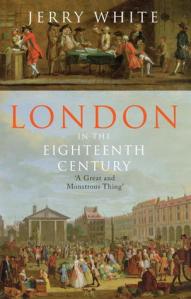 London in the eighteenth century was very much a new city, risen from the ashes of the Great Fire. With thousands of homes and many landmark buildings destroyed, it had been brought to the brink. But the following century was a period of vigorous expansion, of scientific and artistic genius, of blossoming reason, civility, elegance and manners. It was also an age of extremes: of starving poverty and exquisite fashion, of joy and despair, of sentiment and cruelty. Society was fractured by geography, politics, religion and history. And everything was complicated by class. As Daniel Defoe put it, London really was a ‘great and monstrous Thing’.
Jerry White’s tremendous portrait of this turbulent century explores how and to what extent Londoners negotiated and repaired these open wounds. We see them going about their business as bankers or beggars, revelling in an enlarging world of public pleasures, indulging in crimes both great and small – amidst the tightening sinews of power and regulation, and the hesitant beginnings of London democracy.
In the long-awaited finale to his acclaimed history of London over 300 years, Jerry White introduces us to shopkeepers and prostitutes, men and women of fashion and genius, street-robbers and thief-takers, as they play out the astonishing drama of life in eighteenth-century London.
Exhibition | Measuring the Universe and the Transit of Venus
The last transit of Venus was in 2004, but the next one won’t occur until 2117. From Captain Cook’s first voyage to the construction of the Kew Observatory, these celestial events were enormously important in the eighteenth century: 1761 and 1769 (click on either date for details at the Royal Society’s website). For a sense of just how important, see the eighteenth-century bibliography compiled by Utrecht’s Institute for History and Foundations of Science. -CH
◊ ◊ ◊ ◊ ◊
From Royal Museums Greenwich:
Measuring the Universe: From the Transit of Venus to the Edge of the Cosmos
Royal Observatory Greenwich, London, 1 March — 2 September 2012

Royal Observatory, Greenwich, photographed on 24 July 2006 (Wikimedia Commons)
On 5-6 June 2012 a very rare astronomical event takes place: the planet Venus will pass directly between the Earth and the Sun, appearing as a small black dot against the face of our parent star. These transits of Venus occur in pairs eight years apart, but each pair is separated by more than a century. The last one was in 2004 and, after June 2012, the next won’t be until December 2117.
Historically, transits of Venus were used by astronomers to give the first accurate measure of the distance between the Earth and the Sun. To be sure of observing these twice-in-a-lifetime events expeditions were sent around the world in the 18th and 19th centuries and the story involves many famous characters. Captain Cook was sent to Tahiti to observe the transit of 1769, and King George III had Kew Observatory built so that he could view the transit himself (the telescope he used will be on display in the Royal River exhibition at the National Maritime Museum).
By the 21st century the distance to the Sun was well-established, with confirmation by radar studies and space missions. But the 2004 transit still excited the interest of the press and public and was even the subject of a series of photographs by Turner Prize-winning artist Wolfgang Tillmans, some of which can be seen in the Royal Observatory’s free exhibition Measuring the Universe. And now the idea of transits has acquired a new significance for astronomers as they are used to discover new planets orbiting distant stars.
◊ ◊ ◊ ◊ ◊
As Paul Cockburn writes for Time Out London (28 May 2012) . . .
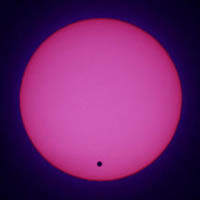
2004 transit of Venus taken from the Royal Observatory
‘This one really is your “last chance to see”,’ explains Dr Marek Kukula, public astronomer at the Royal Observatory, Greenwich. ‘The next one is not until December 2117 – very few, if any, people alive today are going to see that.’
‘When watching a planet slide in front of the Sun, the mechanics of the heavens are laid open for anyone to see,’ Kukula says. And, as the exhibition Measuring the Universe, currently running at the Royal Observatory, explains, the transit of Venus has played an important historical role in helping astronomers calculate the size of the solar system.
‘In the eighteenth century, the transits were among the first examples of international big science collaborations,’ says Kukula. ‘Despite a lot of national tensions within Europe, scientists were communicating with each other across borders. These were also early examples of government-sponsored science; Captain Cook’s first voyage to the South Seas was funded so that he could observe the 1769 transit from Tahiti.’ On the way back, of course, he went on to discover New Zealand and Australia.
There were practical considerations in all this. ‘By measuring the transit accurately, you gained a new level of understanding in how the heavens worked, and that actually was very useful for navigation,’ says Kukula. ‘Even in the eighteenth century, though, the observations were not quite good enough to really nail it. For the nineteenth-century transits – in 1874 and 1882 – you have Greenwich sending out numerous expeditions around the world. Armed with photography, they can at last make accurate observations.’ . . .
The full article, with directions for safe viewing, is available here»
‘Gloriana’ to Lead the Flotilla for the Diamond Jubilee in London

The Gloriana launched in April 2012; from Leon Watson’s
story for the Mail Online, 19 April 2012; Photo by David Parker
◊ ◊ ◊ ◊ ◊
From The BBC (19 April 2012)
The £1m boat that will the lead the Thames Diamond Jubilee Pageant has been launched on the river. The 94ft (28.6m) royal barge Gloriana was escorted through the streets of London on the back of a truck. It had been transported from a unit in Brentford to Isleworth, west London, where it was placed in the Thames. A pageant of more than 1,000 boats involving some 20,000 people will sail down the river on 3 June to mark the Queen’s 60 years on the throne. . . .
Lord Sterling said: “I became enamoured with the idea of building something timeless and got inspiration from Canaletto’s paintings that showed the great barges of the 18th Century and decided to build one. If we had to give it a style, it would be Regency. Including 18 rowers, it will carry 52 people. No-one’s really built anything like this for 200 years and the way we’ve built it, it will last for 200 years if looked after” . . .
◊ ◊ ◊ ◊ ◊
From the official event website:

Photo from ‘Luxatic’; click image to access the article.
On Sunday 3rd June 2012, over one thousand boats will muster on the River Thames in preparation for Her Majesty The Queen to take part in the Thames Diamond Jubilee Pageant. The formal river procession will be between 2pm and 6pm, starting upriver of Battersea Bridge and finishing downriver of Tower Bridge. The boats will muster between Hammersmith and Battersea and disperse from Tower Bridge to West India Docks.
It will be one of the largest flotillas ever assembled on the river. Rowed boats and working boats and pleasure vessels of all shapes and sizes will be beautifully dressed with streamers and Union Flags, their crews and passengers turned out in their finest rigs. The armed forces, fire, police, rescue and other services will be afloat and there will be an exuberance of historic boats, wooden launches, steam vessels and other boats of note.
The flotilla will be bolstered with passenger boats carrying flag-waving members of the public placed centre stage (or rather mid-river) in this floating celebration of Her Majesty’s 60 year reign. The spectacle will be further enhanced with music barges and boats spouting geysers. Moreover, there will be specially constructed elements such as a floating belfry, its chiming bells answered by those from riverbank churches.
The opening ceremony of London’s Olympic Games will be just six weeks away and the public that crowd the riverbanks and bridges will give a rousing reception to the many boats that have travelled from far and wide to represent UK port cities, the Commonwealth countries and other international interests. Downriver of London Bridge, there will be a gun salute and the flotilla will pass through a spectacular Avenue of Sail made by traditional Thames sailing boats, oyster smacks, square riggers, naval vessels and other impressive ships.
The Thames Diamond Jubilee Pageant celebrates Her Majesty’s 60 years of service by magnificently bringing the Thames to life; making it joyously full with boats, resounding with clanging bells, tooting horns and sounding whistles; recalling both its royal heritage and its heyday as a working, bustling river.
Exhibition | ‘Shelf Lives: Four Centuries of Collectors’
Two of the collectors from this Cambridge exhibition come from the eighteenth century: John Moore (1646-1714) and George Lewis (d. 1729), as noted below. From the exhibition website:
◊ ◊ ◊ ◊ ◊
Shelf Lives: Four Centuries of Collectors and Their Books
Cambridge University Library, 18 January — 16 June 2012
 With more than eight million items on its shelves, Cambridge University Library is one of the largest accumulations of books and manuscripts in Europe, and one of the most important in the world. But its holdings are not a single, uniform entity: instead they consist of a great variety of different collections which, over the centuries, by one route or another, have come to be housed under the same roof. Some of the most remarkable of these are the collections gathered by ardent individual book-lovers, whose intensely personal passions for acquiring rare and beautiful volumes have, through the eventual deposit of their treasures in the Library, gone on to enrich the national heritage.
This exhibition presents ten such collectors, whose lives span the sixteenth to the twentieth centuries. As well as placing on display some of the most splendid, distinctive and—in a few cases—unexpected items held in the Library, it allows us to observe the changing motives, fashions and tastes of book-collectors over the course of four hundred years.
◊ ◊ ◊ ◊ ◊
Great Industry, Accurate Judgement and Royal Favour: John Moore
John Moore (1646–1714), an undergraduate of Clare College and later Bishop of Norwich (1691–1707) and Ely (1707–1714), was one of the greatest bibliophiles of his day, celebrated for his collection of early English ‘black letter’ printing. The range of manuscripts and early printed books he acquired reflected the breadth of his interests, above all in medicine.
After he died, on 31 July 1714 (one day before Queen Anne), the collection was bought by King George I at Lord Townshend’s suggestion and presented to the University as a reward for Cambridge’s loyalty to the Hanoverian succession during the Jacobite rebellion of 1715. It was known henceforth as the Royal Library. The manuscripts include such treasures as the Moore Bede and the Book of Cerne, and number among them some of the most valuable items in the Library. Yet in many cases comparatively little is known about their origins and provenances: the Library’s greatest accession of all remains in large part mysterious.
◊ ◊ ◊ ◊ ◊
The Archdeacon and his ‘Bibliotheca Orientalis’: George Lewis
George Lewis’s valuable collection of 76 manuscripts, mainly in Persian, came to the Library in 1727 in a wooden cabinet inscribed ‘Bibliotheca Orientalis’.
Lewis (d. 1729) was educated at Queens’ College in the 1680s and subsequently entered the Church. He travelled to India in 1692 where he was Chaplain to the East India Company settlement in Madras until 1714. He was a gifted linguist, proficient in Persian, and during his stay in India he collected manuscripts which closely reflected his own interests and expertise. The collection is strong in religious texts (Qur’ans and translations of the Bible into Persian), manuscripts on grammar, and dictionaries, including Lewis’s own unfinished dictionary of Persian. Significantly, there are texts by poets such as Hātifī and Jāmī and a rare volume by Rahā’ī—the literary traditions of the Islamic world were little known in Europe at this date.
Along with the manuscripts came an assortment of curiosities: coins, weights, inscriptions, miniature Indian playing cards on wood and tortoiseshell, and a pair of embroidered slippers.
◊ ◊ ◊ ◊ ◊
For more information, see the exhibition website.
Conference | Color between Science, Art, & Technology
Colour in the 17th and 18th Centuries: Connexions between Science, Art, and Technology
Technische Universität, Berlin, 28-30 June 2012
Organized by Magdalena Bushart, Reinhold Reith, and Friedrich Steinle
Knowledge of how to use, combine, analyse, and understand colour has always been widely distributed, if not dispersed. Painters and architects, dyers and printers, pigment producers and merchants, physicists and chemists, natural historians and physiologist, among others, have been dealing with colour, its properties, mixtures, harmonies, meanings and uses. For long periods, different communities that were concerned with colour and the knowledge about it did not interact? at least so it appears.
One of the first to come up with fundamental claims concerning colour in full generality was Newton whose 1704 Opticks indeed quickly became a common reference point for most of those who reflected on colour. Throughout the 18th century, however, the reactions to Newton remained wildly controversial, from unrestricted appraisal via indifference to open and fierce opposition. Several attempts to reconcile Newton’s account with practitioner’s knowledge remained unsuccessful, and this was still the case in early 19th century, when the physiology of colour perception opened yet another field of colour research. The central aim of the conference is to bring together scholars who are interested in how the various strands of colour use and knowledge were interwoven and connected.
Technische Universität Berlin, Architekturgebäude, Room A 053, Straße des 17. Juni 150/152, 10623 Berlin,
◊ ◊ ◊ ◊ ◊
P R O G R A M M E
Thursday, 28 June
12:00 Registration
13:00 Welcome
13:30 Sarah Lowengard (New York), Analogies, Adaptations and Disorientations in the Mechanization of Color-Printing
14:30 Coffee Break
15:00 PRACTICES Chair: Reinhold Reith (Salzburg)
• Ad Stijnman (Amsterdam) and Elizabeth Upper (Cambridge), Early Modern Colour Printing 1600-1700
• Susan Wager (New York), Coloring the Rococo: Intermedial Reproduction and the Invention of Color in Eighteenth-Century France
• Carole Blumenfeld (Rome), Colors for Paintings Sold at Market in Rome and Paris
17:00 Coffee Break
17:30 COLOURS IN NATURE Chair: Magdalena Bushart (Berlin)
• Karin Leonhard (Berlin), Painting the Rainbow: Colour in Nature versus Colour in Art
• Ulrike Kern (Los Angeles), Broken Colours: A Key Concept in Seventeenth-Century Colour Theory
18:50: Snacks
20:00 PUBLIC LECTURE — Jenny Balfour-Paul (Exeter), Indigo: Not Just a Colour
Friday, 29 June
9:15 Alan Shapiro (Minneapolis), Newton’s Theory of Color and Painters’ Primaries
10:15 Coffee Break
10:30 COLOUR AND NEWTONIANISM Chair: Friedrich Steinle (Berlin)
• Fokko Jan Dijksterhuis (Twente), Perception of Colours by Different Eyes
• Gerhard Wiesenfeldt (Melbourne), Practitioners’ Materials and Optical Theories: Colour in Dutch Eighteenth-Century Natural Philosophy
• Heiner Krellig (Berlin/ Venice), Algarotti, Newton, and the Advantage of Their Theory of Light for Painterly Practice
12:30 Lunch Break
14:00 NATURAL PHILOSOPHY BEFORE NEWTON Chair: Sven Dupré (Berlin)
• Tawrin Baker (Bloomington), Colour in Seventeenth-Century Natural Philosophy Textbooks
• David Brafman (Los Angeles), Broken Colours: A Key Concept in Seventeenth-Century Colour Theory
15:20 Coffee Break
15:40 PRACTICE AND SYSTEM Chair: Lissa Roberts (Twente)
• Sachiko Kusukawa (Cambridge), The Colour Chart of Richard Waller, FRS, 1686
• Bruno Belhoste (Paris), Dyeing at the Gobelins in the Eighteenth Century: The Challenge of Quémizet
17:00 Coffee Break
17:20 COLOURS AFTER NEWTON Chair: Sven Dupré (Berlin)
• Robin Rehm (Basel), ‘Beauty and Perfection of the Pure Colours’: Anton Raphael Mengs and the Singularity of Yellow, Red, Blue
• Olaf L. Müller (Berlin), Border Spectra in the Atmospheric Colours of Hokusai and Hiroshige?
Saturday, 30 June
9:15 Ulrike Boskamp (Berlin), Primary Colours in the Eighteenth Century: Concepts and Uses
10:15 Coffee Break
10:30 MEANINGS Chair: Regina Lee Blaszczyk (Philadelphia)
• Corinne Thépaut-Cabasset (London), Words of Fashion: Words of Colours in Parisian Textile Trade in the Seventeenth and Eighteenth Centuries
• Theresa M. Kelley (Madison, WI), Fugitive and Variable: Color, Material Practice, and Aesthetic Contingency
• Romana Filzmoser (Florence), Color Knowledge and Color Practice in English Cosmetic Treatises of the Seventeenth Century
12:30 Lunch Break
14:00 ARTISTS’ ACCOUNTS I Chair: Ulrich Heinen (Wuppertal)
• Audrey Adamczak (Paris), A Dry Coloured Powdery Medium: The Art of Making Pastel and the Artistic and Technical Literature in France Ancien Régime
• Matthias Vollmer (Berlin), Disegno versus Colorito: Science versus Illusion?
15:20 Coffee Break
15:40 ARTISTS’ ACCOUNTS II Chair: Ulrich Heinen (Wuppertal)
• Ioana Magureanu (Bucharest), Colour: From Damnation in the Scientific Discourse to Its Recovery in Art Theory
• Petra Schuster (Berlin), How Knowledge of Color Affected Value Judgments in Siglo de Oro Painting Technique Innovation: Carducho’s Diálogos de la Pintura (1633) in Comparison to Pacheco’s Arte de la Pintura (1649)
17:00 Coffee Break
17:20 BLUE! Chair: Lissa Roberts (Twente)
• Aida Yuen Wong (Boston), Kingfisher Blue in Ming China
• Francois Delamare (Paris) and Bernard Monasse (Paris), Dyeing with Berliner Blue: A Jointed French Venture
18:40 Closing Remarks
Forthcoming | Hanneke Grootenboer’s ‘Treasuring the Gaze’
As noted in Heidi Strobel’s review of The Look of Love from yesterday, Hanneke Grootenboer’s book on eye miniatures is scheduled for release in November. Here’s the description from the University of Chicago Press:
◊ ◊ ◊ ◊ ◊
Hanneke Grootenboer, Treasuring the Gaze: Intimate Vision in Late Eighteenth-Century Eye Miniatures (Chicago: University of Chicago Press, 2012), ISBN: 9780226309668, $45.
 The end of the eighteenth century saw the start of a new craze in Europe: tiny portraits of single eyes that were exchanged by lovers or family members. Worn as brooches or pendants, these minuscule eyes served the same emotional need as more conventional mementoes, such as lockets containing a coil of a loved one’s hair. The fashion lasted only a few decades, and by the early 1800s eye miniatures had faded into oblivion. Unearthing these portraits in Treasuring the Gaze, Hanneke Grootenboer proposes that the rage for eye miniatures—and their abrupt disappearance—reveals a knot in the unfolding of the history of vision.
Drawing on Alois Riegl, Jean-Luc Nancy, Marcia Pointon, Melanie Klein, and others, Grootenboer unravels this knot, discovering previously unseen patterns of looking and strategies for showing. She shows that eye miniatures portray the subject’s gaze rather than his or her eye, making the recipient of the keepsake an exclusive beholder who is perpetually watched. These treasured portraits always return the looks they receive and, as such, they create a reciprocal mode of viewing that Grootenboer calls intimate vision. Recounting stories about eye miniatures—including the role one played in the scandalous affair of Mrs. Fitzherbert and the Prince of Wales, a portrait of the mesmerizing eye of Lord Byron, and the loss and longing incorporated in crying eye miniatures—Grootenboer shows that intimate vision brings the gaze of another deep into the heart of private experience.
With a host of fascinating imagery from this eccentric and mostly forgotten yet deeply private keepsake, Treasuring the Gaze provides new insights into the art of miniature painting and the genre of portraiture.
Reviewed | Heidi Strobel on ‘The Look of Love’
Graham Boettcher, ed., with essays by Graham Boettcher, Elle Shushan, and Jo Manning, The Look of Love: Eye Miniatures from the Skier Collection (London: D. Giles Limited in association with the Birmingham Museum of Art, Birmingham, Alabama, 2012), 208 pages, ISBN: 9781907804014, $35.
Reviewed for Enfilade by Heidi Strobel
Drink to me only with thine eyes,
And I will pledge with mine.
– Ben Jonson, “Song to Celia” (1616)
 In the sumptuously illustrated catalogue for The Look of Love: Eye Miniatures from the Skier Collection (on at the Birmingham Museum of Art from 7 February to 10 June 2012 ), Graham Boettcher, Elle Shushan, and Jo Manning highlight the world’s largest collection of eye pictures: small, often jewel-encrusted, paintings of individual eyes of lovers or beloved family members. These synecdochal portraits enjoyed a brief heydey between 1790 and 1850, in large part due to the patronage of the Prince of Wales (later George IV) who famously commissioned several lover’s eye portraits for his forbidden amour, Maria Fitzherbert. Although the best known of such commissions, these were not the first. In antiquity, the Romans and Etruscans produced similar images and, more recently, according to Horace Walpole, the French did so in the eighteenth century (18).
In “The Artist’s Eye,” Elle Shushan describes the evolution of the eye miniature and introduces its practitioners, portraitists such as Richard Cosway, who produced the aforementioned miniatures in his role as Miniature Painter to the Prince of Wales, and George Engleheart, Miniature Painter to the prince’s father, George III. In addition to the latter’s prolific output (4853 portrait miniatures between 1775 and 1813), Engleheart trained several relatives to paint eye miniatures, including his cousin Thomas Richmond and nephew John Cox Dillman Engleheart, whose work is also included in the catalogue. Shushan explains the initial modern popularity of the genre (in England and on the Continent) and describes patrons who later resuscitated the genre, including Queen Victoria who requested eye pictures of her closest friends and relatives from her Royal Miniaturist, Sir William Charles Ross. In closing, Shushan attributes the genre’s demise to its hybrid status — “part portrait, part jewelry, and part decoration” (27).
In “Symbol & Sentiment: Lover’s Eyes and the Language of Gemstones,” Graham Boettcher demonstrates how the jewels that often surrounded an eye portrait provided additional information about the qualities and features of the sitter and its wearer. Since many of these portraits were memorials to a deceased loved one, Boettcher’s discussion of these items as mourning jewelry is particularly useful.
In the third section of the catalogue, Jo Manning contributes five fictional vignettes inspired by items in the Skier Collection, an inclusion stimulated by the lost identities of most of the sitters and artists. Interspersed amid the catalogue entries are brief biographies of specialists George Engleheart and his family protégés, Cosway, Richmond, William Grimaldi, as well as George IV. Some of the entries also supply information about inscriptions and particular sitters.
Although most recent publications on miniatures include a section on eye miniatures, The Look of Love is the first publication devoted to this fleeting genre. While the liminal status of the eye miniature as part jewelry, part decoration, and part portrait may have contributed to the genre’s transience, we might ask whether such images should be considered portraits at all, a point made by Hanneke Grootenboer in her 2006 Art Bulletin article, “Treasuring the Gaze: Eye Miniature Portraits and the Intimacy of Vision.”[1] Perhaps it would be more accurate to describe these small paintings as ‘eye pictures’ (rather than portraits) since they work so differently from traditional portrait conventions grounded in personal identification. And, given that more typical portrait miniatures were also commonly hybrids (part portrait, part jewelry, and part decoration), why was their popularity more enduring than that of the eye pictures? Were eye pictures – often profusely decorated – more expensive than standard portrait miniatures? And if so, did this factor contribute to the genre’s demise?
Notwithstanding such questions, this generously illustrated catalogue marks a significant addition to the study of miniatures and should appeal to a broad audience with its combination of scholarly scrutiny and fictional narratives.
[1] Hanneke Grootenboer, “Treasuring the Gaze: Eye Miniature Portraits and the Intimacy of Vision,” The Art Bulletin 88 (September 2006): 496-507; also see her forthcoming book from the University of Chicago Press, Treasuring the Gaze: Intimate Vision in Late Eighteenth-Century Eye Miniatures (November 2012).
◊ ◊ ◊ ◊ ◊
Heidi Strobel is Associate Professor of Art History at the University of Evansville, in Indiana. Her dissertation research, focused on the promotion of eighteenth-century female artists by female patrons such as Charlotte, wife of King George III of England, is published as The Artistic Matronage of Queen Charlotte (1744-1818) (Edwin Mellen Press, 2011). Other recent publications include articles on twentieth-century topics such as British sculptor Barbara Hepworth, American folklore artist Howard Finster, World War II icon Rosie the Riveter, and women’s scholarship on women.
Reviewed | Davis’s ‘A General Theory of Visual Culture’
Recently added to caa.reviews:
Whitney Davis, A General Theory of Visual Culture (Princeton: Princeton University Press, 2011), 432 pages, ISBN: 9780691147659, $55.
Reviewed by James Elkins, School of the Art Institute of Chicago; posted 18 May 2012.
Along with David Summers’s ‘Real Spaces: World Art History and the Rise of Western Modernism’ (New York: Phaidon, 2003) (click here for review), Whitney Davis’s ‘A General Theory of Visual Culture’ is one of the most ambitious and potentially foundational books on art history in recent decades. It is unusually dense in logical argumentation, so it is more than a convention to say that it cannot helpfully be summarized. Because longer reviews will be needed to assess the book’s arguments, I want to use the generally shorter review length here in caa.reviews to raise two points about the book as a whole. But first I will evoke, as succinctly as possible, the book’s content, purpose, and significance.
Davis’s book ranges widely across the central examples of art-historical methodology, from Heinrich Wölfflin to Michael Baxandall, including discussions of writers as different as T. J. Clark, Arthur Danto, Ernst Cassirer, Nelson Goodman, and Giovanni Morelli. There are extended readings of texts by Erwin Panofsky, Richard Wollheim, E. H. Gombrich, and Ludwig Wittgenstein, and critiques of formal analysis (chapter 3), style analysis (chapter 4), and iconography (chapter 7). The book’s visual examples range from prehistory to Renaissance art to modernism and Warhol.
Davis’s principal purpose is to provide a “general theory of visual culture,” by which he means an account of the relation between what is cultural about vision, and what is visual about culture. He has many ways of putting this difference, and the variety is itself significant. (More on that later.) To ask about what is cultural about vision is to note that “styles of depiction . . . have materially affected human vision,” and to ask about what is visual about culture entails the possibility that “some things,” but not all, “are visual in culture, or visible as culture” (6; see also p. 8).
As a conceptual reorganization of art history’s fundamental terms of engagement with objects, the book is exemplary, and it is difficult to imagine a reader who is engaged with the discipline for whom this book is optional reading. . .
The full review is available here» (CAA membership required)
Ceilings of Versailles as You’ve Never Seen Them Before
Thanks to Mia Jackson for passing along this story by Tony Cross from Radio France Internationale (16 May 2012): “Louis XIV Railway Carriages Take to Paris-Versailles Line,” . . .
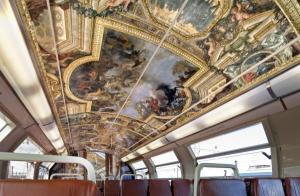
Inside one of the carriages with a reproduction of a ceiling from Versailles, Christophe Recoura/SNCF
They may look like any old beat-up railway train on the outside but inside they are decorated with reproductions of interiors from the royal château of Versailles. For the modest price of a local network ticket passengers travelling to Versailles, just outside Paris, will have a décor fit for a king. The first of five carriages decorated with reproductions of the château’s world-famous royal apartments built by Louis XIV, Louis XVI’s library and similar sumptuous scenes started running Wednesday. The others will all be in operation by the end of the year. . .
The full article is available here»
◊ ◊ ◊ ◊ ◊
Note (added 8 December 2012) — Eleanor Beardsley reported on the story for NPR’s Weekend Edition Saturday (8 December 2012).
Call for Papers | The Work of Art, Particular and Universal
As noted at Le Blog de L’ApAhAu:
L’œuvre d’art entre ambition identitaire et aspiration à l’universel
Institut Catholique de Paris (ICP), 5-6 April 2013
Proposals due by 31 July 2012

Institut Catholique de Paris, founded in 1875
L’œuvre d’art et le sens qu’on lui donne sont porteurs d’une tension : la création est tout à la fois symbole d’une identité culturelle spécifique et dépositaire d’un message d’ordre universel. Ce phénomène s’accentue dans le contexte contemporain de mondialisation des échanges où l’art semble constituer plus que jamais un repère stable dans un monde au caractère mouvant parfois perçu comme inquiétant. Le propos de ce colloque est d’explorer, dans une perspective historique, cette dialectique identité / universalité de l’œuvre d’art par le biais de trois thématiques :
• L’étude des œuvres hybrides, combinant ostensiblement différentes traditions artistiques, culturelles, techniques… et les conséquences de l’intégration de nouveaux modèles sur la formation d’une identité culturelle.
• La thématique du transfert : voyages d’artistes, circulation d’œuvres, décentrement des foyers artistiques… : autant d’éléments aux conséquences majeures sur la création de nouvelles formes d’art, sur leur appropriation et la portée du sens qui s’y attache.
• La question muséale avec le contraste entre un spectaculaire développement du nombre de musées à vocation plus ou moins universelle et les difficultés croissantes liées à la circulation et à la propriété des œuvres, considérées tantôt comme des marqueurs identitaires nationaux tantôt comme des icônes universelles.
Le colloque se tiendra sur deux jours dans les locaux de l’ICP. Les propositions de candidatures devront être envoyées avant le 31 juillet 2012 à l’adresse suivante : colloqueicp-2013@yahoo.fr. Elles comporteront un exposé du projet de communication 1500 signes environ ainsi qu’un bref CV ou résumé biographique. La durée des communications est fixée à 20 mn.










 Enfilade
leave a comment