Exhibition | The Triumph of Pleasure: Vauxhall Gardens
From The Foundling Museum:
The Triumph of Pleasure: Vauxhall Gardens 1729 — 1786
The Foundling Museum, London, 11 May — 9 September 2012
Curated by David Coke
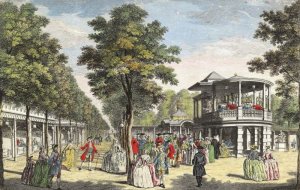
‘Vauxhall Gardens showing the Grand Walk at the entrance of the Garden and the Orchestra with the Musick Playing’, print published in London, 1751
The twenty-first-century public appetite for cultural consumption is unquenchable; but unbeknown to many, mass consumption of contemporary art, popular music and entertainment began over 200 years ago. In 1729 and 1739 two London institutions changed the face of British art forever, Vauxhall Pleasure Gardens under the management of Jonathan Tyers and the Foundling Hospital for abandoned babies and England’s first public art gallery established by Thomas Coram. To ensure the success of the two institutions both men enlisted the help of two great artists of the age, painter and engraver William Hogarth and composer George Frideric Handel.
The Foundling Hospital became the premier venue for London’s polite society to combine socialising and culture with philanthropy whereas Vauxhall Gardens was a place to enjoy contemporary music and art, spectacular design, al fresco dining, beautiful gardens and supper boxes from which to see and be seen. The Triumph of Pleasure: Vauxhall Gardens 1729 – 1786 will explore the Gardens, which for its visitors was an escape from daily realities and a re-affirmation of all the good things that life had to offer.
Drawing from the collections of major museums and galleries across the country, The Triumph of Pleasure: Vauxhall Gardens 1729 – 1786 will display works by Hogarth, Canaletto, Hayman, Rowlandson and Gainsborough. Visitors can view original manuscripts and song sheets which will be supported by a series of specially commissioned concerts. One of the last surviving supper box paintings will be on display alongside objects associated with the Gardens and the Foundling Hospital. This will include an identifying token left by a mother with the baby she left at the Foundling Hospital. This token is a copper 1737 Vauxhall Garden season ticket, attributed to Hogarth. The exhibition will also be the first time François Roubiliac’s three terracotta portrait busts of William Hogarth, George Frideric Handel and Jonathan Tyers have been seen together.
Vauxhall Gardens was an all-embracing sensual experience, becoming an international byword for pleasure and now, over 200 years later, visitors to the Foundling Museum can experience the sights, sounds and tastes of the Gardens once more.
◊ ◊ ◊ ◊ ◊
David Coke, the exhibition’s curator and co-author of Vauxhall Gardens: A History (Yale UP, 2011), offers a preview of the show with his article “Vauxhall Gardens: Patriotism and Pleasure,” in this month’s issue of History Today 62 (May 2012). Also, see Coke’s own immensely useful website for the gardens (this last noted added 1 June 2012).
Marking Frederick the Great’s 300th Birthday
On the 300th anniversary of the birth of Frederick the Great, the Prussian Culture Heritage Foundation has organized a series of nine exhibitions. A few of them are detailed here at Enfilade, but more information is available from the series website:
◊ ◊ ◊ ◊ ◊
Art – King – Enlightenment
Exhibition Series Organized by the Prussian Cultural Heritage Foundation, Berlin, 2012

Johann Gottfried Schadow, “Stettin Monument of Frederick the Great,” 1793 © Staatliche Museen zu Berlin, photo: Achim Kleuker
The 24 January 2012 marked the 300th anniversary of the birth of Frederick the Great. To mark the occasion, the five institutions that make up the Prussian Cultural Heritage Foundation have joined forces to deliver a series of diverse exhibitions and events that will guide visitors through the tercentenary celebrations.
The joint project bears the title Art – King – Enlightenment. The institutions involved are: the Staatliche Museen zu Berlin (National Museums in Berlin), the Staatsbibliothek zu Berlin (Berlin State Library), the Geheimes Staatsarchiv Preußischer Kulturbesitz (Prussian state archives), the Ibero-American Institute and the Staatliche Institut für Musikforschung (an institute for scholarship in music). Together, they highlight various areas relating to the king as a person and the age in which he lived.
Coinage reforms, Montezuma, the image as a mass medium, Jean-Jacques Rousseau, Chinese porcelain service, secret correspondence, and a concert flute are just some of the things that provide a snapshot of what we can expect to see in 2012. This colourful palette of events revolving around the anniversary will provide an insight not just into the life and work of the famous Prussian king, but
also into his historical impact, for Prussia, Germany and Europe.
◊ ◊ ◊ ◊ ◊
War Court in Köpenick! Anno 1730: Crown Prince – Katte – Order of the King
Köpenick Palace, 29 October 2011 — 5 February 2012
It’s Enough for Eight Groschen… Frederick the Great Seen through His Coins and Medals
Bode-Museum, 24 January — 14 October 2012
Frederick’s Montezuma: Power and Meaning in the Prussian Court Opera
Museum of Music Instruments, 27 January — 24 June 2012
On the Edge of Reason: Cycles of Works on Paper in the Age of the Enlightenment
Kupferstichkabinett at Kulturforum, 16 March — 29 July 2012
‘…Old Fritz, Who Lives in His People’: The Image of Frederick the Great in Adolph Menzel
National Gallery, Kupferstichkabinett and Gemäldegalerie in the Old National Gallery, 23 March — 24 June 2012
On the Plurality of Worlds: The Arts of the Enlightenment
Art Library at Kulturforum, 10 May — 5 August 2012
China and Prussia: Porcelain and Tea
Museum of Asian Art, Dahlem Museums, 8 June — 31 December 2012
Porcelain for the Palaces of Frederick the Great
Museum of Decorative Arts in Köpenick Palace, 15 June — 28 October 2012
Homme de lettres – Federic: The King at His Writing Desk
Prussian State Archives and Berlin State Library presented in the Art Library at Kulturforum, 6 July — 30 September 2012
Exhibition | Frederick the Great through His Coins and Medals
From the Staatliche Museen zu Berlin:
It’s Enough for 8 Groschen … Frederick the Great Seen through His Coins and Medals
Bode-Museum, Berlin, 24 January — 14 October 2012

Ludwig Heinrich Barbiez, Medaille auf die Schlacht bei Kesselsdorf, 1745 © Staatliche Museen zu Berlin, Münzkabinett
Coins and medals reflect the history of Prussia and its great king in an immediate way: quite literally in the palms of our hands. No other European monarch wrought such wide-reaching changes to his country’s coinage and monetary system as Frederick II of Prussia. With his coinage reforms of 1750 and 1764, he not only set Prussia on a new course, but also significantly paved the way for later monetary developments in the rest of Germany.
By radically debasing the currency, specifically of specie (by lowering the quantity of precious metals in newly minted coins), he managed to finance the Seven Years’ War (1756-1763). He was just as radical in overhauling the Prussian currency after the war. The mints went from being half-private companies to efficient, state-run money factories. Under Frederick II, gold coins and larger silver coins were standardised across the country in a process that started in 1750. The diversity of territories under Prussian control and their various types of coins and monetary systems are reflected in the coins of the time. The coin portraits of Frederick II reveal a lot about the image of the ruler – from handsome young man in the year of his coronation in 1740 up to his death in 1786, by which time he was dubbed ‘Old Fritz’. Besides his great battles and victories, various other kinds of events that took place during his reign are captured on his medals.
The Numismatic Collection holds over 3500 coins from the time of Frederick the Great, thus making it not only the largest, but also the most complete collection of its kind in the world. This particular collection will be published for the first time in its entirety, in a combination of print and online catalogues to mark the celebrations surrounding Frederick II’s birth. The result means that the public now has unprecedented access to this historical source on the life of Frederick the Great.
The exhibition is being held as part of a wider series of events called Art – King – Enlightenment, coordinated by the Prussian Cultural Heritage Foundation in honour of the 300th anniversary of the birth of Frederick the Great on 24 January 2012.
London’s National Gallery Acquires Portrait by Lawrence
Press release from London’s National Gallery:

Sir Thomas Lawrence, “Portrait of the Hon. Emily Mary Lamb,” 1803 (London: National Gallery)
A portrait by Sir Thomas Lawrence that has never been on public display since it was painted over two hundred years ago is now available for visitors to enjoy at the National Gallery in Room 34. Portrait of the Hon. Emily Mary Lamb (1787–1869), 1803, has been allocated to the National Gallery by Arts Council England under the Acceptance in Lieu scheme, which allows donors to leave major works of art to the nation in lieu of inheritance tax. Sir Thomas Lawrence (1769–1830) is generally regarded as one of the finest European portraitists of the late 18th and early 19th centuries, portraying some of the most important personalities of his day. This work is an important addition to the National Gallery’s British collection. The Gallery currently holds examples of formal and full-length works by Lawrence – John Julius Angerstein, aged about 55, about 1790; John Julius Angerstein, aged over 80, 1824; and Queen Charlotte, 1789 – but this painting exemplifies Lawrence’s influential but more informal depiction of children and families. Its inclusion in the collection will enable Gallery visitors to appreciate the breadth of Lawrence’s repertoire.
The oval portrait depicts the 16-year-old sitter in motion, her head turned towards the viewer in a pose that has a long tradition in the history of portraiture. However, Lawrence brings a freshness to the work, reflected in the informality and economy of his brushwork. The Hon. Emily Lamb went on to become an influential, politically prominent society hostess. She first married Peter Leopold Clavering-Cowper, 5th Earl Cowper. After his death, in 1839 she married Henry John Temple, 3rd Viscount Palmerston, who served twice as Prime Minister between 1855 and 1858 and again from 1859 to 1865. Her brother, Viscount Melbourne, also served as Prime Minister. His wife, Lady Caroline Lamb, was notorious for her affair with Lord Byron.
The work was commissioned by the subject’s father, Peniston Lamb, 1st Earl Melbourne, whose image can also be seen in the Gallery represented in a work by Stubbs, The Milbanke and Melbourne Families, about 1769. Lawrence’s painting has been in the possession of the sitter’s descendants since its completion. Born in Bristol, Lawrence was largely self-taught and a child prodigy; he was already producing accomplished portraits in crayon aged 10. He went on to become a pupil at the Royal Academy at the age of 18 and exhibited his first portrait the following year. He had a distinguished career during which he became a member of the Academy, going on to become its president in 1820. He was appointed Painter-in-Ordinary to King George III and received a knighthood in 1815.
Forthcoming | ‘The Materiality of Color’
From Ashgate this fall:
Andrea Feeser, Maureen Daly Goggin, and Beth Fowkes Tobin, eds., The Materiality of Color: The Production, Circulation, and Application of Dyes and Pigments, 1400-1800 (Aldershot: Ashgate, 2012), 350 pages, ISBN: 9781409429159, £65.
Although much has been written on the aesthetic value of color, there are other values that adhere to it with economic and social values among them. Through case studies of particular colors and colored objects, this volume demonstrates just how complex the history of color is by focusing onthe diverse social and cultural meanings of color; the trouble, pain, and suffering behind theproduction and application of these colors;the difficult technical processes for making and applying color; and the intricacy of commercial exchanges and knowledge transfers as commodities and techniques moved from one region toanother. By emphasizing color’s materiality, the way in which it was produced, exchanged, and used by artisans, artists, and craftspersons, contributors draw attention to the disjuncture between the beauty of color and the blood, sweat, and tears that went into its production, circulation, and application as well as to the complicated and varied social meanings attached to color within specific historical and social contexts.
This book captures color’s global history with chapters on indigo plantations in India and the American South, cochineal production in colonial Oaxaca, the taste for brightly colored Chinese objects in Europe, and the thriving trade in vermilion between Europeans and Native Americans. To underscore the complexity of the technical knowledge behind color production, there are chapters on the ‘discovery’ of Prussian blue, Brazilian feather techné, and wallpaper production. To sound the depths of color’s capacity for social and cultural meaning-making, there are chapters that explore the significance of black ink in Shakespeare’s sonnets, red threads in women’s needlework samplers, blues in Mayan sacred statuary, and greens and yellows in colored glass bracelets that were traded across the Arabian desert in the late Middle Ages.
The purpose of this book is to recover color’s complex–and sometimes morally troubling–past, and in doing so, to restore a sense of wonder and appreciation for our colorful world. With its nuanced and complex depiction of how color operated within local contexts and moved across the globe, this book will appeal to art historians, social and cultural historians, museum curators, literary scholars, rhetoric scholars, and historians of science and technology.
◊ ◊ ◊ ◊ ◊
C O N T E N T S
Andrea Feeser, Maureen Daly Goggin, and Beth Fowkes Tobin — Introduction: The Value of Color
Part I: Color’s Social and Cultural Meanings
Jason LaFountain — Colorizing New England’s Burying Grounds
Maureen Daly Goggin — The Extraordinary Powers of Red in 18- and 19th-Century English Needlework
Molly H. Basset and Jeanette Favrot Peterson — Coloring the Sacred in 16th-Century Central Mexico
Mitchell Harris — The Expense of Ink and Wastes of Shame: Poetic Generation, Black Ink, and Material Waste in Shakespeare’s Sonnets
Vanessa Alayrac-Fielding — ‘Luscious Colors and Glossy Paint’: The Taste for China and the Consumption of Colors in 18th-Century England
Part II: Producing and Exchanging Pigments and Dyes
Jeremy Baskes — Seeking Red: The Production and Trade of Cochineal Dye in Oaxaca, Mexico, 1750–1821
J.-F. Lozier — Red Ochre, Vermilion and the Transatlantic Cosmetic Encounter
Padmini Tolat Balaram — Indian Indigo
Andrea Feeser — The Exceptional and the Expected: Red, White, and Black Made Blue in Colonial South Carolina
Sarah Lowengard — Prussian Blue: Transfers and Trials
Part III: Making Colored Objects
Stéphanie Karine Boulogne — Glass Bracelets in the Medieval and Early Modern Middle East: Design and Color as Identity Markers
Éva Deák — The Colorful Court of Gabriel Bethlen and Catherine of Brandenburg
Richard Blunt — The Evolution of Blackface Cosmetics on the Early Modern Stage
Amy Buono — Crafts of Color: Tupi Tapirage in Early Colonial Brazil
Elaine Gibbs — Colors and Techniques of 18th-Century Chinese Wallpaper: Blair House as Case Study
Beth Fowkes Tobin — Butterflies, Spiders, and Shells: Coloring Natural History Illustrations in Late 18th-Century Britain
Bibliography and Index
◊ ◊ ◊ ◊ ◊
Editors: Andrea Feeser is Associate Professor of Modern and Contemporary Art, Theory, and Criticism at Clemson University. Maureen Daly Goggin is Associate Chair in the Department of English, Arizona State University. Beth Fowkes Tobin is Professor of English and Women’s Studies at the University of Georgia.
Trying to Think Seriously about Pinterest
From the editor

Edward Collier, “A Trompe l’Oeil of Newspapers, Letters and Writing Implements on a Wooden Board,” ca. 1699 (London: Tate Collection)
Last year I planned to run a piece on Pinterest — just before everyone seemed to know about it. Well, I put it off for a few weeks, which turned into a few months, and then suddenly there was no need. Now, however, with Pinterest recently in the news for raising $100 million, bringing its start-up value to $1.5 billion, I decided to weigh in. For although a good portion of people now know about Pinterest (its users having soared from 1 million in 2011 to 20 million last month), I’m not sure anyone has a handle on how varied uses of the site will be, even in the near future.
A recent Wall Street Journal article (17 May 2012) describes it as a “scrapbooking site,” but from my experience (I starting ‘pinning’ a few months ago), the characterization is inaccurate and disregards the metaphor altogether: it’s a pinboard, after all, not a scrapbook (how interesting are all of these metaphors for how we interact with computers, going back to files and the desktop — hardly anything new with Pinterest in that regard).
So why raise the issue on a site dedicated to the art and architecture of the eighteenth century? For two reasons: 1) to extend an invitation to brainstorm and 2) to suggest a few preliminary ideas.
On the first front, I’m eager to hear of scholarly or at least ‘cultural’ uses for Pinterest. Are there examples of academics already using the site in such a manner? And if Pinterest isn’t going to help you write your next book, might there be any pedagogical function? By all means feel free to weigh in with examples or ideas.
As for my own suggestions, it seems to me that a genuinely engaging Pinterest presence could particularly serve the interests of museums. By way of comparison, I’ve been fascinated to see how House Beautiful uses the site (full disclosure: I’m afraid one of my Pinterest boards is given over to an upcoming bathroom renovation). Realizing, I imagine, that Pinterest users are inevitably going to ‘pin’ images from the magazine, House Beautiful ‘pins’ images itself. If you ‘follow’ the magazine, a photograph or two will appear on your Pinterest site each day, and with one click, you’re able to add it to your own board. The advantages? First, the magazine controls the text under the image (it’s easy enough to make changes, but most people don’t take the time). Second, it provides a steady stream of contact between magazine and its followers. Rather than getting an issue once a month in the mail, you get updates each day (no matter that it’s mostly the same content). Third, and this seems crucial, the magazine is able to tell precisely what photos resonate most fully with users (in terms of which ones are ‘liked’ and ‘repinned’). Presumably (for better or worse), this can be mapped onto all sorts of analytic data about individual users’ preferences more generally, with huge marketing and advertising potential (hence the $1.5 billion start-up value).
It seems that these advantages would apply equally well in the case of museums; and indeed, major institutions are already well represented. But surely the possibilities have only begun to be tapped.
For instance, at House Beautiful, I’m able to choose from 22 different ‘boards’ to follow — from ‘mixing patterns’ to ‘living rooms’ to ‘bookshelves’ (or I can ‘follow all’). At The Met, there are currently just nine boards, and they tend to be arranged by silly themes — treating letters or dogs, for instance — rather than the kind of information people presumably want from The Met, i.e. upcoming exhibitions, lectures and scholarly events, children’s programming, new acquisitions, &c. (by contrast, The Met has invested considerably energy in its Facebook presence). In some ways, The Art Institute of Chicago is better with its generally more sensible eight boards, addressing topics like ‘News & Views’, but again a lot is missing. Remarkably, what gets posted all too often does look more like a scrap for a book than than a poster for a pinboard. On the other hand, both institutions look like models of progress in comparison to MoMA, which has a profile and 660 followers but not a single pin posted. The British Museum’s experimental approach is interesting. There are just three boards so far — ‘pattern and texture’, ‘jewelry’, and ‘architecture’ — but it’s easy to see how both the groupings and the things the’ve pinned so far would find a keen audience. I’ve no idea about the going rates for advertising in The New York Times or The Times Literary Supplement, but it must be astronomical compared to the 2-minutes it takes to add that same image to Pinterest. Museum goers have long covered their walls with exhibition posters, why wouldn’t they do the same to their Pinterest boards?
Just as blogs were long derided as being frivolous — because so much of the content was only frivolous — it’s easy to mock Pinterest (there’s far too much truth in this piece from The New Yorker). I’m not sure, however, it’s the medium that’s at fault. Who knows? A year from now, the world may have already abandoned Pinterest, in pursuit of the next new thing. But I doubt it. -CH
◊ ◊ ◊ ◊ ◊
Note (added 24 May 2012) — Along with the interesting comments submitted below, readers might be interested in Emile de Bruijn’s posting at Treasure Hunt, the blog he writes for the UK’s National Trust.
Note (added 8 June 2012) — Treasure Hunt pursues the subject with more interesting examples and, from Emile de Bruijn, questions about the relationships between viewers and objects.
Call for Papers | Politeness & Prurience
From the conference website:
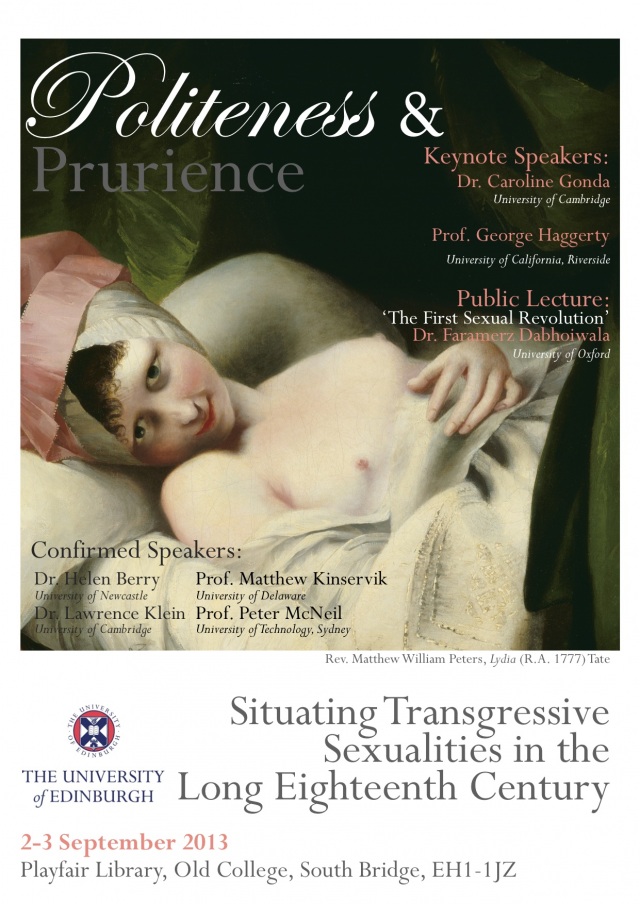
Politeness & Prurience: Situating Transgressive Sexualities in the Long Eighteenth Century
History of Art Department, the University of Edinburgh, 2-3 September 2013
Proposals due by 10 September 2012
 Embedded within the narrative of John Cleland’s infamous novel Fanny Hill, or Memoirs of a Woman of Pleasure (1748), is a vignette which affronts the moral compass of even the tale’s sexually promiscuous protagonist. Having attended a ‘drag masquerade’, Fanny bears witness, through a convenient crack in a wall, to a sodomitical act, which she finds ‘not only universally odious but absurd’. Despite her apparent condemnation, Fanny pruriently watches on. In its dichotomous nature, Fanny’s reaction – suggestive of both outrage and intrigue – mirrors reactions to homosexuality in the eighteenth-century and its subsequent historiography, wherein it is treated at once as a site of fascination, but considered separately from the history of normative sexualities. Situated as it is, within this feast of heterosexual eroticism, Fanny Hill’s same-sex love scene may seem incongruous. Cleland’s text however, proffers a way to approach homosexuality as both explicitly aberrant and problematic, but still located within the general lexicon of eighteenth-century sexual congress. By the same token, Cleland offers a model for resituating the homosexual narrative within a wider historiography of sexuality, where its relationality to dominant modes, not its difference from them, might fruitfully be used as a way to re-evaluate transgressive sexualities during the period.
In his 2006 article ‘Queering Horace Walpole’ George Haggerty advocates an approach to the history of sexuality wherein the search for a ‘concrete account of same-sex sexual behaviour’ is rejected, forcing the historian ‘to look elsewhere in almost every case’. Accordingly, this conference will privilege the assessment of cultural evocations of the ‘other eighteenth century’; the transgressive will be identified as, and sought within, dominant modes of eighteenth-century culture and its discourses. In the realm of visual culture, transgressive and deviant sexualities have previously been interpreted as autonomous and distinct from these prevailing modes. Hogarth’s famous print-series A Harlot’s Progress (1732) and A Rake’s Progress (1735) have been interpreted simplistically – in accordance with their appellation – as ‘modern moral subjects’. As such they have routinely been presented as providing antitheses to a broadly defined exemplar of ideal polite culture. Such a prima facie interpretation however, boldly precludes the rich scopophilic potential provided by scenes of prostitution and illicit sexuality, locating it instead within the polite framework of moralising art. Like Fanny, the viewer of such images is at once repulsed and titillated. Yet Hogarth’s satirical oeuvre is not merely a visualisation of moral imperatives central to polite culture, but a vivid visualisation of a real section of contemporary society. In reintegrating these apparently oppositional forms of behaviour a clearer picture of eighteenth-century society and culture emerges. Hogarth’s images may therefore be viewed not as simply the commentary on the mores of an apparently ‘polite’ society via the representation of its very opposite, but, analogous to David Halperin’s definition of ‘queer’ in Saint Foucault: Towards a Gay Hagiography (1997), as ‘a positionality vis à vis the normative’.
In an attempt to highlight underwritten facets of contemporary sexuality, texts such as G. S. Rousseau and Roy Porter’s Sexual Underworlds of the Enlightenment (1987) which label themselves as examining the ‘other’ or ‘underworld’ have instead further problematised the role and import of such histories to wider eighteenth-century culture. The aim of this conference is therefore not to present illicit sexuality as an underbelly to a dominant polite culture, but to reconcile the ‘two eighteenth centuries’ that have for too long been presented as the subject of two discrete discourses – politeness and prurience. As well as dealing with the interface between politeness and prurience as it appears throughout eighteenth-century visual, material and literary culture more generally, specific topics for papers could include:
• Bodies – the venereal body, castrati, physicalities, sadomasochism
• Settings – home and abroad, urban centres, rural backwaters
• Spaces – the architectural exterior and the private interior, the bagnio, the brothel, the masquerade
• Gaze/Experience – viewing sexualities, the keyhole testimony, description and biography
• Material Evidence – the objects of sexuality, dress, sex aids, collections, erotica
• Masculinities and Femininities – gender roles, reversals and subversions
• Modes of the illicit – sodomitical, Sapphic, pathological, pederastic, extra-marital, rape
• Public & Private – reception/reaction, fear/celebration, homophobia, display, expression
• Language – parlance, designation, rumour, slander, code
We invite abstracts of no more than 500 words to Dr. Viccy Coltman, Head of History of Art, Jordan Mearns & Freya Gowrley at politeness.prurience@gmail.com by 10 Sept 2012. Website: http://www.politenessandprurience.com
Conference | ‘Contested Views’ at Tate Britain
From Tate Britain (as noted at BARS) . . .
Contested Views: Visual Culture and the Revolutionary and Napoleonic Wars
Tate Britain, London, 19-20 July 2012

Joseph Mallord William Turner, “The Field of Waterloo,” exhibited 1818
In July 2012, in advance of commemoration of the bicentenary of the Battle of Waterloo, Tate Britain will be hosting a two-day conference exploring the impact of the Revolutionary and Napoleonic Wars on worldwide visual culture, from the outbreak of the pan-European conflict with France in 1792 to the present day. Centred on themed panels, plenary lectures and workshops, this cross-disciplinary conference will promote knowledge and understanding of the range of ways in which the ‘first total war’ has been mediated in visual cultures, not only in Britain and continental Europe but throughout the world. Confirmed plenary speakers: Mary Favret, Gillian
Russell, Susan Siegfried, Paul White.
The 2012 Issue of ‘The Walpole Society’
The Walpole Society 74 (2012)
• Rodney Griffiths, “The Life and Works of Edward Haytley (1713-1762),” pp. 1-60.
• Jason M. Kelly, “Letters from a Young Painter Abroad: James Russel in Rome, 1747-53,” pp. 61-164.
• Andrew Graciano, “The Memoir of Benjamin Wilson FRS (1721-1788): Painter and Electrical Scientist,” 165-244.
• Hugh Brigstocke, “The Journals and Accounts of James Irvine in Italy (1802-1806): Art Dealing and Speculation for William Buchanan, Arthur Champernowne and Alexander Gordon,” 245-432.
General information about The Walpole Society is available here»
Exhibition | British Silver: The Wealth of a Nation
Thanks to Courtney Barnes of Style Court for this one. From The Met:
◊ ◊ ◊ ◊ ◊
British Silver: The Wealth of a Nation
The Metropolitan Museum of Art, New York, 15 May 2012 — 20 January 2013
 The production of silver in Britain was understood to be the embodiment of the country’s prosperity—an outward expression of political stability, taste, and industriousness. This exhibition explores some of the ingredients that made the English silver trade such a vigorous success in the sixteenth, seventeenth, and eighteenth centuries. Drawn largely from the Museum’s collections, it also includes extraordinary loans from private collectors, including Paul de Lamerie’s great rococo coffeepot of 1738 and the justly famous Maynard Dish belonging to the Cahn Family Foundation.
Since sterling silver was the coinage of the realm, a silver dinner service was, most literally, worth its weight. But the display and use of silver meant more than riches. Silver was an expression of a patron’s taste and education, designed to celebrate his achievements and complement the architecture of his house.
In England, as in Continental Europe, a rich display of silver was essential to the expression of power. Government officials and emissaries dispatched to foreign courts were expected to entertain in a style that reflected the dignity of the English crown. To ensure that they could set an impressive table, an office holder or ambassador was issued a silver service from the Jewel Office, the division of the royal household responsible for precious metals and jewels. Several examples of silver made for ambassadorial use are included in the exhibition. Although the court was an important source of orders for silversmiths, it did not support workshops of its own, and makers broadened their market by serving the growing professional and merchant classes. (more…)










 Enfilade
leave a comment