Conference | Two Centuries of Mapping Washington, D.C.
From the Library of Congress:
PHILIP LEE PHILLIPS ANNUAL CONFERENCE
Visualizing the Nation’s Capital: Two Centuries of Mapping Washington, D.C.
Library of Congress, Washington, D.C., 18-19 May 2012

“Plan of the City of Washington,” engraving, March 1792 (Wikimedia Commons)
Visualizing the Nation’s Capital: Two Centuries of Mapping Washington, D.C. is the first conference devoted to mapping the nation’s capital, covering the period from Pierre-Charles L’Enfant’s 1791 Plan of the City of Washington to the present. Participants include historians, archaeologists, building and landscape architects, urban planners, cartographers, geographers, land surveyors, Library of Congress specialists and Anthony Williams, the former mayor of Washington, D.C. The conference is presented by the Library and the Philip Lee Phillips Society, which was established in 1995 as an association of collectors, geographers, historians and map enthusiasts, with a shared interest in supporting and promoting the programs and activities of the Library’s Geography and Map Division. The conference is free and open
to the public. Reservations are needed; contact
SpecialEvents@loc.gov or call 202-707-1616.
◊ ◊ ◊ ◊ ◊
Friday, 18 May 2012 (Coolidge Auditorium, Thomas Jefferson Building) (more…)
At Auction | Rare 1792 Silver Center Cent Coin
A Heritage Auctions press release (5 April 2012), as noted at ArtDaily.com:
Heritage Auctions, Central States U.S. Coin Auction
Schaumburg, Illinois, 18-20 April 2012
Highest bid as of 13 April: $1,000,000
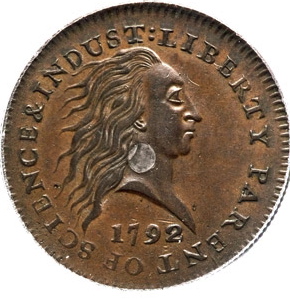 DALLAS – One of the most historic coins struck by the early U.S. Mint, a 1792 Judd-1 Silver Center cent pattern, MS61 Brown PCGS, headlines the Heritage Auctions April 2012 Central States Signature U.S. Coin Auction, April 18-20, with Platinum Night offerings on April 19.
“Our long-running relationship with the Central States Numismatic Society and conducting its annual convention’s official auction is alive and well,” said Greg Rohan, President of Heritage, “as is our tradition of bringing important rarities to those auctions. The 1792 Silver Center cent is tremendously important to the history of U.S. coinage – arguably far more so than a number of better-known and more celebrated rarities.”
 The 1792 Silver Center cents were experimental pieces designed by Chief Coiner Henry Voigt to remedy a flaw in the Mint Act of 1792: the official weight for one cent coins would have made them too large and heavy for practical use. Voigt suggested a small silver plug, worth ¾ of a cent, surrounded by copper worth ¼ of a cent. The value of the metal would be the same, but the Silver Center cent was designed to be smaller and easier to handle. The Silver Center cents were the first coins struck on the grounds of the U.S. Mint, lending them great historical importance, but they never went into general production and are very rare today. Congress reduced the official weight of the cent instead, making an all-copper coin more practical. Heritage’s roster of Silver Center cents counts only 14 positively identified survivors. This Silver
Center cent, presented as An Offering From The Liberty Collection,
was used to illustrate the type in Walter Breen’s famous
Encyclopedia and is pictured in certain past editions of A Guide
Book of United States Coins, popularly known as the “Red Book.” . . .
◊ ◊ ◊ ◊ ◊
Update (added 20 April 2012) — The coin sold for $1million (plus the 15% commission), as noted here»
Catherine Molineux on Visual Ethnography
Catherine Molineux | Visual Ethnography: The Travelogue Illustration as a Site of Encounter
The Newberry Library, Chicago, 28 April 2012
Please join us Saturday, April 28, 2012, 2-4 pm for our Newberry Library Eighteenth-Century Seminar works-in-progress session with Catherine Molineux of Vanderbilt University.
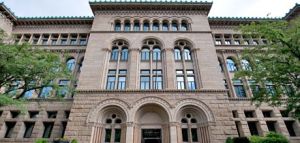 Between the 1730s and 1780s, a French traveler’s tale about the coronation of a West African king circulated through France, England, and the Netherlands. Embedded in this description of Hueda rituals surrounding kingship was a story about European rivalry for the favor of a key African player in the Atlantic slave trade. As this commercial drama played out in Europe through multiple retellings of the story, engravers transformed the single image that accompanied it, reworking the original sketch into a full-color engraving. The illustration’s evolution tells a modern story about the role of the visual in securing imperial hierarchies threatened by the encounter with African sovereignty.
The Newberry Library Eighteenth-Century seminar is designed to foster research and inquiry across the scholarly disciplines in eighteenth-century studies. It aims to provide a methodologically diverse forum for work that engages our ongoing discussions and debates along this historical and critical terrain.
Attendance at all events is free and open to the public but in order to receive the precirculated paper, participants are asked to register in advance by contacting the Center for Renaissance Studies at: renaissance@newberry.org. A reception follows each presentation. It is also the custom of the seminar to gather at a restaurant in the Newberry neighborhood to continue our conversation. If you would like to join us for dinner after any session, please email Lisa Freeman at lfreeman@uic.edu. For more information about the seminar, please visit our website. We welcome your attendance and participation at the seminar and look forward to continuing our lively discussions.
Yours,
Timothy Campbell, University of Chicago
Lisa A. Freeman, University of Illinois at Chicago
John Shanahan, DePaul University
Helen Thompson, Northwestern University
Conference | Carrara Marble and the Low Countries
I’ve included only a selection of the sessions, generally as directly related to the eighteenth century, but the entire conference looks fascinating. For more information, consult the listing at H-ArtHist. -CH
◊ ◊ ◊ ◊ ◊
Carrara Marble and the Low Countries from the Late Middle Ages to Today
Rome and Carrara, 4-8 June 2012
Registration due by 15 May 2012
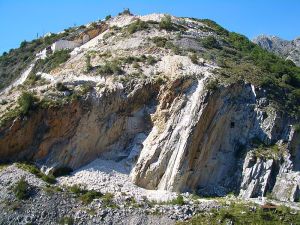
Marble quarries above Carrara (Photo: Wikimedia Commons)
Organized by Academia Belgica, Roma; Royal Netherlands Institute in Rome; Université Libre de Bruxelles; Universiteit Gent; Katholieke Universiteit Leuven; Université de Liège; Royal Museums of Art and History, Brussels; Royal Museums of Fine-Arts of Belgium, Brussels; Nederlands Interuniversitair Kunsthistorisch Instituut, Firenze; The Low Countries Sculpture Society, Brussels
4-5 June 2012 (Monday and Tuesday morning)
Pre-Conference Study Days in Rome: The sculpted and painted decoration of galleries in Roman palaces and villas c.1500-1830
Please note that during the one-and-a-half days of Pre-Conference Excursions we will be visiting embassies and other official residences that are rarely or never open to the public, but which may be closed at short notice for official functions. If this were the case, we might have to change the order of the individual visits or even attempt to substitute the cancelled visit with another. The provisional programme includes the galleries of : Raphael’s Villa Madama, Palazzo Farnese, Borromini’s Palazzo Pamphilj (Piazza Navona), Algardi’s Villa Doria-Pamphilj (Via Aurelia Antica), Museo Pio Clementino and Casino di Pio IV in the Vatican Gardens and the stone conservation workshops of the Vatican Museums.
Tuesday, 5 June 2012
Academia Belgica, Roma via Omero 8
14.30-15.00 Registration
15.00 Welcome by Ambassadors Vincent Mertens de Wilmars and Alphonsus Stoelinga (tbc), Prof Dr Walter Geerts, director of the Academia Belgica and Prof Dr Bernard Stolte, director of the Royal Netherlands Institute in Rome . . .
Wednesday, 6 June 2012
Academia Belgica, Roma via Omero 8
9.00 Registration
Session Three — The trade in Carrara marble to the Low Countries: local and international actors and strategies, and their impact on the design and production of luxury goods
9.30 Dr Cristiano Giometti, Università di Pisa, Marble merchants from the Low Countries in the early 18th century from the documents of the State Archives of Massa
10.00 Muriel Barbier, Institut National du Patrimoine, Paris, Carrara marble for French fireplaces delivered by Flemish marble masons in the 18th century
10.30 Prof Dr Krista De Jonge, Catholic University of Leuven, Luxury Artefacts: The Early Modern Low Countries and the Genoese Trading Network in Carrara Marble
11.00 Dr Francis Tourneur, Association Pierres et Marbres de Wallonie, Namur, Marble gleanings: commerce, design, production and techniques from Boussu to Corroy-le-Château
11.25 Discussion
11.40 Coffee
Session Four — The social prestige of Carrara marble vs. alabaster
12.00 Dr Aleksandra Lipi?ska, University of Wroclaw (PL), « Marbre blanc qu’on dit albastre. » Italian marble vs. Transalpine alabaster in 16th-century Low Countries sculpture
12.30 Géraldine Patigny, Université Libre de Bruxelles/Royal Institute of Cultural Heritage, Brussels, La place du marbre dans la sculpture à Bruxelles à l’époque de Jérôme Du Quesnoy père et fils
12.55 Discussion
13.10 Lunch
Session Five — Carrara marble as a vehicle for classical ideals
14.00 Dr Léon Lock, Catholic University of Leuven, The techniques of Carrara marble carving in Antwerp in the 17th century between tradition and innovation
14.30 Inger Groeneveld, Royal Academy of Arts, Den Haag, Carrara marble for the Dutch Interior 1600-1800
15.00 Dr Sophie Mouquin, Université de Lille III / Ecole du Louvre, Paris, Poetics, symbolism and science: The perception of Carrara marble in Paris and in the Low Countries in the 18th century
15.25 Discussion
15.40 Coffee
16.00 Dr Emile van Binnebeke, Royal Museums of Art and History, Brussels, The theory and practice of Carrara marble sculpture by Gabriel and Godecharle
16.30 Wim Oers, WENK Sint-Lucas Brussels-Gent / University of Oxford, The use and meaning of Carrara marble sculptures and decorations at Schönenberg (the current royal palace at Laken), near Brussels, 1781-87 . . .
Exhibition | Lux in Arcana: The Vatican Secret Archives
Thanks to Hélène Bremer for drawing my attention to this exhibition in Rome. If only things revealed themselves! -CH
Lux in Arcana: The Vatican Secret Archives Reveals Itself
Musei Capitolini, Rome, 1 March — 9 September 2012

It will be the first and possibly the only time in history that they leave the confines of the Vatican City walls. And they will do so in order to be housed and displayed in the beautiful halls of the Capitoline Museums in Rome. One hundred original and priceless documents selected among the treasures preserved and cherished by the Vatican Secret Archives for centuries. The exhibition which is conceived for the 4th Centenary of the foundation of the Vatican Secret Archives aims at explaining and describing what the Pope’s archives are and how they work and, at the same time, at making the invisible visible, thus allowing access to some of the marvels enshrined in the Vatican Secret Archives’ 85 linear kilometers of shelving; records of an extraordinary historical value, covering a time-span that stretches from the 8th to the 20th century.
The name, Lux in arcana, conveys the exhibition’s main objective: the light piercing through the Archive’s innermost depths enlightens a reality which precludes a superficial knowledge and is only enjoyable by means of direct and concrete contact with the sources from the Archive, that opens the doors to the discovery of often unpublished history recounted in documents. The exhibition is enriched by multimedia installations, guided by an intriguing but rigorous historical narration, to allow the visitor to experience some famous events from the past and to “re-live” the documents, that will come to life with tales of the context and the people involved.
The 100 documents, chosen among manuscript codices, parchments, strings and registers, will remain at the Capitoline Museums for nearly seven months, from 1st March till September 2012. An extremely prestigious location, chosen to host this memorable event since it underlines the profound bond existing between the city of Rome and the Papacy since medieval times; the origins of both institutions involved in the event trace their roots back to Sixtus IV’s artistic sensibility; however, at the same time, the history enshrined in the Vatican Secret Archives is intertwined with the history of Italy, Europe and the World as a whole.
The Vatican Secret Archives represent a cultural world heritage centered in the city of Rome; for this very reason the exhibition has been conceived in cooperation with Roma Capitale, Assessorato alle Politiche Culturali e Centro Storico – Sovraintendenza ai Beni Culturali di Roma and Zètema Progetto Cultura. This memorable exhibition is already creating great expectations, fuelled by the mysterious fascination that the Vatican Secret Archives generate in the collective imagination. All of the above will make Lux in arcana – The Vatican Secret Archives reveals itself an event of unprecedented scientific and media importance.
◊ ◊ ◊ ◊ ◊
An eighteenth-century sample from the exhibition:
A Note from Prison by Marie Antoinette of France, ca. 1792-93
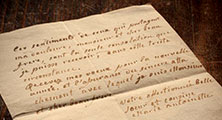 The feelings of those who share my sorrow, my dear brother-in-law, are the only consolation I can receive in this sad circumstance. Please receive my wishes for the new year and reassurance of my sincere devotion, that I am, my dearest brother-in-law, your affectionate sister-in-law and cousin Marie Antoinette.
A note with no date, just over ten lines in French, written in a clear and tidy script on a small sheet of paper, signed by the last queen of France. The contents of this dispirited message that bears no official character suggest it may have been written during one of the gloomiest periods in Marie Antoinette’s existence: between December 1792 and January 1793, just after the revolutionary tribunal’s death sentence against her husband Louis XVI, desacralized as “Citoyen Louis Capet”, and just before his execution on January 19, 1793. Marie Antoinette was held prisoner with all the royal family at the Tour du Temple, an ancient fortress built by the knights Templar in the 13th century. Anxious over her husband’s dire fate and certainly foreseeing her own death, the queen wrote this message to an unknown recipient, possibly Louis XVI’s brother, Charles Philippe, count of Artois and future king Charles X of France. Ten months after this note’s supposed date, Marie Antoinette’s curse fate unfolded: early on October 16, 1793, she was taken to the guillotine on a squalid barrow . . .
The full entry is available here (click on the letter on the far right side, second from the top).
French Porcelain Society Conference Honors Rosalind Savill
From The French Porcelain Society’s website:
A Two-Day Symposium in Honour of Dame Rosalind Savill
The Wallace Collection, London, 13-14 April 2012
Symposium Organisers: John Whitehead, Susan Newell, Patricia Ferguson and Mia Jackson
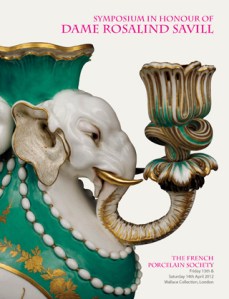 The French Porcelain Society is delighted to announce a two-day symposium to be held in honour of our President, Dame Rosalind Savill. Ros became a star of French decorative arts with the publication of her ground-breaking 3 volume Catalogue of Sèvres Porcelain in the Wallace Collection in 1988. Her career as a museum curator started at the Victoria & Albert Museum and continued at the Wallace where she served for 37 years, the last 19 as Director. The symposium is a tribute to her dedication to Sèvres porcelain research and her enjoyment and enthusiasm for the French decorative arts in general. New research on a wide range of subjects relating to French porcelain and the decorative arts will be presented by around 30 speakers – a veritable ‘Who’s Who’ of those currently involved in these fields including:
Andreina d’Agliano, Antoine d’Albis, Vincent Bastien, Sir Geoffrey de Bellaigue, Anthony du Boulay, Juliet Carey, Yves Carlier, Maureen Cassidy-Geiger, Aileen Dawson, Virginie Desrante, Claire Dumortier, Oliver Fairclough, Alden Gordon, Michael Hall, Ulla Houjkaer, Catrin Jones, Bet McLeod, Errol Manners, Jeffrey Munger, Tamara Préaud, Christophe de Quénétain, Marie-Laure de Rochebrune, Pamela Roditi, Linda Roth, Adrian Sassoon, Dame Rosalind Savill, Timothy Schroder, Christoph Vogtherr and Samuel Witwer.
The first day’s proceedings will be followed by an evening Reception in the upstairs galleries, and on Saturday 14th there is a celebratory Dinner in the Wallace Collection restaurant. For members only, on Sunday 15th, there is an Outing to Boughton. The symposium is open to members and non-members of The French Porcelain Society. Bursaries are available for scholars who wish to attend.
◊ ◊ ◊ ◊ ◊
P R O G R A M M E (more…)
Call for Essays | Interpeting Sexual Violence, 1660-1800
Interpreting Sexual Violence, 1660-1800
Volume Editor: Anne Greenfield, Valdosta State University
Abstracts due by 15 May 2012
Sexual violence was a favorite subject of many (long) eighteenth-century writers, artists, and thinkers. This collection seeks to examine the conflicting, intersecting, and shared ideologies within representations of sexual violence over the course of the long eighteenth century. Since depictions of sexual violence appeared in various forms and in a variety of genres, papers examining sexual violence in one or more venues between 1660 and 1800 are welcome.
Please submit to the editor a 250-500 word abstract, along with a biographical statement (indicating your affiliation, prior publications, and contact information) by May 15, 2012. If accepted, a final version of the paper (6,000-8,000 words) would be needed by fall 2012 (details to follow). Inquiries and questions may be directed to Anne Greenfield, algreenfield@valdosta.edu.
New Title | James Wyatt, 1746-1813: Architect to George III
From Yale UP:
John Martin Robinson, James Wyatt, 1746-1813: Architect to George III (London: Paul Mellon Centre for Studies in British Art, 2012), 400 pages, ISBN: 9780300176902, $75.
 James Wyatt (1746–1813) is widely recognized as the most celebrated and prolific English architect of the 18th century. At the start of his lengthy career, Wyatt worked on designs for the Oxford Street Pantheon’s neo-Classical interior as well as Dodington, the Graeco-Roman house that served as the model for the Regency country house. Wyatt was the first truly eclectic and historicist architect, employing several versions of Classical and Gothic styles with great facility while also experimenting in Egyptian, Tudor, Turkish, and Saxon modes. His pioneering Modern Gothic marked him as an innovator, and his unique neo-Classical designs were influenced by his links with the Midlands Industrial Revolution and his Grand Tour education.
This groundbreaking book sheds new light on modern architectural and design history by interweaving studies of Wyatt’s most famous works with his fascinating life narrative. This masterly presentation covers the complex connections formed by his web of wealthy patrons and his influence on both
his contemporaries and successors.
John Martin Robinson is an independent architectural historian. He is a partner in Historic Buildings Consultants, Librarian to the Duke of Norfolk, Maltravers Herald Extraordinary and Vice Chairman of the Georgian Group. He is a regular architectural contributor to Country Life and the author of numerous books.
Graduate Conference | Beyond Borders
From the conference website:
Beyond Borders: The Impact of Cultural Exchange in Art History
Magdalene College, University of Cambridge, 10-11 May 2012
Conference registration due by 1 May 2012
 The University of Cambridge History of Art Graduate Conference, Beyond Borders: The Impact of Cultural Exchange in Art History will be held on 10-11 May 2012 at Magdalene College, University of Cambridge. The two-day conference will address cross-cultural influences within the various art disciplines over a far-reaching geographical and chronological spectrum. The aim of the conference is to provide, and promote, an interdisciplinary forum for scholars investigating issues from appropriation of styles and motifs, to collecting and patronage. For more information and to register to attend, please visit: www.artconference2012.com. Please note that registration closes 1 May and seats are limited. For any queries, please contact us at: info@artconference2012.com
Keynote Speakers: Professor Partha Mitter (University of Sussex) and Dr. Sarah Turner (University of York)
◊ ◊ ◊ ◊ ◊
Thursday, 10 May 2012
9:30 Registration
10:00 Welcome address
10:05 Professor Partha Mitter, Introduced by Professor Jean Michel Massing
11:00 Panel I: India and Cultural Exchange, Chair: Professor Jean Michel Massing
• Kimia Shahi, ‘Translation and Transformation: Bernard Picart and Mughal Indian Miniatures’
• Rashmi Viswanathan, ‘The Tressider Album: A Case Study of a Private Ethnography’
• Krista Gulbransen, ‘Rao Surjan Singh and the Origins of Painted Portraiture in Bundi’
12:30 Lunch
1:30 Panel II: Architecture and Interiors, Chair: Dr. Frank Salmon
• Ellen Hurst, ‘The Reinvention of Russian Architecture: Italians in the Service of Vasily III, 1505-33’
• Hank Johnson, ‘Palladio Might with Envy View It? Eighteenth-Century British Design, British Self-Perception, and Italian Architecture’
• Josefine Baark, ‘”Small, Fat and Paunchy”: Chinoiserie Figures in Rosenborg Castle, Denmark’
3:00 Coffee
3:15 Panel III: Gift and Commercial Exchange, Chair: Dr. Meredith Hale
• Lejla Bajramovic, ‘A European Artist Collecting Non-European Art: Emil Preetorius’
• Andrew Chen, ‘Simone Martini’s Orsini Polyptych: A Gift from the Avignon Pope Clement VII to Philip the Bold, Duke of Burgundy, and the Politics of the Western Schism c. 1390′
• Antonia Gatward Cevizli, ‘The Marquis and the Sultan: Mantuan-Ottoman Cultural Exchange in the 1490s’
Friday, 11 May 2012
9:30 Registration
10:00 Panel IV: The Ancient World to 1000AD, Chair: Ms. Aurelie Petiot (PhD candidate)
• Samar Faruqi, ‘Orientalist Painting and the Victorian Art Market: Edwin Long’s Babylonian Marriage Market (1875)’
• Einav Zamir, ‘The Empire of Bacchus: Exchange from West to East’
• Theodore Van Loan, ‘From Symbol to Text: The Contingency of Influence in Umayyad Coin Design’
11:30 Coffee
11:45 Dr. Sarah Turner, Introduced by Dr. Polly Blakesley
12:30 Lunch
1:30 Panel V: Identity and Exchange, Chair: Mr. Duncan Robinson
• Liz Renes, ‘Sargent and His Mentors: Carolus Duran, Henry James and the Fostering of a Cosmopolitan Identity’
• Jill Baskin, ‘Picturing Freedom’s Shores: The Visual Culture of African Americans in Liberia, 1821-1865’
• Galina Mardilovich, ‘Rembrandt’s Shadow in Late Nineteenth-Century Russia’
• Loyd Grossman, ‘Benjamin West’s Confused Nationality’
3:30 Closing Address
Display | The Comte de Vaudreuil: Courtier and Collector
From the National Gallery of Art:
The Comte de Vaudreuil: Courtier and Collector
National Gallery, London, 7 March — 12 June 2012
 The Comte de Vaudreuil (1740–1817) was one of the leading courtiers and collectors of paintings in Paris during the 1780s. This display features Dutch and Flemish Old Master paintings in the National Gallery’s collection that were once owned by Vaudreuil or were in Parisian collections at that time. Vaudreuil’s collection provides an example of the decoration of wealthy homes in pre-Revolution Paris. Reflecting the fashion of the time, the paintings are hung according to their size and symmetry rather than by subject or chronology.
The Paintings
The display features paintings from the Comte’s collections by artists Jan Wijnants, Jacob van Ruisdael, Jan Steen and Adriaen van Ostade. Alongside these are works that were in French collections in the same period by artists Nicolaes Berchem, Aelbert Cuyp, Willem van de Velde and Gabriel Metsu. The paintings show a variety of subjects, from portraits of peasants to social life in 17th-century Holland to landscapes with ruined castles.










 Enfilade
leave a comment