Call for Papers | Digital Revolutions
Digital Revolutions: Interpreting and Historicizing American Culture
New England American Studies Association 2012 Conference
University of Rhode Island, Providence, 12-13 October 2012
Proposals due 3 May 2012 (extended from the original 15 April deadline)
Recent developments in digital technologies have transformed the place of the humanities in American life. From online versions of Cotton Mather’s Magnalia Christi Americana to a daily John Quincy Adams Twitter feed to the Smithsonian’s publicly accessible Archives of American Art to the Women Writers Online Project, digital technologists are reshaping our sense of history, place, community, and identity. Digitization of America’s cultural heritage has also fundamentally transformed work in the humanities itself. From universities to libraries to cultural institutions, the information infrastructure has brought forth digital collaborations across disciplines and beyond the academy, as well as between scholars, educators, archivists and programmers. But it has also brought forward concerns about copyright, control and access to information and the future of print media.
Are such changes unprecedented? Prior evolutions in communications technology suggest otherwise. From broadsides to blogs, such changes have reshaped the way Americans interact and understand themselves both in the present and the past. The 2012 NEASA conference, Digital Revolutions, invites participants to consider what these developments are, how they are redefining work in the humanities and what previous media revolutions suggest for the future.
This conference will combine scholarly investigation of the cultural, political and economic significance of communications media with a series of panels, workshops and participatory forums that can take advantage of technologies now available to us. In addition to individual paper proposals, we also welcome submissions for roundtable discussions, hands-on workshops and multimedia sessions such as film screenings, online presentations and 5-minute micropapers.
Proposals should include a one page abstract and title, as well as the author’s name, address (including email), and institutional or professional affiliation. For panel proposals please include contact information for all participants, as well as a brief (no more than two page) description of the session topic and format. Submit proposals to neasaconference12@gmail.com by the revised deadline of May 3, 2012.
Proposal or queries may also be sent to:
Sara Sikes, NEASA President
Massachusetts Historical Society, The Adams Papers
1154 Boylston Street
Boston, MA02215
ssikes@masshist.org
For more information about the conference and NEASA, including an expanded Call for Papers, please visit www.neasa.org.
New Title | ‘Knowing Nature: Art and Science in Philadelphia’
From Yale UP:
Amy R. W. Meyers and Lisa L. Ford, eds., Knowing Nature: Art and Science in Philadelphia, 1740-1840 (New Haven: Yale University Press, 2012), 424 pages, ISBN: 9780300111040, $65.
 Philadelphia developed the most active scientific community in early America, fostering an influential group of naturalist-artists, including William Bartram, Charles Willson Peale, Alexander Wilson and John James Audubon, whose work has been addressed by many monographic studies. However, as the groundbreaking essays in Knowing Nature demonstrate, the examination of nature stimulated not only forms of artistic production traditionally associated with scientific practice of the day, but processes of making not ordinarily linked to science.
The often surprisingly intimate connections between and among these creative activities and the objects they engendered are explored through the essays in this book, challenging the hierarchy that is generally assumed to have been at play in the study of nature, from the natural sciences through the fine and decorative arts, and, ultimately, popular and material culture. Indeed, the many ways in which the means of knowing nature were reversed – in which artistic and artisanal culture informed scientific interpretations of the natural world – forms a central theme of this pioneering publication.
At Sotheby’s in June 2012 | Pastel Portrait by Liotard
Press release (28 March 2012) from Sotheby’s:
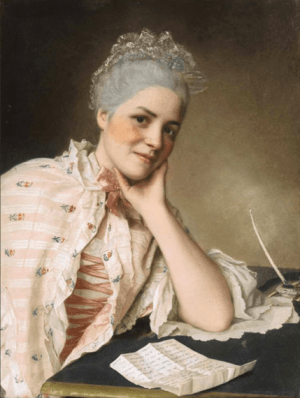
Jean Etienne Liotard, “Portrait of Mademoiselle Jacquet” (Photo: Sotheby’s)
Sotheby’s announced that their sale of Old Master & 19th Century Paintings & Drawings in Paris on 21 June 2012 will feature a very rare work of art by the most important pastellist of the 18th century, Jean Etienne Liotard. Estimated between 300.000 and 400.000€ ($400,000-530,000 / excluding buyer’s premium), this beautifully preserved pastel has been rediscovered by the Director of the Old Master Paintings Department at Sotheby’s in Paris, Pierre Etienne, in a collection in the South of France. This portrait of Mademoiselle Jacquet, a French actress at the Opéra (Académie Royale de Musique) in the 18th century, has never appeared before on the art market.
Liotard grew up in Geneva and trained as a miniaturist and enameller – first in Switzerland, then in France under Jean-Baptiste Massé, with whom he also studied engraving. However, apparently bored in his master’s studio, the young Liotard left for Italy in 1735, where he met Sir William Ponsonby, 2nd Earl of Bessborough, who offered to travel with him to Constantinople, drawing the costumes and characters they met along the way. Thereafter Liotard continued to travel, through Turkey, Greece, Moldavia (where the prince invited him to paint the royal family), Austria, Germany, Switzerland, Great Britain, Holland, Italy – and France. During his career Liotard came to Paris for three lengthy stays, and also stopped off in the French capital from time to time en route for other destinations.
The portrait of Mademoiselle Jacquet probably dates either from his second stay in Paris (1748-52), or from his brief trip to Paris in Spring 1757. When Liotard arrived in Paris in 1748 he was already famous. In 1749 he was asked to paint the royal family and, in the wake of this commission, numerous courtiers and other influential figures asked him to do their portraits, ranging from Madame de Pompadour and Voltaire to well-known figures of the theatre such as Marivaux and the great actress Madame Favart. It is thus interesting to note that the portrait of Louise Jacquet, also an actress, was probably commissioned during this period. The work to be offered for sale by Sotheby’s is drawn in pastel, Liotard’s preferred medium. Liotard’s first known pastel dates from his trip to Italy in 1736. Also in his autobiography, he explains that he especially appreciated pastel because it facilitated a subtle blend of colours and enabled him to rework a subject without having to repaint it. The portrait, executed with a pronounced delicacy, differs markedly from the standard format Liotard was used to propose, involving a frontal view of the sitter, without hands. The pastel is slightly larger than Liotard’s standard works of this type, and the sitter is unusually lent a context, or mise en scène.
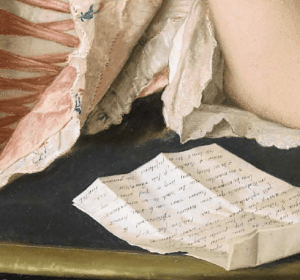 It is not unusual to find letters in Liotard’s portraits, but this one in particular is unusually explicit, and the only one to be partly legible. We can make out a string of compliments addressed to the young lady, such as ‘You know how much I am interested in and admire you… and your perfections.’ Such details suggest that it was the sitter herself, or one of her admirers, who chose this ambitious mode of representation – one that makes no allusion to her profession as a singer. Jacquet’s name has always been associated with the pastel; it was offered to the ancestors of the current owners by Louise Jacquet herself.
The portrait will be exhibited in Paris, 18-20 June 2012, 10am-6pm.
◊ ◊ ◊ ◊ ◊
Note (added 24 June 2012) — As reported at Art Daily, Liotard’s pastel far surpassed estimates, selling for a record €1,464,750 ($1,853,509).
Exhibition | Gainsborough’s Landscapes
From the Holburne Museum in Bath . . .
Gainsborough’s Landscapes: Themes and Variations
Holburne Museum, Bath, 24 September 2011 — 22 January 2012
Compton Verney, Warwickshire, 11 February — 10 June 2012

Thomas Gainsborough, Landscape with a View of a Distant
Village, ca. 1750 (Edinburgh: National Gallery of Scotland)
◊ ◊ ◊ ◊ ◊
Gainsborough’s Landscapes: Themes and Variations is the first exhibition in fifty years devoted solely to his landscape paintings and drawings, bringing together remarkable works from public and private collections, many of them little known and some not previously exhibited. For Gainsborough, if portraiture was his business, landscape painting was his pleasure, and his landscape paintings and drawings reveal his mind at work, the extraordinary breadth of his invention and the dazzling quality of his technique.
Thomas Gainsborough (1727-1788) sold relatively few of his landscape paintings, and none of his drawings, but he regarded them as his most important work. His paintings do not represent real views, but are creations ‘of his own Brain’, as he put it. A limited number of rural subjects exercised his imagination from one decade to the next, changing as he developed an increasingly energetic ‘hand’, or manner of painting, and becoming ever grander in conception.
The exhibition includes some of his most famous and popular works including The Watering Place from the National Gallery (the most famous of all his landscape compositions in his life-time) and less well-known works such as the little-seen but ravishing Haymaking from Woburn. The paintings have been selected to represent six landscape themes; the remarkable drawings and prints show Gainsborough returning to these themes and demonstrate the longevity of each theme and the degree of experimentation that was involved in the search for the perfect composition.
The evolution of Gainsborough’s style is traced from early naturalistic landscapes in the Dutch manner, enlivened with small figures (pictured above), to grand scenery that is dramatically lit and obviously imaginary, such as the Romantic Landscape from the Royal Academy of Arts. In the Girl with Pigs, from the Castle Howard Collection, a rustic figure takes centre stage: fancy figures of this kind are, in Gainsborough’s art, closely integrated with his landscape practice.
◊ ◊ ◊ ◊ ◊
Accompanying publication: Susan Sloman, Gainsborough’s Landscapes: Themes and Variations (London: Philip Wilson Publishers, 2011), ISBN: 9780856676970, £14.99
Conference | Desiring Statues
From the University of Exeter:
Desiring Statues: Statuary, Sexuality, History
University of Exeter, 26–27 April 2012
 A Wellcome Trust funded conference, hosted by the Centre for Medical History at the University of Exeter
This interdisciplinary conference seeks to investigate how statuary intersects with questions of sexuality, and temporality, specifically history. It explores the numerous different ways in which statues – as historical and/or imagined artefacts – allow us to think about the past and its relation to sex, gender and sexuality. The conference brings together contributors from a variety of disciplines, including history, gender and sexuality studies, literary and cultural studies, art history, classics, archaeology and philosophy.
◊ ◊ ◊ ◊ ◊
P R O G R A M M E
Thursday, 26th April 2012
9.00 Registration
9.45 Welcome
10.00 Session 1
Panel 1: Gender and the Erotics of the Living Statue
•Beth Brunton (Queen Mary University of London), From Motherhood to Mannequin: Bodily Perfection in Good Morning Midnight
• Lynsey McCulloch (Anglia Ruskin University), ‘Why, did you think you had married a statue?’ The Erotics of Sculptural Motion in English Renaissance Drama
• Will McMorran (Queen Mary University of London), Made of Stone: Reading And Watching Sade’s ‘Eugénie de Franval’
Panel 2: Statues, Censorship and Nudity
• Julie Anne Godin Laverdière (Université du Québec à Montréal), The Arrest of The Family (1949) and the Destruction of The Peace (1951): The Reception of Two Indecent Sculptures in Montréal
• Linda Ann Nolan (John Cabot University and American University of Rome), Deadly Nudity and Xenophobia in St. Peter’s Basilica in Early Modern Rome: the reception of the figure of Justice on the Tomb of Pope Paul III
• Sophie Schoess (University College London), The Naked Truth: Ancient Greek Sculpture in the Face of Christian Censorship
11.30 B R E A K
12.00 Session 2
Panel 1: Statuary, Sexuality and Modernity
• Andrew Eschelbacher (University of Maryland), Gendering Modernity/Modernizing Masculinity
• Charles Miller (University of Manchester), The Sex of an Origin: Picasso, Freud, Glozel
• Bernard Vere (Sotheby’s Institute of Art), ‘A Token of Triumph Cut Down to Size: Jacob Epstein’s Rock Drill as Fetish Object’
Panel 2: The Erotics of the Gaze: Interacting with Statuary Objects
• Sarah Jones (University of Exeter), ‘The Art of Love’: Religion, Sex, and the Tourist Gaze at the Temples of Khajuraho
• Amy Mechowski (Victoria and Albert Museum), ‘Britain’s Most Romantic Museum’ or a ‘Temple of Lust’?: Statuary, Lesbian Spectatorship and the V&A
• Lisa Trentin (Wilfrid Laurier University), The Sleeping Hermaphrodite: Desirous Viewing in Ancient and Eighteenth-Century Rome
13.30 L U N C H
14.30 Session 3
Panel 1: Desiring the Past: Eighteenth-Century Uses of Statuary
• Sarah Betzer (University of Virginia), Dangerous Admiration: Sculpture and Desire on the Grand Tour
• Katharina Boehm (University of Regensburg), Desiring Antiques: Sir William Hamilton, Commercial Antiquarianism and the Cult of Priapus
• Elsje van Kessel (DFK, Paris and Leiden University), Longing for the Past: Eichendorff’s Marmorbild and the Lives and Deaths of Statues
• Katie McAfee (University of Cambridge), The Sexy Statue: Venus’ Body through Eighteenth-Century Eyes
Panel 2: Sculpting Gender and Sexual Norms in Antiquity and Beyond
• Linnea Åshede (University of Gothenburg), Hermaphroditos: Desired Object and Desiring Subject
• Glenys Davies (University of Edinburgh), The Gendered Body Language of Roman Portrait Statues
• Jane Draycott (British School at Rome), Determining Desirability: Aphrodite of Cnidus vs. Baubo of Eleusis
• Fabio Guidetti (Scuola Normale Superiore di Pisa), “I am black, but comely” desire, sensuality and colour in Roman ideal statuary
16:30 B R E A K
17.00 Keynote Lecture by Dr. Ian Jenkins (Senior Curator, Ancient Greece at the British Museum), The Body Beautiful: The Human Body in Greek Art and Society
19.00 C O N F E R E N C E D I N N E R
Friday 27th April 2012
9.00 Registration
9.30 Session 4
Panel 1: Statuary (Im)Possibilities of Desire
• June Dunn (Eastern Connecticut State University), Statuesque Landscape: The Cailleach and the Topolatry of Desire in Colm Tóibín’s “A Long Winter”
• Sarah Parker (University of Birmingham), ‘Which is the god, / which is the stone / the god takes for his use?’: H.D. and Bryher’s Sculptural Exchanges
• Ery Shin (University of Oxford) “She was gracious and yet fading, like an old statue in a garden”: Nightwood’s Robin Vote, Impossible Object Desire, and the Culture/Nature Binary
Panel 2: Sculptural (In)Decency
• Catriona MacLeod (University of Pennsylvania), Flirting with Sculptural Indecency: The Realist Psyche
• Melissa Percival (University of Exeter), Angelina Jolie as a Breastfeeding Muse: The Nude Female Portrait in Context
• Linda Walsh (The Open University), Houdon’s Winter and the Problematic Sexuality of Youth
11.00 B R E A K
11.30 Session 5
Panel 1: Agalmatophilia
• Jane Fae (Independent Scholar) “Agalmatophilia” as Paraphilia
• Caterina Y. Pierre, (Kingsborough Community College, CUNY), The Pleasure and Piety of Touch in Aimé-Jules Dalou’s Tomb of Victor Noir
• Shawn O’Bryhim (Franklin & Marshall College), In the Footsteps of the Greek Agalmatophiliacs
• Lise Wajeman (Aix‐Marseille Université), The Erotic Power of Sculpture and the Question of Artistic Superiority: Agalmatophilia and the Paragone during the Sixteenth Century
Panel 2: Statuary and Science
• Richard Brown (University of Leeds), “Silent veining…drinking electricity”: The Bodies of Statues in Joyce
• Melissa Haynes (University of Wisconsin, Madison), A Unique Anthropometry: Measuring the Venus de Milo and a Rationality of Desire
• Alice McEwan (University of Hertfordshire), Mythological Sculpture at the Service of Eugenicist Desire in the early
Twentieth Century: the Case of George Bernard Shaw’s ‘Living Statues’
• Guillermo de Eugenio Pérez (Carlos III University of Madrid), Wax Dolls and the Dream of Asepsis
13.30 L U N C H
14.30 Session 6
Panel 1: Statuary, Colonialism and Nation
• Cora Gilroy‐Ware (University of Bristol), “The Fragment of the Negro’s Chest”: Benjamin Robert Haydon and the Black Body
• James Hargrove (Roanoke College), Paris 1900: Bodies of National Identity
• Gráinne O’Connell (University of Sussex), Embodying the Nation; Emancipated Ex-Slave Statues in Jamaica’s Emancipation Park and the Jamaican Afro-Creole Nationalist Project
Panel 2: Metamorphosis, Materiality and Desire
• Vito Adriaensens (School of Arts, University College, Ghent) and Steven Jacobs (University of Ghent), Mysteries of the Wax Museum: Eros, Thanatos and Sculpture in American Cinema
• Katie Faulkner (Courtauld Institute of Art), Metamorphosis in Sexuality and Sculpture in the Nineteenth century: G.F. Watt’s Clytie, 1868-78
• Ashley Hannebrink (University College London), Stone and Flesh in Antoine Watteau’s Fêtes Galantes
16.00 B R E A K
16.30 Keynote Lecture by Dr Stefano Evangelista (Fellow and Tutor in English, Trinity College, University of Oxford), Title TBC
17.30 Closing remarks
Please note that the programme might be subject to minor changes due to unforeseeable circumstances.
Call for Session Proposals | 2013 ASECS in Cleveland
2013 American Society for Eighteenth-Century Studies Conference
Cleveland, Ohio, 2-7 April 2013
Session proposals due by 1 May 2012
The 2013 ASECS conference takes place in Cleveland, Ohio at the Renaissance Cleveland Hotel. Committee organizers are now accepting proposals for sessions. The form (as a PDF file) is available for download here.
Portrait of Chevalier D’Éon — Diplomat, Spy, and Transvestite
News from Philip Mould of a painting that’s reportedly attracted the attention of the National Portrait Gallery in London. The portrait is on display in London this week (16-20 April 2012). From Artdaily.com:

Thomas Stewart, "Portrait of Charles Genevieve Louis Auguste André Timothée D’Éon de Beaumont, called the Chevalier D’Éon," 1792
The earliest surviving formal portrait of a male transvestite has been discovered by Philip Mould in a New York saleroom. On first glance the historic portrait featuring a rather masculine looking woman piqued the renowned art sleuth’s interest. A gentle clean and further painstaking research uncovered a rich and colourful history. “The eighteenth-century portrait appeared to be of a somewhat manly middle-aged lady. Research before the sale suggested otherwise, and upon cleaning, the face revealed a distinctive 5 0’clock shadow. This fuelled further investigation that resulted in the astonishing discovery that the portrait is of the legendary spy, diplomat and transvestite, Chevalier D’Éon that has been lost since 1926. The painting is now “under serious consideration” by the National Portrait Gallery, London. Should it be purchased will represent the gallery’s first oil painting of a cross-dresser in guise. “The story of D’Éon is one of the more remarkable biographies of the eighteenth century. The recent rediscovery of this lost and only oil portrait should dramatically reawaken his historical significance,” adds Philip Mould.
The picture will be on display at Philip Mould & Company, 29 Dover St from Monday 16th – Friday 20th April 2012 (excluding Wednesday morning). Although some line engravings and satirical prints survive, until the re-discovery of this lost portrait last year no illuminating portrait of D’Éon was known to survive. The painting emerged, fittingly for the sitter, as Portrait of a Woman with a Feather in Her Hat, as attributed to Gilbert Stuart, as part of a general antique paintings auction a Thos. Cornell Galleries Ltd, New York, in November last year. It was part of the collection of Ruth Stone, daughter of Samuel Klein of Klein’s Department Stores, USA. Research undertaken by Philip Mould Ltd has since proved that the picture is by the theatrical artist called Thomas Stewart who specialised in painting actors and theatrical scenes in London in the 1790s – the same time as D’Éon was performing on stage as a fencer in drag.
D’Éon is known as the ‘Patron Saint of Transvestites’ and the word “eonism” meaning cross dressing and cross-sexuality derives from him. D’Éon was the son of middle class, provincial French parents and having excelled at school in 1756 the brilliant graduate was recruited by the top-secret network of spies called Le Secret du Roi, which worked personally for King Louis XV. The monarch sent D’Éon on a secret mission to Russia in order to meet Empress Elizabeth and intrigue with the pro-French faction against the Habsburgs. Later tales claim that D’Éon disguised herself as a lady to do so, and even became a maid of honour to the Empress. In 1763, having spent a heroic spell in the French dragoon guards where he distinguished himself as a master fencer, D’Éon was sent by Louis to London with the title Special Ambassador from France. His true mission was to spy for the king and collect information for a potential invasion – an initiative of which Louis’s ministers were unaware. Despite remaining private documents that prove he was buying female corsets, at this stage D’Éon kept his transvestite proclivities clandestine. After a year, D’Éon was replaced as ambassador by the aristocratic Count of Guerchy. Furious and humiliated by being reduced to his former rank as secretary, D’Éon decided to disobey orders to return to France, claiming that the new ambassador had tried to murder him. In an effort to save his position in London, D’Éon published most of the secret diplomatic correspondence. This breach of diplomatic protocol was unprecedented and scandalous, but D’Éon was careful to keep back from publication the King’s secret invasion documents and those relative to the Secret du Roi as ‘insurance’. With the invasion documents in hand, D’Éon held the king in check, and continued to work as a spy. But he could not return to France. At this point D’Éon began to dress publicly as a woman, the motives for which are not entirely clear, and a betting pool was started on the London Stock Exchange about his true sex. Observers described him as elaborately attired as a woman, but with masculine traits such as stubble and a tendency to hitch his skirts up when climbing stairs – all characteristics which have become more comprehensible since the emergence of the lost portrait. He was noted for his great intelligence and intellect but also his boorish lack of female charms. . .
The full article is available here»
Things: Material Culture at Cambridge, Easter Term 2012
Programming from CRASSH at the University of Cambridge:
Things: Material Cultures of the Long Eighteen Century
Centre for Research in the Arts, Social Sciences and Humanities (CRASSH), Cambridge, ongoing series
Please note the change to the time and location of the seminar:
We meet alternate Tuesdays 12.30-2.30pm in the CRASSH Seminar Room at 7 West Road on the Sidgwick Site. A light lunch will be provided.
◊ ◊ ◊ ◊ ◊
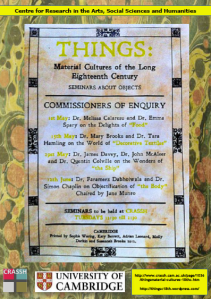 The eighteenth century was the century of ‘stuff.’ Public production, collection, display and consumption of objects grew in influence, popularity, and scale. The form, function, and use of objects, ranging from scientific and musical instruments to weaponry and furnishings were influenced by distinct features of the time. Eighteenth-century knowledge was not divided into strict disciplines, in fact practice across what we now see as academic boundaries was essential to material creation. This seminar series will use an approach based on objects to encourage us to consider the unity of ideas of the long-eighteenth century, to emphasise the lived human experience of technology and art, and the global dimension of material culture. We will re-discover the interdisciplinary thinking through which eighteenth-century material culture was conceived, gaining new perspectives on the period through its artefacts.
Each seminar features two talks considering the same type of object from
different perspectives.
1 May 2012 – Food
Dr Melissa Calaresu and Dr Emma Spary (University of Cambridge)
15 May 2012 – Decorative Textiles
Dr Mary Brooks (York Museums Trust) and Dr Tara Hamling (University of Birmingham)
29 May 2012 – The Ship
Dr James Davey, Dr John McAleer and Dr Quintin Colville (National Maritime Museum)
12 Jun 2012 – The Body
Dr Faramerz Dabhoiwala (University of Oxford) and Dr Simon Chaplin (Wellcome Library), Guest Respondent: Jane Munro (Fitzwilliam Museum)
We will be rounding off the year with a one-day colloquium on Friday, 28 September 2012, We Need to Talk about ‘Things’: Concluding Colloquium. Details can be found at http://www.crassh.cam.ac.uk/events/1980/
◊ ◊ ◊ ◊ ◊
You’re invited to visit the external blog and welcome to subscribe to the group mailing list at https://lists.cam.ac.uk/mailman/listinfo/crassh-things
Exhibition | Botanical Watercolours from the the Van Berkhey Collection
On at NCB Naturalis, as noted by Hélène Bremer:
Passion for Flowers: Drawings from the Van Berkhey Collection
NCB Naturalis, the Netherlands Centre for Biodiversity, Leiden, 29 March — 8 July 2012
 Johannes le Francq van Berkhey (1729-1812) was a man of the Enlightenment. His love for the arts, antiquities, literature and the natural sciences was reflected in his being an artist, collector, writer and lector in Natural History. He obtained a doctorate in medicine in his beloved home town of Leiden for his thesis on botanical studies. Over a period of forty years he assembled a magnificent and wide-ranging collection of natural history objects, including a remarkable collection of drawings and engravings, intended as a classified version of the entire living nature. Having a wide interest in his time, he could not keep himself out of politics. After being denounced for his political ideas, he was forced to sell his collections at auction in order to pay for his defence in court in 1785. The Spanish Royal Cabinet for Natural History realised the value of Van Berkhey’s collection and acquired it to advance the knowledge of natural history.
At Naturalis, for the first time, we present a careful selection of 41 of his botanical illustrations, meticulously preserved in Madrid’s Royal Botanic Gardens. The species represented include clovers,
lilies, peonies, roses, bamboos, chrysanthemums, asters, poppies and a flowering branch of a cherry or plum tree; species that typically started being introduced into European gardens during the 18th century.
Passie voor bloemen is on view until 8 July 2012.
◊ ◊ ◊ ◊ ◊
NCB Naturalis, the Netherlands Centre for Biodiversity, was launched on 28 January 2010. The centre is the result of cooperation between Amsterdam University (Amsterdam Zoological Museum), Leiden University and Wageningen University and Research Centre (National Herbarium Nederland) and the National Natural History Museum Naturalis in Leiden. The partners’ collections will come together at NCB Naturalis into a collection totalling over 37 million objects. In terms of collection size, NCB Naturalis is one of the top five natural history museums in the world.
Call for Papers | CAA in New York 2013
The following represents a selection of panels that might be of interest for scholars of the eighteenth century, though readers are encouraged to consult the full Call for Papers. HECAA members are asked to pay special attention to the session organized by Hector Reyes ‘Art in the Age of Philosophy?’ along with an Open Session for New Scholars. -CH.
◊ ◊ ◊ ◊ ◊
101st Annual Conference of the College Art Association
New York, 13-16 February 2013
Proposals due by 4 May 2012
The 2013 Call for Participation for the 101st Annual Conference, taking place February 13–16 in New York, describes many of next year’s programs sessions. CAA and the session chairs invite your participation: please follow the instructions in the booklet to submit a proposal for a paper or presentation. This publication also includes a call for Poster Session proposals and describes the eight Open Forms sessions.
◊ ◊ ◊ ◊ ◊
Historians of Eighteenth-Century Art and Architecture
Art in the Age of Philosophy?
Hector Reyes, University of California, Los Angeles, hreyes@humnet.ucla.edu
The relationship between philosophy and art has been a rich field of research for scholars of eighteenth-century painting. Such inquiry has identified philosophical motivations for the pursuit of pleasure, especially aesthetic pleasure, and led to a new understanding of the intellectual foundations and commitments of supposedly frivolous painters, such as Fragonard, Greuze, Boucher, and Chardin. This panel seeks to broaden the inquiry in eighteenth-century philosophy and art by considering a wide range of philosophical and artistic practices. Are there neglected philosophies that might relate to artistic theory or production? How might philosophical approaches help us to rethink the status of other media or artistic production more generally in the eighteenth century? Does an emphasis on philosophical questions occlude or lead us away from important formal questions? Papers that question or interrogate the philosophical approach to art-historical research are as welcome as those that present new research or propose new approaches and methodologies.
◊ ◊ ◊ ◊ ◊
The Decorative Arts within Art Historical Discourse: Where Is the Dialogue Now and Where Is It Heading?
Christina Anderson, University of Oxford, and Catherine Futter, Nelson-Atkins Museum of Art; cm.anderson@usa.net and cfutter@nelson-atkins.org.
The decorative arts are frequently regarded as minor arts in comparison with the “beaux arts” of painting, sculpture, and architecture. Although William Morris wished to democratize art, his writings tended to exacerbate this gulf. The Wiener Werkstätte, Omega Workshops, and Bauhaus also all tried, but failed, to bridge the gap. Today, art history students often encounter the decorative arts late in their careers, if at all. Even among scholars, the decorative arts have become associated with “material culture,” a social science term. This panel will investigate the current status, and future direction, of the decorative arts within art history from a number of different approaches, including material culture, gender studies, Marxism, and semiotics. Are museums better repositories of decorative arts scholarship than universities? Is the term “decorative arts” appropriate, or is it as limiting as “applied arts,” “material culture,” “design,” and “craft?”
◊ ◊ ◊ ◊ ◊
The Watercolor: 1400–1750
Susan Anderson, Harvard Art Museums, and Odilia Bonebakker, Harvard University; susan.anderson.phd@gmail.com and bonebakk@gmail.com
Art history tends to view watercolor as a modern phenomenon. However, the medium (including gouache and distemper) enjoyed broad-ranging application in a wide spectrum of independent, finished objects produced before 1750. Neither painting nor drawing, and practiced by professionals and amateurs, watercolor resisted contemporary categorization and cohesive analysis during this period of institutionalizing art and its makers. Despite watercolor’s conspicuous presence, a thorough discussion of its theory, practice, and collecting habits from 1400–1750 has been wanting. We seek to re-inscribe watercolor as a significant category in the history of early modern art. Rather than view early watercolors as inevitably leading to the grand British tradition as codified by the Royal Watercolor Society, this session first and foremost aims to place these earlier objects within their own historical, geographical, and cultural moments. Papers from a range of topics and methodological approaches are welcome.
◊ ◊ ◊ ◊ ◊
Open Session: French Art, 1715–1789
Colin B. Bailey, The Frick Collection, New York, Bailey@frick.org
Papers that shed new light on individual painters, draftsmen, printmakers, sculptors, practitioners of the decorative arts, and architects in the period between the Regency and the end of Louis XVI’s reign are encouraged. It is hoped that the presentations will also illuminate the range of approaches and methodologies that have revitalized the study of eighteenth-century French art in the past two decades.
◊ ◊ ◊ ◊ ◊
Tapestry and Reproduction
Barbara Caen, Universität Zürich, and K.L.H. Wells, University of Southern California; barbaracaen@gmail.com and katharlw@usc.edu
The session will examine how the tapestry has developed as a reproductive art from the sixteenth century, when Raphael’s famous Acts of the Apostles tapestries were widely copied throughout Europe, to the present day, when digital imaging facilitates the creation of almost photorealist tapestries by contemporary artists. Focusing on tapestry suggests not only that the issue of reproduction was relevant long before the onset of photography, but also that the workshop traditions of the early modern period continue to shape artistic production today. This session asks how tapestry’s status as a collaboratively crafted reproduction of a prior design, cartoon, or model has influenced its production and reception. Papers could address the working relationship between designers and weavers, the role of the market, or perceived differences between manual and mechanical reproduction. We invite papers by scholars working in a range of historical time periods and methodologies, as well as by artists who have participated in tapestry production.
◊ ◊ ◊ ◊ ◊
Historians of British Art
Parallel Lines Converging: Art, Design, and Fashion Histories
Julie Codell, Arizona State University; Julie.codell@asu.edu
Historians of art, design, and fashion, long separated into discrete disciplines, have begun shared investigations of British culture, often focused on material objects from which radiate a range of topics: domesticity, collecting, museums, gender, consumption, empire, objects’ social and economic trajectories, and social identities constructed through things, among others. Yet, scholars may retain different disciplinary methodologies through which they examine social, historical and cultural meanings of art, objects, dress, furnishings, and spaces. Papers on British visual culture from all historical periods and media are welcome and should address aspects of this convergence, such as (but not limited to) its history in the Arts and Crafts movement or the Gesamtkunstwerk; its appearance as a consequence of commercial or academic changes; its effects on rethinking periodicity and styles; similar objects studied through different methods; design or fashion in paintings; advertising and art history; film costume and mise-en-scene; art and design histories converging in studies of empire.
◊ ◊ ◊ ◊ ◊
Imagining Creative Teaching Strategies in Art History
Marit Dewhurst and Lise Kjaer, City College, City University of New York; mdewhurst@ccny.cuny.edu and lkjaer@ccny.cuny.edu
Exciting discoveries and challenging new scholarship in the field of art history are commonly taught in a pitch-dark classroom, in a classical lecture style. This session calls for papers that will address, rethink, and critique alternative pedagogical strategies in teaching art history on both graduate and undergraduate levels. Papers may address a variety of teaching theories that actively engage students, such as cooperative learning, critical pedagogy, experiential learning, and inquiry-based learning. Papers may consider methods that empower students in an active and self-motivated investigation of art history. Finally, creative teaching strategies that explore critical research and writing assignments are also welcome.
◊ ◊ ◊ ◊ ◊
The Darwin Effect: Evolutionary Theory, Art, and Aesthetic Thought
Michael Dorsch, The Cooper Union for the Advancement of Science and Art, and Jean M. Evans, The Oriental Institute of the University of Chicago; michaelscottdorsch@gmail.com and jmevans@uchicago.edu
Charles Darwin’s theory of evolution bore a decisive influence on aesthetic thought that was nothing if not diverse. Its impact has cropped up in a variety of places, ranging from the dating of geometric ornament of so-called primitive cultures to Emmanuel Frémiet’s sculptures of entanglements between simians and prehistoric humans and ultimately to the work of contemporary artists. Using the wealth of new scholarship that resulted from the 200th anniversary of Darwin’s birth and the 150th anniversary of the publication of The Origin of the Species as a springboard, this session will examine the impact of evolutionary theory. To that end, we seek papers that examine the role of Darwinian theory in the construction of trans-cultural, trans-historical discourses on artistic practice, aesthetic theory, and the historiography of art history.
◊ ◊ ◊ ◊ ◊
Putting Design in Boxes: The Problem of Taxonomy
Craig Eliason, University of St. Thomas; cdeliason@stthomas.edu
When design historians label a chair as “Louis XV” style or a typeface as a “humanist sans-serif,” they are imposing classification schemes upon these design artifacts. This taxonomic approach, which has shaped much of design history, itself deserves attention. This panel welcomes papers that address the problem of taxonomy in the historiography of design, whether through case studies or theoretical reflections. Papers might consider the entrenchment of classification systems in the practice of design studies (e.g., in textbooks and syllabi); might address the roles of industry in both demanding and supplying classification schemes; or might probe the points at which taxonomic systems fail. Looking ahead, papers might also propose new strategies for effective classification (perhaps employing bottom-up semantic tagging in place of top-down fixed categorical schemes). The panel will consider how the intentional examination of the problem of taxonomy can generate insights both about design and about the scholarship thereof.
◊ ◊ ◊ ◊ ◊
Material and Narrative Histories: Rethinking Studies of Inventories and Catalogues
Francesco Freddolini and Anne Helmreich, The Getty Research Institute; AHelmreich@getty.edu
This session aims to identify innovative scholarly approaches to inventories and catalogues by exploring these texts as narratives and material objects. Rethinking the role of these texts is particularly pertinent now when digital humanities have fuelled a quest for “empirical data.” Our questions include: What is the role of authorship and who constitutes the author(s) and additional protagonists? How were these texts developed as multivalent strategies? How is meaning produced at the linguistic, semantic, rhetorical, visual, and material levels? Are there sufficient commonalities to regard these texts as genres? How is the reader understood at the original point of production and in subsequent reception histories? How do such temporal shifts impact on our approach? Papers may investigate case studies but should nonetheless explore the larger theoretical and methodological significance of the materials. We are particularly interested in lesser-known inventories and catalogues posing unusual problems as well as exploring a diverse breadth of chronological and geographic material.
◊ ◊ ◊ ◊ ◊
Building for the “Common Good”: Public Works, Civic Architecture, and Their Representation in Bourbon Latin America
Luis J. Gordo-Peláez, University of Texas at Austin, and Paul B. Niell, University of North Texas; pelaezluis@mail.utexas.edu and paul.niell@unt.edu
In 1700, a new king, Philip V, and a new royal dynasty, the French Bourbons, ascended the Spanish throne and introduced ambitious governmental, military, and fiscal reforms in the overseas colonies. For the next century, the cities of colonial Latin America experienced a considerable transformation in their urban landscapes. Viceroys, Corregidores, Intendentes, and Cabildos promoted drastic improvements of public works, buildings, and repairs of city halls, jails, bridges, fountains, paved roads, granaries, slaughterhouses, and parks. This panel seeks to examine civic architecture, public infrastructures, and their representation, built for the “common good,” during the eighteenth and early nineteenth centuries in Latin America. It also explores the relationship between such public improvements and late colonial identities. The panel thus invites papers dealing not only with architectural history, but also with the history of the image and other forms of material culture.
◊ ◊ ◊ ◊ ◊
CAA International Committee
Crossing Continents: Expatriate Experiences and the History of Art History
Geraldine A. Johnson, University of Oxford; geraldine.johnson@hoa.ox.ac.uk
The history of art history has often been a history of expatriate experiences. Already in the sixteenth century, Van Mander not only read Vasari, but traveled to Italy. The influence of time spent abroad continues to shape the discipline as seen in the peripatetic careers of Okwui Enwezor or T. J. Clark. In intervening centuries, Italy in particular attracted Winkelmann, Burckhardt, Ruskin, Berenson, and many others. From the later nineteenth century, art historians began traveling farther afield, as seen in Warburg’s 1895–96 trip to New Mexico or Sirén’s 1918 visit to Asia. Later, Panofsky, Gombrich, and others fled National Socialism in Europe, with their subsequent writings inevitably affected by their expatriate status. This session explores how such experiences have shaped art history, both what has been studied (or ignored) and how. Proposals on individual scholars, particular approaches or travel to specific countries/regions from Early Modern times to the present are welcome.
◊ ◊ ◊ ◊ ◊
Harems Imagined and Real
Heather Madar, Humboldt State University, Art Department,
1 Harpst St., Arcata, CA, 95521; Heather.Madar@humboldt.edu
The eroticized odalisque is a familiar cliché of Orientalist art. The harem of the Ottoman sultans in particular was much mythologized by Western Europeans, creating a lurid popular image rife with misconceptions. The harem became a key trope of Orientalist thought, encapsulating European perceptions of the decadent, despotic yet desirable East. Images of the harem produced by nineteenth-century Orientalist artists are well known. Yet harem imagery both predates and postdates the time frame of canonical Orientalist art; it was produced by both internal and external observers and, in some cases, by and for women. This panel seeks to critique harem imagery and harem discourse, and to reconsider the sociopolitical freight of harem imagery and the symbolic significance born by depictions of women’s bodies and spaces gendered as female. Papers that examine lesser-known works, including imagery from outside the nineteenth century, depictions of less commonly represented harems, and images by women artists or indigenous representations, are particularly invited.
◊ ◊ ◊ ◊ ◊
Artists, Architects, Libraries, and Books, 1400–1800
Sarah McPhee, Emory University, and Heather Hyde Minor, University of Illinois, Urbana-Champaign; bookscaa2013@gmail.com
Bernini possessed a manuscript of Galileo’s Mecchaniche and Marino’s poetry. Inigo Jones owned books by Plato and Plutarch. Jacques Lemercier collected 3,000 books, including the Koran; Velazquez had books on navigation and the planets. How are historians to understand the content of these libraries? What kinds of libraries did architects/artists assemble and how did they use them? How did their reading affect their art? Traditional approaches to these questions have followed a bibliographic method, equating the contents of books with the owner’s mind and considering individual volumes as sources in the creation of buildings or works of art. But this approach oversimplifies the historical reality of books and the ways people read them. Recently, the basic constituents of study—author, book, reader—have been revised; with this session we hope to gauge the current state of research. We seek papers that consider artists and architects as authors, readers, publishers, borrowers, and collectors of books.
◊ ◊ ◊ ◊ ◊
Interpreting Animals and Animality
Susan Merriam, Bard College; merriam@bard.edu
This session will focus on the representation of animals or animality in Western visual culture from about 1500 to the present. Since the publication of Peter Singer’s Animal Liberation in 1975, animal studies has emerged as an important topic in the humanities. Historical studies, philosophy, and literature have increasingly devoted attention to the study of animals. Yet, arguably, animals are more important in the visual arts than in any field excepting anthropology or the environmental and biological sciences. The extent to which we believe things to be true about animals (that, for example, they think and feel in certain ways) has been informed by images; these beliefs, in turn, have important environmental and ethical consequences. Papers might examine anthropomorphism, or analyze how images of animals shape attitudes about human relationships and cultural practices. Aesthetics is another topic that might be addressed: What type of artistic techniques or compositional forms are used to convey information about animals? The concept of animality itself might also be considered.
◊ ◊ ◊ ◊ ◊
The Art of the Gift: Theorizing Objects in Early Modern Cross-Cultural Exchange
Nancy Um, Binghamton University, and Leah Clark, Saint Michael’s College; nancyum@binghamton.edu and leah.clark@mail.mcgill.ca
This panel focuses on the visual culture of gifts during the dynamic early modern era, when objects of exchange played an important role in burgeoning cross-cultural encounters, long-distance economic interactions, and diplomatic engagements. Its aim is to examine the unique contributions that art history may offer to the critical legacy of the gift, with its anthropological and sociological roots, such as a concern for the visuality of objects in motion, an interest in collecting and display, and an awareness of how objects of exchange may give rise to new social and artistic practices. The panel organizers encourage theoretically engaged papers that represent the broad geographic scope of the gift encounter, locate gifts in dynamic cross-cultural matrices of circulation and consumption, stake out territory within or in response to exchange theory, and/or consider the shifting and unstable meanings of objects as they changed hands across time and space.










 Enfilade
leave a comment