Call for Papers | European Networks in the Baroque Era
As pointed out by Hélène Bremer, from H-Soz-u-Kult:
European Networks in the Baroque Era
Vienna, 26-29 September 2012
Proposals due by 30 April 2012
The first general conference of the ENBaCH Project is intended to bring together research on Baroque forms of exchange and networking, as a basis for a modern network of researchers working on themes related to the cultural heritage of Europe in the seventeenth and eighteenth centuries. The European Network for Baroque Cultural Heritage (ENBaCH, www.enbach.eu) — is a research project supported and funded by the European Commission.
“Baroque” of course has various connotations depending on regions and cultural contexts but also on various approaches in different research fields. As ENBaCH is defined as an interdisciplinary project it is intended to confront these aspects and discuss their impact on what might be defined as “European Cultural Heritage.”
A well-known historiograpical conundrum is the question of periodization. One useful, practicable approach is the collection of characteristics of an epoch from the cultural point of view: works of art, intellectual activities and developments, societal structures and contemporary ways of coping with diverse challenges in a specific society. Baroque culture was influenced by war, famine and epidemic diseases, and the resulting urgency of finding collaborative solutions for survival. New environments and infrastructures, increased mobility of craftsmen, artists and workers as well as the trade of artefacts and goods, and a vivid exchange of knowledge mark the period as much as its art, which represents a reaction to these threats to life in various ways.
We welcome papers on the following aspects of Baroque culture and exchange in particular:
• formal and informal networks of politics (e.g. the role of courts, diplomacy, agents) in the seventeenth and eighteenth centuries
• the Baroque circulation of ideas and knowledge (e.g. the Republic of Letters)
• the development of arts and cultural practices (“artists and artefacts on the move,” baroque festivals and piety, fashion, cooking, etc.)
• (with particular relevance to the venue of the conference): the Baroque perception of the human body in various works of art, death and dying in relation to confessional frameworks, coping with disease and disaster from a medical point of view (e.g. health care provisions, facing famine and epidemic disease) and collaboration in medicine and health care
Conference language: English. The papers should be given in English and should take max. 20 minutes. Discussions and commentaries by attending delegates may include also other languages. Abstracts of one page max., in English, accompanied by a very short CV, should be sent to baroquebodies@meduniwien.ac.at by the end of April 2012. We will be able to cover moderate travelling costs and accommodation for invited speakers other than those involved in the ENBaCH project. Please enquire for details.
Rooms are reserved at two hotels at a convenient location; speakers and conference delegates will benefit from a reduced room rate. Rooms are limited and available on first come, first served basis only. For any further questions about the conference practicalities please contact Paul Zogmann (paul.zogmann@meduniwien.ac.at).
Exhibition | The Art of German Stoneware
From the Philadelphia Museum of Art:
The Art of German Stoneware
Philadelphia Museum of Art, 5 May — 5 August 2012
Curated by Jack Hinton

Inkstand and Candleholder with Musicians, Animals, and a Griffin, ca. 1740. German Salt-glazed stoneware with painted decoration, roughly 20 x 10 x 7 in. (Philadelphia Museum of Art)
From the fourteenth through eighteenth centuries, stoneware ceramics from Germanspeaking centers in modern-day Germany and the Low Countries were valued and widely traded throughout northern Europe. In the 1600s—the heyday of stoneware production—they found an enthusiastic market in colonial North America. The medium’s success is due to its stonelike durability and imperviousness to liquid, making it perfect for cooking, storage, and drinking vessels. The social aspect of stoneware ceramics explains the crisp relief decoration on sixteenth- and seventeenth-century pieces, which feature moralizing images or political figures and their coats of arms; later pieces often eschew such ornament for floral or geometric patterns inspired by Far Eastern porcelains imported to Europe. Inkstand and Candleholder with Musicians, Animals, and a Griffindemonstrates the inventiveness and artistry of stoneware potters, even when faced with a dwindling market for their works in the homes of the well-to-do. This exhibition examines German stoneware from its origins to later revivals in the nineteenth-century and celebrates its long-standing relationship with the city of Philadelphia. It features selections from the Museum, seventeenth-century Dutch pictures demonstrating the high status of stoneware, and a generous promised gift of around forty pieces of German
stoneware from Dr. Charles W. Nichols. The exhibition is accompanied by an
illustrated publication by Jack Hinton, Assistant Curator of European Decorative
Arts and Sculpture.
◊ ◊ ◊ ◊ ◊
From Yale UP:
Jack Hinton, The Art of German Stoneware, 1300-1900 From the Charles W. Nichols Collection and the Philadelphia Museum of Art (New Haven: Yale University Press, 2012), 60 pages, ISBN: 9780300179781, $20.
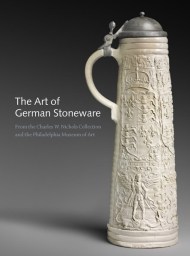 Beautiful and eminently useful, stonewares produced in the German-speaking lands from the Middle Ages onward were highly valued for their durability and suitability for a range of domestic and social uses. Widely traded throughout Europe, they were also among the first European ceramics to reach colonial North America. During the Renaissance the addition of brilliant salt glazes—s well as relief imagery that communicated with the user—raised the status of these wares. Later examples introduced abstract floral or geometric decorations and more unusual, original forms, which retained broad cultural significance.
About ninety fine stoneware pieces from the Philadelphia Museum of Art and a promised private collection testify here to the success, artful decoration, and fascinating variety of this medium. Jack Hinton describes the developments in stoneware through these notable examples, and beautiful color images bring
their details vividly to life.
Puzzle Jugs for Fools
I have long thought that museum gift shops would make a mint with good quality reproductions of these vessels, or perhaps even better, commissions for updated versions from local ceramicists. I first encountered the type as a graduate student, at The Smart Museum of Art in Chicago, and have been childishly enamored ever since. The following comes from Kathryn Kane’s posting at The Regency Redingote (3 July 2009). Happy Fool’s Day! -CH
◊ ◊ ◊ ◊ ◊
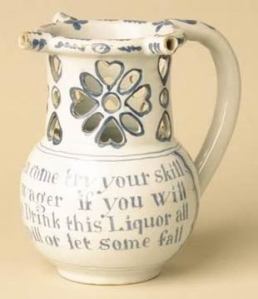
Puzzle Jug, tin-glazed earthenware, Liverpool, ca. 1750 (Liverpool: Walker Art Gallery)
Inscribed: "Here Gentlemen come try your skill, I'll hold a wager if you will, That you don't drink this liquor all, Without you spill and let some fall." For more information, click on the photo.
A diverting drinking vessel which could be found in village inns and public houses for centuries had a resurgence in popularity in the late eighteenth and early nineteenth centuries. These vessels had been made throughout England and northern Europe since at least the fifteenth century. Most commonly called puzzle jugs, they were also sometimes called teasing pitchers or wager jugs. It was a challenge to determine how to drink the liquor which they contained and wagers were often placed on the outcome of the attempt.
By the time of the Regency, puzzle jugs were being made not only for use in inns and taverns, but also for home use. Many gentlemen enjoyed entertaining their male visitors with drinking games using their own puzzle jugs.
Puzzle jugs are a puzzle because it is not obvious how to imbibe the beverage which they contain. The neck of the jug is perforated, often in ornamental patterns, so one cannot simply raise it to one’s lips and drink. Most puzzle jugs also have a hollow rim which can have between three to seven spouts which protrude from it. This hollow rim is connected to either a hollow handle, which opens into the lower part of the jug body, or the inside of the jug has a tube or pipe built into the jug wall. It is through this concealed piping that the liquid contents of the jug flow to the hollow rim. The secret of the puzzle jug is to know which of the spouts on the rim to plug with the fingers, while sucking the liquor out of the jug via the remaining spout. Some puzzle jugs have a small additional opening somewhere below the neck or beneath the handle which will spill the liquid on the hapless drinker if the jug is not held just so. . .
The full posting (including a brief reading list) is available at The Regency Redingote.
Exhibition | Nicholas Hawksmoor: Architect of the Imagination
From the Royal Academy of Arts:
Nicholas Hawksmoor: Architect of the Imagination
Royal Academy of Arts, London, 4 February — 17 June 2012

Nicholas Hawksmoor, Drawing for a detached chapel, Greenwich Hospital, 1711
© The Samuel Courtauld Trust, The Courtauld Gallery, London
◊ ◊ ◊ ◊ ◊
350 years after his birth, the architecture of Nicholas Hawksmoor (1662–1736) continues to inspire and provoke the imagination. This exhibition brings Hawksmoor’s legacy to life by juxtaposing a range of images with quotes from architects, writers and critics, all relating to or inspired by Hawksmoor and his work. Represented are a diverse a range of figures including Sir John Soane RA, Charles Dickens, Peter Ackroyd, John Piper, Alan Moore and Leon Kossoff, along with film interviews with architect Ptolemy Dean, novelist Philip Pullman and poet Iain Sinclair, to dramatically bring to light the imaginative legacy of this most original architect.
March 2012 Issue of ‘The Art Bulletin’
Offerings bearing on the eighteenth century from the March 2012 issue:
 • Anne M. Wagner, “Regarding Art and Art History,” The Art Bulletin 94 (March 2012): 8-9.
• Elizabeth King, J. M. Bernstein, Carolyn Dean, Caroline Van Eck, Finbarr Barry Flood, Dario Gamboni, Jane Garnett and Gervase Rosser, James Meyer, Miya Elise Mizuta, and Alina Payne, “Notes from the Field: Anthropomorphism,” The Art Bulletin 94 (March 2012): 10-31.
• Andrei Pop, “Henry Fuseli: Greek Tragedy and Cultural Pluralism,” The Art Bulletin 94 (March 2012): 78-98.
Abstract: The wash drawings and oil paintings of subjects from Greek tragedy by Anglo-Swiss painter Henry Fuseli (1741–1825), routinely categorized as romantic classicism, might be better explained in terms of the contemporary revival of Greek tragedy, made possible by the philosophical anthropology of Johann Gottfried von Herder and David Garrick’s theater of character. From this climate of experimentation with foreign cultures arose a morally detached spectator and a critique of Eurocentrism in the era of Captain Cook and the American Revolution. Fuseli’s classicism thus played its part in the formation of the modern liberal version of cultural pluralism.
Lecture | Chrisman-Campbell, When Fashion Set Sail
From the BGC:
 Kimberly Chrisman-Campbell | When Fashion Set Sail:
Maritime Modes in Pre-Revolutionary France
Bard Graduate Center, New York, 3 April 2012
Kimberly Chrisman-Campbell will deliver a Françoise and Georges Selz Lecture on 18th- and 19th-Century French Decorative Arts and Culture on Tuesday, April 3, 2012. Her talk is entitled When Fashion Set Sail: Maritime Modes in Pre-Revolutionary France. Dr. Chrisman-Campbell is an independent scholar and a consultant for The Huntington Library, Art Collections, and Botanical Gardens. She received her B.A. from Stanford University, her M.A. from the Courtauld Institute of Art, and her Ph.D. from the University of Aberdeen. Chrisman-Campbell has published numerous journal and magazine articles on 18th– and early 19th-century French fashion. She has also contributed to several books and museum catalogues, including Fashioning Fashion: European Dress in Detail, 1700-1915 (Los Angeles: Prestel and Los Angeles County Museum of Art, 2010); Paris: Life & Luxury in the Eighteenth Century (Los Angeles: Getty Publishing, 2011); The Saint-Aubin ‘Livre de Caricature’ (Oxford: Studies in Voltaire and the Eighteenth Century, forthcoming); and Seeing Satire (Oxford: Studies in Voltaire and the Eighteenth Century, forthcoming).
One of the most iconic and enduring images of 18th-century extravagance is a French fashion plate depicting a woman wearing a miniature ship in her powdered and pomaded hair. This hairstyle—the coiffure à la Belle Poule—was not just an eye-catching novelty. It was one of many ship-shaped headdresses that celebrated specific French naval victories and, more importantly, advertised their wearers’ patriotism and political acumen. In addition to hairstyles, French women of the era wore hats à la maritime and garments adorned with nautical motifs, and the looms of Lyon produced textiles woven with scenes from naval battles. Sailing ships were also rendered in Sèvres porcelain, depicted on snuffboxes, and included in portraits of ladies of fashion. The vogue for nautical fashions and textiles during the reign of Louis XVI was a powerful testimony to the practical and symbolic role the sea played in the everyday lives of women at the most elite levels of French society, whether as a battlefield or a frontier. It also reflected the increasingly tempestuous nature of fashion itself in the pre-Revolutionary period.
Light refreshments will be served at 5:45 pm. The presentation will begin at 6:00 pm.
RSVP is required. Please click on the registration link at the bottom of this page or contact academicevents@bgc.bard.edu.
Please note that our Lecture Hall can only accommodate a limited number of people, so please come early if you would like to have a seat in the main room. We also have overflow seating available; all registrants who arrive late will be seated in the overflow area.
Coming in May | ‘The London Square: Gardens in the Midst of Town’
From Yale UP:
Todd Longstaffe-Gowan, The London Square: Gardens in the Midst of Town (London: The Paul Mellon Centre for Studies in British Art, 2012), 348 pages, ISBN: 9780300152012, $65.
 Modern-day London abounds with a multitude of gardens, enclosed by railings and surrounded by houses, which attest to the English love of nature. These green enclaves, known as squares, are among the most distinctive and admired features of the metropolis and are England’s greatest contribution to the development of European town planning and urban form. Traditionally, inhabitants who overlooked these gated communal gardens paid for their maintenance and had special access to them. As such, they have long been synonymous with privilege, elegance, and prosperous metropolitan living. They epitomize the classical notion of rus in urbe, the integration of nature within the urban plan—a concept that continues to shape cities to this day.
Todd Longstaffe-Gowan delves into the history, evolution, and social implications of squares, which have been an important element in the planning and expansion of London since the early 17th century. As an amenity that fosters health and well-being and a connection to the natural world, the square has played a crucial role in the development of the English capital.
Todd Longstaffe-Gowan is a landscape architect with an international practice based in London. He is gardens adviser to Hampton Court Palace and is currently redesigning the gardens of Kensington Palace in London.
Call for Papers | 2012 NEASECS Conference
The 2012 NEASECS Annual Conference
Wesleyan University, Middletown, Connecticut, 11-14 October 2012
Proposals due by 30 April 2012

I would kindly call your attention to the Call for Papers for the 2012 NEASECS conference to be held at Wesleyan University in October. At the conference website, you will find descriptions of several panels that might be of interest, including my session on “Dislocated Sociability,” and several others chaired by HECAA members. It would be lovely to have a strong art historical contingent at the conference, so I hope that you will consider submitting a proposal.
With thanks, and all best wishes,
Laura Auricchio
Getty Research Journal 4 (2012)
The eighteenth century in the latest Getty Research Journal:
◊ ◊ ◊ ◊ ◊
Articles
• Adriano Amendola, “Frames for Drawings in Roman Collections: A Case Study,” Getty Research Journal 4 (2012): 45–56.
 Using salient examples and on the basis of a comparative analysis of archival data from the Provenance Index® databases of the Getty Research Institute, this paper identifies the typologies of frames used to display drawings in Roman collections of the 17th and 18th centuries. The phenomenon of exhibiting framed drawings, which has not been fully studied up to now, began during the early 1600s when refined collectors began to display the drawings in their collections on the walls of their residences instead of keeping them in albums or drawers. The chromatic quality of the drawings was enhanced by the frames, which were gilded, black, wood-colored, or white, and usually quite simple in design, as in the Salvator Rosa type. In such frames, drawings could hold their own with paintings as part of an arrangement of works on a wall. With the dissemination of academic drawings of nudes, instituted by the most important Roman families during the course of the 17th century, framed drawings began to occupy an important position in collections, soon becoming the focal point of entire rooms devoted to a particular theme.
• Alden R. Gordon, “A Rare Engraving of an Italian Rococo Parade Apartment of 1736: Andrea Bolzoni’s Print of the Interior of the Palazzo Cervelli in Ferrara,” Getty Research Journal 4 (2012): 57–74.
 Engraved images of real secular interiors are rare before 1790. Even more rare are illustrations of nonroyal houses in which the domestic and parade apartments are depicted fully furnished, with portable objects that were actually in use. An illustration by Andrea Bolzoni (1689–1760) accompanying the publication in 1736 of a poem by Jacopo Agnelli (1701 or 1702–99) celebrating a grand festival given by Fortunato Cervelli (1683–1755), the Holy Roman imperial consul in Ferrara, on the occasion of the marriage of Maria Theresa of Austria (1717–80), female heiress to the Habsburg dynasty, provides an exceptional record of Cervelli’s nonroyal suite of parade apartments decorated in a unique “chinoiserie” variant of the Rococo style. The actual decorative interiors represented were prompted by a special set of political and commercial circumstances designed to project the Habsburg interests abroad in the Papal States.
Web extra: Appendix (PDF, 14pp., 11.7 MB)—a transcription of and room-by-room commentary on the engraving
• Vimalin Rujivacharakul, “How to Map Ruins: Yuanming Yuan Archives and Chinese Architectural History,” Getty Research Journal 4 (2012): 91–108.
 In 1860, the 18th-century European-style pavilions, along with the rest of the Yuanming Yuan imperial palace in Beijing, China, were burned down during an invasion of the palace by Anglo-French troops. Thereafter, with further looting and physical aggression, the former Qing dynasty architectural marvel continually deteriorated into complete ruin. By the turn of the 20th century, the only remaining visual reference of its original state was a set of 20 engravings that showed selected building facades. No plans, sections, or other architectural data were available. The situation changed dramatically in the 1930s. Within a few years, researchers of different backgrounds—Chinese, American, and French—began publishing their research on the European-style pavilions and displaying materials that had never appeared before the public. This article examines the sudden emergence of those visual archives and reveals some of their interestingly intertwined stories. Furthermore, by discussing ways in which the new archives contributed to a rereading of the old ruins, it also explores a long-standing paradox in architectural history: How, in reality, did historians connect what they saw on paper to the buildings that no longer existed?
Acquisitions & Discoveries
• Stephanie Schrader, Nancy Turner, and Nancy Yocco, “Naturalism under the Microscope: A Technical Study of Maria Sibylla Merian’s Metamorphosis of the Insects of Surinam,” Getty Research Journal 4 (2012): 161–72.
Call for Papers | Satire Across Borders
Satire Across Borders
Utrecht University, 17-18 January 2013
Proposals due by 1 June 2012
Satire has the ability to contest cultural boundaries in several ways. By addressing political topics or touching upon sensitive issues within a society (e.g. religious and sexual taboos), satirical works intervene in on going cultural debates. This is but one of the reasons why these works can be considered as interculturally charged. By mixing multiple media within one work, or by creatively transposing styles and techniques from one medium to another, satire shows that it can also contest medial boundaries, i.e. that it can be considered as intermedially charged as well. These two conditions, interculturality and intermediality, have framed the functioning of satire in the past and continue to do so in the present. They turn satire into a rather ambiguous phenomenon, for both its producers and its consumers. This assumed ambiguity of satire forms the point of departure of the international conference Satire Across Borders.
Satire’s ability to cross borders will be addressed from five different perspectives:
1) Time
In a historical perspective, satire seems to manifest itself at very specific occasions, for example during officially sanctioned festive activities (carnival, harvest rituals) or in moments of political crisis (during revolts, civil wars, religious upheavals etc.). How do these temporal conditions influence and define the functioning of satire? Is satire bound by such conditions, or does it also contest them?
2) Space
Although western society today seems to be rather tolerant towards satire, controversies still occur every now and then and censorship is sometimes called for. This suggests that the freedom of satirical expression is limited to certain zones, like the ritual context of carnival or the performative space of the television screen or, more generally, the (ideal) public space as one which establishes reciprocal understanding between its participants. What happens if satire crosses the borders of these zones? And can the establishment of these zones also lead to the inclusion or exclusion of certain audiences?
3) Target
One characteristic of satire is that it is always aimed at someone or something, i.e. that it has one or several targets. These can vary from royal figures and political/religious authorities to social taboos, cultural practices and moral values. Are there any general patterns to be discerned in the qualities of these targets themselves, and in the manner in which they are approached by satire? Does satire always contest its targets, or can it also legitimize them in one way or another?
4) Media
Satire is not bound to one medium or genre. On the contrary, it often combines multiple media or refers to the conventions of several styles or genres at the same time. How does this intermediality influence satire’s functioning in society? Does it limit or instead extend the potential audiences of satire? And what role do the material forms (manuscript, printing press, television, internet) of specific satirical works play in all this?
5) Rhetoric
Certain techniques, tactics and rhetorical figures recur time and again in satire, such as humour, irony, parody, burlesque and caricature. Such rhetorical techniques seem to play a pivotal role in the production and reception of satire. Historically speaking, to what extent can the use of them be called cyclical? And in what way do they contribute to satire’s ability to contest cultural boundaries?
The conference language will be English. (more…)










 Enfilade
leave a comment