Exhibition | Landscape, Heroes, and Folktales: German Romanticism
My apologies, this exhibition almost slipped by me completely. Thanks, however, to a brief extension, these prints and drawings (all from the private collection of Charles Booth-Clibbor) are up for another week. -CH
Landscape, Heroes, and Folktales: German Romantic Prints and Drawings
British Museum, London, 23 September 2011 — 9 April 2012
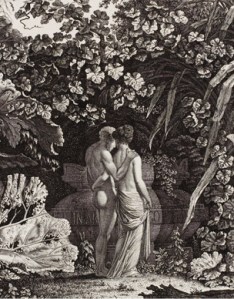
Carl Wilhelm Kolbe, "I too was in Arcadia" (detail). Etching, 1801. Private collection.
German Romanticism was a philosophical and artistic movement in the late 18th and 19th centuries which was highly influential across the whole of Europe. Key figures included composers Beethoven, Schubert and Brahms, philosophers Hegel and Schlegel, and literary giants Goethe and Schiller. Artists in 19th-century Germany were seeking a cohesive national identity that had not existed before – through works often inspired by the German landscape, mythology and Germany’s ancient past.
The prints and drawings on display capture beautiful, poetic scenes, exploring landscapes and wildlife to heroes and folktales. Romantic artists took inspiration from earlier artists, including Albrecht Dürer and Raphael. The works show high standards of draughtsmanship, depict an amazing variety of subject matter and use a range of sophisticated print techniques, including the recently invented technique of lithography. Artists featured in the exhibition include Caspar David Friedrich, Philipp Otto Runge, Wilhelm Tischbein, Carl Wilhelm Kolbe, Julius Schnorr von
Carolsfeld, Friedrich Overbeck, Peter Cornelius, Karl-Friedrich Schinkel
and Johann Christian Reinhart.
Colloquium | Herder and the Arts
As noted at Le Blog d’ApAhAu:
Herder und die Künste: Ästhetik, Kunsttheorie, Kunstgeschichte
Herder et les arts: esthétique, théorie et histoire
Centre Marc Bloch, Berlin, 19-20 April 2012
 Dans l’histoire de la pensée esthétique, les travaux de J. G. Herder (1744-1803) ont une importance centrale. Herder est en effet un lecteur assidu des théories de l’art produites par les auteurs de l’Antiquité et par les penseurs européens des XVIIe et XVIIIe siècles. Contemporain de Diderot, Lessing et Winckelmann, inspirateur du jeune Goethe, Herder réfléchit tant sur l’histoire des arts que sur les fondements et limites de l’esthétique que Baumgarten, vers 1750, avait cherché à constituer en discipline philosophique à part entière. Le présent colloque cherche à éclairer les principaux textes que Herder a consacrés à l’histoire et à la théorie des arts.
19 April 2012
14h00 – 18h00
Élisabeth Décultot (CNRS/Centre Marc Bloch, Berlin) : Introduction
Gérard Raulet (Sorbonne, Paris) : Die Kunst “an die Seele zu gehen” — Kraft und
energeia in Herders erstem Kritischen Wäldchen
Daniel Dumouchel (Université de Montréal, Canada) : Fictions de pensée : origine de l’expérience esthétique et genèse de l’art dans Plastik de Herder
Wolfgang Adam (Universität Osnabrück) : Herder und die Plastik. Theorie und Autopsie
Léa Barbisan (Centre Marc Bloch, Berlin) : Von der taktilen zur haptischen Rezeption: Der Tastsinn in den visuellen Künsten von Johann Gottfried Herder bis Walter Benjamin
20 April 2012
10h00 – 13h00
Mario Marino (Adam Mickiewicz Universität Poznan) : Kunst, Geschichte und Gesellschaft. Zur Verschränkung von Ästhetik und Geschichtsphilosophie bei Herder
Elisabeth Décultot (CNRS et Centre Marc Bloch, Berlin) : “Voll vortrefflicher Grundsätze ; aber …. ”. Herders Auseinandersetzung mit Winckelmann
Ayse Yuva (Centre Marc Bloch, Berlin) : Ecriture et histoire : le caractère anti-systématique des Sylves critiques
15h00 – 18h00
Christian Helmreich (Universität Göttingen/Université Paris 8) : Herders Lyrik. Über die Möglichkeit von Poesie im philosophischen Zeitalter der Sprache
Carlotta Santini (Centre Marc Bloch, Berlin) : L’enfance des Grecs et l’épos homérique. Poésie et chants imaginés du monde dans la pensée herderienne
Ralph Häfner (Universität Freiburg) : Herders Ästhetik im Spiegel seiner Bibliothek
◊ ◊ ◊ ◊ ◊
Lieu : Centre Marc Bloch, Friedrichstrasse 191, 10117 Berlin (métro : Stadtmitte), 3e étage, Georg-Simmel-Saal
Le colloque est organisé avec le soutien du programme « Aisthesis » de l’ANR et de la DFG
Coordination : Elisabeth Décultot (CNRS, Centre Marc Bloch, Berlin) et Gerhard Lauer (Universität Göttingen)
Exhibition | Workshop Drawings of Silversmith Robert-Joseph Auguste
Thanks to Hélène Bremer for noting this exhibition. The following description comes from the Nissim de Camondo (an English summary from Art Media Agency is available here). . .
Dessins d’orfèvrerie de l’atelier Robert-Joseph Auguste (1723-1805)
Musée Nissim de Camondo, Paris, 16 November 2011 — 1 April 2012
Curated by Yves Carlier

Salt cellar design, workshop of Robert-Joseph August
Inv 24 722B (Paris: Les Arts Décoratifs)
◊ ◊ ◊ ◊ ◊
Reçu maître à Paris en 1757, Robert-Joseph Auguste porte à partir de 1777 le titre d’orfèvre ordinaire du roi et devient le principal fournisseur de la Couronne jusqu’à la Révolution. Rien ne nous étant parvenu de ces fournitures, son œuvre est mieux connu par les pièces d’orfèvrerie et les services entiers qu’il réalisa pour les cours de Lisbonne, Londres, Copenhague, Saint-Pétersbourg et Stockholm.
Sélectionnés pour leur rapport avec des pièces connues de Robert-Joseph Auguste, les douze dessins présentés ont été donnés en 1925 au musée des arts décoratifs par le baron Robert de Rothschild (1880-1946) avec dix-huit autres provenant de l’atelier de l’orfèvre et faisant partie de la même vente (Paris, Hôtel Drouot, 4 avril 1925).
De techniques variées (mine de plomb, plume, sanguine, lavis), ces œuvres rares rendent compte des différentes manières de Robert-Joseph Auguste et de la variété de sa production pour les grands services d’orfèvrerie qui lui sont commandés par Christian VII du Danemark, Catherine II de Russie ou Georges III d’Angleterre (pot à oille, saucière, salière, couverts …).
Les quatre dessins de la vente de 1925 conservés dans une collection particulière viennent compléter de manière exceptionnelle cet ensemble. Deux d’entre eux figurant un seau à bouteille et une verrière portent notamment la signature « auguste f. » d’une écriture correspondant à celle de Robert-Joseph Auguste.
En regard de cet accrochage sont exposées les prestigieuses pièces d’orfèvrerie de Robert-Joseph Auguste livrées pour les cours de Russie et du Portugal et conservées dans les collections du musée des arts décoratifs.
Enfin, dans la salle à manger du musée Nissim de Camondo, les deux paires de compotiers du service dit de Moscou réalisées par Auguste pour l’impératrice Catherine II ont retrouvé leur place d’origine sur les dessertes. Dressée avec faste pour l’occasion, la table est ornée du pot à oille à la magnifique hure de sanglier exécuté par l’orfèvre pour un client portugais aux armoiries récemment identifiées.
◊ ◊ ◊ ◊ ◊
Additional information (in English) is available here (as a PDF).
Storied Reconstructed Furniture Sold at Bonhams
Bonhams, London, New Bond Street
Sale 19957 – Fine English Furniture and Works of Art, 7 March 2012
Lot No: 133*
A satinwood, mahogany, sycamore and marquetry and parcel gilt secretaire cabinet reconstructed from an important cabinet by Seddon, Son & Shackleton of 1793 reputedly for Charles IV of Spain, the panels possibly by William Hamilton R.A.
Estimate of £20,000 – 30,000; sold for £25,000 inclusive of Buyer’s Premium

Inlaid with boxwood and ebonised lines, the upper section with pierced gilt metal fret and white marble pilasters, above a bowed central drawer and door painted with a vase of flowers, flanked by a pair of lozenge panelled doors also painted with floral sprays, each with leaf carved reeded and fluted turned pilasters and each enclosing four pigeonholes and a shelf, flanked by larger bowed panelled doors, one painted with the figure of ‘Night’, the other with probably ‘Day’, surmounted by domed plinths with gilt crown finials; above five frieze drawers, the lower part with inverted breakfront and central secretaire drawer with gilt bronze moulded panelling painted with a cherub flanked by reeded pilasters, enclosing a leather lined writing surface, two short drawers and ten compartments, flanked by a short panelled bowed drawers to each side, on six leaf carved and fluted tapering legs joined by a platform stretcher, on turned feet, the central Wedgwood plaque now missing, stamped several times ‘3258’, the reverse marked, ‘MGM 5 X7760’, ‘A605-495’, ‘UAP’, 131cm wide, 49cm deep, 173cm high (51.5″ wide, 19″ deep, 68″ high).
This secretaire on stand is a remarkable survival. Not only is it made from one of the most spectacular late eighteenth century English cabinets ever produced, but it also belonged to the MGM studios in Hollywood where it was used as a film prop. Although parts of its history remain obscured, the exceptional quality of both the cabinet work and the painted decoration are clear to be seen.
The present secretaire comprises parts of the upper section of a magnificent cabinet believed to have been made by Seddon, Sons and Shackleton (active c.1790-1798), to designs by Sir William Chambers (1723-1796), with painted panels by William Hamilton RA (1751-1801). The cabinet was said to have been commissioned by King Carlos IV of Spain (1788-1808) in 1793.
The cabinet was well-known amongst Edwardian connoisseurs and was illustrated and described in early twentieth-century books on English eighteenth-century furniture. It was exhibited twice, once at the Franco British Exhibition in London in 1908, and secondly in a selling exhibition held in the Plaza Hotel in New York in 1910.
At some point during the twentieth century, the cabinet was broken up and made into separate pieces of furniture. A commode made from parts of the centre of the cabinet was sold twice at auction, first at Christie’s in London, 19th November 1987, lot 125 and secondly at Sotheby’s New York, The Collection of Mr & Mrs Saul P. Steinberg, 26 May 2000, lot 236. The fact that present secretaire was made from parts of the same cabinet was not known until it was recognised by Bonhams, London in 2011.
Oxford Art Journal March 2012
The latest issue of Oxford Art Journal is now available. For a free trial, visit: http://www.oxfordjournals.org/page/4541/2
◊ ◊ ◊ ◊ ◊
Dominic Janes, “Unnatural Appetites: Sodomitical Panic in Hogarth’s The Gate of Calais, or, O the Roast Beef of Old England (1748),” Oxford Art Journal 35 (March 2012): 19-31.

William Hogarth, "O the Roast Beef of Old England ('The Gate of Calais')," oil on canvas, 1748 (London: Tate Britain)
Abstract: Hogarth’s The Gate of Calais, also known as O the Roast Beef of Old England (1748), has been extensively studied in relation to its expression of British Protestant prejudice against the French and against Roman Catholicism. However, other aspects of the work have not received such attention. In the eighteenth-century the appetite for food was popularly employed as a metaphor for sexual desire. The painting, and the widely circulated engraving made from it, could, therefore, admit of an erotic reading, particularly bearing in mind the frequency of complex sexual references in Hogarth’s works. The carnality so satirised was not simply related to anti-Catholic parody of transubstantiation, because this composition can be interpreted as having been structured around coded expressions of same-sex desire. Hogarth’s interest in this theme can be related not only to his homosocial environment, but also to the events in Calais that inspired him. Hogarth’s experience as a prisoner aroused in him a ‘sodomitical panic’ which can be seen as the precursor of the ‘homosexual panic’ studied by Eve Kosofsky Sedgwick as an aspect of male sexual anxiety at the end of the nineteenth century. This work can be interpreted, therefore, as evidence for sexual as well as national and religious insecurity in mid-eighteenth-century Britain.
Dominic Janes is Senior Lecturer in the Department of History of Art and Screen Media, Birkbeck College, University of London. His work focuses on representations of religious belief, morality and sexuality in Britain since the eighteenth century. His most recent book is Victorian Reformation: The Fight over Idolatry in the Church of England, 1840–1860 (Oxford University Press, 2009). He is currently researching images of martyrdom and deviance during the duration of an AHRC Fellowship.
Spring 2012 Issue of ‘Eighteenth-Century Studies’
Art historical offerings from the Spring 2012 issue of Eighteenth-Century Studies:

• Ian Haywood, “Rude Britannia: New Perspectives on Caricature,” Review of Amelia Rauser, Caricature Unmasked: Irony, Authenticity, and Individualism in Eighteenth-Century English Prints (2008) and Todd Porterfield, ed., The Efflorescence of Caricature, 1759-1838 (2011), Eighteenth-Century Studies 45 (Spring 2012): 437-40.
• John Bonehill, “The Art of Empire,” Review of John Crowley, Imperial Landscapes: Britain’s Global Visual Culture (2011) and Geoff Quilley, Empire to Nation: Art, History, and the Visualization of Maritime Britain (2011), Eighteenth-Century Studies 45 (Spring 2012): 440-42.
• Michael Yonan, Review of Christiane Hertel, Pygmalion in Bavaria: The Sculptor Ignaz Günther and Eighteenth-Century Aesthetic Art Theory (2011), Eighteenth-Century Studies 45 (Spring 2012): 457-59.
• Stephanie Koscak, Review of Wendy Bellion, Citizen Spectator: Art, Illusion,
and Visual Perception in Early National America (2011), Eighteenth-Century
Studies 45 (Spring 2012): 459-61.
Exhibition | Animal Beauty in Paris
From the Grand Palais:
Beauté Animale / Animal Beauty
Grand Palais, Galeries Nationales, Paris, 21 March — 16 June 2012
Curated by Emmanuelle Héran
 Ever since the Renaissance, artists and naturalists have observed animals closely and represented them as accurately as they could. Nevertheless, naturalism ends where the norm and morality begin: various ethical and aesthetic criteria were established which influenced the artists’ point of view. There is extraordinary variety in the ways the same animal is represented. They reveal our fascination and curiosity for a world whose diversity is far from fully explored.
Through a set of major works, the exhibition looks at the relationships that artists, often great painters and sculptors, have developed with animals. It shows that there is still a close link between art and science, between our desire to know about animals and our fascination for their beauty. Paintings, drawings, sculptures, photographs, famous or unfamiliar… the exhibition brings together about 130 masterpieces of Western art from the Renaissance to the present day, and takes a radical new approach by choosing works in which the animal is shown on its own and for itself, without any human presence. This marvellous menagerie, laid out in a clear design accessible to all audiences, will mingle wild and domestic beasts, the strange and the familiar.
I. Looking at Animals
Just like human beauty, animal beauty must meet specific criteria, which vary with different periods and milieus. A revolution occurred at the Renaissance: outstanding artists such as Dürer, and then the pioneers of zoology studied animals closely and described them in minute detail. This was also when the discovery of the New World revealed new animals, such as parrots and turkeys. Repertoires were soon built up. As soon as they could study animals, painters kept a record of them in their albums, which they dipped into for motifs which had already inspired other works. They also worked on anatomical studies and tried to analyse motion, such as the movements of a galloping horse. But man was not content to represent animal beauty; he modified it, transforming the animals themselves, with all the means that science put at his disposal. New breeds of cows, dogs and cats appear in works of art. And conversely, paintings show us breeds that have gone out of fashion.
II. Aesthetic and Moral Prejudices (more…)
Reviewed | ‘Revolution! The Atlantic World Reborn’
Thomas Bender, Laurent Dubois, and Richard Rabinowitz, eds. Revolution! The Atlantic World Reborn (London: D. Giles Limited in association with the New-York Historical Society, 2011), 287 pages, ISBN: 9780916141240 (softcover), $45 / ISBN: 9781904832942 (hardcover), $65.
Reviewed for Enfilade by Jason Nguyen (Harvard University)
 In the lavishly illustrated catalogue for Revolution! The Atlantic World Reborn (on view at the New-York Historical Society through April 15, 2012), editors Thomas Bender, Laurent Dubois, and Richard Rabinowitz present a collection of eleven essays on the connections between the American, French, and Haitian Revolutions. Whereas traditional narratives have tended to treat the three events separately, the fourteen contributors to Revolution focus instead on their political, economic, and social junctures. “The point here is not to abandon or dilute national history,” Thomas Bender suggests in the catalogue’s first essay, “but rather to enrich it by revealing the ways in which historical causation operates across space as well as through time” (40).
The chain of political events linking the three revolutions is offered straightaway by Bender (and subsequently evaluated by his fellow contributors). The financial and military support that France provided to the United States in their War for Independence sent the European kingdom into a crippling debt that led to the calling of the Estates General in May of 1789. This event resulted in the establishment of the National Assembly and, consequently, the onset of the French Revolution. The rhetoric of the Revolution, and in particular the Déclaration des droits de l’Homme et du Citoyen (1789), helped to ignite abolitionist discourses and revolutionary fervor in the French colony of Saint-Domingue (present-day Haiti). And the political and military successes by the Haitians in the early years of the nineteenth century resulted in the selling of Louisiana by Napoleon to the United States in 1803, thus providing the young American nation with its first taste of continental expansion.
While each essay addresses at least one component of this transcontinental circuit of events, the scope of the catalogue is hardly limited to the political sphere. Cathy Matson, for example, reveals how the revolutions in France and Haiti nearly destabilized the commercial life among Philadelphia grain merchants in the last two decades of the eighteenth century. And in one of the catalogue’s more emotional contributions, Rebecca J. Scott and Jean M. Hébrard chronicle through a chain of legal documents and personal letters the tumultuous social and family life of Rosalie, an African-born inhabitant of Saint-Domingue who found herself the victim of sexual and racial slavery three times during the course of her life.
Rosalie’s story encapsulates two themes that course through the various essays. First is the focus on the peripheral within the predominant historical narrative, or as Richard Rabinowitz terms it, “history’s silences.” This can be noted by the prominence of the Haitian Revolution in the catalogue, with seven of the eleven contributions centering squarely on the global and local dealings of the Caribbean colony between 1791 and 1804. Of the remaining four essays, two focus on the economic and social situation in America, one addresses the broader global condition linking the revolutionary conflicts in the United States, France, and Haiti, and one presents the aims and intentions of the exhibition. The curatorial decision to cast increased light on the Haitian Revolution serves two purposes. The first concerns the marked absence within the general public consciousness of the social and political insurrections that transformed the former French colony. And the second speaks to its privileged status as the culmination (and, indeed, the ultimate test) of eighteenth-century revolutionary fervor. “As the most thoroughgoing of these upheavals,” Rabinowitz writes in the catalogue’s concluding essay, “at least in its destruction of slavery, imperial dependency, and constitutionally sanctioned inequalities — the Haitian revolution could be viewed as the climax of the entire age of Atlantic revolutions” (255).
The revolutionary quest for “freedom” rarely followed a straight path, however: it is this concern that serves as the second theme of the catalogue. Robin Blackburn, for example, carefully unpacks the means by which the slave uprisings in Saint-Domingue during the early 1790s mobilized the Enlightenment trope of “utility” in order to achieve social and economic liberty. The first clause of the Déclaration des droits de l’Homme et du Citoyen, she notes, clearly stated that, “Men are born, and always continue, free and equal in respect of their rights. Civil distinctions, therefore, can be founded only on public utility” (118). The Haitian rhetoric of freedom, therefore, served an instrumental purpose in broadening the social, cultural, and political conceits that made the revolutionary ideology in France possible in the first place. Laurent Dubois and Julius S. Scott press the significance of figurative speech further, examining how the Haitian revolutionaries deployed a host of linguistic symbols, often in conflict with one another. Sometimes Royalist and sometimes Republican, their words and texts eventually turned toward the possibility of national sovereignty, a declaration ultimately claimed in 1804. Yet, as the early decades of Haiti’s independence reveal, this situation too presented profound struggles, including local forms of political tyranny and crippling trade embargoes by both Napoleon’s French Empire and Jefferson’s United States.
The attention paid to verbal and textual rhetoric, however, marks the limit of the authors’ interest in representation, as the images within the catalogue serve mostly an illustrating function. Yet, as art historical contributions by Tim Barringer, Darcy Grimaldo Grigsby, and Jennifer L. Roberts, among others, have made clear, colonial and revolutionary images are profoundly complex, embodying in their very form the geo-political and ideological rupturing that marked the events of this period. “To paint is, at the most fundamental level, to incorporate,” noted Grigbsy in her groundbreaking 2002 analysis of Anne-Louis Girodet’s Portrait of Jean-Baptiste Belley (1797), which serves as the cover image for the Revolution catalogue. “Formal description reenacts that deceptively transparent act of inclusion … constituting Belley as picturing’s object (paint) and aggrandizing him as social subject (portraiture’s sitter) were deeply bound up with one another …”[1] Dubois and Scott acknowledge (while not specificing by name) contributions by Grigsby and others in their essay, “An African Revolution in the Atlantic World.” For them, however, Girodet’s painting – on loan for the exhibition from the Musée National du Château de Versailles – serves not as a problematic in and of itself. Instead, it stands as an optimistic visual prolepsis, demarcating through imagery a future that was never to be realized fully.
Such a critique should hardly detract from the merits of the catalogue, which lucidly present for a general audience the social, political, and economic connections linking the late eighteenth-century Atlantic world. Timely and provocative, it suggests that the each historical event carries with it profound global ramifications. And by tracing these connections (through texts, objects, and images), we might begin to understand better the universal aspirations for human equality and freedom.
[1] Darcy Grimaldo Grigsby, Painting Empire in Post Revolutionary France (New Haven: Yale University Press, 2002), p. 13.
Call for Papers | The Spaces of Art
From the project website:
The Spaces of Arts: Thinking the National and Transnational in a Global Perspective
Purdue University, 27-29 September 2012
Proposals due by 15 May 2012
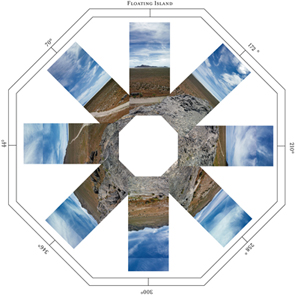
Katherine E. Bash, "Compass Rose, Floating Point Operation," 2008.
Is art history global enough to take up the challenge of cultural mixing, transnationalism, internationalization, and globalization, without neglecting cultural nationalisms and artistic territorialization processes, which are the fabric of our discipline? How do we understand the relationships between circulations, globalizations, and the production of ethnicity or nationality in the arts? What strategies can we develop, besides narration and description, to write a new history of the arts that escapes both historiographical nationalism and blind globalism, while paying due to the national and transnational dimensions of artistic creation?
In response to these questions the École normale supérieure in Paris (ENS-Ulm) and Béatrice Joyeux-Prunel launched a vast research project in 2009. The ambition was to study arts and letters in a socio-spatial perspective that takes into account the spatial turn of Social Sciences. The result is ARTLAS, a digital atlas of arts and literature history which combines spatial, social, cultural, and esthetic questionings, with a narrative/descriptive approach, and visualization techniques, including charts and maps created with GIS technologies (Geographic Information Service).
The reliance on a cartographic approach and multi-scale analysis grows from the conviction that we can transform the geohistorical reflections that Thomas DaCosta Kaufmann presented in Toward a Geography of Art (2004) into maps, and that the atlas model can contribute to meeting the challenge of global art history James Elkins exposed with Is Art History Global? (2006). Still, the format of ARTLAS is motivated by the conviction that we cannot separate the analysis of artistic circulations and globalization from the study of territorialization of artistic practices.
In order to present ARTLAS on the American continents and engage in a dialogue with American scholars, the ENS is teaming with Purdue University to organize a conference which will take place on September 27-29, 2012 at Purdue. We have invited Professor DaCosta Kaufmann and Professor Elkins to present their respective takes on a global art history and the use of maps as art historical tools, while philosopher Edward S. Casey will address the links between art and maps.
We are now inviting scholars, whose research is grounded in socio-spatial analysis and/or aims at meeting the daunting challenge of ubiquity in art history, to join the conversation and offer their perspectives. We welcome papers that explore the connection between the national and transnational in a global perspective for any object, period, and place in the history of arts and letters. (more…)
Exhibition | Treasures of Kenwood House
Press release (9 December 2011) from the MFAH:
Rembrandt, Van Dyck, Gainsborough: The Treasures of Kenwood House, London
Museum of Fine Arts, Houston, 3 June — 3 September 2012
Milwaukee Art Museum, 4 October 2012 — 6 January 2013
Seattle Art Museum, 14 February — 19 May 2013
Arkansas Arts Center, Little Rock, 6 June — 8 September 2013
Curated by Susan Jenkins

Thomas Gainsborough, "Portrait of Mary, Countess Howe," ca. 1764 (London: Kenwood House, English Heritage, Iveagh Bequest)
On June 3, 2012, the Museum of Fine Arts, Houston, will debut the exhibition Rembrandt, Van Dyck, Gainsborough: The Treasures of Kenwood House, London, whose four-venue national tour was announced today by the American Federation of Arts in New York. An exhibition of forty-eight masterpieces, this will be the first tour of this important group of works from the Iveagh Bequest and will provide a unique opportunity to see these superb paintings outside the United Kingdom. Most of these paintings have never traveled to the States before, and many of them have rarely been seen outside Kenwood.
Donated to the nation by Edward Cecil Guinness (1847–1927), 1st Earl of Iveagh and heir to the world’s most successful brewery, the Iveagh Bequest resides at Kenwood House, a neoclassical villa in London that was remodeled by Robert Adam in the eighteenth century. The collection was shaped by the tastes of the Belle Epoque—Europe’s equivalent to America’s Gilded Age—when the earl shared the cultural stage and art market with other industry titans such as the Rothschilds, J. Pierpont Morgan and Henry Clay Frick. Acquired mainly from 1887 to 1891, the earl’s purchases reveal a penchant for the portraiture, landscape and seventeenth-century Dutch and Flemish works typically found in English aristocratic collections. While the majority of the paintings in the exhibition are from the Iveagh Bequest, several are drawn from the works acquired specifically for display at Kenwood. Pauline Willis, AFA’s Director, remarked, “We are extremely proud to be able to give greater exposure to this magnificent selection of paintings while Kenwood undergoes a major refurbishment.” Simon Thurley, Chief Executive for English Heritage, commented, “The collection of works of art on display at Kenwood is one of the most important in England, and we are thrilled that works from this collection will travel across the Atlantic for the first time and find new audiences in the United States.”
The collection is particularly strong in works by such Golden Age eighteenth-century English portraitists as Sir Joshua Reynolds, Thomas Gainsborough and George Romney, whose depictions of society beauties of the Georgian era, also known as England’s “Age of Aristocracy,” held a great appeal for Lord Iveagh. Among the several fine Gainsboroughs in the exhibition is the sumptuous full-length portrait Mary, Countess Howe (c. 1764), an image of both aristocratic elegance and of a landowner among her properties. Such full-length portraits of ladies in nature were very popular during this period, owing to a great admiration for the aristocratic portraits of Van Dyck. Along with such aristocratic women, the collection’s “virtual harem” of English portraits features celebrity demimondes, among them Emma Hart—later Lady Hamilton—who served as Romney’s muse, and Kitty Fisher—one of the most celebrated courtesans in London society. (more…)










 Enfilade
leave a comment