Elena Boeck at The Newberry, Cartography & Peter the Great
From The Newberry:
Elena Boeck, An Icon for Peter the Great: Linking Imperial Cartography and Sacred Topography
The Newberry Library, Chicago, 9 March 2012
Seminar in Art History, Early Modern European Maps as Art
This paper investigates intersections between piety, imperial expansion, and military cartography in an icon presented to Peter I in 1698. It explores a rare convergence of Christian and imperial narratives. The icon was produced in Ukraine, which long served as a bridge between the west and the world of the Russian court, and offered to Peter I by a Ukrainian monastery as a diplomatic gift to commemorate his first triumph, the capture of the Ottoman town of Azov. The iconography of this nearly two-meter-tall image includes an unusual birds-eye view of the siege of Azov.
This innovative image actively participated in the invention of a new, Europeanized, imperial visual tradition in Russia. Furthermore, its seamless and insistent interweaving of imperial symbols, territorial expansion, and religious legitimization came from a contested territory that was in the process of being integrated into empire. Exploring a Ukrainian donor’s motivations for creating such an object, and taking seriously his aspirations for imperial patronage, enables us to understand aspects of empire often obscured in modern national narratives.
Elena N. Boeck is Assistant Professor at DePaul University.
Friday, 9 March 2012, 2:00 pm. A reception will follow the seminar.
Cosponsored by the Hermon Dunlap Smith Center for the History of Cartography.
This program is free and open to the public, but registration in advance is required. Register online here. The paper will be electronically precirculated to registrants.
Exhibition: The Look of Love, Eye Miniatures
From the Birmingham Museum of Art:
The Look of Love: Eye Miniatures from the Skier Collection
Birmingham Museum of Art, Birmingham, Alabama, 7 February — 10 June 2012
University of Georgia, Athens, 6 October 2012 — 6 January 2013
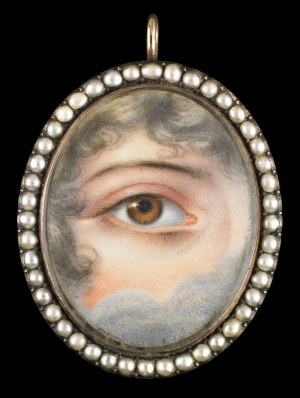 This stunning exhibition explores the little-known subject of “lover’s eyes,” hand-painted miniatures of single human eyes set in jewelry and given as tokens of affection or remembrance. In 1785, when the Prince of Wales secretly proposed to Mrs. Maria Fitzherbert with a miniature of his own eye, he inspired an aristocratic fad for exchanging eye portraits mounted in a wide variety of settings including brooches, rings, lockets, and toothpick cases. With over 100 examples, the collection of Dr. and Mrs. David A. Skier of Birmingham is the largest in the world. This exhibition offers an unprecedented look at these unusual and intriguing works of art.
Visitors can also interact with the exhibition in a new way: the Museum’s very first iPad app! The Look of Love app allows visitors to see these tiny, intricate objects at up to twenty times their actual size. They can also see images of the backs of objects or short videos of how the objects open. Twenty iPad devices are available for check-out and use in the Arrington Gallery, and
volunteers are on hand to show how the devices and the app
work.

ISBN: 9781907804014, $35
The exhibition is accompanied by a full color, hardbound catalogue of the same name, edited by Dr. Graham C. Boettcher, The William Cary Hulsey Curator of American Art, and published by D Giles Ltd., London. An essay by Elle Shushan sets the historical scene and examines the role of lover’s eyes in the broader context of Georgian and early Victorian portrait miniatures. Boettcher looks at the language and symbolism of these tokens and their jeweled settings. Additionally, novelist and biographer Jo Manning offers five fictional vignettes imagining the circumstances surrounding the creation of these extraordinary objects.
◊ ◊ ◊ ◊ ◊
N.B. — Notice of the exhibition at the Georgia Museum of Art in Athens was added on 24 October 2012
Stockholm’s Nationalmuseum Acquires Satyr and Nymph by Clodion
Press release (30 November 2011) from the Nationalmuseum in Stockholm:

Claude Michel, known as Clodion, "Satyr and Nymph," terracotta, 1780s (Photo: Linn Ahlgren/Nationalmuseum)
At an ordinary public auction this past April, Nationalmuseum purchased a magnificent terracotta sculpture by French artist Claude Michel, known as Clodion. The piece, thought to date from the 1780s, depicts a satyr embracing a young nymph. Clodion’s superb attention to detail and perfect balancing of the two figures makes this one of his most significant works.
Claude Michel, known as Clodion, was two years the senior and a colleague of the Swedish sculptor Johan Tobias Sergel during his time in Rome. Clodion never completely abandoned the graceful rococo style. Not surprisingly, he was popular with collectors, but he was never elected to the Académie in his native France. The terracotta sculpture of a satyr embracing a nymph, purchased by Nationalmuseum at a public auction held by Stockholms Auktionsverk in April, typifies Clodion’s work in many respects. This piece, which probably dates from the 1780s, is a finished work rather than a prototype. Clodion produced these terracotta pieces for an eager market that could hardly wait for him to finish his works, since they were so popular. He produced several variations on the satyr and nymph theme, but the piece recently acquired by Nationalmuseum is one of the most thoroughly executed. The two figures, perfectly balanced in relation to each other, appear to be fashioned from a single piece of clay. Rather than powerful eroticism, the work exudes a gentle sensualism, which is most evident in the tentative kiss being exchanged between the couple. Clodion makes elegant play with the contrast between the plastic smoothness of the skin and the graphic nature of the nymph’s hair, carved into the clay while it was still wet.
On account of its sensual subject matter, in 1990 the grouping ended up in a private Swedish erotica collection. At different points in its life it had belonged to Henri Rochefort, a prominent French politician, and Jacques Doucet, a legendary art collector, whose collection (auctioned off piecemeal in 1912) included Picasso’s les Demoiselles d’Avignon. A counterpart to Clodion’s Satyr and Nymph can be seen in the Metropolitan Museum of Art in New York. The version now acquired by Nationalmuseum was long believed to be lost.
The acquisition was made possible by a generous donation from the Sophia Giescke Foundation. The Nationalmuseum has no funds of its own with which to acquire art and design, and so relies on gifts and financial support from private foundations and funds to expand its collection.
The Progress of Love
From D. Giles publishing:
Colin B. Bailey, Fragonard’s Progress of Love at The Frick Collection (London: D. Giles, 2011), 192 pages, ISBN: 9781904832607, £30 / $45.
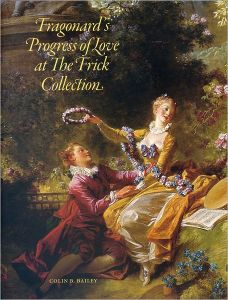 This richly illustrated volume reveals the intriguing story behind the commission, rejection, and rehousing of Jean- Honoré Fragonard’s Progress of Love, a series of 14 paintings considered by many to be the artist’s masterpiece. Fragonard (1732–1806) completed four large canvases for the comtesse du Barry’s chateau at Louveciennes, but they were replaced and returned to the artist. In 1790 Fragonard moved them to his cousin’s house in Grasse, and over the course of the year painted two further large-scale works and 18 additional panels.
With 140 colour images of the Fragonard paintings, details, shots of the room, plans, original sketches, and other comparative images, author Colin Bailey explores the commission of the four main panels, their original arrangement at Louveciennes and the possible reasons for their rejection. Equally enthralling is the history of how the paintings were rediscovered in
the late 19th century and how they eventually came to The Frick Collection.
Colin B. Bailey is Associate Director and Peter Jay Sharp Chief Curator at The Frick Collection, New York. Recent publications include Watteau to Degas: French Drawings from the Frits Lugt Collection (2009); Gabriel de Saint-Aubin (1724–1780) (2007); and The Age of Watteau, Chardin and Fragonard: Masterpieces of 18th-century French Genre Painting (2003).
Call for Papers: Histories of British Art
This CFP was announced here at Enfilade back in November; the deadline, however, is now fast approaching. –CH
Histories of British Art, 1660-1735: Reconstruction and Transformation
King’s Manor, University of York, 20-22 September 2012
Proposals due 2 March 2012
 We welcome proposals from graduate students, academics working in History of Art and other Humanities disciplines, curators and all others engaged in research on the field. The conference is a key output of a major AHRC-funded project on art of the period, Court, Country, City: British Art, 1660-1735. This project is ran in collaboration between Tate Britain and the University of York, and led by Professor Mark Hallett (York), Professor Nigel Llewellyn (Tate), and Dr. Martin Myrone (Tate).
Conference costs will be heavily subsidized thanks to AHRC funding, however spaces for the conference are limited and priority will be given to speakers. A number of graduate student bursaries will be available. Please send abstracts of no more than 300 words to claudine.vanhensbergen@tate.org.uk
A PDF of the poster is available here»
Eighteenth-Century Accessories Exhibition in Aarhus, Denmark
As noted at Fashioning the Early Modern (thanks to Kimberly Chrisman-Campbell for pointing it out) . . .
Shoes and Accessories: Fashion and Frills in the 1700s
Den Gamle By (The Old Town), Aarhus, Denmark, 9 March — 30 December 2012
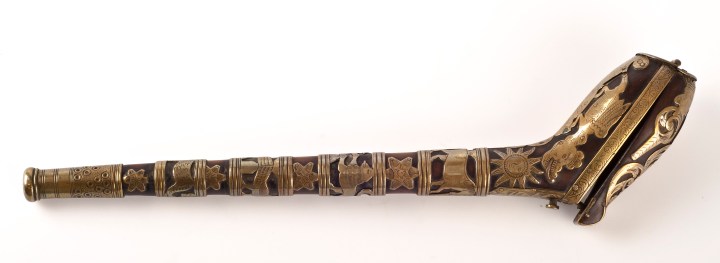
Holder for chalk pipes, eighteenth century
◊ ◊ ◊ ◊ ◊
The style specialists at Den Gamle By have gone trend-spotting, bringing you the hottest accessories and the coolest gadgets for fashionable ladies and gents to flaunt in high society. Must-haves of the 1700s include silk fans with the latest in ivory fan-sticks, practical chalk-pipe cases, English pocket watches, and silk slippers à la Madame de Pompadour, the style icon of the era. For an intimate look at eighteenth-century extravagance, complete with fashion tips from the 1700s, visit Shoes and Accessories at Den Gamle By. Be there, or be square! On show at the Mintmaster’s Mansion – a grand house from the 1700s with marble-painted Baroque Italian staircase and hand-printed Rococo wallpaper.
Call for Papers: AAH Student Symposium

AAH Summer Symposium 2012 Art and Science: Knowledge, Creation and Discovery
The Linnean Society of London, Burlington House, 28-29 June 2012
Proposals due by 29 April 2012
Though their academic paradigms may at first seem diametrically opposed, the association between the arts and the sciences has survived renaissances, revolutions and beyond. This intellectual conjunction has motivated artistic practice and production throughout history, forming the conceptual nucleus of some of the most stimulating forms of creative expression. By engaging with this inter-relationship, we hope to address the assumed divisions that have kept the arts and sciences as separate areas of academic enquiry, whilst at the same time questioning if such an alliance is necessary or profitable for either discipline.
As well as considering general ideas of artistic and scientific collaboration, this year’s Summer Symposium will investigate the interaction between art and science throughout artistic practice, theory and history. Topics for papers could include, but are not limited to:
- Artists who work directly or indirectly with science
- Medical and anatomical images, diagrams, and the art of science
- Architecture and the body
- Histories of collection, taxonomies, display and acquisition in the arts and sciences
- The role of the science of perception in the development of perspective, figuration and abstraction
- The idea of the modern as related to science and technology
- The figure of the polymath
- Neuroscience and histories of vision
- Photography between science and art
- Mathematics and beauty – the Golden Section
- Technology and the evolving dissemination of art history
- Science in art historical conservation and research
Papers should be 20 minutes in length and abstracts of no more than 300 words should be submitted with a brief biography to: aah.art.science@gmail.com by 29 April 2012. The conference is open to all but speakers need to be student AAH members.
Symposium Organisers
Arlene Leis, University of York, acl914@interfree.it
Rebecca Norris, University of Cambridge, rn290@cam.ac.uk
Freya Gowrley, University of Edinburgh, f.l.gowrley@gmail.com
Call for Papers: Third Annual Feminist Art History Conference
Third Annual Feminist Art History Conference
American University, Washington D.C., 9-11 November 2012
Proposals due 15 May 2012
This conference builds on the legacy of feminist art-historical scholarship and pedagogy initiated by Norma Broude and Mary D. Garrard at American University. To further the inclusive spirit of their groundbreaking anthologies, we invite papers on subjects spanning the chronological and geographic spectrum to foster a broad dialogue on feminist art-historical practice. Speakers may address such topics as: artists, movements, and works of art and architecture; cultural institutions and critical discourses; practices of collecting, patronage, and display; the gendering of objects, spaces, and media; the reception of images; and issues of power, agency, gender, and sexuality within visual cultures.
Sessions and keynote will be held on AU’s campus with additional events at the National Museum of Women in the Arts in conjunction with its 25th Anniversary celebration
Keynote address
“Guess Who’s Coming to Dinner? Feminism, Art History and the Story of a Book”
Whitney Chadwick, Professor Emerita of Art History, San Francisco State University
Please submit via email a one-page, single-spaced proposal and two-page curriculum vita by May 15, 2012 to fahc3.cfp@gmail.com. Notification of acceptance by July 1, 2012
Sponsored by the Art History Program, Department of Art, College of Arts and Sciences at American University
Organizing committee: Kathe Albrecht, Juliet Bellow, Norma Broude, Kim Butler, Mary D. Garrard, Namiko Kunimoto, Helen Langa, and Andrea Pearson
Material World Conference at Peabody Essex Museum
From the PEM:
A Material World: The Art and Culture of Global Connections
Peabody Essex Museum, Salem, Massachusetts, 22 March 2012
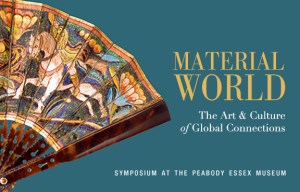 Join us for a dynamic symposium that explores how the global movement of objects — luxury goods, traded commodities and diplomatic gifts — created an increasingly interconnected world from the 1500s to the 1800s. How did these works shape people’s ideas about the wider world? What can these works continue to tell us about early global networks? Nine international speakers focus on different cross-cultural connections in this daylong program highlighting works of art from PEM’s collection.
◊ ◊ ◊ ◊ ◊
S P E A K E R S
Donna Pierce (Denver Art Museum), Chinese Export Silk and Porcelain in Colonial Mexico
Daniel Finamore (Peabody Essex Museum), Mexican Featherwork Fan for the Spanish Market, Early 1600s
Susan Stronge (Victoria and Albert Museum, London), Foreign Luxuries at the Mughal Court
Giorgio Riello (Warwick University), Portrait of Two English Boys in Asian Clothing by Tilly Kettle, 1780s
Jean Michel Massing (University of Cambridge, England), Luso-African Ivories: A New Provenance
Karina Corrigan (Peabody Essex Museum), Chinese Export Lacquer and Enamel Furniture, 1730s
Timon Screech (School for Oriental and African Studies, London), Linnaeus and the Origin of Japanese Numismatics
Christina Hellmich (Fine Arts Museums of San Francisco), Alaskan Overcoat Owned by the King of the Hawaiian Islands, Given to PEM before 1821
Anne Gerritsen (Warwick University, England), Things in Global Context: Mr Nobody Comes Home
◊ ◊ ◊ ◊ ◊
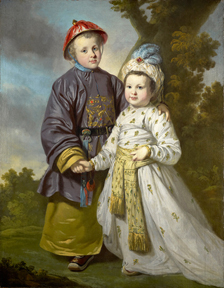
Tilly Kettle (1734-1786), "Portrait of Two English Boys in Asian Clothing," 1780s (Peabody Essex Museum)
This daylong program concludes with a cocktail reception. Registrants will also have the opportunity to attend PEM’s mid-winter Evening Party and opening for FreePort [No. 005]: Michael Lin following the reception. Learn more about FreePort [No. 005]: Michael Lin
Reservations by March 15
Members $85, nonmembers $95, students with ID $20
For more information, call 978-542-1625 or email symposium@pem.org
Related lecture — Timothy Brook, Vermeer’s Hat: The Seventeenth Century and the Dawn of the Global World, Wednesday, March 21.
A Material World: The Art and Culture of Global Connections is sponsored in part by a grant from the Arts and Humanities Research Council (UK). The AHRC grant has funded a two-year international academic partnership exploring global commodities and the material culture of early modern connections, 1400-1800. Partner institutions include Warwick University, Coventry, England; The Victoria and Albert
Museum, London, England; Bilgi University, Istanbul, Turkey; and the
Peabody Essex Museum, Salem, Massachusetts, USA.
Farrow & Ball at the Met
I realize this exhibition — which I’ve not seen but have heard terrific things about — hardly falls in the eighteenth century — even a really long eighteenth century. But I’m completely intrigued by Farrow & Ball’s sponsorship and their use of the support in advertising. I received an email a few days ago, noting the precise paint colors with links to the company’s website (to be clear, I was already on their email list). In some ways this makes perfect sense to me, and the partnership is far less intrusive or annoying than other forms of support; personally, I’m quite glad to know the colors. And yet, the arrangement still somehow feels funny to me. Maybe this has been going on for years, and I’ve just never noticed (it would hardly be the first instance of that). -CH
◊ ◊ ◊ ◊ ◊
From Farrow & Ball:
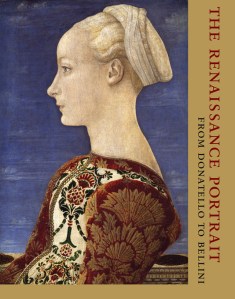 Farrow & Ball paint colours are used around the world to adorn the walls of some of the most prestigious properties and art galleries. Visit them at:
The Metropolitan Museum of Art, New York
The Renaissance Portrait from Donatello to Bellini
December 21, 2011 to March 18, 2012
The Metropolitan Museum of Art hosts an exhibition celebrating the first great age of portraiture in Europe. Farrow & Ball paint colours Black Blue, Down Pipe, Studio Green, Mouse’s Back, Light Gray and Hague Blue provide a fitting backdrop to approximately 160 works, by artists including such masters as Donatello, Filippo Lippi, Botticelli and Bellini. The works of art on display range from exquisite painting and manuscript illumination to marble sculpture and bronze medals from the 15th Century.










 Enfilade
leave a comment