At Christie’s: Old Masters Week in New York
At Christie’s, New York, 25 January 2012, Old Master Paintings (Sale 2534)
◊ ◊ ◊ ◊ ◊
Pompeo Girolamo Batoni, Portrait of a Gentleman, oil on canvas, 39 x 29 in. (99 x 73.6 cm.) — estimate, $400,000-600,000, sold for $866,500.
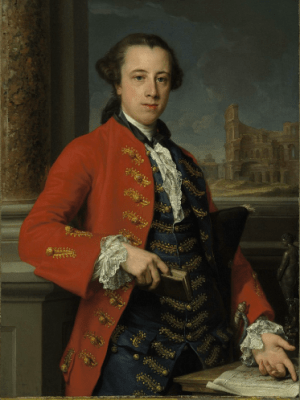 Three-quarter-length, in a red coat and a blue waistcoat with gold embroidery, holding a book and a tricorn hat, with a bronze statuette of the Venus de’ Medici on the table, the Colosseum in the distance.
Provenance
(Possibly) by descent within the Tew family.
Mr. J. Eyles; Christie’s, London, 17 December 1904, lot 111, as ‘Van Loo’ (36 gns. to Shepherd).
Anonymous sale; Sotheby’s, London, 5 July 1984, lot 272.
with Leger Galleries, London, 1990, where acquired by the present owner.
While the sitter in this portrait remains unidentified, his dress – particularly his scarlet coat – suggests that he was one of the many Grand Tourists who had their likeness captured by Batoni during their stay in Rome. The perfect souvenir of an educational voyage to the Italian peninsula, this painting presents the young gentleman as the consummate, erudite aristocrat. . . .
The full entry is available here»
◊ ◊ ◊ ◊ ◊
Giambattista Tiepolo, The Arrival of Henry III at the Villa Contarini, oil on canvas, 28¼ x 42 in. (71.7 x 106.7 cm.) — estimate, $4-6million, sold for $5.9million.
 Provenance
Count Francesco Algarotti, Venice, by 1756.
Wilhelm Rothschild, Schloss Grünberg, Frankfurt am Main, and (presumably) by descent to his daughter, Adelheid de Rothschild, and by descent in the Rothschild family;
Confiscated in Paris by the Einsatzstab Reichsleiter Rosenberg following the Nazi Occupation of Paris, May 1940;
Acquired for Hermann Goering on 4 December 1941 (inv. RM 1150);
Transferred to the Munich Collecting Point by Western Allied Forces (MCCP no. 6759);
Repatriated to Paris on 19 September 1946. Baron Edmond de Rothschild, Château de Prégny, Geneva, until 1980.
with Colnaghi’s, London, 1981, where acquired by S.T. Fee, Oklahoma City; Christie’s, New York, 9 May 1985, lot 20.
with Newhouse Galleries, New York, from whom acquired by the present owner.
Henri de Valois (1551-1589), third son of Henri II and Catherine de Medici, was elected King of Poland in May 1573, but it would not be until January of the following year that he would arrive at the Polish border and 21 February 1574 before he would be crowned in Warsaw. Less than four months later, Henry would abdicate the throne and depart Poland in unseemly haste, returning to France upon the news that his elder brother, Charles IX, had died and the French throne was his to claim. He was to be crowned Henri III, King of France, at the Cathedral of Reims on 13 February 1575.
Henri returned home by way of Vienna and Venice. He arrived in Venice on 18 July 1574 and stayed for ten days of official festivities and sightseeing. His welcome in front of the church of San Nicolò on the Lido was a lavish affair for which Palladio erected a triumphal arch and open loggia supported by ten Corinthian columns. This temporary loggia was decorated with scenes from the young king’s life painted by Tintoretto and Veronese and the ceiling was decorated with winged victories carrying wreaths as if to crown Henri when he passed beneath them. . . .
The full entry is available here»
◊ ◊ ◊ ◊ ◊
Andrea Locatelli, The Roman Forum, oil on copper, 29 x 37 in. (73.7 x 94 cm.) — estimate, $300,000-500,000, sold for $1,082,500.
 Provenance
Liechtenstein family collections, Vienna.
with Hazlitt, Gooden & Fox, London, 1997-1998, from whom acquired by Christian B. Peper.
This luminous view of the Roman Forum was almost certainly painted as a pendant to the View of the Piazza Navona with a market (fig. 1), signed and dated 1733, that was given to the Gemäldegalerie der Akademie der Bildenden Künste, Vienna by the estate of Prince Johann of Liechtenstein in 1881. Both compositions share the same dimensions and large copper support, which Locatelli only used on rare occasions. In fact, both panels stand out in the artist’s oeuvre as part of a remarkably small group of topographically accurate view paintings. In addition to the Vienna panel, Locatelli’s other known vedute reali are the pair of large perspective views of the projected Castello di Rivoli that the artist painted for another illustrious patron, (Castello di Racconigi, Turin), a view of the Tiber with the Ponte Rotto (Städtische’s Museum-Gemäldegalerie, Wiesbaden), and a View of the Tiber with the Castel Sant’Angelo (private collection, Rome).
The Vienna panel represents the same view from the piano nobile of the Palazzo Massimo Lancelotti that, working a generation earlier, Gaspare Vanvitelli had employed for a series of paintings datable from 1688 to 1723 (for an example, see lot 39 of this sale). In no small part due to Bernini’s unforgettable Four Rivers Fountain and the magnificent undulating façade of Borromini’s Sant’Agnese church, that the Piazza Navona became one of the most popular squares in Rome in the seventeenth and eighteenth centuries, and was often represented by view painters. The present composition appears to be entirely conceived by Locatelli and its pairing with the Piazza Navona is uncommon – views of the Piazza Navona were most frequently paired with views of the piazza of Saint Peter’s. . . .
The full entry is available here»
Art, Agency, Empire: India in Global Contexts
From the YCBA:
Art, Agency, Empire: India in Global Contexts — Graduate Student Symposium
Yale Center for British Art, New Haven, 11 February 2012

Edward Lear, "Kangchenjunga from Darjeeling," detail, 1879 (New Haven: Yale Center for British Art)
This one-day graduate student symposium is informed by the recent proliferation of projects on India’s visual and material culture, including two exhibitions that opened at the Center in the fall of 2011: Johan Zoffany RA: Society Observed (October 27, 2011– February 12, 2012), which includes a substantial section devoted to the works the artist produced during his residence in India, between 1783 and 1789; and Adapting the Eye: An Archive of the British in India, 1770–1830 (October 11–December 31, 2011), which concentrated on the complex networks of British and Indian artists, patrons, and scholars in the late eighteenth and early nineteenth centuries.
Art, Agency, Empire: India in Global Contexts explores how, in a postcolonial period, it has become increasingly pressing to reevaluate India as a site of multifarious cultural (indeed intercultural) production, which has provoked global responses across media. The symposium is free and open to the public; registration is required. Online registration is available from January 16 to February 9, 2012. Onsite registration is available on February 11 from 8:30 am.
The program will include papers by graduate students (listed here) as well as breakout sessions in the Johan Zoffany exhibition and Center’s collections.
◊ ◊ ◊ ◊ ◊
Keynote Lecture, 5:30 pm
Gillian Forrester (Curator of Prints and Drawings Yale Center for British Art)
In the Cock-Pit: Zoffany and the Performance of Empire in India
Exhibition: Colorful Realm in Washington
Thanks to Courtney Barnes at Style Court for noting this one. From the National Gallery of Art:
◊ ◊ ◊ ◊ ◊
Colorful Realm: Japanese Bird-and-Flower Paintings by Itō Jakuchū (1716–1800)
National Gallery of Art, Washington, D.C., 30 March — 29 April 2012
 Celebrating the centennial of Japan’s gift of cherry trees to the nation’s capital, this exhibition features one of Japan’s most renowned cultural treasures, the 30-scroll set of bird-and-flower paintings by Itō Jakuchū. Titled Colorful Realm of Living Beings (J. Dōshoku sai-e; c. 1757–1766), these extraordinary scrolls are being lent to the National Gallery of Art by the Imperial Household. Their exhibition here—for one month only—provides a unique, once-in-a-lifetime opportunity: not only is it the first time all 30 paintings will be on view in the United States, but it is also the first time any of the works will be seen here after their six-year-long restoration.
Colorful Realm stands as the most dynamic and comprehensive—yet meditative and distilled—expression of the natural world in all of Japanese art. Synthesizing numerous East Asian traditions of bird-and-flower painting, the set depicts each of its 30 subjects in wondrously meticulous detail, but in such a way as to transcend surface appearances and capture the otherwise ineffable, vital essence of the cosmos, the Buddha nature itself. To present the full significance of Colorful Realm, the exhibition and its catalogue reunite this masterpiece with Jakuchū’s triptych of the Buddha Śākyamuni from the Zen monastery Shōkokuji in Kyoto. Jakuchū had donated both works to the monastery, which displayed them in a large temple room during Buddhist rituals.
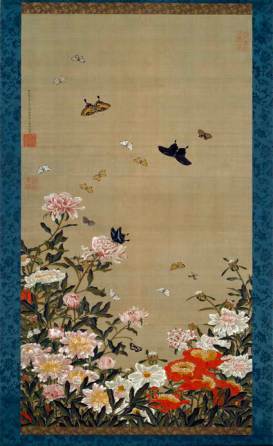 Recent conservation of Colorful Realm has generated an entirely new awareness of the material profile of the set and the technical means by which Jakuchū created each scroll. Drawing upon these findings as well as the most recent research on Jakuchū’s life and cultural environment, this exhibition offers a multifaceted understanding of the artist’s virtuosity and experimentalism as a painter—one who not only applied sophisticated chromatic effects but also masterfully rendered the richly symbolic world in which he moved.
The earliest of the 30 scrolls, Peonies and Butterflies, combines two subjects that enjoyed great popularity in East Asian pictorial traditions. On the one hand, the peony flower was likened to both feminine beauty and prosperity. It became the preferred garden flower of the imperial and aristocratic elite during China’s Tang dynasty (618–907) and at the court of Emperor Xuanzong in particular; in East Asian literary traditions Li Bai’s verse likening the beauty of Xuanzong’s favorite consort Yang Guifei (719–756) to a peony cemented the flower’s association with feminine beauty. Meanwhile, its full and gorgeous appearance lent itself to uncomplicated associations with affluence and good fortune. The butterfly also served as an auspicious symbol, though its popularity was equally attributable to its appearance in one of the most famous parables in early Chinese thought: Zhuangzi’s dream of a butterfly. According to this parable, the legendary sage Zhuangzi dreams that he is a carefree yellow butterfly. Upon awakening, however, “he didn’t know if he was Zhuangzi who had dreamt he was a butterfly, or a butterfly dreaming he was Zhuangzi.” Paintings of butterflies inevitably invoked the oneiric setting and queried selfhood of the Zhuangzi anecdote in most East Asian contexts and particularly in Jakuchū’s circle of erudite Sinophile monks, scholars, and merchants. While visually opulent, Peonies and Butterflies also suggests the uncertainty of a just-awoken dreamer who momentarily confuses reverie with reality.
Careful study of the painting’s pigmentation points to Jakuchū’s remarkable distillation and intensification of traditional East Asian coloration techniques. Different grades of opacity and transparency are achieved in the butterflies, flowers, stems, and leaves by varying the use of mineral and vegetal pigments, occasionally layering them one on top of another and adding a sublayer of color on the back of the silk. This complex stratigraphy of colors results in a convincing imbrication of the motifs in their surroundings. Indeed, when Jakuchū’s cultural and spiritual mentor Daiten (1719–1801) encountered the painting in 1760, he titled it “Beautiful Mist and Fragrant Wind” (Enka kōfū), suggesting that the real subject here was not the peonies and butterflies, but the conceptual atmosphere that enveloped them, the invisible ether within which they swayed and glided.
◊ ◊ ◊ ◊ ◊
Exhibition catalogue: Yukio Lippit, with Ota Aya, Oka Yasuhiro, and Hayakawa Yasuhiro, Colorful Realm: Japanese Bird-and-Flower Paintings by Itō Jakuchū (Chicago: University of Chicago Press, 2012), 224 pages, ISBN: 9780226484600, $50.
◊ ◊ ◊ ◊ ◊
Public Conference: The Art of Itō Jakuchū
National Gallery, East Building Concourse, Auditorium, 30 March 2012, 10:00 to 5:00
Illustrated lectures by noted scholars and conservators of Japanese art. This program is co-organized by the Center for Advanced Study in the Visual Arts, National Gallery of Art, and the Freer Gallery of Art and the Arthur M. Sackler Gallery, Smithsonian Institution. Presented in honor of the National Cherry Blossom Festival.
Exhibition: Copycat at The Clark
Press release from The Clark:
Copycat: Reproducing Works of Art
The Sterling and Francine Clark Art Institute, Williamstown, MA, 29 January — 1 April 2012
Curated by Alexis Goodin and James Pilgrim, in collaboration with Richard Rand and Jay A. Clarke

Francesco Bartolozzi, "The Libyan Sibyl," ca. 1780, etching and color etching on paper © Sterling and Francine Clark Art Institute, Williamstown, Massachusetts
The Sterling and Francine Clark Art Institute will open its latest exhibition, Copycat: Reproducing Works of Art, on January 29. Exploring the line between innovation and imitation, the exhibition features 50 prints and photographs that are both original works of art and repetitions of drawings, prints, paintings, sculptures, and architecture created by other artists. The exhibition highlights the complex process of copying by studying replications of many rarely seen works from the Clark’s permanent collection, including those by Albrecht Dürer, Paul Cézanne, Eugène Delacroix, Rembrandt van Rijn, Roger Fenton, and Édouard Manet, among others. The exhibition also marks the first public presentation of one of the Clark’s recent acquisitions, Jean Dughet’s series The Seven Sacraments. Copycat will be on view in the Clark’s Manton Research Center building through April 1, 2012.
Copycat is one of the ClarkNOW exhibitions that the Institute announced last autumn in conjunction with the launch of its campus expansion project. ClarkNOW is a series of more than 60 programs that the Clark will present in Williamstown, New York, and abroad over the next two
years as it extends the Clark’s reach and engagement during a time of
transformation on its campus. (more…)
CAA 2012, Los Angeles
The 2012 College Art Association conference takes place in Los Angeles, February 22-25, at the Los Angeles Convention Center. HECAA will be represented by two panels, as listed here. The following sessions may also be of interest for dixhuitièmistes. A full list of panels is available here»
H E C A A E V E N T S
Pictures in Place: Depicting Location and the Siting of Representation in the Eighteenth Century
Friday, February 24, 2:30–5:00, Concourse Meeting Room 408B
Chair: Craig Ashley Hanson (Calvin College)
- Dawn Odell (Lewis and Clark College) Place as a Thing: Chinese Screens in Dutch Colonial Contexts
- Hannah Williams (University of Oxford), From Salon to Altar: Relocating Religious Art in Eighteenth-Century Paris
- Julie M. Johnson (University of Texas at San Antonio), A Surplus of Frames: Allegorizing Collecting in the 1720 Stallburg Installation
- Jocelyn Anderson (Courtauld Institute of Art), Paintings in Country Houses and the Development of British Cultural Heritage
- Heather McPherson (University of Alabama at Birmingham), Branding Shakespeare: Boydell’s Shakespeare Gallery and the Politics of Display
◊ ◊ ◊ ◊ ◊
New Scholars Session
Saturday, February 25, 12:30–2:00, West Hall Meeting Room 501ABC
Chair: Kevin Chua (Texas Tech University)
- Lauren Cannady (Institute of Fine Arts, New York University), The Garden Landscape and the French Interior
- Christina Smylitopoulos (University of McGill), “Last Visit from the Doctors Assistant”: Thomas Rowlandson’s Tribute to the “Dying Nabob” and the Birth of the British Body Abroad
- Abigail Zitin (Trinity University), Hogarth among the Moderns
◊ ◊ ◊ ◊ ◊
O T H E R S E S S I O N S R E L A T E D T O T H E 1 8 T H C E N T U R Y
Where the Bodies Lie: Landscapes of Mourning, Memory, and Concealment
Wednesday, February 22, 9:30–12:00, West Hall Meeting Room 501ABC
Chairs: Cynthia Mills (Smithsonian American Art Museum, emeritus) and Kate C. Lemay (Georgia O’Keeffe Museum Research Center); Discussant: Petra ten-Doesschate Chu (Seton Hall University)
- Jennifer Van Horn (Towson University), Civilizing Cemeteries: Portrait Gravestones in Colonial Charleston
- Caterina Y. Pierre (Kingsborough Community College, CUNY), The Corpse Revealed: The Gisant and Modern Memorials at the Fin de Siècle
- Karen Shelby (Baruch College, CUNY), In Flanders Fields: Collection Cemeteries for the German Dead
- Emily Mark-Fitzgerald (University College Dublin), Remembering the Irish Famine: Commemorating the Famine Graveyard and Workhouse, 1990-2011
- Patricia Cronin (Brooklyn College, CUNY), Until Death Do Us Part: National Politics, Modern Love, and “Memorial to a Marriage”
◊ ◊ ◊ ◊ ◊
Icons of the Midwest: Henry Fuseli’s Nightmare (Midwest Art History Society)
Wednesday, February 22, 12:30–2:00, Concourse Meeting Room 405
Chairs: Laura D. Gelfand (Utah State University) and Judith W. Mann (Saint Louis Art Museum)
- Salvador Salort-Pons (Detroit Institute of the Arts), Living with Fuseli’s “Nightmare”
- Beth S. Wright (University of Texas at Arlington), “As I Was Perpetually Haunted by These Ideas”: Fuseli’s Influence on Mary Shelley’s Mathilda and Frankenstein
- Scott Bukatman (Stanford University), Dreams, Fiends, and Dream Screens
◊ ◊ ◊ ◊ ◊
Feminism and Early Modern Art (Society for the Study of Early Modern Women)
Wednesday, February 22, 12:30–2:00, Concourse Meeting Room 407
Chair: Andrea Pearson (American University); Discussant: Mary D. Garrard (American University)
- Jane C. Long (Roanoke College), Shaping Feminine Conduct in Renaissance Florence
- Sarah Joan Moran (Universität Bern), The Word of God on Women’s Shoulders? Pulpits in the Beguine Churches of the Southern Low Countries, ca. 1650-1725
- Corine Schleif (Arizona State University), From Early Modern to Postmodern, from Female to Feminisms to Feminizing: Where Do We Find Our Subjects and Ourselves after 100 Years in the College Art Association?
◊ ◊ ◊ ◊ ◊
Future Directions in the History of British Art (Historians of British Art)
Thursday, February 23, 2:30–5:00, Concourse Meeting Room 403B
Chair: Peter Trippi, Fine Art Connoisseur and Projects in 19th-Century Art, Inc.; Discussant:Kimberly Rhodes, (Drew University)
- Roberto C. Ferrari (The Graduate Center, CUNY), Reconsidering John Gibson, Remolding British Sculpture
- Cristina S. Martinez (University of Toronto ), Legal Thinking: The Rise of Eighteenth-Century British Art
- Corey Piper (Virginia Museum of Fine Arts), Doing the Thing and the Thing Done: The Social World of the British Sporting Print, 1750-1850
- Irene Sunwoo (Princeton University), From the “Well-Laid Table” to the “Market Place”: The Architectural Association Unit System
- Amy M. Von Lintel (West Texas A&M University), Art within Reach: The Popular Origins of Art History in Victorian Britain
◊ ◊ ◊ ◊ ◊
National Endowment for the Humanities Funding Opportunities (NEH)
Thursday, February 23, 5:30–7:00, Concourse Meeting Room 406AB
Chair: Danielle Shapiro (National Endowment for the Humanities)
- Linda Komaroff (Los Angeles County Museum of Art)
- Amy Lyford (Occidental College)
◊ ◊ ◊ ◊ ◊
How to Get Published and How to Get Read: (Arts) Journals in the Digital Age
Friday, February 24, 12:30–2:00, Concourse Meeting Room 404B
Chair: Loren Diclaudio (Routledge, Taylor & Francis Group)
- Jennifer Roberts (Routledge, Taylor & Francis Group)
- Christine L. Sundt (Visual Resources: An International Journal of Documentation)
- Natalie Foster (Routledge, Taylor & Francis Group)
◊ ◊ ◊ ◊ ◊
New Research in the Early Modern Hispanic World (American Society for Hispanic Art Historical Studies)
Saturday, February 25, 9:30–12:00, West Hall Meeting Room 511BC
Chairs: Michael A. Brown (Denver Art Museum) and Sofia Sanabrais (Los Angeles County Museum of Art)
- Laura Leaper (Institute of Fine Arts, New York University), Old Meets New: Classicizing Visions in Diego de Valadés’s “Rhetorica Christiana”
- Niria Leyva-Gutiérrez (Institute of Fine Arts, New York University), Soldier Ecclesiasticus: Images of the Archangel Michael in New Spain
- Sylvia Shorto (American University of Beirut), Dovetailed Cultures
- Luis Gordo-Peláez (University of Texas at Austin), “A Palace for the Maize”: The Granary of Granaditas in Guanajuato and the Neoclassical Civic Architecture in Colonial Mexico
- Daniela Bleichmar (University of Southern California), Visible Empire: Science, Imperial Knowledge, and Visual Evidence in the Hispanic World
◊ ◊ ◊ ◊ ◊
Art and Architecture in Europe: 1600-1750
Saturday, February 25, 9:30–12:00, Concourse Meeting Room 408A
Chair: John Beldon Scott (University of Iowa)
- Karen J. Lloyd (Tulane University), A New Samson: Scipione Borghese and the Representation of Nepotism in the Vatican Palace
- Jason Ciejka (Agnes Scott College), Rhetoric and Narrative in the Architecture of Carlo Rainaldi
- Sabina de Cavi (Getty Research Institute), Artistic Practices and Raw Materials for the Collaborative Art Form of the Festino in Baroque Palermo (1625-1750)
- Robin L. Thomas (Pennsylvania State University), The Bourbon Theater of State: Decorating the Royal Palace at Portici (1744-1745)
- Simone Zurawski (DePaul University), Revealing the Crossroads of Paris at the Cusp of the Revolution: The Works of Henri-Louis Duhamel du Monceau at the Clos Saint-Lazare
◊ ◊ ◊ ◊ ◊
“Useful to the Public and Agreeable to the King”: Academies and Their Products in Spain and New Spain (American Society for Hispanic Art Historical Studies)
Saturday, February 25, 12:30–2:00, Concourse Meeting Room 402AB
Chair: Kelly Donahue-Wallace (University of North Texas)
- Andrew Schulz (University of Oregon), Shifting Attitudes toward Cultural Patrimony in the Madrid Royal Academy of San Fernando, 1755-1808
- Kelly Donahue-Wallace (University of North Texas), Jerónimo Antonio Gil and the Formation of a Director General
- Susan Deans-Smith (University of Texas at Austin), “Open the Door so that Misery Can Leave”: The Rhetoric of Public Utility of the Royal Academy of San Carlos and Public Responses in Late Colonial Mexico
◊ ◊ ◊ ◊ ◊
New Approaches to Post-Renaissance Florence, ca. 1600–1743
Saturday, February 25, 2:30–5:00, Concourse Meeting Room 404A
Chairs: Eve Straussman-Pflanzer (The Art Institute of Chicago) and Eva Struhal (Université Laval)
- Morten Steen Hansen (Stanford University), Ariosto’s Florentine Fortune
- Nina E. Serebrennikov (Davidson College), Manipulating the Miniscule: The Case of Jacques Callot
- Rebecca J. Long (Indianapolis Museum of Art), Florentine Paintings for a Spanish Queen: The Medici Gift in the Convento de las Descalzas Reales, Valladolid
- Elena Ciletti (Hobart and William Smith Colleges), “Ne Posteri Ignorent Quid Factum Sit”: Anna Maria Luisa de’Medici at San Lorenzo
- Jacqueline Marie Musacchio (Wellesley College), Florence, the Medici, and Bianca Cappello through the Eyes of Horace Walpole
Study Day: Sculpture for the Academy
As noted at H-ArtHist:
Morceau de reception, Dono, and Diploma Piece
Histories of a Self-reflective Genre of Sculpture
Kunstakademie, Düsseldorf, 18 May 2012
Organized by Tomas Macsotay and Johannes Myssok
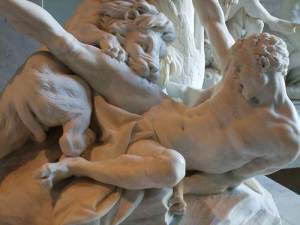
Étienne-Maurice Falconet, "Milo of Croton," marble, 1754 (Paris: Louvre)
In the seventeenth and eighteenth centuries, the significance of a practice of sculpture was to a great extent determined by the incorporation of individual sculptors into royal academies and city guilds, powerful institutions of Ancien Régime society fueled by conflicting socio-economic interests, ethic convictions and aesthetic creeds. For sculptors, the centerpiece of such acts of consecration consisted in marble carvings executed in reduced scale and rendering noble subjects that ranged from the Saints to Ovid and Roman History. As guilds lost ground and influence to academies, the figures became an indispensable means of forging a reputation: they grew increasingly complex and in a few cases, as with Falconet’s Milo, Sergel’s Othryadès and Banks’ Falling Titan, strike the modern viewer as being strangely at odds with stylistic mainstreams of baroque and neo-classicism. What resulted is one of the first forms of sculpture produced independently from overt purposes of noble representation or religious experience, and therefore capable of being called ‘autonomous’. Often lodged within or close to the spaces where academy members convened and held seminars, academic marbles come closest to representing a programmatic statement on the nature of sculpture at the dawn of modernity.
The study day will examine the converging histories of the dono, the morceau de réception and the diploma piece. An international array of scholars will venture into the difficult task of identifying what (if anything) these pieces purport to teach the viewer about the art of sculpture. What are the origins of its typical conventions — among the
private genres of the reproductive bronze, the ivory and the ornamental relief, or among the public sculpture on permanent display in churches, townhouses and squares — and what support is provided modern scholars by academic theoretical discourses? The insistent three-dimensionality of the French morceau de réception seems particularly predictive of a now familiar paradigm of the medium, with its understanding that sculptural objects display non-pictorial properties that fuel a relationship with the beholder through modalities of hard, handled
substance, through the play of spatial presence and multiple viewpoints, and through quasi-architectural framing elements and supports such as pedestals and niches. But does this Ancien Régime embodiment of sculpture really anticipate a modern sensibility to sculptural form?
Admission to the study day is free. Registration is not required.
◊ ◊ ◊ ◊ ◊
P R O G R A M M E
9:00 Reception and coffee
9:25 Johannes Myssok, Welcome and introduction
SESSION 1: Between the Individual and the Institutional, chaired by Johannes Myssok
9:40 Susanne Adina Meyer (Rome): “Die Akademie in der ‘Akademie der Welt’: Wettbewerbe und bildhauerische Aufnahmestücke der Accademia di San Luca in Rom im 18. Jh.”
10:10 Marjorie Trusted (London), “The Beginnings of the Royal Academy in London: Diploma Pieces in the Eighteenth Century”
10:40 Discussion and coffee Break
SESSION 2: Falconet: Exception or Rule?, chaired by Guido Reuter
11:10 Kristina Dolata (Berlin): “Naturstudium und ‘horreur’. Falconets Milon von Kroton”
11:40 Tomas Macsotay (Barcelona), “The Free-standing Morceau de Réception and the Community of Experiment: Thoughts on De Piles and Falconet”
12:10 Discussion
12:30 Lunch
SESSION 3: Sculpture about Sculpture: An Academic Aesthetics, chaired by Tomas Macsotay
14:00 Ursula Ströbele (Berlin): “Vom bas-relief zum ronde-bosse. Narration und Zeitlichkeit bei den Bildhaueraufnahmestücken der königlichen Akademie in Paris”
14:30 Martin Myrone (London), “Extravagance, Excess, Expertise: Thomas Banks’s Falling Titan”
15:00 Discussion and break
15:40 Additional contribution by Magnus Olausson and/or respondent (to be confirmed); final discussion
Emma Barker on the Greuze Girl in ‘Representations’
Emma Barker, “Reading the Greuze Girl: The Daughter’s Seduction,” Representations 117 (2012): 86-119.
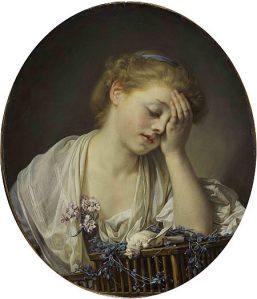
Jean-Baptiste Greuze, "Girl with a Dead Canary," 1765 (Edinburgh, National Galleries of Scotland)
Abstract: This essay challenges the generally accepted interpretation of Greuze’s Girl Weeping over a Dead Bird (1765) as an allegory of lost virginity by considering the painting in relation to eighteenth-century representations of the young girl in a range of discourses, including aesthetic theory, sentimental fiction and medical literature. Its central contention is that the implied spectator to whom the painting is addressed is not a lover as such, but a quasi-paternal figure, who disavows his own desire for the girl whilst nevertheless enjoying an eroticized intimacy with her. In thereby raising the specter of incest even as it represses it, Weeping Girl exemplifies deep-seated tensions within later eighteenth-century French culture.
Exhibition: Slavery at Jefferson’s Monticello
This exhibition looks intriguing for its subject alone, but even more interesting given that it’s the work (in partnership with Monticello) of a museum that doesn’t break ground until later this month. As reported by Brett Zongker of the Associated Press, the National Museum of African American History and Culture (NMAAHC) is organizing exhibits before the museum opens, in 2015, as a way to assess strategies for productively reaching large audiences with difficult subjects. -CH

◊ ◊ ◊ ◊ ◊
Slavery at Jefferson’s Monticello: Paradox of Liberty
National Museum of American History, Washington, D.C., 27 January — 14 October 2012
Atlanta History Center, 1 February — 7 July 2013
Missouri History Museum, St. Louis, 10 August 2013 — 2 March 2014
National Constitution Center, Philadelphia, 9 April 2014 — 4 January 2015
African American Museum, Dallas, 22 September — 31 December 2018 (extended to 21 January 2019)
The Smithsonian’s National Museum of African American History and Culture and Monticello will present Slavery at Jefferson’s Monticello: Paradox of Liberty, an exhibition of artifacts from the Smithsonian’s collections and from excavations at Jefferson’s Virginia plantation. Thomas Jefferson drafted the Declaration of Independence and called slavery an “abominable crime,” yet he was a lifelong slaveholder. The exhibition will provide a look at the lives of six slave families living at Monticello alongside Jefferson and his family. Personal belongings and working tools will be on display, and visitors will have a chance to learn about the families’ connections to one another, their religious faith and their efforts to pursue literacy and freedom.
◊ ◊ ◊ ◊ ◊
Note (added 23 September 2018) — The posting was updated to include the four additional venues.
Reviewed: The English Virtuoso
On a personal note, I want to say how much I appreciate Janice Neri’s thoughtful review. Her reading of my book is, I think, careful and fair. More importantly, her questions and criticisms are spot-on. Thanks as well to Laura Auricchio for doing such a terrific job coordinating reviews as the field editor for the eighteenth century! -CH
Recently added to caa.reviews:
Craig Ashley Hanson, The English Virtuoso: Art, Medicine, and Antiquarianism in the Age of Empiricism (Chicago: University of Chicago Press, 2009), 344 pages, ISBN: 9780226315874, $50.
Reviewed by Janice Neri, Boise State University; posted 28 December 2011.
To the modern day reader, hospitals and scientific societies might seem to be unlikely settings for exhibiting and discussing contemporary art. In ‘The English Virtuoso: Art, Medicine, and Antiquarianism in the Age of Empiricism‘, Craig Ashley Hanson shows how it made perfect sense that such venues would foster art theory and practice in seventeenth- and eighteenth-century England. The leading role in this book is played by the figure of the virtuoso, whose eclectic interests were united under the umbrella of curiosity. Encompassing activities as wide ranging as medicine (learned and unlearned), classical studies, and art collecting, patronage, practice, and theory, Hanson’s study of English virtuoso culture makes an important contribution to an understanding of the intellectual foundations of art scholarship and writing. In illuminating the complex world of the virtuoso, this insightful book also shows how early forms of interdisciplinarity actually worked. Drawing connections between the seventeenth and eighteenth centuries, ‘The English Virtuoso’ provides an opportunity to reflect on the ways that boundaries were often blurred between intersecting areas of knowledge. . . .
The full review is available here» (CAA membership required)
Reviewed: Architectural Space in Eighteenth-Century Europe
Recently added to caa.reviews:
Denise Amy Baxter and Meredith Martin, eds., Architectural Space in Eighteenth-Century Europe: Constructing Identities and Interiors (Burlington: Ashgate, 2010), 284 pages, ISBN: 9780754666509), $119.95.
Reviewed by Heather Hyde Minor, University of Illinois, Urbana-Champaign; posted 13 December 2011.
Eighteenth-century Europe was home to a dazzling array of architectural interiors, from priest-holes designed to hide ecclesiastics from Protestant authorities in England to the home theaters of courtesans in Paris. Diverse characters populated these domains. Bluestockings gathered in a Chinoiserie room while guests waited to be served refreshments before taking in Europe’s premier public collection of ancient sculpture.
‘Architectural Space in Eighteenth-Century Europe’ examines all of these environments and personages, exploring the role architecture and interiors played in fashioning identity in the eighteenth century. The ten essays that it gathers together seek to demonstrate that these spaces served to form a sense of self in creative ways. The book’s editors, Denise Amy Baxter and Meredith Martin, are to be commended for addressing this important question, one that spans a range of fields, and for gathering essays written by scholars from a range of disciplines. Contributing to the recent explosion of interest in eighteenth-century interiors, the volume builds on the work of Katie Scott, Mimi Hellman (both of whom are cited in the introduction), and others. . . .
The full review is available here» (CAA membership required)










 Enfilade
leave a comment