Call for Papers: Le Salon de l’Académie Royale de Peinture et Sculpture
From Fabula:
The Salon of the Royal Academy of Painting and Sculpture: Archaeology of an Institution
National Museum of Fine Arts, Quebec, 13-15 September 2012
Proposals due by 15 March 2012
International Symposium by Centre Interuniversitaire d’étude sur la République des lettres (CIERL), under the direction of Dr Isabelle Pichet
The historiography of the Salon of the Royal Academy of Painting and Sculpture in Paris is often bereft of a key part of its history: how the Salon itself became an art institution. Originally integrated into the fêtes de l’Académie, over time the Salon came to be best known in the form of a temporary, independent, and recurrent exhibition. This event developed little by little, reimagining itself through and eventually blossoming as the popular biennal exhibition. The unique character of the Salon was established through the regular repetition of the exhibition cycle, a sequence that helped to root the event’s particular characteristics in the minds of the public and in the regard of other institutions. In creating this rhythm within Parisians’ horizon of expectation, the Salon provided a habitus for their audience; moreover, the Salon inspired curiosity and desire in the provinces and nations that sought to imitate it.
This conference seeks to define and better understand the trajectory followed by the Salon from its emergence in the late 17th century to its full maturity in the second half of the 18th century. This symposium aims also to identify the diverse parameters and conditions that contributed to the development and helped to affirm the singularity of the Salon. This call for papers solicits proposals that will increase our understanding of the foundations and limits that shaped the form and content of the Salon as well as help us to survey the influence and impact of these exhibitions on various aspects of French and European society. As a multidisciplinary event, this conference is a laboratory and reflection on current research and scholarly approaches that consider the Salon and its place in the “art worlds,” as well as literature, philosophy, politics, and history.
New, unpublished papers shall not exceed the twenty minutes allocated to each participant. Proposals for papers (title and abstract of 250 words, institutional affiliation) should be sent to the committee before March 15, 2012 at the following address: colloque.salon@lit.ulaval.ca
Plenary lecture by Dr. Kim de Beaumont, Adjunct professor at Hunter College, Art Historian specialist of Gabriel de Saint-Aubin
Curatorial Fellowship at the Indianapolis Museum of Art
Allen Whitehill Clowes Curatorial Fellowship
Indianapolis Museum of Art, 2012-2013
Applications due by 30 March 2012
The Indianapolis Museum of Art is pleased to announce a nine-month curatorial fellowship. The fellowship supports scholarly research related to the Clowes Collection at the IMA and provides curatorial training in the field of European painting and sculpture. The Clowes Fellow is fully integrated into the curatorial division of the Museum and has duties comparable to those of an assistant curator, ranging from collection research and management to exhibition development and the preparation of interpretive materials and programs.
To be eligible for the fellowship, the applicant must be enrolled in a graduate course of study leading to an advanced degree in the history of art or a related discipline, or be a recent degree recipient (within the last two years). Applicants must demonstrate scholarly excellence and promise, as well as a strong interest in the museum profession. U.S. citizenship is not required.
The Clowes Fellow will receive a stipend of $18,000 and an educational travel allowance of $2,000. Housing is provided in a scholar’s residence on the grounds of the museum. The nine-month fellowship period will begin September 4, 2012. The appointment is renewable. (more…)
New Resource for the History of Paper
Though especially concerned with issues of book production, this research and the resulting website have implications for all early modern print culture. Aimed at a wide range of audiences — “from the complete novice to the paper-conservation scientist” — the site might be especially helpful for teaching purposes.. –CH
◊ ◊ ◊ ◊ ◊
From a UICB press release (17 January 2012) . . .
Tim Barrett of the University of Iowa Center for the Book Launches Paper History Website

Research by a University of Iowa led team reveals new information about why paper made hundreds of years ago often holds up better over time than more modern paper. Led by Timothy Barrett, director of papermaking facilities at the UI Center for the Book, the team analyzed 1,578 historical papers made between the 14th and the 19th centuries. Barrett and his colleagues devised methods to determine their chemical composition without requiring a sample to be destroyed in the process, which had limited past research. The results of this three-year project show that the oldest papers were often in the best condition, in part, Barrett says, due to high levels of gelatin and calcium.
“This is news to many of us in the fields of papermaking history and rare book and art conservation,” says Barrett. “The research results will impact the manufacture of modern paper intended for archival applications, and the care and conservation of historical works on paper.”
Barrett says one possible explanation for the higher quality of the paper in the older samples is that papermakers at the time were attempting to compete with parchment, a tough enduring material normally made from animal skins. In doing so, they made their papers thick and white and dipped the finished sheets into a dilute warm gelatin solution to toughen it. . . .
◊ ◊ ◊ ◊ ◊
From the project website, Paper through Time . . .
This website is designed for use by a wide range of visitors, from the complete novice to the paper-conservation scientist. Newcomers to the site may want to begin with the PROJECT OVERVIEW & AUTHORS and CONCLUSIONS sections for a quick sense of our research and what we learned. Those unfamiliar with papermaking history and technique may wish to start with European Papermaking Techniques 1300-1800 (under BACKGROUND) for an introduction to the craft. Visitors with a strong interest in papermaking history, materials and processes, paper permanence, paper science, and paper conservation are advised to begin at the top of the menu to the left and click on each tab, reading as interest and time permit. The site will be updated regularly. Suggestions for changes are welcome via email messages . . .
Things: Material Culture at Cambridge
Programming from CRASSH at the University of Cambridge:
Things: Material Cultures of the Long Eighteen Century
Centre for Research in the Arts, Social Sciences and Humanities (CRASSH), Cambridge, ongoing series
Please note the change to the time and location of the seminar:
We meet alternate Tuesdays 12.30-2.30pm in the CRASSH Seminar Room at 7 West Road on the Sidgwick Site.
◊ ◊ ◊ ◊ ◊
 The eighteenth century was the century of ‘stuff.’ Public production, collection, display and consumption of objects grew in influence, popularity, and scale. The form, function, and use of objects, ranging from scientific and musical instruments to weaponry and furnishings were influenced by distinct features of the time. Eighteenth-century knowledge was not divided into strict disciplines, in fact practice across what we now see as academic boundaries was essential to material creation. This seminar series will use an approach based on objects to encourage us to consider the unity of ideas of the long-eighteenth century, to emphasise the lived human experience of technology and art, and the global dimension of material culture. We will re-discover the interdisciplinary thinking through which eighteenth-century material culture was conceived, gaining new perspectives on the period through its artefacts.
Each seminar features two talks considering the same type of object from
different perspectives.
24 January 2012 — Fashion
Professor John Styles (University of Hertfordshire) and Amy Miller (National Maritime Museum)
7 February 2012 — Advertising
Dr Philippa Hubbard (Adam Matthew Digital) and Jenny Basford (University of York)
21 February 2012 — Porcelain
Dame Rosalind Savill (Wallace Collection) and Dr Anne Gerritsen (University of Warwick)
6 March 2012 — Artist’s Things
Dr Katie Scott (Courtauld Institute of Art) and Dr Hannah Williams (University of Oxford)
◊ ◊ ◊ ◊ ◊
Subscribe to the group mailing list at https://lists.cam.ac.uk/mailman/listinfo/crassh-things
Visit the external blog at http://thingsc18th.wordpress.com/
Call for Papers: Emblems of Nationhood, Britishness
From the conference website:
Emblems of Nationhood: Britishness, 1707-1901
University of St Andrews, 10-12 August 2012
Proposals due by 1 March 2012
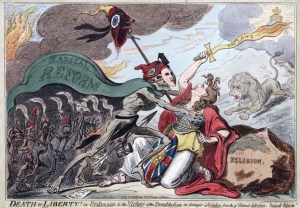
George Cruikshank, "Death or Liberty!" 1819 ( The Lewis Walpole Library, Yale University)
National identity is a central point of enquiry that is repeatedly called upon in contemporary social and political rhetoric. Our conference, ‘Emblems of Nationhood, 1707–1901’, will address the roots of this theme by discussing depictions of Britain and Britishness in literature, philosophy, and art between the Act of Union in 1707 and the death of Queen Victoria in 1901. Over the course of this multidisciplinary conference, we aim to explore how expressions of nationalism have moulded both critical perspectives on national identity and their creative products.
Discussing emblems of nationhood in 2012 is a fitting way to mark the twentieth anniversary of Linda Colley’s seminal account of Britishness, Britons: Forging the Nation, and coincides with the Queen’s Diamond Jubilee. Several broad questions could potentially be explored in the course of the conference: What did Britishness mean in the eighteenth and nineteenth centuries, and how was it represented and perceived? To what extent is nationalism tied with military events and empire building? How “British” was Britain before the launch of the Empire? (more…)
Call for Papers: Grand Tour Studies in Rome
Grand Tour del Terzo Millenio (V edizione)
Ricerche di Storia dell’Architettura dei Borsisti e Artiste e Artisti Stranieri a Roma
La facoltà di Ingegneria dell’Università di Roma – Tor Vergata, 20 April 2012
Proposals due by 23 March 2011
In vista della V edizione della giornata di studio intitolata Grand Tour del Terzo Millenio (V edizione) Ricerche di Storia dell’Architettura dei Borsisti e Artiste e Artisti Stranieri a Roma, che si terrà presso la facoltà di Ingegneria dell’Università di Roma – Tor Vergata il 20 aprile 2012, viene lanciato un call for paper (con scadenza 23 marzo 2012) indirizzato a tutti i borsisti, studiosi e professori stranieri attualmente in Italia che vogliono partecipare alla giornata di studio attraverso una breve relazione di circa 10-12 minuti che presenti i risultati delle loro ricerche relative a Roma: architettura e rappresentazione della città. La giornata di studio vuole favorire lo scambio tra le Istituzioni culturali straniere e l’Università di Tor Vergata, tradizionale luogo di confronto internazionale sulla cultura architettonica.
La giornata di studi apre un dialogo permanente tra l’Università di Roma Tor Vergata e le istituzioni culturali straniere di Roma, attraverso incontri periodici con cadenza annuale. La cattedra di Storia dell’architettura invita gli studiosi delle Accademie straniere a presentare le loro ricerche sulla storia dell’architettura, della costruzione e delle arti a Roma. Questi incontri, che hanno cadenza annuale, sono aperti agli studenti, dottorandi, docenti e a quanti sono interessati allo scambio tra studiosi di scuole e nazionalità diverse.
La giornata di studi è divisa in quattro sessioni:
1- architettura contemporanea (secc. XIX-XXI)
2- architettura dell’evo moderno (secc. XV-XVIII)
3- rapporti tra archeologia e architettura
4- ricerche su architettura e paesaggio
Una discussione finale concluderà la giornata.
Le proposte, riferite esclusivamente ai temi sopra indicati, possono essere inviate sotto forma di un breve abstract (600 caratteri o 100 parole), il cui titolo faccia riferimento a un’area tematica. Esse dovranno essere inviate entro il 23 marzo 2012, all’indirizzo del coordinatore Giuseppe Bonaccorso (bonaccorso@ing.uniroma2.it). Entro il 27 marzo sarà comunicato il calendario definitivo della giornata di studio. La lingua ufficiale del convegno è l’italiano; potranno essere presentati testi e relazioni anche in inglese, francese e spagnolo.
Online Reviews from BSECS
 The British Society for Eighteenth-Century Studies launched its new online reviewing system at its annual conference in Oxford earlier this month. The site is designed to address Music, Media (of all sorts), Exhibitions, and Theatre, areas of performance which fall within the Society’s remit. The site’s remit is not limited; as can be seen from the reviews the system contained at its launch, it will include reviews world-wide. All those with interests in the 18th century are encouraged to contribute.
The site is under editorship of Matthew McCormack, reviews editor for the Journal of Eighteenth-century Studies; the area editors are Zak Ozmo (Music), Daniel Cook (Media), Alexander Marr (Exhibitons), and Michael Caines (Theatre).
Greetings from Venezia!

My apologies for the recent interruption in posting. I’m in Venice with fourteen students for our January term and just haven’t been able to spend as much time with the site as I had envisioned (traveling with an eighteen-month old has added its own further complications, if also joys).
Regular posts should resume soon, and I’ll include some of the terrific eighteenth-century offerings I’ve encountered — often as lovely surprises alongside materials from very different periods. In the short-term, thanks for your patience. I’ll be back soon. -CH
Reviewed: Fordham’s ‘British Art and the Seven Years’ War’
Recently added to caa.reviews:
Douglas Fordham, British Art and the Seven Years’ War: Allegiance and Autonomy (Philadelphia: University of Pennsylvania Press, 2010), 352 pages, ISBN: 9780812242430, $65.
Reviewed by Kay Dian Kriz, Brown University; posted 8 December 2011.
In ‘British Art and the Seven Years’ War: Allegiance and Autonomy’, Douglas Fordham offers an original and provocative re-interpretation of the emergence of public art and art institutions in eighteenth-century Britain. Scholars have long noted that the 1750s and 1760s were marked by increasing concern about the development and institutionalization of a school of British art. “Why,” Fordham asks, “did the visual arts become a pressing national concern at this moment in Britain’s history?” (1) He argues that any answer to such a question must take into account the “transformative place in British culture” (2) occupied by the Seven Years’ War, which was fought in the middle of this time period (1756–63). And indeed, cultural, political, and military history were deeply intertwined at this moment when the British Empire in America was firmly secured through a war that has largely been overlooked by art historians.
Books about art and war usually focus on military painting; Fordham’s book is much more expansive and ambitious, being concerned with the effects of militarism on the development and organization of the arts, as well as on their subject matter. . . .
The full review is available here» (CAA membership required)
Small Exhibition: Women and Children in Prints after Chardin
From the Fitzwilliam:
Work, Rest and Play: Women and Children in Prints after Chardin
Fitzwilliam Museum, Cambridge, 6 September 2011 — 4 March 2012
 In 1733 the Parisian artist Jean-Siméon Chardin, who had made his name as a painter of ‘animals, cookware and various vegetables’, began to paint domestic interiors containing women, children and servants. The paintings were an immediate hit, and engravings reproducing certain works soon became available for purchase. This exhibition investigates the appeal of Chardin’s familial imagery for the 18th-century public, and takes a close look at the skill of the printmakers who interpreted his canvases into graphic art.
Charrington Print Room (16)










 Enfilade
leave a comment