Exhibition: Chess Sets from the Past
Thanks to all of you who have helped make 2011 such a good year for Enfilade. I’m taking a few days off, but postings will resume soon. Happy holidays, and I hope the next few days bring plenty of tasty food, some extra sleep, time with friends and family, and maybe even some games around a table. -CH
◊ ◊ ◊ ◊ ◊
From the World Chess Hall of Fame:
Chess Masterpieces: Highlights from the Dr. George and Vivian Dean Collection
World Chess Hall of Fame, St Louis, 9 September 2011 — 12 February 2012
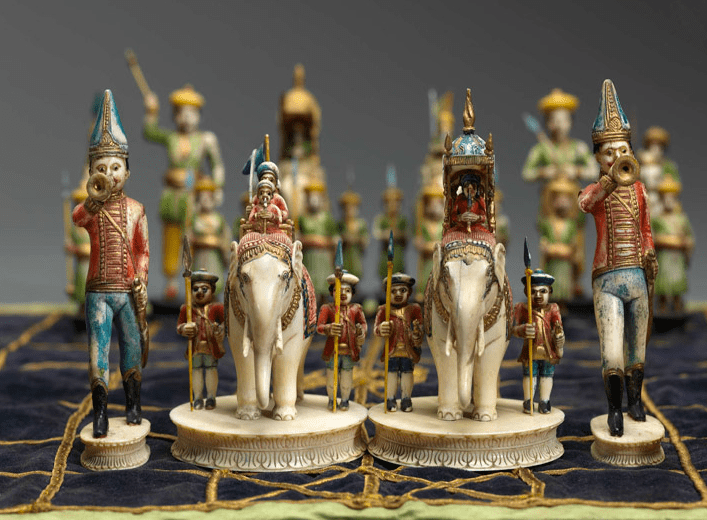
John Style Chess Set, India
Late 18th century, polychromed ivory
◊ ◊ ◊ ◊ ◊
Chess Masterpieces: Highlights from the Dr. George and Vivian Dean Collection celebrates the Deans’ 50th year of collecting together and uses outstanding selected works to trace the development of the game of chess and the design of fine chess sets from the tenth to the early twentieth century. Sets come from Austria, Cambodia, China, England, France, Germany, India, Italy, Japan, Kashmir, Morocco, Persia, Russia, Syria, and Turkey. Among the works on display are ones owned or commissioned by Catherine the Great, Napoleon, Czar Nicolas II, and the British royal family.
Chess has been called ‘The Royal Game’ not only because it originated in such royal courts but also because, across all eras and cultures, chess sets have been created from gold, silver, ivory, gemstones, crystal, and other opulent materials by the world’s finest craftsmen. The world-renowned Fabergé, Meissen, and Wedgewood workshops and many others were eager to join ranks with generations of elite anonymous craftsmen who worked for their ruler, church, or wealthy civil patrons to craft chess sets recognized as consummate works of art.
Just as the world’s finest craftsmen devised ever-more ingenious chess set designs, chess players plotted and planned ever-more innovative and elegant styles of play. Hence, each chess set in this exhibition is shown in a famous middle game or problem position from approximately the same timeframe and locale as the set. This enables one to view the pieces as they were intended to be viewed – in play, with the visual beauties of the designs complimented by the strategic brilliancies of the games. Hopefully, looking at pieces in the middle of a period game will bring one a step closer to the original experience of both the chess set and chess play of the time. These games were researched by curator Larry List with the help of chess scholar Myron Samsin of the Ken Whyld Association and noted chess teacher and author, Fred Wilson.
◊ ◊ ◊ ◊ ◊
Information on the John style set pictured above, from the exhibition checklist:
The theme of this style set is the opposition of native Indian troops to the John Company soldiers (often British mercenaries). These soldiers enforced the English control of Indian provinces and guarded the lucrative trade of the British East India Company. Such highly detailed decorative sets were made for display, not play. They were bought from skilled carvers in Berhampur by the British soldiers and traders as mementoes of their time in India serving the Crown. This prime example of the figurative polychromed designs uses the earliest Indian chess color scheme— red vs. green, with red-suited Brits facing off with green-clothed Indians.
From the December 2011 Issue of ‘Apollo Magazine’
From Apollo Magazine:
Michael Burrell, “Reynolds and Leonardo,” Apollo Magazine (December 2011)
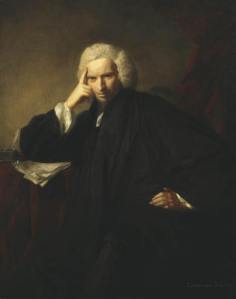
Joshua Reynolds, "The Revd Laurence Sterne," 1760 (London: National Portrait Gallery)
Among the highlights of the National Gallery’s current exhibition on Leonardo da Vinci is his Last Supper [a near-contemporary, full-scale copy on loan from the Royal Academy]. The fresco greatly influenced Sir Joshua Reynolds’ Society of Dilettanti paintings, and is one of nine new examples of Reynolds’ borrowing from the master, revealed here for the first time.
The borrowings of the 18th-century painter Sir Joshua Reynolds are the subject of fascination and much discussion. One painting by Reynolds, The Revd Laurence Sterne, has already been identified as derived from a Studio of Leonardo da Vinci painting. This article proposes other works by Reynolds that are derived from or influenced by Leonardo: a Leonardo drawing in the Ashmolean; a painting that was at the time in the Palazzo Barberini and attributed to Leonardo or a follower; and, intriguingly, Leonardo’s Last Supper. . . .
The full article is available here»
Submissions for the Oscar Kenshur Book Prize
Oscar Kenshur Book Prize
Applications due by 31 January 2012
The Center for Eighteenth-Century Studies at Indiana University is pleased to announce its annual book prize, to be awarded for an outstanding monograph of interest to eighteenth-century scholars working in a range of disciplines. The prize honors the work of Oscar Kenshur, professor emeritus of comparative literature at Indiana University, a dix-huitièmiste par excellence, and one of the founding members of the Center.
Submissions in English from any discipline are welcome; authors can submit their work irrespective of citizenship. Multi-authored collections of essays and translations, as well as books by members of the Indiana-University-Bloomington faculty, are not eligible. The Kenshur prize of $1000 will be awarded together with an invitation to the Center for Eighteenth-Century Studies for a workshop dedicated to the winning book, in which several colleagues will discuss the book from different disciplinary perspectives. The Center will cover the author’s expenses to attend this event.
To be eligible for this year’s competition, a book must carry a 2011 copyright date. Submissions can be made by the publisher or the author: three copies must be received at the ASECS office by the 31st of January 2012. Please send the books (clearly marked for Kenshur Prize) to ASECS, 2598 Reynolda Rd., Suite C, Winston-Salem, NC 27106. For further inquiries please contact Professor Mary Favret, Director of the Center for Eighteenth-Century Studies at Indiana University (email favretm@indiana.edu).
Reviewed: Meredith Martin’s ‘Dairy Queens’
Recently added to caa.reviews:
Meredith Martin, Dairy Queens: The Politics of Pastoral Architecture from Catherine de’ Medici to Marie-Antoinette, Harvard Historical Studies, vol. 176 (Cambridge: Harvard University Press, 2011), 336 pages, ISBN: 9780674048997, $45.
Reviewed by Jean-François Bédard; posted 3 November 2011.
Among the most fanciful objects commissioned by the French monarchy is a pair of Sèvres porcelain pails designed for Marie-Antoinette’s pleasure dairy at the Château de Rambouillet. They are shaped like tinettes—wooden buckets used on ordinary dairy farms for making fresh cheese—and painted with wood grain to imitate their rustic models. Like Marie-Antoinette’s mock hamlet at Trianon, the Rambouillet pails are outlandish inventions of the pastoral movement in literature and art, which celebrated naturalness with contrived theatricality. As the ill-fated monarch so cruelly experienced, bourgeois sensibilities soon lashed out at this noble ostentation. To pre-Revolutionary critics of the society of orders, a queen masquerading as a dairy maid in a luxurious simulated farm was particularly odious. Marie-Antoinette’s pastoral persona triggered venomous accusations of social irresponsibility, political usurpation, and even sexual deviance that contributed to her downfall and still taint her reputation.
The pastoral has not always elicited such heated reactions. In her amusingly titled book, Meredith Martin sets out to rehabilitate this courtly art form. Looking beyond the alleged frivolity of pastoral art and architecture, Martin emphasizes the crucial role they played in the social and political self-fashioning the French nobility, most notably the queens, forged for itself. Her discussion focuses on the pleasure dairy—known in French as the ‘laiterie d’agrément’, or ‘laiterie de propreté’, to distinguish it from the functioning dairy (laiterie de préparation). . . . Martin makes a convincing case for the importance of pleasure dairies as sites of empowerment for French noblewomen. . . .
The full review is available here» (CAA membership required)
Reviewed: ‘Thomas Lawrence: Regency Power and Brilliance’
Recently added to caa.reviews:
Cassandra Albinson, Peter Funnell, and Lucy Peltz, eds., Thomas Lawrence: Regency Power and Brilliance, exhibition catalogue (New Haven and London: Yale Center for British Art, National Portrait Gallery, London, and Yale University Press, 2011), 280 pages, ISBN: 9780300167184, $70.
Reviewed by Bruce Redford; posted 17 November 2011.
‘How various he is!’ Thomas Gainsborough’s tribute to Joshua Reynolds applies equally well to their successor in grand-manner portraiture. It is one of the signal achievements of ‘Thomas Lawrence: Regency Power and Brilliance’ that it removes any lingering traces of the negative stereotype: Lawrence the slick, formulaic sycophant who prostituted his gifts in the service of a decadent Regency elite. In its place this wide-ranging exhibition and thoughtful catalogue substitute a dynamic, probing, and inventive explorer of human psychology—one who is keenly attentive to the interplay of surface and depth, social mask and private self. Even Lawrence’s most public statements create a form of co-extensive space: not by breaking the picture plane, as in Caravaggio for instance, but by drawing the viewer into an
electric zone of intimacy. . . .
The full review is available here» (CAA membership required)
Happy Hanukkah
From The Jewish Museum:
The Jewish Museum, New York, 2 December 2011 — 29 January 2012
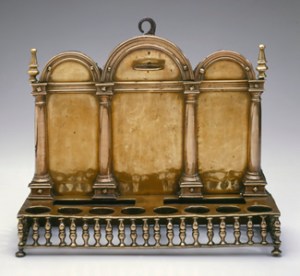
Hanukkah Lamp, Italy, 18th century (?), copper alloy, wood, and iron (New York: The Jewish Museum)
For this exhibition, the museum invited renowned artist and illustrator Maurice Sendak to choose a group of Hanukkah lamps from the collection. Sendak’s work is characterized by a push and pull between beauty and sorrow, light and darkness. His art is triggered by memories and is also their repository. The world he creates is both dangerous and healing, as he tries to deal with the trauma of the Holocaust, in which many members of his family perished.
When going through the museum’s collection, the sheer number and variety of lamps struck a nerve, underscoring Sendak’s deep, lifelong sense of loss at the destruction of the prewar world of his Eastern European Jewish parents. Having movingly evoked that world in his drawings for Zlateh the Goat and Other Stories (1966) and In Grandpa’s House (1985), he surprised himself by mostly avoiding its rich visual language when choosing lamps for this presentation. “I stayed away from everything elaborate. I kept looking for very plain, square ones, very severe looking,” he explained. “Their very simplicity reminded me of the Holocaust. And I thought it was inappropriate for me to be thinking of elaboration.”
The lamps Sendak finds most compelling and poignant are those that “go right to the heart,” whose “beauty is contained.” Yet his sense of humor is never far from the surface: as he made his choices he often free-associated, whimsically recalling old movies and Catskills family vacations. Above all, he is guided by his sensibility as an artist and author. He is drawn to simplicity of line, to a design “subservient to the basic idea of the piece,” and responds to the depth of emotion that emanates from a work itself or from the stories behind it. Concerned lest the past be forgotten, he hopes that young visitors to this exhibition will keep alive the memory of a vanished world.
Susan L. Braunstein and Claudia J. Nahson
Touro Synagogue — Newport, Rhode Island
The November/December 2011 issue of Preservation highlights a dozen National Trust Historic sites, across the United States, from James Madison’s Montpelier (1797) in Virginia to the Cooper Molera Adobe (1823) in Monterey, California. One that caught my eye, in particular: the Touro Synagogue (1763) in Newport, Rhode Island. From Lauren Wasler’s article in Preservation:
◊ ◊ ◊ ◊ ◊
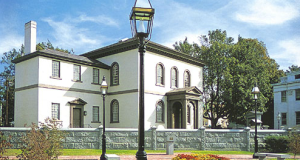 In 1658, 15 Jewish families whose ancestors had fled the Inquisition in Spain and Portugal arrived in Rhode Island by way of the West Indies. Settling in Newport, they established a close-knit community and founded a congregation in a colony already recognized for its religious tolerance. A century later, Isaac Touro became the congregation’s first spiritual leader and was part of the effort to build an elegant house of worship for the faithful.
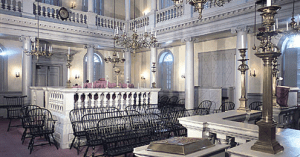 Today, that synagogue endures atop a hill near the city harbor—a living monument to religious freedom. “This is both a historic site and a functional synagogue. It has two distinct purposes,” says Chuck Flippo, manager of Touro Synagogue’s visitors center. “Come in the afternoon and you’ll see it as a historic site with guided tours. Come back in the evening and it reverts to its other role—its primary role—as a synagogue.”
Touro, the oldest standing synagogue in the United States, remains virtually unaltered since it was completed and dedicated in 1763. Designed by Peter Harrison, a British American merchant, sea captain, and self-taught architect, the two-story Palladian structure accommodates the religious needs of a typical Jewish congregation (for example, the ark containing the sacred scrolls is positioned so that worshipers can pray facing Jerusalem), while also reflecting New Englanders’ preference for restraint. Twelve Ionic columns (one for each tribe of Israel) support a second-story gallery; Corinthian columns ringing the gallery support the domed ceiling. Declared a National Historic Site in 1946, the synagogue became a National Trust Historic Site in 2001. . . .
The full article is available here»
San Diego Museum of Art Acquires Portrait by Mengs
As noted at ArtDaily

Anton Raphael Mengs, "Don Luis de Borbón," 1750-51 (San Diego Museum of Art)
The San Diego Museum of Art announces its newest addition to the permanent collection. An eighteenth-century painting by Anton Raphael Mengs, a portrait of Don Luis de Borbón, is now displayed among the Museum’s world-renowned collection of Spanish art.
“Although Spanish art is one of the Museum’s strengths, the collection has not had a Spanish painting made between the 1650s—the date of our late Zurbarán and early Murillo—and 1795, the date of our great portrait by Goya. This portrait by Mengs, the leading artist in Spain in the 1760s and 70s, begins to fill that gap. More importantly, the Don Luis de Borbón will hang proudly alongside our works by Goya and Pompeo Batoni, giving us a spectacular display of European portraiture from the later eighteenth century” says John Marciari, Curator of European Art at The San Diego Museum of Art.
Mengs (1728-1779) was famous throughout Europe during his lifetime. In the 1740s and 50s he divided his time between Dresden and Rome, winning major commissions for both portraits and fresco paintings in both cities. In Rome, he was also closely associated with the archaeologist and writer Johann Joseph Winckelmann, and their research into Greek art made them key figures in the rise of Neo-Classicism. Despite his importance as a theoretician and as a history painter, however, Mengs was most accomplished in the field of portraiture; the Don Luis de Borbón displays his delicacy and refined touch in the genre.
From 1761 onward, Mengs spent much of his time in Spain and was eventually named Primer Pintor (First Painter) and executed portraits of the royal family. Don Luis (1727-1785), the younger brother of King Charles III, had been destined for a career in the church and was named Cardinal at age eight, although he later renounced that office and became the Count of Chinchón. Living in semi-exile outside of Madrid, he became an important patron of the arts and was responsible for commissioning, for example, Francisco de Goya’s first major works.
Marciari will lecture on this painting, telling the story behind the acquisition and giving more details of the fascinating lives of both Mengs and Don Luis, on Saturday, February 11th, at 10:30 a.m.
Exhibition: Making the News in Eighteenth-Century France
From Carleton University:
Making the News in 18th-Century France
Carleton University Art Gallery, Ottawa, 13 February – 15 April 2012
Curated by Stéphane Roy
In 18th-century France, the dramatic rise in the production and rapid dissemination of prints played a key role in the creation of modern political culture. Prints helped people grasp the nature of newsworthy events both near and far, covering a wide range of historical moments, from the taking of Québec City in 1759 or the storming of the Bastille in 1789, to seemingly anecdotal acts of virtue performed by members of the monarchy or everyday individuals. Despite (or because) of the variable time lag involved in their making, printed images shaped public opinion as much – if not more – than the printed word, giving visual and tangible meaning to abstract yet politically-charged ideas and concepts such as “tyranny” or “patriotism.” Making the News presents approximately 40 prints made in France from 1770 to 1820, looking at their representation of actual events and the ways in which they fashioned how the French perceived their own place in History. Woven into a narrative linking history and art history, literature and journalism, politics and image-making, these objects will shed new light on art and ideas in the era of the Enlightenment and the French Revolution. Bound to the possibilities of centuries-old printmaking techniques, the 18th-century public’s relation to visual information echoes, in many ways, our own experience in the digital age, concerned with access to and transformation of content. Making the News ultimately prompts us to examine our current practice of looking, understanding and consuming the news.
Lemoyne’s Annunciation on Loan to the National Gallery
From the National Gallery:

François Lemoyne, The Annuncation, 1727
François Lemoyne, The Annuncation, 1727
National Gallery, London
On Loan from Winchester College
According to Saint Luke’s Gospel, the archangel Gabriel announces to the Virgin that she will give birth to Jesus. This depiction of the subject is signed and dated 1727, the year the artist was awarded a prize for history painting by Louis XV. It may have been commissioned by the then headmaster of Winchester College where it was installed in 1729. Its painted arched top suggests an arched frame was originally intended.










 Enfilade
leave a comment