Phillips Book Prize
Phillips Book Prize
Applications due by 15 January 2012
The Phillips Collection Center for the Study of Modern Art offers an annual prize for an unpublished manuscript presenting new research in modern or contemporary art from 1780 to the present. Preference is given to applicants whose research focuses on subjects related to the museum’s areas of collecting. The winner receives $5,000, and his or her manuscript will be published by the Univ. of CA Press. Scholars who received their PhDs within the past 5 years are strongly encouraged to apply.
TO APPLY: submit a cover letter, a CV, an abstract of the proposed book (1-page max), and a book proposal (8-10 pages). The book proposal should include a project overview, chapter outlines, a plan for revisions and completion of the manuscript, and a description of the book’s position in the literature of modern or contemporary art. Three current letters of recommendation are also required. Please send materials electronically to CSMAprograms@phillipscollection.org.
Panel Discussion of ‘The Image of the Black in Western Art’
From the National Gallery:
Image of the Black in Western Art, Part II
National Gallery of Art, Washington DC, 11 December 2011
Panel discussion includes David Bindman, emeritus professor of the history of art, University College London; Henry Louis Gates Jr., Alphonse Fletcher University Professor and director of the W. E. B. Du Bois Institute for African and African American Research, Harvard University; and Sharmila Sen, general editor for the humanities, Harvard University Press. Moderated by Faya Causey, head of academic programs, National Gallery of Art. Book signing of The Image of the Black in Western Art (volumes 1-3) follows. Sunday, 11 December 2011, 2:00pm, East Building Concourse, Auditorium.
◊ ◊ ◊ ◊ ◊
David Bindman and Henry Louis Gates, Jr., eds., associate editor Karen C. C. Dalton, The Image of the Black in Western Art Volume III: From the ‘Age of Discovery’ to the Age of Abolition, Part 3: The Eighteenth Century (Cambridge: Harvard University Press, 2011), 400 pages, ISBN 9780674052635, $95.
 In the 1960s, art patron Dominique de Menil founded an image archive showing the ways that people of African descent have been represented in Western art. Highlights from her collection appeared in three large-format volumes that quickly became collector’s items. A half-century later, Harvard University Press and the Du Bois Institute are proud to publish a complete set of ten sumptuous books, including new editions of the original volumes and two additional ones.
The Eighteenth Century features a particularly rich collection of images of Africans representing slavery’s apogee and the beginnings of abolition. Old visual tropes of a master with adoring black slave gave way to depictions of Africans as victims and individuals, while at the same time the intellectual foundations of scientific racism were established.
Postdoctoral Fellowship in DC
Postdoctoral Fellowship: Phillips Collection and The George Washington University
Washington, DC, 2012-2013
Applications due by 15 January 2012
The Phillips Collection and The George Washington University (GW) offers a Postdoctoral Fellowship available to support research and teaching on topics in American, European, or non-western art, including photography, from 1780 to the present. The Fellow will be expected to teach one undergraduate or graduate course at the Phillips Center for the Study of Modern Art or at GW, present at least one public lecture at the Phillips, and participate in other programs and discussions. The appointment carries a departmental affiliation with GW’s Department of Fine Arts and Art History and with The Phillips Collection, and carries a stipend. The Fellowship is open to untenured scholars who have received their PhDs within the past five years. Preference will be given to applicants whose projects focus on subjects related to the museum’s areas of collecting.
More information is available here»
December 2011 Issue of ‘The Art Bulletin’
The eighteenth century in the latest issue of The Art Bulletin:
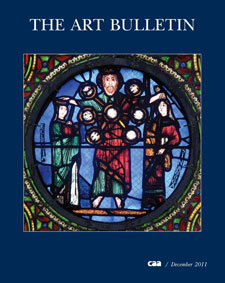 James M. Córdova, “Clad in Flowers: Indigenous Arts and Knowledge in Colonial Mexican Convents,” The Art Bulletin 93 (December 2011): 449-67.
Nuns in New Spain (colonial Mexico) wore spectacular flowery trappings when they professed and again when reposing on their funeral biers. Local artists, commissioned by the nuns’ families and convents, captured these stunning images. Despite differences in ethnicity, religious order, age, and other factors that distinguished these women, their flowery trappings have the effect of establishing an iconic image of the New Spanish nun. Furthermore, their regalia, which combine Euro-Christian and Mesoamerican practices and beliefs, not only represented the preeminence of the “brides of Christ,” they also conjured the spiritual transformations that nuns experienced in their ritual lives.
◊ ◊ ◊ ◊ ◊
Étienne P. H. Jollet, Review of Frank Fehrenbach’s Compendia Mundi: Gianlorenzo Berninis “Fontana dei Quattro Fiumi” (1648-51) und Nicola Salvis “Fontana di Trevi” (1732-62), The Art Bulletin 93 (December 2011): 491-94.
◊ ◊ ◊ ◊ ◊
N.B. — Notice of Jollet’s review did not appear in the original posting from 2 December 2011; it was added on 9 February 2012. I apologize for the initial oversight. -CH
Installing a Ceramic Room in Honolulu
As a follow-up to yesterday’s essay from Amanda Strasik, which relied heavily upon an interview she conducted with Amber Ludwig, today’s posting gives us a glimpse at one of the projects keeping Amber busy these days . . . From her posting at the Honolulu Academy of Arts Blog (1 November 2011) . . .
◊ ◊ ◊ ◊ ◊
 Many museums are reinstalling their ceramics collections in a manner that reflects the high point of innovation in Western ceramics—the 18th century. It was during the early 18th century that Europeans were finally able to produce the strong, thin, white-bodied ceramic known as porcelain, some 1,100 years after the Chinese began making it. Porcelain was so highly valued in the Western world that wealthy collectors displayed their collections not in large breakfronts or atop delicate tea tables, but in entire rooms filled floor-to-ceiling with “white gold,” as porcelain was commonly called.
Gallery five at the Honolulu Academy of Arts is the second gallery to be reinstalled as part of a year-long curatorial project that began with gallery four. The new design of gallery five includes a ceramics cabinet that reflects this curatorial trend of large-scale installations of porcelains and other ceramics. Currently, gallery five displays exquisite examples of 17th-century painting and sculpture. Soon, however, it will be reinstalled with European and American paintings and sculpture from the 18th and 19th centuries and will also include a floor-to-ceiling ceramics display, meant to evoke the great “ceramic rooms” of the 18th century.
I was hired in September as the Curatorial Assistant to Theresa Papanikolas, Curator of European and American Art, and, for my first project, Theresa asked me to research the Academy’s collection of European and American ceramics for the reinstallation. My academic background is 18th- and 19th-century European art, so this is a good fit and something I am enjoying immensely. For the past month, I’ve been scouring the Academy’s holdings of European ceramics to determine a checklist and to create a design for the gallery five ceramics cabinet. I find myself often visiting the Seattle Art Museum’s Guide to the Porcelain Room for inspiration. . . .
The full posting is available here»
From Student to Art Historian: Transitioning into Professionalism
As Enfilade’s internship program continues to develop and finds its way, I’m happy to give a large public word of thanks to Amanda Strasik as her two-months with us draws to an end. She’s done a fantastic job tracking down material — much of which was posted under her name (though plenty of things appeared generically under the ‘editor’ label). Even more, she patiently put up with my hectic fall schedule. Here, in her final posting, she, as a first-year Ph.D student, contemplates what the end of her graduate training might bring — all with the help of Amber Ludgwig, whom she interviewed for the essay. Many thanks, Amanda! -CH
◊ ◊ ◊ ◊ ◊
In ruminating over the development of academic identity, I’m grateful to Dr. Amber Ludwig for her insights. — AS
 s a new Ph.D. student immersed in the world of the classroom, I’ve already noticed that it’s easy to become absorbed in my own research and neglect greater thought to the existence of the professional world of art history—the very world I’m striving to join. While the completion of my graduate work lies in the distant future, I’ve begun to consider the evolution of my own identity as a young scholar, progressing toward the “transitional phase” that all successful graduate students eventually face, the period when one looks to the job market but still has not entirely shed the identity of a student. In an effort to help demystify the “transition” from student to professional in terms of the development of scholarly identity, Dr. Amber Ludwig, a 2011 doctoral graduate of Boston University, kindly volunteered to share some of her experiences as she went from a “deferential graduate student to a commanding ‘doctor.’” Currently a Curatorial Assistant at the Honolulu Academy of Arts and the Interim Co-Director of the University of Hawaii Art Gallery, Dr. Ludwig has, through her own insights, encouraged me to conjoin, rather than separate, my identity as a student-professional, in the course of pursuing my own career as a young art historian.
During our interview, Amber mentioned that the dissertation writing process was a period of time when she felt very much alone with her thoughts. As a student, she worked independently on topics of her choosing, and she was really responsible only to the professors on her dissertation committee. In addition to the personal enjoyment she found in her subject matter, the notion of introducing new ideas to the field of eighteenth-century art history was inspiring in itself. Now as a museum professional, she’s been forced to adapt to a more “team-like” setting that is constrained by budgetary restrictions and the specific interests of the university audience. While this framework alleviates much of the “what comes next” pressure, it’s a very different working environment than graduate school.
Amber notes, for instance, that whereas her audience was previously dominated by her adviser, it’s now large and varied in terms of scholarly backgrounds — and she adds, “surprisingly more critical!” She credits the dissertation defense as an “incredibly helpful exercise” for instilling confidence in one’s work. She also stresses that the dissertation process is the beginning of one’s career, not the end. Thus, the dissertation is not simply about exhibiting expertise on a particular subject; rather, one is expected to “use the lessons learned throughout the process to improve one’s scholarship and professional practice.” In Amber’s case, she found herself constantly evaluating and re-evaluating how she could improve both her argument and the process itself in order to transition into the professional world more confidently confidently.[i]

As I evaluate my own development of scholarly identity and moments of academic self-discovery, I asked Amber if she had any advice that might make the transition from grad student to professional a little less intimidating. In response, she emphasized the value of presenting at conferences. The experience not only builds students’ confidence to speak authoritatively about their work, but also facilitates networking among others with similar interests.
She concluded our interview with a thought that has made a real impression me: don’t take criticism too personally. For a quasi-sensitive graduate student like me, criticism of one’s academic performance is both necessary and terrifying. And so I’m going to do my best to keep her words in mind: “if you were already perfect, there would be no need for education. Think of it as money well spent.”
◊ ◊ ◊ ◊ ◊
[i] For an interesting take on the dissertation as the beginning of one’s academic career, see Karen Kelsky’s article, “Dissertation Limits,” from InsideHigherEd.com (12 September 2011). Kelsky explains how little, in her opinion, the dissertation itself matters in the bigger picture for a prospective academic job candidate. It’s an intriguing perspective when thinking about the formation of a graduate student’s scholarly identity.
November Issue of ‘The Burlington’
The Burlington Magazine 153 (November 2011)
 Articles
• Gauvin Alexander Bailey and Fernando Guzmán, “The ‘St Sebastian’ of Los Andes: A Chilean Cultural Treasure Re-examined,” pp. 721-26. — A discussion of the polychrome statue of St Sebastian (c.1730-35) in Los Andes, Chile, which is here attributed to Adam Engelhard.
• Chiara Teolato, “Roman Bronzes at the Court of Gustavus III of Sweden: Zoffoli, Valadier and Righetti,” pp. 727-33. — The provenance and installation of Roman bronzes by Giacomo Zoffoli, Luigi Valadier and Giovan Battista Piranesi in the collection of Gustavus II of Sweden.
Reviews
• Tommaso Manfredi, Review of Heather Hyde Minor, The Culture of Architecture in Enlightenment Rome (University Park: Penn State University, 2010), p. 749.
Call for Papers: Congress of Portuguese Art History
IV Congresso de Historia da Arte Portuguesa
Lisbon, 21-24 November 2012
Proposals due by 29 February 2012
The Portuguese Association of Art Historians (APHA) is pleased to announce that the Call for Papers for the IV Congress of Portuguese Art History is now open and can be consulted on the site of the congress: http://www.chap-apha.com/pdf/CFP20110921.pdf). It consists of 12 thematic sessions, as well as a number of open sessions. The languages of the Congress are Portuguese, English, Spanish, French and Italian.
The abstracts, of no more than 300 words, should be sent by email (until February 29, 2012) both to the secretary of the congress (secretariado@chap-apha.com) and the organizers of the respective sessions. The abstracts should be accompanied by a brief curriculum vitae (including institutional affiliation, address and contact details).
The participants will be notified by March 31, 2012 and the program of the Congress will be available on May 7, 2012. The full texts of the communications should be delivered to the organizers of the respective sessions by July 31, 2012. The texts of each session should be made available to its participants to ensure an informed debate.
The abstracts and full texts of the communications will be published in print and digital form by September 30, 2012 and, based on that material, the organization of the Congress will publish in 2013 an Hommage to José-Augusto França, to whom the Congress is dedicated.
Exhibition: Winter Tales, from Bruegel to Beuys
From the Kunsthistorisches Museum:
Winter Tales: Depictions of Winter in European Art from Bruegel to Beuys
Kunsthistorisches Museum, Vienna, 18 October 2011 — 8 January 2012
Kunsthaus Zurich, 10 February — 29 April 2012
Curated by Ronald de Leeuw

Joshua Reynolds,"Lady Caroline Scott as Winter," 1776. Collection of the Duke of Buccleuch and Queensberry, Bowhill, Selkirk, Scotland (Photo: Wikimedia Commons)
The creation myths of most great civilizations agree that winter came into the world to punish man, or as a plague. Boreas, the Greek god of the cold north wind, personified winter. In northern mythology three years of frost herald the end of the world.
Large-scale depictions of how Napoleon’s Grande Armée was defeated by the Russian winter are a modern equivalent of these ancient scenarios of the end of the world. The contrary vision comprises serenity and joyous cheer: we gaze at views of a snow-covered countryside with skaters enjoying themselves on frozen ponds and rivers in the distance. The late 18th century sees a revival of long-unfashionable winter landscapes: at first romanticized, they evolve to reflect the palette of winter.
Impressionism, Dutch art and a wealth of landscapes – these were the ingredients of earlier winter exhibitions. The Kunsthistorisches Museum and the Kunsthaus Zurich have expanded this successful trio. Broadening the selection to include many different genres and schools, the two museums present a comprehensive survey comprising over 180 works by west-European artists. Four galleries and nine small rooms of the KHM’s
Picture Gallery form the show’s spectacular setting. The works on show
date from 1450 to the present. In addition to the subjects mentioned
above there are Dutch allegories of the months, depictions of winter
festivities and folk customs, and still lifes; even portraits join in and
present changing winter fashions.
 The paintings are arranged more or less in chronological order; the show’s guest curator, Ronald de Leeuw, was able to augment the selection by including large-scale tapestries and an imperial sleigh as well as cups and goblets, fragile porcelain figures and vessels cut from semi-precious stones. Three years in the making, the exhibition brings together important loans from Amsterdam, Munich, London, Cambridge, Paris, Strasbourg, Rotterdam, Dresden, Zurich, Philadelphia, Darmstadt, Edinburgh, Cologne, The Hague, New York, Gent, Weimar and Boston, to name but a few. However, the unique focal point of any winter exhibition is in the Picture Gallery of the Kunsthistorisches Museum: Pieter Bruegel the elder’s painting “Hunters in the Snow”, perhaps the most famous depiction of winter in European art. The large panel cannot be loaned and will only be on show in Vienna.
In addition to works by Pieter Bruegel the exhibition includes paintings by Jacob van Ruisdael, Hendrick Avercamp, Jan van Goyen, Aert van der Neer, Peter Paul Rubens, Jan Steen, Jacob Jordaens, William Turner, Francisco de Goya, Caspar David Friedrich, Gustave Courbet, Jean-François Millet, Claude Monet, Alfred Sisley, Camille Pissarro, Vincent van Gogh, Giovanni Segantini, Edvard Munch, Joseph Beuys and Anselm Kiefer.
For more information, see the exhibition press release»
◊ ◊ ◊ ◊ ◊
Catalogue: Sabine Haag, Ronald de Lleuw, and Christoph Becker, Wintermärchen: Der Winter in der Kunst von Bruegel bis Beuys (Cologne: DuMont, 2011), 432 pages, ISBN: 9783832193935, €39 / $77.50 [available from artbooks.com]
Exhibition: Duncan Phyfe, Master Cabinetmaker in New York
From The Met:
Duncan Phyfe: Master Cabinetmaker in New York
The Metropolitan Museum of Art, New York, 20 December 2011 — 6 May 2012
Museum of Fine Arts, Houston, 20 June — 11 September 2012
 In the early 1800s, furniture from the workshop of New York City cabinetmaker Duncan Phyfe (1770–1854) was in such demand that he was referred to as the “United States Rage.” This exhibition—the first retrospective on Phyfe in ninety years—will serve to re-introduce this artistic and influential master cabinetmaker to a contemporary audience.
The full chronological sweep of Phyfe’s distinguished career will be featured, including examples of his best-known furniture based on the English Regency designs of Thomas Sheraton, work from the middle and later stages of his career when he adopted the richer “archaeological” antique style of the 1820s, and a highly refined, plain Grecian style based on French Restauration prototypes. The exhibition brings together nearly one hundred works from private and public collections throughout the United States. Highlights of the exhibition include some never-before-seen documented
masterpieces and furniture descended directly in the Phyfe family, as well as
the cabinetmaker’s own tool chest.
Organized chronologically, the exhibition will present the cabinetmaker’s life and work through drawings, documents, personal possession, and furniture. Portraits of his clients and contemporary depictions of New York City street scenes and domestic interiors will provide a glimpse into Phyfe’s milieu.
Read more»
◊ ◊ ◊ ◊ ◊
Catalogue: Peter Kenny, Frances Bretter, Michael Brown, and Matthew Thurlow, Duncan Phyfe: Master Cabinetmaker in New York (New York: Metropolitan Museum of Art, 2011), 352 pages, ISBN: 9780300155112, $65.










 Enfilade
leave a comment