Call for Papers: Association of Historians of American Art Conference
From the Association of Historians of American Art:
American Art: The Academy, Museums, and the Market
The Second Association of Historians of American Art Symposium
Boston, 12-13 October 2012
Proposals due 1 December 2011
We invite proposals on any aspect of American Art that relate to the symposium’s theme of the Academy, Museums, and the Market. Proposed papers should be 20-minute, formal papers on any period of American art, in any media, from 1600 to the present day. We are also inviting proposals, from current graduate students at the dissertation stage, for a Graduate Student Lightning Round Session at the conference. Proposed papers for this session should be a 5-minute synopsis of the larger research project. In the subject line of your email, please distinguish whether you are applying for inclusion in the general symposium (20-minute paper) or in the Graduate Student Lightning Round Session (5-minute paper). Please only apply to one type of session. Please send your proposal and a short cv by December 1, 2011 to both David Dearinger and Melissa Renn, AHAA Symposium co-chairs at dearinger@bostonathenaeum.org and melissa_renn@harvard.edu.
Exhibition: The English Prize, The Capture of the Westmorland
From the YCBA:
The English Prize: The Capture of the Westmorland, an Episode of the Grand Tour
The Ashmolean Museum, Oxford, 17 May — 27 August 2012
The Yale Center for British Art, New Haven, 20 September 2012 — 6 January 2013
Curated by Scott Wilcox, Elisabeth Fairman, and María Dolores Sánchez-Jáuregui Alpañés
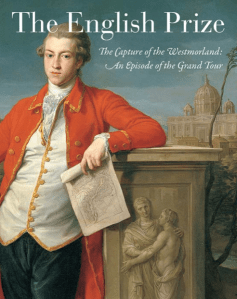 This exhibition tells the extraordinary story of the capture of the Westmorland, a British merchant ship laden with works of art acquired by young British travelers on the Grand Tour in Italy, and the subsequent disposition of its contents. Shortly after sailing from Livorno, Italy, in 1778, the ship was captured by the French navy, which was well aware of its exceptional contents. The Westmorland was escorted to Málaga, in southern Spain, where its contents were inventoried and acquired by agents who in turn sold most of the works of art on board to King Carlos III of Spain. Much of the material was subsequently presented by the king to the Real Academia de Bellas Artes de San Fernando in Madrid. The original inventories, which survive in the Academia’s archives, are remarkably thorough, enabling the identification of many of the items on board the ship when it was captured. Much of the material remains in the Real Academia, but significant works were passed on to the Spanish Royal Collection and are now in the Museo Nacional del Prado or in royal residences in Spain. Because most of these works can be associated with the tourists who were sending them back to Britain, the contents of the Westmorland forms the most complete “cross section” of the Grand Tour discovered to date. The exhibition comes out of a major research project initiated in the late 1990s, led by Professor José María Luzón Nogué, that investigates the story of the Westmorland and its contents. In recent years, with the support of the Paul Mellon Centre for Studies in British Art in London, remarkable progress has been made in identifying and cataloguing these extraordinarily diverse treasures, and this research forms the basis of the exhibition.
◊ ◊ ◊ ◊ ◊
Catalogue: María Dolores Sánchez-Jáuregui Alpañés and Scott Wilcox, eds., The English Prize: The Capture of the Westmorland, an Episode of the Grand Tour (New Haven: Yale University Press, 2012), 400 pages, ISBN: 9780300176056, $75.
◊ ◊ ◊ ◊ ◊
Charlotte Higgins writes about the exhibition for The Guardian (20 November 2011).
Williamsburg Conference: Working Wood in the Eighteenth Century
From Colonial Williamsburg:
Working Wood in the Eighteenth Century: Furniture of George and Martha Washington
Colonial Williamsburg, 22-25 and 26-29 January 2012
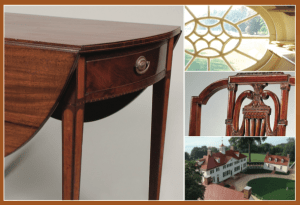 George Washington’s Mount Vernon will partner with Colonial Williamsburg and Fine Woodworking to present the 14th annual Working Wood in the 18th Century conference at Colonial Williamsburg. Mount Vernon curators and restoration staff will explore Washington’s home and the furniture he and Martha acquired to furnish it. Cabinetmakers from Colonial Williamsburg’s Hay Shop will build two pieces at Mount Vernon today: a lady’s knee-hole dressing table made in Williamsburg at the Peter Scott shop, sold to Daniel Parke Custis, Martha Washington’s first husband, in 1754, and brought by Martha to Mount Vernon after she married Washington in 1759; and, an elaborate sculptural candle stand, or torchère, that George Washington purchased for £ 3.10 on December 2, 1759, from the Scottish cabinetmaker James Allan who was then working in Fredericksburg, Virginia.
Guest cabinetmakers Dan Faia of The North Bennet Street School and Jeff Headley and Steve Hamilton of Mack S. Headley and Sons will lead us into the Federal period. Jeff and Steve will reproduce one of the Washingtons’ dining chairs made by John Aitken of Philadelphia in 1797, and Dan will construct a delicate, inlaid Pembroke, or breakfast, table. Colonial Williamsburg’s joiners will demonstrate sash construction by reproducing the famous bull’s-eye window in the pediment of the Mansion.
Along with the conference in Williamsburg, Mount Vernon is planning special interest Mansion, museum, and behind-the-scenes tours for conference participants on January 26 and 30. More information to come as details are in place. If in the meantime, you want to take a look at some of the pieces, they can be viewed at the Mount Vernon website: www.mountvernon.org
Note: The program is the same number of days as previous years but is scheduled later in January and session one runs Sunday through Wednesday and session two Thursday through Sunday.
An event brochure is available here»
Call for Papers: Spaces of Work
From Warwick:
Spaces of Work, 1770–1830
University of Warwick, 28th April 2012
Proposals due by 1 December 2011
Spaces of Work, 1770-1830 will address the relationships between workers and spaces in Britain. We aim to showcase current research and are particularly interested in interrogating under-analyzed types of work and space. For example, we hope to develop the theorization of types of work that critics have not conventionally understood as ‘work’ (the performance of music as practical activity, for instance). We also aim to bring attention to under-analysed spaces. For example, due to Romanticism’s traditionally rural focus, literary critics of this period have only recently begun to interrogate urban spaces; interdisciplinary discussion of urbanism in this period would therefore be particularly valuable. We aim to analyze the interfacing of work and space as two factors that fundamentally shape everyday life in order to gain a greater understanding of material life in the period. To these ends, 500 word abstracts are invited which attempt to answer questions such as the following:
• How do workers and their work uniquely shape space?
• How does space facilitate or hinder workers and their work?
• How does the social relationship among workers and between them and their supervisors/masters alter according to the work they are doing and the spaces in which they perform it?
• How does gender, race, and/or class inform workers’ relationship to each other in different contexts of space and work?
Possible approaches could include, but are not limited to: genteel work and the city; work in spaces of ‘leisure’; work and (sub)urban domestic spaces; men’s work in the home; space and female accomplishment; work and emergent manufacturing/industrial spaces. Please send submissions to the conference organizers, Kate Scarth & Joseph Morrissey, at j.morrissey@live.co.uk by 1/12/2011. Papers at the conference will be thirty minutes in length, with a generous allocation for questions.
Confirmed keynote speakers: Karen Harvey (University of Sheffield) and Jennie Batchelor (University of Kent)
Call for Papers: ‘Shift: Graduate Journal of Visual & Material Culture’
From the journal’s website:
Shift: Graduate Journal of Visual and Material Culture
Proposals due 1 March 2012
Shift welcomes academic papers, exhibition and book reviews, as well as discussions concerning other art-related events from current graduate students. The committee welcomes submissions dealing with visual and material culture from any discipline. Papers may address a full range of topics and historical periods. Topics may include, but are not limited to, art and propaganda, patronage, gender and identity, spirituality and art, nationalisms and regionalisms, modernism and modernity, performance art, photography and film, perspectives in theory, methodology, and historiography, collection and representation, art and technology. Please see Submission and Style Guidelines on our website for appropriate guidelines.
For each issue, submitted papers will be reviewed by an Editorial Committee composed of current graduate students from The University of Western Ontario. Papers considered the strongest will be sent to the Editorial Board, which is composed of upper-level graduate students and established scholars. Papers judged by the Editorial Board as contributing to existing scholarship will be accepted for publication in the journal. All papers are selected by blind jury panel, and are therefore considered refereed.
This journal is an online publication. All manuscripts should be sent by email to editors@shiftjournal.org. Papers must be submitted to the editors of Shift by 1 March 2012. The issue launch will take place 1 October 2012.
Exhibition: French Genre Painting, 1770-1820
From the museum’s website, as noted by Hélène Bremer . . .
Petits théâtres de l’intime: La peinture de genre française
Musée des Augustins, Toulouse, 22 October 2011 — 22 January 2012
 The history of French genre painting from 1770 to 1820: a window into changing tastes,fashions and the curiosity of society
Through this exhibition, the Musée des Augustins offers a panorama of the various movements in French genre painting from the end of the 18th century to the beginning of the 19th century. By presenting these scenes of day-to-day life, the exhibition gives the viewer a fresh vision of a set of painters. Some works by the most famous artists such as Fragonard, Marguerite Gérard, Greuze, Boilly or Drolling will be presented to the public for the first time, but there will also be many works by artists whose names have been forgotten or lost.
Through sixty scenes, this exhibition echoes moments in French society between the end of the Ancien Régime and the Restoration: private moments, family time, artistic and society events.These works, which have been kept both in French public collections and in private collections, illustrate changes in tastes and fashion and the influence of foreign schools on the French painting of this very troubled period.
A brochure for the exhibition (in French) is available here»
Reviewed: ‘Pierre Jacques Volaire (1729-1799)’
Recently added to The Art Tribune:
Emilie Beck Saiello, Pierre Jacques Volaire (1729-1799), dit le Chevalier Volaire (Paris: Arthena, 2010), 486 pages, ISBN: 9782903239435, 119€ / $175.
Reviewed by Bénédicte Bonnet Saint-Georges; posted 31 October 2011.
 He does not lie in the pantheon of great artists and his work does not fall under the genre of grand painting; some would even say that his art is repetitive, a succession of views of Mount Vesuvius meant to sell briskly as souvenirs of the Grand Tour. Emilie Beck Saiello has nevertheless set out to reinstate the artistic legacy of Pierre Jacques Volaire, known as the Chevalier Volaire, by publishing the catalogue raisonné of his works at Arthena Ed. She explains that ‘art history is not made up of only great masters just as history is not made up only of great men and the study of a successful or “commercial” artist might lead us to discover how his work reflected the taste, culture and aesthetics of a certain period and was able to express a moment, a place and a society.’ . . .
The full review is available here»
Seminar Series: Tableaux Vivants
Le tableau vivant ou l’image performée: sources, méthodes, enjeux
Institut national d’histoire de l’art, Paris, 2011-2012
For the 2011-2012 academic year, INHA in Paris is addressing tableaux vivants with six sessions on the topic. The second in the series takes place on Tuesday, 29 November, from 5-7pm. More information on the series as a whole is available here»
◊ ◊ ◊ ◊ ◊
From Le Blog de l’ApAhAu
Aux frontières du tableau vivant : la pantomime ou l’éloquence du corps, XVIIIe-XIXe siècles
Institut national d’histoire de l’art, Paris, 29 November 2011
Organized by Julie Ramos and Léonard Pouy
 Communément définie comme un arrangement de personnes vivantes reproduisant une composition artistique, que ce soit une peinture, une sculpture, une estampe ou une scène littéraire, la pratique du « tableau vivant » aurait, selon les récits admis, connu son apogée dans les salons privés du début du XIXesiècle avant de déchoir en simple divertissement populaire. Cette vision du tableau vivant a contribué à concentrer son étude autour de 1800, à occulter ses origines plus anciennes, ainsi qu’à négliger ses évolutions ultérieures et son apport à l’histoire de l’art. Partant de ce constat, ce séminaire vise à examiner le tableau vivant et ses genres connexes dans la durée, ainsi qu’à saisir la manière dont ils franchissent les frontières esthétiques et sociales et questionnent les définitions traditionnelles de l’art.
Pratique variée et sans cesse réactivée, des anciennes entrées royales au cinéma et à l’art contemporain, elle interroge la relation entre mimesis et représentation, la capacité de l’art à véhiculer des affects et des idéaux, ainsi que les statuts d’auteur et de spectateur. L’étude des tableaux vivants permet de réfléchir sur le caractère reproductible et la diffusion des œuvres d’art, sur l’apparition du terme dans la critique, sur les effets de réel et de présence, ou encore sur les relations entre image et performativité.
◊ ◊ ◊ ◊ ◊
Chiara Savettieri Wurmser (Université de Pise)
L’art du geste comme modèle de la peinture ? le cas de Jacques Nicolas Paillot de Montabert
Enseignant-chercheur en Histoire de l’Art à l’Université de Pise, Chiara Savettieri travaille sur les interactions entre peinture et littérature de même qu’entre arts visuels et musique. Parmi ses travaux les plus significatifs: Ingannare la morte. Anne-Louis Girodet Trioson e l’illusione dell’arte (Palermo 2005), tiré d’une partie de sa thèse de doctorat consacrée à la pensée esthétique de Anne-Louis Girodet ; Dal Neoclassicismo al Romanticismo. Fonti per la Storia dell’arte (Carocci, 2006, Rome, 766 p.) ; “Il faut que le peintre adopte, comme le musicien, un mode: peinture et musique dans la pensée esthétique de Paillot de Montabert”, Jacques-Nicolas Paillot de Montabert, 1771 – 1849: idées, pratiques, contextes, dir. par F.Desbuissons, Langres, Guéniot, 2009, p. 171-187 ; “L’essence du cinéma consiste dans le rythme : peinture, cinéma et musique dans l’Univers de Luigi Veronesi”, dans Ligeia, 97/100.2010, p. 83-95 . Avec Marie-Pauline Martin elle a organisé le colloque «La musique face aux Beaux-arts ou les vicissitudes de l’imitation» (Centre Allemand d’Histoire de l’art, INHA, février 2010) dont la publication des actes est en préparation.
Arnaud Rykner (Université Paris 3-Sorbonne Nouvelle)
Le paradigme pantomimique
Romancier, essayiste et dramaturge, Arnaud Rykner est également Professeur à l’Institut d’Etudes Théâtrales de l’Université Paris 3-Sorbonne Nouvelle et membre associé du Laboratoire « Lettres, Langages et Arts » de l’Université Toulouse II – Le Mirail. Il a notamment dirigé l’ouvrage Pantomime et théâtre du corps. Le jeu du hors-texte (Presses Universitaires de Rennes, 2009, 245 p.) ; « Tableau vivant, scène érotique. L’entrelacs des images et des corps », Journée d’études Théâtralité de la scène érotique aux XIXe et XXe siècles, 21 mai 2010, Maison de la Recherche de l’Université Toulouse II – Le Mirail. Les actes du colloque Entre code et corps. Tableau vivant et photographie mise en scène, organisé en collaboration avec Christine Buignet à Toulouse du 18 au 20 mars 2010, paraîtront en mars 2012 dans le 22e numéro de la revue Figures de l’art.
Bernard Vouilloux (Université de Paris-Sorbonne)
Gestes, attitudes, mouvements : le tableau vivant des arts de la scène à la photographie
Professeur de littérature française du XXe siècle (littérature et arts visuels) à l’Université de Paris-Sorbonne, Bernard Vouilloux a centré ses recherches sur les rapports entre le verbal et le visuel, littérature et peinture, poétique et esthétique. Outre de très nombreux articles (notamment dans les revues Poétique, Littérature et Critique), il a publié dix-sept ouvrages, parmi lesquels La Peinture dans le texte. XVIIIe-XXe siècles (CNRS Éditions, 1994), Langages de l’art et relations transesthétiques (Éd. de l’Éclat, 1997), Le Geste, suivi de Le geste ressassant (La Lettre volée, 2001), Le Tableau vivant. Phryné, l’orateur et le peintre (Flammarion, 2002), L’œuvre en souffrance. Entre poétique et esthétique (Belin, 2004), Tableaux d’auteurs. Après l’Ut pictura poesis (Presses universitaires de Vincennes, 2004), Écriture de fantaisie. Grotesques, arabesques, zigzags et serpentins (Hermann, 2008), Un art sans art. Champfleury et les arts mineurs (Fage Éditions, 2009), Le Silence et la nuit des images. Penser l’image avec Pascal Quignard (Hermann, 2010), Le Tournant « artiste » de la littérature française. Écrire avec la peinture au XIXe siècle (Hermann, 2011).
Pauline Beaucé (Université de Nantes, Centre Marc Bloch, Berlin)
Répondante
Auteur d’une thèse de doctorat consacrée à la Poétique de la parodie dramatique d’opéra au XVIIIe siècle en France (dir. F. Rubellin), Pauline Beaucé est membre du Centre d’études des théâtres de la Foire et de la Comédie-Italienne (Univ. de Nantes). Rattachée au Centre Marc Bloch, elle a édité plusieurs parodies d’opéra (et notamment une parodie pantomime) aux Editions Espaces 34 et a publié différents articles sur le théâtre au XVIIIe siècle tels « La parodie-pantomime d’opéra au XVIIIe siècle ou l’adaptation sous contraintes », actes du colloque L’Adaptation comique, de la référence à l’irrévérence, 2009 ; « Musique et théâtre : pour de nouvelles perspectives théoriques et méthodologiques à partir de l’exemple de la parodie dramatique d’opéra en France au XVIIIe siècle », colloque junior franco-allemand Musique-Contexte, CIERA, Berlin, 4-6 février 2010, actes à paraître, chez Lang ; « L’envers parodique du magicien d’opéra au XVIIIe siècle », Les Scènes de l’enchantement, Desjonquères, 2011.
Exhibition: French Drawings from the Mariette Collection
From the Louvre, as noted by Hélène Bremer:
French Drawings from the Mariette Collection
Musée du Louvre, Paris, 10 November 2011 — 6 February 2012
Curated by Pierre Rosenberg, Laure Barthélemy-Labeeuw, and Bénédicte Gady

Jean-Baptiste Oudry, Egret (Paris: Louvre)
Pierre Jean Mariette (1694–1774) brought together one of the most fascinating collections in the whole of the eighteenth century, with drawings taking pride of place (around ten thousand sheets). Masterpieces by great artists stood alongside pieces of bravura by minor masters, in line with the encyclopedic commitment of this “genius jack-of-all-trades.” A collection of this caliber seemed destined to join those of king and nation. This was the wish of both Mariette and the administration—but, as sometimes happens, the heirs decided otherwise. The auctioning-off lasted for no less than two and a half months, during which time nearly one thousand drawings were nonetheless purchased for the king’s cabinet.
Pierre Rosenberg, of the French Academy, President emeritus of the Musée du Louvre, assisted by Laure Barthélemy-Labeeuw, rose to the dizzying challenge of reconstructing this legendary collection by scouring public and private collections the world over to track down drawings that had once belonged to Mariette. On the occasion of the publication of two initial volumes listing nearly four thousand French drawings, the Musée du Louvre is presenting the survey’s methodological basis and its main findings. On display are around one hundred works, some famous and some recently identified, which went from the collector’s to the museum’s portfolios.
◊ ◊ ◊ ◊ ◊
From Artbooks.com:
Pierre Rosenberg and Laure Barthélemy-Labeeuw, Les Dessins de la Collection de Pierre-Jean Mariette, volumes 1-2 (Milan: Electa, 2011), 704 pages, ISBN: 9788837064273, €600 / $900.
After the reproduction of the complete auction catalogue illustrated by Saint-Aubin and kept in Boston, a necessary tool through which to track down many of the items, the entire drawing collection which belonged to Pierre-Jean Mariette (1694-1774) is now being reproposed. Without any doubt, to use the words of Frederik Johannes “Frits” Lugt, the 20th-century collector, Mariette was the greatest, if not the ‘prince’ in the field of drawing collections. He began his collection during brief sojourns in Italy and, from 1750 onwards, devoted himself exclusively to this pursuit. During his lifetime he put together almost 9,000 items, carefully cataloguing them according to school and type. When he died, they were scattered as a result of 42 auctions (between November 1775 and January 1776).
The incredible task of putting the collection back together was made possible because of the trade-mark (a capital M) which Mariette stamped on every drawing he owned and by the unusual mounting of each drawing on a blue background (‘Mariette blue’) which brought out the best qualities of the drawings. The whole collection will be published in six volumes: the first two are devoted to the French School, three to the Italian school and one to the Dutch, Flemish and German schools. A monumental work of inestimable historical and artistic value. This ambitious publishing project reconstructed the world’s largest-ever collection of drawings. The first volumes focus on the French school: thousands of drawings that were scattered worldwide can now finally be seen at a single glance.
Additional information (in Italian) comes from the Italian bookseller, LibroCo.Italia»
Humphrey Wine provides a review in the April 2012 issue of Apollo Magazine (note added April 2012).
Fellowship: New York Public Library
From the NYPL:
New York Public Library Short-term Fellowships, 2012-13
Applications due 1 March 2012

NYPL Reading Room, January 2006
(Photo by David Iliff, Wikimedia Commons)
◊ ◊ ◊ ◊ ◊
The New York Public Library is delighted to announce the availability of short-term fellowships to support visiting scholars conducting research in the Library’s unique research and special collections. Fellowships stipends up to $4,000 are available to scholars from outside the New York metropolitan area engaged in graduate-level, post-doctoral, or independent research. Scholars researching in the humanities including but not limited to art history, cultural studies, history, literature, performing arts and photography are welcome to apply. Applicants must be United States citizens or permanent residents with the legal right to work in the U.S. . . .
More information is available at the Library’s website.










 Enfilade
leave a comment