The East India Company at Home
As noted by Emile de Bruijn at Treasure Hunt (and he includes terrific images), a new program developed at Warwick University aims to explore the routes by which Asian luxury goods arrived in Britain’s country houses. From the program’s website:
 The East India Company at Home, 1757-1857 is a 3-year research project (beginning in September 2011 and ending in August 2014) funded by the Leverhulme Trust. The project is one of the many externally-funded research programmes developed under the aegis of Warwick University’s Global History & Culture Centre.
This new project is led by Margot Finn, a professor of modern British History at Warwick. Dr Helen Clifford will play a leading role in orchestrating the project’s engagement with local and family historians, working together with the project’s full-time postdoctoral research fellow, Dr Kate Smith. Ms Ellen Filor will be funded by the grant to complete a doctoral dissertation on East India Company family networks and identities in Roxburghshire, Scotland (c. 1780-1857) as an integral part of the larger research team.
The project seeks to enhance historical understanding of the form and function of British country house culture by situating changes in elite domestic interiors within wider global contexts. Specifically, it explores the regional, national and imperial routes by which Asian luxury goods – ceramics, textiles, metal-ware, furniture, fine art and the like – found their way into the homes of Britain’s governing elite in the Georgian and early Victorian periods, and examines what these exotic objects meant in these domestic settings and in wider national and international contexts. The project builds upon recent developments in the study of consumer culture, gender studies, globalisation, and material culture.
The project also capitalises upon the recent explosion of historical research conducted by community-based family historians. The East India Company at Home, 1757-1857 seeks to integrate the findings produced by family and local historians, curators, academics and other researchers into a wider collaborative research project that illuminates Britain’s global material culture from the eighteenth century to the present.
For more information, visit the program’s website or click here to download a brochure.
On 11.11.11 at 11am . . .
On Friday, the much-anticipated Crystal Bridges Museum of American Art opens in Bentonville, Arkansas. We’re sure to hear a lot about it in the coming weeks. In the meantime, Julia Halperin’s short piece for ArtInfo (7 October 2011) highlights a few early responses (Rebecca Mead’s article for The New Yorker is especially good on the origins of the project) . . .
◊ ◊ ◊ ◊ ◊
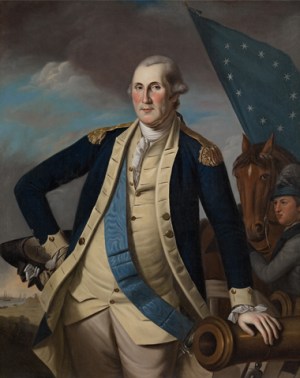
Charles Willson Peale, "George Washington," ca. 1780-82 (Crystal Bridges Museum of American Art)
Wal-Mart heiress Alice Walton’s mammoth Crystal Bridges Museum of American Art in Arkansas will soon be open for business, and The Washington Post’s Philip Kennicott snagged the coveted first look.
The $800 million museum has been subject to sharp skepticism in the art world (though not, it should be noted, in The New Yorker or The New York Times). Many art professionals believe the museum is “too rich, too conservative, and too reflexively American” to be a major player, according to Kennicott. So what’s his verdict? Apparently, money may not buy the art world’s happiness, but it can buy a pretty impressive museum.
“There’s no embarrassment about the immense fortune that made the museum possible, no old-fashioned cultural money-laundering in the manner of Carnegie or Mellon,” writes Kennicott of the museum, which will be free for everyone, forever thanks to a $20 million donation from Wal-Mart. “It is a mature, serious, relatively progressive museum launched at a
time when increasing numbers of people consider themselves
socially tolerant and fiscally conservative.”
◊ ◊ ◊ ◊ ◊
Writing for Architectural Record (17 October 2011), Fred Bernstein responds to Moshe Safdie’s building . . .

Model of Moshe Safdie's design for Crystal Bridges Museum of American Art (Photo: John Horner)
. . . Putting a museum containing many of the acknowledged masterpieces of American art above ponds fed by an active spring smacks of hubris. But a complex flood control system, approved by three separate consultants and monitored by the Army Corps of Engineers, has been designed to protect the building and its contents. Crystal Bridges’ executive director, Don Bacigalupi, said in an interview that the confluence of running water and precious artworks worried him when he first took the job—but now, having studied the plans, he believes, the museum is prepared for what he called “the next Noah flood.”
The high-water act pretty much sums up the paradox of Crystal Bridges. Alice Walton, the Walmart heir who founded, and largely funded, the museum, chose to build it in the town where her father opened his first five-and-dime. (Sam Walton’s original store, now operated as a cozy Walmart history museum, is a few blocks away.) But Sam’s daughter, who is famous for being unpretentious, let the project evolve into an architectural extravaganza, comparable to some of Safdie’s other recent projects, the curving Kauffman Center for the Performing Arts, in Kansas City, and the Marina Bay Sands resort complex in Singapore (with a park cantilevered off three 55-story towers), beautiful forms arranged for maximum impact. . . .
The full review is available here»
Call for Papers: Chicago Art Journal
From the Chicago Art Journal:
Chicago Art Journal: Historiographies of New Media
Proposals due by 28 November 2011
 The Chicago Art Journal, the annual publication of the University of Chicago Department of Art History, is seeking submissions of original work by graduate students and faculty for its 2011-2012 edition. This year’s issue asks how new media have affected not only the production of art, but also the production of knowledge about art. What is at stake in approaching art history through the concept of new media?
The term ‘new media’ has been applied to a range of formats (from photography to video to the internet) that have revolutionized the modes of transmission and reproduction of ‘old’ media of art at particular historical moments. Although the concept of new media seems to promise a mass media address, artists have often emphasized the limits of circulation—for instance, in closed circuit television, or zines that made use of Xerox processes and yet were distributed to small networks through the mail. Such a dialectical relation escapes media theory’s emphasis on mass distribution, and points instead toward misalignments and points of friction between the imaginative and material aspects of new media. Furthermore, from the double slide lecture to the publication of photographs in books, and from the use of facsimiles in the classroom to broadcasts of ‘art on television,’ the formation and performance of the art historical discipline has itself been contingent upon pivotal introductions of reproductive media. In turning our attention to new media, we consider art history’s rhetorics of description and display.
The importance of thinking through the art historical repercussions of new media has become paramount. Just as recent scholarship has addressed the nuances of ‘pre-modern’ and modern notions of mediality (including forms of mechanical reproducibility and audiovisual displays emergent in the middle ages), so might we aim to reframe more contemporary art historical categories of ‘lateness’ (such as Rosalind Krauss’s ‘post-medium condition’). Here we propose examining notions of new media within a long durée. How do such temporal categories foreground technologies that are positioned as obsolete? As Peter Weibel has proposed, “the intrinsic success of the new media resides less in the fact that they have developed new forms and possibilities of art than in the fact that they have enabled us to establish new approaches to the old media of art—and above all, have kept the latter alive by forcing them to undergo a process of radical transformation.” What conditions of possibility are embedded (or not) in the positioning of art as new media? How might we emphasize the aesthetic and pedagogical aspects of new media over notions that emerged out of communications theory, such as interactivity? We are especially interested in papers that address new media art histories that diverge from the well-known chronologies of Euro-American technological developments. Topics might include but are not limited to:
• performance and circulation of art history through facsimiles, photographs, slide projections, radio, and television
• responses and counter-responses to new media technologies within art criticism, critical theory, and film theory
• legacies of Friedrich Kittler and Miriam Hansen for theorizing new media
• analog and digital in art and art history
• historical modes of mechanical reproduction, imprinted coins, technologies of the book, seals, etc.
• ekphrasis
• transfers and transformations among media, media as reference for other media
• in what way are new media performative and public?
• materiality of new media, processes of materials
• new media and abstraction, issues of movement and circulation
• wider implications of artists’ practices in Xerox, zines, artists’ books, flip books, holograms, etc.
• relationship between art transmitted through media and art as media
• aesthetics of television in the context of capitalism and communism
• new media’s relevance for reframing art historical cycles and geographies of innovation
• challenges to medium specificity, from medium unspecificity to post-medium condition
• art and technology movements, including the role of dance and ‘new music’
• computerized models of art, computational ways of thinking
• collectivity and coalitions, notions of ‘social media’
• photography as new media
• historiographies of ‘video art,’ including the role of projection and the long durée of optical media
• queer aesthetics and new media
• painting after the advent of network theory
• theories of text as visual image and text as mediation
Submissions
Full papers must follow The Chicago Manual of Style, and should not exceed 4000 words. Each submission should include an abstract of approximately 500 words. If you would like to submit an abstract without a full paper, please contact the editors in advance. Both Word documents and PDFs are welcome. All contributors should include their name, address, telephone number, and email address. Authors are responsible for securing image reproduction rights and any associated fees. Please send submissions to the graduate student editors Solveig Nelson and Stephanie Su at UChicagoArtJournal@gmail.com by November 28, 2011.
Exhibition: Masterworks from the Speed Art Museum in Tulsa
Press release from the Philbrook:
Magnificent Vision: Two Centuries of European Masterworks from the Speed Art Museum
Philbrook Museum of Art, Tulsa, 9 October 2011 — 8 January 2012
Flint Institute of Arts, Flint, Michigan, 5 May — 19 August 2012

Adélaïde Labille-Guiard, “Portrait of Madame Adélaïde,” ca. 1787, oil on canvas (Louisville: Speed Art Museum)
After two exhibitions focusing primarily on work from 20th-century America, Tulsa’s Philbrook Museum of Art is preparing for a dramatic shift in both time and setting. For the Museum’s final and biggest show of the year, the Museum is taking a look back at Europe in the 17th and 18th centuries. Magnificent Vision: Two Centuries of European Masterworks from the Speed Art Museum features more than 70 major works by the likes of Rembrandt, Rubens, Tiepolo, and Gainsborough.
The works in the exhibition are entirely drawn from the permanent collection of the Speed Art Museum in Louisville, KY, one of this country’s premier regional art museums. Forming the backdrop to this exhibition, which is organized thematically, is a two-hundred-year period in which European art underwent a dramatic and radical transformation. During the 1600s, particularly in the Netherlands, a newly affluent populace with a desire to improve their standing in society helped to generate a tremendous demand for artwork, and the market for paintings boomed. In the 1700s, as the artistic profession became institutionalized, the mood shifted and the abundance and variety of the earlier period was replaced. As significant taste-making institutions like the Academie des Beaux-Arts in Paris gained new power, demand for paintings remained high but became more focused.
“It is a group of paintings that not only dovetails beautifully with Philbrook’s own collection, but it also elegantly reflects one of the most extraordinary and inspiring periods in European art; it was truly a Golden Age,” says Dr. Tanya Paul, Philbrook’s Ruth G. Hardman Curator of European Art.
Call for Papers: Cleveland Symposium
Cleveland Graduate Student Symposium — Things Fall Apart: Fragmentation in Visual Culture
Cleveland Museum of Art, 23 March 2012
Proposals due 15 December 2011
 The 2012 Cleveland Symposium invites graduate submissions exploring the theme of fragmentation in the visual arts. This trope has manifested itself in a variety of ways in response to political, social, ideological, or aesthetic trends of a particular epoch. Students are encouraged to interpret this theme broadly, through avenues such as iconoclasm, revolution, political upheaval, physical fragmentation of materials, or particular aesthetic movements.
We welcome submissions from graduate students in all stages of their studies and from all fields and geographic regions, ranging from ancient through contemporary art. We will also consider papers from a wide range of methodologies and approaches. A monetary prize will be awarded to the speaker who presents the most innovative research in the most successfully delivered paper.
Please send an abstract of no more than 300 words for papers of no longer than 20 minutes, along with a curriculum vitae or résumé, to clevelandsymposium@gmail.com by December 15, 2011. Please include “Cleveland Symposium Submission” in the subject line of your email. Selected presenters will be notified by January 1, 2012.
Reviewed: The Intelligence of Tradition in Rajput Court Painting
Recently added to caa.reviews:
Molly Emma Aitken, The Intelligence of Tradition in Rajput Court Painting (New Haven: Yale University Press, 2010), 352 pages, ISBN: 9780300142297, $65.
Reviewed by Catherine Glynn; posted 21 October 2011.
“Why Rajput paintings look the way that they do” is the enormous concept that Molly Emma Aitken addresses in ‘The Intelligence of Tradition in Rajput Court Painting’. Fortunately for readers entering into her innovative and complex thinking, Aitken is especially gifted in her word choice, graphically evocative, and the book is filled with well-reproduced images of stunning Rajput paintings. Her descriptions of the paintings and the artists who produced them give both the seasoned scholar and uninitiated reader a series of intriguing ideas to ponder.
Aitken’s premise is concisely explained in her introduction: conventions used in Rajput painting were purposefully developed; painters made choices based on intent. As she posits, much past analysis by scholars of Indian painting has juxtaposed “a simple, archaic aesthetic [Rajput painting] against a technically advanced idiom [Mughal painting]” (11). It is Aitken’s contention that Rajput painters were skilled in their own aesthetic, taking what they deemed useful from Mughal painting and rejecting those elements that did not fit into their vision. It was not a question of ability—the Rajput painters were able to paint in any style that they chose—it was a question of choice.
The full review is available here» (CAA membership required)
Exhibition: Satire and Religion
From The Walpole Library:
Sacred Satire: Lampooning Religious Belief in Eighteenth-Century Britain
The Lewis Walpole Library, Farmington, Connecticut, 22 September 2011 — 2 March 2012
Curated by Misty Anderson and Cynthia Roman
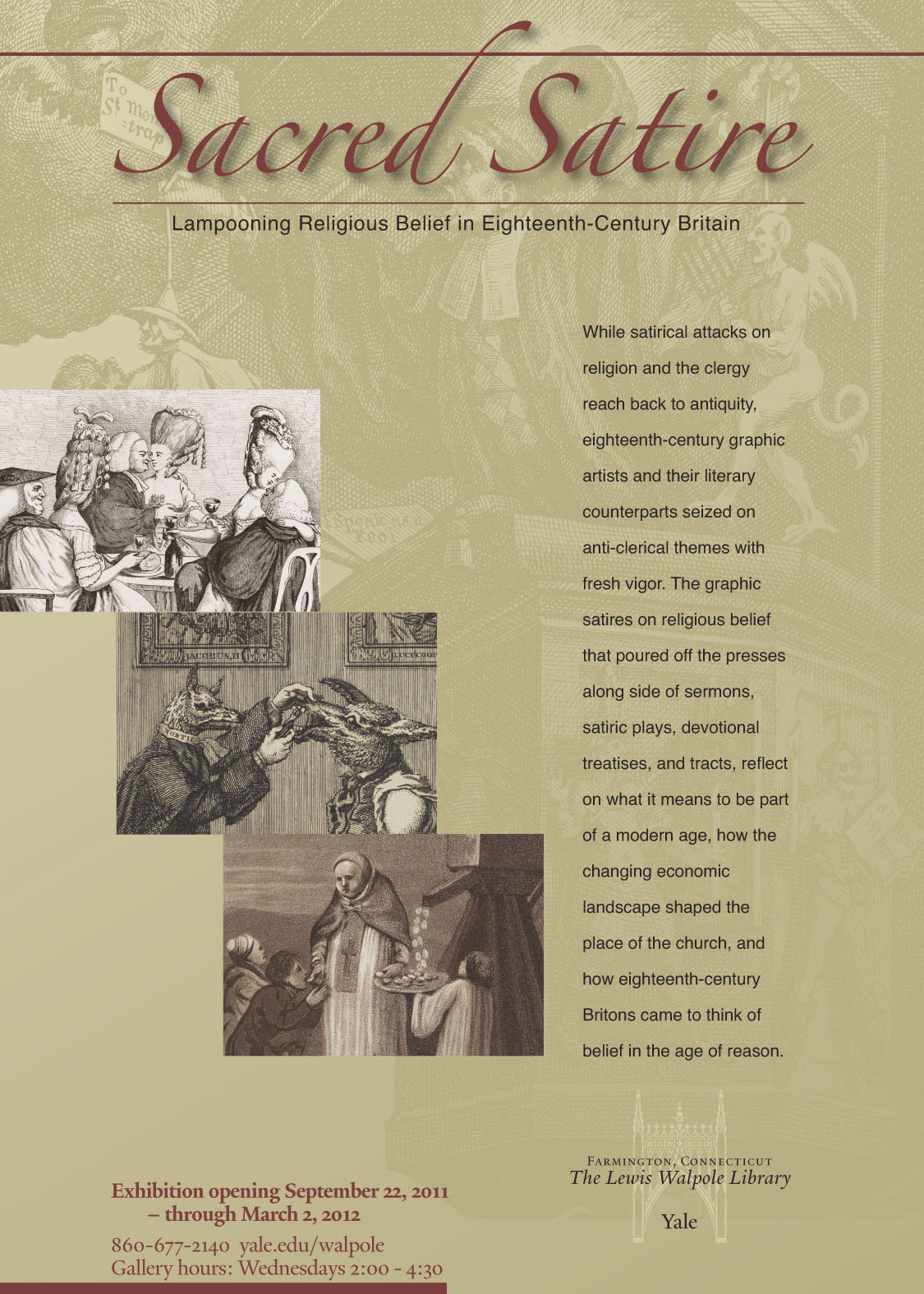 Religious beliefs and practices provided ample subject matter for the irreverent printmakers producing graphic satire in eighteenth-century Britain. While clerical satire is an ancient mode, eighteenth-century British artists seized on it with fresh vigor. Satirists appropriated centuries-old themes like corruption, hypocrisy, and greed, but updated them with contemporary concerns about the role of religion in the age of enlightenments. The visual rhetoric of these prints illustrates some of the ways in which eighteenth-century Britons were renegotiating their relationship to religious practice and belief.
The prints in this exhibition reflect a tension between a vision of religion as part of traditional life and the emergence of modern Christianity as a collection of new movements, practices, and ideas about belief. The eighteenth-century images on display preserve for us a moment in an ongoing conversation about the relationship of religion, representation, and modernity.
Call for Papers: London-Irish
The London-Irish in the Long Eighteenth Century, 1680-1830
University of Warwick, 13-14 April 2012
Proposals due by 31 January 2012
 The Irish became an intrinsic part of the London population through the course of the eighteenth century. Whether Catholic and Protestant, professional or plebeian, London provided opportunities for waves of Irish migrants. Irish migrants can of course be found throughout Britain (and Europe) at this time but London offered a burgeoning world capital that embraced all tiers of Irish society. The Irish, from both sides of the religious divide, could be found almost anywhere in London: in its kitchens, drawing rooms, legal chambers, banking houses, theatres, newspaper offices, and courts. Nevertheless robust systematic historical data on these migrants is scarce – such accounts that exist of the Irish diaspora in pre-1815 London (Denvir, Akenson, and Jackson) are useful but fragmentary and Irish historiography on the diaspora has generally tended to concentrate on the famine years.
There is work on Irish Catholics in Europe but only recently have more focused accounts of Irish networks operating in London in the eighteenth century begun to emerge. Yet despite the sparse accounts of their activities, there was certainly a strong Irish – Catholic as well as Protestant – presence in London throughout this period. Archbishop King warned that Irish visitors in London ‘converse only in a very sneaking private way with one another’ and this observation suggests a metropolitan space within which the Irish diaspora could form themselves into tight social and professional networks. The study of such networks would provide a fresh perspective on London in the long eighteenth century. How did such networks form? How did they evolve? To what degree were they inclusive/ exclusive? How did they represent ‘Irishness’ and/or Ireland to London? And how were they received?
This interdisciplinary conference is being organized by David O’Shaughnessy and will be hosted by the Department of English & Comparative Literature, University of Warwick. Plenary lectures will be given by Professor Toby Barnard (History, University of Oxford); Professor Claire Connolly (Literature, University of Cardiff; and Professor Mary Hickman (Sociology, London Metropolitan University). Papers will be welcomed in all disciplines and from scholars at all stages of their careers. The deadline for 300-word abstracts is 31 January 2011 (email: londonirish@warwick.ac.uk). Suggested topics might include but are not limited to:
- Quantifying the Irish diaspora (population, migration patterns/routes, births, deaths, baptisms, funerals)
- Defining an Irish community/network
- Catholic and Protestant communities/networks
- Professional Irish (lawyers, bankers, merchants, tutors, physicians, booksellers)
- Literary and artistic Irish (theatre, newspapers, literary clubs, artists, Society of Antiquaries, Royal Academy, bookshops)
- Labouring Irish (military, servants, sailors, shipwrights, builders)
- Religious Irish (places of worship, priests)
- Political Irish (clubs, societies, parliament, lobbyists, spies, petitioners, the Irish at court)
- Anti-Irish sentiment
- Irish language
- Riots
- Sport
- Irish societies and charitable organizations
- The Irish on trial (lawyers and criminals)
- The rise of the Irish pub (taverns/coffee houses patronised by the Irish)
- The Irish ‘ghetto’ (geography of the Irish in London)
- Irish elites and their circles (Burke, Goldsmith, Sheridan)
Frick Acquires Hard-Paste Sèvres Vase in Honor of Anne Poulet
Press release from The Frick, as noted at ArtDaily:
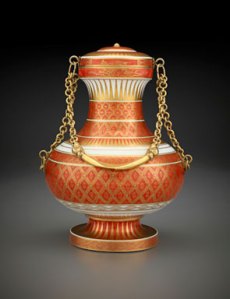
Vase Japon, 1774, Royal Manufactory of Sèvres, painted and gilded hard-paste porcelain with silver-gilt mounts, The Frick Collection; photo: Michael Bodycomb
The Frick’s Board of Trustees announces the acquisition of two objects that will enhance the museum’s holdings in areas that interested founder Henry Clay Frick at the end of his life: eighteenth-century French porcelain and Italian Renaissance drawings. A rare and beautiful vase created at the Royal Manufactory of Sèvres has been acquired in honor of Anne L. Poulet, who retired at the end of September after serving as Director for eight years. The vase, a partial purchase by the Frick and a partial gift from Alexis and Nicolas Kugel, is the first piece of hard-paste porcelain from the Royal Manufactory of Sèvres to enter the Collection. It complements the museum’s substantial Sèvres holdings made with the earlier soft-paste formula, objects obtained by Mr. Frick from the dealer Joseph Duveen. This latest acquisition is particularly appropriate given the interest of Director Emerita Anne Poulet in eighteenth-century French decorative arts. The vase will be displayed this winter alongside selections from a promised gift of hard-paste Meissen porcelain objects in the new Portico Gallery for Decorative Arts and Sculpture, which opens to the public on December 13. Also entering the collection is an important Italian Renaissance by drawing the Sienese artist Domenico Beccafumi (1486–1551), a two-sided sheet given to the Frick by Trustee Barbara G. Fleischman in honor of Deputy Director and Peter Jay Sharp Chief Curator Colin B. Bailey.
Despite its name, the Vase Japon is a French interpretation of a Chinese Yu (or Hu) vase from the Han Dynasty (206 B.C–A.D. 220). Examples of this type of baluster-shaped vessel survive in bronze and earthenware. Documents from the Sèvres archives indicate that the Frick vase was made in 1774 along with two others of the same size, shape, and decoration. Each bears the mark of the gilder-painter Jean-Armand Fallot, who was active at Sèvres between 1765 and 1790. Of the three, however, only the Frick vase is adorned with an elaborate silver-gilt handle and chain, which, like its shape and surface pattern, were directly inspired by the Chinese model. The mounts bear the mark of Charles Ouizille (1744–1830), who worked extensively for the French court throughout the 1770s and 1780s and became Marie-Antoinette’s favorite jeweler. He created exquisite gold mounts for the queen’s rare and precious collections of hard-stone vases and cups.
The shape and decoration of the Vase Japon derive from a woodblock print reproduced in a forty-volume catalogue of the vast Chinese imperial collections (a record compiled at the behest of the Qianlong Emperor who reigned 1735–1796). Included are entries for more than fifteen hundred ancient bronze objects—primarily ritual vessels, but also mirrors, lamps, and weapons—each accompanied by a brief description of its size and origin. Sometime during the 1770s, Father Joseph Amiot, a Jesuit missionary working in Peking, sent a copy of this catalogue to Henri Bertin in Paris. Bertin was France’s secretary of state and had recently been appointed the commissaire du roi at the Sèvres manufactory, an administrative position he held until 1780. In addition to being a politician and a businessman, Bertin was an art collector with a profound interest in China and Chinese art, and he likely played a key creative role in the production of this piece. (more…)
Call for Papers: Napoleonic Wars
From The Courtauld:
Contested Views: Visual Culture and the Revolutionary and Napoleonic Wars
Courtauld Institute of Art Research Forum at Tate Britain, London, 19-20 July 2012
Proposals due by 16 December 2011
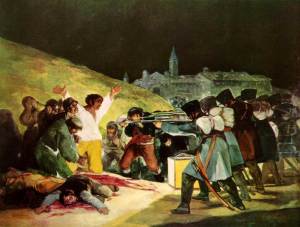
Goya, "The Third of May 1808," 1814 (Madrid: Prado)
In July 2012, in advance of commemoration of the bicentenary of the Battle of Waterloo, Tate Britain is to host a two-day conference exploring the impact of the Revolutionary and Napoleonic Wars on world-wide visual culture, from the outbreak of the pan-European conflict with France in 1792 to the present day. Centered on themed panels, plenary lectures and workshops, this cross-disciplinary conference will promote knowledge and understanding of the range of ways in which the ‘First Total War’ has been mediated in visual cultures, not only in Britain and continental Europe but throughout the world.
The organizers are keen to receive proposals for papers that present new research and/or methodological approaches. In particular they would like to encourage proposals from scholars from different disciplines who wish to work in collaboration with each other. Please send proposals of no more than 250 words to Phil Shaw ps14@le.ac.uk.
Organised by Martin Myrone (Tate Britain), Satish Padiyar (The Courtauld Institute of Art), Phil Shaw (University of Leicester), and Philippa Simpson (National Maritime Museum)










 Enfilade
leave a comment