Seminar at The Frick: A 1767 Longcase Clock
From The Frick:
Seminar with Joseph Godla and Charlotte Vignon: “It’s About Time”
The Frick Collection, New York, 17 November 2011

Balthazar Lieutaud, Longcase Regulator with Mounts Emblematic of Apollo, 1767. Bronze Mounts by Philippe Caffiéri; movement by Ferdinand Berthoud (Frick Collection)
Clocks are among the most interesting and elaborate works of art in The Frick Collection. In this seminar, a curator and a conservator will discuss the design, history, and function of a magnificent French longcase regulator clock from the permanent collection. This exceptional example was made in 1767 by Ferdinand Berthoud, one of the leading Parisian clock and watchmakers of his day, together with case maker Balthazar Lieutaud and sculptor and bronze caster Philippe Caffiéri.
Click here to register at the regular rate of $100 per person. Members of The Frick Collection may click here to register at the discounted membership rate of $90 per person. Discounts will be applied upon verification of membership. To register over the phone, please call 212.547.0704.
Questions: seminars@frick.org
Journée d’étude: Alexandre Lenoir, histoire et collections
As noted at Le Blog de ApAhAu:
Le musée des monuments français et la construction de l’histoire
Institut national d’histoire de l’art, Paris, 17 November 2011
 8:30 Accueil des participants
9:00 Roland Recht (Collège de France), ouverture de la journée
9:15 Anne Ritz-Guilbert (École du Louvre), François Roger de Gaignières (1642-1715) : collection, méthodes, finalites
10:00 Jean-René Gaborit (conservateur général honoraire, musée du Louvre), Pour l’histoire de la sculpture française. Emeric David versus Alexandre Lenoir : la théorie et le pragmatisme
10:45 Odile Parsis-Barubé (université Charles-de-Gaulle-Lille 3/IRHIS – UMR CNRS 8529), Entre culture de l’inventaire et approche romantique des vestiges : le réveil historien de la province au lendemain de la Révolution (1800-1830)
11:30 Emmanuel de Waresquiel (École pratique des hautes études), Ecrire l’histoire sous la Restauration
12:15 Mary B. Shepard (Friends University, Wichita, Kansas), Alexandre Lenoir et George Grey Barnard : la perspective artistique et la construction de l’histoire
1:00-2:30 pause déjeuner
2:30 Valérie Montalbetti (fondation Pierre de Coubertin, Saint-Rémy-lès-Chevreuse), Alexandre Lenoir, Jean Goujon et la création d’un imaginaire artistique national
3:15 Claire Mazel (C.R.H.I.A., université de Nantes), Alexandre Lenoir, histoire de l’art et politique des arts
4:00 Pascal Griener (université de Neuchâtel), Alexandre Lenoir et le modèle anglais. La politique et l’histoire après la Révolution
4:45 Claude Rétat (CNRS UMR 5611-LIRE), Alexandre Lenoir et les formes du christianisme : art et religion chrétienne dans l’œuvre muséographique et dans le corpus maçonnique (musée des monuments français, œuvre maçonnique publiée et manuscrite)
Stormy Skies, Calm Waters: Vernet’s Lansdowne Landscapes
Press release (18 October 2011) from the Dallas Museum of Art (as noted at ArtDaily):
Vernet Pendants from Lansdowne House Reunited in Dallas
Dallas Museum of Art, 18 October — 11 December 2011

Claude-Joseph Vernet, "A Mountain Landscape with an Approaching Storm," 1775 (Dallas Museum of Art)
Two landscape paintings by eighteenth-century French master Claude-Joseph Vernet have been reunited for the first time in more than 200 years at the Dallas Museum of Art. Commissioned in 1774 at the height of Vernet’s career by famous English collector Lord Lansdowne, the two large-scale paintings depict the complementary scenes of unruly rustic landscape and tranquil seaport. The duo, A Mountain Landscape with an Approaching Storm and A Grand View of the Sea Shore, hung together in the collector’s home, Lansdowne House, Berkeley Square, London, until his death, when the paintings were sold to separate private collections in 1806.

Claude-Joseph Vernet, "A Grand View of the Sea Shore Enriched with Buildings Shipping and Figures" 1775
On view through December 11, 2011, the Dallas presentation is the first opportunity, since the Museum acquired A Mountain Landscape several decades ago, to bring the two paintings together to be viewed as Vernet originally intended. The exhibition will be accompanied by a new monograph published by the Dallas Museum of Art examining Vernet’s landscape practice.
The Dallas Museum of Art is presenting the paintings in its second-floor European art galleries, where they can be viewed in dialogue with other eighteenth-century masterworks. The landscapes, which are unusually large for the genre, measuring five by eight feet each, reflect both the collector’s neoclassical taste as well as Vernet’s powerful use of light and atmosphere. A Grand View of the Sea Shore depicts elegant buildings set against a tranquil sea at sunset, while A Mountain Landscape portrays an ominous rocky terrain with villagers scrambling to weather an impending storm.
ISBN: 9780936227009, $20
The presentation of the Vernet paintings is made possible by the generous loan of A Grand View of the Sea Shore by collector David H. Koch. The landscape paintings will remain on view at the Dallas Museum of Art through December 11, 2011.
“The temporary reunion of the pair not only presents a singular opportunity for our audiences to experience anew a beloved painting in our collection, but allows for a new scholarly consideration of Vernet’s oeuvre,” said Olivier Meslay, Interim Director of the DMA and its Senior Curator of European and American Art and The Barbara Thomas Lemmon Curator of European Art. “Vernet’s precision in and exploitation of pairings has been highly influential to European art, and we are delighted to be able to display these
magnificent works together.”
“The Museum has sought to reunite these two landscape works since the realization, in January 2011, that A Grand View of the Sea Shore was not lost as presumed, and after such a lengthy separation the reunion is extraordinarily vivid, both historically and visually,” said Dr. Heather MacDonald, The Lillian and James H. Clark Associate Curator of European Art at the DMA. “In bringing the pair back together, we are finally able to fully experience the contrasting natural effects and the complex dialogue of aesthetics and ideas created by the two scenes. Their full meaning is finally revealed.”
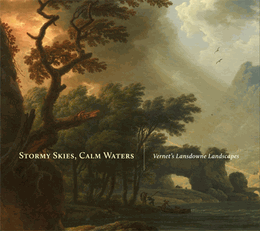
A monograph, the first English book-length publication on Vernet’s work in thirty years, will be published in conjunction with the reunification of the pair at the DMA. The fifty-page illustrated catalogue, Stormy Skies, Calm Waters: Vernet’s Lansdowne Landscapes, with an introduction by Olivier Meslay and scholarly essay by Heather MacDonald, provides a reappraisal of the Lansdowne commission and examines the meaning of the pairing and the role of pendant canvases within Vernet’s practice as a whole.
◊ ◊ ◊ ◊ ◊
Heather MacDonald, Stormy Skies, Calm Waters: Vernet’s Lansdowne Landscapes (Dallas: Dallas Museum of Art, 2011), 48 pages, ISBN: 9780936227009, $20.
Call for Papers: The History of Jewish Art
Ars Judaica Conference: Traditions and Perspectives in History of Jewish Art
Bar-Ilan University, Israel, 10-13 September 2012
Proposals due by 6 November 2011
The conference will bring together historians of art and material culture and researchers in history, religions, semiotics, psychology, sociology, and folklore to explore the fields of interest of Ars Judaica: The Bar-Ilan Journal of Jewish Art that include, but are not limited to:
– The Jewish contribution to the visual arts and culture from antiquity to the present
– Art and architecture of Jewish sacred spaces
– Biblical texts as a source in Christian and Muslim visual arts
– Jerusalem and the Holy Land as an object and model in visual arts
– Images of Jews in visual arts
– Hebrew script in visual arts
– Patrons, collectors and museums of Jewish art
– Jews, arts and politics
Abstracts (limited to 200 words) of twenty-minute presentations with a short CV should be submitted (as attached MSWord documents) by January 6, 2012 to gr.ajudaica@biu.ac.il. The applicants will be notified of the decision regarding their proposals by February 6, 2012.
New Title: Drew Armstrong on Julien-David Leroy
From the publisher:
Christopher Drew Armstrong, Julien-David Leroy and the Making of Architectural History (Routledge, 2011), 300 pages, ISBN: 9780415778893, $125.00
 This book examines the career and publications of the French architect Julien-David Leroy (1724–1803) and his impact on architectural theory and pedagogy. Despite not leaving any built work, Leroy is a major international figure of eighteenth-century architectural theory and culture. Considering the place that Leroy occupied in various intellectual circles of the Enlightenment and Revolutionary period, this book examines the sources for his ideas about architectural history and theory and defines his impact on subsequent architectural thought. This book will be of key interest to graduate students and scholars of Enlightenment-era architectural history.
C O N T E N T S
Introduction: Positioning LeRoy
Part 1: Voyageur / Philosophe — 1. Traveler in the Academy 2. A Book by Its Cover 3. Measuring the Earth 4. Greek Architecture and the Doctrine of Vitruvius 5. Greece and the Orient 6. A New Way of Making History 7. Mentor in the Garden
Part 2: Academician / Mentor — 8. Architecture and Enlightenment 9. Science for the Public Good 10. Monument to a Revolutionary Hero. Select Bibliography
◊ ◊ ◊ ◊ ◊
Christopher Drew Armstrong is an Assistant Professor and Director of Architectural Studies in the Department of History of Art and Architecture at the University of Pittsburgh.
Trio of Witches at the National Portrait Gallery
Press release from the NPG:

Daniel Gardner, "The Three Witches from Macbeth (Elizabeth Lamb, Viscountess Melbourne; Georgiana, Duchess of Devonshire; Anne Seymour Damer)," pastel on paper, 1775 (London: NPG)
As it launches a major exhibition of actress portraits, the National Portrait Gallery has announced the acquisition of a large and rarely seen picture of three of eighteenth-century society’s most glamorous and notorious women – as the three witches from Shakespeare’s Macbeth. Georgiana, Duchess of Devonshire and Elizabeth Lamb, Viscountess Melbourne – the most famous political hostesses and society beauties of their day – are shown gathered around the witches’ cauldron alongside their friend, the sculptor Anne Seymour Damer.
The portrait will be seen by museum visitors for the first time at the National Portrait Gallery’s autumn exhibition The First Actresses: Nell Gwyn to Sarah Siddons, where it’s included in a section devoted to amateur dramatics. It was acquired through the Government’s Acceptance in Lieu scheme having been allocated to the Gallery from a private collection in lieu of inheritance tax.
This unusual group portrait of 1775 in pastel by artist Daniel Gardner (1750-1805) shows three intimate friends who enjoyed attending private theatricals and shared a common passion for Whig politics and the arts. Gardner’s choice of the Cauldron scene from Macbeth can be related to their shared and shadowy political machinations as leading members of the Devonshire House circle. The daughter of the First Earl Spencer, Georgiana’s marriage to the fifth Duke of Devonshire placed her at the apex of Whig Society. She held famously libertine parties at Devonshire house in London, and recently was the subject of Amanda Foreman’s hugely successful book and the subsequent film The Duchess with Keira Knightley.
Viscountess Melbourne was married to Sir Penniston Lamb MP and was an ‘enthusiastic manager of her husband’s political interests’. While she had been friends with Damer, the foremost female sculptor of her day, since the early 1770s, her friendship with Georgiana was fairly recent. This pastel portrait may in part be related to Melbourne’s desire to publicise this new friendship. Melbourne is thought to have commissioned the work that has descended in her family. (more…)
Exhibition: The Occult as Inspiration
From the exhibition website:
Europe and the Spirit World or the Fascination with the Occult, 1750-1950
Musée d’Art Moderne et Contemporain, Strasbourg, 8 October 2011 — 12 February 2012

ISBN : 9782351250921, 48€
Europe and the Spirit World or the Fascination with the Occult, 1750-1950 is a cross-disciplinary exhibition exploring the influence of the occult on artists, thinkers, writers and scholars throughout Europe, at decisive moments in the history of the modern world. The exhibition is organized into three sections:
- The creative arts: painting, drawing, sculpture, print-making and photography, the literature of the irrational and unexplained.
- The esoteric tradition revisited, with an extensive chronological survey encompassing the movement’s foundational texts and print iconography.
- The relationship between occult phenomena and the scientific world, through key scholarly figures and thinkers, and an examination of their experiments and scientific instruments.
With some 500 works of art, 150 scientific artefacts, 150 books and 100 documents from a host of European countries, Europe and the Spirit World will be presented in a dedicated 2500-m² space at the the Museum
of Modern and Contemporary Art of Strasbourg.
◊ ◊ ◊ ◊ ◊
Exhibition catalogue: L’Europe des esprits ou la fascination de l’occulte, 1750-1950 (Éditions des Musées de la Ville de Strasbourg, 2011), 450 pages, ISBN: 9782351250921, 48€.
Conference: Juvarra, Architect for the Savoy, Architect for Europe
From EAHN:
Filippo Juvarra (1678-1736): Architetto dei Savoia, architetto in Europa
La Venaria Reale, Turin, 14-16 November 2011

Filippo Juvarra, Great Stables at La Venaria Reale, Turin, 1722-27. In the eighteenth century, the stables (140 meters in length) could accommodate up to 160 horses.
The third conference of the series Architettura e potere: Lo Stato sabaudo e la costruzione dell’immagine in una corte europea is dedicated to Filippo Juvarra (1678-1736), the abbé from Messina who trained in Rome in the studio of Carlo Fontana and at the Accademia di San Luca, and went on (in 1714) to become first architect of the Savoy court, indissolubly linking his name with that of the capital of the kingdom, Turin. Despite numerous scholarly initiatives dedicated to his activity, knowledge of Juvarra’s work is still open to expansion. The greater part of both Italian and international scholarship has been consistently focused on the Turin-Madrid axis, in consideration prevalently of the executed architecture and its associated projects (whether of a permanent or an ephemeral nature), as well as of his role as a great artistic director. Beyond this core area, which is itself always open to further study, however, several fundamental themes for the activity and influence exercised by Juvarra in the European ambit remain to be investigated. Among these are his travels, which together with the albums of drawings now conserved in Italian and foreign collections were important vehicles for the dissemination of ideas, his heterogeneous architectural activity in other centers in Italy and in Europe (for example in Messina, Naples, Lucca, Como, Mantua, Brescia, Lisbon), and his projects for the decoration of royal and villa gardens and their links to contemporary treatise literature.
The scope of the conference is to approach themes that will generate new contributions, also from the point of view of methodology, aimed at a more comprehensive definition of the figure of Filippo Juvarra, both biographically and by approaching the dynamics and strategies – adopted more or less consciously – that allowed him to leave Sicily, passing through papal Rome (with all the positive and negative aspects of this experience) and arriving in Turin and then in Madrid, in an on-going endeavor to secure commissions in the international ambit.
◊ ◊ ◊ ◊ ◊
The conference program (as a PDF file) is available here»
Lecture: Mark Hallett at the Scottish National Gallery
As reported at the blog for British Art Research:
Mark Hallett, Faces in a Library: Sir Joshua Reynolds’s Streatham Worthies
Scottish National Gallery, Edinburgh, 3 November 2011
 Mark Hallett, Professor of History of Art at the University of York, will be giving this year’s Watson Gordon Lecture at the Scottish National Gallery (Hawthornden Lecture Theatre – Gardens Entrance), which will analyse the remarkable set of thirteen portraits that the celebrated Georgian artist Sir Joshua Reynolds painted for a private library at Streatham Park, just outside London, between the early 1770s and 1781. Professor Hallett’s lecture is entitled Faces in a Library: Sir Joshua Reynolds’s Streatham Worthies, and will take place at 6pm on November 3rd. The lecture, which will be published as a short book in 2012, focuses on Reynolds’s pictures for Streatham, which include portraits of such cultural luminaries as Edmund Burke, Oliver Goldsmith and Samuel Johnson, which will be explored as expressions of friendship, learning and fame, and as works that responded to the social rituals and intellectual ideals of the eighteenth-century library.
Eighteenth-Century Glass at Bonhams
Press release from Bonham’s (as noted at ArtDaily.com) . . .
Important English and Dutch Glass: The Collection of A. C. Hubbard, Jr.
Bonhams, London, 30 November 2011
 Bonhams will be auctioning the internationally renowned glass collection of A C Hubbard Jr. on 30th November 2011 at Bonhams, 101 New Bond Street, London. The important and magnificent Prince William V of Orange Goblet, circa 1766, is the major highlight not only of the sale but of all English glass offered at auction in recent years, and is estimated to sell for £100,000-150,000.
This goblet is signed by William Beilby. The Beilby workshop in Newcastle was renowned for its enamel decoration of glass and produced around 90 recorded heraldic decanters, goblets and wine glasses, mainly with English armorials of which a significant handful depict Royal coats of arms. Simon Cottle, Head of Bonhams Glass Department, comments, “The majority of their fine goblets with Royal armorials now reside in public institutions worldwide. The Prince William V of Orange Goblet in this auction offers a rare opportunity to possess an example, it is one of only four left in private hands. It is also one of only 16 glasses to be signed, and at an imposing 30.2cm in height it is by far the largest of all Beilby goblets. I believe its production may have led William Beilby’s entry to a contemporary valuable Dutch glass market. Its large size and colourful enamel decoration would have been particularly impressive to the Dutch at a time when their craftsmen were producing smaller, engraved pieces.”
Assembled by a discerning Baltimore collector with a passion for fine wines, A C Hubbard Jr.’s collection includes examples of the best of English and Dutch glass from the seventeenth and eighteenth centuries, many previously published in the literature on glass. From majestic early heavy baluster goblets of both large and small size to the attractive colour-twist wine glasses of the later period, this private collection is one of the finest to be offered at auction in recent years.
Iconic eighteenth-century drinking glasses, such as those painted by the Beilby family in Newcastle, also include several further important colourful heraldic goblets and a range of their exquisite wine glasses painted with a variety of subjects in white enamel. Of the colour-twist glasses in the sale several examples feature rare combinations of threads, three of which have highly uncommon canary-yellow stems. Notable English engraved political wine glasses sit happily alongside their Dutch counterparts of which there are numerous light-baluster examples decorated with Royal armorials, VOC ships and political themes such as the patriotic glass by Jacob Sang, dated 1758. Dutch stipple-engraved glass from the hands of David Wolff, Alius and other contemporary eighteenth-century artists represents further classic highlights of this magnificent collection of over 270 lots.
Simon Cottle, comments, “There are few collections of English and Dutch eighteenth-century glass of this quality still in private hands. The Hubbard sale therefore presents a wonderful and rare opportunity to acquire examples from what is now considered to be the Golden Age of lead crystal.”










 Enfilade
leave a comment