Symposium | A Puritan Picture
From the Yale Center for British Art:
A Puritan Picture: Vanity, Morality, and Race in Seventeenth-Century Britain
In-person and online, Hastings Hall, Yale School of Architecture, New Haven, 27 September 2024
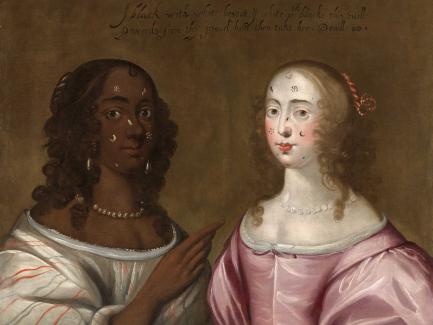
Unknown artist, Two Women Wearing Cosmetic Patches, ca. 1655, oil on canvas (Compton Verney Art Gallery and Park, Warwickshire, UK).
The YCBA, in partnership with Compton Verney, will host a symposium to increase understanding of the painting Two Women Wearing Cosmetic Patches. Topics include the painting’s provenance, attribution, and future display; the cloth trade in seventeenth-century England, Africa, and India; and evolving perceptions of beauty standards, including a keynote conversation focusing on cosmetic patches.
The middle decades of the seventeenth century in Britain were characterized by radical political, religious, and social change. In this period, an unknown artist created a remarkable painting that spoke to fears and anxieties crystallizing around a perceived increase in moral laxity, gender transgression, and the insidious influence of foreigners. The painting depicts two women side by side, each wearing a conspicuous array of beauty patches. The woman on the left reprimands her companion with the words “I black with white bespott: y[o]u white w[i]th blacke this Evill / proceeds from thy proud hart, then take her: Devill.” Text and image combine to inveigh against the sins of pride, vanity, and worldly excess. The painting reminds viewers that sinful behavior leads to the devil and exhorts them to seek salvation.
Compton Verney Art Gallery and Park in Warwickshire, England, has loaned the painting to the YCBA for conservation treatment and inclusion in the museum’s ongoing technical study of the theory and practice of painting skin tones. It will be on view at the Yale University Art Gallery from 20 August until 30 September 2024, before returning to Compton Verney. Registration for online and in-person attendance is recommended. For more information, please email jemma.field@yale.edu.
s c h e d u l e
9.20 Welcome by Jemma Field (Associate Director of Research, YCBA) and Oli McCall (Senior Curator, Compton Verney Art Gallery and Park)
9.30 Opening Talk
• A Painter for a Puritan Picture? — Edward Town (Assistant Curator of Paintings and Sculpture, YCBA)
This opening talk will provide an account of the recent history of the painting Two Women Wearing Cosmetic Patches and the research partnership between the YCBA and Compton Verney. It will present new findings about the painting’s early history and its attribution, set within the context of artistic production during the Interregnum.
9:50 Panel I | Women, Dress, and Morality
Chair: Elizabeth Cleland (Curator of European Paintings and Sculpture, Metropolitan Museum of Art)
This session will consider visual and textual ideals of female beauty and behavior in seventeenth-century England. Topics of discussion include the construction of ‘otherness’, the political and gendered value of clothing, and contemporary desires to increase control over women’s bodies and lives.
• Ad-dressing Conventions: Clothing, Gender, and Race in Two Women Wearing Cosmetic Patches — Jennifer Wu (Adjunct Professorial Lecturer, American University)
• Striped Cloth: Morality, Politics, and Gender in Interregnum England — Jemma Field (Associate Director of Research, YCBA)
• Beauty beyond Borders? English Perceptions of ‘Barbarous’ Beauty in the Seventeenth Century — Haijiao Wang (PhD student, University of Warwick)
11.05 Panel II | Bodies and Voices
Chair: Patricia Fumerton (Distinguished Professor, University of California, Santa Barbara)
This session interrogates female beauty standards, gender roles, and the concept of ‘otherness’. Drawing on an array of contemporary evidence—including emblems, anti-cosmetic polemics, travel narratives, pamphlets, and sermons—the speakers will look to further our understanding of the categories of desire, the racialization of beauty, and the development of national identities.
• ‘All your most excellent thoughts can desire’: The Transformation and Consumption of Bodies in Early Modern England — Todd Simmons (PhD student, Lehigh University)
• Body Language: Reading Text and Image in Two Women Wearing Cosmetic Patches — Jane Partner (Fellow and College Associate Professor, Trinity Hall, University of Cambridge)
• Patches, Paint, and Proto-Dermatology: The Moral Medicalization of Cosmetics in John Bulwer’s Anthropometamorphosis (1653) and John Gauden’s A Discourse of Auxiliary Beauty (1656) — Katherine Aske (Lecturer, Edinburgh Napier University)
12.20 Lunch break
2.00 Keynote Session | Cosmetics and Cultures of Beauty
Chair: Erin Griffey (Associate Professor, University of Auckland)
This keynote brings together experts on seventeenth-century beauty cultures to discuss the complexities of patching. The discussants will consider the performative aspects of the painting, including the dialogue between the subjects and the imagined viewer, as well as the overall image of adornment. Patching is then discussed from a variety of angles that include its material properties, cost, patterns of usage, and place in moral and social commentaries, to consider contemporary beauty ideals, how early moderns understood the skin, how they treated skin conditions, and how they read appearances as an index of character, physical health, and spiritual virtue.
• Jill Burke (Chair of Renaissance Visual and Material Cultures, University of Edinburgh)
• Evelyn Welch (Vice-Chancellor and President, University of Bristol)
3.30 Break
3.45 Closing Discussion | Exhibiting the Painting
Chair: Edward Town (Assistant Curator of Paintings and Sculpture, YCBA)
• Oli McCall (Senior Curator, Compton Verney Art Gallery and Park)
• Jane Simpkiss (Curator, Compton Verney Art Gallery and Park)
◊ ◊ ◊ ◊ ◊
Note (added 28 December 2024) — A recent press release notes the newly identified artist responsible for the painting: “Extensive research, including x-ray analysis,has concluded that the artist behind the painting is likely to be Father Jerome Hesketh (active 1647–1666). More than a dozen works by Hesketh feature in UK public collections today, such as Lyme Park, Sizergh Castle, and Moseley Old Hall. Comparisons between these and Two Women Wearing Cosmetic Patches offer compelling evidence they are by the same hand. . . .”
Talk | Philippa Tudor on Huguenot Records at Lambeth Palace Library
From Eventbrite:
Philippa Tudor | Huguenot Records in Lambeth Palace Library: Cataloguing Complexity
Lambeth Palace Library, London, 2 October 2024, 5.30pm
Registration due by 30 September 2024
Philippa Tudor will be talking about her work as a volunteer at LPL cataloguing the Huguenot records.
The term ‘refugees’ was first used to describe the 50,000 Protestants who fled to England from France in the 16th–18th centuries. The miscellany of related records in Lambeth Palace Library sheds light on the experiences of Huguenots in England, as well as attempts to secure the release of those condemned to the French galleys. All are welcome, but anyone wishing to attend must book an individual ticket or email archives@churchofengland.org no later than Monday, 30 September.
Philippa Tudor, who completed her doctorate in the literature of the early Reformation in England, is a volunteer cataloguer and friend of Lambeth Palace Library, working on a finding aid to its Huguenot-related resources.
Call for Papers | AAH 2025, York
A selection of AAH panels of potential interest for dixhuitièmistes, though please also consult the full Call for Papers:
Association for Art Historians Annual Conference
University of York, 9–11 April 2025
Proposals due by 1 November 2024
The Association for Art History’s annual conference brings together international research and critical debate about art history and visual culture. A key annual event, the conference is an opportunity to keep up to date with new research, hear leading keynotes, broaden networks, and exchange ideas. The conference attracts around 400 attendees each year and is popular with academics, curators, practitioners, PhD students, early career researchers, and anyone engaged with art history research. Members of the Association get reduced conference rates, but non-members are welcome to attend and propose sessions and papers. We actively encourage applications from candidates who are Black, Asian, minority ethnic, or from other groups traditionally underrepresented within art historical roles in the UK, as well as new partnerships from those representing these groups.
To offer a paper, please email your paper proposals direct to the session convenor(s). You need to provide a title and abstract (250 words maximum) for a 20-minute paper (unless otherwise specified), your name and institutional affiliation (if any). Please make sure the title is concise and reflects the contents of the paper because the title is what appears online, in social media, and in the digital programme. You should receive an acknowledgement of receipt of your submission within two weeks.
◊ ◊ ◊ ◊ ◊
Art Histories of Experience
Stephen Whiteman (Courtauld Institute of Art), stephen.whiteman@courtauld.ac.uk; and Peyvand Firouzeh (University of Sydney), peyvand.firouzeh@sydney.edu.au
This panel explores the experience of spatial environments as an art historical question. Experience is multivalent, subjective, and above all ephemeral. Our experience of the built environment, designed landscapes, and the world at large is highly mediated and contingent, connected to both individual perspectives and cultural framing. It is, moreover, a subject that lies at the complex intersection of the humanities and the sciences, as the senses, emotions, perception, and memory incorporate objective and subjective elements of cognition. What contributes to our experience of a site or space? How do textual, visual, spatial, and cognitive elements interact to create experience? What sources can help reconstruct that experience? How does experience change across different cultural contexts, and how should our methods change in response? How can digital tools, such as mapping, 3-D modelling, or augmented reality, aid our understanding of experience?
We invite proposals for papers and presentations that explore historical experience of landscape and the built environment through art historical and interdisciplinary means. Papers may focus on experience of a specific site, take up a range of examples, address broader methodological issues, or pursue other approaches. We welcome submissions employing analog and/or digital methods and are eager to create conversation across the two. We also warmly encourage proposals from scholars working on pre-modern materials, and outside Euramerican contexts.
◊ ◊ ◊ ◊ ◊
Burning Matters: The Limits of the Image in a ‘World on Fire’
Elsa Perryman Owens (University College London), elsa.owens.15@ucl.ac.uk; and Jacob Badcock (University College London), jacob.badcock@ucl.ac.uk
In the context of rising global temperatures, raging wildfires, blazing conflict in the Middle East, and ever more incendiary political speech in Western liberal democracies, the politics and aesthetics of fire have become an increasingly important area of study, crucial to understanding a world caught in the throes of environmental crisis and unrest. This panel considers the role of representation in a ‘world on fire’. When the flames abate, they leave behind a world changed, but this change needs nuance. How are images of fire deployed in art and media and what are the limits of these images in representing this new reality? How do the frames of art and artworks conflict with and appease the boundaries of representation? Is it possible for burning to be a generative and transformative process, as well as a destructive one? What does studying burnt matter and fire-affected objects reveal about the wider social causes of disaster, both contemporary and historical, and what challenges do they present to the art historical method?
We invite papers addressing modern and contemporary or historical topics (we encourage those concerning pre-1900 material) including but not limited to the aesthetic politics of fire, fire and non-human agency, fire and environmental politics, fire and conflict, the language of fire and burning, burnt matter as art and/or testimony, and the conservation and care of fire-affected objects within the archive.
◊ ◊ ◊ ◊ ◊
For a History of Artists’ Models
Raisa Rexer, Vanderbilt University, Raisa.Rexer@Vanderbilt.edu; and Colette Morel (Université de Grenoble-Alpes / LARHRA (Laboratoire de recherche historique Rhône-Alpes), colette.jeanne.morel@gmail.com
In his Dictionnaire universel du XIXe siècle, Pierre Larousse wrote that the model must “contribute to the perfection of the work.” Yet despite the model’s implied significance, the terms of their contribution to art, and the toll it exacted on the men and women who made it, have remained shrouded in controversy and anonymity. This panel seeks to confront the history of the model by exploring both the conditions of their contribution to creative work and their personal agency.
The history of the model is fundamentally rooted in a feminist history of art, even as methodological approaches have shifted over time. Early scholarship focused on the invention of the ‘sexually available’ model as a social type (Waller 2006; Lathers, 2001), access to live models as fundamental to the training of 19th-century artists (Nochlin 1977) and tracing the biographical paths of these female contributors (Seibert 1986, Lipton 1992). More recent historiography has shifted towards empowering the model, moving beyond the modernist myth of the ‘muse’ and the artist. These approaches have situated the model within the study of the live model and the anatomy courses given in art academies and drawing schools since the 17th century (Lahalle 2006; Brugerolles 2009; Guedron 2003); coexisting studio trades (Fugier 2007; Nerlich 2013), the history of the body and of gender (Solomon-Godeau 1997; Comar 2008), colonisation (Murell 2018), networks of sociability (Marsch 2019; Robert 2023; Morel 2023), and early photography (Rexer, 2021, 2023).
Building on these historiographical shifts, the panel solicits contributions exploring the methodological challenges of writing the history of models. Proposals may include:
• Typology of the model and its representation
• Epistemological issues raised by biographical/prosopographical approaches (anonymity, identification, sources)
• Social and economic history of work (precariousness, working conditions, interconnected socio-professional worlds: theatre, dance, prostitution, etc.)
• Networks of sociability framing the profession (modelling agencies, collective action, circulation between workshops, etc.)
• Production and circulation of photographs of models (marketing of images produced for artists, studio collections, nude magazines, library and university collections, overlap with pornography, etc.)
◊ ◊ ◊ ◊ ◊
How Was It Made? How Interdisciplinary Collaborations in Material Culture Studies and Art History Can Unlock New Avenues of Knowledge
Rebecca Klarner (University of Leeds), fhrlmk@leeds.ac.uk; and Julia Tuveri (University of Leeds), ml17jm@leeds.ac.uk
Traditionally in art history, the study of material culture and decorative arts has been relegated to a subordinate role. Only more recently, objects and their materiality have received more rigorous attention: from Smith’s interdisciplinary project ‘Making and Knowing’ to work by e.g. Yonan, Adamson, Scott, etc.
While object-based and technical art history approaches do consider the material knowledge of curators, conservators, heritage scientists, and others, rarely is the knowledge and material intelligence of makers considered through this art historical lens.
‘How was it made?’ With this question as our starting point, this panel argues that material literacy should be an art historical priority. New avenues of knowledge can be unlocked through interdisciplinary collaboration when we consider the material processes of an object, combining the unique and often tacit knowledge of craftspeople and artists with the knowledge of conservators, art historians, heritage scientists, and curators. As such this panel will demonstrate how historic objects in art history can be further interrogated by extending the object biography approach and by also encompassing an even earlier point of material processes and specialist knowledge leading up to the object’s very creation.
As professional curators and conservators we invite professionals of various disciplines, including the above, working with and in various media, across all time periods to explore the question ‘How does our understanding of material and manufacturing processes enhance our understanding of an object’s historical value?’ and ‘What can material literacy and material intelligence offer the study of art history today?’
◊ ◊ ◊ ◊ ◊
The Art of a Nation: British Culture on the Continent, 1625–1900
Daniela Roberts (Institute of Art History, University of Würzburg), daniela.roberts@uni-wuerzburg.de; and Gerry Alabone (National Trust Knole / City Guilds of London Art School)
For decades, the state of self-reflection about English or British identity and cultural values had not reached such heights as it did during the Brexit referendum, reinforcing a feeling of national belonging in an entire nation. This provides the occasion to reappraise how Englishness or Britishness in terms of artistic innovations has been understood and defined in the past and has contributed to European culture. There is generally no doubt that the English landscape garden, Gothic Revival or the Arts and Crafts Movement have had a great impact on the artistic evolution and on aesthetic ideas in Europe. However, we know far less about the recognition of British art, the extent of its influence, the mechanisms of contribution, the processes of appropriation and the intentions or motivations behind them.
This session aims to explore continental engagement with British art and architecture through their processes of transfer, adaptation, and interaction with local art production. To this end, we seek to examine how British art was conceived and understood as foreign innovation, and for which qualities and cultural attribution it was selected. How did contemporary reviews judge on the significance and status of British Art? What role did aristocratic networks, politics, economic ties, the art market, and Grand Tour tourism play as decisive factors in activating the transfer process. To discuss these topics, we welcome case studies on understudied examples of artistic transfers including interior design, furniture, and ceramics as well as studies on collecting British art and art historiography.
◊ ◊ ◊ ◊ ◊
The Artist as Art Historian
Melissa L Gustin (National Museums Liverpool), melissa.gustin@liverpoolmuseums.org.uk; and Susie Beckham (University of York), susie.beckham@york.ac.uk
The earliest art historians were also artists, or perhaps rather artists who were also art historians. The relationship between theory, historiography, and practice is often led and taught from the historian’s perspective, rather than artists’. This panel considers the multivalent approaches to art history by artists/practitioners, from Vasari, to Ruskin, to contemporary artists and exhibitions. While the expression of an art historical perspective across media and methods has changed in response to contemporary pressures, art history within artmaking has been a consistent practice for centuries. This panel invites contributions for 20-minute papers that ask what relevance historic art and historiography have to the past and present. We especially welcome artists whose practice incorporates art historical research. How have artists used art history to better understand their practice and thus engaged in art history across media? How have artists used their practice to teach or better understand art history to contextualise their work and that of others? How can these art historical manoeuvres activate new understanding of historical contexts including colonialism, imperialism, racism, sexism, or more? What do recent exhibitions such as Entangled Pasts or I Preraffaeliti: un Rinascimento Moderno and the works therein offer for this kind of art historical-artist perspective? How have art historical artists been involved in creating a ‘canon’ or ideas of ‘canonicity’ in the first place through their valorisation of certain names and involvement in institutions like the Royal Academy, or in reaction against it? How does art history cross borders and temporality for artists? This session invites papers from the Renaissance to the present day and expects to include a wide range of historical and geographic areas.
◊ ◊ ◊ ◊ ◊
The Visual Display of Art Historical Information
Allison Stielau (University College London), a.stielau@ucl.ac.uk
The translation of visual and material phenomena into verbal form is usually framed as the central challenge of art historical method. Yet this translation often takes place alongside visual forms of description, quantification, and analysis. Models, didactic drawings, graphs, tables, reconstructions: such visual displays of art historical information (to paraphrase Edward Tufte’s classic study of data visualisation) have played a central, if underexamined role in the formation of the discipline. They include ‘family trees’ of artistic schools, graphic analyses of composition, diagrams identifying iconography and explaining perspectival systems, among other formats. Building on a recent interest in the diagram as image across art historical fields, this session turns to art historians’ own use of graphic elements to communicate information seemingly unavailable in reproductive illustration. How have these contributed to, or undermined, the scientistic underpinnings of art history and mediated its vexed relationship to “objectivity”? How do diagrams or schematic drawings allow for different modes of analysis, synthesis or criticism? The expanding use of big data in the humanities has brought with it new visual models. What might the longer history of the discipline’s relationship to ‘data visualization’ teach us about the affordances and pitfalls of these analytic forms?
Papers exploring these and other questions should focus primarily on a single example and be 10 minutes in length. Pairs of papers will be followed by a 5-minute response, ending with a 25-minute panel discussion. Ideally contributions will consider art historical practice in a wide range of fields and across geographies, from prehistory to the present.
◊ ◊ ◊ ◊ ◊
Visualising Human-Animal Relations: Animals in Visual and Material Culture, 1750–1900
Luba Kozak (University of Regina), kozak20l@uregina.ca; and Kate Nichols (University of Birmingham), e.k.nichols@bham.ac.uk
The ‘animal turn’ has gained traction in the humanities and social sciences, bringing animals to the forefront of academic discourses. Visual culture can offer new insights into the animal turn, opening up new ways of reading animals in art, and revealing nuanced human-animal relations. 1750–1900 was a crucial period in human-animal relations, yet representations of animals in both visual and material culture remain underexplored. This session aims to reevaluate animals in 18th and 19th-century artworks to shed light on human-animal relations through interdisciplinary perspectives. It encourages papers which integrate perspectives from the animal turn to critically rethink how animals are represented, understood, and treated. We invite art historians, researchers and museum professionals to explore ways of challenging anthropocentric perspectives and empowering animal narratives.
Papers might consider:
• Animals as art materials
• Trade and mobility of animals across global networks
• Pet culture and pet-owner relationships
• Conflicting categories of animals (ie. pets vs. pests or livestock)
• Menageries and animal collecting practices
• Animals and science
• Anthropomorphism and blurring human-animal identities
• Recognizing animal individuality, subjectivity and agency
• Moral and ethical shifts in attitudes towards animals, including animal welfare
• Visual cultures of meat and/or vegetarianism
• Animal cruelty and suffering
• Religious and spiritual beliefs on shaping human-animal relations
• Connections between nationalism and attitudes towards animals
• Methodological reflections on animal studies and art history
◊ ◊ ◊ ◊ ◊
What Is Architectural Scenography?
Paul Ranogajec (Independent), pranogajec@gmail.com
Can scenography be a generative category for studying the history of architecture and urban design? As a descriptive term, scenography concerns the design of framed views and raises questions of spectatorship and public ceremonial. In a more interactive sense, it also identifies the choreography of space, the ways in which architectural and urban forms foster distinctive bodily and somatic experiences. While architectural writers including Rudolf Wittkower, Michael Fried, and Kenneth Frampton have occasionally invoked scenography, there are no shared understandings about its definition or scope in the literature. In fact, there have been few sustained studies of architectural scenography as a design mode in specific historical circumstances. Does the theatrical understanding of scenography as ‘setting the scene’, of staging the fictional within a performance space, translate to architectural scenography?
Two touchstones will help orient the panel’s scope. One is Daniel Savoy’s Venice from the Water (Yale, 2012), a book analysing ‘water-oriented urbanistic practices’ as part of the city’s civic ceremonial and contributing to the symbolic construction of the ‘myth of Venice’. Another, A Civic Utopia (Drawing Matter Studies, 2016), identifies scenography in 18th- and 19th-century France as related to the “very fabric [of cities], so that … the sight of the town itself would provide pleasures in its aspects and a ready awareness of its civic, social and commercial life.” This panel invites papers exploring the design elements, spatial dynamics, and historical significance—social, political, or economic—of architectural scenography from the early modern period to the present.
New Book | Réseaux et académies d’art au Siècle des lumières en province
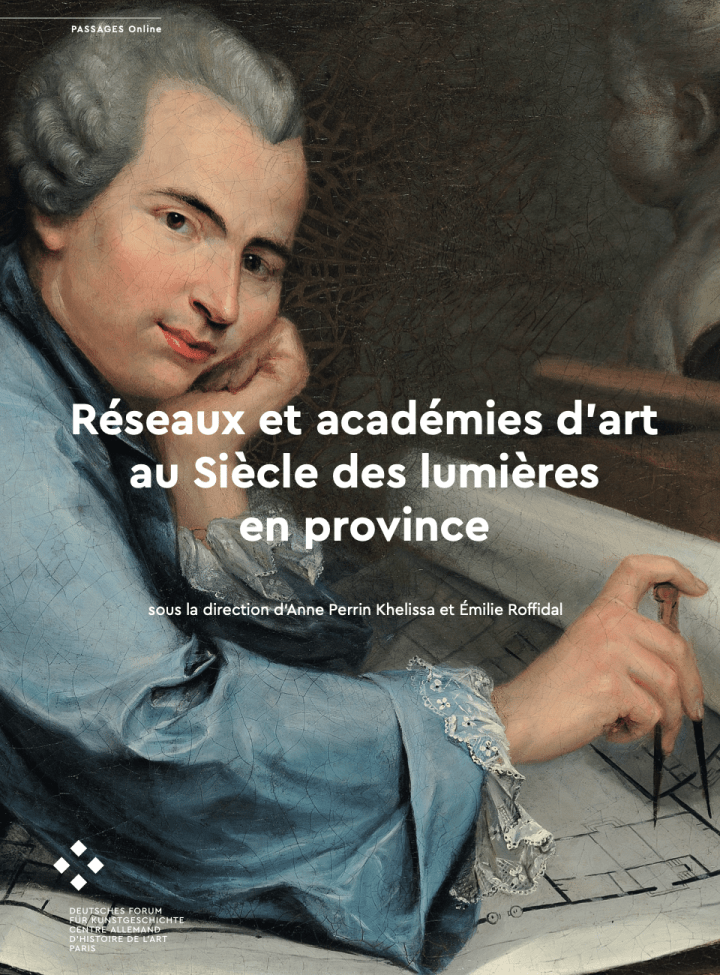
We are delighted to announce the publication of Réseaux et académies d’art au Siècle des lumières en province by Editions de l’Université d’Heidelberg, a partnership between the Université de Toulouse Jean Jaurès and the Deutsches Forum für Kunstgeschichte. The book is the result of seven years of research conducted by the ACA-RES program (Les académies d’art et leurs réseaux dans la France préindustrielle), giving rise to several study days and publications, a vast archival and digital survey, a virtual exhibition, and a concluding colloquium on the theme of circulations, as well as numerous collaborations between universities, museums, and researchers from diverse horizons. To celebrate, there will be a presentation of the book followed by a drinks reception on Wednesday, October 16, starting at 6pm at the Centre allemand d’histoire de l’art (45 rue des Petits Champs).
–Anne Perrin Khelissa and Émilie Roffidal
The full volume is available for free here»
Anne Perrin Khelissa and Émilie Roffidal, eds., Réseaux et académies d’art au Siècle des lumières en province (Heidelberg: arthistoricum.net-ART-Books, 2024), 428 pages, ISBN: 978-3985010790 (hardcover) / ISBN: 978-3985010783 (PDF).
c o n t e n t s
Remerciements
 Introduction générale
• Anne Perrin Khelissa, Émilie Roffidal — Le progrès par les arts : l’émergence du phénomène académique
Partie I | Dynamique des réseaux interpersonnels et interinstitutionnels
• Anne Perrin Khelissa, Émilie Roffidal — Introduction
• Lesley Miller — L’École gratuite de dessin et la production textile à Lyon au XVIIIe siècle : réévaluer l’utilité et l’application d’un enseignement
• Hélène Rousteau-Chambon — L’école de dessin de Nantes, un creuset pour les architectes ?
• Stéphanie Trouvé — Les cercles académiques bordelais dans la trajectoire du peintre Pierre Lacour (1745–1814)
• Catherine Voiriot — Les femmes académiciennes en province : l’exemple de l’Académie de peinture et de sculpture de Marseille
• Joëlle Raineau-Lehuédé — Nicolas Ponce (1746–1831) : la trajectoire d’un graveur au sein des académies de province
• Maël Tauziède-Espariat — Les artistes de Paris et les écoles de dessin provinciales au XVIII e siècle : les cas de Bordeaux, Reims et Rouen
• Gaëtane Maës — Enseignement du dessin et perspectives transnationales : réflexions à partir du cas de Jean-Baptiste Descamps (1715–1791)
Partie II | Mobilité des collections et des savoirs artistiques
• Anne Perrin Khelissa, Émilie Roffidal — Introduction
• Flore César — Les collections des écoles de dessin et des académies d’art en province : entre intentions et institutionnalisation
• Pierre Marty — Expositions de peintures et académies artistiques provinciales : vers une structuration du marché de l’art
• Nelly Vi-Tong — Les collections pédagogiques des établissements de Reims, Valenciennes et Dijon
• Tara Cruzol — Le traité de sculpture d’Antoine-Michel Perrache (1726–1779) à Lyon, ou la culture d’un professeur
• Fabienne Sartre — Le « ciseau statuaire » et la sculpture académique à l’épreuve du terrain. L’expérience montpelliéraine (1770-1800)
• Catherine Isaac — Le rôle des académies des sciences et des arts dans la création et l’essor du corps des ingénieurs du Languedoc
• Marion Amblard — Des arts manufacturés aux beaux- arts : l’importance des modèles romains et français dans le développement des académies écossaises
• Anne Perrin Khelissa, Émilie Roffidal — Conclusion générale | Entre utopie et réalité des arts : de l’échelle régionale à l’échelle mondiale
• Pierre-Yves Beaurepaire — Ouverture | Historiographie et linéaments des sociabilités des Lumières
Notices historiques des académies d’art
Carte des principales villes avec une école de dessin ou une académie d’art
Sources manuscrites, imprimées et visuelles des académies d’art
Liste des publications ACA-RES
Bibliographie générale
Index
Crédits photographiques
◊ ◊ ◊ ◊ ◊
Note (added 11 September 2024) — The original posting mistakenly gave the reception date as Thursday, October 17. It has been corrected above as Wednesday, October 16.
Print Quarterly, September 2024
The long eighteenth century in the latest issue of Print Quarterly:
Print Quarterly 41.3 (September 2024)
a r t i c l e s
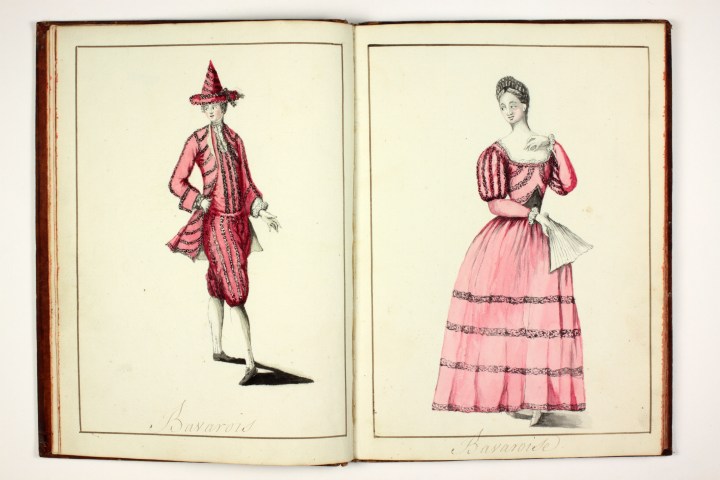
Anonymous artist, A Bavarian Man and A Bavarian Woman, ca. 1759, watercolour, 269 × 190 mm (Welbeck, Nottinghamshire: Welbeck Abbey).
• Derek Adlam and Maureen Cassidy-Geiger, “The Duke of Portland’s Album of Masquerade Costumes Worn in Warsaw in 1759”, pp. 268–84.
This article examines an album of watercolours in the library of the Dukes of Portland at Welbeck Abbey near Worksop, Nottinghamshire, depicting costumed figures and the print sources that inspired them. Seemingly related to the Polish masked balls and banquets mounted in Warsaw on 26 and 27 February 1759 by Jerzy August Mniszech (1715–78), King August III, the album is closely related to imagery seen in Abraham a Sancta Clara’s Neu-eröffnete Welt-Galleria (Nuremberg, 1703), among others, listed in an Appendix at the end of the article. Its commission and creator remain unknown.
n o t e s a n d r e v i e w s
• Daniel Godfrey, Review of Anna Marie Roos, Martin Lister and his Remarkable Daughters: The Art of Science in the Seventeenth Century (Bodleian Library, 2019), pp. 313–16.
• Antoinette Friedenthal, Review of Erminia Gentile Ortona, Le Lettere di Pierre-Jean Mariette ‘Eccellente nella Intelligenza delle Tre Arti’ a Giovanni Gaetano Bottari. Il Codice 1606 (32-E-27) della Biblioteca dell’Accademia Nazionale dei Lincei e Corsiniana (Bardi Edizioni and Accademia Nazionale dei Lincei, 2022), pp. 316–19.

Letitia Byrne, Title-Page to the series ‘Animals’, 1795, etching, 145 × 181 mm (London: British Museum).
• Andaleeb Badiee Banta, Review of Artemis Alexiou and Rose Roberto, eds., Women in Print 1: Design and Identities (Peter Lang, 2022) and Caroline Archer-Parré, Christine Moog and John Hinks, eds., Women in Print 2: Production, Distribution and Consumption (Peter Lang, 2022), pp. 319–20.
• Antony Griffiths, Review of Nigel Tattersfield, Dealing in Deceit: Edwin Pearson of the ‘Bewick Repository Bookshop’, 1838–1901 (The Bewick Society, 2020), pp. 320–21.
• Suzanne Boorsch, Review of Arianna Quaglio, Linda Schädler and Patrizia Keller, eds., From Albrecht Dürer to Andy Warhol: Masterpieces from the Graphische Sammlung ETH Zürich (MASI Lugano and Graphische Sammlung ETH Zürich, 2023) and Elizabeth Nogrady and Alyx Raz, eds., Making & Meaning: The Frances Lehman Loeb Art Center / Vassar College (Hirmer, 2023), pp. 327–30.
• Rena Hoisington, Review of Edouard Kopp, Elizabeth Rudy and Kristel Smentek, eds., Dare to Know: Prints and Drawings in the Age of the Enlightenment (Harvard Art Museums, 2022), pp. 346–50.
• Tim Clayton, Review of Allison Stagg, Prints of a New Kind: Political Caricature in the United States, 1789–1828 (Pennsylvania State University Press, 2023), pp. 351–54; recipient of Ewell L. Newman Book Award from the American Historical Print Collectors Society.
b o o k s r e c e i v e d
• Clarissa von Spee and Yiwen Liu, eds., China’s Southern Paradise: Treasures from the Lower Yangzi Delta (Cleveland Museum of Art, 2024), pp, 340–41.
• Iris Brahms, ed., Marginale Zeichentechniken: Pause, Abklatsch, Cut&Paste als ästhetische Strategien in der Vormoderne (De Gruyter, 2022), p. 341. The book explores ‘marginal drawing practices’ through a collection of essays focusing on works on paper from the sixteenth to eighteenth centuries.
Call for Applications | Seminar in Curating Prints
From ArtHist.net and Print Quarterly:
Seminar in Curating Prints
London and Paris, 12–27 March 2025 (9 days)
Applications due by 18 September 2024
 Print Quarterly invites applications for a program dedicated to prints connoisseurship and curatorial practice, spanning from printmaking techniques to innovative strategies of display and public engagement in a museum context. The program will take place over approximately nine days in London and Paris in the period 12–27 March 2025, with exact dates to be confirmed in October 2024. Most sessions will be held in museum print rooms, but insights into commercial print publishing, current printmaking, and the art market will also be provided. The program will be led by the editor of Print Quarterly, Rhoda Eitel-Porter, with the contributions of international senior experts.
The program is tailored to early and mid-career curators with responsibility for prints and works on paper seeking professional development. Applications from scholars involved with print curating or advanced graduate students pursuing a thesis on a print-related topic will also be considered. A maximum of ten participants will be admitted to the program. The seminars will allow participants to strengthen their knowledge of and familiarity with prints across media and contexts, while exploring new fields and methods, including non-Western traditions. Besides furthering their knowledge of the subject, the seminar will also stimulate the participants to think differently and further on how to manage, display, and deploy their collections for the benefit of the public. Furthermore, through exposure to other museum curators and managers at the host venues and selected experts, participants will develop their network within the community of print scholars. The working language is English. Participants will be asked to prepare one or two short presentations of five to ten minutes on selected topics.
Travel, accommodation, and meal expenses will be covered by the program. The program is supported by The Getty Foundation, as part of The Paper Project: Prints and Drawings Curatorship in the 21st Century.
Applications with the following (as PDF files) should be emailed to curating@printquarterly.co.uk by 18 September 2024.
• A brief letter of intent of no more than one page summarizing your interest in the program. The letter should describe your current responsibilities and work, your future hopes and ambitions, and an explanation of how participation in the program might help you achieve your goals. It should also include your thoughts about what you would hope to see covered in the program and wish to learn from it.
• A curriculum vitae that includes your name, title, current position (and whether this is part- or full-time), affiliation, email address, residential address, nationality/citizenship, languages spoken, education, publications, and name and contact details of two references.
Participants will be selected and notified by late October 2024. Questions about the program may be directed to curating@printquarterly.co.uk.
Call for Papers | The Myth of French Taste
The Myth of French Taste
A Special Issue of H-France Salon edited by Oliver Wunsch
Proposals due by 15 October 2024
The French have taste in all they do
Which we are quite without;
For Nature which to them gave goût
To us gave only gout.
–Thomas Erskine (1750–1823)
The concept of goût français first became a subject of sustained critical inquiry during the eighteenth century, integrating the discourse of aesthetic experience with new forms of national identity. Enlightenment theories of the nation as something both perfectable and corruptible gave rise to the idea of French taste as something requiring both cultivation and protection. Usage of the term le goût français grew gradually through the early twentieth century, peaking during the interwar period before dropping precipitously. Few scholars today would speak of ‘French taste’ as a coherent entity, and the national chauvinism implicit within the term make it an awkward fit for an era of research that emphasizes cultural relativism and global interconnection.
But even if we believe that ‘French taste’ represents an outdated and jingoistic myth, we still need to contend with its historical impact. How did the mythology of French taste shape cultural experience in the greater Francosphere between the eighteenth and twentieth centuries? How was French taste defined, whom did it exclude, and what purpose did it serve? And can scholars today characterize French cultural tendencies without reinforcing an essentializing understanding of national character? This special issue of H-France Salon welcomes essays that approach these questions from a range of disciplinary perspectives, including cultural history, literary studies, sociology, art history, and the history of collecting. Contributions could analyze specific works of art or literature that shaped concepts of French taste, or they might examine the theorization of French taste in the writing of a particular philosopher or cultural critic. Essays might also consider how scholarly specialization in French culture and the existence of professional organizations such as H-France serve to reinforce or challenge historical conceptions of French taste.
Interested contributors should email an abstract (max. 500 words) to Oliver Wunsch (wunscho@bc.edu) by 15 October 2024.
Oliver Wunsch
Art, Art History, and Film Department | Boston College
Exhibition | Jean-Baptiste Oudry and the Royal Hunts of Louis XV
From the press release for the exhibition:
Peintre de courre: Jean-Baptiste Oudry et les Chasses royales de Louis XV
Château de Fontainebleau, 12 October 2024 — 27 January 2025
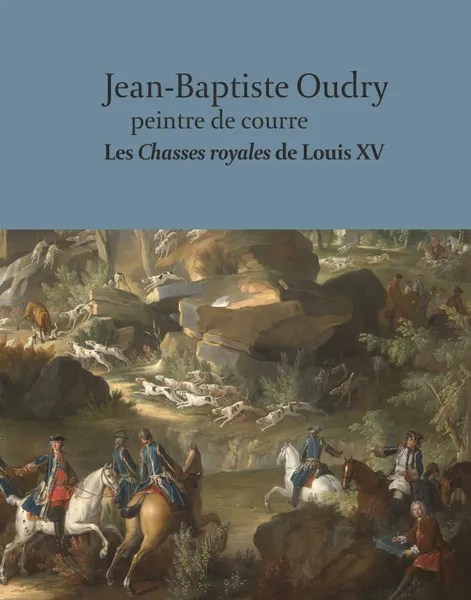 Cette exposition valorisera des trésors méconnus du château : les cartons préparatoires au tissage de la tenture des Chasses de Louis XV, dont quatre cartons tout récemment restaurés.
À l’automne 2024, le château de Fontainebleau mettra en lumière le travail du peintre Jean-Baptiste Oudry, célèbre pour ses représentations des chasses du roi Louis XV et ses portraits animaliers. Peintures, ouvrages, porcelaines, dessins, habits et tapisseries plongeront les visiteurs dans l’univers de la chasse, activité favorite du roi, qu’il souhaita fixer pour l’éternité en passant la commande à Oudry à partir de 1733 d’un ensemble de tapisseries. Cette exposition présentera pour la première fois, côte à côte, les dessins préparatoires, les cartons d’Oudry (œuvres préparatoires à l’échelle réelle qui servent ensuite au lissier à tisser les tapisseries), conservés à Fontainebleau et dont quatre ont été récemment restaurés et les tapisseries qui en sont issues, tissées par la manufacture royale des Gobelins.
Par ailleurs, l’exposition illustrera le goût pour les scènes de chasse dans la peinture et le décor intérieur des demeures royales et aristocratiques du XVIIIe siècle , ainsi que l’« Oudrymania », c’est-à-dire la diffusion des créations de l’artiste dans divers domaines des arts décoratifs, tels que les illustrations de beaux livres, la porcelaine et l’orfèvrerie. L’exposition invite les visiteurs à (re)découvrir la résidence de chasse favorite des rois de France que fut le château de Fontainebleau au fil des siècles.
Un colloque Jean-Baptiste Oudry et la peinture animalière sera co-organisé avec la Fondation François Sommer et se tiendra à Paris et à Fontainebleau mi-décembre 2024.
Vincent Cochet et Oriane Beaufils, eds., Peintre de courre: Jean-Baptiste Oudry et les Chasses royales de Louis XV (Paris: Réunion des Musées Nationaux, 2024), 229 pages, ISBN: 978-2711880423, €49.
The full press release is available here»
Exhibition | Oudrymania
Now on view at the Château de Chantilly:
Oudrymania: Fables, Hunts, Fights
Musée Condé, Château de Chantilly, 8 June — 6 October 2024
Curated by Baptiste Roelly with Oriane Beaufils
 Depicted in hunting scenes, portraiture, and combat, animals feature among the most striking images produced by Jean-Baptiste Oudry (1686–1755). A gifted artist with an unrivalled mastery of his technique, he brings us face-to-face with the animal repertoire as it existed in the 18th century, including in a series of three hunting scenes painted for the Château de Chantilly, works that were scattered after the French Revolution but which have now been brought back together.
Animal scenes were extremely popular with the leading collectors of the 18th century, including the princes of Condé, who commissioned them from the artist. A set of exquisite drawings by Oudry loaned from a private collection feature in the exhibition alongside works from Chantilly’s collections, allowing visitors to see pieces never before displayed in public. These include a large number of illustrations for La Fontaine’s fables, showing how the fabulist and the artist use the animal kingdom to help us laugh at and reflect on human nature. These illustrations were so effective they were copied by the arts and crafts industry and included in their decorative production, examples of which can also be admired in the exhibition. Through paintings, drawings, objets d’art, and rare books, this show shines a light into every corner of the Oudrymania that has gripped art lovers for centuries.
The exhibition is organized by Baptiste Roelly, curator at the Condé museum, in collaboration with Oriane Beaufils, curator and director of collections at the Villa Ephrussi de Rothschild.
Baptiste Roelly and Oriane Beaufils, eds, Oudrymania: Fables, Chasses, Combats (Éditions Faton, 2024), 128 pages, ISBN: 978-2878443585, €22. With contributions by Oriane Beaufils, Claire Betelu, Lucile Brunel-Duverger, Laurence de Viguerie, Juliette Debrie, Mathieu Deldicque, Nicole Garnier-Pelle, François Gilles, Maxime Georges Métraux, Roberta J.M. Olson, and Baptiste Roelly,
The press release (in French) is available here»
The Huntington Acquires Portrait by Antoine-François Callet
From the press release (28 August 2024) . . .
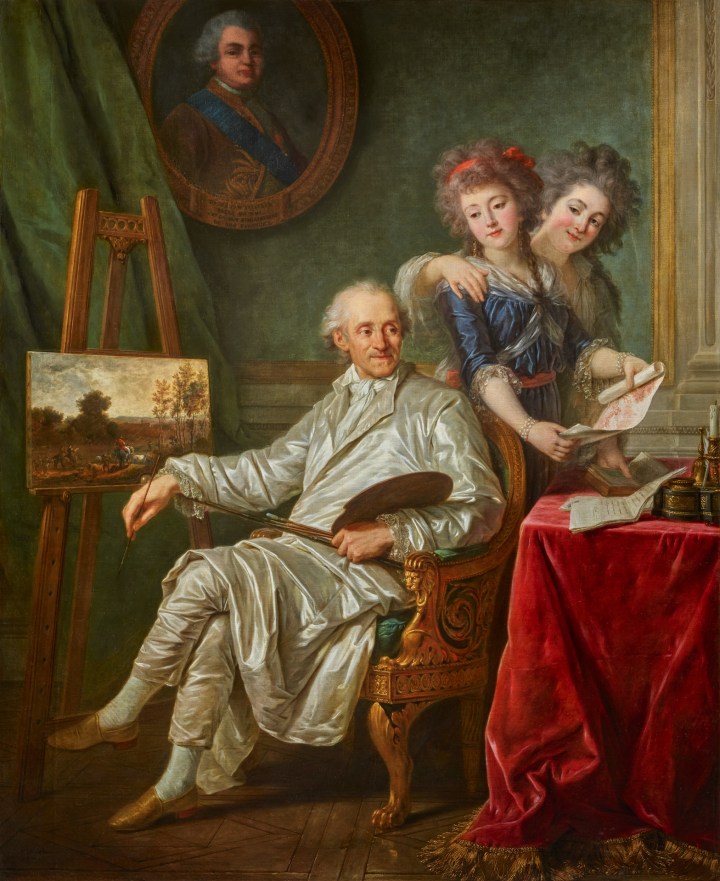
Antoine-François Callet, Portrait of the Comte de Cromot, Superintendent of the Comte de Provence, at an easel, accompanied by his two daughters-in-law, 1787, oil on canvas, 78 × 64 inches (San Marino: The Huntington Library, Art Museum, and Botanical Gardens).
The Huntington Library, Art Museum, and Botanical Gardens has acquired an ambitious, large-scale masterpiece by 18th-century French portraitist Antoine-François Callet (1741–1823), the official painter of Louis XVI. The work is the fourth in a series of acquisitions made possible by The Ahmanson Foundation.
Painted at the height of the artist’s career, Portrait of the Comte de Cromot, Superintendent of the Comte de Provence, at an easel, accompanied by his two daughters-in-law is a unique Old Master work that contains a painting within a painting. The small landscape on the easel adjacent to the sitter was painted on a separate canvas and signed by the Comte de Cromot himself, known to be an amateur painter, and then inserted into the overall composition by Callet. The complex portrait will go on view in the Huntington Art Gallery this fall as an important counterpart to the institution’s world-class collection of 18th-century French decorative arts, complementing the recent addition of Joseph Hyacinthe François-de-Paule de Rigaud, comte de Vaudreuil by Élisabeth Louise Vigée Le Brun, which also became part of the collection through a gift from The Ahmanson Foundation.
“This historically significant work by Antoine-François Callet is an extraordinary addition to our signature portrait collection and will be vital in our interpretive work as we draw connections to our related French holdings,” Huntington President Karen Lawrence said. “We are immensely grateful to The Ahmanson Foundation for their support in strengthening The Huntington’s collection of European art with this masterpiece.”
Antoine-François Callet was born in Paris in 1741. In 1764, at the age of 23, he won the Prix de Rome and completed his artistic education at the Académie de France in Rome. In the late 1770s, he returned to Paris to begin work on a ceiling painting for the Louvre, which earned him admission to the Académie Royale. He received patronage and the protection of King Louis XVI and the monarch’s brothers. As the official painter of Louis XVI, he painted the famous portrait of the king in his coronation robes. Callet was also the First Painter to ‘Monsieur’ (Comte de Provence) and the official painter to the Comte d’Artois, who were the king’s brothers. During the turbulent 18th and 19th centuries, Callet regularly exhibited at the Salon of the Académie des Beaux-Arts in Paris.
“The portrait of the Comte de Cromot is exceptional both historically and artistically,” said Christina Nielsen, Hannah and Russel Kully Director of the Art Museum at The Huntington. “It has tremendous presence—great not only in scale but also in ambition as it contains four portraits in one: that of the Comte de Cromot, his two daughters-in-law, and the future King Louis XVIII, seen in a roundel on the wall in the background.”
The primary sitter, the Comte de Cromot, was Jules-David Cromot du Bourg, superintendent of finances to the Comte de Provence, who was the brother of Louis XVI and the future king of France. The frame of the portrait of the Comte de Provence is inscribed with the words “Donné par Mr. frère du Roi au Grand Surintendant de ses finances,” acknowledging that the monumental work was commissioned by the future king for the model. The Comte de Cromot died in 1786, which makes the portrait the last representation of this important 18th-century figure. The two daughters-in-law in the painting are Marie Sophie Guillauden du Plessis and Sophie de Barral. “The Comte de Cromot is rendered as an accomplished artist, while his daughters-in-law are pictured reading letters and books and considering drawings, signifying the importance of the arts across the spectrum of intellectual life in French society,” Nielsen said.
Through its partnership with The Ahmanson Foundation, The Huntington has acquired Portrait of José Antonio Caballero, Second Marqués de Caballero, Secretary of Grace and Justice (1807) by Francisco de Goya in 2023; Portrait of Joseph Hyacinthe François-de-Paule de Rigaud, comte de Vaudreuil (ca. 1784) by Vigée Le Brun, the most important female artist of 18th-century France, in 2022; and the monumental Portage Falls on the Genesee (ca. 1839) by Anglo American painter Thomas Cole in 2021.
◊ ◊ ◊ ◊ ◊
On 25 January 2023, the portrait was sold at Christie’s in New York as lot 55 of Remastered: Old Masters from the Collection of J.E. Safra for $201,600, well under its low estimate of $300,000. –CH










 Enfilade
leave a comment