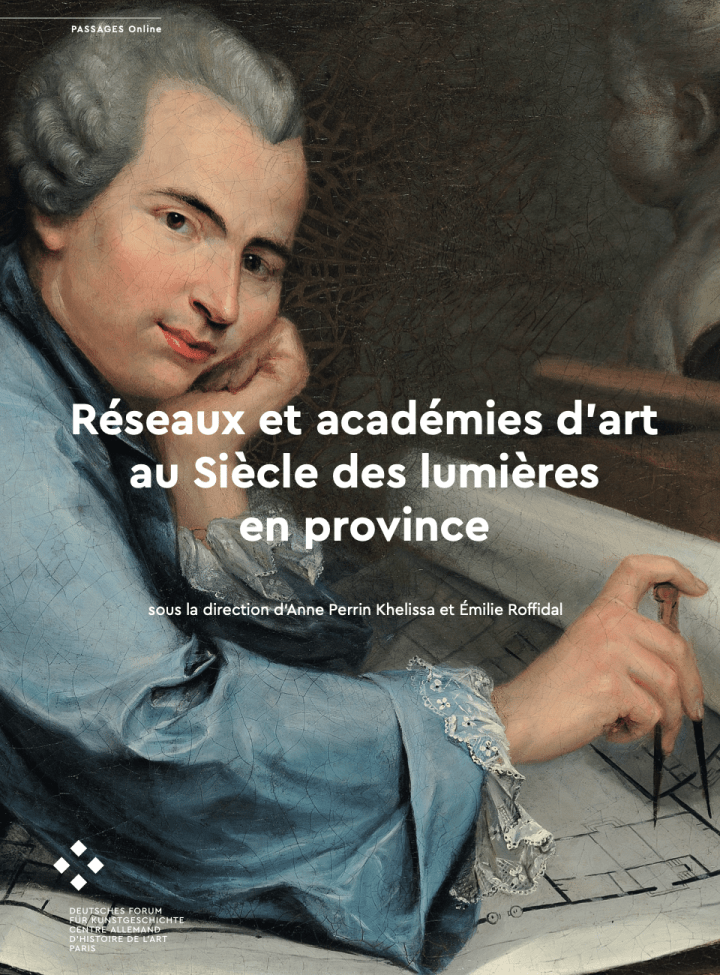
New Book | Réseaux et académies d’art au Siècle des lumières en province
We are delighted to announce the publication of Réseaux et académies d’art au Siècle des lumières en province by Editions de l’Université d’Heidelberg, a partnership between the Université de Toulouse Jean Jaurès and the Deutsches Forum für Kunstgeschichte. The book is the result of seven years of research conducted by the ACA-RES program (Les académies d’art et leurs réseaux dans la France préindustrielle), giving rise to several study days and publications, a vast archival and digital survey, a virtual exhibition, and a concluding colloquium on the theme of circulations, as well as numerous collaborations between universities, museums, and researchers from diverse horizons. To celebrate, there will be a presentation of the book followed by a drinks reception on Wednesday, October 16, starting at 6pm at the Centre allemand d’histoire de l’art (45 rue des Petits Champs).
–Anne Perrin Khelissa and Émilie Roffidal
The full volume is available for free here»
Anne Perrin Khelissa and Émilie Roffidal, eds., Réseaux et académies d’art au Siècle des lumières en province (Heidelberg: arthistoricum.net-ART-Books, 2024), 428 pages, ISBN: 978-3985010790 (hardcover) / ISBN: 978-3985010783 (PDF).
c o n t e n t s
Remerciements
 Introduction générale
• Anne Perrin Khelissa, Émilie Roffidal — Le progrès par les arts : l’émergence du phénomène académique
Partie I | Dynamique des réseaux interpersonnels et interinstitutionnels
• Anne Perrin Khelissa, Émilie Roffidal — Introduction
• Lesley Miller — L’École gratuite de dessin et la production textile à Lyon au XVIIIe siècle : réévaluer l’utilité et l’application d’un enseignement
• Hélène Rousteau-Chambon — L’école de dessin de Nantes, un creuset pour les architectes ?
• Stéphanie Trouvé — Les cercles académiques bordelais dans la trajectoire du peintre Pierre Lacour (1745–1814)
• Catherine Voiriot — Les femmes académiciennes en province : l’exemple de l’Académie de peinture et de sculpture de Marseille
• Joëlle Raineau-Lehuédé — Nicolas Ponce (1746–1831) : la trajectoire d’un graveur au sein des académies de province
• Maël Tauziède-Espariat — Les artistes de Paris et les écoles de dessin provinciales au XVIII e siècle : les cas de Bordeaux, Reims et Rouen
• Gaëtane Maës — Enseignement du dessin et perspectives transnationales : réflexions à partir du cas de Jean-Baptiste Descamps (1715–1791)
Partie II | Mobilité des collections et des savoirs artistiques
• Anne Perrin Khelissa, Émilie Roffidal — Introduction
• Flore César — Les collections des écoles de dessin et des académies d’art en province : entre intentions et institutionnalisation
• Pierre Marty — Expositions de peintures et académies artistiques provinciales : vers une structuration du marché de l’art
• Nelly Vi-Tong — Les collections pédagogiques des établissements de Reims, Valenciennes et Dijon
• Tara Cruzol — Le traité de sculpture d’Antoine-Michel Perrache (1726–1779) à Lyon, ou la culture d’un professeur
• Fabienne Sartre — Le « ciseau statuaire » et la sculpture académique à l’épreuve du terrain. L’expérience montpelliéraine (1770-1800)
• Catherine Isaac — Le rôle des académies des sciences et des arts dans la création et l’essor du corps des ingénieurs du Languedoc
• Marion Amblard — Des arts manufacturés aux beaux- arts : l’importance des modèles romains et français dans le développement des académies écossaises
• Anne Perrin Khelissa, Émilie Roffidal — Conclusion générale | Entre utopie et réalité des arts : de l’échelle régionale à l’échelle mondiale
• Pierre-Yves Beaurepaire — Ouverture | Historiographie et linéaments des sociabilités des Lumières
Notices historiques des académies d’art
Carte des principales villes avec une école de dessin ou une académie d’art
Sources manuscrites, imprimées et visuelles des académies d’art
Liste des publications ACA-RES
Bibliographie générale
Index
Crédits photographiques
◊ ◊ ◊ ◊ ◊
Note (added 11 September 2024) — The original posting mistakenly gave the reception date as Thursday, October 17. It has been corrected above as Wednesday, October 16.
Print Quarterly, September 2024
The long eighteenth century in the latest issue of Print Quarterly:
Print Quarterly 41.3 (September 2024)
a r t i c l e s
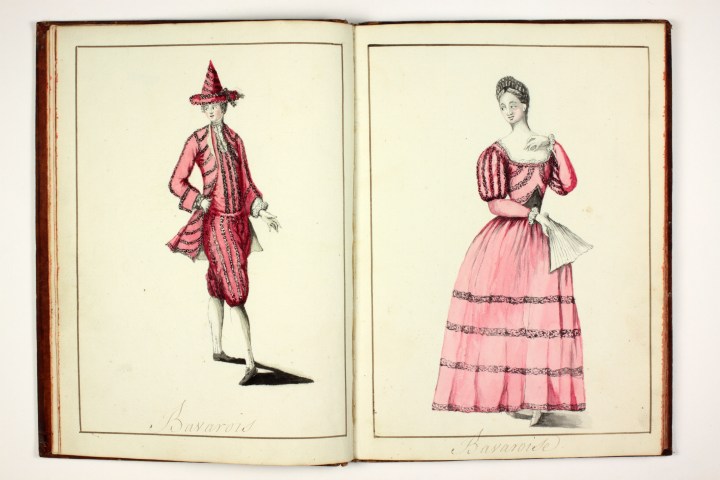
Anonymous artist, A Bavarian Man and A Bavarian Woman, ca. 1759, watercolour, 269 × 190 mm (Welbeck, Nottinghamshire: Welbeck Abbey).
• Derek Adlam and Maureen Cassidy-Geiger, “The Duke of Portland’s Album of Masquerade Costumes Worn in Warsaw in 1759”, pp. 268–84.
This article examines an album of watercolours in the library of the Dukes of Portland at Welbeck Abbey near Worksop, Nottinghamshire, depicting costumed figures and the print sources that inspired them. Seemingly related to the Polish masked balls and banquets mounted in Warsaw on 26 and 27 February 1759 by Jerzy August Mniszech (1715–78), King August III, the album is closely related to imagery seen in Abraham a Sancta Clara’s Neu-eröffnete Welt-Galleria (Nuremberg, 1703), among others, listed in an Appendix at the end of the article. Its commission and creator remain unknown.
n o t e s a n d r e v i e w s
• Daniel Godfrey, Review of Anna Marie Roos, Martin Lister and his Remarkable Daughters: The Art of Science in the Seventeenth Century (Bodleian Library, 2019), pp. 313–16.
• Antoinette Friedenthal, Review of Erminia Gentile Ortona, Le Lettere di Pierre-Jean Mariette ‘Eccellente nella Intelligenza delle Tre Arti’ a Giovanni Gaetano Bottari. Il Codice 1606 (32-E-27) della Biblioteca dell’Accademia Nazionale dei Lincei e Corsiniana (Bardi Edizioni and Accademia Nazionale dei Lincei, 2022), pp. 316–19.

Letitia Byrne, Title-Page to the series ‘Animals’, 1795, etching, 145 × 181 mm (London: British Museum).
• Andaleeb Badiee Banta, Review of Artemis Alexiou and Rose Roberto, eds., Women in Print 1: Design and Identities (Peter Lang, 2022) and Caroline Archer-Parré, Christine Moog and John Hinks, eds., Women in Print 2: Production, Distribution and Consumption (Peter Lang, 2022), pp. 319–20.
• Antony Griffiths, Review of Nigel Tattersfield, Dealing in Deceit: Edwin Pearson of the ‘Bewick Repository Bookshop’, 1838–1901 (The Bewick Society, 2020), pp. 320–21.
• Suzanne Boorsch, Review of Arianna Quaglio, Linda Schädler and Patrizia Keller, eds., From Albrecht Dürer to Andy Warhol: Masterpieces from the Graphische Sammlung ETH Zürich (MASI Lugano and Graphische Sammlung ETH Zürich, 2023) and Elizabeth Nogrady and Alyx Raz, eds., Making & Meaning: The Frances Lehman Loeb Art Center / Vassar College (Hirmer, 2023), pp. 327–30.
• Rena Hoisington, Review of Edouard Kopp, Elizabeth Rudy and Kristel Smentek, eds., Dare to Know: Prints and Drawings in the Age of the Enlightenment (Harvard Art Museums, 2022), pp. 346–50.
• Tim Clayton, Review of Allison Stagg, Prints of a New Kind: Political Caricature in the United States, 1789–1828 (Pennsylvania State University Press, 2023), pp. 351–54; recipient of Ewell L. Newman Book Award from the American Historical Print Collectors Society.
b o o k s r e c e i v e d
• Clarissa von Spee and Yiwen Liu, eds., China’s Southern Paradise: Treasures from the Lower Yangzi Delta (Cleveland Museum of Art, 2024), pp, 340–41.
• Iris Brahms, ed., Marginale Zeichentechniken: Pause, Abklatsch, Cut&Paste als ästhetische Strategien in der Vormoderne (De Gruyter, 2022), p. 341. The book explores ‘marginal drawing practices’ through a collection of essays focusing on works on paper from the sixteenth to eighteenth centuries.
Call for Applications | Seminar in Curating Prints
From ArtHist.net and Print Quarterly:
Seminar in Curating Prints
London and Paris, 12–27 March 2025 (9 days)
Applications due by 18 September 2024
 Print Quarterly invites applications for a program dedicated to prints connoisseurship and curatorial practice, spanning from printmaking techniques to innovative strategies of display and public engagement in a museum context. The program will take place over approximately nine days in London and Paris in the period 12–27 March 2025, with exact dates to be confirmed in October 2024. Most sessions will be held in museum print rooms, but insights into commercial print publishing, current printmaking, and the art market will also be provided. The program will be led by the editor of Print Quarterly, Rhoda Eitel-Porter, with the contributions of international senior experts.
The program is tailored to early and mid-career curators with responsibility for prints and works on paper seeking professional development. Applications from scholars involved with print curating or advanced graduate students pursuing a thesis on a print-related topic will also be considered. A maximum of ten participants will be admitted to the program. The seminars will allow participants to strengthen their knowledge of and familiarity with prints across media and contexts, while exploring new fields and methods, including non-Western traditions. Besides furthering their knowledge of the subject, the seminar will also stimulate the participants to think differently and further on how to manage, display, and deploy their collections for the benefit of the public. Furthermore, through exposure to other museum curators and managers at the host venues and selected experts, participants will develop their network within the community of print scholars. The working language is English. Participants will be asked to prepare one or two short presentations of five to ten minutes on selected topics.
Travel, accommodation, and meal expenses will be covered by the program. The program is supported by The Getty Foundation, as part of The Paper Project: Prints and Drawings Curatorship in the 21st Century.
Applications with the following (as PDF files) should be emailed to curating@printquarterly.co.uk by 18 September 2024.
• A brief letter of intent of no more than one page summarizing your interest in the program. The letter should describe your current responsibilities and work, your future hopes and ambitions, and an explanation of how participation in the program might help you achieve your goals. It should also include your thoughts about what you would hope to see covered in the program and wish to learn from it.
• A curriculum vitae that includes your name, title, current position (and whether this is part- or full-time), affiliation, email address, residential address, nationality/citizenship, languages spoken, education, publications, and name and contact details of two references.
Participants will be selected and notified by late October 2024. Questions about the program may be directed to curating@printquarterly.co.uk.
Call for Papers | The Myth of French Taste
The Myth of French Taste
A Special Issue of H-France Salon edited by Oliver Wunsch
Proposals due by 15 October 2024
The French have taste in all they do
Which we are quite without;
For Nature which to them gave goût
To us gave only gout.
–Thomas Erskine (1750–1823)
The concept of goût français first became a subject of sustained critical inquiry during the eighteenth century, integrating the discourse of aesthetic experience with new forms of national identity. Enlightenment theories of the nation as something both perfectable and corruptible gave rise to the idea of French taste as something requiring both cultivation and protection. Usage of the term le goût français grew gradually through the early twentieth century, peaking during the interwar period before dropping precipitously. Few scholars today would speak of ‘French taste’ as a coherent entity, and the national chauvinism implicit within the term make it an awkward fit for an era of research that emphasizes cultural relativism and global interconnection.
But even if we believe that ‘French taste’ represents an outdated and jingoistic myth, we still need to contend with its historical impact. How did the mythology of French taste shape cultural experience in the greater Francosphere between the eighteenth and twentieth centuries? How was French taste defined, whom did it exclude, and what purpose did it serve? And can scholars today characterize French cultural tendencies without reinforcing an essentializing understanding of national character? This special issue of H-France Salon welcomes essays that approach these questions from a range of disciplinary perspectives, including cultural history, literary studies, sociology, art history, and the history of collecting. Contributions could analyze specific works of art or literature that shaped concepts of French taste, or they might examine the theorization of French taste in the writing of a particular philosopher or cultural critic. Essays might also consider how scholarly specialization in French culture and the existence of professional organizations such as H-France serve to reinforce or challenge historical conceptions of French taste.
Interested contributors should email an abstract (max. 500 words) to Oliver Wunsch (wunscho@bc.edu) by 15 October 2024.
Oliver Wunsch
Art, Art History, and Film Department | Boston College
Exhibition | Jean-Baptiste Oudry and the Royal Hunts of Louis XV
From the press release for the exhibition:
Peintre de courre: Jean-Baptiste Oudry et les Chasses royales de Louis XV
Château de Fontainebleau, 12 October 2024 — 27 January 2025
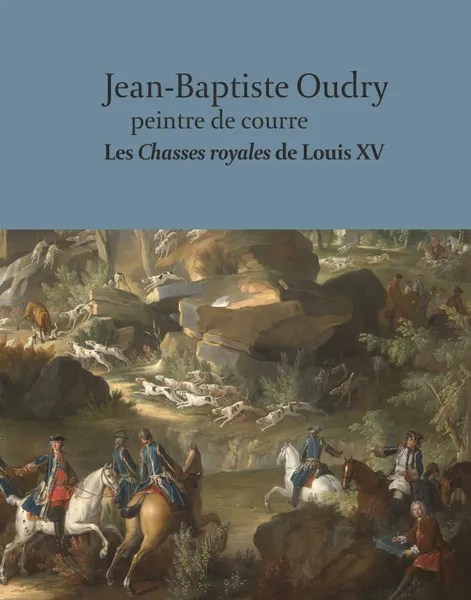 Cette exposition valorisera des trésors méconnus du château : les cartons préparatoires au tissage de la tenture des Chasses de Louis XV, dont quatre cartons tout récemment restaurés.
À l’automne 2024, le château de Fontainebleau mettra en lumière le travail du peintre Jean-Baptiste Oudry, célèbre pour ses représentations des chasses du roi Louis XV et ses portraits animaliers. Peintures, ouvrages, porcelaines, dessins, habits et tapisseries plongeront les visiteurs dans l’univers de la chasse, activité favorite du roi, qu’il souhaita fixer pour l’éternité en passant la commande à Oudry à partir de 1733 d’un ensemble de tapisseries. Cette exposition présentera pour la première fois, côte à côte, les dessins préparatoires, les cartons d’Oudry (œuvres préparatoires à l’échelle réelle qui servent ensuite au lissier à tisser les tapisseries), conservés à Fontainebleau et dont quatre ont été récemment restaurés et les tapisseries qui en sont issues, tissées par la manufacture royale des Gobelins.
Par ailleurs, l’exposition illustrera le goût pour les scènes de chasse dans la peinture et le décor intérieur des demeures royales et aristocratiques du XVIIIe siècle , ainsi que l’« Oudrymania », c’est-à-dire la diffusion des créations de l’artiste dans divers domaines des arts décoratifs, tels que les illustrations de beaux livres, la porcelaine et l’orfèvrerie. L’exposition invite les visiteurs à (re)découvrir la résidence de chasse favorite des rois de France que fut le château de Fontainebleau au fil des siècles.
Un colloque Jean-Baptiste Oudry et la peinture animalière sera co-organisé avec la Fondation François Sommer et se tiendra à Paris et à Fontainebleau mi-décembre 2024.
Vincent Cochet et Oriane Beaufils, eds., Peintre de courre: Jean-Baptiste Oudry et les Chasses royales de Louis XV (Paris: Réunion des Musées Nationaux, 2024), 229 pages, ISBN: 978-2711880423, €49.
The full press release is available here»
Exhibition | Oudrymania
Now on view at the Château de Chantilly:
Oudrymania: Fables, Hunts, Fights
Musée Condé, Château de Chantilly, 8 June — 6 October 2024
Curated by Baptiste Roelly with Oriane Beaufils
 Depicted in hunting scenes, portraiture, and combat, animals feature among the most striking images produced by Jean-Baptiste Oudry (1686–1755). A gifted artist with an unrivalled mastery of his technique, he brings us face-to-face with the animal repertoire as it existed in the 18th century, including in a series of three hunting scenes painted for the Château de Chantilly, works that were scattered after the French Revolution but which have now been brought back together.
Animal scenes were extremely popular with the leading collectors of the 18th century, including the princes of Condé, who commissioned them from the artist. A set of exquisite drawings by Oudry loaned from a private collection feature in the exhibition alongside works from Chantilly’s collections, allowing visitors to see pieces never before displayed in public. These include a large number of illustrations for La Fontaine’s fables, showing how the fabulist and the artist use the animal kingdom to help us laugh at and reflect on human nature. These illustrations were so effective they were copied by the arts and crafts industry and included in their decorative production, examples of which can also be admired in the exhibition. Through paintings, drawings, objets d’art, and rare books, this show shines a light into every corner of the Oudrymania that has gripped art lovers for centuries.
The exhibition is organized by Baptiste Roelly, curator at the Condé museum, in collaboration with Oriane Beaufils, curator and director of collections at the Villa Ephrussi de Rothschild.
Baptiste Roelly and Oriane Beaufils, eds, Oudrymania: Fables, Chasses, Combats (Éditions Faton, 2024), 128 pages, ISBN: 978-2878443585, €22. With contributions by Oriane Beaufils, Claire Betelu, Lucile Brunel-Duverger, Laurence de Viguerie, Juliette Debrie, Mathieu Deldicque, Nicole Garnier-Pelle, François Gilles, Maxime Georges Métraux, Roberta J.M. Olson, and Baptiste Roelly,
The press release (in French) is available here»
The Huntington Acquires Portrait by Antoine-François Callet
From the press release (28 August 2024) . . .
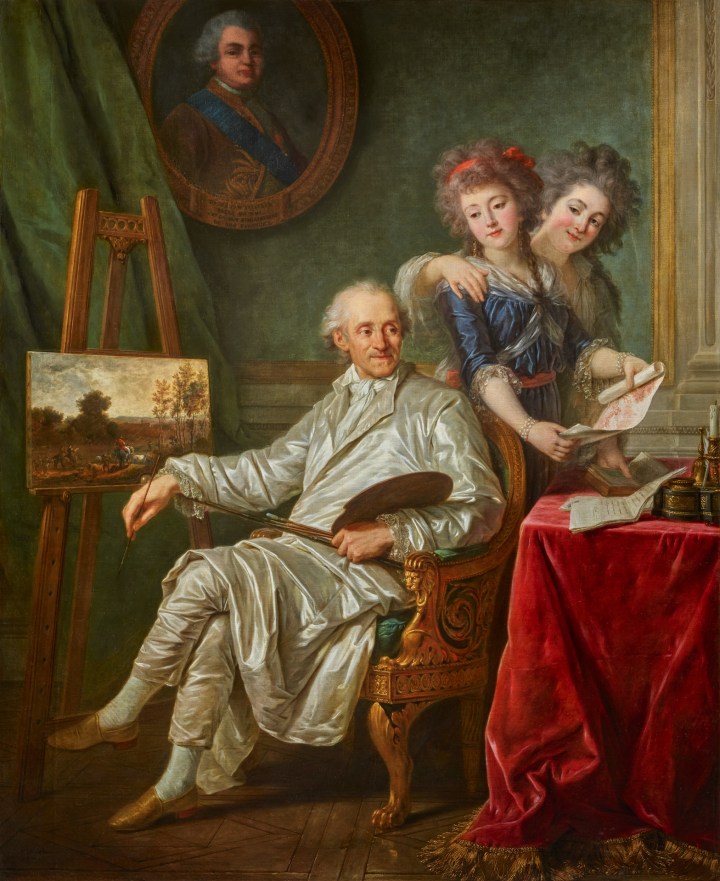
Antoine-François Callet, Portrait of the Comte de Cromot, Superintendent of the Comte de Provence, at an easel, accompanied by his two daughters-in-law, 1787, oil on canvas, 78 × 64 inches (San Marino: The Huntington Library, Art Museum, and Botanical Gardens).
The Huntington Library, Art Museum, and Botanical Gardens has acquired an ambitious, large-scale masterpiece by 18th-century French portraitist Antoine-François Callet (1741–1823), the official painter of Louis XVI. The work is the fourth in a series of acquisitions made possible by The Ahmanson Foundation.
Painted at the height of the artist’s career, Portrait of the Comte de Cromot, Superintendent of the Comte de Provence, at an easel, accompanied by his two daughters-in-law is a unique Old Master work that contains a painting within a painting. The small landscape on the easel adjacent to the sitter was painted on a separate canvas and signed by the Comte de Cromot himself, known to be an amateur painter, and then inserted into the overall composition by Callet. The complex portrait will go on view in the Huntington Art Gallery this fall as an important counterpart to the institution’s world-class collection of 18th-century French decorative arts, complementing the recent addition of Joseph Hyacinthe François-de-Paule de Rigaud, comte de Vaudreuil by Élisabeth Louise Vigée Le Brun, which also became part of the collection through a gift from The Ahmanson Foundation.
“This historically significant work by Antoine-François Callet is an extraordinary addition to our signature portrait collection and will be vital in our interpretive work as we draw connections to our related French holdings,” Huntington President Karen Lawrence said. “We are immensely grateful to The Ahmanson Foundation for their support in strengthening The Huntington’s collection of European art with this masterpiece.”
Antoine-François Callet was born in Paris in 1741. In 1764, at the age of 23, he won the Prix de Rome and completed his artistic education at the Académie de France in Rome. In the late 1770s, he returned to Paris to begin work on a ceiling painting for the Louvre, which earned him admission to the Académie Royale. He received patronage and the protection of King Louis XVI and the monarch’s brothers. As the official painter of Louis XVI, he painted the famous portrait of the king in his coronation robes. Callet was also the First Painter to ‘Monsieur’ (Comte de Provence) and the official painter to the Comte d’Artois, who were the king’s brothers. During the turbulent 18th and 19th centuries, Callet regularly exhibited at the Salon of the Académie des Beaux-Arts in Paris.
“The portrait of the Comte de Cromot is exceptional both historically and artistically,” said Christina Nielsen, Hannah and Russel Kully Director of the Art Museum at The Huntington. “It has tremendous presence—great not only in scale but also in ambition as it contains four portraits in one: that of the Comte de Cromot, his two daughters-in-law, and the future King Louis XVIII, seen in a roundel on the wall in the background.”
The primary sitter, the Comte de Cromot, was Jules-David Cromot du Bourg, superintendent of finances to the Comte de Provence, who was the brother of Louis XVI and the future king of France. The frame of the portrait of the Comte de Provence is inscribed with the words “Donné par Mr. frère du Roi au Grand Surintendant de ses finances,” acknowledging that the monumental work was commissioned by the future king for the model. The Comte de Cromot died in 1786, which makes the portrait the last representation of this important 18th-century figure. The two daughters-in-law in the painting are Marie Sophie Guillauden du Plessis and Sophie de Barral. “The Comte de Cromot is rendered as an accomplished artist, while his daughters-in-law are pictured reading letters and books and considering drawings, signifying the importance of the arts across the spectrum of intellectual life in French society,” Nielsen said.
Through its partnership with The Ahmanson Foundation, The Huntington has acquired Portrait of José Antonio Caballero, Second Marqués de Caballero, Secretary of Grace and Justice (1807) by Francisco de Goya in 2023; Portrait of Joseph Hyacinthe François-de-Paule de Rigaud, comte de Vaudreuil (ca. 1784) by Vigée Le Brun, the most important female artist of 18th-century France, in 2022; and the monumental Portage Falls on the Genesee (ca. 1839) by Anglo American painter Thomas Cole in 2021.
◊ ◊ ◊ ◊ ◊
On 25 January 2023, the portrait was sold at Christie’s in New York as lot 55 of Remastered: Old Masters from the Collection of J.E. Safra for $201,600, well under its low estimate of $300,000. –CH
Exhibition | Kerry James Marshall and John Singleton Copley
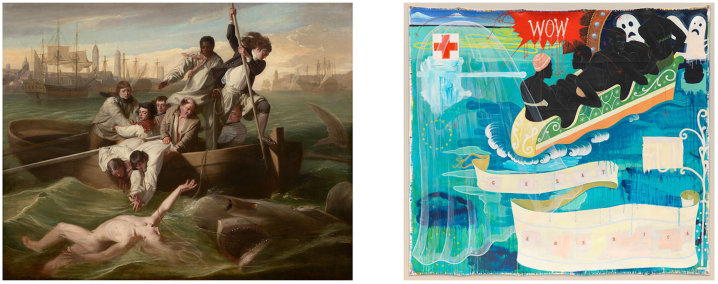
John Singleton Copley, Watson and the Shark, 1778, oil on canvas (DC: NGA, 1963.6.1); and Kerry James Marshall, Great America, 1994, acrylic and collage on canvas (DC: NGA, Gift of the Collectors Committee, 2011.20.1).
◊ ◊ ◊ ◊ ◊
Now on view at the NGA in DC:
Conversations: Kerry James Marshall and John Singleton Copley
National Gallery of Art, Washington DC, 18 November 2023 — 31 January 2025
Two centuries apart, American artists John Singleton Copley and Kerry James Marshall pushed the boundaries of history painting.
A special installation brings together three monumental paintings for a thought-provoking dialogue: Copley’s 18th-century canvas Watson and the Shark and Marshall’s two 20th-century works Great America and Voyager. These paintings—all maritime-themed—address the violent history of the transatlantic slave trade and the Middle Passage, the forced journey of enslaved people across the Atlantic. All three works are part of the National Gallery of Art collection, but this is a rare chance to experience them together in the same exhibition space, in conversation. Compare how Marshall and Copley skillfully wove historical and contemporary events together with cultural, mythological, and spiritual allusions. Take a closer look at these iconic paintings and explore a selection of Marshall’s related drawings for a glimpse into his process.
This is the second installation in our Conversations series, which connects works in our collection from our past and present to reveal how artists help us understand our place in history.
Exhibition | The Birch Trials at Fraunces Tavern
From the press release for the exhibition:
The Birch Trials at Fraunces Tavern
Fraunces Tavern Museum, New York, opening 23 October 2024
Curated by Craig Hamilton Weaver
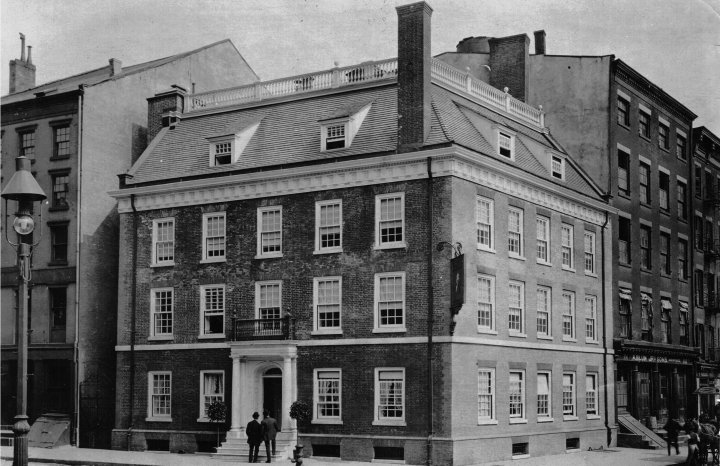
As noted at the museum’s website: “Built by the De Lancey family in 1719, 54 Pearl Street has been a private residence, hotel, and one of the most important taverns of the Revolutionary War.” It is the oldest standing structure in Manhattan.
On 23 October 2024, the Fraunces Tavern Museum, located in the oldest building in Manhattan, will unveil a vastly enlarged permanent exhibition entitled The Birch Trials at Fraunces Tavern. The exhibition highlights the role of Fraunces Tavern in the emancipation of thousands of Black Loyalists at the end of the Revolutionary War (enabling them to leave New York City) and in the creation of the Book of Negroes (the record created of those who departed with the British). The exhibition expands upon one opened at the Museum in June 2023. Recognition is also given to the thousands of Black Patriots who fought to further the cause of American Independence. The previous exhibition attracted a multitude of visitors from around the world, including large numbers of school children. Relocating the exhibition to a larger permanent gallery will enable the Museum to provide a better visitor experience as well as include recent new discoveries of significant information concerning the identities of individuals participating in the Birch Trials and their inclusion in the Book of Negroes.
The exhibition reflects several years of exhaustive research on both sides of the Atlantic in thousands of pages of existing original documents. Museum and Art Committee Co-Chairman and Chief Curator of the exhibition, Craig Hamilton Weaver, emphasizes that “this exhibition is the most comprehensive ever organized on this tremendously significant event in the history of Black emancipation in the United States and is made all the more compelling because it can be viewed within the very walls of the building within which the events occurred.”
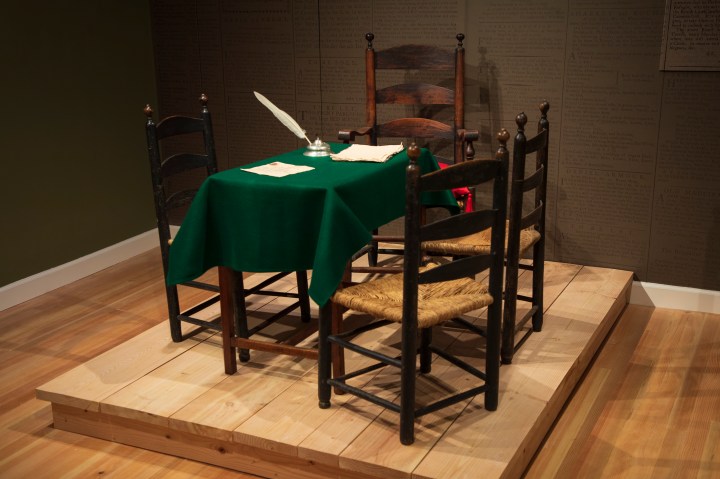
Installation view of The Birch Trials at Fraunces Tavern, 2024.
In 1783, as the Revolutionary War was drawing to a close, a joint British and American Commission met weekly at Fraunces Tavern from April until November. The proceedings of the Commission are known as the ‘Birch Trials’, named after Brigadier General Samuel Birch who oversaw the proceedings. The Commission reviewed and deliberated upon the eligibility of some Black Loyalists to evacuate with the British Army. Testimonies were provided by individuals in person and through documentary evidence to enable the Commissioners to render final decisions. Given that the Commissioners met at Fraunces Tavern weekly and had the responsibility “to superintend all embarkation,” it is reasonable to conclude that the British and American Commissioners reviewed and compiled the lists of names for inclusion in the Book of Negroes during the course of their weekly sessions at Fraunces Tavern. The names would later be inscribed neatly into the final Book of Negroes by staff.
Visitors will observe chairs and a table arranged as if waiting for the Commissioners to enter the room and hear cases. The exhibition also contains reproductions of pages from the Book of Negroes as well as the advertisement in the 30 May 1783 New York Gazette stating that the Commissioners would meet at Fraunces Tavern. Recent discoveries featured in this newly expanded exhibition include the identities of two women, Dinah Archey and Judith Jackson, whose fates were undecided by the Commission at their hearings, but who ultimately were recorded in the Book of Negroes as having evacuated New York City on departing ships.
Major support for this exhibition has been provided by the Robert David Lion Gardiner Foundation. The purpose of the Robert David Lion Gardiner Foundation is to educate, cultivate, and encourage the study and understanding of Long Island and New York’s historic role in the American experience. The Foundation also supports scholarships and historic preservation, including study, stewardship, and promotion of Long Island’s historic educational aspects. The Robert David Lion Gardiner Foundation remains inspired by Robert David Lion Gardiner’s personal passion for Long Island and New York history.
SAAM Fellowships for American Art History
From the Smithsonian American Art Museum:
The Smithsonian American Art Museum and its Renwick Gallery invite applications for its 2025–26 research fellowships, awarded through the Smithsonian Institution Fellowship Program (SIFP). Residencies are available at the graduate, doctoral, postdoctoral, and senior levels. The deadline to apply is October 15.
Scholars from any discipline who are researching topics relating to U.S. art, craft, and visual culture are encouraged to apply, as are those who foreground new perspectives, materials, and methodologies. Fellowships are residential and support full-time research. SAAM is devoted to advancing inclusive excellence in art history and encourages candidates who identify as members of historically underrepresented groups to apply.
The stipend for a twelve-month SIFP fellowship is $45,000 for predoctoral scholars and $57,000 for postdoctoral and senior scholars, with a supplemental research allowance of up to $5,000. Applicants who need less time to complete their research may apply for as few as three months with a prorated stipend. Residencies should take place between 1 June 2025 and 31 August 2026.
SIFP graduate student fellowships are available for ten-week summer terms and carry a stipend of $10,000.
To learn more and apply, click here. With additional questions or for research consultation, email SAAMFellowships@si.edu.










 Enfilade
leave a comment