New Book | Animal Modernities
From Leuven University Press, with distribution by Cornell UP:
Daniel Harkett and Katie Hornstein, eds., Animal Modernities: Images, Objects, Histories (Leuven: Leuven University Press, 2025), 320 pages, ISBN: 978-9462704589, €60 / $69.
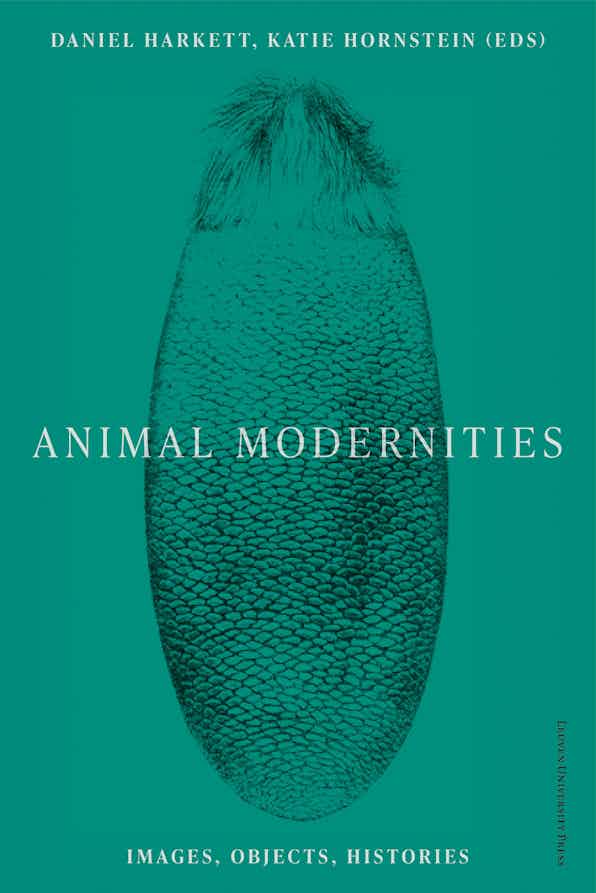 Animal Modernities challenges the traditional human-centered focus of art history and explores how modern art, visual culture, and modernity itself emerge from relationships between humans and animals. The essays in this volume reveal histories of exploitation and domination, as well as confusion and ambivalence, and occasional moments when affinities between humans and animals have been embraced, and animal agency asserted and acknowledged. The authors collectively point to the importance of thinking about animal–human relations for addressing today’s ecological challenges.
This book will be made open access within three years of publication thanks to Path to Open, a program developed in partnership between JSTOR, the American Council of Learned Societies (ACLS), University of Michigan Press, and The University of North Carolina Press to bring about equitable access and impact for the entire scholarly community, including authors, researchers, libraries, and university presses around the world. Learn more here.
Daniel Harkett is associate professor in the Department of Art at Colby College.
Katie Hornstein is professor in the Department of Art History at Dartmouth College.
c o n t e n t s
List of Illustrations
Acknowledgments
Introduction — Daniel Harkett and Katie Hornstein
1 Rethinking the Animal in Art History: Charles Darwin, Karl Woermann, and the Bowerbird — Nina Amstutz
2 Photography Needs Animals: Materials, Processes, and the Colonial Supply Chains of Gelatine Dry Plates — Rosalind Hayes
3 Shooting Elephants and the Performance of Imperial Power — Niharika Dinkar
4 A Tale of Two Serpents — Laura Nüffer
5 Mourning across Species: Ivory Miniatures and Elephant Death — Katherine Fein
6 War Horses, Commemoration, and Mutilation: Copenhagen (1808–1836) and Marengo (ca. 1793–1831) — Katie Hornstein
7 To Fool a Fish: Exploring Interspecies Aesthetics in Nineteenth-Century Fly-Fishing — Emily Gephart
8 Feline Creativity on the Eve of Modernity — Amy Freund and Michael Yonan
9 The Bird that Cuts the Airy Way: William Blake’s Avian Modernity — Alysia Garrison
10 Bovine Ubiquity — Maura Coughlin
11 Against the Visual: Seals, Indigenous-Settler Relations, and the Material Culture of Sealing since 1697 — Catherine Girard
12 Mr. Crowley’s Signature: Race, Resistance, and the Queerness of American Animal Portraiture — Annie Ronan
13 Memory and Materiality: Commemorating Canine Companions in Eighteenth-Century Britain — Sean Weiss
14 Herd Mentality: Animal Relationality and QueerKinships in the Life and Work of Anton Braith — Stephanie Triplett
Selected Bibliography
Contributors
Index
Call for Papers | Love’s Matter: The Material Culture and Art of Affection
From the Call for Papers:
Love’s Matter: The Material Culture and Art of Affection, 1700–1900
9th Edition of the Entretiens de la Fondation Maison Borel
University of Neuchâtel and Maison Borel, Switzerland, 12–13 November 2026
Organized by Henriette Marsden and Lara Pitteloud
Proposals due by 20 March 2026
International Workshop for PhD Students and Early Career Researchers
From the early 18th century onwards, the material qualities of love were explored as a cultural technique and an artistic practice transformed by the onset of modernity. Young lovers courted their sweethearts by sending mass-produced valentine cards, friends filled each other’s albums with carte de visite photographs and industrially made paper scraps, husbands romanced their wives through the gifting of colonial luxuries, and sisters used embroidery patterns circulated through the periodical press to stitch presents with and for one another. Evidently, love, as a practice of affection between family members, romantic partners and friends, became deeply embroiled in the material conditions of global trade, colonial expansion, nation-building, and the advance of industrialised commerce.
This workshop will explore how the affective properties of love shaped and were shaped by the material conditions of modernity from the early 18th to the end of the 19th century. It takes as a starting point the claim that modernity is characterised by a shift away from older understandings of transcendental love and toward a notion of love that is qualified by immanent, sensorial, and interpersonal experiences (Hanley, 4–5). Building on the conceptual framework of the “co-constitutive nature of things and emotions,” as demonstrated in recent scholarship (Downes/Holloway/Randles, 9), we invite doctoral and postdoctoral researchers to examine not only the use of objects and artworks in the performance of love but also how their materiality (size, shape, material construction, other sensorial qualities) impacted the experience of love. By investigating how love’s affective potential was navigated in the particular aesthetic constitution of objects, this workshop will explore different facets of love, such as the feeling of romantic desire, a wish for amicable companionship, a charitable responsibility, etc.
We invite papers by doctoral students and early career researchers that examine this diversity of love in the breadth of its aesthetic functioning as material culture, as art, and as cultural performance. The workshop also encourages comparative and cross-cultural perspectives, looking beyond Western Europe to consider how love was materially performed in the modern contexts of empire, global trade, and colonialism. The workshop is committed to fostering an open discussion between researchers at any stage of their project. We welcome submissions for papers covering both early-stage work and substantive original research on the art and material culture of love, as well as theoretical and methodological discussions problematising the state of love studies within art history.
Topics might include, but are not confined to
• personal gifts as expressions of hetero- and homo-romantic, familial, and amicable love
• material culture of heartbreak, loss, and/or separation
• commercialisation of love tokens; affection and consumer culture
• collaborative artistic production amongst friends
• material bonds between parents and children
• sexual self-identification and pictorial self-representation
• art as an affective instrument for nation-building and colonial expansion
• materiality of divine love in ecclesiastical, missionary, and charitable contexts
The workshop is organised in the context of the 9th edition of the Entretiens de la Fondation Maison Borel, held by the Institute of Art History and Museology at the University of Neuchâtel. These study days aim to foster the exchange of ideas and perspectives on methodological issues across the various disciplines of the Humanities and Social Sciences. As in previous editions, the workshop will take place in the historic 17th-century Maison Borel near Neuchâtel (Auvernier), a setting that offers an informal yet stimulating environment for scholarly exchange. The workshop may result in a publication. Accommodation, and, where possible, full coverage of travel costs will be provided by the organisers.
Please send a 300-word abstract, in English for 20-minute presentations, as well as a 100-word CV to Henriette Marsden (hm772@cam.ac.uk) and Lara Pitteloud (lara.pitteloud@unine.ch) by 20 March 2026. We look forward to reading your proposals.
–Henriette Marsden (University of Cambridge) and Lara Pitteloud (University of Neuchâtel)
s e l e c t i v e b i b l i o g r a p h y
Barclay, Katie and Sally Holloway, eds. A Cultural History of Love in the Age of Enlightenment. Bloomsbury Academic, 2025.
Dolan, Alice and Sally Holloway. “Emotional Textiles: An Introduction.” Textile: Cloth and Culture 14.2 (2016): 152–59.
Downes, Stephanie, Sally Holloway, and Sarah Randles, eds. Feelings Things: Objects and Emotions through History. Oxford University Press, 2018.
Hanley, Ryan Patrick, ed. Love: A History. Oxford University Press, 2024.
Holloway Sally, ed. The Game of Love in Georgian England: Courtship, Emotions, and Material Culture. Oxford University Press, 2019.
Labanyi, Jo. “Doing Things: Emotion, Affect, and Materiality.” Journal of Spanish Cultural Studies 11 (2010): 223–44.
Lipsett-Rivera, Sonya. A Cultural History of Love in the Age of Empire. Bloomsbury Academic, 2025.
Moran, Anna and Sorcha O’Brien, eds. Love Objects: Emotion, Design, and Material Culture. Bloomsbury, 2014.
Pellegry, Florence, Sandra Saayman, and Françoise Sylvos, eds. Gages d’affection, culture matérielle et domaine de l’intime dans les sociétés d’Europe et de l’océan Indien. Presses Universitaires
Indianocéaniques, 2020.
Staremberg, Nicole, ed. Et plus si affinités … Amour et sexualité au XVIIIe siècle. Musée national suisse, Antipodes, 2020.
Sheer, Monique, “Are Emotions a Kind of Practice (and Is That What Makes Them Have a History)? A Bourdieuian Approach to Understanding Emotion.” History and Theory 51 (2010): 193–220.
New Book | Pictures of Cotton in Eighteenth-Century China
From Routledge:
Roslyn Lee Hammers, Pictures of Cotton in Eighteenth-Century China (New York: Routledge, 2025), 170 pages, ISBN: 978-1032888019, $160. Also available as an ebook.
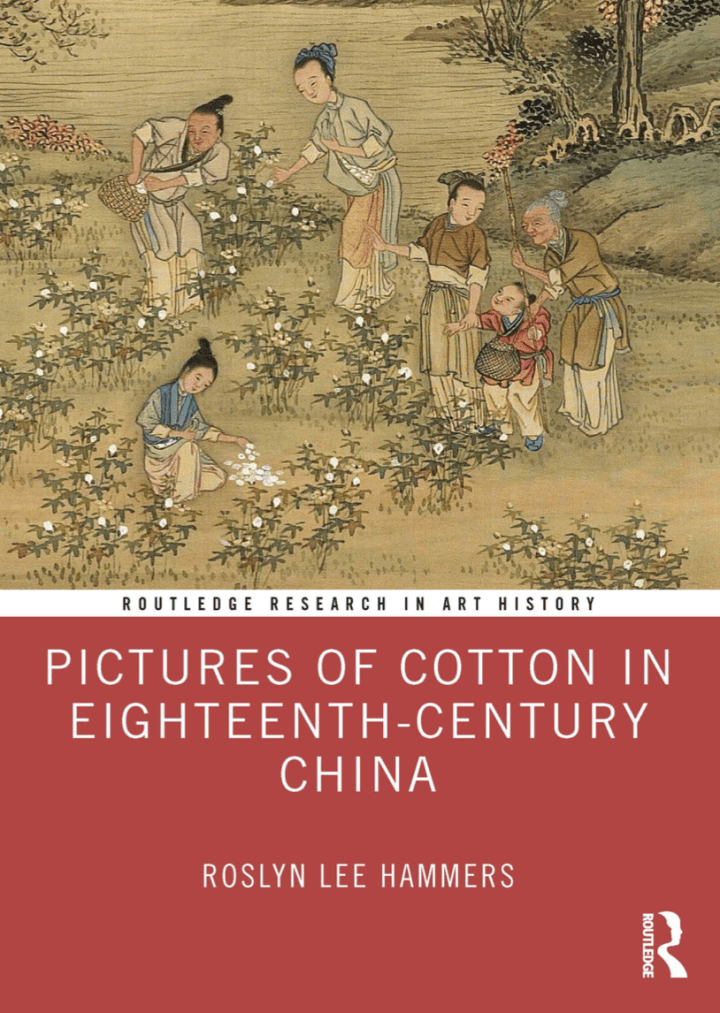 Pictures of Cotton in Eighteenth-Century China narrates cotton’s journey from a little understand material to a cherished commodity ennobled by associations with the classical heritage of China. In the 12th century, cotton, an imported crop, was plucked from the fields and entered the margins of agricultural treatises. The material was eventually ‘acknowledged’ as cotton, an object distinct from silk, worthy of representation. By the late 16th century, representations of the plant and of the labor used to process it were incorporated into agricultural publications. During the 18th century, cotton imagery and discussions were situated in imperial encyclopaedias, further consolidating its classical legacy. Governor-general Fang Guancheng (1696/8–1768) deemed cotton a worthy subject for ambitious painting. In 1765, he designed the Pictures of Cotton, a series of sixteen paintings complete with commentary that delineated the processes of growing cotton and manufacturing fabric. He presented the Pictures of Cotton to the Qianlong emperor (r. 1735–1796) who inscribed his imperial verse on each scene. Knowledge about the fiber became a means to collaborate at the highest level of the court and bureaucracy. Fang replicated the series, complete with imperial verses into carved stone to enable replication. The Jiaqing emperor (r.1796–1821) likewise published the series as woodblock prints. Upon domestication, cotton advanced political legitimacy, becoming a commodity that attained canonical status. Cotton was represented in a scopic regime formulated by the Qing imperium, and in the process, the Imperially Inscribed Pictures of Cotton became the authoritative vision of cotton.
Roslyn Lee Hammers is Associate Professor at the University of Hong Kong.
c o n t e n t s
List of Figures
Acknowledgements
Introduction: Coming to Terms with Cotton in Chinese Visual Culture and Literature
1 Bringing Cotton into the Fold of Ming-dynasty Visual Culture
2 The Qing Imperium and the Classified Production of Knowledge
3 Presenting the Pictures of Cotton
4 Recasting the Qing Reign: Imagining Cotton in a Scopic Regime
Coda to the Imperially Inscribed Pictures of Cotton: Speculations on Visualizing Cotton
Appendix: Texts and Poems of the Yu Ti Mian Hua Tu (Imperially Inscribed Pictures of Cotton) and of the Qin Ding Shou Yi Guang Xun (Imperially Approved Magisterial Guidance on the Bestowing of Clothes)
Selected Bibliography
Index
Lecture | Laura Beltrán-Rubio on Fashion in the Colonial Andes
In March at BGC:
Laura Beltrán-Rubio | Indigenizing Fashion in the Colonial Andes
Bard Graduate Center, New York, 25 March 2026, 6.00pm
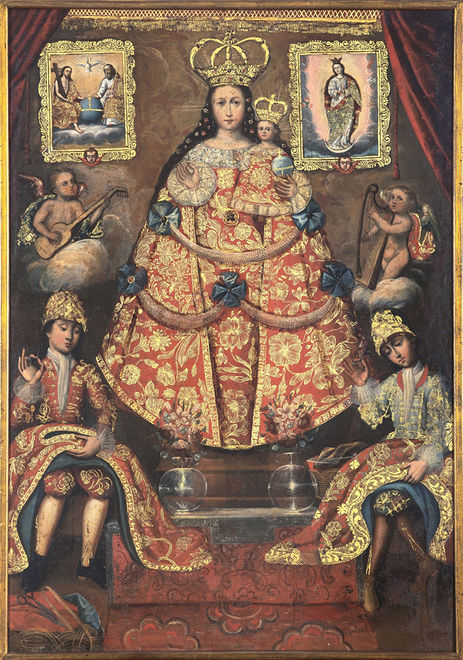
Unidentified artist from Cusco, The Virgin with Tailors, ca. 1750, oil and gold on canvas, 58 × 40 inches (Lima: Museo Pedro de Osma).
Textiles have been central to the material culture of the Andes since time immemorial. With the Spanish colonization of the Americas, the textile primacy of the Andes adapted: rather than a straightforward imposition of European trends, Indigenous fashion and textile practices have undergone complex processes of ‘cultural authentication’ and ‘survivance’. This lecture unravels evidence from archival and pictorial sources from the sixteenth through the eighteenth century to recenter the Indigenous agents, materialities, techniques, technologies, and systems of knowledge that have shaped Indigenous fashion practices in the Andes. It thus offers a reevaluation of the history of fashion and textiles in the colonial Andes to demonstrate that Native American and Euro-American histories of fashion and textiles are inevitably intertwined, complex, and mutually influential.
Registration is available here»
Laura Beltrán-Rubio is a researcher, curator, and educator, specializing in the history of art and fashion. Her research explores the construction and performance of identities through artistic expression, with a broad interest in Native American and Indigenous fashion and textiles. Her first book, Empire of Fashion: Luxury, Consumption and Identity in the Viceroyalty of New Granada, is under contract with the University of Texas Press. Beltrán-Rubio completed her PhD at the College of William and Mary (Williamsburg, VA) and holds an MA in Fashion Studies from Parsons School of Design (New York). She has previously taught at Parsons, William and Mary, Universidad de los Andes (Bogotá, Colombia), and De Montfort University (Leicester, UK). She is senior researcher and managing editor at the Fashion and Race Database and hosts the podcast Redressing Fashion. As a public-facing scholar, her mission is to expand the narratives of fashion to create more diverse, equitable, and socially just societies.
Call for Papers | Views of their Own: The Work of Women Artists
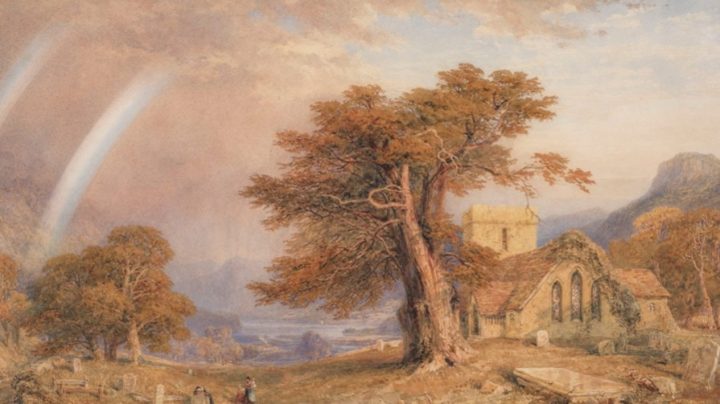
Fanny Blake, A Rainbow over Patterdale Churchyard, Cumbria, 1849, watercolour and opaque watercolour over graphite, with scratching out, on wove paper (Jointly owned by the Samuel Courtauld Trust and The Wordsworth Trust, Gift from a private collection in memory of W. W. Spooner, 2025).
◊ ◊ ◊ ◊ ◊
From The Courtauld:
Views of Their Own: Rediscovering and Re-presenting the Work of Women Artists
The Courtauld Institute of Art, London, 13 March 2026
Organized by Rachel Sloan
Proposals due by 6 February 2026
Timed to coincide with the Courtauld Gallery’s current exhibition, A View of One’s Own: Landscapes by British Women Artists, 1760–1860, this conference aims to investigate the challenges and opportunities presented by the recovery and re-presentation of historic women artists whose work and reputations have fallen out of art historical narratives.
Bringing together art historians and curators, this conference will explore various approaches to the complexities of bringing to light artists long overlooked by art history, whether via exhibition (permanent or temporary) or through the written word. Although the exhibition focuses on British artists, working both at home and abroad, from the mid-18th to the mid-19th centuries, we welcome papers that move beyond these chronological and geographical boundaries. The conference seeks to examine how attitudes and approaches to restoring to view the lives and work of women lost to art history have evolved, and continue to evolve, over recent decades, and the complexities, discoveries and rewards of charting overlooked artists and their work.
We would particularly welcome submissions in the following areas:
• Negotiating the grey area between the categories of ‘amateur’ and ‘professional’ in women artists’ careers
• The presentation of women artists’ work in settings other than temporary exhibitions
• Institutions and networks that fostered and supported the work of women artists
• Women artists’ strategies for publicising their work
Please submit an abstract of 300–500 words for a 20-minute paper, with a title, your affiliation (if any), and a short biographical summary to Rachel.Sloan@courtauld.ac.uk by 6 February 2026. Selected papers will be confirmed by 10 February.
Organised by The Manton Centre for British Art, The Courtauld Institute of Art.
Call for Papers | Women Conservators in Europe, 1750–1970
From ArtHist.net:
Women Conservators between Europe and Italy, 1750–1970
Sapienza University of Rome, 14–15 May 2026
Proposals due by 15 February 2026
In recent years, gender studies have profoundly reshaped the historiography of art and heritage preservation, bringing renewed attention to the role of women as key protagonists in the culture of heritage and expanding scholarly perspectives beyond the limits imposed by traditional narratives. The contribution of women to the history of conservation and restoration, however, remains largely understudied and only fragmentarily documented.
The earliest women active in collecting, museum, and private contexts can be traced back to the eighteenth century in Italy and across Europe. Figures now better known, such as Margherita Bernini, documented in Rome in the service of major aristocratic families, or Marie-Éléonore Godefroid, involved in the restoration of paintings for the collections of the Musée du Louvre and other Parisian institutions, stand alongside many other professionals whose work is only now being brought to light by recent research. In many cases, their activity emerges in connection with that of their husbands, whom they often succeeded in the management of workshops and restoration sites, assuming significant technical and administrative responsibilities that nevertheless remained largely invisible in historical sources. During the twentieth century, women’s presence became increasingly established within public institutions responsible for heritage protection, contributing substantially to the definition of the professional identity of the conservator at a time of profound transformation in the discipline. In this period, restoration gradually developed into a critically structured practice, grounded in technical, methodological, and historical expertise and embedded within an increasingly complex institutional framework, in which women played a far from marginal role.
This conference aims to offer a first systematic survey of women active in the field of heritage conservation and restoration between the mid-eighteenth century and the second half of the twentieth century, not only from the perspective of gender studies, but more broadly within the history of preservation and conservation in Italy and Europe.
The conference will explore the relationships between:
• restoration practices and techniques in different European contexts
• institutional transformations (museums, heritage authorities, conservation bodies)
• individual and collective careers, professional networks, and regional contexts
• diverse geographies and chronologies of restoration
• relationships between theory, practice, and training
• phenomena of family continuity and ‘professional inheritance’
• material, documentary, and photographic sources relevant to reconstructing women’s professional profiles
We invite proposals addressing, but not limited to, the following topics:
• studies on women conservators active in Italy or Europe between 1750 and 1970
• workshops, laboratories, restoration sites, museums, or archival institutions where women conservators worked
• restoration of paintings, works on paper, textiles, decorative arts, frescoes, sculpture, and architectural heritage
• patronage networks, professional collaborations, and working relationships with senior figures within state heritage institutions
• conservation methodologies, diagnostic practices, and operational protocols
• family-based transmission of skills and professional knowledge, continuity of practice, and workshop inheritance
• comparative and transnational perspectives.
Submission Guidelines
Abstract: maximum of 300 words
Short bio: maximum of 150 words
Languages: Italian and English
Submission address: convegnorestauratrici@gmail.com
Deadline: 15 February 2026
Notification of acceptance: 10 March 2026
Conference dates: 14–15 May 2026
Conference papers will be published. Further information regarding editorial arrangements and publication timelines will be provided in due course. Speakers selected through the call are kindly asked to note that the conference organization will not be able to cover travel and accommodation expenses.
Scientific Committee
Eliana Billi (Sapienza University of Rome)
Giuseppina Perusini (formerly University of Udine)
Simona Rinaldi (University of Tuscia)
Martina Visentin (University of Udine)
Organising Secretariat
Laura D’Angelo (University of Arkansas, Rome Center)
Call for Papers | Revolutions, Art, and the Market
From ArtHist.net:
Revolutions, Art, and the Market
Sotheby’s Institute of Art, London, 4–5 June 2026
Proposals due by 1 March 2026
Art market trends and practices, whether historical or contemporary, are affected by networks of complex and often competing forces. As moments of political, economic, intellectual or technological rupture, revolutions have significantly shaped art market systems and fortunes, refracting and redirecting collecting ambitions, displacing existing markets and creating new ones, and promoting novel modes of commercialisation of art.
Embracing wide chronological and geographical spans, this conference will consider how revolutions have inflected the circulation and consumption of art and facilitated the emergence of new art market practices and collecting paradigms. The conference is deliberately adopting a broad definition of the term Revolution, intending to encompass its political, cultural, intellectual, economic, and technological incarnations.
Interdisciplinary proposals and methodological approaches including empirical evaluations, economic analyses, and studies from the digital humanities are welcome. The conference is intended to foster rich discussions at the intersection of academic scholarship and professional practices, and contributions from both academics and art market professionals are actively sought. Papers addressing contemporary perspectives and practices, as well as under-represented regions of the art market and the Global South are particularly encouraged.
Proposals offering critical perspectives may consider (but are not limited to) the following themes:
• Political revolutions and shifting art market geographies
• The dispersal and looting of collections
• Revolutions and markets for luxury goods
• Political revolutions and artistic migrations
• The markets for revolutionary art
• The American Revolutionary War and transatlantic artistic exchanges
• The Russian Revolutions
• The aftermath of PCR’s Cultural Revolution
• Iran’s White and Islamic Revolutions and the national and international markets for Iranian art.
• The artistic expressions of the Arab Springs
• The Scientific Revolution and its new collecting paradigms
• The Printing Revolution and the markets for prints
• The digital revolution and the emergence of new art market commercial platforms
• Technological revolutions and innovations: NFTs, Blockchain, AR, VR, AI-generated art
Please submit an abstract of no more than 300 words for a 25-minute paper, along with a brief biography to Barbara Lasic, b.lasic@sia.edu, by 1 March 2026. Successful papers will be notified by 15 March.
Call for Articles | Spring 2027 Issue of J18: Untitled
From the Call for Papers:
Journal18, Issue #23 (Spring 2027) — Untitled
Issue edited by Catherine Girard, Sylvia Houghteling, Meredith Martin, and Hannah Williams
Proposals due by 3 April 2026; finished articles will be due by 1 September 2026
In 2026, Journal18 celebrates a decade of publishing cutting-edge scholarship on the art, material culture, and social life of the eighteenth century. To mark this tenth anniversary, for the first time since launching Journal18, we will take an open call approach. Unlike our usual tightly themed issues, this “Untitled” issue invites contributions from scholars working on any aspect of visual and material culture of the long 18th century from around the globe, drawing on diverse methodologies, perspectives, and global contexts.
Our “Untitled” issue of Journal18 offers an opportunity for open reflection and critical intervention in the field of eighteenth-century studies. What assumptions, canonical narratives, or disciplinary boundaries merit reconsideration today? What methods, sources, or frameworks might illuminate eighteenth-century art in new and unexpected ways? Which objects, artists, or practices remain unexplored, and why? Can we rethink the role of audiences—past or present—in shaping our understanding of the eighteenth century? How can our field speak to contemporary debates, challenges, or experiences affecting the world today?
We welcome contributions that explore, but are not limited to:
• Transnational and cross-cultural approaches to eighteenth-century art.
• New theoretical, methodological, or archival interventions.
• Reconsiderations of canonical objects, artists, or movements.
• Reflections on the evolving field of eighteenth-century art history and cultural studies.
• We are especially interested in work that offers fresh perspectives from underrepresented regions, traditions, or voices within the global eighteenth-century art world.
We anticipate an issue comprised of relatively short texts (max 4000 words). We also welcome contributions that do not follow the standard scholarly essay format, including pieces that are co-authored or take the form of an interview, data visualization, short film, audio recording, virtual exhibition, creative collaboration, or something that has yet to be dreamed up.
Proposals for issue #23 Untitled are now being accepted. The deadline for proposals is 3 April 2026. To submit a proposal, send an abstract (250 words) and a brief biography to editor@journal18.org. Articles should not exceed 4000 words (including footnotes) and will be due for submission by 1 September 2026. For further details on submission and Journal18 house style, see Information for Authors.
Issue Editors
Catherine Girard, St. Francis Xavier University, Nova Scotia
Sylvia Houghteling, Bryn Mawr College
Meredith Martin, NYU and Institute of Fine Arts, New York
Hannah Williams, Queen Mary University of London
Journal18, Fall 2025 — Clean
The latest issue of J18:
Journal18, Issue #20 (Fall 2025) — Clean
Issue edited by Maarten Delbeke, Noémie Etienne, and Nikos Magouliotis
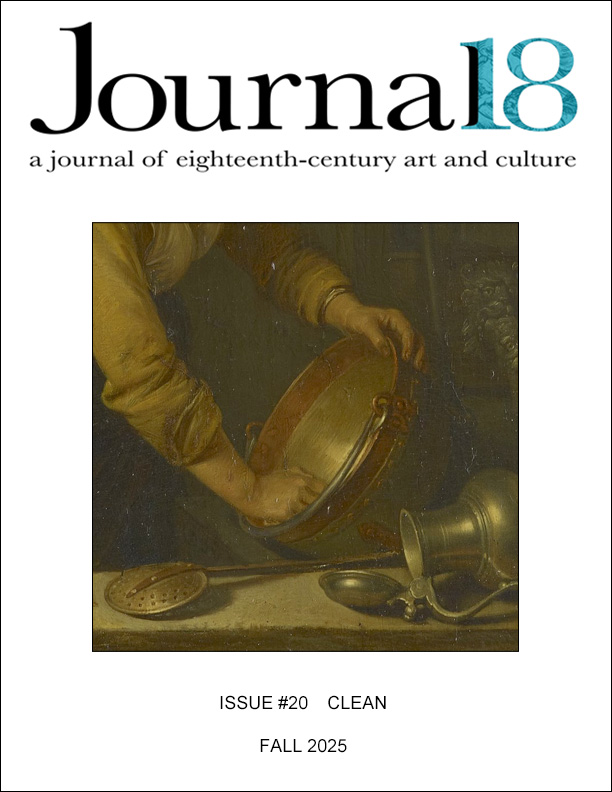 Cleaning is never a neutral act. In the eighteenth century, acts of cleaning became a way to decide what counted as disorder, to separate asserted purity from designated pollution, and to display authority over matter, space, and people. From the forecourt of Paris’s Notre-Dame to the Ganges river in Varanasi to Scotland’s filthy privies, practices of cleaning have shaped political order. Racial issues, colonization, and the management of public space revolved around the idea and implementation of cleaning, which could also involve the deliberate relocation or erasure of human beings.
a r t i c l e s
Economies of Waste: Revolutionary Administration and the Afterlives of the Kings of Notre-Dame — Demetra Vogiatzaki
‘Beneath the Waters of a Universal Ocean’: Containing, Contaminating, and Cleaning the Ganges River in Varanasi — Ushma Thakrar
Piss, Poison, and other Paths between Scotland and England in Caricature since 1745 — Laura Golobish
c o n v e r s a t i o n p i e c e
The Grammar of Cleaning: A Conversation — Maarten Delbeke, Noémie Etienne, and Nikos Magouliotis
All articles are available for free here, along with recent notes & queries:
r e c e n t n o t e s a n d q u e r i e s
Marie Antoinette Style: An Exhibition Catalogue Review — Madeleine Luckel
Room for the Lost Paradise: A Symposium — Jason M. Kelly
Reflections on Mai, Joshua Reynolds, and Eighteenth-Century Art — A Roundtable
Colonial Crossings: A Review — Juan Manuel Ramírez Velázquez
Call for Papers | Building Identities: Character in Architecture
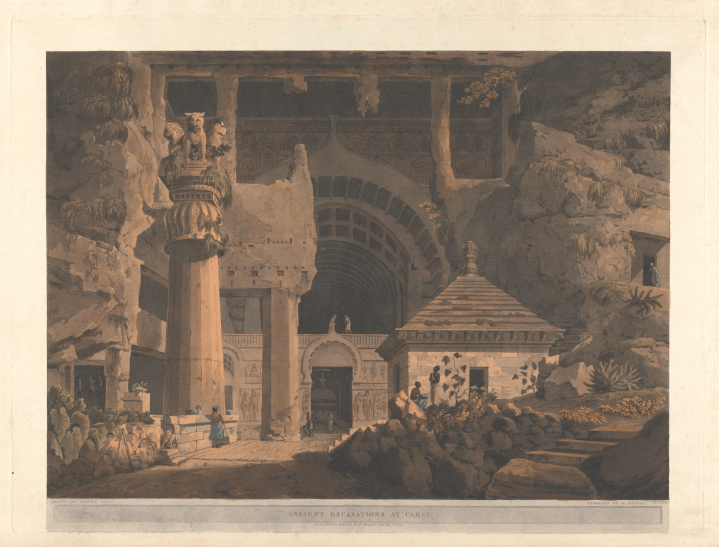
Henry Salt, Ancient Excavations at Carli, from Twenty-four Views in St. Helena, the Cape, India, Ceylon, the Red Sea, Abyssinia, and Egypt, London: Published by William Miller, Albemarle-Street, 1809 (New Haven: Yale Center for British Art, Paul Mellon Collection).
◊ ◊ ◊ ◊ ◊
From the Call for Papers:
Building Identities: Character in Architecture and Beyond, 1700–1900
Zurich, 2–4 September 2026
Organized by Sigrid de Jong, Maarten Delbeke, Nikos Magouliotis, and Dominik Müller
Proposals due by 1 March 2026
The term ‘character’ is part of today’s vocabulary of architecture: we casually refer to the ‘character’ of specific buildings or landscapes, and the ‘characteristics’ of projects or historical city centres, to emphasize their uniqueness, or the qualities attributed to them. We seem to resort to the term whenever more figurative terms fail to describe a certain formal or material je-ne-sais-quoi, which may also be associated with a distinct atmosphere or ethos. ‘Character’ often allows us to personify a building—to apply human empathy to inanimate matter.
‘Character’ emerged as a critical concept in the eighteenth century and developed into a key notion within architectural discourse of that period. It became ubiquitous in public debates concerning buildings, cities and landscapes between 1750 and 1850. Writers on architecture employed this notion to indicate how a building expressed the personality of its patron, its architect, a style or genre, how its form related to its use, or how it represented a culture or a nation; in short, a building’s character was synonymous with its identity. Borrowing from literary theory, architects such as Germain Boffrand, Jacques-François Blondel, William Chambers, Étienne-Louis Boullée, and Quatremère de Quincy elaborated on the notion of character in their writings. They used the term to articulate principles that ensured buildings properly express their function, or would be read and experienced appropriately by their audiences.
‘Character’ became especially versatile when the discovery of non-classical architectures rendered the Vitruvian orders insufficient to describe the different building cultures of the world, and when the stylistic repertoire of Western architecture broadened in all directions to include the gothic, the rural vernacular and various forms of non-European architecture. With questions of meaning and appropriateness becoming increasingly urgent, writers turned to the term ‘character’ when discussing landscapes, cities, buildings, and interiors in architectural theory, philosophy, travel literature, as well as literary fiction. Furthermore, as discussions regarding architectural proportions shifted from ideal systems and norms to the emotional effects of proportional modulation, ‘character’ came to encapsulate the affective dimensions of architecture and landscape. Our project Building Identity: Character in Architectural Debate and Design, 1750–1850 explores how such discussions were related to broader uses of the term ‘character’, rooted in its origins outside the discipline of architecture. A convenient vehicle for various metaphors and metonymies, ‘character’ often signifies both the means and instruments of classification and their intended effect.
While scholars usually studied the uses of the concept focusing on Western-Europe and on designers and architectural critics (Szambien, Forty, Grignon and Maxim), our conference ‘Building Identities’ is interested in examining character in a broader manner, across various disciplines and geographies. We aim to investigate the complexity, variety and contradictions surrounding its centrality in discourse. By foregrounding aspects that have long been undervalued, the conference Building Identities invites participants to collaborate in writing a critical history of ‘character’ tracing:
• How ‘character’ connects and relates to different fields (art history, landscape, urban history, travel, literature, the performing arts, philosophy, religion, cultural history, anthropology, nascent natural sciences).
• What ‘character’ presupposes in terms of ideologies, also in connection to notions such as identity, custom, mœurs, civilisation, etc.
• How and why ‘character’ operates in specific contexts (classification, subordination, naturalisation).
We invite proposals that
• Examine the notion of ‘character’ and its intellectual history in a variety of sources, within a diversity of disciplines and geographies.
• Question texts or practices that rely on ‘character’ in relation to architecture, landscape, and territory.
• Explore descriptions of the built environment that rely on ‘character’ to bridge the specific with the universal.
• Interrogate the notion in artistic practices, in building, urban, and landscape designs.
• Exemplify the problems, paradoxes, flaws, and possibilities of the notion.
We are interested in paper proposals treating and complicating ‘character’ as a historical concept, addressing specific uses of the term ‘character’ in sources from the period 1700–1900. Papers are welcomed that venture beyond the canonical sources of architectural theory, and engage with one or more of the following topics:
• The gender of architecture (buildings and interiors), cities and landscapes: usages of ‘character’ to gender the built environment, its relation to patrons, clients, and the public.
• The emotions of architecture, cities and landscapes: authors for whom ‘character’ served as a synonym for empathy, affect, or the emotional impact on the human mind and soul.
• The cultural or national identity of architecture, cities and landscapes: texts in which the term ‘character’ is employed to articulate cultural specificity and difference, or to construct ideas such as race, ethnicity and nation.
We particularly welcome papers that examine how the term migrated between different fields, semiotics, and epistemes, as well as how it was translated from one language to another.
Abstracts of max. 300 words should be submitted to buildingidentities@gmail.com by 1 March 2026, along with the applicant’s name, email address, professional affiliation, address, telephone number and a short curriculum vitae (maximum one page). Please combine both abstract and CV in one PDF file. Selected speakers will be notified by April.
The conference is part of the project Building Identity: Character in Architectural Debate and Design, 1750–1850, funded by the Swiss National Science Foundation, and based at the Chair for the History and Theory of Architecture, gta Institute, ETH Zurich.










 Enfilade
leave a comment