New Book | Outposts of Diplomacy
Distributed by The University of Chicago Press for Reaktion Books:
G. R. Berridge, Outposts of Diplomacy: A History of the Embassy (London: Reaktion Books, 2024), 256 pages, ISBN: 978-1789148497, £25 / $35.
 A profusely illustrated history of the diplomatic embassy, from antiquity to today.
This compelling history traces the evolution of the embassy, from its ancient origins to its enduring presence in the modern world. Beginning with its precursors in antiquity, the book explores the embassy’s emergence on the cusp of the Italian Renaissance, its pinnacle during the nineteenth century, and its navigation through the challenges of twentieth-century conference diplomacy. G. R. Berridge investigates how this European institution adapted its staffing, architecture, and communication methods to changing international landscapes, including the tumultuous wars of religion and encounters in the Far East. He also describes the expansion of the embassy’s responsibilities, such as providing diplomatic cover for intelligence operations. Infused with vibrant anecdotes of remarkable individuals and the creation of influential family dynasties, and illustrated throughout, this book offers a fascinating exploration of the embassy’s rich history.
G. R. Berridge is professor emeritus of international politics at the University of Leicester and a senior fellow of the Geneva-based DiploFoundation. He was associate editor of the Oxford Dictionary of National Biography, to which he still contributes, and his most recent book is the sixth edition of Diplomacy: Theory and Practice.
c o n t e n t s
Preface
Introduction
1 Fifteenth-Century Beginnings
2 Expanding Duties
3 Household and Buildings
4 Pre-Telegraphic Communications
5 Nineteenth-Century Highpoint
6 Enter the Americas
7 The Middle East and Africa
8 Far Eastern Compounds
9 Backseat after the First World War
10 Stubborn Institution
Epilogue
Bibliography
Acknowledgements
Photo Acknowledgements
Index
Call for Papers | Early Modern State Descriptions
From ArtHist.net:
Early Modern State Descriptions in an Interdisciplinary Perspective
Münster, 10–11 April 2025
Organized by Karl Enenkel and Lukas Reddemann
Proposals due by 21 July 2024
From the 16th through to the 18th century, state descriptions were a vital part of European literary production and book markets. Such publications covered an enormous range of topics including geography, economics, cities, military, political constitutions, and numerous other aspects of early modern political formations. State descriptions were written in Latin and vernacular languages alike. They could be composed as single descriptions or as collections and were often published in numerous editions and translations. Such ‘bestsellers’ on the early modern book market included several well-known works. For example, one can call to mind Lodovico Guicciardini’s description of the Low Countries (Descrittione di tutti i paesi bassi, 1567), William Camden’s description of Britain (Britannia, 1586), and the collections in Giovanni Botero’s Relationi universali (1590s), Pierre d’Avity’s Les estats, empires, et principautez du monde (1613), and the ‘Republics’, a series of Latin state descriptions printed by Elzevir and other Dutch publishers in the 1620s and 1630s. In the course of the 17th century, the production of state descriptions gained new momentum through the formal establishment of statistics as an academic discipline, in Protestant universities in Germany in particular. This development resulted in the famous “Göttinger Schule” of statistics that is associated with Gottfried Achenwall and August Ludwig von Schlözer.
It is paramount that we attain a clearer picture of the place of state descriptions in the larger context of early modern academic and non-academic learning, as well as their connections to other, non-textual media. For instance, what role did state descriptions play in the development of early modern political theory, the education of and communication between diplomats, and the knowledge networks of merchants? How did they intersect with fields such as cartography or other media concerned with the pictorial representation of geographical and political aspects of early modern states?
Our conference aims to bring together multiple interdisciplinary perspectives on early modern state descriptions to address the abovementioned areas and similar fields. Rather than investigating state descriptions as a single literary genre or form of printed publication, we want to shed light on the early modern interest in different forms of literary and non-literary representations of contemporary political formations as a broader cultural phenomenon. Contributions might address, but are not limited to, the following research questions:
• On what methodical basis can we identify target audiences and actual readers of early modern state descriptions? Which academic and non-academic factors stimulated the huge interest in such publications?
• How can we describe the relationship between state descriptions in Latin and in the vernacular languages? Are there certain focal points related to time or region? Can we recognize specific connections between the language and the target audiences of such publications? What role do translations play?
• How did the authors and editors of state descriptions systematize and manage the vast amount of potentially relevant information? How do their different forms of information management interact with the literary and academic purposes of a work?
• How can we describe these often-complicated use of literary sources more specifically, rather than applying general concepts such as ‘compilation’ or ‘anthology’ (cf. e.g. Reddemann, Staatenkunde als Weltbeschreibung, 2024)?
• How do state descriptions, as ‘factual’ representations of concrete political formations, respond to and interact with writings and trends in the field of political theory?
• How does book-historical evidence help us shape clearer ideas about the dissemination, readerships, and practical use of state descriptions? What can we say about their presence in early modern libraries and book collections and how may this reveal more about domain-specific practices of book collecting?
• Which non-literary forms of representing, illustrating, and describing early modern states can we identify? Do they interact with or react to textual state descriptions and, if so, in what specific ways?
We look forward to receiving contributions from researchers in the entire breadth of disciplines within the field of early modern studies. We plan to publish the revised papers in the series Intersections: Interdisciplinary Studies in Early Modern Culture (Brill).
The conference will take place 10–11 April 2025 in Münster. The University of Münster will take care of travel costs for speakers and provide their hotel accommodation for the duration of the conference. The language of contributions and discussion is English. The deadline for submissions is 21 July 2024. Please send an abstract of your contribution (ca. 250 words) and a preliminary title to both organisers, Karl Enenkel (kenen_01@uni-muenster.de) and Lukas Reddemann (lukas.reddemann@uni-muenster.de).
New Book | Strangers Within
From Princeton UP:
Francisco Bethencourt, Strangers Within: The Rise and Fall of the New Christian Trading Elite (Princeton: Princeton University Press, 2024), 624 pages, ISBN: 978-0691209913, $45 / £38.
A comprehensive study of the New Christian elite of Jewish origin—prominent traders, merchants, bankers, and men of letters—between the fifteenth and eighteenth centuries
 In Strangers Within, Francisco Bethencourt provides the first comprehensive history of New Christians, the descendants of Jews forced to convert to Catholicism in late medieval Spain and Portugal. Bethencourt estimates that there were around 260,000 New Christians by 1500—more than half of Iberia’s urban population. The majority stayed in Iberia but a significant number moved throughout Europe, Africa, the Middle East, coastal Asia, and the New World. They established Sephardic communities in North Africa, the Ottoman Empire, Italy, Amsterdam, Hamburg, and London. Bethencourt focuses on the elite of bankers, financiers, and merchants from the fifteenth to the eighteenth centuries and the crucial role of this group in global trade and financial services. He analyses their impact on religion (for example, Teresa de Ávila), legal and political thought (Las Casas), science (Amatus Lusitanus), philosophy (Spinoza), and literature (Enríquez Gomez).
Drawing on groundbreaking research in eighteen archives and library manuscript departments in six different countries, Bethencourt argues that the liminal position in which the New Christians found themselves explains their rise, economic prowess, and cultural innovation. The New Christians created the first coherent legal case against the discrimination of a minority singled out for systematic judicial inquiry. Cumulative inquisitorial prosecution, coupled with structural changes in international trade, led to their decline and disappearance as a recognizable ethnicity by the mid-eighteenth century. Strangers Within tells an epic story of persecution, resistance, and the making of Iberia through the oppression of one of the most powerful minorities in world history. Packed with genealogical information about families, their intercontinental networks, their power, and their suffering, it is a landmark study.
Francisco Bethencourt is the Charles Boxer Professor of History at King’s College London. He is the author of Racisms: From the Crusades to the Twentieth Century (Princeton) and The Inquisition: A Global History, 1478–1834.
New Book | An Economy of Strangers
From Penn Press:
Avinoam Yuval-Naeh, An Economy of Strangers: Jews and Finance in England, 1650–1830 (Philadelphia: University of Pennsylvania Press, 2024), 264 pages, ISBN: 978-1512825053, $65.
 One of the most persistent, powerful, and dangerous notions in the history of the Jews in the diaspora is the prodigious talent attributed to them in all things economic. From the medieval Jewish usurer through the early-modern port-Jew and court-Jew to the grand financier of the nineteenth and twentieth centuries and contemporary investors, Jews loom large in the economic imagination. For capitalists and Marxists, libertarians and radical reformers, Jews are intertwined with the economy. This association has become so natural that we often overlook the history behind the making and remaking of the complex cluster of perceptions about Jews and economy, which emerged within different historical contexts to meet a variety of personal and societal anxieties and needs.
In An Economy of Strangers, Avinoam Yuval-Naeh historicizes this association by focusing on one specific time and place—the financial revolution that England underwent from the late seventeenth century that coincided with the reestablishment of the Jewish population there for the first time in almost four hundred years. European Christian societies had to that point shunned finance and constructed a normative system to avoid it, relying on the figure of the Jew as a foil. But as the economy modernized in the seventeenth century, finance became the hinge of national power. Finance’s rise in England provoked intense national debates. Could financial economy, based on lending money on interest, be accommodated within Christian state and society when it had previously been understood as a Jewish practice?
By projecting the modern economy and the Jewish community onto each other, the Christian majority imbued them with interrelated meanings. This braiding together of parallel developments, Yuval-Naeh argues, reveals in a meaningful way how the contemporary and wide-ranging association of Jews with the modern economy could be created.
Avinoam Yuval-Naeh is a post-doctoral fellow at the University of Haifa. He is the author of articles in The Journal of Early Modern History and Historia. This is his first book.
Call for Papers | Jewish Art and Museums in Latin America
From ArtHist.net:
Jewish Museums and Professionals in Jewish Art and Material Culture in Latin America
Museos Judíos y Profesionales del Arte y Cultura Material Judía en América Latina
Sociedad Hebraica Argentina, Buenos Aires, 19–21 November 2024
Proposals due by 15 August 2024
Organized by Sociedad Hebraica Argentina with support from the World Union for Jewish Studies and the Latin American Jewish Studies Association
We invite proposals for papers to be presented at the first seminar for Jewish Museums and Professionals in Jewish Art and Material Culture in Latin America, to be held at Sociedad Hebraica Argentina, Buenos Aires, in November 2024. We welcome proposals from curators, conservators, educators, art historians, artists, and researchers in Jewish studies.
The seminar aims to bring together a small group of professionals in Jewish museums and art to explore the question of Jewish art and museums in Latin America. Over three days, participants will give short presentations on their individual experiences, research, and institutions, engaging in discussions on sources, methodology, and theory to evaluate current and future trends, as well as common challenges, at the intersection of museums and art related to the Jewish experience in Latin America. Additionally, participants will engage in practical workshops and visits to relevant local museums and collections.
Jewish museums have existed in Latin America since the mid-20th century. However, the region lacks a network to connect and share experiences among museums that can enrich museum activities: education, visitor centers, provenance research, collection management, preservation, and research. Understanding that Latin American Jewish museums are underrepresented in both museum studies and Jewish studies, the purpose of this seminar is to bring together professionals in Jewish art, collectors, professionals from museums of Jewish history and material culture, archivists, librarians, educators, and scholars in Jewish studies to develop a program of exchange and debate on the current situation of the field in the Latin American region.
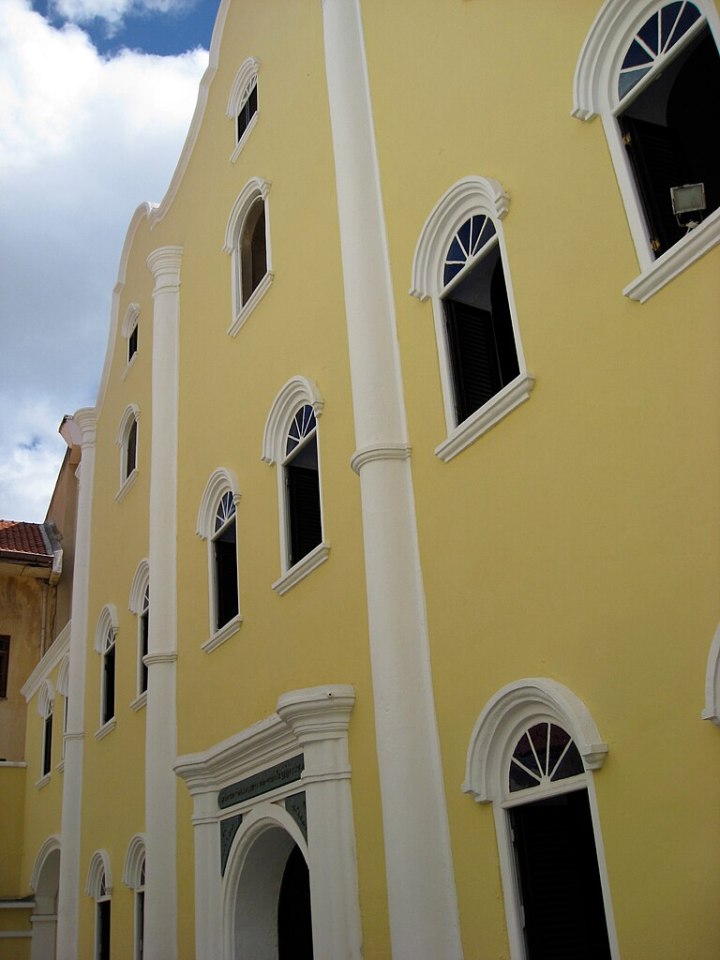
The Mikvé Israel-Emanuel Synagogue (The Hope of Israel-Emanuel Synagogue) in Willemstad, Curaçao is, according to Wikipedia, “the oldest surviving synagogue in the Americas. . . . The community (congregation Mikvé Israel) dates from the 1650s, and consisted of Spanish and Portuguese Jews from the Netherlands and Brazil. . . . The first synagogue building was purchased in 1674; the current building dates from 1730.” Photo from January 2008, Wikimedia Commons. Image added to the Call for Papers at Enfilade by Craig Hanson
Based on case studies of experiences in producing Jewish art and presenting Jewish history and experiences through exhibitions, as well as the conservation and dissemination of museum and archival material, we seek to identify different approaches and key themes of the field in relation to our region. The focus areas may include, but are not limited to:
• Exhibition of Jewish history and culture: Jewish history and culture in general and in Latin America. Jewish immigration and presence in Latin American countries.
• Exhibition spaces: Jewish sections in historical museums, in synagogues, and in art museums.
• Jewish art: contemporary art, Jewish art salons, Latin American Jewish artists.
• Holocaust and memory: Holocaust museums and memory spaces.
• Education and accessibility: education programs in museums and interaction with the community.
• Digitization and technology: digital and online museums, digitization projects, and collections of Jewish material culture in archives and libraries.
• Conservation and collection management: provenance research and management of art, archive, and Jewish material culture collections. Management of donations.
• Methodology and research: research methodologies in museums, research on Jewish material culture, and research on the Jewish presence in Latin America.
The seminar will be conducted in Spanish, but presentations in English and Portuguese will also be accepted. Submit short proposals (maximum of 500 words) and a one-page CV to Tammy Kohn (tammykohn@gmail.com) and Hebraica (cultura@hebraica.org.ar) by August 15. Selected applicants will be notified in September. Participants and their institutions are responsible for covering travel and accommodation expenses, but limited financial assistance is available upon request. Requests for financial aid must be submitted by August 1. Full papers must be submitted by November 1 for circulation in advance.
Important Dates
Submission of proposals: by 15 August 2024
Request for financial aid: by 1 August 2024
Notification of acceptance to participants: September 2024
Submission of papers: by 1 November 2024
Seminar date: 19–21 November 2024
Call for Papers | Portraiture in a Trans-Asian Context
From ArtHist.net:
Making the Subject of Portraiture in a Trans-Asian Context, ca. 1500–Present Day
SOAS University of London, 5–6 December 2024
Organized by Mariana Zegianini and Conan Cheong
Proposals due by 29 July 2024
Portraits have commonly been understood as naturalistic likenesses of human beings, centred on the face. The work of scholars such as Jean Borgatti, Richard Brilliant (1990), and Joanna Woodall (1997) opened the field in conceptualising portraiture as a truly multi-local genre, foregrounding relational and performative processes. Following their research, this symposium defines portraiture as a process where subjectivities are constructed as a result of the collaboration between artists, patrons, sitters, and viewers living in a specific time and space, This call for papers therefore is addressed to scholars of art, cultural, visual, and material culture at any career level who explore how notions of subjectivity are constructed in text and images created between the sixteenth century and the present day in Asia and its diasporas. The symposium organisers will consider papers analysing literary and pictorial processes of embodiment through the production of objects and artefacts such as paintings, photographs, prints, sculptures, ceramics, jewellery, and currency; and of designed spaces including gardens and architecture.
Portraits have long been studied as documents or biographies of a person that once existed. Without denying the capacity of a portrait to index a living person, the symposium wishes to address the varied performative elements that portraits display in the Asian context. These performances reveal the enactment of class, gender and race of specific societies and cultures of Asia and its diasporas. Understanding the performative function of portraiture in Asia, we argue, reveals cultural, social, religious, and philosophical ideas that are important to understanding the region.
This two-day in-person symposium focuses on the portraiture of Asia with two specific purposes in mind. First, to decenter studies of Asian portraiture from Eurocentric conceptions of subjecthood and thus to expand the field of portraiture studies; second, to foreground the connections, transfers and tensions articulated by portraiture within the trans-Asian context. The focus on Asia should not be read as exclusionary, but rather as the intent to initiate a dialogue with existing research on the portraiture of other regions such as Africa and Europe. Thirty-five years after Borgatti, Brilliant, and Woodall’s contributions to the field of portraiture studies, the symposium Making the Subject of Portraiture in a Trans-Asian Context, ca. 1500–Present Day proposes to take stock of a changing field by contributing the scholarship of art, cultural and literary historians, anthropologists, and specialists in gender and critical race theory whose research interests focus on the embodiment of selfhood in portraiture from Asia.
We therefore invite papers which develop our core concern with ‘Making the Subject’ and with the performative dimensions of portraiture in Asia. Suggested topics (but not limited to):
• Dimensions of reality in portraiture
• Issues of re-/presentation
• Issues of materiality, style, and making
• Portraiture and authority: imperial, monastic, patriarchal, or cultural
• Cults of personality
• Portraiture and changing notions of beauty
• Religious and philosophical dimensions of portraiture, including rituals and ceremonies
• Issues of display and viewing: notions of theatricality and performance
• Gendered dimensions of portraiture, including theorisations of gender performance
• Self-portraiture of female and male artists
• Race and ethnicity in portraiture
• Portraiture as currency and commodities
• Fashion and material culture in embodied images
• Non-anthropomorphic portraiture: sacred geographies, depictions of nature, non-human subjects, and gardens
• Cross cultural exchange, i.e. portraits of Asians by non-Asians and vice versa, and similarly within the Asian region
To be considered as a presenter, please send a 300-word abstract plus a short biography (150 words max) for 20-minute presentations to the organisers, Dr Mariana Zegianini (mz15@soas.ac.uk) and Conan Cheong (656531@soas.ac.uk), by Monday, 29 July 2024. A selection of the conference papers will be included in a proposal for an edited volume to be considered for publication.
Research Seminar | Katherine Gazzard on Portraiture and the Royal Navy
From The Mellon Centre:
Katherine Gazzard | Naval Gazing: Portraiture and the Royal Navy
Online and in-person, Paul Mellon Centre, London, 19 June 2024, 5pm

Joshua Reynolds, Portrait of George Edgcumbe, 1749 (Greenwich: National Maritime Museum, BHC2677).
Part of the series Out to Sea, which focuses on the influence of oceans and their coasts in relation to Britain and its global empire, on visual and architectural imagination, and production.
Joshua Reynolds’s portrait of naval officer George Edgcumbe (1749, National Maritime Museum) can be split into two zones: a maritime zone on the left, containing the young captain’s warship afloat in Plymouth Sound; and an architectural zone on the right, where ivy-covered columns evoke his Cornish country estate. Edgcumbe’s body straddles the divide, symbolising his ability to move between the worlds of naval service and aristocratic society. He wears the Royal Navy’s first-ever official uniform, introduced only months before. Perched above his shoulder is an African long-tailed paradise whydah bird, a souvenir from his travels. Positioning its sitter at the intersection of social, institutional, sartorial, local, national, and global concerns, this portrait serves as an introduction to the complex currents that have shaped the representation of naval personnel in British art. To what extent can naval portraiture be understood as a distinctive genre? What were its conventions, and how did they emerge?
In answering these questions, this talk by Katherine Gazzard will chart a visual and conceptual journey from the beach to the boardroom. Naval portraiture emerged in the eighteenth century as a genre that looked ‘out to sea’, employing coastal settings to symbolise colonial expansion, maritime trade and even the transgression of social norms. Through public display and reproduction, many portraits became known outside of naval circles, sometimes assuming immense cultural or political significance. Yet, over time, the focus of naval portraiture turned inward. Displayed in mess rooms and Admiralty corridors, portraits legitimised particular manifestations of authority within the Royal Navy and visually reinforced the service’s institutional and bureaucratic structures. This journey through the history of ‘naval-gazing’ invites us to reflect on how portraits can cross between private, public and institutional realms and what happens when they do.
Katherine Gazzard is Curator of Art (post-1800) at Royal Museums Greenwich. Through her research and curatorial work, she explores the interconnections between British art and the maritime world. She has previously taught art history and museum and gallery studies at the University of East Anglia, where she obtained her PhD in 2019. Her thesis explored the representation of naval officers in eighteenth-century British portraiture. She is the author of The Art of Naval Portraiture, published in March 2024.
Respondent: Sara Caputo is Senior Research Fellow and Director of Studies at Magdalene College, British Academy Postdoctoral Fellow at the Department of History and Philosophy of Science, and Affiliated Lecturer at the Faculty of History, University of Cambridge. Caputo specialises in the social and cultural maritime history of the eighteenth and nineteenth century, with particular focus on transnational migration, health and medicine, and mapping. Her first book, Foreign Jack Tars: The British Navy and Transnational Seafarers during the Revolutionary and Napoleonic Wars, was published by Cambridge University Press in 2022. Her second book, titled Tracks on the Ocean: A History of Trailblazing, Maps and Maritime Travel, will appear with Profile Books and The University of Chicago Press in summer 2024.
New Book | The Art of Naval Portraiture
From Royal Museums Greenwich:
Katherine Gazzard, The Art of Naval Portraiture (Greenwich: National Maritime Museum, 2024), 224 pages, ISBN: 978-1739154202, £30 / $45.
 From elite officers to ordinary sailors, the portrayal of naval personnel has been a significant branch of British art for over 500 years. The National Maritime Museum, Greenwich holds the largest collection of naval portraits in the world, including over 600 paintings and many more prints and drawings, spanning from the sixteenth century to the present day. These portraits reveal how the Royal Navy was viewed at different moments in history and grant us access to individual stories, revealing the concerns and aspirations of people and families caught up in naval affairs. Many are also innovative and important works of art. For centuries, naval portraits have forged, reinforced, and challenged ideas of gender, heroism, and loyalty. They have functioned as icons of empire, demonstrations of professionalism, and personal mementos for loved ones. While charting the historical evolution of the Royal Navy’s image and explaining the meaning of common naval symbols—from anchors, cannons, and swords to uniforms, medals, and badges—this book also tells the stories of specific artists, sitters, and collectors, and of the places where portraits were made and displayed, from private homes to public exhibitions, and ultimately the museum itself.
Katherine Gazzard is the Curator of Art (post-1800) at Royal Museums Greenwich. She has taught courses on art history and museum studies for the University of East Anglia and Yale University. Her research focuses on eighteenth-century British art, especially portraiture and the cultural history of the Royal Navy.
New Book | Tracks on the Ocean
Coming this fall, from The University of Chicago Press:
Sara Caputo, Tracks on the Ocean: A History of Trailblazing, Maps, and Maritime Travel (Chicago: The University of Chicago Press, 2024), 352 pages, ISBN: 978-0226837925, $38.
An engaging look at ocean routes’ complicated beginnings and elusive impact.
 Sara Caputo’s Tracks on the Ocean is a sweeping history of how we have understood routes of travel over the ocean and how we came to represent that movement as a cartographical line. Focusing on the representation of sea journeys in the Western world from the early sixteenth century to the present, Caputo deftly argues that the depiction of these lines is inextricable from European imperialism, the rise of modernity, and attempts at mastery over nature. Caputo recounts the history of ocean tracks through an array of lively stories and characters, from the expeditions of Captain James Cook in the eighteenth century to tracks depicted in Moby Dick and popular culture of the nineteenth century to the use of navigational techniques by the British navy. She discusses how tracks evolved from tools of surveying into tools of surveillance and, eventually, into paths of environmental calamity. The impulse to record tracks on the ocean is, Caputo argues, reflective of an ongoing desire for order, schematization, and personal visibility, as well as occupation and permanent ownership—in this case over something that is unoccupiable and impossible to truly possess. Both beautifully written and deeply researched, Tracks on the Ocean shares how the lines drawn on maps tell the audacious and often tragic and violent stories of ocean voyages.
Sara Caputo is a senior research fellow and director of studies in history at Magdalene College, University of Cambridge. She is the author of Foreign Jack Tars: The British Navy and Transnational Seafarers during the Revolutionary and Napoleonic Wars.
Lecture | Louis Nelson on Global Houses of the Efik
Upcoming at the Mellon Centre:
Louis Nelson | Global Houses of the Efik, with Shaheen Alikhan as respondent
Online and in-person, Paul Mellon Centre, London, 5 June 2024, 5pm

Carl Wadström, Design for a House in a Tropical Climate, from An Essay on Colonization (London, 1794).
Much of the scholarship on the globalised house of the early modern period privileges colonisers creating a false impression that globalisation was unidirectional. A more responsible examination explores the ways colonised communities also engaged in acts of collection, reinscription, and identity construction. Unlike many African communities, the Efik in Old Calabar (now modern Nigeria) never gave Europeans land rights to build the trading forts that slowly became the huge slave castles now dotting the West African coast. Forbidding European development allowed Africans far greater control over the landscapes of exchange along the waterline, where British ships’ captains would purchase enslaved Africans from Efik traders. Visitors’ descriptions include lavish accounts of the ways wealthy Efik traders donned British costume, swords, cocked hats, and umbrellas. But even more surprising for many were the traders’ houses. These took the common form of a raised two-storey house with a gallery on all sides. Over generations, some of these trading families stockpiled extraordinary collections of English material goods including gilt pier glasses, sofas, marble sideboards, engravings, clocks, and handsome dining tables. Years of negotiations while dining onboard with ships’ captains also meant that these traders could easily navigate both African and British dining practices. It was common practice for Efik traders to order not just objects but whole houses. This paper explores this practice and offers preliminary frames for interpretation.
Louis P. Nelson, Professor of Architectural History at the University of Virginia, is a specialist in the built environments of the early modern Atlantic world, with published work on the American South, the Caribbean, and West Africa, and is a leading advocate for the reconstruction of place-based public history. Louis is an accomplished scholar, with two book-length monographs published by University of North Carolina Press and Yale University Press, three edited collections of essays, two terms as senior co-editor of Buildings and Landscapes—the leading English language venue for scholarship on vernacular architecture—and numerous other articles. His work focuses on the early American South, the Greater Caribbean, and the Atlantic rim. Architecture and Empire in Jamaica (Yale, 2016) won three major book awards and was very positively reviewed in twelve different venues ranging from the popular Times Literary Supplement to the scholarly William and Mary Quarterly, The Art Bulletin, and Architectural History, many calling it a tour de force.
Shaheen Alikhan’s dissertation work, continuing from her MA thesis in architectural history on the construction of eighteenth-century slaving vessels, focuses on the reshaping and creation of waterfront spaces to facilitate the transatlantic trade in enslaved Africans. These liminal spaces, essential but unique within the larger landscape of chattel slavery, represented concentrated areas in which enslaved and legally free Africans and members of the African diaspora took opportunities to learn, communicate, earn wages, and build relationships and they have been largely overlooked. As an architectural historian, Shaheen has contributed to anthologies pertaining to the Caribbean world and reparative justice, and worked as a digital documentation specialist. She is currently in discussion with a publisher about her book Building a Floating Prison: Slave Ships throughout the Long Eighteenth Century.










 Enfilade
leave a comment