Exhibition | Dutch and Flemish Encounters with the Islamic World

Pieter Coecke van Aelst, Customs and Fashions of the Turks, detail, 1553, woodcut printed from 10 blocks on joined sheets of antique laid paper (Harvard Art Museums/Fogg Museum, Acquisition Fund for Prints, 2011.11).
◊ ◊ ◊ ◊ ◊
Now on view at Harvard Art Museums (with more information available from the press release) . . .
Imagine Me and You: Dutch and Flemish Encounters with the Islamic World, 1450–1750
Harvard Art Museums, Cambridge, 18 May — 18 August 2024
Curated by Talitha Maria Schepers
Discover a story of cross-cultural artistic connection over 300 years between the Dutch, the Flemish, and the Islamic world.
Imagine Me and You unveils the vibrancy of multicultural exchange between the Low Countries (roughly modern-day Belgium and the Netherlands), then part of the Habsburg empire, and the Islamic world, in particular the Ottoman, Safavid, and Mughal empires that concurrently controlled much of Central and Southeast Europe, North Africa, and South, West and Central Asia. Prompted by the rich diversity of these empires, the exhibition explores a wide range of artistic, cultural, diplomatic, and mercantile interactions that took place either in person or through the peaceful exchange of objects, art, and ideas over the course of three centuries. This exhibition disrupts the persistent notion that war—in particular, religious strife between Christians and Muslims—dominated interactions between the Low Countries and the Islamic world.
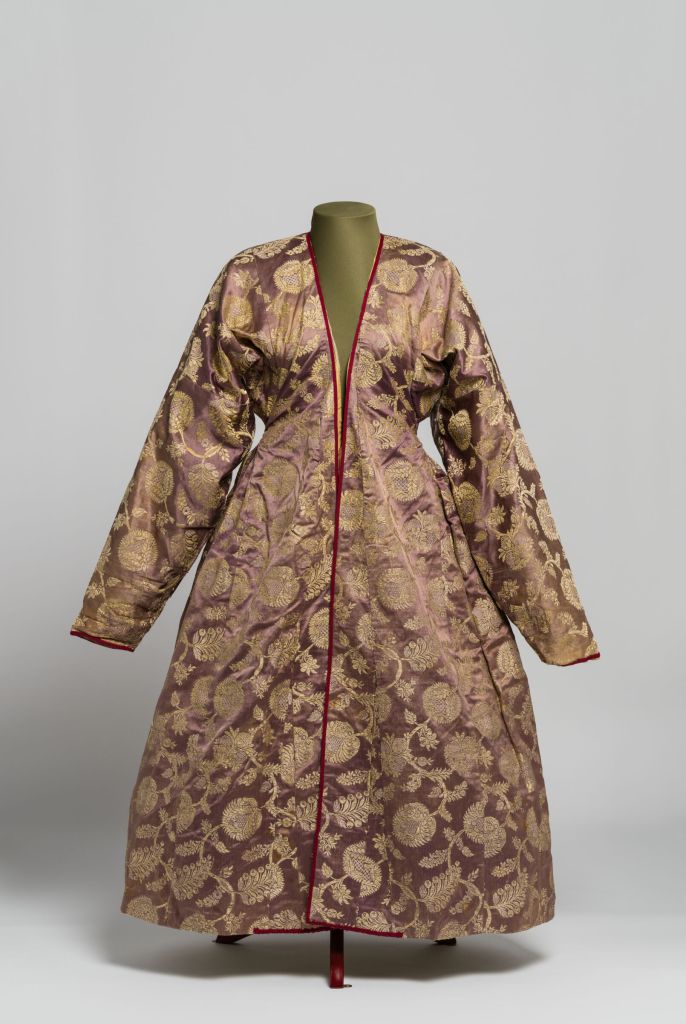
Aubergine Robe Decorated with Swaying Vine Motif, Ottoman, 18th–19th century, silver and silver gilt threads, silk satin ground, 126 × 178 cm (Harvard Art Museums/Arthur M. Sackler Museum, Gift of the Estate of Margaret Schroeder, 1999.323).
Imagine Me and You traces these multiple encounters through the world of Netherlandish artworks and their varied representations of the Islamic realm. Looking also at the ways in which contemporary Ottoman fashion played a role in biblical and historical scenes by Netherlandish artists, the exhibition invites viewers to reflect on the profound impact these interactions have had on crafting our shared history. This dynamic interplay between cultures unearths revelations about individual heritage and the broader global community. While acknowledging the complexity of establishing the origin of certain hybrid objects, the exhibition ultimately suggests that it is more important to amplify and celebrate these objects’ multicultural and multifaceted characteristics.
The approximately 120 objects in the exhibition include drawings, prints, paintings, textiles, and more; the works come from the collections of the Harvard Art Museums as well as from the Maida and George Abrams Collection, The Tobey Collection, other Harvard institutions, and the Museum of Fine Arts, Boston. In addition to sumptuous textiles and striking wool carpets from Türkiye (Turkey) and intricate album paintings from the Ottoman and Mughal periods, there is a range of drawings and prints from Dutch, Netherlandish, and other artists, including Margaretha Adriaensdr. de Heer, Haydar Reis, Pieter Coecke van Aelst, Melchior Lorck, Nicolas de Nicolay, Lucas van Leyden, Jacob Marrel, Rembrandt, and many more. A display of historical pigment samples sheds light on some of the materials these artists used.
The exhibition is curated by Talitha Maria G. Schepers, 2022–24 Stanley H. Durwood Foundation Curatorial Fellow, Division of European and American Art, Harvard Art Museums. Support for Imagine Me and You is provided by the Stanley H. Durwood Foundation Support Fund and the Melvin R. Seiden and Janine Luke Fund for Publications and Exhibitions. Related programming is supported by the M. Victor Leventritt Lecture Series Endowment Fund.
An accompanying digital resource dives deeper into the exhibition’s core themes of encounter and imagination. A variety of contributions, ranging from short texts focused on a single object to longer technical studies, reflects a multitude of voices from across the Harvard Art Museums and Harvard University.
Journal18, Spring 2024 — Color
The latest issue of J18:
Journal18, Issue #17 (Spring 2024) — Color
Issue edited by Ewa Lajer-Burcharth and Thea Goldring
 Color has been at the center of artistic debates at least since the seventeenth century, and it has remained a key issue in the historiography of art. Recent research has largely pursued two directions. First, color has been studied as a material substance and a technology. Scholars have documented the relation between technological, industrial, and commercial developments and the quality, range, and availability of pigments and colorants available to artists, manufacturers, and consumers. A second approach has focused on the key role of color in the construction of social, racial, colonial, and gender hierarchies. Recent scholarship has revealed the intimate connection between aesthetic debates on chroma and the development of the modern discourse of race. The eighteenth century’s feminization of color, linked to make-up and artifice, has also been reexamined. Clearly, it is no longer viable to think of color or its materials, technologies, and processes in purely aesthetic, ideologically innocent terms. This issue of Journal18 considers what is at stake now in reconsidering color in its historical dimensions by bringing these two lines of research together.
The four articles and two notes in this issue explore how the current interest in materiality and the matter of art might be harnessed to alter—enrich, complicate, or challenge—our understanding of the historical functions and socio-cultural meanings of color in the long eighteenth century. . . .
a r t i c l e s
Andrea Feeser — When Blue and White Obscure Black and Red: Conditions of Wedgwood’s 1787 Antislavery Medallion
Caroline Culp — Embalming in Color: John Singleton Copley’s Vital Portraits at the Edge of Empire
Tong Su — Color in Taxidermy at the Eighteenth-Century Qing Court
Melissa Hyde — Men in Pink: The Petit-Maître, Refined Masculinity, and Whiteness
s h o r t e r p i e c e s
Tori Champion — Catherine Perrot: Color, Gender, and Medium in the Seventeenth-Century Académie
Philippe Colomban — The Quest for the Western Colors in China under the Qing Emperors
Conference | Congress of Historical Botanical Gardens
From ArtHist.net and the conference website:
Prevention of Historical Botanical Gardens and Their Heritage from the Major Threats of Our Time
2nd International Congress of Historical Botanical Gardens
HBLFA für Gartenbau / College of Horticulture, Wien, 29–31 July 2024
Registration due by 30 June 2024
 Historical botanical gardens and historical plant collections embedded in a larger context are often a neglected topic. Especially in the field of garden history, landscape architecture, botany, history of science, and even art history, their importance cannot be overestimated. In recent years, there has been a growing interest in these fields of research. In 2021, the 1st International Congress of Historical Botanical Gardens was held in Lisbon.
The initial impulse to communicating the issues and importance of botanic gardens to a broader public, highlighting their history and importance, and building a common network will be continued at the 2nd International Congress of Historical Botanical Gardens. The second meeting will expand the focus to include conservation and preservation of plants and gardens. How can we protect historical botanical gardens and their heritage from the major threats of our time, such as lack of resources, climate change, war, and conflicts of all kinds? What can we learn from the often turbulent past?
The three organizing institutions (Austrian Federal Gardens, Natural History Museum, Botanical Garden of the University of Vienna) were founded by the Habsburg emperors for scientific and representative reasons. For more than 450 years, these institutions have collected, cultivated, studied and exhibited plants in Vienna. This long and continuous tradition makes Vienna one of the most important locations for current and historic plant research and conservation. Building on this tradition and moving forth together, we look forward to welcoming you to Vienna for the Second International Congress of Historical Botanical Gardens.
m o n d a y , 2 9 j u l y
9:00 Welcome Addresses
• Norbert Totschnig (Austrian Federal Minister of Agriculture, Forestry, Regions and Water Management)
• Dalila Espírito Santo (Head of Organization of the 1st ICHBG 2021, University Lisbon)
• Tim Entwisle (International Association of Botanic Gardens, IABG)
• Gerd Koch (College of Horticulture and Austrian Federal Gardens
• Katrin Vohland (Natural History Museum, Vienna)
• Michael Kiehn (Botanical Garden, University of Vienna)
10:00 Keynote
• Botany, History, and Biodiversity: New Horizons for the Jardin des Plantes de Paris — Isabelle Glais (Jardin des Plantes de Paris)
10:30 Coffee Break
10.50 Session 1 | The Transition of Historical Botanical Collections
• A Phoenix from the Ashes: The Transition of the Court Gardens to the Austrian Federal Gardens — Claudia Gröschel (Austrian Federal Gardens)
• Paleis Het Loo: From Royal Showcase towards a Decolonized Botanical Garden — Renske Ek (Palais Het Loo)
• The Role of Curation in Botanic Gardens: Platforms for Environmental and Social Transition — Kevin Frediani (Botanic Garden, University of Dundee)
• Art and Art Projects at the Historic Botanical Garden of the University of Vienna — Barbara Knickmann (Botanical Garden, University of Vienna)
12.10 Lunch
13.45 Afternoon Sessions
• Restoration Saga of the Only Croatian Public Greenhouse — Vanja Stamenkovic (Botanical Garden, University of Zagreb)
• The Impact of Climate Change on the Living Collections of the Botanic Garden of the University of Pisa — Marco D‘Antraccoli (Botanic Garden, University of Pisa)
• The Botanical Garden in Halle (Saale) through the Ages — Heike Tenzer (State Office for Heritage Management and Archaeology Saxony Anhalt)
• Decolonizing the Dutch Botanical Gardens — Sarina Veldman (Hortus Botanicus Amsterdam)
• A Healing Place: The Modern Botanic Garden as a Reimagined Physic Garden — Tim Entwisle (International Association of Botanic Gardens, Australia)
16.00 Natural History Museum — Visit of archive and collection of botanical illustrations, herbarium, and rooftop
18.00 Natural History Museum — Poster session and cocktail reception
t u e s d a y , 3 0 j u l y
9.00 Keynote
• Horticulture in the Age of Globalization, Biological Invasions, and Climate Change — Franz Essl (University of Vienna, Austria)
9.30 Session 2 | Horticulture: Challenges in Daily Horticulture Practice
• The Transfer towards Working with the Environment in a Historical Garden — Willem Zieleman (Palais Het Loo, Netherlands)
• Theory and Practice of Recreating Exotic Plant Collections in European Historic Gardens — Jacek Kuśmierski (Museum of King Jan III’s Palace at Wilanów, Poland) and Katarzyna Hodor (Cracow University of Technology)
• Charm and Harm of the Indian Lotus (Nelumbo nucifera) in a Historic Landscape Garden — Vince Zsigmond (National Botanic Garden Vácrátót, Hungary)
10.20 Coffee Break
10.40 Keynote
• Zagreb University Botanical Garden: 135 Years of Sharing Botanical Knowledge, High Hopes, and Practical Challenges — Sanja Kovacic ́(University of Zagreb)
11.10 Session 3 | Science: Sharing of Knowledge
• Heritage Skills in Historic Gardens: Conserving for the Future — Kate Nicoll (gardenconservation.eu, Norway) and Christian Grüßen (European Garden Heritage Network, Germany)
• Herbaria: Essays for a Material and Postnaturalist Memory of Botany and Film — Paula Bertúa (Leuphania University, Germany)
• A Park with Paths of Knowledge in the 18th Century: Challenges and Manifestations — Martina Sitt (University of Kassel)
12.10 Lunch
13.30 Afternoon Sessions
• Cultivation of Sensitive Plants at Belvedere Garden — Michael Knaack (Austrian Federal Gardens)
• The Hungarian Plant Names in Carolus Clusius’s Works in the Context of His Botanical Program — Áron Orbán (Tokaj University)
14.10 Coffee Break
14.45 Back-up collection at Schönbrunn Palace Garden
16.00 Palmhouse Schönbrunn
19.30 Conference Dinner, Palmhouse Burggarten
w e d n e s d a y , 3 1 j u l y
9.00 Keynote
• The Making of a Historical Botanical Garden — Santiago Madriñán (University of Bogotá and Botanic Garden Cartagena, Colombia)
9.30 Session 4 | Historical Botanical Gardens
• The Puccini Garden in Tuscany: A Celebratory Landscape Park and Its 19th-Century Botanical Cultivations — Costantino Ceccanti (Musei del Bargello, Florence)
• Arboretum Trsteno of the Croatian Academy of Sciences and Arts: The Garden with the Historically Longest Continuity on the Territory of the Republic of Croatia — Ivan Šimić (Croatian Academy of Sciences and Arts) and Mara Marić (University of Dubrovnik)
• How Botanical Gardens Helped To Shape International Trade Law — Elena Falletti (Carlo Cattaneo University, Castellanza)
10.30 Coffee Break
• Luca Ghini and the Origin of Modern Botany: An Italian History of Academic Botanic Gardens — Marco D‘Antraccoli (Botanic Garden, University of Pisa)
• Methods of Visually Experiencing Lost Historical Botanical Gardens — Dominik Lengyel (Brandenburg University of Technology Cottbus-Senftenberg)
• The Historical Botanical Gardens in Algiers, Kiev, and Tunis and Their Cooperation Projects with the Republic of Austria — Brigitte Mang (University College for Agricultural and Environmental Education, Vienna)
• Building the Botanical Garden for Roma Capitale: History, Architecture, Characters — Giulia Ceriani Sebregondi (University of Campania ‘Luigi Vanvitelli’)
12.00 Lunch
13.00 Afternoon Session
• The Botanic Garden and Museum of the University of Pisa: Five Centuries of Botanical Research, from Simples to New Frontiers — Marco D‘Antraccoli (Botanic Garden, University of Pisa)
13.20 Concluding Remarks by Michael Kiehn
13.50 Coffee Break
15.15 Botanical Garden University of Vienna
16.45 Back-up collection Belvedere Garden
18.00 Farewell
Cultural Heritage Magazine, Spring/Summer 2024

◊ ◊ ◊ ◊ ◊
From the National Trust:
Launched in October 2022 and published twice a year, the National Trust Cultural Heritage Magazine (CHM) showcases the latest curatorial findings, conservation projects, and research initiatives; keeps readers up to date with relevant National Trust publications and events; and shares other insights into the houses, collections, and gardens in the Trust’s care.
In the latest issue, readers will find:
• A conversation between writer and curator Robin Muir and National Curator for Photography Anna Sparham
• A long-term project to revitalise the historic designed landscape at Lodge Park
• Expert insights into a rare 18th-century doll at Dudmaston
• New research on Coleridge Cottage, the Trust’s first literary home
• Research and conservation project round-ups
• Cultural heritage news, events and publications
• Highlights of recent exhibition loans from the National Trust
The full issue is available here»
Écrans, 2024: William Hogarth et le cinéma
From Classiques Garnier, where individual articles are also available for purchase:
Marie Gueden and Pierre Von-Ow, ed., Écrans, Nr. 20: William Hogarth et le cinéma (Paris: Garnier, 2024), 295 pages, French and English, ISBN: 978-2406169727, €25.
 This special issue of Écrans explores the largely overlooked and unexpected connections between William Hogarth and cinema. Frequently mentioned in passing, these links are thoroughly examined here by art historians, film and literary scholars, and a filmmaker. The collection addresses various crucial themes (such as narrative serialization, visual dynamics, and socio-cultural aspects), aiming to showcase the historical significance, artistic richness, and contemporary relevance of the relationship between Hogarth and cinema.
Marie Gueden holds a PhD in film studies from Université Paris 1 Panthéon-Sorbonne. Associate researcher at the Institut ACTE (Université Paris 1 – Panthéon-Sorbonne) and Passages XX-XXI (Université Lumière Lyon 2), lecturer at ENS Lyon and Université Sorbonne Nouvelle-Paris 3, she has published several articles, including studies on Sergei M. Eisenstein and William Hogarth.
Pierre Von-Ow recently received his PhD in History of Art from Yale University. His research focuses primarily on the intersections of arts and sciences in the early modern period. Among his recent projects, he curated in 2022 the virtual exhibition William Hogarth’s Topographies for The Lewis Walpole Library.
s o m m a i r e
• Marie Gueden et Pierre Von-Ow — Introduction: William Hogarth et le cinéma
I Sérialisation narrative et genres / Narrative Serialization and Genres
• Kate Grandjouan — Virtual witnessing in A Harlot’s Progress (1732). Hogarth’s visio-crime media
• Marie Gueden — Progress hogarthien et continuité narrative et morale aux États-Unis. Du pré-cinéma au cinéma des années 1930
• Brian Meacham and Yvonne Noble — An early film adaptation of Henry Fielding’s Tom Jones at Yale University
II Image et mouvement / Image and Movement
• Marie Gueden — « Hogarthisme » outre-Atlantique. Du tournant du XXe siècle aux années 1920–1930
• Marion Sergent — Sur la serpentine. Hogarth et l’abstraction musicaliste de Janin, Béothy et Valensi
• Jordi Xifra — Luis Buñuel, cinéaste hogarthien
• Théo Esparon — Beauté, glamour, baroque dans La Femme et le pantin (1935) de Josef von Sternberg
III Revoir Hogarth / Re-Viewing Hogarth
• Jean-Loup Bourget — Hogarth au cinéma, indice d’anglicité ?
• Pierre Von-Ow — Hogarth through a camera. Bedlam from print to film
• Enrico Camporesi — De Southwark Fair à Tom, Tom, the Piper’s Son. Cinéma des origines et origines du cinéma
• Mike Leigh on Hogarth, Interview by Pierre Von-Ow
Annexes / Appendices
1 Angles and Pyramids (1936)
2 Pierre Kast — De la parodie de « Paméla » à « Tom Jones ». L’Angleterre georgienne, scénario de Henry Fielding, réalisation de Hoggarth (1948)
Filmographie
Résumés / Abstracts
New Book | Art and Its Geographies: Configuring Schools of Art
This volume of essays grew out of a June 2019 conference; from Amsterdam UP:
Ingrid Vermeulen, ed., Art and Its Geographies: Configuring Schools of Art in Europe, 1550–1815 (Amsterdam: Amsterdam University Press, 2024), 470 pages, ISBN: 978-9463728140, €159. An ebook as a PDF file is available for free.
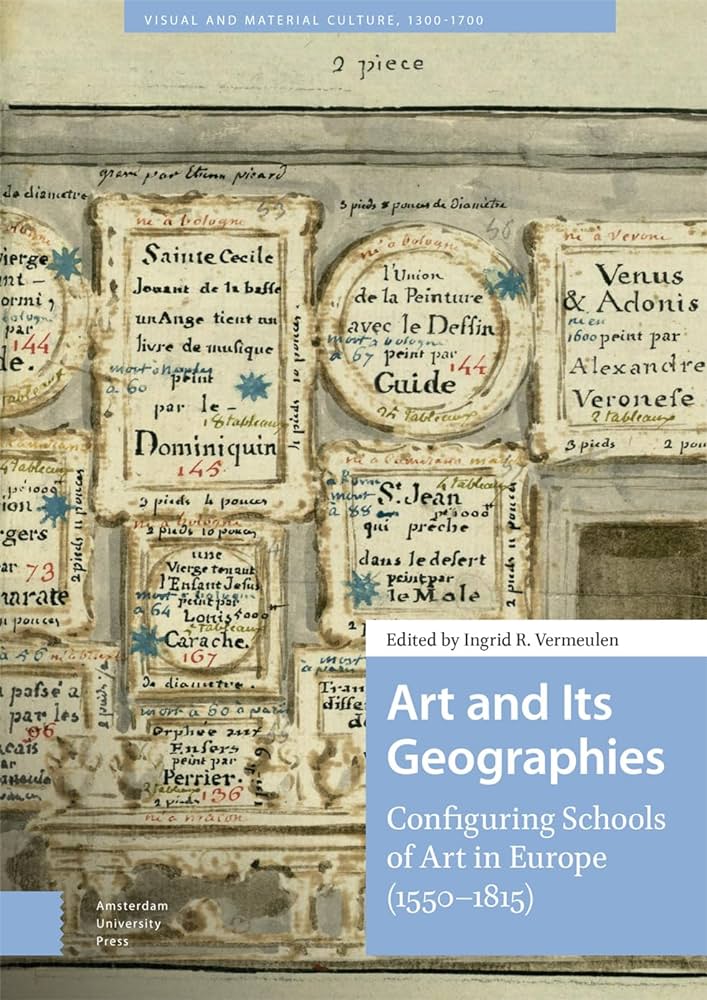 Schools of art represent one of the building blocks of art history. The notion of a school of art emerged in artistic discourse and disseminated across various countries in Europe during the early modern period. Whilst a school of art essentially denotes a group of artists or artworks, it came to be configured in multiple ways, encompassing different meanings of learning, origin, style, or nation, and mediated in various forms via academies, literature, collections, markets, and galleries. Moreover, it contributed to competitive debate around the hierarchy of art and artists in Europe. The ensuing fundamental instability of the notion of a school of art helped to create a pluriform panorama of both distinct and interconnected artistic traditions within the European art world. This edited collection brings together 20 articles devoted to selected case studies from the Italian peninsula, the Low Countries, France, Spain, England, the German Empire, and Russia.
Ingrid R. Vermeulen is Associate Professor of Early-Modern Art History at Vrije Universiteit Amsterdam. Her research focuses on the early-modern history of art history grounded in art literature, collections, and museums. It generated the book Picturing Art History (2010) and the project The Artistic Taste of Nations (2015) funded by the Dutch Research Council (NWO).
c o n t e n t s
Introduction
• Art and Its Geographies, 1550–1815: Configuring Schools of Art in Europe — Ingrid Vermeulen
Academies of Art, Churches, and Collective Artistic Identities
• Notions of Nationhood and Artistic Identity in Sixteenth- and Seventeenth-Century Rome — Susanne Kubersky-Piredda
• A Failed Attempt to Establish a Spanish Art Academy in Rome (1680): A New Reading of Archival Documents — Maria Onori
• Mantua: A School of History and Heritage (1752–1797) — Ludovica Cappelletti
Art Literature, Artists, and Transnational Identities
• Conceptualizing Schools of Art. Giovanni Battista Agucchi’s (1570–1632) Theory and Its Afterlife — Elisabeth Oy-Marra
• Claimed by All or Too Elusive to Include: The Appreciation of Mobile Artists by Netherlandish Artists’ Biographers — Marije Osnabrugge
• The Galeriewerk and the Self-Fashioning of Artists at the Dresden Court — Ewa Manikowska
Drawings, Connoisseurship, and Geography
• Padre Sebastiano Resta (1635–1714) and the Italian Schools of Design — Simonetta Prosperi Valenti Rodinò
• Connoisseurship Beyond Geography: Some Puzzling Genoese Drawings from Filippo Baldinucci’s (1624–1696) Personal Collection — Federica Mancini
• Arthur Pond’s (1705–1758) Prints in Imitations of Drawings (1734–1736): Old Masters, Copies, and the National School in Early Eighteenth-Century Britain — Sarah W. Mallory
Taste and Genius of Nations
• ‘Taste of Nations’: Roger de Piles’ (1635–1709) Diplomatic Take on the European Schools of Art — Ingrid Vermeulen
• How Do Great Geniuses Appear in a Nation? A Political Problem for the Enlightenment Period — Pascal Griener
Prints, Collecting, and Classification
• Dezallier d’Argenville’s (1680–1765) Concept of a Print Collection: by Topic or by School? – Gaëtane Maës
• Michael Huber’s (1727–1804) Notices (1787) and Manuel (1797–1808): A Comparative Analysis of the French School of the Eighteenth Century — Véronique Meyer
• Chronology and School: Questioning Two Competing Criteria for the Classification of Print Collections around 1800 — Stephan Brakensiek
Art Markets: Selling and Collecting
• The Eighteenth-Century Art Market and the Northern- and Southern-Netherlandish Schools of Painting: Together or Apart? — Everhard Korthals Altes
• The Print Collector Pieter Cornelis van Leyden (1717–1788): Literature of Art, Concepts of School, and the Genesis of a Connoisseur — Huigen Leeflang
• The Problem of European Painting Schools in the Context of the Russian Enlightenment: Alexander Stroganoff (1733–1811) and his Catalogue (1793, 1800, 1807) — Irina Emelianova
On Public Display in Picture Galleries
• Everyman’s Aesthetic Considerations on a Visible History of Art: Joseph Sebastian von Rittershausen’s (1748–1820) Betrachtungen (1785) on Christian von Mechel’s (1737–1817) Work at the Imperial Picture Gallery in Vienna — Cecilia Hurley
• An Organisation by Schools Considered Too Commercial for the Newly Founded Louvre Museum — Christine Godfroy-Gallardo
• Scuole Italiane or Scuola Italiana? Art Display, Historiography, and Cultural Nationalism in the Pinacoteca Vaticana after 1815 — Pier Paolo Racioppi
Contributors
Illustration Credits
Index
Call for Papers | Drawn to Blue
From ArtHist.net:
Drawn to Blue
Online, 12–13 November 2024
Organized by the J. Paul Getty Museum and the University of Amsterdam
Proposals due by 31 July 2024
Made from discarded blue rags, early modern blue paper was a humble material. Despite that, its manufacture required expert knowledge and its impact on European draftsmanship was transformative. This call seeks proposals for 20-minute papers that address the history of European blue paper from the fourteenth century until 1800. Open to art historians, curators, conservators, conservation scientists, paper historians, papermakers, and dyers, successful proposals will demonstrate original archival research and/or object-based approach to their discussion of works on blue paper. While all topics will be considered, organizers encourage papers related to the following subjects:
• blue paper production outside the Italian peninsula and the Netherlands
• color shift in blue paper and its implications
• technical and/or scientific examination of blue paper
• artistic applications of blue paper
• non-artistic uses of blue paper
• blue paper as means of transcultural exchange
• intersection between blue paper production and textile trade and technological developments
Co-organized by the J. Paul Getty Museum and the University of Amsterdam, this interdisciplinary online symposium will take place 12–13 November 2024, over two morning sessions Pacific Standard Time. Proposals should include author’s name, title, and an abstract (not to exceed 500 words). Submissions should be sent to drawings@getty.edu by 31 July 2024. Please put ‘Drawn to Blue’ in the subject. Accepted speakers will be notified by mid-August.
◊ ◊ ◊ ◊ ◊
Earlier this year, The Getty presented the exhibition Drawing on Blue (30 January — 28 April 2024) and published an accompanying book edited by the show’s curators, Edina Adam and Michelle Sullivan, Drawing on Blue: European Drawings on Blue Paper, 1400s–1700s (Los Angeles: J. Paul Getty Museum, 2024).
Conference | New Perspectives on Life Drawing
From The Courtauld (and note the two virtual sessions, June 17 and June 18):
Pose, Power, Practice: New Perspectives on Life Drawing
The Courtauld Institute of Art, Vernon Square, London, 20 June 2024
Organised by Zoë Dostal and Isabel Bird
From the 16th century to the present, drawing the human body from life has remained a mainstay of Western institutional art practice. Despite significant shifts in the aesthetics, media, and purpose of art over the last five hundred years, life drawing endures in both the studio and the classroom.
Pose, Power, Practice is a one-day symposium that seeks to reassess the state of the field on life drawing and apply new critical frameworks to this sustained practice. It aims to better understand life drawing in all its complexity, from its presumed advantages to its consequences. This is a practice deeply intertwined with concerns central to the discipline of art history, including but not limited to: the power dynamics of the gaze; the politics of representation; recognition of multiple forms of artistic labour; formulations of race, dis/ability, gender, and sexuality; and critiques of institutions. How has life drawing changed across time and place? How and why has it endured as a pedagogical practice, despite repeated dismissals of its “academicism”? What uses does it hold today, for artists and art historians alike?
Our re-evaluation of life drawing will start with two virtual panels earlier in the week, hosted in collaboration with The Drawing Foundation. At Life Drawing After Death on Monday, 17 June, 16:00 BST and Life Model as Laborer and Artist on Tuesday, 18 June, 13:00 BST, we will dive into topics that will resonate with and inform our in-person discussions on the varied perspectives, ethical considerations, and diverse practices that make up life drawing. Visit The Drawing Foundation’s event webpage for further details.
Organised by Dr Zoë Dostal (Kress Fellow, The Courtauld) and Isabel Bird (PhD candidate, Harvard University)
p r o g r a m m e
10.00 Registration, with coffee and tea
10.30 Welcome
• Professor Alixe Bovey (The Courtauld)
• Zoë Dostal (The Courtauld) and Isabel Bird (Harvard University)
10.50 Session 1 | Life Drawing as an Enduring Practice
Chaired by Tara Versey (Royal Drawing School)
• Antje Southern (The King’s Foundation Diploma Year), The Creative Impact of Life Drawing at Fine Art Foundation Level: A Case Study
• Susanne Müller-Bechtel (Saxon Academy of Sciences and Humanities in Leipzig – Young Forum), The Experimental Arrangement in the ‘Aktsaal’ at the Early Modern Academies and the Effects on the Artistic Practice
• John Fagg (University of Birmingham), ‘Take the pose of the model, yourself’: Empathy in Robert Henri’s Pedagogy and Practice
12.15 Lunch Break
13.45 Session 2 | Exposure and Expression: Life Modelling
Chaired by Carole Nataf (The Courtauld)
• Fra Beecher (Director of United Models Life Drawing CIC), The Body, Captured: Photography and the Life Room
• Tomáš Valeš (Institute of Art History, Czech Academy of Sciences, Prague / Department of Art History, Masaryk University, Brno), Employed, Exposed, Captured: Life Model Praxis in 18th-Century Vienna
• Yanyun Chen (School of the Museum of Fine Arts, Tufts University), Skinning Nudity: Life Modelling Practice in Singapore
15.10 Coffee and tea
15.40 Session 3 | Beyond the Life Room: Unexpected Practices
Chaired by Professor Joanna Woodall (The Courtauld)
• Suri Li (University of Cambridge), A Renaissance Nun’s Drawing Practices: Suor Plautilla Nelli (1524–1588) and Her Drawing of a Young Woman
• Oriane Poret (Université Lyon 2, LARHRA), Beyond Human: Drawing from Non-Human Life during the 19th Century
• Nick Robbins (University College London), The Life Academy and the Origins of Landscape
17.00 Drinks Reception
Symposium | Angelica Kauffman

Angelica Kauffman, Self-portrait with Bust of Minerva, detail, ca. 1780–84, oil on canvas, 93 × 76 cm
(Chur: Grisons Museum of Fine Arts, on deposit from the Gottfried Keller Foundation, Federal Office of Culture, Bern)
◊ ◊ ◊ ◊ ◊
I posted this a couple of weeks ago, but without the schedule, which is now added below. –CH
From the Royal Academy:
Angelica Kauffman
Royal Academy of Arts, London, 7 June 2024
As part of the Royal Academy’s retrospective exhibition of the work of Angelica Kauffman (1741–1807), this one-day symposium will provide an in-depth look at the work of one of the RA’s founding members. Known for her society portraits and pioneering history paintings, Kauffman painted some of the most influential figures of her day—queens, countesses, actors, and socialites. Her history paintings often focused on female protagonists from classical history and mythology. Organised in partnership with the Paul Mellon Centre for Studies in British Art, this symposium will address Kauffman’s international career and her time in London, her inspirations and subjects, and her place in the art world at the time and her position now in the broader context of art history.
Speakers include Emma Barker, Rosalind Polly Blakesley, Bettina Baumgartel, Rebecca Cypess, Ellen Hanspach-Bernal, Yuriko Jackall, Chi-Chi Nwanoku, Wendy Wassyng Roworth, Jane Simpkiss, and Annette Wickham. The day will conclude with a special artist in-conversation between Sutapa Biswas and Griselda Pollock.
If you have any accessibility needs, please contact public.programmes@royalacademy.org.uk.
p r o g r a m m e
8.30 Private View of the Exhibition
10.00 Welcome and Opening Remarks
• Rebecca Lyons
10.10 Session 1 | Angelica Kauffman and the Royal Academy of Arts
Chair: Rebecca Lyons
• Annette Wickham — Angelica Kauffman at the Royal Academy: From a Face on the Wall to Painting the Walls
• Bettina Baumgärtel — Angelica Kauffman in Context
• Jane Simpkiss — An Artist among Equals: A Comparative Analysis of Angelica Kauffman’s Self-Portraits with Those of Her Male Contemporaries
11.35 Break
12.00 Session 2 | Performance and Self-Fashioning in 18th-Century London
Chair: Marie Tavinor
• Chi-chi Nwanoku — 18th-Century Musical Prodigies
• Rebecca Cypess — Music and the Self-Fashioning of Angelica Kauffman
• Emma Barker — Figuring the Sibyl: Angelica Kauffman and the Image of Female Genius
1.25 Lunch Break
2.40 Session 3 | The International Business of Art
Chair: Sarah Victoria Turner
• Yuriko Jackall and Ellen Hanspach-Bernal — The Connections between Style, Reputation, and Business Acumen
• Rosalind Polly Blakesley — Kauffman in the Reign of Catherine the Great
• Wendy Wassyng Roworth — An Enterprising Artist: Angelica Kauffman and the Business of Art
4.10 Break
4.30 Artist Talk / In-Conversation
• Griselda Pollock and Sutapa Biswas
5.30 Concluding Remarks
• Sarah Victoria Turner
Colloquium | The Bottle, 17th- and 18th-C. Representations of Alcohol
From the conference programme:
The The Culture of the Bottle: Uses and Visual Representations of Alcoholic Drinks in the 17th and 18th Centuries
La culture du flacon: Usages et représentations visuelles des boissons alcoolisées aux XVIIe et XVIIIe siècles
Online and in-person, Institut national d’histoire de l’art, Paris, 13–14 June 2024
 Pour tout renseignement ou pour l’inscription Zoom : asso.grham@gmail.com
Organisation scientifique par le bureau du GRHAM avec le soutien financier et logistique de l’HiCSA et du Collège des écoles doctorales de l’Université Paris 1 Panthéon-Sorbonne.
t h u r s d a y , 1 3 j u n e
14.00 Accueil des participants
14.30 Conférence d’ouverture
• Boissons enivrantes et société française du XVIe au XVIIIe siècle — Matthieu Lecoutre, professeur agrégé d’histoire / chercheur associé à l’équipe Alimentation de l’université de Tours François-Rabelais et au centre George Chevrier de l’université de Bourgogne
15.45 Session 1 | Du chais au verre. Contenir l’ivresse
Modération : Maxime Bray, doctorant en histoire de l’art moderne, Sorbonne Université
• Avant le flacon, un contenant nécessaire, la barrique — Marguerite Figeac-Monthus, professeure des universités d’histoire moderne, Université de Bordeaux
• Une bouteille à succès : l’âge d’or de la bouteille couverte d’osier en France au XVIIe siècle — Elise Vanriest-Dabek, conservatrice du patrimoine, musée archéologique d’Istres / docteure en histoire de l’art moderne, EPHE
• Servir des alcools frappés : usages, formes et motifs des récipients en porcelaine au XVIIIe siècle — Défendin Détard, professeur agrégé d’histoire / doctorant en histoire de l’art moderne, Sorbonne Université
17.15 Présentation de notre partenaire Gallia et dégustation
19.00 Visite du musée des Arts décoratifs — Ariane James-Sarazin, conservatrice générale du patrimoine, Musée des Arts Décoratifs – Musée Nissim de Camondo
20.30 Dîner (réservé aux intervenants)
f r i d a y , 1 4 j u n e
9.30 Accueil des participants
10.00 Conférence
• Verser le vin, tenir le verre. Réflexions sur la gestuelle du vin dans la peinture européenne (XVIe–XVIIe siècles) — Philippe Morel, professeur émérite des universités d’histoire de l’art moderne, Paris 1 Panthéon Sorbonne
11.15 Session 2 | Artistes & regardeurs. L’émulation par l’ivresse
Modération : Maël Tauziède-Espariat, docteur en histoire de l’art, UBFC
• Toasting and Drinking in Dutch Golden Age Art — Benjamin Binstock, Assistant Professor, The Cooper Union
• Usages et mythologie de l’alcool chez les Bentvueghels : de la pratique à la théorie — Suzanne Baverez, docteure en histoire de l’art moderne, EPHE
12.30 Déjeuner des participants
14.30 Conférence
• Les portraits en buveur : une tradition iconographique de la peinture européenne aux XVIIe et XVIIIe siècles ? — Christine Gouzi, professeure des universités d’histoire de l’art moderne, Sorbonne Université
15.30 Session 3 | « Le goût des lumières ». Vins et images épicuriennes au XVIIIe siècle
Modération : Alice Ottazzi, docteure en histoire de l’art moderne, Université de Turin / Université Paris 1 Panthéon-Sorbonne
• Héraclite et Démocrite sous la Régence : Peinture, chansons à boire et sociétés parisiennes à l’aube des Lumières — Ulysse Jardat, conservateur du patrimoine, musée Carnavalet – Histoire de Paris
• Sculpteur Satyrs: Art, Alcohol and Materiality in 18th-Century Paris — Ashley Hannebrink, doctorante en histoire de l’art et de l’architecture, Harvard University
16.30 Pause-café
16.45 Session | Speed Talking
Modération : Justine Cardoletti, doctorante en histoire de l’art moderne, Paris 1 Panthéon-Sorbonne
• Les étiquettes de bouteilles au XVIIIe siècle — Maxime Georges Métraux, chercheur, Galerie Hubert Duchemin
• Les interprétations biblique et antique de « L’automne » de Nicolas Poussin — Chao Ying Lee, maîtresse de conférences en relations et cultures ethniques, Université nationale de Don Hwa, Taïwan
• La représentation du vin dans la nature morte italienne vers 1700 — Claudia Salvi, docteure en histoire de l’art, Université d’Aix-Marseille et experte en peinture ancienne
• « Les liqueurs estoient en quantité » : consommation de liqueurs lors des fêtes à la cour sous le règne de Louis XIV — Clémence Pau, docteure en histoire de l’architecture moderne et ATER, Sorbonne Université
• L’ivresse du décor : représenter le buveur dans le dessin de plafond. Le cas de la salle à manger du château de Chantilly ornée par Claude III Audran, 1692–1709 — Hugo Guibert, étudiant en Master 2 à l’École du Louvre
• Réflexion autour des lieux de consommation du Palais-Égalité à la fin du XVIIIe siècle — Charlotte Duvette, docteure en histoire de l’art et de l’architecture, Université Paris 1 Panthéon-Sorbonne et cheffe de projet à l’Institut national d’histoire de l’art
• « Cachez ce vin que je ne saurais boire. » Comment ressert-on son vin à Paris au XVIIe siècle ? — Jean Potel, doctorant en histoire de l’architecture moderne, Sorbonne Université
• Alcool et sexe : un mélange iconographique inexistant dans la France du XVIIIe siècle ? — Maël Tauziède-Espariat, docteur en histoire de l’art, UBFC
18.00 Mots de fin et pot de l’amitié










 Enfilade
leave a comment