Exhibition on George Washington Now in Raleigh
Washington’s dentures coming to a city near you. . . . From the N.C. Museum of History:
Discover the Real George Washington: New Views From Mount Vernon
Heinz History Center Pittsburgh, 19 February — 1 August 2010
North Carolina Museum of History, Raleigh, 10 September 2010 — 21 January 20110
Seven additional venues listed below

Gilbert Stuart, "Portrait of George Washington," c. 1798 (Mount Vernon)
The N.C. Museum of History is hosting the traveling exhibition Discover the Real George Washington: New Views From Mount Vernon during its three-year national tour. Approximately 100 objects associated with Washington are featured in this exhibition on view through Jan. 21, 2011, in Raleigh. The N.C. Museum of History is the only venue in the Southeast on the exhibition’s tour. “Although over a million people come to walk in Washington’s footsteps at Mount Vernon each year, we know that not everyone will have a chance to visit his home,” said Jim Rees, President of Mount Vernon. “We wanted to bring the fascinating story of Washington’s life to people around the country by showing a wide variety of compelling personal belongings and some intriguing elements from our new Donald W. Reynolds Museum and Education Center.”
Discover the Real George Washington offers a new and refreshing perspective on our nation’s first president, his achievements, and his family and times. The exhibition reveals the real George Washington not only as a general and president, but as a young land surveyor, experimental farmer and savvy entrepreneur. Washington’s views on religion and slavery, and the influence of his wife, Martha, are also explored. Highlights among the objects associated with Washington include:
- the only surviving complete set of Washington’s famous dentures, made of ivory, human teeth and animal teeth
- three life-size figures of Washington based on cutting-edge forensic research, showing him at different stages of his life: as a young surveyor, as commander in chief, and as our first president
- Gilbert Stuart’s famous portrait of Washington, ca. 1798
- the family Bible from Washington’s personal library
- surveying equipment and maps used by Washington.
Mrs. Washington is represented by original jewelry, pieces of her china, silver, glassware, and reproductions of her gold wedding dress and purple satin slippers. Discover the Real George Washington is presented in 11 sections, ranging from Washington’s youth to his final days. Engaging videos and a large 3D model of Mount Vernon Estate & Gardens enhance the visitor experience, and computer touch screens encourage interactivity. The exhibition features a full-size, functional replica of Washington’s pew at Pohick Church and detailed scale models of Fort Necessity, a gristmill, and an innovative 16-sided treading barn. An extensive selection of educational programs is offered throughout the exhibition run, and children can enjoy hands-on activities in the museum lobby. A dedicated Web site (DiscoverGeorgeWashington.org) provides additional learning opportunities.
Complete List of Venues
Heinz History Center, Pittsburgh, 19 February — 1 August 2010
North Carolina Museum of History, Raleigh, 10 September 2010 — 21 January 2011
Minnesota History Center, St. Paul, 22 February — 29 May 2011
National Constitution Center, Philadelphia, 1 July — 5 September 2011
Fort Worth Museum of Science and History, 11 October 2011 — 20 January 2012
Ronald Reagan Presidential Library and Museum, Simi Valley, CA, 22 February — 18 May 2012
Gilcrease Museum Tulsa, 22 June — 23 September 2012
Western Reserve Historical Society Cleveland, 19 October 2012 — 18 January 2013
Nevada, 15 February — 15 May 2013
New ‘Burlington Magazine’ Index — and Reasons to Use It
The Benefits of Traditional Indexing versus Free-Text Searches
The Burlington Magazine has produced its own index with content up to December 1997. The editor of the Index, Barbara Pezzini, outlines some of the advantages it holds over JStor (from a recent discussion at ARLIS-L). To use the index, register at http://index.burlington.org.uk/ and a password will be emailed to you.
Illustrations
1) In the Burlington Index you can search for illustrations, which have been indexed and are vocabulary controlled. In JStor you can free-text search for captions, but in many captions the name of the artist is not included (especially in issues up to the 1970s), and when the artist is included, names are often cited with various and inconsistent spellings: i.e. Roger de La Pasture for Rogier Van Der Weyden, John Van Eyck for Jan Van Eyck, Baciccio for Gaulli, etc.
2) Illustrations in the Burlington Index can be browsed according to media and artists, and artist searches can be refined for works attributed to artists, formerly attributed, and a list of 10 other roles. For instance, one can search for prints after Raphael, for paintings formerly attributed to Giotto, Drawings from the circle of Michelangelo etc. This is simply not possible to do in JStor. This makes the Burlington digital photographic index, where users can search for images that appeared linked to exhibitions or in the art market, which then can be used to establish provenance and attribution history of works.
Content
1) In the Burlington Index there is the opportunity to browse a complete census of all the contributors who wrote for the Burlington Magazine. Especially in the first fifty years of publications, many contributors signed articles with their initials only. In the Index it has been taken great care to associate those initials with authors, whereas on JStor the initials RF and Roger Fry are quoted as two different authors. This is particularly important when establishing bibliographies or reconstructing the critical personality of an author.
2) As for the illustrations, the contents indexed are vocabulary controlled. As above, many artists’ names have inconsistent spelling and variations; in the Burlington Index they are cited consistently and linked to the Getty Ulan thesaurus to facilitate searching.
3) The keywords are vocabulary controlled as opposed to a free text search. For instance, there could be articles of Chinese Aesthetics where the word ‘Aesthetics’ is never used and so it would be missed, whereas in the Burlington, articles on Chinese aesthetics have been clearly indexed as such. The Burlington really surpasses JStor in this more ‘general keywords’ search. For instance, if you try to search for ‘museums architecture’ in JStor (Burlington Magazine 1903/03-1977/12), you obtain 1045 results, of which the first two are already false hits. In the Burlington Index, you will have 22 results of which only one is a false hit. Even more blatant the results for ‘National Gallery architecture’: over 1,500 hits in Jstor (of which 99.9% are false) and 4 true hits in the Burlington Index.
4) In the Burlington Index, searches can be highly refined. For instance, you can specify if you want to see results only pertaining to Vasari as an artist (opposed to a source) or Henry VII as patron (opposed to a simple subject) or Empoli as the artist Empoli as opposed to the town in Italy.
5) In the Burlington Index you can browse critical lists of museums, private galleries, artists, collectors, and patrons. This allows the user to gauge the depth of the indexing and makes the structure of the system more transparent.
These are all examples of differences between indexing and free-text searching. Then there are some limitations pertinent to JStor; the most annoying for me is that all the articles in one page have the same code, so that, say you are searching for Picasso, you have a list of all the articles present in one page, even if only one of them has got the reference Picasso in them.
Lastly, there is one thing that Jstor does better than the Burlington because it is a free-text search. If you are studying a minor personality, say the painter Nina Hamnett, JStor will give you all mentions (and some more, see point above) whereas in the Burlington, you’ll have only the most important critical citations.
From the September Issue of ‘Art History’
Caroline van Eck, “Alfred Gell’s Art and Agency: Living Presence Response and the Sublime,” Art History 33 (September 2010): 642-59.
 Abstract: At issue in the reception of Alfred Gell’s Art and Agency is the relation between this ahistorical account of art works as agents operating in social networks and the historical study of art. In this article the merits are considered of applying a Gellian analysis to one, very widespread, case of art acting on the viewer: living presence response, in which viewers react to art works as if they are living beings. The first section of the article argues that such responses make sense only if their experiental aspect is taken into account, and Gell’s art nexus is adapted accordingly. Concentrating on the experience of art seeming alive also allows for an historical account of such responses. In the second part the argument is that theories of the sublime, as developed first by Longinus and subsequently by eighteenth-century authors such as Burke, Lawson and Usher, can be read as a theory of art’s agency, while the experience of living presence can be read as a sublime experience.
Paul Duro, “‘Great and Noble Ideas of the Moral Kind’: Wright of Derby and the Scientific Sublime,” Art History 33 (September 2010): 660-79.
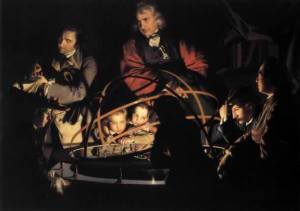
Joseph Wright, "A Philospher Lecturing on an Orrery," 1766, Derby Museums and Art Gallery (Image from Wikimedia Commons)
Abstract: In the 1760s Joseph Wright of Derby produced two important paintings — the Orrery, and the Air Pump — that show lectureres demonstrating the laws of science to a small audience of men, women, and children. While Wright’s paintings have been widely and variously discussed in terms of their representation of science, as images of the Industrial Revolution, their use of artificial light, and what they tell us about gender relations, they have hitherto not been specifically considered from the point of view of the eighteenth-century’s interest in the aesthetic category of the sublime. This article seeks to redress the balance through exploration of the paintings’ relationship to the sublime, particularly as it is represented in the writings of Edmund Burke and Immanuel
Kant, and to further consider Wright’s paintings as a commentary
on contemporary society’s fascination with art, science, and the
Enlightenment ideal of human perfectability.
ASECS Conference Funds for Graduate Students
Traveling Jam-Pot: Fund for Graduate Students
Applications due by 1 November 2010
Among the best — and customarily youngest — of our colleagues are graduate students, whose presence and voices we welcome at ASECS meetings. Their presence is vital to the continued success not just of ASECS as an organization but of our studies; these are the professors of the near future who will make “the long eighteenth century” live for countless students of the 21st century. Institutions, finding themselves strapped for funds, are economizing on grants to graduate students. Many young scholars can no longer obtain travel grants for appearances at conferences.
Award recipients are ABDs and PhDs within a year after receiving doctoral degree. An award of up to $300 will be given toward the cost of attending the ASECS annual meeting. Three (3) copies of the following information must be submitted by each applicant: Applicants must be members of ASECS at the time of submission.
- A statement of need
- Identity of other sources of funding sought
- Budget
- Endorsement from a faculty member (one copy is sufficient)
- Number of professional conferences attended in the past year
Application deadline: November 1, 2010. Applications will be read and awards given by a committee of three scholars; The Board also agreed that conference registration fees will be waived for successful candidates. Please send applications to: Byron R. Wells, Executive Director, ASECS, PO Box 7867, Wake Forest University, Winston-Salem, NC 27109.
Flaxman at UCL
From the UCL website:
Life, Action, and Sentiment: John Flaxman on the Art of Modern Sculpture
University College London, Strang Print Room, 21 June — 17 December 2010
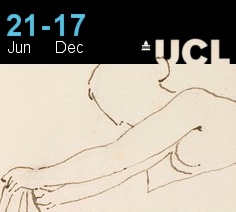 This exhibition celebrates the 200th anniversary of John Flaxman’s appointment as the first Professor of Sculpture at the Royal Academy. On display are the many preparatory sketches Flaxman drew to work through his ideas on how to convey life, action and sentiment in three-dimensional form. Kept for reference at his studio, then given to UCL by his family, these informal, linear drawings are shown together for the first time. They reveal Flaxman’s almost obsessive dedication to his cause, the creation of a modern school of sculpture.
Flaxman at the Royal Academy of Arts in London
From the Royal Academy of Arts:
The Language of Line: John Flaxman’s Illustrations to the Works of Homer and Aeschylus
Royal Academy of Arts Library, London, 27 July — 29 October 2010
Curator’s Talk, Tuesday, 5 October, 3:30 in the Library Print Room

John Flaxman, "Lampetia Complaining to Apollo," 1792-93, pen and ink with pencil on paper. © Royal Academy of Arts, London; photographer J. Hammond
This year marks the 200th anniversary of John Flaxman’s appointment as the first Professor of Sculpture at the Royal Academy. Although recognised as one of the leading sculptors of his day, it was Flaxman’s talent as a draughtsman that won him international acclaim. His dynamic yet understated outline illustrations to the works of Homer, Hesiod, Aeschylus and Dante were an immediate success when published as engravings and proved highly influential for generations of artists. The display features a selection of Flaxman’s drawings for the Iliad, the Odyssey and the Tragedies of Aeschylus. The works reveal delicate modifications to the designs that offer insight into the artist’s creative process prior to the production of the engraved plates. Flaxman’s experimentations with pose and composition are resolved into an archetypal style of linear clarity in the engravings, highlighting the practice underpinning his ability to convey dramatic, emotive and even comic effect with a single line.
Canaletto Exhibition To Open Soon in London
Press release from the National Gallery in London:
Venice: Canaletto and His Rivals
National Gallery, London, 13 October 2010 — 16 January 2011
National Gallery, Washington D.C., 20 February — 30 May 2011
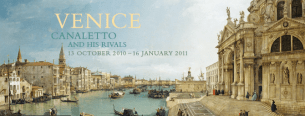 This exhibition presents the finest assembly of Venetian views, by Canaletto and all the major practitioners of the genre, to be held since the much-celebrated display in Venice in 1967. Remarkably, considering the dominant role of British patronage in this art form, Venice: Canaletto and His Rivals is also the first exhibition of its kind to be organised in the UK.
Additional information can be found here»
Call for Papers: AAH Conference in Warwick
Association of Art Historians (AAH) Annual Conference
University of Warwick, 31 March — 2 April 2011
Proposals due by 8 November 2010
The AAH 2011 Annual Conference showcases the diversity and richness of art history in the UK and elsewhere over an extensive chronological range from ancient to contemporary (with a healthy dose in the middle). Sessions are geographically inclusive of Western Europe and the Americas, the Middle East, and Asia. A full range of methodologies is on offer, ranging from object-based studies, socio-historical analyses, theoretical discourses, visual culture of the moving image, exhibition cultures and display. The sessions reflect the composition of our wide constituency – independent or academic researchers (including students), museum curators and teachers.
Plenary Speakers
Horst Bredekamp, Humboldt University and Permanent Fellow of the Institute of Advances Studies, Berlin
Patricia Rubin, Institute of Fine Arts, New York University
If you would like to offer a paper, please email the session convenor(s) directly, providing an abstract of your proposed paper in no more than 250 words, your name and institutional affiliation (if any). You should receive an acknowledgement of receipt of your submission within two weeks. In the absence of this, please post a paper copy, including your full contact details to the convenor. Please do not send proposals to the conference convenor.
Details, including descriptions of all sessions, are available here»










 Enfilade
leave a comment