A Fine Time in Vancouver

Just a quick note of thanks to all of you who helped make this year’s ASECS conference in Vancouver such a terrific experience. The HECAA sessions were well attended and instructive at multiple levels. As is often the case, I left thinking how much I still don’t know about the eighteenth century but also how excited I am to take away a broader vision of the period and its cultural production. Any HECAA members who would like a copy of the minutes from this year’s business meeting are welcome to send me an email requesting a copy. Thanks again! -CAH
Art History Post-Doc in Hong Kong
From The University of Hong Kong:
Two-Year Research Post-Doc at The University of Hong Kong
Applications due by 18 April 2011
Founded in 1911, The University of Hong Kong is committed to the highest international standards of excellence in teaching and research, and has been at the international forefront of academic scholarship for many years. Ranked 21st among the top 200 universities in the world by the UK’s Times Higher Education, the University has a comprehensive range of study programmes and research disciplines spread across 10 faculties and about 100 sub-divisions of studies and learning. There are over 23,400 undergraduate and postgraduate students coming from 50 countries, and more than 1,200 members of academic and academic-related staff, many of whom are internationally renowned.
The Society of Scholars in the Humanities at the University of Hong Kong is a society of young scholars involved in cutting-edge research. It is designed to encourage critical and creative thought both within and between the disciplines in the Arts and Humanities. There are two research Scholarships for 2011: one in Art History and one in History.
Each Scholarship is for two years and is non-renewable. Applicants are invited from all educational institutions across the world. The Scholarships are intended for researchers early in their careers to carry out innovative research. Candidates are expected to be either graduate students in the final stages of their Ph.D. studies, or researchers who have been awarded their Ph.D. degree for not more than two years from the date of application. Details about the Society and FAQs are available at: http://www.soh.hku.hk/scholars/2011/index.html.
Scholars will be provided with free accommodation, office space, airfares for overseas candidates, a research grant of up to HK$14,000 a year, and a stipend of HK$22,000 per month. (Scholars who have not yet been awarded a Ph.D. degree will receive a salary of HK$18,000 per month.) Successful candidates will be appointed as Research Scholar. (more…)
Call for Papers: Furnishing Elite Interiors, Old and New
Between the ‘Old’ and the ‘New’: Furnishing the Elite Interior 1740-1940
European Social Science History Conference (ESSHC), Glasgow, 11-14 April 2012
Proposals due by 1 May 2011
This ESSHC session examines European and North American market practice in order to address class difference and identification in the lust for the ‘new’ of the eighteenth-century elites and the desire for the ‘old’ amongst the aspirant middle classes thereafter. As Thomas Chippendale asserted in 1762, ‘The Title-Page has already called the following Work, The Gentleman and Cabinet-Maker’s Director, as being calculated to assist the one in the Choice, and the other in the Execution of the Designs; which are so contrived, that if no one Drawing should singly answer the Gentleman’s Taste, there will yet be found a Variety of Hints, sufficient to construct a new one’. This suggests that furnishing the elite interior could be a collaborative process between patron and cabinetmaker/upholder, as witnessed in the demand for increasingly novel styles of furniture capable of integration into the new architect-designed interiors of the later eighteenth century.
For the nouveaux riches, or those like the Wynns of Nostell Priory and the Lascelles family of Harewood House whose wealth increased dramatically as the century progressed, taste (and thus class identity) was best expressed through the acquisition of fine art, furniture and other items to fill their new town and country houses. Once such families became part of the Establishment, with associated titles and influence, their original consumption practices became the model for the next generation of arrivisti and their ‘new’ objects became the desirable ‘antiques’ of the nineteenth century. (more…)
Conservation of Jefferson’s Bible
Press release (11 March 2011), from the National Museum of American Art:
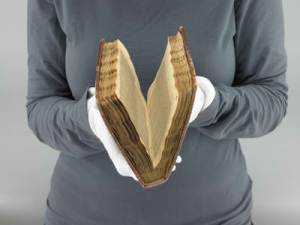 The Smithsonian’s National Museum of American History is currently performing a specialized conservation treatment to ensure the long-term preservation of Thomas Jefferson’s bible, a small handmade book that provides an intimate view of Jefferson’s private religious and moral philosophy.
At age 77 and living at Monticello in retirement following his two terms as President, Jefferson completed a project he had long planned and long discussed with others. In 1820 he assembled what he titled “The Life and Morals of Jesus of Nazareth.” Using excerpts from the Four Gospels of the New Testament, Jefferson
arranged the text to tell a chronological and edited story of Jesus’
life and moral philosophy.
 “The volume provides an exclusive insight to the religious and moral beliefs of the writer of the Declaration of Independence, the nation’s third President, as well as his position as an important thinker in the Age of Enlightenment,” said Brent D. Glass, director of the museum. “The treatment will ensure that generations to come will be able to study and view this tangible witness to history.”
Professionally bound in rich Morocco leather with gold tooling, this volume (86 pages; 8.25 inches by 5 inches) was not printed but rather constructed more like a “scrapbook.” Jefferson clipped
various passages from printed New Testaments in English, French,
Greek and Latin and glued them onto the front and back of blank
pages in four columns to allow for immediate comparison. On
those pages, Jefferson wanted to clarify and distill Jesus’ teachings. (more…)
At Sotheby’s in Paris: Furniture, Porcelain, & Sculpture
Press release from Sotheby’s (as noted art ArtDaily, 12 March 2011). . .
Important Furniture, Sculpture & Objets d’Art (Sale PF1101)
Sotheby’s, Paris, 6 April 2011 (viewing 2-5 April)
 The sale of Important Furniture, Sculpture & Objets d’Art at Sotheby’s Paris on 6 April comprises an exceptional ensemble of 230 precious items from a variety of European collections, including a rare Italian Renaissance bronze and a group of French 18th- and early 19th-century terracottas.
Highlight of the sale is sure to be an extremely rare Louis XV Secrétaire en Cabinet in citronnier, sycamore and amaranth veneer, adorned with ormolu mounts and Sèvres porcelain plaques, stamped four times A. Weisweiler, from the former Collection of Baron Gustave de Rothschild (estimate €1.5-2.5m*). Furniture incrusted with Sèvres porcelain plaques has always been popular among aficionados of the French 18th-century decorative arts and considered the epitome of refined cabinet-making. The greatest 18th-century cabinet-makers, such as BVRB, RVLC, Carlin, Riesener or Weisweiler, were commissioned to make sophisticated furniture by marchands-merciers, notably Poirier and Daguerre (who enjoyed a monopoly on the purchase of Sèvres porcelain plaques). Our secrétaire, probably made around 1778-80 at the time when Adam Weisweiler was qualifying, reflects the stylistic demands of Dominique Daguerre. An extensive array of furniture with porcelain plaques entered the Rothschild Collections in the 19th century, like the extraordinary ensemble from the Baron Edmond de Rothschild Collection acquired by the Louvre in 1990. (more…)
Ding, Ding, Ding, Ding, Ding . . .
Note from the Editor
Yesterday, Enfilade topped the 100,000 mark! In just over 20 months, there have been 100,062 views for the site (and counting). I realize that by most digital standards (certainly any commercial standards), this is pretty insignificant, but given Enfilade’s focus on serious engagements with eighteenth-century art, architecture, and visual culture, I think it’s immensely exciting. Thanks so much to all of you for reading and for submitting. Our monthly numbers continue to grow, steadily if slowly (February was our best month to date, with over 6,900 views). As a result of seeing how much energy there is for the period — in terms of exhibitions, new publications, and conferences — I’m quite optimistic about the future of eighteenth-century studies.
It’s especially appropriate and gratifying that we would pass this milestone at the start of this year’s ASECS conference in Vancouver. I arrived with my wife and eight-month old daughter earlier today. What a wonderful city! I look forward to catching up with many of you over the next few days. And to everyone else, thanks again for all you’ve done to support HECAA and Enfilade.
best,
Craig Hanson, editor
Call for Articles: English Catholic Women Writers
English Catholic Women Writers, 1660-1829
Special Issue of Tulsa Studies in Women’s Literature, edited by Anna Battigelli and Laura M. Stevens
Abstracts due by 1 June 2011
This special issue of Tulsa Studies in Women’s Literature will focus on English Catholic women’s imaginative work as it was inflected by Catholicism or through self-identification with a Catholic minority culture during the long eighteenth century. Articles on eighteenth-century Catholic women from the British Isles, including exiled English women working abroad or in the colonies, are sought exploring topics including, though not limited to, the following:
- the strategies English Catholic women used to express, promote, or protect their faith
- the intersections of gender and faith, particularly in the face of anti-Catholic polemic equating all Catholics with women or with the feminine
- women’s education
- the role of religious houses or religious orders within literary texts or as sites of literary or artistic production
- the reciprocal influence of Anglo-Catholic culture and Gothic literature
- Catholic women’s political engagement as Torries or Jacobites
- their literary, artistic, or political responses to the Catholicism of the Restoration Court, the Stuart kings, the Revolution of 1688, the Whig ascendancy, or Catholic emancipation
- their representation of English national history or English national identity
- their participation in the minority press.
Most of the essays will concentrate on women writers, but proposals for essays on other forms of women’s imaginative work, particularly the visual and domestic arts, are welcome. All essays should be informed by the rich repository of recent work in early modern Catholic studies. Articles should not exceed 25 pages (6250 words) and should conform to the 15th edition of the Chicago Manual of Style. All submissions should be in Microsoft Word. Initial queries and abstracts are encouraged, though final acceptance will be determined by the completed essay. Please send abstracts by June 1, 2011 and final submissions via e-mail by September 1, 2011 to both: Anna Battigelli (SUNY, Plattsburgh), a.battigelli@att.net AND Laura M. Stevens (editor, Tulsa Studies in Women’s Literature, University of Tulsa), laura-stevens@utulsa.edu
University of Warwick: Spanish America in the Eighteenth Century
Spanish America in the Early 18th Century: New Perspectives on a Forgotten Era
University of Warwick, Coventry, 15-16 April 2011
A day and a half workshop, to take place at the University of Warwick on 15 and 16 April 2011, will bring together a group of scholars working on Spanish America during the first half of the eighteenth century from different disciplines and perspectives. Until recently, the years between the accession of the house of Bourbon to the Spanish throne in 1700 and the coronation of Charles III in 1759 had failed to attract the interest of scholars of the Spanish world in the way that the latter part of the century had. Over the past few years, however, a growing number of scholars have begun to explore the early Bourbon period from innovative perspectives challenging the traditional view of the period as a largely inconsequential sequel to the later years of Habsburg rule. The workshop is an opportunity for a new generation of scholars, and for those well established academics that spearheaded these new developments, to talk about the directions in which research is moving and to discuss what the period looks like from our different perspectives. Particular emphasis will be placed on discussing the different ways in which the Bourbon succession, international competition over access to Spanish American resources, and war affected the region in the short and medium term. Participants include Rebecca Earle (Warwick), Allan Kuethe (Texas Tech), Anthony McFarlane (Warwick), Adrian Pearce (KCL), Christoph Rosenmuller (MTSU), Nuria Sala (Girona), Christopher Storrs (Dundee). Conference fee £20 (£12 for graduate students/unwaged). For further details please visit the conference website.
In Munich: Conserving Boulle Furniture, Exhibition and Symposium
From the museum’s website:
Prunkmöbel am Münchner Hof: Barocker Dekor unter der Lupe
Bayerisches Nationalmuseum Munich, 8 April — 31 July 2011
Symposium — Baroque Furniture in the Boulle Technique: Conservation, Science and History
Bayerisches Nationalmuseum Munich, 5-7 May 2011
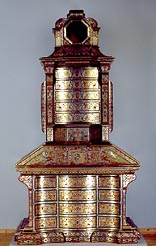 In spring 2011 the Bayerisches Nationalmuseum will have completed an interdisciplinary research project dedicated to the conservation /restoration of four writing cabinets decorated with fine marquetry in the Boulle technique. These cabinets were made by Johann Puchwiser (1680-1744), ebenist to the Munich court. The project has been supported by the Getty Foundation, the Ernst von Siemens Kunststiftung und the Eleonora-Schamberger-Stiftung and joined by an international group of furniture experts, scientists and conservators/restorers.
To showcase this project, we are planning the exhibition Prunkmöbel am Münchner Hof: Barocker Dekor unter der Lupe from 8th April to 31st July 2011. The show will present magnificent furniture in the Boulle technique and focuses especially on the conservation of the Puchwiser cabinets, stylistic developments, manufacturing
techniques, and Boulle marquetry in general.
 The announced symposium on the conservation project Baroque Furniture in Boulle Technique: Conservation, Science, and History is addressed to art historians, conservators/restorers and scientists. Internationally recognized experts will present their results in conservation/ restoration and scientific analysis of objects in Boulle technique. Lectures and guided tours will be held in English. Post-prints will be published shortly after the conference and can be ordered in advance. Conference fee including coffee break and lunch: 120€ / Reduced fee for students: 60€. Deadline for registration: 15th April 2011.
On Thursday 5th May we will meet for an evening dinner in the restaurant of the Bayerisches Nationalmuseum. If you would like to join, please add 40€ to the conference fee. For registration and information, please contact:
restaurierung.sekretariat@bnm.mwn.de
A preliminary program is available here»
Architecture Dissertations in Progress
As part of the Early Modern Architecture initiative, we are compiling an international list of Ph.D. dissertations from any discipline and on any aspect of the architecture (design, theory, and practice) of Europe and its colonies, 1400-1800. Once we have assembled a substantial number of dissertations, we will post the list on our site. If you are supervising or writing a dissertation that is in progress or was completed during the 2010-2011 school year, please email us with the author’s and supervisor’s names, the dissertation title, and the names of your department as well as institution. We will then add your information to our list. Alternatively, an online form is available through our website here.
— Kimberley Skelton and Freek Schmidt










 Enfilade
2 comments