Latest Issue of ‘Journal for Eighteenth-Century Studies’
Journal for Eighteenth-Century Studies 33 (December 2010)
Special Issue: Animals in the Eighteenth Century, guest edited by Glynis Ridley
 Peter Singer, “Foreword”
Glynis Ridley, “Introduction: Representing Animals”
Speakers
Ann Cline Kelly, “Talking Animals in the Bible: Paratexts as Symptoms of Cultural Anxiety in Restoration and Early Eighteenth-Century England,” pp. 437-51.
Conrad Brunström and Katherine Turner, “‘I shall not ask Jean-Jacques Rousseau’: Anthropomorphism in the Cowperian Bestiary,” pp. 453–68.
Jane Spencer, “Creating Animal Experience in Late Eighteenth-Century Narrative,” pp. 469–86.
Subjects
Sam George, “Animated Beings: Enlightenment Entomology for Girls,” pp. 487–505.
Jeff Loveland, “Animals in British and French Encyclopaedias in the Long Eighteenth Century,” pp. 507–23.
Christopher Plumb, “‘Strange and Wonderful’: Encountering the Elephant in Britain, 1675-1830,” pp. 525–43.
Craig Ashley Hanson, “Representing the Rhinoceros: The Royal Society between Art and Science in the Eighteenth Century,” pp, 545–66.
Boundaries
Tobias Menely, “Sovereign Violence and the Figure of the Animal, from Leviathan to Windsor-Forest,” pp. 567–82.
Anne Milne, “Sentient Genetics: Breeding the Animal Breeder as Fundamental Other,” pp. 583–97.
Peter C. Messer, “Republican Animals: Politics, Science and the Birth of Ecology,” pp. 599–613.
Paula Young Lee, “The Curious Affair of Monsieur Martin the Bear,” pp. 615–29.
Emotions
Lisa Berglund, “Oysters for Hodge, or, Ordering Society, Writing Biography and Feeding the Cat,” pp. 631-45.
James P. Carson, “Scott and the Romantic Dog,” pp. 647–61.
Elizabeth Amy Liebman, “Animal Attitudes: Motion and Emotion in Eighteenth-Century Animal Representation,” pp. 663–83.
Edward Rothstein on Recounting the Histories of Slavery
Critic’s Notebook
Edward Rothstein, “Emancipating History,” The New York Times (11 March 2010)
. . . Slavery and its heritage are everywhere here. Charleston was one of the main colonial ports of the 18th century, dealing in rice, indigo and slaves. In 1860 South Carolina held as many slaves as Georgia and Virginia, which were at least twice its size. The genteel grace and European travels of its wealthy citizens were made possible by the enslavement of about half the population.
So on a recent visit, I searched for a public display of an understanding of that American past and its legacy. After all, is there any more vexed aspect of this country’s history than its embrace and tolerance of slavery? And is there any aspect of its past that has been less well served in museums, exhibitions and memorials? . . . .
The full article is available here»
At the Newberry: Goodman on Masculinity in the Age of Revolutions
Dena Goodman, ‘Becoming a Man in the Age of Revolutions’
Newberry Library Eighteenth-Century Seminar, Chicago, 9 April 2011, 1-3pm
Professor Dena Goodman seeks to complicate the picture of nineteenth-century reactionary aristocrats and modern republicans by bringing an eighteenth-century perspective to bear on French revolutionary and post-revolutionary culture and society. Her paper will trace the life and career of a boy born less than a decade before the start of the French Revolution and asks how he became a man—and what kind of a man he became—through the successive upheavals of French history, from the Revolution and the Terror through the restoration of the monarchy and the regimes that followed. She argues that he became a “new man” of the nineteenth century only by drawing on family ties and patronage networks deeply embedded in the ancien regime of the seventeenth and eighteenth century. The paper for this seminar session will be pre-circulated. Those who plan to attend will be sent the paper via email after they have registered. Advance registration is required for all Newberry Library Center for Renaissance Studies programs. To register for this seminar, please send an e-mail to: renaissance@newberry.org or call: 312-255-3514. A reception will follow the seminar. For more information about the seminar, please visit our website.
Rijksmuseum Acquisition: Glass Engraved with Plantation Scene
Press release from the Rijksmuseum:
Rijksmuseum Acquires Surinamese Occasional Glass
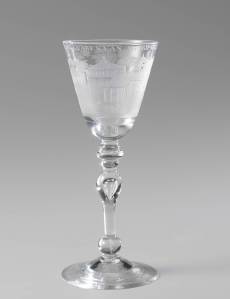 The Rijksmuseum has acquired an extremely rare 18th-century glass engraved with a scene depicting the Surinamese sugar plantation Siparipabo and the text ‘t welvaren van Siparipabo’ [‘The Prosperity of Siparipabo’]. The magnificent, detailed engravings are partly polished. Once the Rijksmuseum’s main building reopens, the glass will be given a prominent place among the 18th-century works of art, telling the story of Surinam’s plantation economy. Plantation owners in Surinam and Europe used glasses such as these to toast the prosperity of their possessions; in this case, the prosperity of the Siparipabo sugar plantation in Surinam. The plantation is first mentioned on a map dated 1686, on which it is depicted adjacent to the River Commewijne. The glass was probably ordered at the beginning of the 18th century by the owner of the plantation, Catharina Marcus, widow of Willem Pedij d’Oude. The engraver based his depiction on engravings from the book Beschryvinge van de volks-plantinge Zuriname (‘Description of the Surinam People’s Plantation’) by J. D. Herlein, which was published in 1718. One scene depicts a female slave resting under a tree and a male slave with a shovel and a sheaf of sugar cane. The other scene shows the plantation owner’s house, the sugar mill and the slave huts. The engraver has expertly depicted the original print in glass, allowing for the tapered shape of the goblet. He added vitality to the engraving by polishing certain parts. The detail of the little huts in the background, for example, is not as precise as the detail of the sugar mill in the foreground.
From the moment when the Netherlands exchanged Surinam as a colony for New Amsterdam (now New York) in 1667, the Dutch took African men and women there to work as slaves on the plantations (approximately 100,000 in the 17th century and approx. 400,000 in the 18th century). By 1775, there were around 600 plantations in Surinam, most of which were for sugar. There were still around 35,000 slaves in the colony when the Netherlands abolished slavery in 1863.
Eveline Sint Nicolaas, Curator in the Rijksmuseum’s History Department, explains: ‘When I first saw the glass I knew immediately that it was very special. There are only a few glasses that refer to Surinamese plantations and the combination with the prominently featured slaves near the sugar mill makes this a very special acquisition. The text and the scenes depicted also set one thinking. Why does it say ‘prosperous’ (‘welvaren’)? Hopefully it will soon have the same effect on the museum’s visitors. Apart from this item, there are very few objects in the collection that depict slavery in the former colonies, which is why the glass will have an important place among the 18th- century objects in the new Rijksmuseum’.
Latest Issue of ‘Ars Orientalis’: Globalizing Cultures
Volume 39 of Ars Orientalis, “Globalizing Cultures: Art and Mobility in the Eighteenth Century,” guest-edited by Nebahat Avcıoğlu and Finbarr Barry Flood, is now available. The volume addresses various aspects of the movement of cultural forms in Europe and Asia during the eighteenth century.
Contents
- Nebahat Avcıoğlu and Finbarr Barry Flood, “Globalizing Cultures: Art and Mobility in the Eighteenth Century”
- Sanjay Subrahmanyam, “A Roomful of Mirrors: The Artful Embrace of Mughals and Franks, 1550–1700”
- Kristel Smentek, “Looking East: Jean-Etienne Liotard, the Turkish Painter”
- Tülay Artan, “Eighteenth-Century Ottoman Princesses as Collectors: From Chinese to European Porcelain”
- Anton Schweizer and Avinoam Shalem, “Translating Visions: A Japanese Lacquer Plaque of the Haram of Mecca in the L. A. Mayer Memorial Museum, Jerusalem”
- Chanchal Dadlani, “The ‘Palais Indiens’ Collection of 1774: Representing Mughal Architecture in Late Eighteenth-Century India”
- Elisabeth A. Fraser, “‘Dressing Turks in the French Manner’: Mouradgea d’Ohsson’s Panorama of the Ottoman Empire”
- Mercedes Volait, “History or Theory? French Antiquarianism, Cairene Architecture, and Enlightenment Thinking”
Exhibition: Empress Elizabeth Petrovna in Moscow
From the museum’s website (with some editing for clarity) . . .
Elizabeth Petrovna and Moscow
The State Tretyakov Gallery, Moscow, 10 December 2010 — 27 March 2011

А. Belskiy, "Allegory, Astronomy," oil on canvas, 1756
This exhibition in honour of the 300th anniversary of the birth in Moscow of empress Elizabeth Petrovna (1709–1762) finishes the trilogy devoted to mutual relations of the Russian emperors of the eighteenth century and the ancient capital. The intermuseum project will unite exhibits from funds of the largest treasuries of Moscow and Moscow suburbs. All stages of the biography and a side of the person of the empress are shined: childhood and youthful years, coronation celebrations of 1742, “a small court yard,”court hunting, the visiting of orthodox monasteries in vicinities of the first capital city (Moscow), home life and activity in the culture sphere, connected with foundation University in Moscow and Academy of Arts in Petersburg and the creation of the first Russian theatre. Paintings, jewelry, sculpture, drawings, and architectural sketches and models will present a life of the empress against a wide background of life in the middle of eighteenth-century Moscow.
Congratulations to This Year’s Mary Vidal Memorial Fund Recipients
Congratulations to the recipients of this year’s Mary Vidal Memorial Fund for travel. Georgina Cole will present a paper, “Eavesdropping: Rethinking Space and Subjectivity in the Eighteenth Century,” at the American Society for Eighteenth-Century Studies meeting next week in Vancouver, British Columbia. The second recipient, Susan Wager, a doctoral student at Columbia University in New York, presented a paper, “Madame de Pompadour’s Indiscreet Jewels: Boucher, Reproduction, and Luxury in Eighteenth-Century France,” at CAA’s 2011 Annual Conference in New York.
ASECS in Vancouver, 2011
2011 American Society for Eighteenth-Century Studies Conference
Vancouver, British Columbia, 17-20 March 2011
The 2011 ASECS conference takes place in Vancouver, British Columbia, March 17-20, at the Sheraton Vancouver Wall Centre. Along with our annual luncheon and business meeting on Friday, HECAA will be represented by two panels (also on Friday) chaired by Douglas Fordham and David Ehrenpreis and Kevin Justus. In addition to these, a wide selection of sessions are also included below (admittedly there are lots of others that will interest HECAA members). For the full program, see the ASECS website.
◊ ◊ ◊ ◊ ◊
T H U R S D A Y , 1 7 M A R C H , 2 0 1 1
8:00-9:30
The Material Culture of Authorship, Pavilion Ballroom C
Chair: Robert MILES, University of Victoria
1. David A. BREWER, The Ohio State University, “Authorial Heads: Painted, Printed, Carved and Cast”
2. Brian COWAN, McGill University, “Henry Sacheverell and Material Celebrity in Eighteenth-Century Britain”
3. Sören C. HAMMERSCHMIDT, Ghent University, “‘The Best Work, or Best Character’: Intermedial Authorship in Alexander Pope’s Letters”
4. Tom MOLE, McGill University, “The Material Culture of Commemoration: The Scott Monument and the Reformed Nation”
◊ ◊ ◊ ◊ ◊
9:45-11:15
Clothing/Costume/Fashion – I, Pavilion Ballroom C
Chairs: Vivian P. CAMERON, Independent Scholar AND William W. CLARK, Queens College and Graduate Center, City University of New York
1. Emily PFIEFER, University of California, Riverside, “Fashioning Absolute Control: Defining the French Autocratic Ideal through Indian Textile Regulation, 1700–1706”
2. Jeffrey COLLINS, Bard Graduate Center, “Cornelis Troost: Fashioning Satire in Eighteenth-Century Holland”
3. Meredith MARTIN, Wellesley College, “Fashion and Globalization in Pre-Revolutionary France”
◊ ◊ ◊ ◊ ◊
11:30-1:00
Clothing/Costume/Fashion – II, Pavilion Ballroom C
Chairs: William W. CLARK, Queens College and Graduate Center, City University of New York AND Vivian P. CAMERON, Independent Scholar
1. Denise Amy BAXTER, University of North Texas, “Fashion and the Maternal Body in France, 1792–1814”
2. Laura ENGEL, Duquesne University, “Much Ado about Muffs: Actresses, Accessories, and Austen”
3. Alicia KERFOOT, McMaster University, “‘Let firm, well-hammer’d Soles protect thy Feet’: Footwear and the Permeability of the Street in Gay’s Trivia”
◊ ◊ ◊ ◊ ◊
2:30-4:00
Prints: Past and Present in the Eighteenth Century, Pavilion Ballroom C
Chair: Craig HANSON, Calvin College
1. Robert FOLKENFLIK, University of California, Irvine, “Illustrating English Novels in the Eighteenth Century”
2. Catharine INGERSOLL, University of Texas at Austin, “Medieval Margaret, Enlightenment Edinburgh: Alexander Runciman’s Etchings of St. Margaret of Scotland in their Historical Contexts”
3. Michael YONAN, University of Missouri, “‘The Uniqueness of English Humours’: Hogarth’s Prints and the German Critique of National Character”
4. Liza OLIVER, Northwestern University, “Sites of Exclusion and Slippages of Time: Murphy’s Arabian Antiquities of Spain, 1815”
◊ ◊ ◊ ◊ ◊
4:15-5:45
Aesthetics, Ethics, and Economics in Late Eighteenth-Century Art and Literature, Port McNeill
Chair: Catherine LABIO, University of Colorado, Boulder
1. Sophie RAUX, Université Lille 3, “Amateurs vs. Dealers: Defining the Value of Art in Enlightenment France”
2. Bradford MUDGE, University of Colorado, Denver, “Eating Money: Kitty Fisher, Joshua Reynolds, and the Ethics of Consumption”
3. Konstanze BARON, University of Halle-Wittenberg, “Diderot’s Les Deux amis de Bourbonne: The Passions and the Interests (of Reading)”
4. Yota BATSAKI, Center for Hellenic Studies, Washington, DC, “‘Interesting in Every Sense: Economics, Ethics, and Aesthetics in Olaudah Equiano’s The Interesting Narrative (1789)”
◊ ◊ ◊ ◊ ◊
6:00-7:30
A Round Table In Memory of Angela Rosenthal, Grand Ballroom A
Organized by Laura AURICCHIO, Bernadete FORT, and Melissa HYDE
Eight speakers will pay tribute to Angela Rosenthal’s life and the influence of her scholarship on the study of Eighteenth-Century visual culture.
◊ ◊ ◊ ◊ ◊
F R I D A Y , 1 8 M A R C H 2 0 1 1
8:00-9:30
The Dutch Connection in European Visual Arts, Pavilion Ballroom C
Chair: JoLynn EDWARDS, University of Washington, Bothell
1. Georgina COLE, University of Sydney, “Eavesdropping: Rethinking Space and Subjectivity in the Eighteenth Century”
2. Christina K. LINDEMAN, Pima Community College, “Illustrating a Painter’s Profession: Convergence of Dutch Genre Conventions in Anna Dorothea Therbusch’s Self Portraits”
3. Craig HANSON, Calvin College, “From Scientific Illustration to the Painted Landscape: The Importance of Dutch Artists for British Visual Culture”
4. Julie CADOTTE, University of Montreal, “A French Play Seen by a Dutch Artist: Cornelis Troost and the Scene from Tartuffe”
◊ ◊ ◊ ◊ ◊
9:45-11:15
Art Before Nationalism, Pavilion Ballroom C — (Historians of Eighteenth-Century Art and Architecture)
Chairs: David EHRENPREIS, James Madison University AND Douglas FORDHAM, University of Virginia
1. Claude WILLAN, Stanford University, “Performance Anxiety: Sociality, Theatre, and Watteau’s political fêtes galantes”
2. Andrew SCHULZ, University of Oregon, “Excavating Spain’s Islamic Past”
3. Daniel O’QUINN, University of Guelph, “The Countenance of Patriotism: Sir Joshua Reynolds’ Portraits of Augustus Keppel”
◊ ◊ ◊ ◊ ◊
11:30-1:00
Looking Forward, Looking Back: HECAA’s New Scholars Session, Pavilion Ballroom C — (Historians of Eighteenth-Century Art and Architecture)
Chair: Kevin L. JUSTUS, Independent Scholar
1. Leah SINGSANK, University of Arizona, “Ambiguity, Legibility, and the Erotic in Eighteenth-Century France”
2. Heidi E. KRAUS, The University of Iowa, “New Sources: David’s Sabine Women Reconsidered”
3. Molly MEDAKOVICH, University of North Carolina, Chapel Hill, “A Portrait of Female Friendship: Juliette Récamier at the Abbaye-aux-Bois”
◊ ◊ ◊ ◊ ◊
1:00-2:30
HECAA Luncheon
◊ ◊ ◊ ◊ ◊
2:30-4:00
Presidential Address, Awards Presentation, and ASECS Business Meeting
Heather MCPHERSON, University of Alabama at Birmingham, “‘Thinking Heads’: Deciphering Enlightenment Portraits”
◊ ◊ ◊ ◊ ◊
4:15-5:45
Confluences and Continguties in Eighteenth-Century French Literary, Visual Arts and Musical Arts: A Seminar in Memory of Walter E. Rex, Grand Ballroom BC
Chairs: Dorothy JOHNSON, University of Iowa AND Mary SHERIFF, University of North Carolina, Chapel Hill
1. Paula RADISICH, Whittier College, ‘A bust, a globe,’ Chardin and the Quarrel of the Ancients and Moderns”
2. Tili Boon CUILLÉ, Washington University, “Staging the Supersensory”
3. Christopher M. S. JOHNS, Vanderbilt University, “Canova’s Penitent Magdalene: Art, Literature, and Roman Catholicism in Napoleonic Paris.”
◊ ◊ ◊ ◊ ◊
S A T U R D A Y , 1 9 M A R C H 2 0 1 1
9:45-11:15
Transfers and Transformations: The Visual Arts in the Iberian Peninsula and the New World – I, Grand Ballroom BC
Chair: Anne-Louise G. FONSECA, Université de Montréal
1. Giuseppina RAGGI, Centro Histórico de Além Mar / Universidade Nova de Lisboa, Portugal, “A pintura de quadratura nas terras portuguesas d’aquém e além mar”
2. Rodrigo Almeida BASTOS, Universidade Federal de Minas Gerais/ UNIVILLE, Brazil, “Adaptação de modelos e elementos portugueses na arquitetura religiosa do século XVIII em Minas Gerais, Brasil”
3. Rafael MOREIRA, Universidade Nova de Lisboa / Sociedade Portuguesa de Estudos do Século XVIII, Portugal, “A Portuguese “Temple of Solomon” in the Tropics: the Sanctuary of São Bento de Olinda in late Eighteenth-Century Brazil”
◊ ◊ ◊ ◊ ◊
2:00-3:30
Dogs and Cats, Monkeys and Birds: Pets and Pet Keeping in the Eighteenth Century, Finback
Chair: Julie-Anne PLAX, University of Arizona
1. Erin PARKER, University of Toronto, “Be our Guest: Pets, Hospitality, and Sarah Trimmer’s Fabulous Histories”
2. Ingrid TAGUE, University of Denver, “Fops and Dancing-Masters, Apes and Lapdogs: Masculinity and Pets in England”
3. Sandra BARR , Independent Scholar, “Alone in a Crowd—the People’s Pet Rhino, Clara”
4. Kevin L. JUSTUS, Independent Scholar, “Pussy Cat, Pussy Cat, Where Have You Been? I’ve been to Versailles to Visit the King: Louis XV’s
Pets, or How the King Loves and Indulges his Animals.”
◊ ◊ ◊ ◊ ◊
2:00-3:30
Transfers and Transformations: The Visual Arts in the Iberian Peninsula and the New World – II, Port McNeill
Chair: Gloria EIVE, Emerita, Saint Mary’s College of California
1. Sebastian FERRERO, Université de Montréal, “Un motivo andino en la Apoteosis de San Ignacio de Andrea Pozzo. La red jesuita y los alcances del conocimiento pseudo-etnográfico”
2. Leticia SQUEFF, Universidade Federal de São Paulo, Brazil, “History Painting or Allegory? Manuel Dias de Oliveira’s Nossa Senhora da Conceição”
3. Anne-Louise G. FONSECA, Université de Montréal, “Eighteenth-Century Colonial Painting in Brazil: Enlightenment and Cultural Transfers”
◊ ◊ ◊ ◊ ◊
3:45-5:15
Everyday Objects, Grand Ballroom BC
Chair: Paula RADISICH, Whittier College
1. Amy FREUND, Texas Christian University, “Things in Portraits: Everyday Objects and Personal Identity in Revolutionary France”
2. David EHRENPREIS, James Madison University, “Ordering Things: The Beauregard Primer of 1814”
3. Chi-ming YANG, University of Pennsylvania, “Race, Chinoiserie, and the Technology of the Umbrella”
4. Christine A. JONES, University of Utah, “The Eloquence of Porcelain Objects in French Eighteenth-Century Painting”
◊ ◊ ◊ ◊ ◊
3:45-5:15
Naples Reconsidered, Grand Ballroom A
Chairs: Heidi A. STROBEL, University of Evansville AND Amber LUDWIG, Boston University
1. Clorinda DONATO, California State University, Long Beach, “Of Synthetic Marble and Anatomical Machines: Displaying Occult Science in Early Modern Naples”
2. Tom ALLSUP, Independent Scholar and Appraiser, “Eighteenth-Century Naples Porcelain”
3. Christoph WEBER, University of North Texas, “Witnesses to Disaster: Naples’ Response to the Calabrian Earthquake of 1783 in the Crossfire of German Travel Accounts”
4. Jack D’AMICO, Canisius College, “Naples, Byron, and the Early Risorgimento”
Call for Articles: Women in Eighteenth-Century Scotland
New Edited Collection on Women in Eighteenth-Century Scotland
Proposals due by 18 April 2011
The eighteenth century looms large in the Scottish imagination. It is a century that saw the doubling of the population, rapid urbanisation, industrial growth, the political Union of 1707, the Jacobite Rebellions and the Enlightenment – events that were intrinsic to the creation of the modern nation and to putting Scotland on the international map. The impact of the era on modern Scotland can be seen in the numerous buildings named after the luminaries of the period –Adam Smith, David Hume, William Robertson, the endorsement of Robert Burns as the national poet/ hero, the preservation of the Culloden battlefield as a tourist attraction, and the physical geographies of its major towns. Yet, while it is a century that remains central to modern constructions of national identity, it is a period associated with men. Until recently, the history of women in eighteenth-century Scotland, with perhaps the honourable exception of Flora McDonald, remained unwritten. Over the last decade however, research on women and gender in Scotland has flourished and we have an increasingly full picture of women’s lives at all social levels across the century. As a result, this is an appropriate moment to reflect on what we know about Scottish women during the eighteenth century, to ask how their history affects the traditional narratives of the period, and to reflect on the implications for a national history of Scotland and Scottish identity. (more…)
TEFAF Opens in Maastricht March 18
The European Fine Art Fair (TEFAF)
Maastricht, 18-27 March 2011
 TEFAF Maastricht has built its reputation as the world’s most influential art and antiques fair on the unique quality of its exhibits. The 24th edition at the MECC (Maastricht Exhibition and Congress Centre) in the southern Netherlands from 18 to 27 March 2011 will include great rarities and recent rediscoveries among more than 30,000 works of art, all rigorously vetted by committees of international experts. Among them will be the last fragment of an Egyptian water clock still in private hands, a painting containing one of the few self-portraits of Bernardo Bellotto, and a bronze by Gustave Courbet rediscovered after being lost for more than a century.
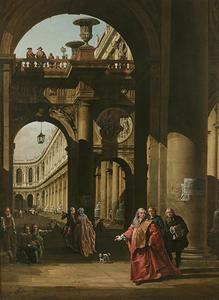 Bernardo Bellotto, Architectural Capriccio with a Self-Portrait of Bellotto in the Costume of a Venetian Nobleman, oil on canvas, 155 x 112 cm, 1760s — This painting contains one of the few self-portraits of Bellotto. He is depicted here lavishly clad in the traditional costume of Venetian nobility. The artist extends his arm in pride, inviting the viewer to admire the magnificent palatial setting, a testament of his exemplary artistic talent and innovation. Dating from the artist’s second Dresden sojourn between 1761 and 1767, the present work is the first of three known versions of the composition by Bellotto. Exhibited by Otto Naumann Ltd. Price: $11.5 million USD










 Enfilade
leave a comment