Graduate Students and Young Scholars: Newberry Summer Workshop
Summer Workshop: Reintegrating British and American History, 1660-1750
The Newberry Library, Chicago, 11-22 July 2011
Applications due by 21 March 2011
Directors: Mark Knights and Trevor Burnard of the University of Warwick
Speakers: Kevin Sharpe, Queen Mary, University of London; David Hancock, University of Michigan; Evan Haefeli, Columbia University; Phil Withington, University of Cambridge; John Garrigus, University of Texas at Arlington; Lisa Cody, Claremont McKenna College.
Themes: British and American historiographies; trade and political economy; space and time; toleration, witchcraft and religious diversity; citizenship and communities; political culture; visual culture; race, Native Americans and slavery; French and Spanish America; gender. Participants will also have an opportunity to present a paper based on their own research.
Eligibility: Advanced graduate students and early career researchers who have completed a Ph.D. in a relevant field within the last two years. Up to two graduate students studying in the UK with an interest in the late seventeenth and early eighteenth centuries will be chosen to attend. Priority will be given to students/early postdoctoral scholars connected to institutions that are members of the Newberry Center for Renaissance Studies consortium.
Awards: Successful applicants will receive economy airfare to Chicago, accommodation near the Newberry Library, and a per diem for meals.
To apply: Complete the form here and upload a cover letter setting out why you would like to attend the workshop and how its themes relate to your research, and a curriculum vitae of no more than two pages. Include the names and contact details of two referees in your cover letter.
This program is funded by a generous grant from the Andrew W. Mellon Foundation.
Exhibition: Chardin in Madrid
The Chardin exhibition formerly on view in Ferrara recently opened at the Prado:
Chardin: The Painter of Silence
Ferrara, Palazzo dei Diamanti, Ferrara, 17 October 2010 — 30 January 2011
Museo Nacional del Prado, Madrid, 1 March — 29 May 2011
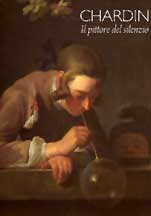 The Museo del Prado presents the exhibition Chardin, a comprehensive survey of the work of Jean Siméon Chardin (1699-1779). Chardin is one of the leading names in 18th-century French painting but has never been the subject of an exhibition in Spain, which only houses three of his paintings, all in the Museo Thyssen. After being shown at the Palazzo dei Diamante in Ferrara, the exhibition is presented in Madrid thanks to the sponsorship of Fundación AXA. It comprises 57 paintings by this great master of the still life and of genre painting, including some works not shown in the version of the exhibition seen in Italy.
Additional information is available here»
Reviewed: ‘The City’s Pleasures: Istanbul in the Eighteenth Century’
From The Art Bulletin 93 (March 2010): 101-04.
Shirine Hamadeh, The City’s Pleasures: Istanbul in the Eighteenth Century (Seattle: University of Washington Press, 2007), 368 pages, ISBN: 9780295986678, $60.
Reviewed alongside Cigdem Kafescioglu’s Constantinopolis/Istanbul: Cultural Encounter, Imperial Vision, and the Construction of the Ottoman Capital (2009) and Murat Gül’s The Emergence of Modern Istanbul: Transformation and Modernisation of a City (2009).
Reviewed by Robert S. Nelson, Yale University.
. . . Hamadeh defines the character of a period through its buildings. Especially noteworthy is her use of poetry and building inscriptions. And, like Kafescioglu, she discusses vision, power, and the location of buildings . . . . she relies on the concept of ‘pleasure’ in the title and, behind it, a more fundamental notion of public space, adapted from Jürgen Habermas and others, that did not exist in the earlier centuries. Istanbul in the eighteenth century resembles John Brewer’s view of London from the late seventeenth century, in which ‘high culture moved out of the narrow confines of the court and into diverse spaces’ [The Pleasures of the Imagination, p. 3]. Finally, while her book is firmly ensconced in Turkish studies, the author also situates it laterally in early modern studies and critiques Westernization theories of
Ottoman architecture, that is, the notion that it follows at a
distance fashions set elsewhere. . .
Colloquium on the Ties between Painting and Gardening
From Le blog de APAHAU:
De la peinture au jardin: transferts artistiques de l’Antiquité à nos jours
Villa Medici, Rome, 17-19 March 2011
 Si les ouvrages d’ensemble sur l’iconographie des jardins dans la peinture se sont multipliés depuis peu, à l’inverse les répercussions de la peinture sur les jardins n’ont fait l’objet pour l’instant que de travaux dispersés. C’est sur les modalités des transferts de la peinture au jardin et leur évolution, depuis l’Antiquité jusqu’aux créations les plus contemporaines, que le colloque souhaite apporter une réflexion renouvelée. Trois thématiques principales orienteront les réflexions des chercheurs : d’une part, la présence de la peinture dans les jardins qui enrichit symboliquement la sémantique de leur espace à travers une « iconographie ». D’autre part, la question de la peinture comme modèle du jardin, qui atteindra son apogée dans l’Angleterre du XVIIIe siècle à travers les diverses esthétiques rassemblées sous la bannière du « picturesque ». Enfin, la conception du jardin en tant que représentation et la place paradoxale de cette forme de création au sein des différents « systèmes des beaux-arts ». Cette approche des transferts complexes de la peinture au jardin – selon un rapport d’imitation, d’émulation, de traduction ou parfois d’émancipation – sera enfin susceptible de déboucher sur une interrogation plus large quant aux fonctions – et aux limites – du paradigme pictural dans le rapport culturel au paysage, en Occident comme dans d’autres cultures.
Exhibition: Pastel Portraits at the Met
Press release from the Met:
Pastel Portraits: Images of 18th-Century Europe
Metropolitan Museum of Art, New York, 17 May — 14 August 2011
Curated by Katharine Baetjer and Marjorie Shelley
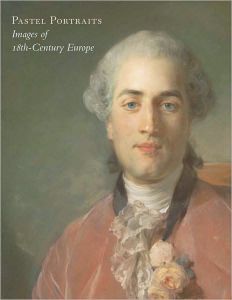 In the 18th century, pastel portraiture was so popular in Europe that by 1750 almost 2,500 artists and amateurs were working in pastel in Paris alone. Across Europe works were commissioned by royalty and courtiers, as well as the wealthy middle classes. Although pastel is a drawing material, 18th-century portraits are often highly finished, relatively large, brightly colored, elaborately framed, and hung in the same fashion as oil paintings. The powdery pastel crayons and slightly roughened paper are particularly suited to capturing the evanescent effects of expression that characterize the most life-like portraits. Pastel Portraits: Images of 18th-Century Europe will feature 40 pastel portraits from the collections of the Metropolitan Museum and other museums, and from private collections in New York, Princeton, and New Haven. At the core of the exhibition will be a group of French works, and the English, German, Italian, and Swiss schools will also represented.
Pastels are susceptible to fading if overexposed to light, and they are vulnerable to damage from excessive vibration, which can loosen the powder. As a practical consequence, they can only be shown three months of the year, rarely travel, and are not often exhibited in museums. Pastel Portraits will give visitors the rare opportunity to view these exquisite works in a museum exhibition, which will include generous loans from the Princeton University Art Museum, Yale Center for British Art, New Haven, Pierpont Morgan Library, New-York Historical Society, and Frick Collection, as well as several private collections.
Pastel Portraits will feature a number of fine works by Maurice Quentin de La Tour and Jean Baptiste Perronneau, two of the best known and outstanding artists who were working with this medium in mid-18th–century Paris. Highlights of the exhibition will include La Tour’s Jacques Dumont le Romain (1701-1781) Playing the Guitar; Perronneau’s Olivier Journu; Adélaïde Labille-Guiard’s portrait of the sister of Louis XVI, Madame Elisabeth de France (1764-1794), recently acquired by the Metropolitan Museum; Jean Étienne Liotard’s Young Woman in Turkish Costume with a Tambourine; John Russell’s John Collins of Devizes; and the beautiful Young Woman with Pearl Earrings by Venetian artist Rosalba Carriera, who became a favorite of Grand Tourists visiting Italy. The popularity and appeal of pastel in the 18th century reached as far as Boston, where John Singleton Copley, who was self-taught and had never seen an important European work in the medium, created exceptional portraits. Two of Copley’s portraits, also recently acquired by the Metropolitan Museum, will be on view in the exhibition.
Katharine Baetjer and Marjorie Shelley, Pastel Portraits: Images of 18th-Century Europe, exhibition catalogue (New Haven: Yale University Press, 2011), 9780300169812, 56 pages, $14.95.
Mimi Hellman to Speak at the Bard Graduate Center
From the Bard Graduate Center:
Mimi Hellman, Forms of Distraction: Towards a Decorative Imagination in Eighteenth-Century France
Bard Graduate Center, New York, 30 March 2011
The eighteenth-century French interior was filled with a multitude of artfully designed objects, from lustrous porcelain vases to intricately veneered furniture to paintings representing the trysts of mythological lovers. Yet sustained appreciation of these works was often difficult due to factors such as location, lighting, and codes of conduct. By exploring the tensions between visual abundance and compromised visibility, this lecture suggests that both designers and consumers imagined the interior as a space where distraction, not attention, shaped the aesthetic and social value of decorative art.
Mimi Hellman is Associate Professor in the Department of Art History at Skidmore College, Saratoga Springs, New York, where she has taught since 2004. She has also taught at Smith College in Northampton, Massachusetts, and Mount Holyoke College in South Hadley, Massachusetts. Dr. Hellman received her B.A. and M.A. from Smith College, and the Ph.D. from Princeton University. She has been the recipient of prestigious fellowships including a David E. Finley Fellowship from the Center for Advanced Study in the Visual Arts at the National Gallery of Art in Washington, D.C. (1997-2000), and a research fellowship at the American University in Paris from the Samuel H. Kress Foundation (1995-7).
Dr. Hellman is preparing a book entitled The Hôtel de Soubise: Art and Ambition in Eighteenth-Century France. She has published numerous essays, including “Enchanted Night: Decoration, Sociability, and Visuality after Dark,” in Paris: Life and Luxury (forthcoming in 2011); “The Nature of Artifice: French Porcelain Flowers and the Rhetoric of the Garnish,” in The Cultural Aesthetics of Porcelain in the Eighteenth Century (2010); “Up the River: Touring Sing Sing,” in Lives of the Hudson (2010); “The Decorated Flame: Firedogs and the Tensions of the Hearth,” in Taking Shape: Finding Sculpture in the Decorative Arts, winner of Historians of British Art book prize (2010); “The Joy of Sets: The Uses of Seriality in the French Interior,” in Furnishing the Eighteenth Century: What Furniture Can Tell Us About the European and American Past (2006); “Interior Motives: Seduction by Decoration in Eighteenth-Century France,” the introduction to the Metropolitan Museum of Art exhibition catalogue, Dangerous Liaisons: Fashion and Furniture in the Eighteenth Century (2006); and “Domesticity Undone: Three Historical Spaces,” in Undomesticated Interiors (2003).
Please RSVP and join us in the Lecture Hall at 38 West 86th Street, between Columbus Ave and Central Park West, at 5:45pm for a reception before the talk. For general information please contact academic-events@bgc.bard.edu.
American Print Culture Summer Seminar
From the American Antiquarian Society:
Encountering Revolution: Print Culture, Politics, and the British American Loyalists
American Antiquarian Society, Worcester, MA, 13-17 June 2011
Applications due by 11 March 2011
 What happens to the dominant critical models in Revolutionary history-those that govern the way we conceptualize the meanings of print, the nature of authorship, the rhetorical forms of expression, and the very notion of “public” culture-when we reinsert the Loyalist presence into Revolutionary American Studies? The 2011 AAS Summer Seminar in the History of the Book in American Culture will employ transatlantic methods and contexts as a way of challenging the field’s reliance on nationalist models of literary and cultural history that rest upon the political history of the formation and development of the United States. This seminar will interrogate the “Americanness” of American political writing to articulate generic and thematic continuities between British and British American writing and printing. By accounting for Loyalist writing in a revisionary history of Revolutionary print culture-through an examination of Loyalist printers and distribution networks as well as of efforts to censor Loyalist publications-we also hope the seminar will interrogate current models of the “public sphere” and of the historical/theoretical models informing public and private life in late eighteenth-century British America. Our goal is to consider the multiple, transatlantic audiences that Loyalist writing imagines for itself-and the larger issues about British American identity and identification that such imagined communities of readers raise for us today. The seminar will be led by Philip Gould (Professor of English, Brown University) and Ed Larkin (Associate Professor of English, University of Delaware). Details about the seminar and application forms are available at the AAS website. Limited amounts of financial aid are available for graduate student applicants.
Oldest American Porcelain Traced to Charleston Area, ca. 1765
From The Magazine Antiques:
Robert Hunter, “American Porcelain Teabowl,” The Magazine Antiques
Unveiled for the first time at the Winter Antiques Show, a small teabowl is revealed to be the earliest intact piece of American porcelain known to date—and it was made near Charleston.
 . . . For years, scholars had been aware that another master potter, John Bartlam immigrated to South Carolina from Staffordshire around 1763 to exploit the abundant clays of the region and to take advantage of the growing American market for English style table wares. Bartlam may have been producing soft-paste porcelain as early as 1765 in the settlement of Cain Hoy just north of Charleston, and then later in Charleston until 1773. But the extent of his manufactory was not recognized until archaeologist Stanley South and his team from the South Carolina Institute of Archaeology and Brad Rauschenberg, former director of research at the Museum of Early Southern Decorative Arts, found the nants of his site in Cain Hoy. Their excavations recovered misfired waster fragments of press-molded creamware and blue decorated porcelain. Of particular interest was the recovery of three
fragmentary but matching porcelain teabowls . . . .
Armed with the information provided by the scientific and visual analysis of the Bartlam sherds, one of the researchers working on the project, the English porcelain dealer and scholar Roderick Jellicoe, recently discovered the bowl shown here in an English collection. The printed scenes are identical to those on the Bartlam archaeological examples, and in fact, appear to have come from the same copperplates. . . .
The full article is available here»
Belfast Lecture on Urban Culture: Peter Borsay on Promenading
Upcoming at Queen’s University:
First Annual Belfast Lecture on Urban Culture
Peter Borsay — Promenading: Recreational Walking and Green Space in the English Town during the Long Eighteenth Century
Queen’s University Belfast, Senate Room, QUB, 8 March 2011
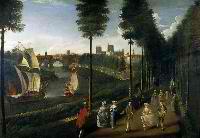 All welcome. The lecture will be followed by a wine reception to mark the launch of the lecture series. Peter Borsay is Professor of History at Aberystwyth University. He is the author of numerous publications on urban history and the history of leisure, including The English Urban Renaissance (Oxford, 1989), The Image of Georgian Bath, 1700-2000 (Oxford, 2000) and A History of Leisure (Palgrave Macmillan, 2006). He is editor of The Eighteenth-Century Town (Longman, 1992) and co-editor, with Lindsay Proudfoot, of Provincial Towns in Early Modern England and Ireland (Oxford, 2002). He is currently engaged in research on ‘green’ space in or on the edge of British towns, 1660-1900, and on spas and seaside resorts in Britain, and he is also preparing a monograph on The Discovery of England.
English Needlework at Auction — What Lovely Shoes!
As noted at ArtDaily:

Lot No: 26, A pair of lady's shoes English, circa 1740 Embroidered yellow silk worked in chain stitch in coloured silks with carnations, tulips and other flowers, having a broad silk lined tongue, waisted heel and slightly pointed toe.
A pair of embroidered lady’s shoes, dating back to 1740, is to be sold at Bonhams, New Bond Street, as part of its Fine English Furniture Sale on 2 March 2011. The shoes are part of a remarkable collection of early English needlework comprising 63 pieces with estimates totalling £210,000 – 315,000, which was owned by the former Chairman of Debenhams and Harvey Nichols, Sir Frederick Richmond (1873-1953). Made from embroidered yellow silk worked in chain stitch, depicting carnations, tulips and other flowers, and with a broad silk lined tongue and a pointed toe, the shoes have attracted a pre-sale estimate of £1,000 – 2,000. . . .
The full article is available here»










 Enfilade
leave a comment