May Issue of ‘The Burlington’
This posting on eighteenth-century topics from the May issue of The Burlington is long overdue, but given the discovery of a new Watteau document, I wanted to include it all the same — in hopes of sending good luck to all of you busy in the archives this summer. Good hunting! -CH.
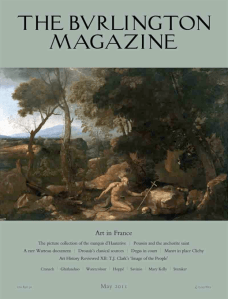 The Burlington Magazine 153 (May 2011)
• François Marandet, “Jean-Antoine Watteau: The First Documents,” pp. 312-13.
Newly discovered notarial acts from the National Archives in Paris clarify what happened to the painter’s property after his death in 1721, revising Gersaint’s account on two accounts.
• Todd Magreta, “Marius at Minturnae by Jean-Germain Drouais: A Classical Source and the Sublime,” pp. 314-17.
An examination of Marius at Minturnae (1786) by Jean-Germain Drouais.
• Satish Padiyar, “Neoclassicisms,” pp. 357-58.
Review of the exhibition, L’Antiquité rêvée / Antiquity Rediscovered.
Call for Papers: Special Issue of ‘Fragmenta’ on Art & Knowledge
As noted at Le Blog de ApAhAu:
Art and Knowledge, 1500-1750 — Special issue of Fragmenta
Journal of the Royal Netherlands Institute in Rome
Proposals due by 30 September 2011
 The interdisciplinary journal Fragmenta welcomes contributions to the theme Art and Knowledge in Italy and the European Republic of Letters, 1500-1750. The volume explores the ways in which knowledge was shaped and shared among painters, architects, collectors and scientists. It brings to the fore the epistemological dimensions of the making, trading, collecting and discussion of artworks. The city of Rome, debating ground for the key artistic and scientific issues of the Early Modern period, and perennial fulcrum of European antiquarianism and the academic approach of art, functions as the backdrop for a range of topics with a wide geographical spread.
The editors especially encourage a transnational perspective. How and why were artists and architects involved in the knowledge networks of the Republic of Letters, and how does this international dimension modify older historiographical differentiations? Possible topics include:
● artists’ and collectors’ writings
● images and material objects included in correspondence
● scientific publications and “paper museums” involving international collectives of artists (e.g., Dutch and French engravers working in Rome)
● the interrelations between artists, artisans and scientists in the production of scientific instruments and encyclopaedic collecting
● the role of material objects in the shaping and circulation of antiquarian scholarship
● notions of virtuosity and connoisseurship
● the role of the visual arts in communicating technical and theological knowledge to the non-Western world (and knowledge about the colonies and missions to Europe).
Fragmenta, published by Brepols, is a peer-reviewed interdisciplinary journal available in print and online, focusing on history, art history and archaeology. Recent thematic issues have discussed Early Modern subjectivity (forthcoming) and archaeology and national identity (2008). It is edited by the staff of the Royal Netherlands Institute in Rome. Guest editor for this volume is Thijs Weststeijn. Contributors are invited to send a one-page abstract to: thijs.weststeijn@uva.nl before September 30th, 2011.
Call for Papers: Ekphrasis for ‘Word & Image’
As noted by Jon Lackman at The Art History Newsletter, Michèle Hannoosh and Catriona MacLeod are succeeding John Dixon Hunt as editors at Word & Image. Their editorial from the current issue (27:1) seems promising for the eighteenth century:
. . . All of us working in the area of word and image studies owe an enormous debt of gratitude to John Dixon Hunt for making Word & Image the journal of reference for all work in the relation between images and texts. As new editors, we aim to continue the formative role the journal plays in advancing the field of word and image studies in its latest developments. We would like to open up the field to new research in as many periods and approaches as possible. While maintaining our acknowledged strength in medieval and modern subjects, we encourage submissions in other periods such as antiquity, early modern, romanticism and the nineteenth century, and
contemporary; in Western and non-Western subjects; in philosophical and theoretical approaches to word and image; in book arts, photography, new media and virtuality; in translation and adaptation. On-line technologies now make it possible to include supplemental material and video images on our website, thus expanding the possibilities for illustration beyond the printed page. We envisage a series of critical assessments of key works in the history of word and image studies. We welcome ideas from our readers for other initiatives in which the journal could take the lead. In all things, we remain committed to publishing significant new research, methodologically rigorous and intellectually enlightening. We take this occasion to announce a special issue in honor of John Dixon
Hunt. The issue will focus on one of the most fundamental issues in the relations of word and image, one in which John Dixon Hunt has had a long interest: ekphrasis. Readers are invited to submit articles on any aspect of ekphrasis in theory or practice by 1 December 2011. . . .
The full editorial is available here»
Looking Smart, Packing Smart
For those of you interested in issues of fashion and what a well-dressed academic looks like these days, you might click on over to Academichic, a blog edited by a “consortium of feminist academics.” I was apparently long overdue for a visit — recent pregnancy posts from E. and S. nicely round out the usual challenges and opportunities for looking smart and professional within a reasonable budget.
There are also details for entering your name for a Tom Bihn carry-on giveaway; the contest ends at midnight Central Time, Sunday, 10 July 2011. To judge from E.’s recent review, I’m envious of the lucky winner — the bag does look amazing. -CH.
◊ ◊ ◊ ◊ ◊
 . . . For short trips — particularly short trips when you need to hit the ground running off to a museum, archive, or auditorium — this bag is a great blend of briefcase and suitcase, small enough to fit easily in a locker but spacious enough to accomodate more than enough clothes and whatnot for a few days. Take, for example, my recent research trip to New York City. I needed to go directly from the airport to a museum archive. This meant bringing my luggage with me on a bus, train, and a brief walk to a building with not-generously sized lockers. Besides clothes and toiletries, I also needed to bring my laptop, some reading material, note-taking material, and folders to house my piles (we hope!) of research findings. . . .
Are these the most aesthetically stylish bags on the market? No. But it’s incredibly well-made, sturdy, smart, and worth the initial output of cash. And I like that in a bag. Oh, and, for you international travelers, the Tri-Star meets carry-on requirements for Europe and Australia as well, since it’s smaller than the Aeronaut. . . .
The full review, along with inspiring packing photos, is available here»
Introducing Enfilade’s First Intern: Freya Gowrley
I’ve been delighted by the emails I’ve received expressing interest in Enfilade’s new internship program. At least tentatively, I have the spot filled until the end of the year. And this morning, I’m really excited to introduce our first intern, Freya Gowrley — or more precisely, to allow her to introduce herself. Welcome aboard, Freya! -CH.
◊ ◊ ◊ ◊ ◊
Note (added 5 May 2025) — The full postings for interns have been archived offline.
Call for Papers: Europe’s Academies at AAH Conference
A selection of panels at the AAH conference addressing the eighteenth century; for further information, visit the AAH website:
Association of Art Historians 38th Annual Conference
The Open University, Milton Keynes, 29-31 March 2012
Proposals due by 7 November 2011
The 2012 AAH Annual Conference will showcase the diversity and richness of art history in the UK and globally over an extensive chronological range. Like The Open University itself, AAH2012 is open to all people, places and ideas. This three-day event will profice a broad scope of geographies and methodologies, ranging from object-based studies, socio-historical analyses, theoretical discourses, visual culture of the moving image, exhibition cultures and display. Sessions and papers will reflect the composition of the wide consituency that is art history today. Keynote events and special interest sessions/workshops will celebrate the strengths and respond to the challenges that face art history now, whilst the book fair, receptions, and visits will provide opportunities for delegates to relax and network.
If you would like to propose a paper, please email the session convenor(s) directly. You will need to submit an abstract of your proposed paper in no more than 250 words, your name and insitututional affiliation (if you have one). You should receive acknowledgement of receipt of your submission within two weeks. Do not send paper proposals to the conference administrator, convenor or AAH office, send them to the Session Convenor(s). Please also read the Conditions of Submission if you are considering submitting a paper.
◊ ◊ ◊ ◊ ◊
Art’s Insiders: New Histories of Europe’s Academies
Keren Hammerschlag (King’s College London) keren.hammerschlag@kcl.ac.uk
Hannah Williams (University of Oxford), hannah.williams@sjc.ox.ac.uk
For centuries, institutions like the Royal Academy in London, the Académie Royale (later the Académie des Beaux Arts) in Paris, and the Accademia di San Luca in Rome were the epicentres of European art practice, theory and education. For artists, having the letters ‘RA’ after their name, or the opportunity to show works at the Salons or the Summer Exhibitions promised elevated social standing and commercial success. As institutions, Academies developed principles and ideals that dominated artistic production throughout the period. In art history, however, the ‘Academy’ has been variously recast as staid, kitsch and archaic. According to critics, ‘academic’ art represents the inert centre against which avant-garde innovation and originality was pitted. But in their time, Europe’s Academies were anything but static or homogenous. Established by groups of artists resisting under-developed or conservative attitudes to art, these communities often began as innovative alternatives; they were home to radical new approaches, and became sites of heated debate in response to political, theoretical and social shifts.
This session seeks a re-evaluation of art’s insiders. What did it mean to be at the centre of these powerful institutions? And how can we effectively revisit the Academy without falling into the trap of reviving dead, white, male, bourgeois artists? We invite proposals for papers that take a new look at the ‘Academy’ and academicians in the period 1600 to 1900. Papers might address issues of gender, social networks, individual and collective identity, educational practices, centre and periphery (eg. regional academies), in-groups and rivalries, competition and emulation, successes and failures. In particular we invite papers informed by sociological, anthropological and cultural theory approaches, which take art objects as their focus.
◊ ◊ ◊ ◊ ◊
Conflicting Art Histories: Dialogues of Cosmopolitanism and Nationalism in Eighteenth-Century British Culture
Freya Gowrley (University of Edinburgh), f.l.gowrley@gmail.com
Viccy Coltman (University of Edinburgh), viccy.coltman@ed.ac.uk
William Hogarth’s traditional position as the stalwart of English nationalism in the arts was drastically re-evaluated in 2007 with the publication of Robin Simon’s Hogarth, France & British Art. Published to coincide with the Tate’s major Hogarth exhibition of 2007, Simon’s text situates Hogarth, a renowned anglophile, within a firmly European context of artistic theory and practice. How does the idea that Hogarth gleefully propagated his anti-Gallic public image, but was in fact greatly indebted to French art and theory, affect our understanding of apparently critical eighteenth-century works of art such as his Marriage-à-la- Mode (c. 1743)? While historians Linda Colley and Gerald Newman prioritised national identity as an evaluative tool for the examination of aspects of eighteenth-century British culture, is it appropriate to apply this label to broad cultural manifestations, notably the consumptive behavioural patterns of the aristocracy and the middling classes alike? This session will consider this intriguing dichotomy of eighteenth-century British art – the underwritten and unresolved conflict between nationalism and cosmopolitanism – and its relation to the artistic practice, material culture and intellectual history of the period. Topics for discussion could include, but are not limited to:
– artistic response to the luxury debates
– landscape and nation
– the connoisseur and the Grand Tour
– the usefulness of labels (exotic, chinoiserie, rococo)
– the reception of Italy
– the creation of a British national school
– consumption & the meaning of goods
– the local and the global/the provincial and the metropolitan
– the issue of -isms (Englishness, Britishness, Scottishness)
◊ ◊ ◊ ◊ ◊
Art History beyond National Boundaries
Emma Barker (The Open University), e.barker@open.ac.uk
Since its inception, the modern discipline of art history has been informed or even defined by the notion of the national school. The belief that works of art manifest a nation’s culture can be traced back to the foundational scholarship of Winckelmann in the eighteenth century and was reinforced by nationalistically-minded scholars in the nineteenth century. Although such notions are now generally discredited, their influence persists in so far as the practice of art history continues to be organized along predominantly national lines. Occasional studies of artistic exchanges between one nation and another and the current interest in the impact of empire and colonization on European art have not fundamentally challenged this state of affairs. As a result, comparatively little attention has been paid to the international dimension of artistic practice in the period before the emergence of modernism as a self-consciously international movement.
Contributions to this session may seek to rectify this omission by discussing the internationalization of art in broad, theoretical terms or by exploring specific artistic developments that transcend national boundaries. In either case, the challenge will be to do so without falling back on the similarly problematic notion of the transnational period style. Papers dealing with any period before 1900 are welcome, though in the interests of intellectual coherence preference may be given to those focusing on the art of the centuries immediately preceding this date.
◊ ◊ ◊ ◊ ◊
Out of Time
Rosalind McKever (Kingston University), rosalind.mckever@gmail.com
James Day (Courtauld Institute of Art), james.day@courtauld.ac.uk
The date an artwork was produced does not seal it off from the rest of time. Indeed historical readings might trace how an artwork intersects different times. Art history presents past art through conservation, exhibition and writing. Artworks are connected diachronically, linking the artist to predecessors, contemporaries and successors. Narratives of art chart traditions and innovations, historians source-hunt for influences and appropriations. Artists are identified as precursors and rebels; periods and movements are labelled as renaissances and avantgardes. The changing interests of art history also affect practice contemporary to it, as research, excavations, restorations, discoveries and exhibitions alter the canon, art education and the sources of appropriation available; they also revise the lens through which we look at the past. This session invites papers addressing art from any period, particularly those which do not belong to that period. In this panel we will interrogate the temporality of art history by focussing on the premature, the belated, and the anachronistic. Topics for papers could include, but are not limited to:
– Precursors and avant-gardes, conservatives and rebels, Post- and Neo Appropriation, translating art of one time into art of another
– Excavations and discoveries, how unearthing disrupts the past and affects the present
– Writing art history: non-linear narratives and creative history
– Chronology in galleries and exhibitions
– Posthumous casts, copies and reproductions
– Art education’s role in artists’ relationships with the past
[NB: This could be a particularly interesting session for those HECAA members interested in any aspect of revivalism in eighteenth-century visual culture]
◊ ◊ ◊ ◊ ◊
Student Session: The Everyday and the Extraordinary, Material Culture and Art History
Gemma Carroll (University College London), gemmacarroll@gmail.com
Laura Bolick (The Open University), l.bolick@open.ac.uk
Elizabeth Moore (University of Birmingham), exm592@bham.ac.uk
Art washes away from the soul the dust of everyday life. –Pablo Picasso
Art objects not only range from the everyday, such as a piece of furniture or a photograph in a newspaper, to the extraordinary, a heavily jewelled illuminated manuscript, but the places these objects are found also differ widely, from our daily encounters on street corners to the singular magnificence of a gothic cathedral. The physical creation of art can also be understood as spanning this chasm from commonplace household objects, ephemera and preparatory sketches to lapis lazuli, gold and exquisitely finished works. In addition critical approaches to art understand it variously as an autonomous agent or as a site of exploration and perhaps intervention in the life praxis. This session will openly investigate art objects from tapestries to performance art and gardens to media studies, readdressing and examining traditional divisions between decorative and fine art and notions of artist, artisan, author, designer and producer. Exploring how everyday items make the transition into art objects and how ‘fine’ art has been brought into the everyday, the session will also examine the idea that the emphasis on the everyday in art means that we no longer place value on the extraordinary. Finally, the concept that the everyday and the extraordinary co-exist within all art objects will be considered. Topics for papers could include, but are not limited to:
– Different stages of Art Production
– Theories of the Everyday
– Museum Studies/ Conservation/ Collecting
– Recycling and Salvaging
– Socially Engaged Art
– Immateriality/ Ephemera
– Shifting boundaries between art and material culture
– Uniqueness/ Transcendence
Exhibition: French Romantic Gardens
Thanks to Hélène Bremer for this notice. From the exhibition website:
Jardins Romantiques Français (1770-1840)
Musée de la Vie Romantique, Paris, 8 March — 17 July 2011
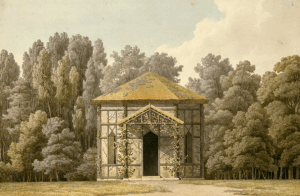
Louis-Hippolyte Lebas, "Le Petit Pavillon du Parc de Malmaison," watercolor (Musée National du château de la Malmaison) © RMN/Gérard Blot -- the building was designed by François Cointereaux around 1790.
Comment proposer aujourd’hui une définition du jardin romantique français, telle est la question que nous nous sommes posée alors que certains des meilleurs spécialistes en réfutent l’appellation. Aussi bien avons-nous usé du pluriel dans le titre « Jardins romantiques » pour évoquer, sans pouvoir être exhaustif, certains parmi les trop multiples reflets du romantisme au jardin.
Au fil des siècles et des saisons, le goût du jardin pittoresque s’est raffiné en un art de vivre à part entière dont les Encyclopédistes puis Beaumarchais avant l’impératrice sont les ambassadeurs écoutés. Au premier rang s’imposent naturellement voyageurs et savants qui rapportent et multiplient, d’un continent à l’autre, moult herbiers
soigneusement conservés au Muséum et rares cultivars
développés dans le secret des pépinières ou à l’arboretum.
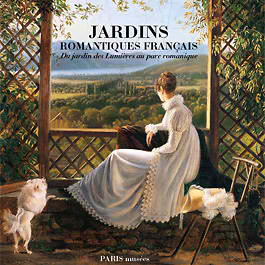
ISBN: 9782759601592, 30€
Au XIXe siècle l’Europe des botanistes résonne tel un bruissant arbre à palabres : on y disserte en latin comme en français sur les principes modernes de la taxinomie et de la dendrologie ; jardinistes et passionnés ouvrent largement les enclos sur la nature environnante et plantent des parcs paysagers. Serres chaudes et palmariums ponctuent les propriétés que leurs commanditaires identifient à leur récente prospérité. Le sentiment du sublime inspire fabriques et cascades, grottes et lacs. Ces nouveaux jardins d’Armide s’ornent de maints caprices secrets : temple de l’amour ou laiterie, chalet ou casino, faux tombeaux ou ménagerie. Pour les délices du vert galant, il n’est pas de sens plus nomade que la vue. Ainsi, la Restauration et la Monarchie de Juillet voient la pratique du jardinage conquérir toutes les couches de la société, et les grands destins du romantisme s’y enracinent. . . .
More information is available here»
◊ ◊ ◊ ◊ ◊
Exhibition catalogue: Daniel Marchesseau, Jardins romantiques français: Du jardin des Lumières au parc romantique (Paris Musées, 2011), 256 pages, ISBN: 9782759601592, 30€.
Exhibition: ‘Scraps: British Sporting Drawings’ at the VMFA
From the VMFA:
Scraps: British Sporting Drawings from the Paul Mellon Collection
Virginia Museum of Fine Arts, Richmond, 18 June — 18 September 2011
Curated by Corey Piper

Thomas Rowlandson, "The Woolpack Inn, Hungerford, Berkshire," detail, 1796, pencil, pen, ink and watercolor (VMFA: Paul Mellon Collection, 85.1037). Copyright VMFA
Taking its title from a series of drawings and prints by Henry Alken depicting sketches of country life, Scraps: British Sporting Drawings from the Paul Mellon Collection features drawings and watercolors that showcase the passing moments of observation that comprise the rich world of British Sporting Art. Works in the exhibition range from pencil sketches which record the artist’s direct observation of animal subjects to more highly finished works which present a more fully developed vision of sport and country life.
The exhibition offers a broader view of artists well known for their sporting paintings and prints such as Henry Alken, James Seymour, Sawrey Gilpin, Edwin Landseer, James Ward and Thomas Rowlandson and reveals them to be skilled draftsmen as well as keen observers of the natural world and the realm of sport. Drawn entirely from the extensive holdings of works on paper in the Mellon Collection at VMFA, this exhibition offers a rare look into the working methods and personal vision of Britain’s greatest sporting artists. (more…)
Exhibition: ‘Revolution!’
From the New-York Historical Society:
Revolution! The Atlantic World Reborn
New-York Historical Society, 11 November 2011 — 15 April 2012
Details of additional venues to be announced later
Curated by Richard Rabinowitz

ISBN: 9781904832942, $65
Revolution! The Atlantic World Reborn, an international exhibition sponsored by the New-York Historical Society, will open in New York in November 2011 and travel to sites in Britain, France, the United States, and Haiti. Occupying about 3,500 square foot (325 m2), the exhibition will feature magnificent paintings, drawings, and prints from collections in a half-dozen countries; historical documents, maps, and manuscripts penned by participants in these revolutions; audio-visual presentations and computer-interactive learning stations; inventive and beautiful works of art commissioned for this exhibition; and curriculum materials for students from kindergarten through graduate school. The exhibition will be fully accessible in English, French, and Haitian Kreyol. Dr. Richard Rabinowitz of the American History Workshop, is Chief Curator of the exhibition. A beautifully illustrated catalog, with scholarly essays by leading scholars in revolutionary studies and edited by Professors Thomas Bender of NYU and
Laurent Dubois of Duke, will accompany the exhibition.

Noel le Mire, "General Washington," 1780, engraving (New York Historical Society)
The exhibition explores the enormous transformations in the world’s politics and culture between the 1763 triumph of the British Empire in the Seven Years War and the end of the Napoleonic Wars 52 years later. For the first time, this story will be told as a single global narrative rather than as chapters within national histories. Opposing the power and reach of European imperial authorities, the diverse men and women of the Atlantic world — natives of Africa, Europe, and the Americas — registered their grievances in both legal argument and violent protest. Their first major outbursts, comprised in the American Revolution, triggered an explosion of radical ideas. And these in turn drew many Britons to the antislavery crusade, then fomented a fierce antagonism to entrenched privilege among French revolutionaries, and finally spawned the astonishing insurrection on the island of Saint Domingue leading to the world’s only successful slave revolt and the establishment of the first nation fully committed to equality and emancipation, Haiti.

John Greenwood, "Sea Captains Carousing in Surinam," ca. 1752-58, oil on bed ticking (Saint Louis Art Museum)
Linking the attack on monarchism and aristocracy to the struggle against slavery, Revolution! explores how thousands of revolutionaries across the Atlantic world made freedom, equality, and the sovereignty of the people into universal goals. The eighteenth-century revolutionaries certainly did not succeed in obliterating every trace of the Ancient Regime, but they invented the notions of human rights, within a world of nation states, that still fire the desire for justice everywhere.
◊ ◊ ◊ ◊ ◊
Exhibition catalogue: Thomas Bender and Laurent Dubois, eds., Revolution! The Atlantic World Reborn (London: Giles, 2011), 288 pages, ISBN: 9781904832942, $65.
Exhibition: ‘Life, Liberty, and the Pursuit of Happiness’
Life, Liberty, and the Pursuit of Happiness: American Art from the Yale University Art Gallery
Speed Art Museum, Louisville, 7 September 2008 — 4 January 2009
Seattle Art Museum, 26 February — 24 May 2009
Birmingham Museum of Art, Alabama, 4 October 2009 — 10 January 2010
Yale University Art Gallery, New Haven, 29 July 2011 — 8 July 2012 (in three parts)

John Trumbull, "The Declaration of Independence, July 4, 1776," 1786–1820 (Yale University Art Gallery)
This exhibition draws upon the Gallery’s renowned collection of American paintings, decorative arts, and prints to illuminate the diverse and evolving American experience from the time of the settlements of the late seventeenth century to the World’s Columbian Exposition in 1893. The more than 200 works in this traveling exhibition—including treasures such as John Trumbull’s Declaration of Independence and Winslow Homer’s Morning Bell—now return to New Haven for a three-part presentation.
Exhibition and publication organized by Helen A. Cooper, the Holcombe T. Green Curator of American Paintings and Sculpture, with Robin Jaffee Frank, the Alice and Allan Kaplan Senior Associate Curator of American Paintings and Sculpture; Elisabeth Hodermarsky, the Sutphin Family Associate Curator of Prints, Drawings, and Photographs; and Patricia E. Kane, Friends of American Arts Curator of American Decorative Arts, all Yale University Art Gallery.
◊ ◊ ◊ ◊ ◊
Exhibition catalogue: Helen A. Cooper, ed., Life, Liberty, and the Pursuit of Happiness: American Art from the Yale University Art Gallery (New Haven: Yale University Press, 2008), 368 pages, ISBN: 9780300122893.
 The American experience—from its colonial beginnings to the modern age—has captured the imagination of all Americans, including its artists. This richly illustrated book explores works from the renowned collections of American paintings, decorative arts, prints, and photographs at the Yale University Art Gallery and creates a vivid portrait of a young country defining itself culturally, politically, and geographically.
Distinguished scholars shed new light on American history by examining some of the most familiar and revered objects in American art—paintings by Trumbull, Peale, Copley, Eakins, Church, and Homer; silver by Revere and Tiffany; furniture by Roux and Connelly; and photographs by Muybridge, among others. The authors discuss how issues of cultural heritage, patriotism, politics, and exploration shaped America’s art as well as its attitudes and traditions.










 Enfilade
leave a comment