Happy President’s Day! — Washington on Civility
The text isn’t a new release, but I only recently learned of it, thanks to Courtney Barnes of Style Court, who pointed me to this version. Washington’s rules themselves, from a manuscript in the Library of Congress, are widely available for free at a variety of websites, including NPR (which featured a story on Brookhiser’s book in 2003) and Colonial Williamsburg.
On a more personal note, I recall that my mother, a school teacher for much of her life, would observe the holiday by taking chocolate-covered cherries in for her third-graders. Given that a large number (if not most) of the students were none too fond of these treats, it seemed like the perfect way to underscore the bittersweet component of national myth-making. -CH
◊ ◊ ◊ ◊ ◊
From the University of Virginia Press:
Richard Brookhiser, ed., Rules of Civility: The 110 Precepts that Guided Our First President in War and Peace (Charlotttesville: University of Virginia Press, 2003), 96 pages, ISBN: 9780813922188, $18.
 As a young man, George Washington admired and copied into a little notebook 110 rules for civil behavior that originated from a Jesuit textbook. Washington took these rules very much to heart, and that handwritten list remained with him throughout his life, serving as inspiring guidance from his military days at Valley Forge and Yorktown to his two terms as president. Guidance that at first sounds archaic, it is in fact just as relevant as — indeed, possibly more necessary than — it was nearly three hundred years ago. Richard Brookhiser makes clear the pertinence of these rules for modern readers and proposes that now more than ever we will be wise to follow the modest example of such a great man. Witty and insightful, Brookhiser’s commentary offers real-world instruction in the lost art of self-discipline, and his new preface provides a compelling and timely context in which to employ these guidelines today.
Richard Brookhiser, senior editor of the National Review and a columnist for the New York Observer, is the author of Founding Father: Rediscovering George Washington; Alexander Hamilton, American; and America’s First Dynasty: The Adamses, 1735-1918.
Washington’s Wine Cooler
A silver wine cooler owned by Washington sold at Christie’s on 19 January 2012. Here’s the report from ArtDaily.com:
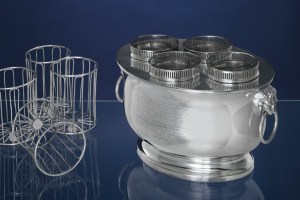 A Sheffield-plated silver wine cooler, ordered by George Washington in 1789, and given to Alexander Hamilton in 1797, sold at Christie’s during Americana Week for $782,500, exceeding its estimate of $400,000-600,000. This four-bottle wine cooler is an exceptionally well documented historical object, symbolizing the famous partnership between Washington and Hamilton in the early days of the republic. It was sold by direct descendants of Alexander Hamilton and bought by Americana expert, Gary Hendershott.
Jeanne Sloane, Deputy Chairman, Head of Silver, comments, “We are thrilled with the result of this unique piece of American history—the only three-dimensional object known to connect Washington with Hamilton, his most important collaborator.”
The four-bottle wine cooler is one of four commissioned by George Washington in 1789 to be used for entertaining after dinner. Detailed correspondence between Washington and his emissary, Gouvernor Morris, who was tasked with procuring objects to outfit the President’s House, describes the great level of forethought Washington devoted to creating an appropriate style for the new country.
In response to Washington’s admonition to “avoid extravagance,” Morris wrote to Washington in 1790, “I think it of very great importance to fix the Taste of our Country properly, and I think Your Example will go very far in that respect. It is therefore my Wish that every Thing about you should be substantially good and majestically plain; made to endure.”. . . .
The full article is available here»
New Title: Facing Beauty, Painted Women and Cosmetic Art
From Yale UP:
Aileen Ribeiro, Facing Beauty: Painted Women and Cosmetic Art (New Haven: Yale University Press, 2011), 256 pages, ISBN: 9780300124866, $45.
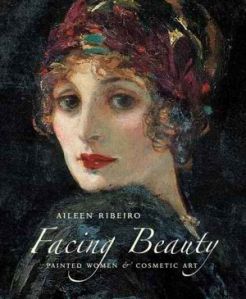 Throughout the history of the Western world, countless attempts have been made to define beauty in art and life, especially with regard to women’s bodies and faces. Facing Beauty examines concepts of female beauty in terms of the ideal and the real, investigating paradigms of beauty as represented in art and literature and how beauty has been enhanced by cosmetics and hairstyles.
This thought-provoking book discusses the shifting perceptions of female beauty, concentrating on the period from about 1540 to 1940. It begins with the Renaissance, when a renewed emphasis on the individual was reflected in the celebration of beauty in the portraits of the day. The fluid, sensual lines of the Baroque period initiated a shift toward a more “natural” look, giving way in the 18th century to a more stylized and artificial face, a mask of ideal beauty. By the late 19th century, commercial beauty preparations had become more readily available, leading to new technological developments within the beauty industry in the early 20th century. Beauty salons and the wider availability of cosmetics revolutionized the way women saw themselves.
Ravishing images of some of the most beautiful women in history, both real and ideal, accompanied by illustrations from costume books, fashion plates, advertisements, caricatures, and cosmetics, bring the evolving story of beauty to life.
Aileen Ribeiro is Professor Emeritus in the history of art at the Courtauld Institute of Art, London.
◊ ◊ ◊ ◊ ◊
Kimberly Chrisman Campbell recently interviewed Ribeiro for Worn Through (15 February 2012). A sampling:
KCC: Was it a natural progression from writing about dress to writing about beauty?
AR: Beauty and cosmetics are intimately linked with clothing. In the Renaissance, the word “cosmetic” was defined in the broadest way as the enhancing of body and face. Painting the face can be equated with dressing the body, and both are about appearances and their meanings. . . .
The full interview is available here»
Call for Papers: CSECS 2012 in Edmonton
From the Canadian Society for Eighteenth-Century Studies:
CSECS 2012 — Crossings: The Cultures of Global Exchange in the Eighteenth Century
Edmonton, Alberta, 18-20 October 2012
Proposals due by 15 March 2012
Plenary Speakers: Srinivas Aravamudan (Duke University) and David Bell (Princeton University)
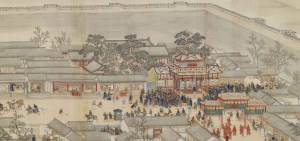
Xu Yang, "The Qianlong Emperor's Southern Inspection Tour," Scroll Two, detail, 1770. Accession #2004.19.15.1, Mactaggart Art Collection, University of Alberta
The Cultures of Global Exchange seeks papers investigating what happens when cultures meet in the eighteenth century. Many historians now trace the origins of modern globalization to the eighteenth century, pointing to the global circulation of goods, labour, and information as its defining feature. By focusing on the nature of cross-cultural exchange, the conference will pursue the significance of framing the century within the terms of a nascent globalized world. We invite proposals that investigate cultural exchanges in a range of fields, including but not limited to history, literature, visual culture, geography, economics, anthropology and area studies. Investigations of transcultural crossings could address dialogues between Europe, the Americas, Africa, the Levant, India, China and the South Pacific. Especially welcome are papers on the topic of cultural encounters between Europeans and Western Canadian First Nations peoples. Possible topics include:
• the material history of global traffic
• translation histories
• literary circulations
• the culture of mobility
• information/scholarly networks
• representations of cross-cultural encounters
• cultural and commercial trade routes
• spaces of intellectual exchange
• the culture of commodity exchange
• theories of globalization
• travel writing
• eighteenth-century empires
• ideas of difference
• trans-cultural versus cross-cultural
As is traditional in CSECS, proposals not on the conference theme will also be considered.
Email: csecs.scedhs2012@ualberta.ca
Mail: Katherine Binhammer, CSECS
3-5 Humanities, U of Alberta
Edmonton, AB T5G 2E5
Call for Papers: Qing Encounters, China and the West
Qing Encounters: Artistic Exchanges between China and the West
Peking University, Beijing, 10-13 October 2012
Proposals due by 12 April 2012
Proposals are called for papers to be presented at a bilingual (Chinese-English, with simultaneous translation) symposium called Qing Encounters: Artistic Exchanges between China and the West, to be held on the campus of Peking University, October 10-13, 2012. The goal of the symposium is to highlight new ways of looking at the artistic contacts and mutual interactions between China and the West during the Qing dynasty (1644-1911). By gathering scholars from around the world, it aims at bringing together different art histories as well as diverse methods of analyzing the artistic products of intercultural exchange. The symposium covers all forms of art, architecture, and decorative art. Special preference will be given to young scholars bringing a fresh methodological perspective to the subject.
Held under the auspices of the J. Paul Getty Foundation, in the context of its initiative of “Connecting Art Histories,” the symposium is co-sponsored by Peking University and Seton Hall University. Its steering committee is comprised of Ding Ning, Peking University; Petra Chu, Seton Hall University; Greg Thomas, The University of Hong Kong, and Chiu Che Bing, Paris. Advisor: Thomas Gaehtgens, Getty Research Institute.
Those interested in presenting a paper at the symposium should send a one-page (double-spaced) proposal accompanied by a one-page resume (in one document) as an e-mail attachment to Petra Chu at petra.chu@shu.edu. Both proposal and résumé need to be in English (though completed papers may be delivered in Chinese). Proposal deadline: April 5, 2012. Selected participants will be notified by May 5, 2012. Final papers are due August 1, 2012. Travel to Beijing and lodging for all speakers will be paid by a generous grant from the Getty Foundation. For more information, please e-mail Petra Chu at petra.chu@shu.edu or Ding Ning at dingning@pku.edu.cn
New Title: ‘The Perfect Foil’
From the U of Minnesota Press:
Elizabeth C. Mansfield, The Perfect Foil: François-André Vincent and the Revolution in French Painting (Minneapolis: University of Minnesota Press, 2011), 320 pages, ISBN 9780816675814 (paper, $35) / ISBN 9780816675807 (cloth, $105).
 Art history is haunted by the foil: the dark star whose diminished luster sets off another’s brilliance. Relegated to this role by modern historians of Revolutionary-era French art, François-André Vincent (1746–1816) is chiefly viewed in the reflection of his contemporary, Jacques-Louis David. The Perfect Foil frees Vincent from this distorting mirror. Offering a nuanced and historically accurate account of Vincent’s life and work, Elizabeth C. Mansfield reveals the artist’s profound influence on the visual culture of the French Revolution—and, paradoxically, on the art historical narrative that would consign him to obscurity.
The Vincent of The Perfect Foil is an artist whose life and work responded to cultural conditions—religious difference, emotional bonds, institutional pressures—only now finding their way into art historical accounts of the period. A successful academician despite his status as a member of the Protestant minority, a leading reformer of arts institutions during the Revolution, the progenitor of French Romanticism, and the husband of one of the period’s most celebrated women artists, François-André Vincent emerges in these pages as an embodiment of the ambivalences and contradictions of life in France in the wake of the Enlightenment.
By giving us a detailed and faithful portrait of this artist poised at the turning point of history, Mansfield restores a critically important body of work to its rightful place in the story of French art and reorients Revolutionary-era French art history toward a broader, more inclusive understanding of the period.
Elizabeth Mansfield’s The Perfect Foil is a remarkable piece of scholarship that both transcends and transforms the genre of the art historical monograph. It is a sophisticated work that expands the way we conceive of how the visual arts and politics interacted during the French Revolution. Mansfield’s provocative and methodological surefootedness will make readers aware of the contingencies that inform their own thinking.
—Julie Anne Plax, author of Watteau and the Cultural Politics of Eighteenth Century France
◊ ◊ ◊ ◊ ◊
Elizabeth C. Mansfield is associate professor of art history at New York University. Her publications address topics ranging from seventeenth-century Dutch printmaking and the history of modernism to contemporary obscenity laws governing digital artworks and the surgical performances of Orlan. She has edited two volumes of essays on the institutional history of the discipline of art history and is coediting an anthology on eighteenth-century satire and visuality. Too Beautiful to Picture: Zeuxis, Myth, and Mimesis, published by the University of Minnesota Press, received the Charles Rufus Morey Book Award from the College Art Association. Her research has been supported by fellowships from the National Humanities Center, the Gladys Krieble Delmas Foundation, and the Paul Mellon Centre for Studies in British Art.
Reviewed: ‘Picturing Art History’
Recently added to caa.reviews:
Ingrid R. Vermeulen, Picturing Art History: The Rise of the Illustrated History of Art in the Eighteenth Century (Amsterdam: Amsterdam University Press, 2011), 359 pages, ISBN: 9789089640314, $69.50.
Reviewed by Pamela J. Warner, University of Rhode Island; posted 9 February 2012.
Ingrid Vermeulen undertakes an important self-reflexive task in ‘Picturing Art History’: the examination of the transition from unillustrated to illustrated texts about art. Surprisingly, that transformation had little to do with technological changes. Using three specific publications as examples, she argues that eighteenth-century scholars increasingly came to conceive of the artistic past not as a series of biographies of artists, but rather as a seamless “chain” of artworks in which historical progress can, and indeed must, be seen to be fully understood. Vermeulen tracks her topic through four related questions: What types of images were considered appropriate to the study of art history? How should we understand the notion that drawing and reproductive print collections, along with illustrated art books, embody the artistic past? How did collecting traditions relate to art-historigraphic traditions? And to what extent did eighteenth-century scholars believe that works on paper were faithful representations of the artworks they studied? (12–13) She organizes her answers into three chapters dedicated to case studies of individual projects by Giovanni Bottari, Johann Joachim Winckelmann, and Jean-Baptiste Séroux d’Agincourt, each of whom mobilized a different type of visual resource, namely prints, drawings, and book illustrations. . . .
The full review is available here» (CAA membership required)
Elena Boeck at The Newberry, Cartography & Peter the Great
From The Newberry:
Elena Boeck, An Icon for Peter the Great: Linking Imperial Cartography and Sacred Topography
The Newberry Library, Chicago, 9 March 2012
Seminar in Art History, Early Modern European Maps as Art
This paper investigates intersections between piety, imperial expansion, and military cartography in an icon presented to Peter I in 1698. It explores a rare convergence of Christian and imperial narratives. The icon was produced in Ukraine, which long served as a bridge between the west and the world of the Russian court, and offered to Peter I by a Ukrainian monastery as a diplomatic gift to commemorate his first triumph, the capture of the Ottoman town of Azov. The iconography of this nearly two-meter-tall image includes an unusual birds-eye view of the siege of Azov.
This innovative image actively participated in the invention of a new, Europeanized, imperial visual tradition in Russia. Furthermore, its seamless and insistent interweaving of imperial symbols, territorial expansion, and religious legitimization came from a contested territory that was in the process of being integrated into empire. Exploring a Ukrainian donor’s motivations for creating such an object, and taking seriously his aspirations for imperial patronage, enables us to understand aspects of empire often obscured in modern national narratives.
Elena N. Boeck is Assistant Professor at DePaul University.
Friday, 9 March 2012, 2:00 pm. A reception will follow the seminar.
Cosponsored by the Hermon Dunlap Smith Center for the History of Cartography.
This program is free and open to the public, but registration in advance is required. Register online here. The paper will be electronically precirculated to registrants.
Exhibition: The Look of Love, Eye Miniatures
From the Birmingham Museum of Art:
The Look of Love: Eye Miniatures from the Skier Collection
Birmingham Museum of Art, Birmingham, Alabama, 7 February — 10 June 2012
University of Georgia, Athens, 6 October 2012 — 6 January 2013
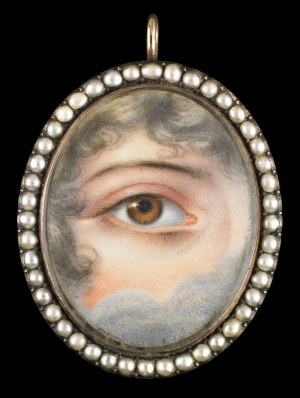 This stunning exhibition explores the little-known subject of “lover’s eyes,” hand-painted miniatures of single human eyes set in jewelry and given as tokens of affection or remembrance. In 1785, when the Prince of Wales secretly proposed to Mrs. Maria Fitzherbert with a miniature of his own eye, he inspired an aristocratic fad for exchanging eye portraits mounted in a wide variety of settings including brooches, rings, lockets, and toothpick cases. With over 100 examples, the collection of Dr. and Mrs. David A. Skier of Birmingham is the largest in the world. This exhibition offers an unprecedented look at these unusual and intriguing works of art.
Visitors can also interact with the exhibition in a new way: the Museum’s very first iPad app! The Look of Love app allows visitors to see these tiny, intricate objects at up to twenty times their actual size. They can also see images of the backs of objects or short videos of how the objects open. Twenty iPad devices are available for check-out and use in the Arrington Gallery, and
volunteers are on hand to show how the devices and the app
work.

ISBN: 9781907804014, $35
The exhibition is accompanied by a full color, hardbound catalogue of the same name, edited by Dr. Graham C. Boettcher, The William Cary Hulsey Curator of American Art, and published by D Giles Ltd., London. An essay by Elle Shushan sets the historical scene and examines the role of lover’s eyes in the broader context of Georgian and early Victorian portrait miniatures. Boettcher looks at the language and symbolism of these tokens and their jeweled settings. Additionally, novelist and biographer Jo Manning offers five fictional vignettes imagining the circumstances surrounding the creation of these extraordinary objects.
◊ ◊ ◊ ◊ ◊
N.B. — Notice of the exhibition at the Georgia Museum of Art in Athens was added on 24 October 2012
Stockholm’s Nationalmuseum Acquires Satyr and Nymph by Clodion
Press release (30 November 2011) from the Nationalmuseum in Stockholm:

Claude Michel, known as Clodion, "Satyr and Nymph," terracotta, 1780s (Photo: Linn Ahlgren/Nationalmuseum)
At an ordinary public auction this past April, Nationalmuseum purchased a magnificent terracotta sculpture by French artist Claude Michel, known as Clodion. The piece, thought to date from the 1780s, depicts a satyr embracing a young nymph. Clodion’s superb attention to detail and perfect balancing of the two figures makes this one of his most significant works.
Claude Michel, known as Clodion, was two years the senior and a colleague of the Swedish sculptor Johan Tobias Sergel during his time in Rome. Clodion never completely abandoned the graceful rococo style. Not surprisingly, he was popular with collectors, but he was never elected to the Académie in his native France. The terracotta sculpture of a satyr embracing a nymph, purchased by Nationalmuseum at a public auction held by Stockholms Auktionsverk in April, typifies Clodion’s work in many respects. This piece, which probably dates from the 1780s, is a finished work rather than a prototype. Clodion produced these terracotta pieces for an eager market that could hardly wait for him to finish his works, since they were so popular. He produced several variations on the satyr and nymph theme, but the piece recently acquired by Nationalmuseum is one of the most thoroughly executed. The two figures, perfectly balanced in relation to each other, appear to be fashioned from a single piece of clay. Rather than powerful eroticism, the work exudes a gentle sensualism, which is most evident in the tentative kiss being exchanged between the couple. Clodion makes elegant play with the contrast between the plastic smoothness of the skin and the graphic nature of the nymph’s hair, carved into the clay while it was still wet.
On account of its sensual subject matter, in 1990 the grouping ended up in a private Swedish erotica collection. At different points in its life it had belonged to Henri Rochefort, a prominent French politician, and Jacques Doucet, a legendary art collector, whose collection (auctioned off piecemeal in 1912) included Picasso’s les Demoiselles d’Avignon. A counterpart to Clodion’s Satyr and Nymph can be seen in the Metropolitan Museum of Art in New York. The version now acquired by Nationalmuseum was long believed to be lost.
The acquisition was made possible by a generous donation from the Sophia Giescke Foundation. The Nationalmuseum has no funds of its own with which to acquire art and design, and so relies on gifts and financial support from private foundations and funds to expand its collection.










 Enfilade
leave a comment