Queen Lovisa Ulrika’s memorial cup
Press release from Sweden’s National Museum:
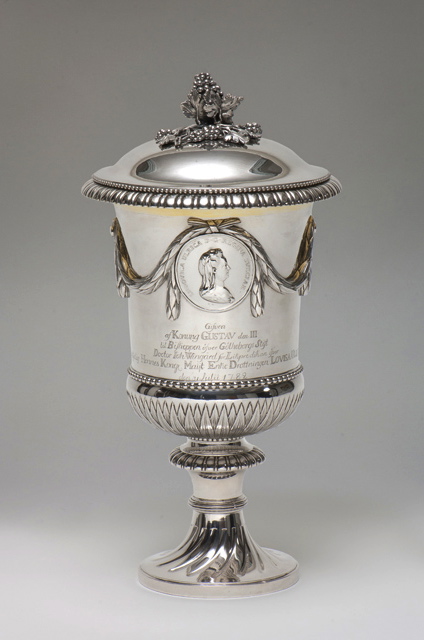
Pehr Zethelius, Queen Lovisa Ulrika’s Memorial Cup, silver, ca. 1782. Photo: Hans Thorwid/Nationalmuseum.
Queen Lovisa Ulrika’s memorial cup was donated to the museum at the annual meeting of the Friends of Nationalmuseum. This unique object was made by silversmith Pehr Zethelius and presented as a memento to Johan Wingård, Bishop of Gothenburg, in thanks for the funeral sermon that he gave for the deceased Queen in 1782.
The existence of Queen Lovisa Ulrika’s memorial cup, donated by the Friends of Nationalmuseum, has been unknown to most people until now. The silver cup is an impressive size and weighs almost three kilos, as befits a sister of King Fredrik the Great of Prussia. The rediscovery of the memorial cup adds an important jigsaw piece to the history of Swedish design at the Nationalmuseum. At the same time, this magnificent piece is an example of the long royal tradition of presenting an expensive gift to the key officials at ceremonies of state such as christenings and funerals.
The Dowager Queen Lovisa Ulrika died at Svartsjö Palace on 16 July 1782 and was buried in Riddarholmen Church on 31 July. The funeral sermon was given by Chaplain to the Queen Johan Wingård, Bishop of Gothenburg. In thanks for this, he was given this specially commissioned cup, which was then passed down through the family. The craftsman who made the memorial cup was Pehr Zethelius (1740-1810), a leading light in Swedish silversmithing during the late 18th century. Pieces from his workshop show both high artistic and technical quality. Zethelius became a real trendsetter and was responsible for introducing new styles from the Continent.
The memorial cup was donated in memory of Henry Montgomery (1927-2010), chairman of the Friends of Nationalmuseum from 1982-1994. The Barbro and Henry Montgomery Donation Fund was established in 1998 and is managed by the Friends of Nationalmuseum.
Exhibition | Napoleon: Revolution to Empire
Press release from the NGV:
Napoleon: Revolution to Empire
National Gallery of Victoria, Melbourne, 2 June — 7 October 2012
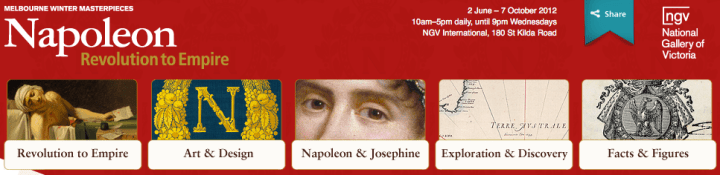
On 2 June 2012 the National Gallery of Victoria will opened this year’s spectacular Melbourne Winter Masterpieces exhibition, Napoleon: Revolution to Empire, examining French art, culture, and life from the 1770s to the 1820s. Its story runs from the first French voyages of discovery to Australia during the reign of Louis XV to the end of Napoleon’s transforming leadership as first Emperor of France.
Premier and Minister for the Arts Ted Baillieu said, “Now a well-established highlight of our major events calendar, the Melbourne Winter Masterpieces series has set the benchmark for blockbuster exhibitions in this country. I’m pleased to welcome the latest installment, Napoleon: Revolution to Empire. Through hundreds of priceless treasures, never before seen in Australia, this exhibition brings to life the legend one of history’s most extraordinary and complex figures. It’s another great Melbourne exclusive, another tourism drawcard for Victoria and another stunning exhibition for the NGV.”
This panoramic exhibition features nearly 300 works, dating from the 1770s to the 1820s, objects of breathtaking opulence and luxury – from paintings, drawings, engravings, sculpture, furniture, militaria, textiles, porcelain, gold and silver, fashion and jewellery.
Dr Gerard Vaughan, Director NGV, said, “Napoleon: Revolution to Empire continues the tradition of spectacular NGV exhibitions which have become a winter highlight in Victoria’s cultural calendar. This year visitors will be intrigued by the life of Napoleon, a man who held the world captive to his ambition. He had a vision of a united Europe, but a Europe controlled by France and united through conquest. Napoleon is well known as a master military strategist; this exhibition reveals that he was also a passionate lover and dedicated patron of the arts, sciences and literature.”
Napoleon: Revolution to Empire explores, amongst other themes, the stormy period of social change forced upon France through the outbreak of the French Revolution, the execution of Louis XVI and Marie-Antoinette, and the rise to power of the young Napoleon Bonaparte and his new wife Josephine, as the couple worked to cement their place as France’s new political and social leaders.
Ted Gott, Senior Curator International Art, NGV said, “World leaders in the Age of Exploration, Napoleon and Josephine were a true power couple- famous and stylish. The stunning artworks and objects in this exhibition illustrate their belief that the advancement of knowledge was integral to social order; they welcomed scientists and artists to receptions and dinners where world affairs were reshaped under their rule.”
Personal items will give visitors a glimpse into an extravagant private world of the couple. Jewels owned by Josephine, Napoleon’s personal weapons, lavish furniture from private residences and a lock of Napoleon’s hair feature alongside spectacular decorative objects, bejewelled gifts given to dignitaries, military uniforms and a beautiful court dress- the only surviving garment worn at Napoleon’s coronation ceremony in 1804.
Napoleon: Revolution to Empire also considers the enormous cultural and scientific contact between Australia and France from the 1770s to the 1820s. This is a story that is not often told. Both Napoleon and Josephine were captivated by Australia, which had newly entered the world’s imagination following the publication of Captain Cook’s travels. The exhibition tells the story of how this fascination spurred Napoleon to fund a voyage in 1805 that collected information about the continent and produced the first map of the southern Australian coastline with the land we now know as Victoria, but which was at the time first named Terre Napoléon (Napoleon Land). French voyages to Australia returned with collection’s of Australian flora and fauna, much specifically earmarked for the hothouses and enclosures of Napoleon and Josephine’s country residence Malmaison. Captivating works in the exhibition show kangaroos, black swans and a range of native Australian plants in the grounds of this quintessentially French estate.
Organised in partnership with the Fondation Napoléon in Paris, who are lending many of their greatest works, the exhibition also features incomparable treasures drawn from Europe’s most important Revolutionary and Napoleonic collections, including the Château de Malmaison, Château de Versailles, Musée Carnavalet and Musée de l’Armée in France, the Napoleonmuseum Thurgau in Switzerland, and the Museo Napoleonico in Rome.
More information is available at the exhibition website.
◊ ◊ ◊ ◊ ◊
From the NGV:
Catalogue: Ted Gott and Karine Huguenaud with contributing authors, Napoleon: Revolution to Empire (Melbourne: National Gallery of Victoria, 2012), 336 pages, ISBN: 9780724103560 (hardback) /978072410355-3 (paperback).
 This panoramic volume tells the story of French art, culture and life from the 1770s to the 1820s: the first French voyages of discovery to Australia, the stormy period of social change with the outbreak of the French Revolution, and the rise to power of the young Napoleon Bonaparte and his wife Josephine. Together the couple defined taste for a new century, and in the age of exploration developed a particular fascination for Australia. As well as telling the remarkable story of France’s close involvement with Australia in the early 1800s, Napoleon: Revolution to Empire showcases hundreds of works of breathtaking opulence and luxury. Featuring insightful writing by world-renowned historians of Napoleonic art and design, this authoritative publication celebrates the vital contributions to the visual arts made by Napoleon as first Emperor of France.
New Title | ‘Don’t Ask for the Mona Lisa’
This small book looks useful not only for those new to working on exhibitions but also as a model for how a conference session with real-world application could be shaped into a publication and made available to a larger audience through print-on-demand (POD) services like Lulu.com. –CH
◊ ◊ ◊ ◊ ◊
From the AAH:
Heather Birchall and Amelia Yeates, Don’t Ask for the Mona Lisa: Guidelines for Academics on How to Propose, Prepare, and Organise an Exhibition (London: Association of Art Historians, 2012), 36 pages, ISBN: 9780957147706, £5 (hardcopy) / £3 (PDF download), available at Lulu.com.
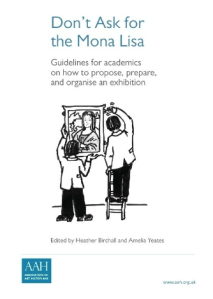
36 pages, ISBN: 9780957147706
The writing and publication of these guidelines was prompted by an event held by the Committee of the Museums & Exhibition Members Group of the Association of Art Historians (AAH), at the AAH Annual Conference at Manchester Metropolitan University in 2009. The session, entitled Curators Don’t Bite, attracted a large crowd of academics and museum professionals eager to hear about the experiences, both positive and negative, of other academics and curators who had organised exhibitions. Following the event, it was clear that there was a demand for some advice on how to propose exhibitions and, once a show had been agreed, the practicalities of working with curators and other museum staff. This publication therefore aims to provide an introduction to key aspects of exhibition curation, from the early planning stages to the design and opening of the show.
Of course, every exhibition is different and, whilst this document cannot cover every aspect of exhibition planning, it does provide assistance to those organising both small-scale and large exhibitions, as well as offering guidance on working with paintings, sculptures, and contemporary installations. Whether your exhibition is to be held at a large venue, such as Tate Britain, with a team of curators, conservators, and technicians, or a smaller institution with only one or two members of staff, the intention of the authors has been to outline the possible eventualities and responsibilities associated with exhibition planning.
The first part of this publication gives guidance on why and how to propose an exhibition, and offers general advice on exhibition planning and installation. It describes the roles performed by certain staff members in galleries and museums, and the responsibilities they carry when an exhibition is being put together. Some technical terms are highlighted in bold in the main text, and defined in the
margin.
The second part comprises case studies by academics who have worked on exhibitions for both large organisations, such as Birmingham Museum and Art Gallery, and small venues, including the Henry Moore Institute. This section also includes an interview with an exhibition designer that sets out some of the demands of fitting the design around the show’s theme, and sheds light on how to create a space that doesn’t overwhelm the exhibits.
At a time when museums and galleries are constantly tightening their budgets, a page at the end of this publication includes a list of funders to be approached if the museum’s budget cannot cover all the costs associated with the show, such as producing a catalogue or organising an associated study day or conference. Although the publication is primarily aimed at academics, and also freelances and students who may be considering putting together an exhibition proposal, we hope that it will also be useful for curators in the early stages of their careers working in a museum or gallery.
Information on ordering a copy is available here»
Call for Entries | Travellers’ Conceptions of Unlikely Creatures
As noted at Le Blog de L’ApAhAu:
Dictionnaire des créatures mythiques, légendaires et improbables des voyageurs
Proposals due 15 August 2012; completed entries for approved topics due 31 January 2013
Le but de ce dictionnaire serait, dans la lignée du numéro spécial consacré par la revue Chemin d’étoiles, dirigée par Emeric Fisset et Julie Boch, au Bestaire des voyageurs, de présenter les créatures humaines et animales, aperçues, décrites, imaginées, rêvées ou fantasmées par les voyageurs de l’Antiquité au XXIe siècle.
Parmi ces créatures et parmi une liste non exhaustive figureront le Géant patagon, le nain fuégien, le Lapon, le Hottentot, le Niam-Niam, l’Amazone, le Sciopode, le Blemye, le Garamante, le Monoculus, la Sirène, le Kraken, le Lézard du Cap, la Vache marine, l’Ile baleine… Les notices devront allier informations scientifiques et anecdotes. Le style devra être vif, alerte, éviter le jargon. Le lecteur devra pouvoir en même temps se cultiver et se distraire.
Il s’agira pour chacune d’entre elles de remonter à ses origines, de présenter ses représentations, de mettre en évidence leur évolution et leur fortune, dans la culture populaire, dans la culture littéraire et dans la culture scientifique ; dans l’imaginaire des voyageurs comme dans l’imaginaire collectif appréhendé de manière plus globale.
Toutes les personnes désireuses de rédiger une ou plusieurs notices sont priées de m’indiquer la ou les notices sur lesquelles elles souhaiteraient travailler, au plus tard au 15 août, afin que Valérie Dumeige et moi-même puissions établir la liste des entrées. Une fois celle-ci établie et les notices confirmées avec chaque auteur, les textes, établis suivant le protocole indiqué ci-dessous, devront m’être adressés au plus tard le 31 janvier 2013 par courriel à l’adresse suivante : dominiquelanni@yahoo.fr (more…)
Call for Papers | The Permissive Archive
From CELL:
The Permissive Archive: A CELL Conference
Queen Mary, University of London, early November 2012
Proposals due by 31 July 2012
For ten years, the Centre for Editing Lives and Letters has pioneered original archival research that illuminates the past for the benefit of the modern research community, and beyond. To celebrate this anniversary, in early November 2012 we will be holding a conference examining the future of the ‘Permissive Archive’. The scope of archival history is broad, and this conference seeks presentations from a wide range of work which opens up archives – not only by bringing to light objects and texts that have lain hidden, but by demystifying and demonstrating the skills needed to make new histories. Too long associated with settled dust, archival research will be championed as engaged and engaging: a rigorous but permissive field.
We welcome proposals for papers on any aspect of early modern archival work, manuscript or print, covering the period 1500 – 1800. Topics may include, but are not limited to:
 • The shape of the archive – ideology and interpretation
• The permissive archive: its definition and its past, present and future
• Alternatives to the permissive archive
• Archival research as discovery or construction
• The archive which challenges or disrupts
• Uncatalogued material – how to find it, how to access it, how to use it
• New findings
• Success and failure
• Broken or dispersed collections
• The archive and the environment
• The archivist and the historian
• The ethics of the archive
• The comedy of the archive
• Order and anarchy
Please send 300-word proposals to hjgrahammatheson@gmail.com by 31 July 2012. Submissions are not limited to the 25-minute paper. CELL will be holding a work-shop on the use of archival materials, and we are keen to hear from scholars with ideas for alternative presentations such as group sessions, trips or guided walks. Submissions will be peer-reviewed by Professor Lisa Jardine.
Display | The Comte de Vaudreuil: Courtier and Collector
I included notice of this display in April, but here’s a bit more information, including a portion of the wall text. -CH
From the National Gallery of Art:
The Comte de Vaudreuil: Courtier and Collector
National Gallery, London, 7 March — 12 June 2012
 The Comte de Vaudreuil (1740–1817) was one of the leading courtiers and collectors of paintings in Paris during the 1780s. This display features Dutch and Flemish Old Master paintings in the National Gallery’s collection that were once owned by Vaudreuil or were in Parisian collections at that time. Vaudreuil’s collection provides an example of the decoration of wealthy homes in pre-Revolution Paris. Reflecting the fashion of the time, the paintings are hung according to their size and symmetry rather than by subject or chronology.
The Paintings
The display features paintings from the Comte’s collections by artists Jan Wijnants, Jacob van Ruisdael, Jan Steen and Adriaen van Ostade. Alongside these are works that were in French collections in the same period by artists Nicolaes Berchem, Aelbert Cuyp, Willem van de Velde and Gabriel Metsu. The paintings show a variety of subjects, from portraits of peasants to social life in 17th-century Holland to landscapes with ruined castles.
From the Wall Text of the Display
Vaudreuil gained his position in Parisian society thanks to his aristocratic status and the wealth generated from his sugar plantations in the French colony of Saint-Domingue (now Haiti). His advancement at court was secured through the purchase of military office and by his friendship with the Duchesse de Polignac, the favourite of the queen, Marie-Antoinette.
Vaudreuil’s collection provides an example of the decoration of wealthy homes in Paris during this period. The largest part of it comprised Dutch and Flemish Old Master Paintings, four of which are displayed here alongside other Northern paintings then in Parisian collections. Reflecting the fashion of the time, they are hung according to size and symmetry rather than by subject of chronology (see also the display of pictures in Danloux’s Baron de Besenval in his Salon de Compagnie, Room 33).
In 1784 Vaudreuil decided to sell his Italian, Dutch, and Flemish works in order to focus his interest extensively on French paintings. His collection comprised both works by fashionable contemporary artists, such as a version of David’s Oath of the Horatii [now in the Toledo Museum of Art], and those from the past, including Poussin’s Bacchanalian Revel before a Term (Room 19).
Checklist
• François-Hubert Drouais, Le Comte de Vaudreuil, 1758
• Willem van de Velde, Dutch Ships in a Calm, ca. 1660
• Aelbert Cuyp, A Herdsman with Five Cows by a River, ca. 1650-55
• Nicolaes Berchem, Peasants with Cattle Fording a Stream, 1670s
• Gabriel Metsu, An Old Woman with a Book, ca. 1660
• Jan Wijnants, A Landscape with a Dead Tree, 1659 [from Vaudreuil’s collection]
• Adriaen van Ostade, A Peasant Holding a Jug and a Pipe, ca. 1650-55 [from Vaudreuil’s collection]
• Jan Steen, Skittle Players outside an Inn, probably 1660-63 [from Vaudreuil’s collection]
• Jacob van Ruisdael, A Ruined Castle Gateway, ca. 1650-55 [from Vaudreuil’s collection]
• Nicolaes Berchem, Peasants by a Ruined Aqueduct, 1655-60
◊ ◊ ◊ ◊ ◊
 Usually on display in Room 15 are paintings by Claude and J.M.W. Turner. Claude’s Seaport with the Embarkation of the Queen of Sheba and Landscape with the Marriage of Isaac and Rebecca are shown with Turner’s Dido Building Carthage and Sun Rising through Vapor, as stipulated in the latter’s will. All four pictures were part of the exhibition, Turner Inspired: In the Light of Claude in the National Gallery’s Sainsbury Wing. The exhibition was itself useful for the eighteenth century in terms of collectors’ interest in Claude and the eighteenth-century origins of Turner’s work.
Conference | Curiosly Drawn: Eary Modern Science as a Visual Pursuit
From the Royal Society’s website:
Curiously Drawn: Early Modern Science as a Visual Pursuit
Royal Society, London, 21-22 June 2012
Science produces some of the most intriguing and arresting images in modern culture, from wildlife photographs to scanning electron microscope images. Yet the historical links between scientific research and visual representation are not always apparent. This conference brings together historians of science and art in order to examine the relationship between science and visual culture in the first hundred years of the Royal Society. We hope that the meeting will demonstrate how art, artists, and print-makers enabled creativity and innovation in science, and the extent to which naturalists and natural philosophers, in turn, transformed visual resources and strategies into something of their own.
This meeting is supported by the AHRC as part of an international network on ‘Origins of science as a visual pursuit: the case of the early Royal Society’. Relevant printed books and manuscripts from the Royal Society’s collections will be on display during the meeting.
Registration details are available here»
◊ ◊ ◊ ◊ ◊
Thursday, 21 June
10:00 Registration and coffee
10:30 Sachiko Kusukawa (University of Cambridge), Welcome and Introduction
11:00 Paula Findlen (Stanford University), The Specimen and the Image: John Woodward, Agostino Scilla, and the Depiction of Fossils
12:00 Kim Sloan (The British Museum), Sir Hans Sloane’s Pictures: The Science of Connoisseurship or the Art of Collecting?
1:00 Lunch
2:00 Domenico Bertoloni-Meli (Indiana University, Bloomington), Disease in the Philosophical Transactions
3:00 Urs B. Leu (Zentralbibliothek Zürich), Swiss Mountains and English Scholars: Johann Jacob Scheuchzer’s Contributions to the Philosophical Transactions of the Royal Society
4:00 Tea
4:30 Scott Mandelbrote (University of Cambridge), Illustrating the History of the Earth
5:30 Opportunity to view the exhibition
6:00 Public lecture by John Barrow (FRS), Pictures, Images, and Visualization in Science
Friday June 22
9:30 Nathan Flis (Oxford University), Barlow’s Pursuits: Pictures of Birds and Beasts before the Era of Modern Scientific Illustration
10:30 Coffee
11:00 Lorraine Daston (Max-Planck Institute for the History of Science, Berlin), Super-Vision: Weather Watching across Space and through Time at the Early Royal Society and Académie Royale des Sciences
12:00 Matthew Hunter (McGill University), Joshua Reynolds, the Royal Society, and the Temporally-Evolving Chemical Object in the British Enlightenment
1:00 Lunch
2:00 Michael Hunter (Birkbeck, University of London, Emeritus), Commentary
3:00 Further avenues of research
◊ ◊ ◊ ◊ ◊
Correction: An earlier version of this posting, following a preliminary programme, did not include the title for John Barrow’s talk, and Matthew Hunter’s presentation was described as ‘Commentary’.
Film | A Royal Affair
Inspired by, though not based upon, Per Olov Enquist’s 1999 novel The Visit of the Royal Physician, A Royal Affair (En kongelig affære) brings the eighteenth-century Danish court to cinema screens this summer. As noted at Screen Daily (19 May 2011), much of this $8million film was shot in the Czech Republic. For more information, consult the film’s website.
◊ ◊ ◊ ◊ ◊
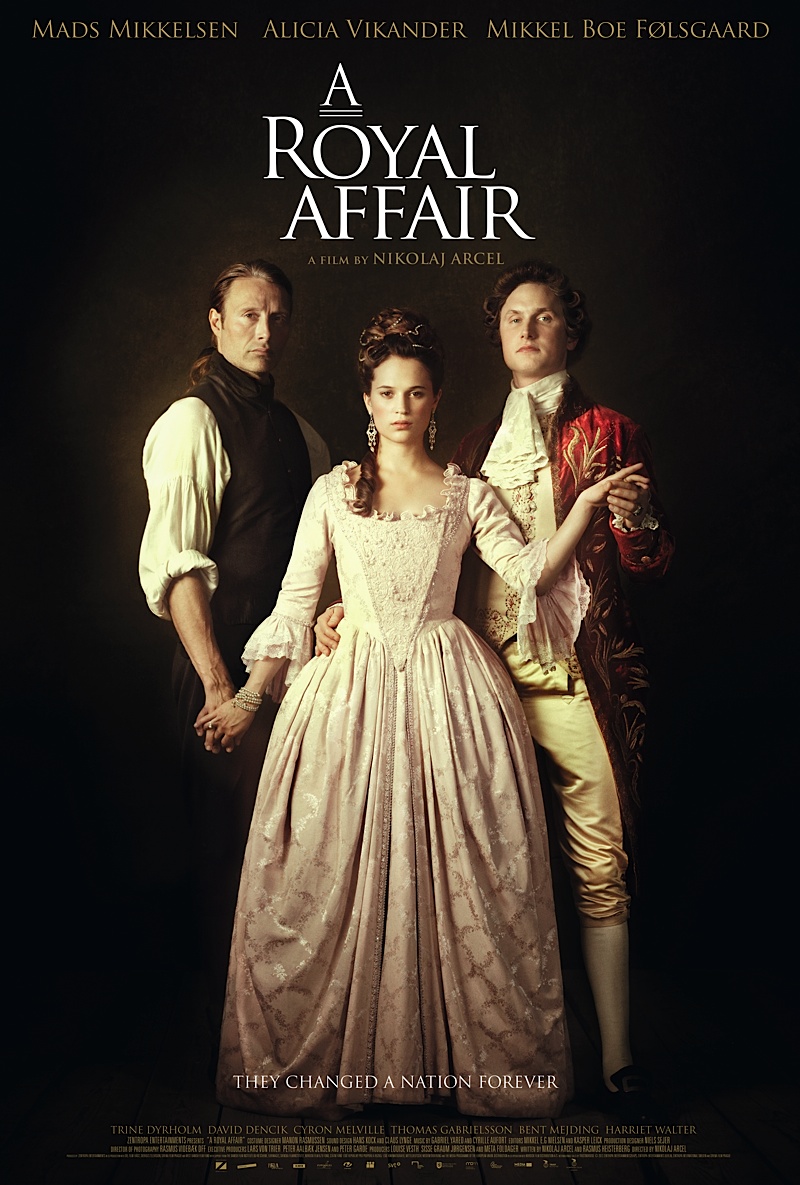 Winner of the Best Actor and Best Screenplay awards at the Berlin Film Festival, and written and directed by Nikolaj Arcel (co-writer of The Girl with the Dragon Tattoo), A Royal Affair is an epic tale of a passionate and forbidden romance that changed an entire nation.
Denmark, 1766, and Caroline Mathilde is married to the mad and politically ineffectual King Christian VII. Ignored by the wild King who chooses to live scandalously, Caroline grows accustomed to a quiet existence in oppressed Copenhagen. When the King returns from a tour of Europe accompanied by Struensee, his new personal physician, Queen Caroline finds an unexpected ally within the kingdom. The attraction between the two is initially one of shared ideals and philosophy, but it soon turns into a passionate and clandestine affair.
Committed to the ideals of the Enlightenment that are banned in Denmark, Struensee convinces the King to assert his previously untapped power to remove the conservative political council and implement drastic changes to Danish society. As the Court plot their return to power and the downfall of the Queen and Struensee, the consequences of their affair are made clear and the entire nation will be changed forever.
Director’s Statement
A Royal Affair is based on one of the most dramatic events in Danish and indeed European history; whenever I used to pitch the film to foreign investors, people had a hard time believing that the story was true, that these momentous events had actually happened in the late 1700s. In Denmark however, it is taught in school, more than 15 books have been written about it (both factual and fictional) and there has even been an opera and a ballet. I feel honored and extremely lucky to finally bring the full story to the screen.
Tonally, I was inspired by the great epics from the 40s and 50s where films would often feel like literary works, structured around characters and the passage of time, and not clearly following the obvious screenplay roadmaps. But my creative team and I were also fired up by the idea of bringing the Scandinavian historical drama into the new century. We wanted to achieve this by adhering to a self imposed rule; we didn’t want to ‘show’ history, didn’t want to dwell pointlessly on the big official events, the fancy dresses and hairdos, or the way the food was served.
Rather, we wanted people to simply experience the story through the eyes of the characters, taking the 1760s for granted. Even though the period is obviously there in the set designs, the costumes (Mikkel Foelsgaard who plays King Christian still insists our tagline should have been ‘Big emotions, Big wigs’), it was filmed and edited as we would have filmed and edited a film taking place in modern Copenhagen.
Finally, Gabriel Yared and Cyrille Aufort’s beautiful score has brought the film full circle, and home to its epic roots.
— Nikolaj Arcel
Call for Papers | Art and Its Afterlives at The Courtauld
From The Courtauld:
Fourth Early Modern Symposium: Art and Its Afterlives
The Courtauld Institute of Art, London, 17 November 2012
Proposals due by 1 July 2012
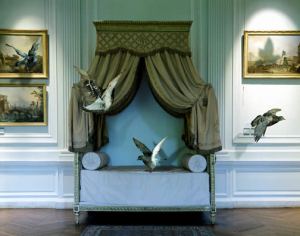
Karen Knorr, The Green Bedroom of Louis XVI. © Eric Franck Fine Art
Art and Its Afterlives aims to address the ways in which the work of art continues to resonate after its creation. While much art history takes as its focus the initial facture of the work of art, this one-day symposium explores what happens to early modern art after the moment of its making. How did early modern works continue to be created in their display, preservation, and reception from the moment of their creation on? Papers will examine how art is shaped by its afterlives – whether these collect, curate, cut up, cut out, copy or correct it – and the ways in which art both persists and changes through time as a material object, a field of generative meaning, and a subject of debate and interpretation. Material, technical and social histories as well as theoretical approaches drawn from the discipline of art history and other fields of the humanities
are welcome. Accounts from curatorial practice and the field
of museology are also encouraged. (more…)
Forthcoming | ‘London: A Social and Cultural History’
Robert Bucholz, Professor of History at Loyola University Chicago, has been teaching a thematic course on London for years (a version is available at The Great Courses). Long dissatisfied with the available options for texts, he finally decided — with his co-author Joseph Ward — to write one. With its emphasis on the experience of living in early modern London and the varied lives of the city’s residents, the book is good news for anyone trying to fit the city into a semester. -CH
◊ ◊ ◊ ◊ ◊
From Cambridge UP:
Robert O. Bucholz and Joseph P. Ward, London: A Social and Cultural History, 1550–1750 (New York: Cambridge University Press, 2012), 415 pages, ISBN: 9780521896528, $28.
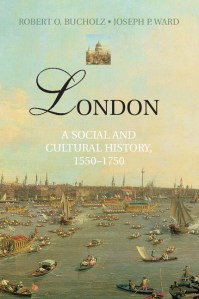 Between 1550 and 1750 London became the greatest city in Europe and one of the most vibrant economic and cultural centres in the world. This book is a history of London during this crucial period of its rise to world-wide prominence, during which it dominated the economic, political, social and cultural life of the British Isles, as never before nor since. London incorporates the best recent work in urban history, contemporary accounts from Londoners and tourists, and fictional works featuring the city in order to trace London’s rise and explore its role as a harbinger of modernity, while examining how its citizens coped with those achievements. London covers the full range of life in London, from the splendid galleries of Whitehall to the damp and sooty alleyways of the East End. Readers will brave the dangers of plague and fire, witness the spectacles of the Lord Mayor’s Pageant and the hangings at Tyburn, and take refreshment in the city’s pleasure-gardens, coffee-houses and taverns.
Contents
Introduction: London’s Importance
1. London in 1550
2. The Socioeconomic Base
3. Royal and Civic London
4. Fine and Performing Arts
5. The Public Sphere and Popular Culture
6. The People on the Margins
7. Riot and Rebellion
8. Plague and Fire
Conclusion: London in 1750










 Enfilade
leave a comment