Conference | Objects in Motion in the Early Modern World
I posted notice of this two-day conference in February, but here I’ve included the full program, and what a program! In addition to the really interesting papers, the breakout sessions look like immense fun. -CH
From The Getty:
Objects in Motion in the Early Modern World
The Getty Center, Los Angeles, 10-11 May 2013
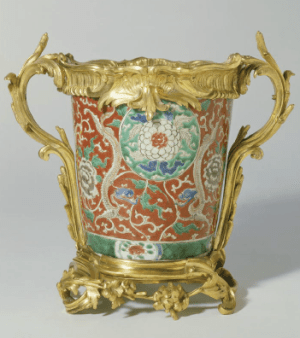
Mounted Vase, Chinese porcelain ca. 1662–1722, French mounts, ca. 1745–49. J. Paul Getty Museum (79.DI.121.1)
The Getty Research Institute and the USC-Huntington Early Modern Studies Institute are co-sponsoring a two-day conference, “Objects in Motion in the Early Modern World,” on Friday, May 10 and Saturday, May 11, 2013, at the Getty Center in Los Angeles, California.
An international group of scholars will examine the circulation of objects across regions and cultures in the early modern period (1500-1800), addressing the ways in which mobility led to new meanings, uses, and interpretations. Break-out sessions will invite the audience to consider these questions as we examine objects from the Getty’s collections. A closing roundtable will provide an opportunity to discuss the methodological and theoretical potential of this line of inquiry for the study and teaching of art history. The symposium is organized by Daniela Bleichmar (University of Southern California), Meredith Martin (Wellesley College), and Joanne Pillsbury (Getty Research Institute).
Admission is free. Separate reservations are required for each
day of the conference.
◊ ◊ ◊ ◊ ◊
F R I D A Y , 1 0 M A Y 2 0 1 3
8:30 Coffee and Pastries
9:30 Welcome, Andrew Perchuk (Getty Research Institute) and Peter Mancall (USC-Huntington Early Modern Studies Institute)
9:35 Introductory Remarks, Daniela Bleichmar (University of Southern California) and Meredith Martin (Wellesley College)
9:45 Session 1 — Moderator: Joanne Pillsbury (Getty Research Institute)
• “The Itinerant Lives of Mexican Codices,” Daniela Bleichmar (University of Southern California)
• “Trading in the Senses: Exotica On and Off the Early Modern Dutch Marketplace,” Claudia Swan (Northwestern University)
11:15 Coffee Break
11:30 Session 2 — Moderator: Alka Patel (University of California, Irvine)
• “Diana Transformed: The Case of the Diana Automaton,” Jessica Keating (University of Southern California)
• “Translating, Transporting, and Transforming Mughal History: An Illustrated French Translation of the ‘Ain-i Akbari,” Chanchal Dadlani (Wake Forest University)
1:00 Lunch
2:00 Breakout Sessions
Lacquer Without Borders led by Arlen Heginbotham, Conservator, J. Paul Getty Museum
This tour through the Museum galleries focuses on examples of Chinese and Japanese lacquer that have been incorporated into French decorative arts and addresses the worldwide exchange of aesthetics, raw materials, and finished goods associated with the lacquer trade.
VOILA—How Science Can Help Establish a Community of Asian Lacquer Researchers, led by Michael Schilling, Senior Scientist, Getty Conservation Institute
Ever wondered why scientists study cultural heritage? This tour of the Organic Materials Laboratory at the Getty Conservation Institute illustrates the role of science in uncovering the mysteries of Asian lacquer, the topic of a recent workshop for conservators and scientists hosted by the Institute.
Looking East: Rubens’s Encounter with Asia, led by Stephanie Schrader, Curator, J. Paul Getty Museum
This exhibition tells an intriguing story about early trade between Europe and Asia, the trafficking of Asian slaves, a shipwreck, the role of Jesuit missionaries in the East, and an unusual hat. Featuring a masterpiece from the Getty collection, Man in Korean Costume, the exhibition includes important scholarship that illuminates unexplored facets of Peter Paul Rubens’s much-celebrated career.
An Evolving Understanding of the Object via Art History and Science: La Roldana’s San Ginés, led by Maite Alvarez, Project Specialist, and Jane Bassett and Brian Considine, Conservators, J. Paul Getty Museum
In the early modern period, materials such as pigments, woods, and dyes traveled across the globe. Scientific advances have enabled these global materials to be more clearly identified; in fact, material identification has became such a part of art history that larger questions are often missed: How do we come to the conclusions we come to? How do we bring out true knowledge rather than conjecture? What are the implications and what is at stake? This session examines Spanish artist La Roldana’s polychrome wood sculpture San Ginés and her use of New World materials like cochineal, indigo, and cedar. An interdisciplinary team of scholars arrived at a new understanding of this work through the combined application of art history and science.
From Military Campaigns to Museum Collections, led by Louis Marchesano, Curator, and Peter Bonfitto, Senior Project Management Coordinator, Getty Research Institute
Napoleon’s military expedition in Egypt was a monumental failure, but it provided both the French and the English an opportunity to seize the country’s riches. This session presents a variety of publications related to the military campaign, including the multivolume Description de l’Égypte (1809–28), auction catalogs, and museum publications.
Imperial Impressions: Chinese Engravings and French Models, led by Marcia Reed, Chief Curator, Getty Research Institute
Rare prints from the Getty Research Institute’s collections demonstrate the evolution of China’s cultural exchange with Europe during the Qing Dynasty.
Facing East: The Western View of Islam in Early Modern Europe, led by David Brafman, Curator, Getty Research Institute
The Getty Research Institute’s rare books and manuscripts from the Renaissance to the Enlightenment display the evolving knowledge of Islamic art and culture in early modern Europe.
Untold Stories: Collecting and Transforming Medieval Manuscripts, led by Elizabeth Morrison, Curator, J. Paul Getty Museum
For hundreds of years, manuscripts have been bought and sold, hidden and displayed, preserved and rearranged, loved and forgotten, cut into pieces, hung on the wall, and glued into albums. Drawn from the Getty Museum’s permanent collection and featuring several outside loans, this exhibition reveals how manuscripts have been refashioned both conceptually and physically and explores the long and eventful history of these books before their arrival at the Museum.
3:15 Session 3 — Moderator: Stephen Little (Los Angeles County Museum of Art)
• “Mirror Reflections: Louis XIV, Phra Narai, and the Material Culture of Kingship,” Meredith Martin (Wellesley College)
• “Coins for Candles: Asian Commodities and the Visual Culture of Spanish America,” Dana Leibsohn (Smith College)
4:45 Reception
◊ ◊ ◊ ◊ ◊
S A T U R D A Y , 1 1 M A Y 20 1 3
8:30 Coffee and Pastries
9:30 Session 4 — Moderator: Charlene Villaseñor Black (University of California, Los Angeles)
• “From the Rue Saint-Jacques to the Paraguayan Outback: The Itinerant lives of Rococo Decorative Prints in Eighteenth-Century South America,” Gauvin Alexander Bailey (Queen’s University, Ontario, Canada)
• “Monumentality in Motion: A Mughal Audience Tent in Late Eighteenth-Century Jodhpur,” Zirwat Chowdhury (Center for 17th- and 18th-Century Studies, University of California, Los Angeles)
11:00 Coffee Break
11:15 Session 5 — Moderator: Polly Roberts (University of California, Los Angeles)
• “Porcelain Objects and Mercantile Aesthetics: Trading Culture in Coastal East Africa,” Sandy Prita Meier (University of Illinois, Urbana-Champaign)
• “Chairs, Writing Tables, and Chests: On the Postures of Commercial Documentation in the Early Modern Indian Ocean,” Nancy Um (SUNY–Binghamton)
12:45 Lunch
2:00 Session 6 — Moderator: Sean Roberts (University of Southern California)
• “Classicizing the New: The Publication of the History of the New World (Tarih ül-Hind il garbi el-müsemma bi-Hadis-i nev),” Avinoam Shalem (Institut für Kunstgeschichte, Munich)
• “Technology in Paradise,” Mary Sheriff (University of North Carolina at Chapel Hill)
3:30 Coffee Break
3:45 Closing Roundtable Discussion
5:15 Closing Reception










 Enfilade
leave a comment