British Sales 1780–1800: The Rise of the London Art Market
From The National Gallery:
The National Gallery has completed a collaborative project with the Getty Research Institute, Los Angeles, to augment records about British art sales in the crucial decades from 1780 to 1800
Overview
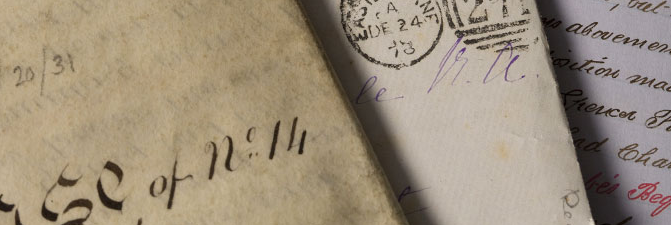 The disruptions caused by the French Revolution had a huge effect on the redistribution of art throughout Europe during the late 18th century. Countless important art collections, including the famous Orléans collection, were dispersed in auction sales. Since many of these auctions took place in Britain’s capital city, London developed into a major import market and soon established itself as the hub of the international art trade.
The Getty Research Institute has been conducting research into European art sales for the past 25 years, notably in relation to art sales catalogues from major cities in Great Britain, France, Germany, Belgium, the Netherlands, and Scandinavia from 1650 to 1840. The Institute has been making its findings available on the Getty Provenance Index®.
In relation to British art sales, it concentrated earlier research into early 19th-century British records. By comparison, little attention was ever focussed on late 18th-century British auction records. This big gap in knowledge prevented meaningful analysis into the art markets of Great Britain, into the continuing lives of dispersed French collections, and – due to the interconnectedness of national art markets – into the development of cultural networks throughout Europe.
In order to rectify the situation, the National Gallery and the Getty Research Institute forged a collaboration from October 2009 to August 2012. The aim of this jointly-funded project was to discover all extant British sale catalogues – in London and across the UK – and to enter them into the Index, thus significantly augmenting the coverage of one of the most powerful and important tools for scholars researching art markets and collecting practices.
British art sales catalogues
The research project, ‘British Sales 1780-1800’, has successfully added over 67,000 records from 1,408 British art auction catalogues to the Getty database: 29,000 records from the 1780s and a further 38,000 records from the 1790s. The database now contains almost 80% of known British art sales catalogues in public collections for the period.
Explore British art sales on the Getty Provenance Index®
The research
The research team worked with many institutions in the UK and abroad to find and then consult and photograph relevant holdings of catalogues from the period. Among the important archives and libraries in London, data was input from annotated auction catalogues held by the Wallace Collection, the British Library, the British Museum, the Victoria & Albert Museum, the Courtauld Institute and the National Archives at Kew, as well as from the National Gallery’s own substantial holdings of historic sales catalogues.
In addition, the team sourced catalogues from numerous regional UK record offices, local archives and university collections, including the Barber Institute of Fine Arts, Birmingham; the Fitzwilliam Museum, Cambridge; and the Ashmolean Museum and Bodleian Library, Oxford. Furthermore, the researchers forged close links with various foreign institutions, notably the Bibliothèque Nationale de France in Paris.
Outcomes
The British Sales research project has resulted in expanded coverage of British materials in the Index®. These tools will allow researchers to track patterns of taste in order to understand better cultural transfers, and to explore more fully the power of art markets. Furthermore, generating new knowledge about the history of the art market will allow greater interdisciplinary exchange among scholars from a variety of fields, including art history, economics, and cultural studies.
To highlight some of the fruits of the collaboration between the National Gallery and the Getty Research Institute, as well as to promote further research in the field, the two institutions are organising a scholarly symposium at the National Gallery on 21–22 June 2013: London and the Emergence of a European Art Market (c. 1780-1820). The theme of the conference will be the European art market of the later 18th century, and in particular, the ways that the market operated at both national and international levels as well as its impact on the history of collecting and taste in public and private spheres.
Happy Arbor Day
I posted notice of this collection last September, but I’m reposting it in honor of National Arbor Day. From SVEC (formerly Studies on Voltaire and the Eighteenth Century), available from the Voltaire Foundation:
Laura Auricchio, Elizabeth Heckendorn Cook and Giulia Pacini, eds., Invaluable Trees: Cultures of Nature, 1660-1830 — SVEC 2012:08 (Oxford: Voltaire Foundation, 2012), 360 pages, ISBN 9780729410489, £65 / €95 / $110.
 Trees and tree products have long been central to human life and culture, taking on intensified significance during the long eighteenth century. In this interdisciplinary volume, contributors trace changes in early modern theories of resource management and ecology across European and North American landscapes, and show how different and sometimes contradictory practices were caught up in shifting conceptions of nature, social identity, physical health and moral wellbeing.
◊ ◊ ◊ ◊ ◊
C O N T E N T S
Introduction
• Laura Auricchio — Elizabeth Heckendorn Cook and Giulia Pacini, Invaluable trees
I. Arboreal Lives
• Hamish Graham — ‘Alone in the forest’? Trees, charcoal and charcoal burners in eighteenth-century France
• J. L. Caradonna — Conservationism avant la lettre,? Public essay competitions on forestry and deforestation in eighteenth-century France
• Paula Young Lee — Land, logs and liberty: the Revolutionary expansion of the Muséum d’histoire naturelle during the Terror
• Peter Mcphee — ‘Cette anarchie dévastatrice’: the légende noire of the French Revolution
• Paul Elliott — Erasmus Darwin’s trees
• Giulia Pacini — At home with their trees: arboreal beings in the eighteenth-century French imaginary
II. Strategic Trees
• Elizabeth Heckendorn Cook — The vocal stump: the politics of tree-felling in Swift’s ‘On cutting down the old thorn at Market Hill’
• Michael Guenther — Tapping nature’s bounty: science and sugar maples in the age of improvement
• Meredith Martin — Bourbon renewal at Rambouillet
• Susan Taylor-Leduc — Assessing the value of fruit trees in the marquis de Fontanes’s poem Le Verger
• Elizabeth Hyde — Arboreal negotiations, or William Livingston’s American perspective on the cultural politics of trees in the Atlantic world
• Lisa Ford — The ‘naturalisation’ of François André Michaux’s North American sylva: patriotism in early American natural history
III. Arboreal Enlightenments
• Tom Williamson — The management of trees and woods in eighteenth-century England
• Steven King — The healing tree
• Nicolle Jordan — ‘I writ these lines on the body of the tree’: Jane Barker’s arboreal poetics
• Waltraud Maierhofer — Goethe and forestry
• Paula R. Backscheider — Disputed value: women and the trees they loved
• Aaron S. Allen — ‘Fatto di Fiemme’: Stradivari’s violins and the musical trees of the Paneveggio
Summaries
Bibliography
Index
◊ ◊ ◊ ◊ ◊
Laura Auricchio is Associate Professor of Art History and Chair of Humanities at The New School in New York. Her current research addresses Franco-American cultural exchanges in the Age of Revolution.
Elizabeth Heckendorn Cook is Associate Professor of English at the University of California, Santa Barbara. She studies the history of environmental ethics and early modern representations of trees and forests.
Giulia Pacini is Associate Professor of French at The College of William & Mary. Her current research focuses on the political and material significance of trees in early modern France.
Conference | Objects in Motion in the Early Modern World
I posted notice of this two-day conference in February, but here I’ve included the full program, and what a program! In addition to the really interesting papers, the breakout sessions look like immense fun. -CH
From The Getty:
Objects in Motion in the Early Modern World
The Getty Center, Los Angeles, 10-11 May 2013
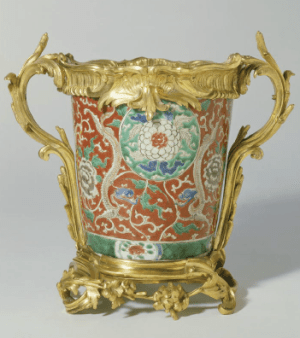
Mounted Vase, Chinese porcelain ca. 1662–1722, French mounts, ca. 1745–49. J. Paul Getty Museum (79.DI.121.1)
The Getty Research Institute and the USC-Huntington Early Modern Studies Institute are co-sponsoring a two-day conference, “Objects in Motion in the Early Modern World,” on Friday, May 10 and Saturday, May 11, 2013, at the Getty Center in Los Angeles, California.
An international group of scholars will examine the circulation of objects across regions and cultures in the early modern period (1500-1800), addressing the ways in which mobility led to new meanings, uses, and interpretations. Break-out sessions will invite the audience to consider these questions as we examine objects from the Getty’s collections. A closing roundtable will provide an opportunity to discuss the methodological and theoretical potential of this line of inquiry for the study and teaching of art history. The symposium is organized by Daniela Bleichmar (University of Southern California), Meredith Martin (Wellesley College), and Joanne Pillsbury (Getty Research Institute).
Admission is free. Separate reservations are required for each
day of the conference.
◊ ◊ ◊ ◊ ◊
F R I D A Y , 1 0 M A Y 2 0 1 3
8:30 Coffee and Pastries
9:30 Welcome, Andrew Perchuk (Getty Research Institute) and Peter Mancall (USC-Huntington Early Modern Studies Institute)
9:35 Introductory Remarks, Daniela Bleichmar (University of Southern California) and Meredith Martin (Wellesley College)
9:45 Session 1 — Moderator: Joanne Pillsbury (Getty Research Institute)
• “The Itinerant Lives of Mexican Codices,” Daniela Bleichmar (University of Southern California)
• “Trading in the Senses: Exotica On and Off the Early Modern Dutch Marketplace,” Claudia Swan (Northwestern University)
11:15 Coffee Break
11:30 Session 2 — Moderator: Alka Patel (University of California, Irvine)
• “Diana Transformed: The Case of the Diana Automaton,” Jessica Keating (University of Southern California)
• “Translating, Transporting, and Transforming Mughal History: An Illustrated French Translation of the ‘Ain-i Akbari,” Chanchal Dadlani (Wake Forest University)
1:00 Lunch
2:00 Breakout Sessions
Lacquer Without Borders led by Arlen Heginbotham, Conservator, J. Paul Getty Museum
This tour through the Museum galleries focuses on examples of Chinese and Japanese lacquer that have been incorporated into French decorative arts and addresses the worldwide exchange of aesthetics, raw materials, and finished goods associated with the lacquer trade.
VOILA—How Science Can Help Establish a Community of Asian Lacquer Researchers, led by Michael Schilling, Senior Scientist, Getty Conservation Institute
Ever wondered why scientists study cultural heritage? This tour of the Organic Materials Laboratory at the Getty Conservation Institute illustrates the role of science in uncovering the mysteries of Asian lacquer, the topic of a recent workshop for conservators and scientists hosted by the Institute.
Looking East: Rubens’s Encounter with Asia, led by Stephanie Schrader, Curator, J. Paul Getty Museum
This exhibition tells an intriguing story about early trade between Europe and Asia, the trafficking of Asian slaves, a shipwreck, the role of Jesuit missionaries in the East, and an unusual hat. Featuring a masterpiece from the Getty collection, Man in Korean Costume, the exhibition includes important scholarship that illuminates unexplored facets of Peter Paul Rubens’s much-celebrated career.
An Evolving Understanding of the Object via Art History and Science: La Roldana’s San Ginés, led by Maite Alvarez, Project Specialist, and Jane Bassett and Brian Considine, Conservators, J. Paul Getty Museum
In the early modern period, materials such as pigments, woods, and dyes traveled across the globe. Scientific advances have enabled these global materials to be more clearly identified; in fact, material identification has became such a part of art history that larger questions are often missed: How do we come to the conclusions we come to? How do we bring out true knowledge rather than conjecture? What are the implications and what is at stake? This session examines Spanish artist La Roldana’s polychrome wood sculpture San Ginés and her use of New World materials like cochineal, indigo, and cedar. An interdisciplinary team of scholars arrived at a new understanding of this work through the combined application of art history and science.
From Military Campaigns to Museum Collections, led by Louis Marchesano, Curator, and Peter Bonfitto, Senior Project Management Coordinator, Getty Research Institute
Napoleon’s military expedition in Egypt was a monumental failure, but it provided both the French and the English an opportunity to seize the country’s riches. This session presents a variety of publications related to the military campaign, including the multivolume Description de l’Égypte (1809–28), auction catalogs, and museum publications.
Imperial Impressions: Chinese Engravings and French Models, led by Marcia Reed, Chief Curator, Getty Research Institute
Rare prints from the Getty Research Institute’s collections demonstrate the evolution of China’s cultural exchange with Europe during the Qing Dynasty.
Facing East: The Western View of Islam in Early Modern Europe, led by David Brafman, Curator, Getty Research Institute
The Getty Research Institute’s rare books and manuscripts from the Renaissance to the Enlightenment display the evolving knowledge of Islamic art and culture in early modern Europe.
Untold Stories: Collecting and Transforming Medieval Manuscripts, led by Elizabeth Morrison, Curator, J. Paul Getty Museum
For hundreds of years, manuscripts have been bought and sold, hidden and displayed, preserved and rearranged, loved and forgotten, cut into pieces, hung on the wall, and glued into albums. Drawn from the Getty Museum’s permanent collection and featuring several outside loans, this exhibition reveals how manuscripts have been refashioned both conceptually and physically and explores the long and eventful history of these books before their arrival at the Museum.
3:15 Session 3 — Moderator: Stephen Little (Los Angeles County Museum of Art)
• “Mirror Reflections: Louis XIV, Phra Narai, and the Material Culture of Kingship,” Meredith Martin (Wellesley College)
• “Coins for Candles: Asian Commodities and the Visual Culture of Spanish America,” Dana Leibsohn (Smith College)
4:45 Reception
◊ ◊ ◊ ◊ ◊
S A T U R D A Y , 1 1 M A Y 20 1 3
8:30 Coffee and Pastries
9:30 Session 4 — Moderator: Charlene Villaseñor Black (University of California, Los Angeles)
• “From the Rue Saint-Jacques to the Paraguayan Outback: The Itinerant lives of Rococo Decorative Prints in Eighteenth-Century South America,” Gauvin Alexander Bailey (Queen’s University, Ontario, Canada)
• “Monumentality in Motion: A Mughal Audience Tent in Late Eighteenth-Century Jodhpur,” Zirwat Chowdhury (Center for 17th- and 18th-Century Studies, University of California, Los Angeles)
11:00 Coffee Break
11:15 Session 5 — Moderator: Polly Roberts (University of California, Los Angeles)
• “Porcelain Objects and Mercantile Aesthetics: Trading Culture in Coastal East Africa,” Sandy Prita Meier (University of Illinois, Urbana-Champaign)
• “Chairs, Writing Tables, and Chests: On the Postures of Commercial Documentation in the Early Modern Indian Ocean,” Nancy Um (SUNY–Binghamton)
12:45 Lunch
2:00 Session 6 — Moderator: Sean Roberts (University of Southern California)
• “Classicizing the New: The Publication of the History of the New World (Tarih ül-Hind il garbi el-müsemma bi-Hadis-i nev),” Avinoam Shalem (Institut für Kunstgeschichte, Munich)
• “Technology in Paradise,” Mary Sheriff (University of North Carolina at Chapel Hill)
3:30 Coffee Break
3:45 Closing Roundtable Discussion
5:15 Closing Reception
Call for Papers | London and the Americas, 1492-1812
Society of Early Americanists | London and the Americas, 1492-1812
Kingston University 17-19 July 2014
Proposals due by 1 September 2013
 This thematic interdisciplinary conference of the Society of Early Americanists will examine London’s connections with the Americas in the colonial era. It will focus on the role that Europe’s largest urban center played in the structuring of an Atlantic world inscribed, amidst both war and peace, by networks of trade, travel, religion, kinship, cultural identification, captivity, slavery, and governance. At the same time, participants will consider how the Americas in particular shaped the geography, both actual and metaphorical, of early modern London (that is, the cities of London and Westminster), influencing its practices, hierarchies, infrastructures, modes of representation, arrangements of space, and movements of peoples. The focus will thus be on London as both recipient and source of transmission and interaction, connected imaginatively and actually with American regions under the control of other European powers as well as with its own colonies.
Hosted by the School of Humanities at Kingston University London, the conference will take place on the University’s campus in South West London, a 25-minute train ride from central London and a short bus ride from Heathrow Airport. Housing options will include university dormitories as well as a diverse array of local hotels.
Proposals are welcome for individual papers or complete panels. Innovative panel formats are welcome along with traditional trios of 20-minute papers. Please send 250 word proposals by October 1, 2013, to: sea14london@gmail.com
Program Committee:
Kristina Bross, Purdue University, co-chair
Laura Stevens, University of Tulsa, co-chair
Eve Tavor Bannet, University of Oklahoma
George Boudreau, Pennsylvania State University Harrisburg
Brycchan Carey, Kingston University
Jonathan Field, Clemson University
Christopher Loar, University of California Davis
Oliver Scheiding, University of Mainz
Book and Conference | The Chesapeake House
The following conference takes place next month at Williamsburg:
The Chesapeake House
Colonial Williamsburg, 19-21 May 2013
 To mark the publication of The Chesapeake House: Architectural Investigation by Colonial Williamsburg by the University of North Carolina Press, the Colonial Williamsburg Foundation will offer a three-day conference focusing on the methods used by architectural historians at Colonial Williamsburg to investigate buildings as well as review new discoveries in the field. The Chesapeake House is a major scholarly landmark that will set the standard for the analysis and history of early Virginia and Maryland architecture for the coming decades. The seventeen essays are based on the collective scholarship of nine authors who have been involved in research in this field for the past three decades. Participants in the conference will receive a copy of the book as part of their registration.
Through a series of lectures, conversations, and specialized tours of the Historic Area of Colonial Williamsburg, The Chesapeake House conference provides an insider’s view of how Colonial Williamsburg’s experts examine historic buildings. The program will appeal to teachers, students, preservationists, and other professionals in the field as well as friends of Colonial Williamsburg and members of the general public with interests in old houses, American history, restoration, and historic preservation. Presentations will explore the practice of architectural fieldwork, the nature of regionalism in building design, and the development of a distinctive framing system in the colonial period. Specialists will discuss the latest techniques of dendrochronoly and paint analysis.
There will be a special audience participation session entitled “How old is your house?” Often, it is one of the first questions homeowners ask and it is always essential for architectural historians to determine. Yet, such a basic query is often hard to answer. Assessing the age and alterations made to buildings is challenging since the process involves piecing together disparate kinds of evidence found in many different parts of a house, from the attic to the cellar. How was the frame constructed? What kind of bonding pattern does the chimney have? What sort of hinges are on the doors? Some details provide solid diagnostic clues while others are less helpful. However, when combined, they can provide plausible dates to within a few years or decades.
Curious about the age of your old house or one you know? Here is your chance to start the process of figuring it out. “Making Sense of the Evidence” will provide an interactive opportunity to review and analyze the material you submit with other participants. This session will demonstrate how the experts read the evidence from the field to make a reasonable estimate of the age of a house based on its form, construction, and style of various features.
◊ ◊ ◊ ◊ ◊
Cary Carson and Carl R. Lounsbury, eds., The Chesapeake House: Architectural Investigation by Colonial Williamsburg (Chapel Hill: University of North Carolina Press, 2013), 488 pages, ISBN: 978-0807835777, $60.
◊ ◊ ◊ ◊ ◊
S U N D A Y , 1 9 M A Y 20 1 3
4:00 Welcome, Colin G. Campbell, president and CEO, Colonial Williamsburg Foundation
4:15 “Publishing The Chesapeake House,” David Perry, editor-in-chief and assistant director, (retired), University of North Carolina Press, Chapel Hill
4:30 “Rendering The Chesapeake House,” Jeffrey Klee, architectural historian, Colonial Williamsburg
M O N D A Y , 2 0 M A Y 2 0 1 3
8:30 The Art Museums of Colonial Williamsburg open for conference participants
9:00 “Why Architectural Fieldwork?,” Edward Chappell, director, architectural and archaeological research department, Colonial Williamsburg
9:45 Coffee
10:15 “What makes Chesapeake Architecture Regional?,” Carl Lounsbury, senior architectural historian, Colonial Williamsburg
11:00 “Timber Framing: The DNA of Chesapeake Architecture,” Willie Graham, curator, architecture, Colonial Williamsburg
1:15 Revolutionary City programming. Looking at Architectural Details. Participants will be divided into four groups and will rotate around in order to participate in all four sessions:
• Timber Framing, Willie Graham, Booker Tenement
• Brickwork, Carl Lounsbury, Wythe House, Cole House, and Courthouse
• Hardware, Edward Chappell, Ken Schwarz, Armoury
• Architectural Elements, Jeffrey Klee, Hennage Auditorium
4:30 “Making Sense of the Evidence, or Stump the Chumps,” Cary Carson, Edward Chappell, Willie Graham, Jeffrey Klee, Carl Lounsbury, and members of the audience. Review of images of buildings and details submitted by members of the audience
6:30 Reception at the home of Margaret Pritchard
T U E S D A Y , 2 1 M A Y 2 0 1 3
8:30 The Art Museums of Colonial Williamsburg open for conference participants
9:00 “How Dendrochronology has Changed Architectural Research,” Michael Worthington, dendrochronologist, Oxford Tree-Ring Laboratory, Baltimore
9:45 “Paint Analysis in Architectural Investigations,” Susan Buck, conservator and paint analyst, Williamsburg
10:15 Coffee
10:45 “Off the Wall: Textile and Paper Hangings in the Chesapeake House,” Margaret Pritchard, curator, prints, maps, and wallpaper, Colonial Williamsburg
11:30 “Furnished Lives,” Cary Carson, vice president of research (retired), Colonial Williamsburg
Call for Papers | Framings
Framings: Interdisciplinary Conference on Frames
University of Copenhagen, 29 November — 1 December 2013
Proposals due by 17 May 2013
 The conference will bring together strands of international research on frames that took place over the past 5 years and extend the conceptual and material framework of interdisciplinary between the Humanities, Social- and Communication Sciences. Expected and welcomed are contributions from art and media history and theory, philosophy and cultural studies, dance and theater studies, film theory and film semiotics, literature and music, communication science, visual and textile studies, and computer science.
Submissions are solicited in, but not limited to, the following areas:
– frames in art and art history
– dialectical nature of frames
– framing strategies in medieval texts
– mediality of the frame
– parergon
– framing (with) textiles
– conceptual frameworks
– mirrors
– (video-)feedback
– ‘frame generators’
– self-reflexive practices
– frame as ‘metaphor generator’
– performativity of the frame
– interdisciplinary and methodological aspects of framings (more…)
Exhibition | La Tauromaquia: Carnicero, Goya, and Picasso
Press release for the current exhibition at Penn:
La Tauromaquia: Carnicero, Goya, and Picasso
Arthur Ross Gallery, University of Pennsylvania, Philadelphia, 19 April — 28 July 2013

Antonio Carnicero, Colleción de las principals suertes de una corrida de toro, plate IV, 1790 (Arthur Ross Foundation)
In celebration of the Arthur Ross Gallery’s 30th anniversary, La Tauromaquia: Carnicero, Goya, and Picasso presents 70 master prints collected by the Arthur Ross Foundation. The prints explore the long-revered tradition of the Spanish bullfight by featuring the works of three extraordinary artists: Carnicero, Goya and Picasso, who interpreted this popular entertainment in very different ways. This is the first time all 70 prints are on display in a single exhibition, which runs from April 19 through July 28, 2013.
In the eighteenth century, the bullfight was both a sport and an entertainment in Spain, democratically beloved from royalty to the lower classes. A skilled matador often became a famed national hero, and his fighting in the corrida was considered a fully developed art form. As Ernest Hemingway wrote: “Bullfighting is the only art in which the artist is in danger of death and in which the degree of brilliance in the performance is left to the fighter’s honor.” Antonio Carnicero’s (1748-1814) seven etchings and title sheet from Colleción de las principals suertes de una corrida de toros (Collection of the main actions in a bullfight), executed in 1790, illustrate the highly ritualized stages of the bullfight. In 1816, at the age of 70, Francisco Goya published the first edition of 33 prints on La Tauromaquia in Madrid. His daring compositions and dramatic chiaroscuro accentuate the drama that unfolds in the ring. A century later, Pablo Picasso (1881-1973), turned to bullfighting for his subject matter. In a single afternoon in 1957 he completed 26 plates for La Tauromaquia, o arte de torear, Pepe Illo’s treatise, for the Ediciones La Cometa specialist collection.
La Tauromaquia: Carnicero, Goya and Picasso is the culmination of exhibitions celebrating the 30th anniversary of the Arthur Ross Gallery. The Gallery was the brainchild of Penn President Emeritus Mr. Martin Meyerson and Mr. Arthur Ross. In 1983, they established the Arthur Ross Gallery on the campus of the University of Pennsylvania for the benefit of the Philadelphia and University communities. It has since expanded to a much broader focus, embracing an eclectic program of changing exhibitions in all fields of the visual arts and cultural artifacts from around the world.
HECAA’s Pinterest Boards Unveiled
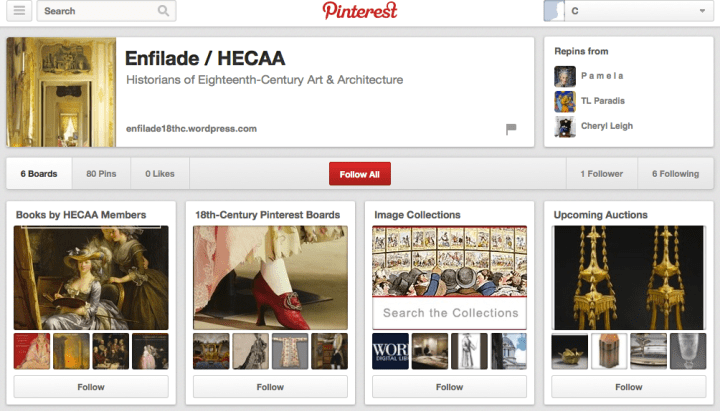
With two fabulous Clerks of the Pinterest Boards — Katrina London and Debs Wiles — taking the lead, I’m delighted to announce that HECAA and Enfilade now have a Pinterest presence! Having written about the site in the past (21 May 2012 and 17 January 2013), I’m now even more optimistic. Lots of you are already pinning. Some of you, on the other hand, are rolling your eyes at the very mention of it — not another new digital platform to make sense of! As one who signed up for a Pinterest account (yes, accounts are free) and then did nothing with it for months, I understand feelings of nagging annoyance and even disdain. But after a year of using Pinterest for personal interests and projects, I’ve been won over. It’s not nearly as good as it should (or could) be, but I think there is enormous potential for scholars to provide some leadership and make this new vehicle serve our own interests. It’s still an experiment, and six months from now, we’ll likely have a much better sense of the limits. On the front end, I offer the following suggestions; and don’t worry, we have no plans to change what happens here at the regular site for Enfilade. As always, feedback is welcome. -CH
◊ ◊ ◊ ◊ ◊
1) Plan. You’ll need to sign up for an account — but even before that — you need to consider how you want to use your account. As a social media platform, Pinterest will want to intertwine you with the people you ‘follow’ and the things you ‘pin’. It’s entirely common for people to use their real names, and if you’re using it to extend a professional presence, that’s probably advantageous. On the other hand, if you’re pinning cleaning tips, then maybe you’ll want something a bit more discreet (initials, pseudonyms, &c.).
2) Press on. When you sign up for an account, you’ll list several sites you want to ‘follow’. Over time, that list will grow as you hone your preferences and likes. For most people, Pinterest is only as satisfying as the things they’re following. Warning: here’s there’s a small learning curve. After you first sign up, you’ll likely be bombarded by lots of images (‘pins’) that have little to do how you want to use the site. Don’t fret. In a day or two, you’ll gradually begin to make sense of how it works, the visual clutter will dissipate, and it’s easy enough to ‘unfollow’ things you want to go away.
3) Follow HECAA! We currently have several ‘boards’. Whenever we post a new pin, it will automatically be pinned to your homepage, too. People who follow you will see it only if you ‘repin’ it yourself.
4) Explore. There are lots of museums, academic presses, and other scholarly institutions to ‘follow’ (Yale UP is one example). There are also lots of images of amazing eighteenth-century artifacts — often posted by historical novelists. At the level of strategy, Enfilade is not aiming to assemble large collections of interesting objects — paintings by Chardin or Kauffman, for instance. We have all kinds of resources for such collections: books, databases, &c. Instead, we’re interested in exploring what kinds of information would be a good fit with Pinterest and how we would take advantage of Pinterest as a venue for distributing visual information. Ultimately, we’ll be exploring how we might marshal collective efforts to maximize a critical mass of interest in eighteenth-century studies.
5) Think about organization. You’ll be able to create your own boards, assigning each pin to one of these. Generally, the more precise a board, the more useful it will be — to yourself and to others who may follow you. If you’re unsettled by the social media component, users are allowed three ‘secret boards’.
6) Think about who might see what you’re pinning. If you’re wondering how Pinterest could possibly be useful, consider this. Say you’re working on a paper on eighteenth-century picture frames. Through web searches, you find 10-20 sites and images you’d like to keep in mind. In a matter of seconds, it’s easy to pin each of those examples to a board you call ‘Frames’. With a system much easier than bookmarking or printing hard copies, you’re able to make a visual record, with brief captions and links. But also bear in mind: if those examples turn out to be crucial to your paper, anyone following you can, now, in effect, peer over your shoulder as you’re working. Perhaps that’s fine. Or perhaps you should use one of your ‘secret boards’ for that material. It’s easy enough to turn a ‘secret board’ into a public one later on, but you can’t go the other way.
HECAA’s Pinterest boards are available here»
Introducing: Clerks of the Pinterest Boards
I’m delighted to introduce two new Enfilade interns: Katrina London and Debs Wiles. For the next six months they’ll be exploring the scholarly potential of Pinterest. As Clerks of the Pinterest Boards, they’ll not only be pinning themselves but also helping us think through issue of organization and anticipating pitfalls. In fact, they’ve been working on all of this already for several weeks now. I’m thrilled at their interest and enthusiasm. Welcome aboard!
For an introduction and invitation to HECAA’s Pinterest boards, please see this posting.
-Craig Hanson
◊ ◊ ◊ ◊ ◊
Katrina London
 I am delighted to join Enfilade as a Clerk of the Pinterest Boards. I recently earned my master’s degree in Decorative Arts, Design History, and Material Culture at the Bard Graduate Center, where I specialized in the decorative arts of eighteenth-century France. Also at the Bard Graduate Center, I was a contributor to the exhibition and catalogue Salvaging the Past: Georges Hoentschel and French Decorative Arts from The Metropolitan Museum of Art, which opened earlier this month. I currently work in the Academic Programs department at the Bard Graduate Center as a program assistant for an NEH Summer Institute directed by Professor David Jaffee, and I am considering doctoral programs in art history.
Deborah (Debs) Wiles
 I came to horticulture as a career change. The more I learned about gardening and gardens, the more interested I became in the history of gardening. This led me to complete an MA in garden history at the University of Greenwich in London where I studied the history of Kensington Gardens and the evolution of the country house garden from the late seventeenth to early eighteenth centuries. I’ve since continued to research the biography of seventeenth-century traveler Celia Fiennes. I look forward to exploring ways to use social media as a scholarly tool!
Conference | The Louvre Before The Louvre: Artisans, Artists, Academies
From the conference website:
The Louvre Before The Louvre: Artisans, Artists, Academies
Wallace Collection, London, 5 July 2013
Organized by Mia Jackson and Hannah Williams

Antoine Coysevox, Charles Le Brun, terracotta, 1676 (The Wallace Collection)
Now one of the world’s most famous museums, the Louvre was once a vast artistic and cultural centre of a different kind. This one-day conference addresses the fascinating but little-known period of the Louvre’s history throughout the seventeenth and eighteenth centuries, exploring the role this space, its objects, and its inhabitants played in the histories of art production and artistic sociability in early modern Paris.
Eminent and emerging scholars including two guest speakers from the Musée du Louvre will together provide an intimate understanding of the artistic and intellectual neighbourhood of the Louvre and its effect on art and design in the period. Papers on the day will investigate the collective spaces and sociable practices of the Louvre (from the royal academies to artists’ studios), the intersections between personal and professional spaces for the artists and artisans who both lived and worked in the Louvre, and the wider significance of the Louvre in artistic social networks both locally and internationally.
Taking place in the Wallace Collection, which houses one of the United Kingdom’s finest collections of art from this period, this conference offers attendees the opportunity to experience the results of these artistic collaborations.
Generously supported by the Wallace Collection and the Faculty of History of the University of Oxford.
To book: www.louvrebeforelouvre.eventbrite.co.uk
◊ ◊ ◊ ◊ ◊
P R O G R A M M E
Welcome by Christoph Vogtherr (Wallace Collection)
Introduction by Mia Jackson (QMUL) and Hannah Williams (University of Oxford)
I. Reception Pieces at the Académie Royale de Peinture et de Sculpture: New Research
Geneviève Bresc-Bautier (Musée du Louvre) Integration of Works into the Collections of the Académie during the Ancien Régime
Guilhem Scherf (Musée du Louvre) Reception and Diffusion of the Morceaux de Réception during the Ancien Régime
II. Collective Spaces and Sociable Practices
Drew Armstrong (University of Pittsburgh) Life and Loss in the Académie Royale d’Architecture
Esther Bell (Cincinnati Art Museum) Coypel the Curator: Studio as Sociable Space
Pierre-Édouard Latouche (Université de Québec à Montréal) Des Recueils des Maisons Royales en Petit (1745) à L’Architecture Française (1756) de Blondel: Le remploi d’un Plan de la Cour Carré
Anne Higonnet (Barnard College, Columbia University) Studios, Sociability, and Unexpected Consequences in the Old Louvre
III. Living and Working in the Louvre
Susan Wager (Columbia University) Un-occupying the Louvre: The Royal Gem-Engraver Jacques Guay
David Maskill (Victoria University of Wellington) Louis Tocqué (1696-1772): A Portrait Painter at the Louvre
Katie Scott (Courtauld Institute of Art) Parade’s End: On Charles Coypel’s Bed
IV. Neighbourhoods and Networks
Dena Goodman (University of Michigan) 4 rue des Orties: the Louvre of the Silvestres, 1675-1805
Bärbel Küster (State Academy for Art and Design, Stuttgart) Britons in the Louvre in the 18th Century
Laura Auricchio (The New School) Beyond the Louvre: Re-mapping the Paris Art World in the Age of Louis XVI










 Enfilade
leave a comment