Wellesley’s Davis Museum Acquires Peruvian Portrait of a Young Woman
Press release from The Davis:
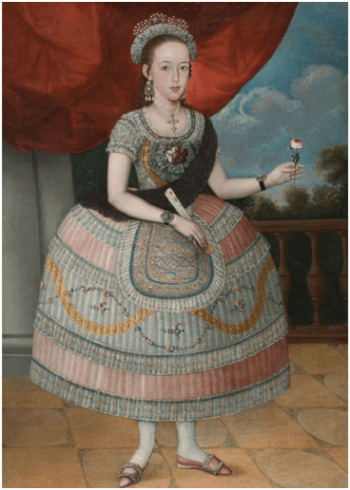
Portrait of a Young Woman, late eighteenth century, oil on canvas,
55 x 39 inches (Davis Museum, Wellesley College)
The Davis Museum at Wellesley College has acquired an extremely rare eighteenth-century Portrait of a Young Woman, nicknamed the ‘Lady from Lima’ that was painted in Lima, Peru. The work, which has never been published or publicly exhibited, went on view at the Davis on Friday, April 26. According to Davis Museum Adjunct Curator of Latin American Art and Senior Lecturer in the Wellesley College Art Department James Oles, “This extraordinary and rare portrait is a stunning addition to the Davis permanent collections, with appeal far beyond its immediate context of Latin American colonial art. The work is not widely known now, but given its rarity, will certainly become an iconic example of Latin American colonial portraiture as it is included in future publications and exhibitions.” The painting was acquired in 2011 with funds from the Wellesley College Friends of Art.
An engaging, if unnamed, woman stands full-length before the viewer; the rather summarily painted backdrop contrasts with her richly-embroidered costume, including a dress with a high hemline, a stylized apron, a dark shawl, silver and pearl jewelry, and fine silk shoes with buckles. The embroidery includes undulating floral garlands and attached ribbons and pleats that together create a dense Baroque field of imagery, although the pastel colors of the dress might indicate the impact of the Rococo. The high hem of the dress is surely an indication of the date of the picture, or perhaps the status of the subject. There is also something strikingly modern about the stiff almost geometrical forms. Her bell-shaped dress and small apron are typical of those worn by women in this period from Peru and Bolivia, where French fashions apparently had less of an impact.
The portrait is closely related to a famous portrait of Doña Mariana Belsunse y Salasar (ca. 1780) at the Brooklyn Museum of Art. Although very little is known about the painting’s early history, it was purchased by Jack Warner (of Warner Studios) and his wife Ann Page in the 1940s, presumably as a prop for Warner Bros, since the back of the painting bears the movie studio’s stamp.
The iconographic complexity of the image is closely tied to what she wears and holds. She delicately holds out a rose in one hand—symbolic of passing beauty, perhaps, and echoed in the rose at the center of her chest—and a closed ivory fan—symbolic of chastity—in the other. The crucifix at her neck reminds us of her faith, and of the Catholic culture that produced the work. She also wears a crest or silver tiara in her hair, and matching bracelets that seem to be of black ribbons with silver ornaments. All this silver reminds us of the source of wealth in this period: silver mining in the Viceroyalty of Peru. Her brown hair cascades down her neck and her features are finely painted. Behind her head a red curtain drapes across the upper left corner; to the right, a sketchily rendered balustrade and garden open out to a bright cloudy sky, to provide some sense of space, even if fictitious.
◊ ◊ ◊ ◊ ◊
From the museum:
A Lady from Lima: Culture, Collecting, Conservation
Davis Museum, Wellesley College, 26 April 2013
A team of experts address many fascinating questions about the work: Who was the artist? Who was the patron? What can this work tell us about art and society in colonial Lima, one of the richest cities in the Spanish Empire? A series of short papers will be presented, including: James Oles on her context in colonial Lima; Pamela A. Parmal, David and Roberta Logie Curator of Textile and Fashion Arts at the Museum of Fine Arts, Boston, on her dress and jewelry; Julie Knight, Co-Director at Hirsch and Associates, New York, on her gilded frame; and Elizabeth Leto Fulton, Conservator, on her condition.










 Enfilade
leave a comment