Glidden and The Cleveland Museum of Art
Last month’s ASECS meeting in Cleveland delivered all sorts of intellectual stimulation, including a lovely reception at The Cleveland Museum of Art, where The Last Days of Pompeii is on show until May 19. We can add the museum to the list of institutions making the most of sponsorship opportunities to include installation wall paint, in this case from Glidden. Given that Glidden’s headquarters have been in the Cleveland area since the company’s founding in 1875, the relationship makes sense. Copies of the following card were available at the exhibition, though interestingly not online (at least, I was unable to find it and thus the less than ideal colors and clarity from my scan). -CH

New Book | Women and Gender in Early Modern Europe
From Ashgate:
Allyson Poska, Jane Couchman, and Katherine McIver, The Ashgate Research Companion to Women and Gender in Early Modern Europe (Aldershot: Ashgate, 2013), 572 pages, ISBN: 978-1409418177, $150.
 Over the past three decades scholars have transformed the study of women and gender in early modern Europe. This Ashgate Research Companion presents an authoritative review of the current research on women and gender in early modern Europe from a multi-disciplinary perspective. The authors examine women’s lives, ideologies of gender, and the differences between ideology and reality through the recent research across many disciplines, including history, literary studies, art history, musicology, history of science and medicine, and religious studies. The book is intended as a resource for scholars and students of Europe in the early modern period, for those who are just beginning to explore these issues and this time period, as well as for scholars learning about aspects of the field in which they are not yet an expert. The companion offers not only a comprehensive examination of the current research on women in early modern Europe, but will act as a spark for new research in the field.
Allyson M. Poska is Professor of History at the University of Mary Washington, USA and co-editor of Ashgate’s ‘Women and Gender in the Early Modern World’ book series. Jane Couchman is Professor Emerita of French Studies, Women’s Studies and Humanities at Glendon College, York University, Toronto. Katherine A. McIver is Professor Emerita of Art History at the University of Alabama at Birmingham.
◊ ◊ ◊ ◊ ◊
C O N T E N T S
Introduction, Allyson M. Poska, Jane Couchman and Katherine A. McIver
Part I | Religion
The permeable cloister, Elizabeth A. Lehfeldt
Literature by women religious in early modern Catholic Europe and the New World, Alison Weber
Convent creativity, Marilynn Dunn
Convent music: an examination, Kimberlyn Montford
Lay patronage and religious art, Catherine E. King
Female religious communities beyond the convent, Susan E. Dinan
Protestant movements, Merry Wiesner-Hanks
Protestant women’s voices, Jane Couchman
Part II | Embodied Lives
Maternity, Lianne McTavish
Upending patriarchy: rethinking marriage and family in early modern Europe, Allyson M. Poska
The economics and politics of marriage, Jutta Gisela Sperling
Before the law, Lyndan Warner
Permanent impermanence: continuity and rupture in early modern sexuality studies, Katherine Crawford
Women and work, Janine M. Lanza
Old women in early modern Europe: age as an analytical category, Lynn Botelho
Women on the margins, Elizabeth S. Cohen
Women and political power in early modern Europe, Carole Levin and Alicia Meyer
Part III | Cultural Production
The Querelle des femmes, Julie D. Campbell
Intellectual women in early modern Europe, Diana Robin
Women in science and medicine, 1400-1800, Alisha Rankin
Early modern women artists, Sheila ffolliott
Beyond Isabella and beyond: secular women patrons of art in early modern Europe, Sheryl E. Reiss
Material culture: consumption, collecting and domestic goods, Katherine A. McIver
Images of women, Andrea Pearson
Women, gender, and music, Linda Phyllis Austern
2012-13 Clifford Prize | Messbarger on the Florentine Anatomical Venus
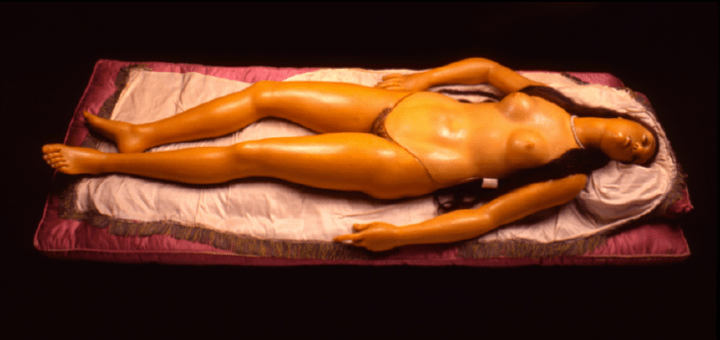
Anatomical Venus, ca. 1780, wax, Museum of Natural History in Florence
(Photo: Saulo Bambi)
◊ ◊ ◊ ◊ ◊
ASECS recently announced that the 2012-13 James L. Clifford Prize was awarded to Rebecca Messbarger for her article “The Re-Birth of Venus in Florence’s Royal Museum of Physics and Natural History” published by the Journal of the History of Collections (May 2012): 1-21.
Messbarger is the author of The Lady Anatomist: The Life and Work of Anna Morandi Manzolini (Chicago: University of Chicago Press, 2010).
Study Day | Le sens du métier: identité et organisation
From Entre art et industrie:
Le sens du métier : identité et organisation dans les métiers
d’art et d’industrie en France (XVIIe-XXe siècles)
Université Paris, 31 May 2013
 L’historiographie a longtemps fait de l’organisation corporative le pilier institutionnel du monde des métiers sous l’Ancien Régime, s’enfermant ainsi dans un débat opposant « corporatisme » et « libéralisme », et faisant des lois de 1791 l’aboutissement d’un long combat des libéraux contre le supposé archaïsme des communautés d’arts et métiers. Depuis une vingtaine d’années, cette vision ancienne a été complètement révisée : il importe de distinguer entre l’exercice d’une profession et l’appartenance à une corporation ; toutes les professions ne sont pas uniformément « instituées » en métiers corporés ; les réalités professionnelles sont bien plus diverses ; enfin, la dissolution des corporations en 1791 n’a pas supprimé tous les besoins organisationnels ou réglementaires, pas plus que les représentations identitaires des différentes professions artisanales. Ainsi, d’une part, la conscience d’une appartenance professionnelle a existé sous l’Ancien Régime en dehors de la forme corporative, et d’autre part, les identités de métier ont continué d’exister après l’abolition des corporations.
Cette journée d’études est consacrée au cas des professions d’art, qui oscillent entre « art » et « industrie » dans les représentations communes, et se situent précisément bien souvent en dehors du système corporatif : comment penser alors l’identité de métier, quand le savoir-faire ne s’incarne pas dans une forme instituée susceptible de cristalliser et manifester à la fois une appartenance collective, de découper un « eux » et un « nous » ? Quel sens, en somme, peut avoir le métier sans corporation ?
◊ ◊ ◊ ◊ ◊
9.45 Accueil, café/thé
10.00 Introduction : Philippe Minard, Audrey Millet (IDHE-Paris 8)
10:15
• Lesley Miller (Victoria and Albert Museum, Londres), Un pied dans la Grande Fabrique. Les dessinateurs de la soierie lyonnaise au XVIIIe siècle
• Audrey Millet (Université Paris 8, IDHE), Dessiner des indiennes de Pondichéry à New-York : une organisation en réseaux (XVIIe-XIXe siècles)
11.15 Discussion : Corine Maitte (Université Paris-Est-Marne-la-Vallée)
12.00 Repas sur place
13.45
• Elodie Voillot (Université Paris Ouest – INHA), Unir, promouvoir et protéger : la Réunion des fabricants de bronzes (1818-1870)
• Eugénie Briot (Université Paris-Est-Marne-la-Vallée), Inspiration vs oxydoréductions : le métier de parfumeur au XIXe siècle, entre chimie et alchimie
• Jérémie Cerman (Université Paris-Sorbonne), L’atelier de dessin industriel de Robert Ruepp, une entreprise prédominante de la Belle Époque
15.15 Discussion : Patrick Verley (Université de Genève)
Call for Papers and Session Topics | CAA and ASECS, 2014
The original May 6 deadline for paper proposals for CAA 2014 in Chicago has been extended to May 13 (thanks, Alicia, for the clarification). More information is available here»
The deadline for proposing a session at ASECS 2014 in Williamsburg has been extended until 1 June 2013. More information is available here»
New Book | Une Facétie de Fragonard
From the publisher:
Carole Blumenfeld, Une Facétie de Fragonard: Les révélations d’un dessin retrouvé (Paris: Editions Gourcuff-Gradenigo, 2013), 80 pages, ISBN: 978-2353401475, 20€.
 L’ouvrage de Carole Blumenfeld apporte un éclairage nouveau sur les talents de portraitistes de Fragonard et lève le voile sur l’identité de chacun des personnages qui se cachent derrière Diderot, La Guimard, L’Inspiration, L’étude…
Les Figures de fantaisie de Fragonard comptent parmi les œuvres les plus éblouissantes, les plus célèbres et les plus énigmatiques de l’histoire de la peinture française. La découverte d’un dessin inédit de l’artiste vient bouleverser aujourd’hui tout ce que nous savions de ces silhouettes peintes en « une heure de temps ». Il apporte la preuve indubitable qu’elles sont des portraits et non des figures imaginaires. Fragonard a en effet esquissé au crayon, sur une feuille, dix-huit de ses tableaux en marquant les noms de chacun de ses modèles. Dans de nombreux cas, il s’agit de révélations étonnantes qui contredisent des certitudes acquises au cours des années.
Available from ArtBooks.com
◊ ◊ ◊ ◊ ◊
Didier Rykner reported on the book’s discoveries for The Art Tribune (4 December 2012). . .
The Fragonard portrait which has, almost, always been known as Portrait of Diderot is in fact not a likeness of the philosopher as proven by the drawing recently auctioned off and published for the first time on 17 July on The Art Tribune by Marie-Anne Dupuy-Vachey.
However, she was not alone in immediately recognizing the probable importance of the sheet. Hubert Duchemin, a Parisian expert and dealer, along with his collaborator Lilas Sharifzadeh, also guessed its likely pedigree. At the auction, Hubert Duchemin made the final bid, a high price given the uncertainty still surrounding the work. After the sale, he turned it over for study to Carole Blumenfeld, the art historian. Now, a small book will appear on 13 December [2012] at Editions Gourcuff-Gradenigo and will reveal the very fruitful results of this research. . .
The full article is available here»
Resource | George III’s Topographical Collection at the BL
Within the British Library’s online gallery (which includes some 30,000 images), a series of online exhibitions highlight particular collections and strengths. One example, the King George III Topographical Collection, underscores how rich are the visual holdings of the British Library, notwithstanding common assumptions that all pictorial materials are now to be found at the British Museum. In fact, this collection alone include approximately 50,000 items dating from 1500 to 1824. Roughly 40% addresses the British Isles, 10% Britain’s former colonies, and a third key sites of the Grand Tour (particularly Italy, France, the Netherlands, and Germany). -CH

Nicholas Hawksmoor, West Front of the Parish Church Wapping-Stepney
pencil and ink on paper, August 1714 (London: British Library).
◊ ◊ ◊ ◊ ◊
From Peter Barber’s introduction at the BL:
Few of King George Ill’s varied interests seem to have been stronger than his fascination with geography. As a child of eleven, when he had barely learned to read, he was painted sitting next to a globe with his brother, the Duke of York. Though an unpromising pupil, George grew into one of the most cultured of English monarchs when he succeeded his grandfather at the age of twenty-two.
Topography was one of the King’s favourite studies: “he copies every capital chart,” observed a contemporary, “takes models of all celebrated fortifications, knows the soundings of the chief harbours in Europe and the strong and weak sides of most of the fortified towers.”
Scattered on shelves and tucked away in drawers of the royal palaces were a considerable number of atlases, maps, plans and charts that had been part of the working libraries of sovereigns and their consorts since the Restoration in 1660. On this foundation, George III began building his topographical collections from the mid-1760s, a period during which Britain was becoming the most prolific, and arguably the most technically skilled, producer of maps and prints in the world.
The King was well served by his librarian, Frederick Augusta Bamard, who employed agents throughout Europe in his mission to acquire large, ready-made collections as well as individual maps and atlases. As ’new found lands’ were opened up beyond Europe by commercial exploration, their territories were mapped and their place-names given the British imperial stamp: Georgia, Georgetown, King George’s Sound. Single maps and bound volumes formally presented to the King by his subjects at home and abroad, and by the occasional foreign visitor, were incorporated into his collections. . . .
The full introduction is available via the online exhibition here»
Call for Papers | European Architectural History Network Meeting 2014
Below is a selection of panels accommodating eighteenth-century topics at the 2014 EAHN conference; see the Call for Papers for more information and a full listing:
European Architectural History Network Third International Meeting
Turin, Italy, 19-21 June 2014
Proposals due by 30 September 2013
 Abstracts are invited for the sessions and round tables listed below between April 15 and September 30, 2013. Abstracts of no more than 300 words should be submitted through the conference website, along with applicant’s name, professional affiliation, title of paper or position, a short curriculum vitae, home and work addresses, e-mail addresses and telephone numbers. Sessions will consist of either five papers or four papers and a respondent, with time for dialogue and questions at the end. Each paper should be limited to a 20-minute presentation. Abstracts for session presentations should define the subject and summarise the argument to be presented in the proposed paper. The content of that paper should be the product of well-documented original research that is primarily analytical and interpretative rather than descriptive in nature.
Round tables will consist of six to eight participants and an extended time for dialogue, debate and discussion among chair(s) and public. Each discussant will have 10 minutes to present a position. Abstracts for round table debates should summarize the position to be taken in the discussion.
More information is available here»
◊ ◊ ◊ ◊ ◊
European Architecture and the Tropics
Chair: Jiat-Hwee Chang (School of Design and Environment, National University of Singapore)
Europeans have a long history of social, cultural and economic contacts and exchanges with the people of the Tropics. Although this history can be traced to an earlier time, it intensified in the past few centuries, with extensive formal and informal colonization of tropical territories by Europeans. The circulation and translation of architectural knowledge and practices between Europe and the Tropics is an inextricable part of this long and rich history.
By choosing the Tropics over other geographic categories, this session foregrounds the environmental and climatic dimensions of this history of exchange. This session will focus on how European architectural knowledge and practices were ‘acclimatized’ to the ecologies, heat and humidity of the Tropics. However, tropicalization entailed more than just environmental and climatic adaptations. Scholars in various interdisciplinary fields, particularly environmental and medical history, have shown that the tropicalization of European knowledge and practices involved social, cultural and political transformations too. David Arnold developed the concept of tropicality to suggest that tropical nature – of which climate is an important component – could be understood along the lines of Saidian Orientalism as an environmental ‘other’, deeply entwined with social, cultural, political, racial and gender alterities in contrast to the normality of the temperate zone. Tropicality is, however, not a monolithic category. Not only have the constructions of the Tropics varied with the changing social, cultural and political conditions of European colonization in the past few decades, they have also changed based on the shifting medical, environmental and other scientific paradigms of understanding the Tropics. How this climatic ‘other’ has been addressed architecturally by various actors at different historical moments has likewise been characterized by multifarious approaches.
This session invites papers that examine in a situated manner how European architecture has been tropicalized in any historical period at any tropical site. Tropicalization is of course not a one-way diffusionist process. Just as this session explores European architecture in the Tropics, the very notion of European architecture is neither immune to outside influence nor necessarily produced solely by Europeans. This session also, therefore, invites papers that explore how European architecture outside the Tropics was transformed by tropicalization and how European architecture might have been a hybrid entity coproduced by non-Europeans.
◊ ◊ ◊ ◊ ◊
How It All Began: Primitivism and the Legitimacy of Architecture in the Eighteenth and Nineteenth Centuries
Chairs: Maarten Delbeke (Faculty of Engineering and Architecture, Ghent University), Sigrid De Jong (Centre for the Arts in Society, Leiden University), and Linda Belijenberg (Centre for the Arts in Society, Leiden University)
By the turn of the eighteenth century, architects and writers questioned many of the foundations of renaissance design theory and its later developments: the role of Roman antiquity as the primary provider of architectural references; the authority of Vitruvius’ De architectura and its many editions, translations and re-workings; and also some of the very concepts that shaped this design theory, such as the idea that architecture emerged as the imitation of primitive forms of building. Challenging these authorities was not merely a matter of rejecting or reinterpreting the design principles espoused by Vitruvius or retrieved from ancient monuments. It also entailed redefining the foundations of architecture as a culturally and socially embedded artistic discipline. After all, traditional models – and primitive origins in particular – explained how architecture was enmeshed with the very fabric of society. If these authorities were challenged, new arguments had to be found explaining how architecture found its place at the centre of human culture.
In this session, we will examine one particular strain of arguments that addressed this problem: new ideas about the origins of architecture. In particular, we are interested in how the increasingly vivid debates about primitivism – the idea that any human action, institution or custom is at its purest at the moment of inception – informed new ways of thinking about architecture, its origins, and its role in society and culture. Hitherto primitivism has been considered mainly in relation to Modernism, but it emerged in the early eighteenth century as a mode of thought about the origins, meaning and legitimacy of society and cultural practices. As such, it offers a unique perspective on the still current problem of how to endow architectural forms with cultural meaning. By advocating a return to first origins, primitivism offers an alternative to history as the storehouse of architectural form and meaning. We invite papers that address the role of the quest for origins in general, and ideas on primitivism in particular, in architectural thought and practice in the eighteenth and nineteenth century. We welcome case studies about texts, buildings or oeuvres that open up wider intellectual, social and institutional contexts. We are particularly interested in how questions about origins and primitivism introduced new ideas into architectural discourse – such as the religious and symbolical, rather than the practical and tectonic origins of architecture – and configured the relation of architecture with other artistic and scientific disciplines, such as archaeology and different kinds of historiography, natural history, linguistics and ethnology. Finally, we are curious to see how the preoccupation with primitivism translated into building practice.
◊ ◊ ◊ ◊ ◊
Architects, Craftsmen, and Interior Ornament, 1400-1800
Chairs: Christine Casey (Department of History of Art and Architecture, Trinity College Dublin) and Conor Lucey (School of Art History and Cultural Policy, University College Dublin)
Is the study of interior ornament an integral part of architectural history? To date, the literature on architectural history has largely neglected the relationship between spatial form and interior ornament, resulting in the development of a sub-genre focused on interior design and decoration. Given the scale of ornament in early modern architecture across Europe, this separation of the building from its decoration militates against a holistic understanding of architecture and divides the Vitruvian triad that lay at the centre of architectural education and practice: firmitas, utilitas and venustas.
For example, in the large literature on Palladianism there has been little and discrete coverage of the interior. Perhaps the multifaceted and complex nature of interiors, mediated as they were by patron, architect and craftsman, complicates overarching historical narratives? But this separation of architecture from ornament does not reflect the real experience of buildings. Is it time to reunite these realms? Given the rehabilitation of craft in contemporary discourse, might interior ornament reclaim its place in architectural history?
Appropriately, pioneering research on Filippo Juvarra’s work in Turin provides an exemplar for broader study of the relationship between architects and craftsmen in early modern Europe.
This session aims to explore the evidence for communication and creative collaboration between architects and craftsmen, including plasterers, carvers and painters. While detailed written instructions are relatively rare, a range of other materials – such as drawings, models and building accounts – illuminates the process. To what extent were architects equipped to design ornament, and to what extent did they rely on craftsmen for ornamental design? Papers are invited that consider these issues in broad or specific terms.
◊ ◊ ◊ ◊ ◊
Public Opinion, Censorship, and Architecture in the Eighteenth Century
Chairs: Carlo Mambriani (Dipartimento di Ingegneria Civile, dell’Ambiente del Territorio e Architettura, Università di Parma) and Susanna Pasquali (Dipartimento di Architettura, Università di Ferrara)
Among the general transformations of the eighteenth century, there arose a new relationship between the press and architecture. For the first time, a space was born for the emergence of public opinion regarding architectural projects of varying scale and relevance. In those countries where the press was under direct censorship, public opinion found other outlets, such as pamphlets and anonymous letters; in all cases, though, there was evidence of a new and more critical response to changes in the built environment, replacing unrestrained praise. The aim of this session is to collect and discuss published, and unpublished, examples of the interaction between architecture and public opinion during the eighteenth century. Architecture in the periodical press, in private correspondence and in pamphlets.
Increasingly, the periodical press becomes a commercial enterprise, with direct competition between different journals and newspapers. How far was architecture – as well as other transformations of the built environment – among the themes that formed part of this process? A periodical press also develops in nations where censorship is in place. In these conditions, how exactly was architectural criticism/ debate affected? And what do other sources tell us about positions that could not be expressed in the official press?
Patronage and building type: major transformations in architecture. For works commissioned by rulers, whether kings, princes or popes, what room for criticism/opinion was there in the Eighteenth century press? What were the restrictions of censorship, either of the state, or self-imposed? What role did official Academies play in facilitating criticism? The Assembly Rooms in Great Britain, the seats of the Accademie scientifiche di dilettanti in Italy, and theatres in every nation were commissioned by collective bodies, such as the Società dei cavalieri, or similar groups of patrons. What kind of discussion developed through the projects for these buildings, and how far was that discussion open in character, involving wider public opinion? And finally, with the growth of cities, the design of open spaces and of urban-scale projects, and the emergence of competitions the European landscape changes. As new public buildings, city squares, bridges and port facilities started to appear, how were contrasting opinions on these transformations expressed? By what means, and where, did a public debate around these objects develop?
◊ ◊ ◊ ◊ ◊
Piedmontese Baroque Architecture Studies Fifty Years On
Chair: Susan Klaiber (independent scholar)
The current decade marks the fiftieth anniversary of the great flowering of studies on Piedmontese Baroque architecture during the 1960s. Proceeding from pioneering works of the 1950s such as Rudolf Wittkower’s chapter “Architecture in Piedmont” in his Art and Architecture in Italy 1600-1750 (1958), or Paolo Portoghesi’s series of articles and brief monograph on Guarini (1956), international and local scholars like Henry Millon, Werner Oechslin, Mario Passanti, and Nino Carboneri produced an impressive array of publications on the period. Some of the milestones of this scholarly output include the architecture section of the exhibition Mostra del Barocco Piemontese (1963), Andreina Griseri’s Metamorfosi del Barocco (1967), and Richard Pommer’s Eighteenth-Century Architecture in Piedmont (1967). This scholarship culminated in major international conferences on Guarini (1968) and Vittone (1970), as well as the initiation of the Corpus Juvarrianum in 1979.
This roundtable aims to commemorate the golden age of studies on Piedmontese Baroque architecture through a critical assessment of the heritage of the 1960s. Have Griseri’s and Pommer’s ‘challenging’ (Wittkower) concepts proven robust? Does a traditional geographic-stylistic designation remain fruitful for investigating a region whose two major architects built throughout Europe and whose ruling dynasty entered supraregional marriage alliances? Do recent interdisciplinary methodologies – drawing from fields like geography, sociology, or history of science – reframe the roles of agents like civic authorities, construction workers, or military engineers? Has new material evidence altered long-held assumptions? Discussion positions may directly address historiography or methodology of the 1960s, or present alternative approaches in the form of case studies or new research projects that critically engage with this historic body of scholarship on Piedmontese Baroque architecture, urbanism, and landscape.
At its previous conferences, the EAHN did not highlight the architecture of the host region in dedicated panels. Turin, however, arguably presents an ideal venue for an international roundtable with regional focus: then as now, Piedmont is a major European crossroad for cultural influences from the Italian peninsula, France and Spain, northern Europe, and the former Hapsburg empire. Piedmontese Baroque architecture continues to occupy both local and international scholars, as demonstrated by the recent series of monographic conferences in Turin on architects like Alfieri, Garove, and Juvarra organized by the Bibliotheca Hertziana together with the Venaria Reale consortium. Breaking out of these monographic constraints, this roundtable will provide an opportunity to reflect on where the field has been during the past half century, as well as where it might go in the next fifty years.
Conference | A Window on Antiquity: The Topham Collection
From the conference progamme:
A Window on Antiquity: The Topham Collection at Eton College Library
The Paul Mellon Centre for Studies in British Art, London, 17 May 2013
In collaboration with the University of Buckingham and Eton College, to accompany the exhibition Paper Palaces: the Topham Drawings as a Source for British Neo-Classicism (Eton College Library, Verey Gallery, 3 May–1 November 2013)
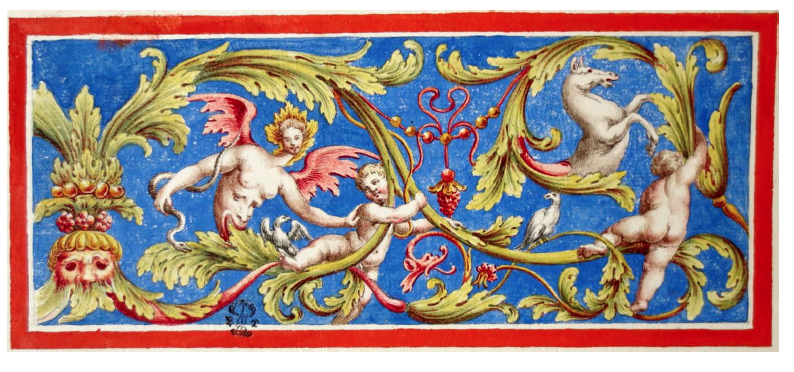
The Topham Collection
Consisting of 37 volumes and more than 3,000 items, the collection amassed by Richard Topham (1671-1730) is one of the most significant resources for the history of antiquarianism and for the culture and industry of the Grand Tour in Europe. This collection of drawings, watercolours and prints after antique sculptures and paintings in Rome and Italy is the largest of its kind assembled in England, surpassing in both scale and breadth those collected by other celebrated antiquarians such as John Talman, Dr Richard Mead or Thomas Coke, 1st Earl of Leicester.
Since its arrival at Eton in 1736 the Topham Collection has fascinated and served archaeologists, researchers investigating collections of antiquities and scholars of the history and reception of the classical tradition. The drawings have also attracted the attention of art historians, as Topham managed to assemble an extraordinary range of works by some of the best Italian draughtsmen of the first half of the eighteenth century, such as Pompeo Batoni, Giovanni Domenico Campiglia and Francesco Bartoli, or by artists who later excelled in other fields, including the architect William Kent. More recently it has also emerged that Francesco Bartoli‟s drawings of ancient ceilings and wall elevations in the collection were extensively copied and re-adapted by neo-classical architects such as Robert Adam, James Wyatt and Charles Cameron, becoming one of the most important sources for a decorative language that would spread over Europe.
However, despite the growing body of scholarship on the Topham Collection produced in recent decades, notably the work of the late Louisa M. Connor Bulman, a comprehensive study of the whole collection and of its role in eighteenth-century antiquarian and artistic culture is still wanting. This conference wishes to indicate new avenues of research and is intended as the first step towards an online catalogue of the whole collection.
◊ ◊ ◊ ◊ ◊
P R O G R A M M E
Abstracts are available here»
9:00 Registration
9:30 Lucy Gwynn (Eton College Library), Opening address and welcome
Session 1: The Topham Collection and Its Context: Antiquarianism and the Grand Tour Market
Chair: Ian Jenkins (British Museum) and Lucy Gwynn (Eton College Library)
9:50 Cinzia Maria Sicca (Università di Pisa), The Mind behind the collection: John Talman, antiquary and advisor to Richard Topham and Henry Hare, 3rd Baron Coleraine
10:20 Eloisa Dodero (Royal Collection Trust, Windsor Castle), Did Topham know of the ‘Museo Cartaceo’? The Paper Museum of Cassiano dal Pozzo and the Topham Collection of drawings
10:50 Novella Barbolani (Università di Roma La Sapienza) and Valentina Rubechini (Università di Firenze), Francesco Maria Niccolò Gabburri, John Talman and Richard Topham: artistic exchanges between Florence and Britain
11:20 Tea and Coffee
11:40 Bruno Gialluca (Independent Scholar), William Kent’s drawings after the Antique in the Topham and Holkham Collections
12:10 Lucia Faedo (Università di Pisa), The Topham Collection and the Roman palaces: British visitors to the Palazzo Barberini
12:35 Discussion
13:00 Lunch
Session 2: The Topham Collection and Its Archaeological Value
Chair: Helen Whitehouse (University of Oxford)
14:15 Mirco Modolo (Università degli Studi di Roma Tre), From philology to the market: the archaeological value of Francesco Bartoli’s drawings in the Topham Collection
14:45 Delphine Burlot (Institut National d’Histoire de l’Art-INHA, Paris), Forgeries of ancient paintings in the Topham Collection
Session 3: Richard Topham: His Library, Legacy and Influence
Chair: Richard Hewlings (English Heritage)
15:15 Paul Quarrie (Maggs Bros Ltd; Eton College Librarian 1977-1994), Richard Topham and his library
15:45 David Noy (University of Wales Trinity St David), Richard Topham’s will: a collector plans for the future
16:15 Adriano Aymonino (University of Buckingham), The Topham Collection as a source for British eighteenth-century classicism
16:40 Discussion
17:00 Drinks Reception
New Book | The Hermit in the Garden
From Oxford UP:
Gordon Campbell, The Hermit in the Garden: From Imperial Rome to Ornamental Gnome (New York: Oxford University Press, 2013), 272 pages, ISBN: 978-0199696994, £17 / $30.
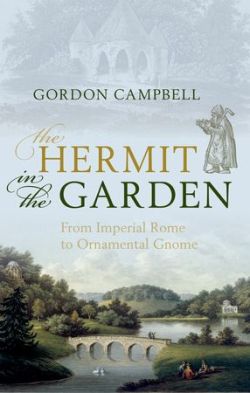 Tracing its distant origins to the villa of the Roman emperor Hadrian in the second century AD, the eccentric phenomenon of the ornamental hermit enjoyed its heyday in the England of the eighteenth century. It was at this time that it became highly fashionable for owners of country estates to commission architectural follies for their landscape gardens. These follies often included hermitages, many of which still survive, often in a ruined state.
Landowners peopled their hermitages either with imaginary hermits or with real hermits – in some cases the landowner even became his own hermit. Those who took employment as garden hermits were typically required to refrain from cutting their hair or washing, and some were dressed as druids. Unlike the hermits of the Middle Ages, these were wholly secular hermits, products of the eighteenth-century fondness for ‘pleasing melancholy’.
Although the fashion for them had fizzled out by the end of the eighteenth century, they had left their indelible mark on both the literature as well as the gardens of the period. And, as Gordon Campbell shows, they live on in the art, literature, and drama of our own day – as well as in the figure of the modern-day garden gnome.
This engaging and generously illustrated book takes the reader on a journey that is at once illuminating and whimsical, both through the history of the ornamental hermit and also around the sites of many of the surviving hermitages themselves, which remain scattered throughout England, Scotland, and Ireland. And for the real enthusiast, there is even a comprehensive checklist, enabling avid hermitage-hunters to locate their prey.
Gordon Campbell is Professor of Renaissance Studies at the University of Leicester. He is the author of the best-selling Bible: The Story of the King James Bible and of many other books on literature, art, history, and biography. A fellow of the British Academy and a former chair of the Society for Renaissance Studies, in 2012 he was awarded the Longman – History Today Trustees Award for a lifetime contribution to History. In this book his interests in cultural history, architectural history, and designed landscapes converge in a pioneering study of the phenomenon of the English ornamental hermit and his hermitage.
◊ ◊ ◊ ◊ ◊
C O N T E N T S
Introduction
1: Origins and Antecedents
2: The Idea of the Hermit
3: The Hermits
4: The Hermitage in Georgian England
5: The Celtic lands and the Continent
6: The Afterlife of the Hermit: from gnomes to Arcadia
Appendix: a Catalogue of Hermitages
Works Consulted
Index










 Enfilade
2 comments