New Book | Delftware in the Fitzwilliam Museum
From Philip Wilson’s current catalogue:
Michael Archer, Delftware in the Fitzwilliam Museum (London: Philip Wilson Publishers, 2012), 464 pages, ISBN: 978-1781300022, £55 / $95.
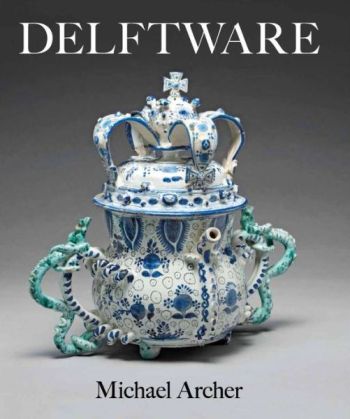 This complete catalogue of the English and Irish delftware in the Fitzwilliam Museum, Cambridge, reveals much that is beautiful and unusual. The greater part of the collection was bequeathed by Dr J.W.L. Glaisher in 1928, and much of it is little known. A detailed publication has long been overdue, and 588 items are illustrated here in colour, many with multiple views. The strength of Dr Glaisher’s collection is the English earthenware of the seventeenth and eighteenth centuries, particularly delftware: no better assemblage has ever been made by a single collector. He amassed objects with great academic rigour over a period of more than thirty years, concentrating particularly on dated pieces while always exercising a discriminating and aesthetical eye. Michael Archer’s catalogue provides details of date and place of manufacture, size, body, glaze, decoration and provenance with a full discussion where appropriate.
Julia Poole has contributed a fascinating chapter with much new material on Dr Glaisher’s life and the extraordinary breadth of his collecting interests. There is also a general introduction to delftware, including a description of the manufacturing process; further sections give indexes and exhaustive information on all the works. This book is an essential addition to the library of all scholars, collectors,auction rooms and dealers in the field and invaluable to those members of the public with an interest in the history of English pottery generally and delftware in particular.
Michael Archer, O.B.E, M.A., F.S.A. is a former Keeper of the Ceramics Department of the Victoria and Albert Museum where he becamethe acknowledged expert on English delftware. He has written numerous articles and books on ceramics, culminating in Delftware: The Tin-Glazed Earthenware of the British Isles, a catalogue of the collections inthe Victoria and Albert Museum, published in 1997.
AHRC Studentship | The Art of Longford Castle
From Birkbeck College:
Patronage, Acquisition and Display: Contextualising the Art
Collections of Longford Castle during the Long Eighteenth Century
AHRC Collaborative Doctoral Award, The National Gallery and Birkbeck College
Applications due by 5 July 2013
Applications are invited for an AHRC-funded PhD studentship researching the collecting and patronage of the Radnor family at Longford Castle during the long eighteenth century, drawing on both the collection itself and previously untapped archival material, largely housed at the Wiltshire and Swindon Record Office. The National Gallery enjoys a unique relationship with Longford Castle, which has made full access to these resources newly possible. This project will make a significant contribution to the history of taste, collecting and the country house
in the long eighteenth century.
The studentship funding is subject to final confirmation by the AHRC but will be fully funded for three years full-time (or five years part-time) and will begin in October 2013. This project will be supervised by Dr Kate Retford, Senior Lecturer in History of Art (Birkbeck College, University of London) and Dr Susanna Avery-Quash, Research Curator in the History of Collecting at the National Gallery.
More information is available here»
Symposium | The Botany of Empire in the Long Eighteenth Century
This fall at Dumbarton Oaks (as noted by Courtney Barnes at Style Court) . . .
The Botany of Empire in the Long Eighteenth Century
Dumbarton Oaks Research Library and Collection, Washington, D.C., 4–5 October 2013

◊ ◊ ◊ ◊ ◊
This two-day symposium will bring together an international body of scholars working on botanical investigations and publications within the context of imperial expansion in the long eighteenth century.
The period saw widespread exploration, a tremendous increase in the traffic in botanical specimens, significant taxonomic innovations, and horticultural experimentation. We aim to revisit these developments from a comparative perspective that will include Europe, the Ottoman Empire, Africa, Asia, and the Americas.
Main themes for discussion are global networks of plant discovery and transfer; the quest for medicinal plants and global crops such as ginseng, tea and opium; the economies of gift, trade, patronage, and scientific prestige in which plants circulated; imperial aspirations or influences as reflected in garden design; and visual strategies and epistemologies. Individual papers will explore the contributions of naturalists such as William Bartram (North America), Paul-Émile Botta (Levant), and François Le Vaillant (South Africa).
The symposium is timed to coincide with the fiftieth anniversary of the Rare Book Room at Dumbarton Oaks, and will feature an exhibit of botanical works from our collections [with an online sample already available]. Registration for the symposium is now open.
◊ ◊ ◊ ◊ ◊
From the program:
Notice sur un Voyage dans L’Arabie Heureuse: Politics and Scientific Authority in the Work of Paul-Emile Botta
Sahar Bazzaz, College of the Holy Cross
Thomas McDonnell’s Opium: Circulating Plants, Patronage and Power in Britain, China and New Zealand, 1830s-1850s
James Beattie, University of Waikato
Botanical Conquistadors: Plants and Empire in the Hispanic Enlightenment
Daniela Bleichmar, University of Southern California
Bricolage of Flowers and Gardens: Agents of Early Modernization in Ottoman Istanbul
Deniz Çalış-Kural, Istanbul Bilgi University
On Diplomacy and the Botanical Gift: France and Mysore in 1788
Sarah Easterby-Smith, University of St. Andrews
François Le Vaillant: Accidental Botanist
Ian Glenn, University of Cape Town
The Geography of Ginseng and the Strange Alchemy of Needs
Shigehisa Kuriyama, Harvard University
Humboldt’s Gifts and a Bountiful Harvest from the Tropical Lowlands of Western South America
Colin McEwan, Dumbarton Oaks
William Bartram’s Drawing of a New Species of ‘Arethusa’ (1796): The Portrait of a Life
Amy Meyers, Yale Center for British Art
Emblems of the Creation and Destruction of All Things: The Lives and Deaths of Robert Thornton’s Medical Plants
Miranda Mollendorf, Harvard University
Making ‘Mongolian’ Nature: Medicinal Plants and Qing Empire in the Long Eighteenth Century
Carla Nappi, University of British Columbia
Ornamental Exotica: Transplanting the Aesthetics of Tea Consumption
Romita Ray, Syracuse University
Visions of Empire: Eighteenth-Century Western Accounts of Chinese Gardens
Bianca Rinaldi, University of Camerino
Echoes of Empire: Redefining the Botanical Garden in Eighteenth-Century Tuscany
Anatole Tchikine, Dumbarton Oaks
New Strategies of Vision in Botanical Illustration and Botanical Art in the Eighteenth Century
Lucia Tongiorgi, University of Pisa
Colonial Williamsburg and MESDA Form Collaboration
As noted at Art Daily (4 June 2013) . . .
The two leading decorative arts institutions in the South are embarking on a new level of collaboration between their organizations. The Art Museums of Colonial Williamsburg [in Virginia] and the Museum of Early Southern Decorative Arts (MESDA) at Old Salem Museums & Gardens [in North Carolina] have entered a five-year agreement between the museums for reciprocal extended loans. The museums have already collaborated on the recently opened exhibition, Painters and Paintings in the Early American South at the Arts Museums of Colonial Williamsburg. With nine major paintings MESDA is the largest single lender to the exhibition, while select objects from the Art Museums of Colonial Williamsburg are already on display at MESDA.
In total, 40 objects from MESDA are on loan to the Art Museums of Colonial Williamsburg and, conversely, 30 objects from the Art Museums of Colonial Williamsburg to MESDA. These objects range from clocks and high chests to paintings and silver coffee pots. The collaboration is part of a five-year agreement between the museums for reciprocal extended loans. Many of the MESDA objects on loan to Colonial Williamsburg will be featured in a new, long-term exhibition opening at the DeWitt Wallace Decorative Arts Museum, one of the Art Museums of Colonial Williamsburg, in January 2014. A Rich and Varied Culture: The Material World of the Early South will feature furniture, silver, ceramics, textiles and costumes, tools, machines, architectural elements and other materials made in or imported to the South before 1840. (more…)
New Book | The Diary of Constantijn Huygens
From Brill (with thanks to Hélène Bremer for noting it — chapter 7 addresses Huygens as an art connoisseur) . . .
Rudolf Dekker, Family, Culture, and Society in the Diary of Constantijn Huygens Jr, Secretary to Stadholder-King William of Orange (Leiden: Brill, 2013), 195 pages, ISBN: 978-9004250949. €98 / $136.
 Based on analysis of a diary kept by Constantijn Huygens Jr, the secretary to Stadholder-King William of Orange, this book proposes a new explanation for the invention of the modern, private diary in the 17th century. At the same time it sketches a panoramic view of Europe at the time of the Glorious Revolution and the Nine Years’ War, recorded by an eyewitness. The book includes chapters on such subjects as the changing perception of time, book collecting, Huygens’s role as connoisseur of art, belief in magic and witchcraft, and gossip and sexuality at the court of William and Mary. Finally this study shows how modern scientific ideas, developed by Huygens’s brother Christiaan Huygens, changed our way of looking at the world around us.
Rudolf Dekker taught history at Erasmus University Rotterdam and directs the Institute for the Study of Egodocuments and History, Amsterdam. He is the author of several books, including Humour in Dutch Culture of the Golden Age (Palgrave 2001). With Arianne Baggerman he wrote Child of the Enlightenment: Revolutionary Europe Reflected in a Boyhood Diary (Brill 2005).
New Book | Newton and the Netherlands
From The University of Chicago Press (with thanks to Hélène Bremer for noting it) . . .
Eric Jorink and Ad Maas, eds., Newton and the Netherlands: How Isaac Newton was Fashioned in the Dutch Republic (Leiden: Leiden University Press, 2012), 256 pages, ISBN: 978-9087281373, $37.
 The Dutch Republic proved to be extremely receptive to the groundbreaking ideas of Isaac Newton (1643-1727). Dutch scholars such as Willem Jacob Gravesande and Petrus van Musschenbroek played a crucial role in the dissemination of Newton’s work, not only in the Netherlands, but also in the rest of Europe. With Newton and the Netherlands, editors Eric Jorink and Ad Maas collect a variety of essays that seek to contextualize Newtonian ideas within Dutch intellectual history and examine Newton’s powerful influence on his contemporaries in the Netherlands.
Eric Jorink is researcher at the Huygens Institute for Netherlands History (Royal Dutch Academy of Arts and Sciences). He is the author of Reading the Book of Nature in the Dutch Golden Age, 1575-1715 (Leiden 2010). Ad Maas is curator at the Museum Boerhaave, Leiden.
Call for Papers | Digital Art History Workshop
From the University of Leipzig:
Workshop | Art History: Research and Teaching Going Digital
University of Leipzig, 22 July — 2 August 2013
Proposals due by 15 June 2013
The 2013 European Summer School in Digital Humanities, focusing on Culture & Technology, is taking place at the University of Leipzig, 22 July-2 August 2013. It includes a workshop on “Art History: Research and Teaching Going Digital” organized by Elli Doulkaridou (PhD candidate in art history at the University of Paris I Panthéon-Sorbonne and a research assistant at the Institut national d’histoire de l’art) and Elaine Hoysted (doctoral candidate at University College, Cork). This joint workshop aims to question research and teaching practices in the field of art history in the digital age.
The first part of this course will be dedicated to investigating the challenges and opportunities that have emerged in the digital realm for scholars in art history. The second half will focus on an analysis of how these resources can be utilized as effective teaching and learning tools within the academic system. The fact that this is going to be a
joint course will allow us to focus on each theme but also bring them together during the collective discussions that will accompany the end of each course.
This workshop does not intend to propose technical training in the use of dedicated tools or encoding languages. Its purpose is to foster a collaborative reflection, in matters of art historical research and teaching methodology. We will be questioning the notion of digital art history through the study of various digital corpora, produced in different fields of art history, such as image databases, digital catalogs, scholarly critical editions, etc. Part of the course will also be dedicated to the commentary and collective debate of recent studies. (more…)
Fellowships | National Humanities Center, North Carolina
National Humanities Center Fellowships
Research Triangle Park, North Carolina, 2014-15
Applications due by 1 October 2013
 The National Humanities Center offers 40 residential fellowships for advanced study in the humanities for the period September 2014 through May 2015. Applicants must have doctorate or equivalent scholarly credentials. Young scholars as well as senior scholars are encouraged to apply, but they must have a record of publication, and new PhDs should be aware that the Center does not normally support the revision of a doctoral dissertation. In addition to scholars from all fields of the humanities, the Center accepts individuals from the natural and social sciences, the arts, the professions, and public life who are engaged in humanistic projects. The Center is also international and gladly accepts applications from scholars outside the United States.
Areas of Special Interest. Most of the Center’s fellowships are unrestricted. Several, however, are designated for particular areas of research. These include a fellowship for a young woman in philosophy and fellowships for environmental studies, English literature, art history, Asian studies, and theology. (more…)
At Auction | Liberty or Death: Relics from the American Revolution
While I generally refrain from editorializing, it seems to me that there’s something dreadful linguistically and maybe conceptually about the phrase “selling exhibition.” On the other hand, the objects included in the sale and the exhibition look interesting enough, and this is the first I’ve heard of the Museum of the American Revolution (further proof of just how much slips past me!). Robert A. M. Stern’s design plans were unveiled last June, and the museum plans to open in 2016. -CH
◊ ◊ ◊ ◊ ◊
From a Sotheby’s press release (6 June 2013) . . .
Liberty or Death: Relics from the American Revolution
Sotheby’s, New York, 1–28 June 2013

Robert A. M. Stern, Architectural Rendering for the Museum of the American Revolution in Philadelphia
Sotheby’s presents Liberty or Death: Relics from the American Revolution, an exciting cross-platform initiative in collaboration with Philadelphia’s Museum of the American Revolution. The selling exhibition features items for sale by Sotheby’s as well as objects on loan from the museum’s extraordinary collection, creating a fresh, multi-dimensional dialogue on America’s struggle for independence. The exhibition will be open to the public through 28 June 2013.
The Museum of the American Revolution will be a national institution that will chronicle the full sweep of the American Revolution – the deadly struggle between British and American forces as well as the growth of the idea of independence. Located in Philadelphia, Pennsylvania, the museum will be built steps away from where the Declaration of Independence was drafted, debated and adopted. Funds are currently being raised to build the institution. “We are delighted to collaborate with Sotheby’s to display these great treasures from our collection. Through this exhibition, people now have a rare opportunity to view these relics as they await display in the new Museum of the American Revolution,” said Michael C. Quinn, President and CEO of the Museum of the American Revolution.
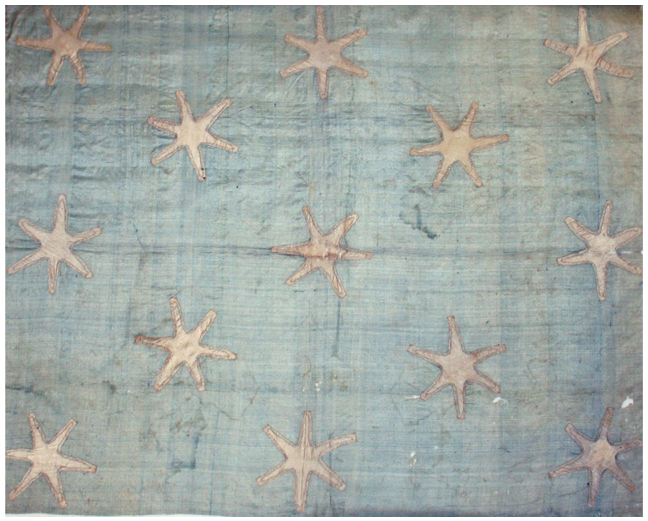
Commander in Chief’s Standard, ca. 1777-83 (Philadelphia: Museum of the American Revolution)
The distinctive thirteen-star blue silk standard circa 1777–83 that marked the presence of the Commander-in-chief on the battlefield and in headquarters is on loan from the museum and currently on view. This rectangular standard has been known for more than a century as George Washington’s Headquarters flag. It descended in the family of Washington’s sister, Betty Washington Lewis, whose son George served as an officer in the Commander-in-Chief’s guard. Also on loan from the museum are ten original silver camp cups from George Washington’s military field equipment with commemorative inscriptions. The original set of twelve cups, used to serve wine to aides and guests at the General’s table, were made in the shop of Philadelphia silversmith Edmund Milne in August 1777.
Sotheby’s selling exhibition will include a rare contemporary printing of the Declaration of Independence, the official printing for Massachusetts Bay, and a fine and rare engraved powder horn from March 22, 1770, owned by Jonathan Leonard Jr. (February 17, 1763 – January 25, 1849), a soldier in the American Revolution. The unique phrase, “Britain to Washington Shall Yield, Freedom Shall Triumph in the Field,” is engraved on the horn, paraphrased from the last verse of the highly popular song of the time, Great News from the Jerseys. Also included in the sale is the William Schuyler American horseman saber with figured maple grip, eagle pommel and original leather scabbard circa 1778–90. Opening hours are Monday – Saturday 10 am – 5pm and Sunday 1 pm – 5pm through 28 June 2013.
The Museum of the American Revolution will tell the complete story of the American Revolution. To be built in historic Philadelphia, just steps from Independence Hall and the Liberty Bell, the museum will feature a distinguished collection of objects, artifacts, artwork, and manuscripts from the period of the American Revolution that will bring to life the original “greatest generation” and engage people in the history and continuing relevance of the American Revolution.
Fellowship | Daiches–Manning Fellowship in Scottish Studies
Daiches–Manning Memorial Fellowship in 18th-Century Scottish Studies
Applications due by 1 January 2014
Co-sponsored by ASECS and the Eighteenth-Century Scottish Studies Society (ECSSS), this $3000 fellowship honors the memory of David Daiches (1912–2005) and Susan Manning (1953–2013), eminent eighteenth-century literary and cultural historians of Scotland and America, recipients of the ECSSS Lifetime Achievement Award, and directors of the Institute for Advanced Studies in the Humanities (IASH) at the University of Edinburgh. It supports at least two-six months of research on eighteenth-century Scotland as a Fellow in residence at IASH.
Eligibility: Post-doctoral scholars without regard to nationality, residence, or academic discipline. Fellows must be members of ASECS and ECSSS at the time the fellowship is awarded.
Application Procedure: Consult the websit of IASH (www.iash.ed.ac.uk) and ECSSS (www.ecsss.org)










 Enfilade
leave a comment