Exhibition | Northern Life and Landscape: Julius Caesar Ibbetson
From Temple Newsam House:
Northern Life and Landscape: Julius Caesar Ibbetson (1759–1817)
Temple Newsam House, Leeds, 12 February – 10 November 2013

Julius Caesar Ibbetson, A Phaeton in a Thunderstorm, 1798 (Leeds Museums and Art Galleries, Temple Newsam House)
This new exhibition looks at works of art made by the Leeds artist Julius Caesar Ibbetson (1759–1817) who painted life and landscape as he saw it – with little interpretation. Today Ibbetson is little celebrated but he was one of the City’s most significant eighteenth-century artists, who became well known for his pictures of rustic scenes, cattle and rural scenery.
As an artist, Ibbetson held a great passion for nature and an intrigue for human oddity, preferring to create factual observations of rural life as he experienced it. In this endeavour his contribution to British history is fascinating as, when we examine his artworks today, they expose a rare view of rural life and begin to reveal some of the realities of living and working in the north of England during the late 1700s. The exhibition brings together a loan collection of Ibbetson drawings recording aspects of his family life and a recent donation of artworks from the Estate of Helen Mackaness to Leeds Museums and Galleries.
More examples of the artist’s work are available at BBC Your Paintings»
Colonial Williamsburg Collaborates with Benjamin Moore
Up to now, Enfilade has reported on The Met’s relationship with Farrow & Ball and The Cleveland Museum of Art’s relationship with Glidden. The Colonial Williamsburg Foundation has just launched an alliance in the other direction with Benjamin Moore. My hunch is that color consultant Patrick Baty (interviewed for Enfilade in 2011 by Courtney Barnes), will see the range as emphatically leaning toward ‘trend’ rather than ‘tradition’. And yet, there are some lovely drab hues with charming names. -CH
Press release (16 May 2013) from the Colonial Williamsburg Foundation . . .

Benjamin Moore, one of North America’s most respected paint manufacturers and color authorities, has joined with the Colonial Williamsburg Foundation’s Williamsburg brand to launch the Williamsburg® Color Collection by Benjamin Moore – an assortment of paint colors authentically rooted in the history of our nation and its founding. The new, 144-color palette represents a unique intersection of history, science and design that reflects actual colors that existed in the 18th and 19th century, brought to customers through the most advanced paint technology in the industry from Benjamin Moore.
“This work showcases the close collaboration between two firms steeped in a rich heritage, both having passion for bringing history into the home,” said Carl Minchew, Benjamin Moore’s vice president of color innovation and design. “The Williamsburg® Color Collection by Benjamin Moore offers our customers beautiful shades in a palette of amazing, accurate colors that are as stylish today as they were 250 years ago.”
Colonial Williamsburg’s unparalleled research team of historians and conservators examined period documents, paint samples, wallpaper and architectural fragments that led to fresh and unexpected color findings. The Benjamin Moore team then carefully studied pigment compositions in order to precisely match these colors using the latest scientific methods to ensure the highest degree of authenticity to the original hues. As a result, the Williamsburg® Color Collection by Benjamin Moore presents vibrant yet complex shades as they appeared more than 250 years ago that can be effortlessly incorporated into the modern home.
“It has been very exciting to work with Benjamin Moore developing a paint palette based on historic precedent,” said Matthew Webster, director of the Grainger Department of Historic Architectural Resources for the Colonial Williamsburg Foundation. “Together we developed the colors using almost 90 years of paint research and an understanding of historic production methods creating a palette that embodies the Williamsburg ‘trend meets tradition’ theme. It’s personally satisfying to see research become reality with a palette that is consistent with colors that would have been found in the 18th century.”
Workshop | Synergies: The Role of Collectors, Critics, Curators
From the The University of York:
Synergies: The Role of Collectors, Critics, and Curators in Artistic Practice, c. 1780-1914
Humanities Research Centre, The University of York, 26 June 2013
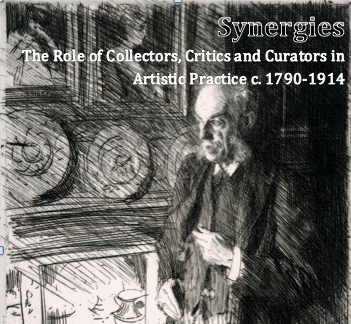 In May 1884 the art critic Marion Harry Spielmann wrote in defence of the often criticised profession of art criticism: ‘The critic – (I am not now referring to the mere notice writer of daily journalism) – spends his life in devotion not only to art but to artists: and, so far as public recognition is concerned, he reaps his reward in sneers and ‘chaff’: sneers from painters, thoughtless and irresponsible, like Mr Whistler; indifference from others less splenetic and querulous’. Spielmann, a prolific author, editor and arts administrator, was an advocate for and close friend of numerous contemporary artists. Along with the collectors and curators whom he frequently worked with and wrote about, he was an active and influential participant in contemporary art practice in late-Victorian London.
Relationships between artists, collectors, critics and curators are often considered in isolation but rarely in tandem. Drawing upon a diverse range of case studies, covering a variety of local and global contexts, this afternoon workshop aims to unpick consistencies, changes and crossovers in the sometimes fraught but often productive relationships between artists, collectors, critics and curators in the long nineteenth century. By bringing together students, early-career researchers and established academics and curators, we hope to provide an informal but stimulating forum for conversation, debate and interdisciplinary exchange about the nineteenth-century art world and its constituents.
Admission is free, but places are limited. Please email collectorscriticscurators2013@gmail.com to register.
Conference | Sensing the Sacred: Religion and the Senses
From The University of York:
Sensing the Sacred: Religion and the Senses, 1300–1800
The University of York, 21-22 June 2013
 Keynote addresses from Chris Woolgar (University of Southampton), Nicky Hallett (University of Sheffield), and Matthew Milner (McGill University)
Religion has always been characterised as much by embodied experience as by abstract theological dispute. From the sounds of the adhān (the Islamic call to prayer), to the smell of incense in the Hindu Pūjā (a ritual offering to the deities), the visual emblem of the cross in the Christian tradition, and the ascetic practices of Theravada Buddhism, sensation is integral to a range of devotional practices. At the same time, the history of many faiths is characterised by an intense suspicion of the senses and the pleasures they offer.
This international, interdisciplinary conference, to be held at the University of York will bring together scholars working on the role played by the senses in the experience and expression of religion and faith in the pre-modern world. The full conference opens on Friday 21st June, but there will be an opportunity to register early on Thursday evening, plus some informal events,
including a Workshop for Postgraduates and a walking tour of
York; see the programme for details.
Exhibitions | Old Masters, Newly Acquired
Press release (2 May 2013) from The Morgan:
Old Masters, Newly Acquired
The Morgan Library & Museum, New York, 31 May — 11 August 2013

Joseph Ducreux (1735–1802), Portrait of a Gentleman, ca. 1802; black, brown, red, and white chalk (New York: The Morgan Library & Museum, Estate of Brooke Astor)
The Morgan Library & Museum’s collection of drawings from the Renaissance to the nineteenth century has grown dramatically over the last few years. During this period, important gifts, purchases, and bequests have both augmented and transformed the museum’s holdings. More than one hundred of these new additions are being featured in an exhibition titled Old Masters, Newly Acquired. On view through August 11, the show presents major gifts from such notable collectors as former Morgan Director Charles Ryskamp, Trustees Eugene V. Thaw and Brooke Astor, and long-standing supporter Joseph McCrindle. Also exhibited are other works that have entered the collection as gifts and bequests, as well as an important group of recent purchases, including a selection of those made on the Sunny Crawford von Bülow Fund.
Particularly significant is a selection of late-nineteenth-century French drawings by such artists as Manet, Cézanne, Vuillard, and Redon, which greatly strengthen the Morgan’s holdings in Impressionist, Post-Impressionist, and Symbolist works. More than forty Danish drawings form another important group, including sheets by several Golden Age masters, among them C.W. Eckersberg and Johan Lundbye. Outstanding watercolors by British artists, notably John Martin and Samuel Palmer, reveal their mastery of the medium and virtuosity of technique. Highlights among the purchases on view include a delicate sheet of studies by Perino del Vaga, a beautiful pastel by Benedetto Luti, and a dynamic compositional study by Charles-Joseph Natoire. (more…)
Conference and Festival | Encounters, Affinities, Legacies
From the conference website:
Encounters, Affinities, Legacies: The Eighteenth Century in the Present Day
The King’s Manor, University of York, 28-29 June 2013
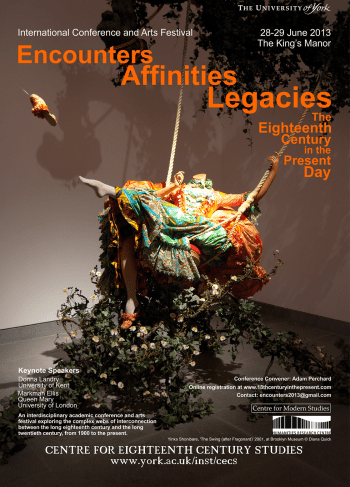 As the field of eighteenth-century studies continues to boom within the academy, the eighteenth century – invoked around names like Rousseau, Voltaire, and Adam Smith – is becoming an increasingly frequent interlocutor in contemporary debates in the international media about society, democracy, human rights, and the economy. Whilst social and political commentators are reading our present in dialogue with our eighteenth-century past, cultural appetites for the eighteenth century on page, stage, and screen continue to grow: powerful suggestions that intertwined discourses like (E)nlightenment and modernity, central to so much eighteenth- and twentieth-century thought, remain vital to the social, political and cultural construction of our contemporary moment.
This interdisciplinary academic conference and arts festival seeks to explore the complex webs of interconnection between the long eighteenth century and the ‘long’ twentieth century, from 1900 to the present.
Over the course of two days, the historic King’s Manor in the centre of York will play host to leading academics, early-career scholars, and postgraduate students from around the world, as well as showcasing the work of exciting young artists, photographers, designers, and performers from across the UK.
Exhibition | East of India: Forgotten Trade with Australia
From the Australian National Maritime Museum:
East of India: Forgotten Trade with Australia
Australian National Maritime Museum, Sydney, 1 June — 18 August 2013
 East of India tracks Australia’s colonial links with India, the power and monopoly of the English East India Company, and its inevitable decline.
It’s a tale of ships and shipwrecks, rice and rum, officers and officials, sailors, soldiers and servants – taking us from the old allure of Asia to modern-day ties between India and Australia.
The exhibition includes over 300 objects including coins, artwork, sculpture, maps, weaponry, ceramics, textiles and clothing from more than 15 local and international lending institutions will feature in the exhibition. Rarely seen artefacts include the bejewelled sword that belonged to the Indian leader Tipu Sultan, killed by East India Company forces at the battle of Seringapatam in 1799, and Indian cargo from the ship Sydney Cove wrecked en route to Australia in 1797.
◊ ◊ ◊ ◊ ◊
From the posting, “Bombay and Calcutta in Sydney” at The British Library’s Asian and African Studies Blog (22 May 2013) . . .

George Lambert and Samuel Scott, Fort William, Calcutta, ca.1731 (London: British Library, Reference: F45)
In 1732 the East India Company commissioned six seascapes of their main trading posts, which were displayed in the Director’s Courtroom of East India House in London. The resulting six paintings showed the East India Company’s trading posts at Bombay, Calcutta, Madras, Tellicherry, the Cape of Good Hope and St Helena. They conjured up the spread of imperial power inside a single room in the City of London. All six of the paintings were by George Lambert (1710-1765), and Samuel Scott (1701/2-1772). . .
281 years after they were commissioned, Lambert and Scott’s seascapes of Bombay and Calcutta have been sent to Australia’s National Maritime Museum in Sydney, where they are being exhibited in East of India: Forgotten Trade with Australia. Their inclusion in this international exhibition is incredibly significant. They were painted to symbolise the world beyond London, and centuries later, they have been sent from London to another part of the world. . .
◊ ◊ ◊ ◊ ◊
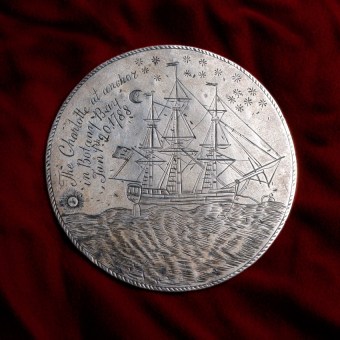
The Charlotte Medal, silver, 1788 (Australian National Maritime Museum, photograph by Andrew Frolows, ANMM)
The exhibition blog is available here»
More images are available here»
Additional information is available from an article in the Indian Herald here»
Conference | Lost Mansions and Country Estates
From the conference programme:
Lost Mansions and Country Estates
Wivenhoe House, University of Essex, Colchester, 13 July 2013

Marks Hall, Coggeshall, Essex, engraving by John Carr Armytage, 1833. The house was destroyed in 1950; the site is now an archeological excavation.
The conference will offer a broad historical context for the destruction of great houses in modern Britain, asking questions about the causes of their loss, the representation of lost mansions and estates at the time of their disappearance, and contemporary resurgent interest in the ‘great estate’. At issue will be the nature of ‘heritage’, the relevance of conservation, and our understanding of proprietorship and estate management in times of social, political and economic transformation. What was the place of the great house in local society, politics and economy, and how does this relate to the popular romanticisation of the great house from Brideshead to Downton?
◊ ◊ ◊ ◊ ◊
P A R T 1 — Wivenhoe House, University of Essex, Colchester
10:30 Registration and welcome over coffee (James Raven)
10:45 Session 1: Irish Mansions
• Terry Dooley (National University of Ireland, Maynooth): ‘The Disappearance of Irish Country Mansions, 1879-2013.’
• Ian d’Alton (Co. Kildare, Ireland): ‘An Aesthetic of Living: Bowen’s Court, Co Cork, and Its Significance in the Imagining of the Irish Gentry’
11:45 Session 2: Rescue and Ruin
• Christopher Ridgway (Castle Howard Estate, Yorkshire): ‘Castle Howard: Lost and Saved’
• Michael Davis (West of Scotland): ‘Better Off As Ruins? The Scottish Castle Restoration Debate’
12:45 Lunch
13:15 Session 3: The Country Estate and General Loss
• Jon Stobart (University of Northampton): ‘Lost Aspects of the Country Estate’
• Barbara Wood (National Trust, South West Region): ‘The Loss of Country Houses and Estates through the Destruction and Obscuring of Identity’
• John Harris (1975 exhibition organiser, London): ‘Empty Country Houses and the Destruction Exhibition in 1975’
W.M. Roberts will sign copies of his book Lost Country Houses of Suffolk during the registration and lunch periods.
P A R T 2 — Marks Hall, Coggeshall
14:45 Coaches to Marks Hall (assemble outside the main entrance to Wivenhoe House)
15:15 Tea at Marks Hall Visitor Centre
15:30 James Raven (University of Essex): ‘The Lost Mansion of Marks Hall’
16:00 Tour of the Marks Hall mansion site and estate
17:00 Discussion at Marks Hall Visitor Centre
18:00 Coaches back to University
Registration: Karen Shields, ‘International History Conference: Lost Mansions and Country Estates’, Departmental Administrator, Department of History, Room 5NW.7.20, University of Essex, Wivenhoe Park, Colchester, Essex, CO4 3SQ. Cheques payable to ‘The University of Essex’. £25; £15 for student concessions.
Exhibition | Robert Polidori, Versailles
Robert Polidori’s Versailles series is currently on view at Galerie de Bellefeuille in Montréal with some images being exhibited for the first time. In 2008, the Edwynn Houk Gallery in New York mounted a similar show, and Polidori’s three-volume Parcours Muséologique Revisité appeared from Steidl in 2009.
Robert Polidori, Versailles
Galerie de Bellefeuille, Montréal, 1-25 June 2013
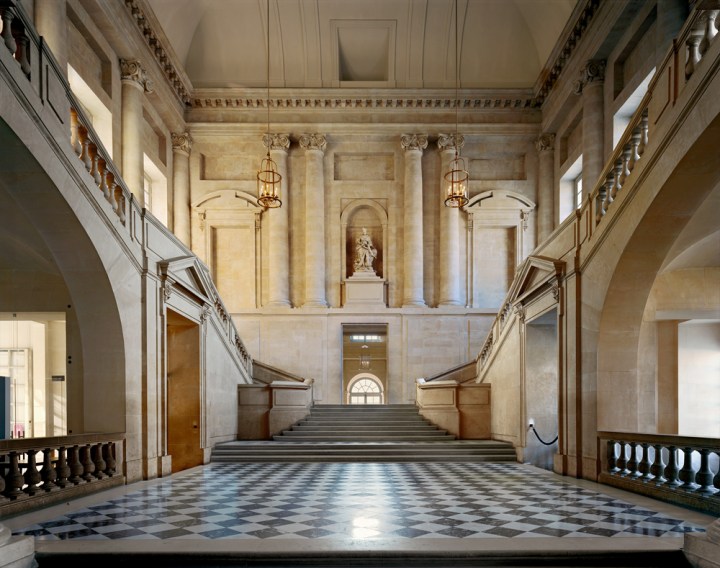
Robert Polidori, Marie Leszczinska en Junon,
MV 6595, by Guillaume Coustou, ca. 1731,
Grand Degré, Escalier Gabriel, 2007.
◊ ◊ ◊ ◊ ◊
Robert Polidori was born in Montréal, Canada, in 1951. At the age of ten he moved to the United States, where he has since remained. From 1970 to 1972 Polidori worked as an assistant to the filmmaker Jonas Mekas at the Anthology Film Archives producing a number of avant-garde films in the early 1970s. The time spent working under Mekas heavily influenced Polidori, helping to shape his unique approach to photography. In 1980 he received an M.A from the State University of New York in Buffalo, where he turned his attention to still photography.
Polidori’s career as a photographer began in earnest in the mid 1980s when he was given permission to document the historic restoration of the Château of Versailles. Since his first visit to Versailles Polidori has returned on a number of occasions, continuing a love affair that endures to this day. Working in opposition to Cartier-Bresson’s notion of the “decisive-moment,” that singular moment in which to capture a truth, Polidori prefers instead to work with the qualities of beauty and stillness of a space effected by its history and its present. As such, his conception of rooms as metaphors and vessels of memory is evident. He produces these interior shots by means of a single long exposure in natural lighting. His tonally rich and seductive photographs are the product of a view camera, long hours waiting for the right light, and careful contemplation of the camera angle. Polidori uses large-format sheet film, which he believes produces superior images to digital photography. While pursuing his career, Polidori also worked as a staff photographer with The New Yorker magazine from 1998 to 2007. (more…)
Call for Papers | Nun Artists in Early Modern Italy
Nun Artists in Early Modern Italy
Biblioteca Domenicana, Florence, 5 October 2013
Proposals due by 31 July 2013
Co-sponsored by the Medici Archive Project’s Jane Fortune Research Program on Women Artists and the Biblioteca Domenicana in Santa Maria Novella, this conference highlights new research on artistic production in female monastic communities since the early Renaissance until the Napoleonic suppression.
Demolishing older notions of enclosure as an absolute barrier between nuns and the world outside, recent research on social and religious aspects has begun to reinsert the convent within the wider networks of patronage and economic life in the early modern state, and to reposition it within larger civic and ecclesiastical discourses.
Presumably this model can also be applied to the study of nun artists. By framing research on nun artists and their activities within broader visions of society and material culture, we hope to arrive at a clearer understanding of the significance of nuns’ artistic production.
We welcome papers on a variety of topics regarding convents and their artistic production, from painting, to needlework, to carta pestata sculpture, to ephemera, to manuscript illumination. Suggested topics include but are not limited to:
• monographic studies on single artists
• studies of artistic practice in one or more female religious communities
• stylistic analysis and attributions of artworks
• studies of the visual culture of nun artists
• the role of art in the economic and patronage strategies of monastic communities
• the teaching of art in female religious communities
• comparisons between nuns’ artistic patronage their artistic production
• investigations of the relations and tensions between piety and artistic production
• historiographic studies of nun artists
Paper presentations, which must feature original research, may be given in Italian or English, and should be no longer than 20 minutes. A publication based on the conference papers is planned. Some support for travel expenses may be available. To apply, please send a one-page abstract and a brief c.v. to Dr. Sheila Barker (barker@medici.org) and Dr. Luciano Cinelli, O.P. (memorie.domenicane@gmail.com). The deadline for applications is July 31, 2013.










 Enfilade
leave a comment