Exhibitions | Edward Harley: The Great Collector
Press release from The Harley Gallery:
Edward Harley: The Great Collector
The Harley Gallery, Welbeck, Nottinghamshire, 25 May 2013 — May 2014

From opulence and obsession to debt and despair, the exhibition Edward Harley: The Great Collector follows the fortunes of the 2nd Earl of Oxford (1689-1741). Showing at The Harley Gallery from 25 May 2013, it explores Edward Harley’s background, family and marriage through his spectacular collections of fine and decorative art and books.
Lord Edward Harley was a dedicated but extravagant collector. He bought at inflated prices when the desire to possess overrode any sense of the value of the piece or the extent of his resources. In 1738 he found himself in great debt and had to sell his family home and his collections.
The son of Robert Harley, one of the most powerful politicians in the country, Edward Harley married Henrietta Cavendish-Holles – the wealthiest heiress in Britain. Harley filled his family home at Wimpole Hall with a hubbub of activity – writers, poets, artists, bibliophiles would be regular visitors. He was a dedicated collector; his collections were extensive and extravagant as he passionately sourced the rarest and most beautiful things. Harley was surrounded by the finest thinkers and the finest things.
Besides magnificent silver, curios, paintings, and other works of art, he collected English miniature portraits dating from the early 1500s to his own time. These likenesses were intended as precious, jewel-like treasures to be kept in cabinets, brought out to be admired, and then returned to safety. They could be love tokens and gifts, souvenirs between friends and family members. Being so small, they were easily portable. Some were to be designed to be worn by a loved one as a pendant or bracelet. Many of Harley’s miniatures came from branches of his and his wife’s families; others were purchased because of the distinction of the artist or the importance of the sitter. They are the work of the greatest masters in the medium.
Harley rapidly added to the library started by his father, and his collection included pivotal works such as Shakespeare’s Second Folio and Jonathan Swift’s Gulliver’s Travels. Through Harley’s dedication, the library at Wimpole Hall grew at an astonishing rate, with some 12,000 books in the collection by September 1717. By the beginning of the eighteenth century, books and pictures were needing special accommodation in more and more houses. They were to become an essential part of country-house life. It was not until the second half of the seventeenth century that rooms called libraries became more common in country houses. Informed buying of art and literature was virtually non-existent until Charles I and other members of the court circle built up their collections in the 1620s and 30s. It required leisure, knowledge and money and house design grew to accommodate the collections with libraries, picture galleries and cabinet rooms. By the end of his life in 1741 Edward Harley had amassed the largest private library in Britain, but his passion for collecting ranged far beyond books and manuscripts. Edward Harley’s library contained 50,000 printed books, 7,639 manuscripts, 14,236 rolls and legal documents, 350,000 pamphlets, 41,000 prints: “the most choice and magnificent that were ever collected” (Collins).
His wealth gradually dwindled, yet Harley continued to add to his collections, often driving up the price of objects in his lust for ownership. In this obsessive collecting, Harley bankrupted himself and spent much of his wife’s fortune, eventually selling his family home and his collections to pay his debts. The great library, started by his father and described by Dr Johnson as excelling any offered for sale, was dispersed in 1742, but the celebrated Harleian collection of manuscripts was one of the founding collections of the British Library. Harley was also a patron of contemporary writers, including Alexander Pope and Jonathon Swift and of artists and architects.
The Harley Gallery is situated in the countryside of Welbeck, a ducal estate which has been home to the Cavendish-Bentinck family for more than 400 years. Edward Harley, 2nd Earl of Oxford (1689-1741) married into this family around 1713, when he wed Lady Henrietta Cavendish–Holles, uniting one of the most politically powerful families in the country with one of the richest. Edward Harley: The Great Collector will be accompanied by a full colour publication written by Curator Derek Adlam.
The Harley Gallery has recently announced plans to build a new Gallery which will show objects from The Portland Collections, the fine and decorative art collected by this family over the centuries. These collections include many objects purchased by Edward Harley, 2nd Earl of Oxford.
Conference | 300th Anniversary of Mandeville’s Fable of the Bees
From the conference website:
Eutopia Seated in the Brain: The 300th Anniversary of
Bernard de Mandeville’s The Fable of the Bees
Coimbra University, Portugal, 27-29 November 2013
Proposals due by 5 September 2013
Dutch physician with a literary, humanist formation, Bernard de Mandeville (1670-1733) is known as a portraitist of manners, a satirist and a fine observer of socio-economic behavior. From the perspective of the literary genre, B. Mandeville was a cultivator of the satirical fable, continuing La Fontaine and P. Scarron. His moral and political thought falls into several lines of the development of the European Enlightenment. His originality was only fully recognized many centuries later. One of his criticisms is related to Shaftesbury’s appreciation of virtue and moral sense in the Characteristics. The possibility of the contribution of pleasure and virtue for the formation of the human society, emphasized again in F. Hutcheson’s Remarks upon the Fable of the Bees, was the controversial point in Mandeville’s point of view. From his peculiar idea about the combination of virtue and the pure self-interest in social behavior evolved his idea of society. The modern sense of ‘interest’ had in B. de Mandeville a former inventor. Additionally, B. Mandeville has questioned the meaning of the connection between conscious actions with defined purposes and the objective results in the market of the autonomous individual drives. His depiction of the creation of social wealth reveals the relative independence of the objective results of individual actions regarding the initial purposes of the conscious agents. Luxury was one of the subjects that B. Mandeville addressed clearly. He tried to explain the imaginary mechanisms allied to the formation of luxury in the nations that explain why luxury cannot result from actions motivated solely by virtue or vice. (more…)
Meadows Acquires Work Attributed to Juan Alonso Villabrille y Ron
Press release (29 May 2013) from the Meadows Museum in Dallas:
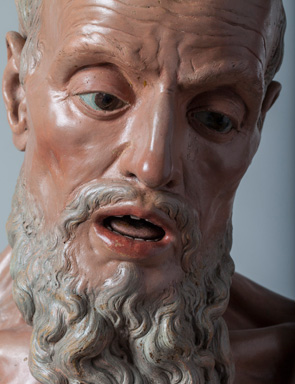
Juan Alonso Villabrille y Ron, St. Paul the Hermit (detail), ca. 1715, terracotta (Dallas: Meadows Museum, SMU)
The Meadows Museum has acquired the first terracotta sculpture attributed to Spanish Baroque master Juan Alonso Villabrille y Ron. In-depth research conducted by museum staff members sheds new light on the identity of the bust-length sculpture’s subject and its historical significance. When the sculpture was initially offered to the Museum it was believed to depict St. Jerome, Doctor of the Church. Meadows curators’ research, however, determined that the subject is in fact St. Paul the Hermit.
Villabrille y Ron is considered one of the most important Spanish sculptors of the Late Baroque period because of his mastery of technique. In addition, he taught another renowned sculptor of the period, Luis Salvador Carmona, and worked for the court in Madrid in the early eighteenth century. The quality of his work was such that he received commissions to create sculptures for some of the most important monuments in the city, such as the Puente de Toledo and the façade of the former Hospicio Provincial (now the Museo Municipal de Madrid). This sculpture is the first terracotta work to be attributed to Villabrille y Ron; not many examples of Spanish terracotta sculptures from the period have survived. Most of the works attributed to Villabrille y Ron are of polychromed wood or stone.
“Villabrille’s sculpture is a work of staggering realism and powerful emotion, and it provides an excellent complement to our already strong collection of works from the Baroque period,” said Mark A. Roglán, director of the Meadows Museum. “The acquisition of this prime example of Late Baroque sculpture will increase our ability to educate our visitors on this rich and versatile era in Spain by using objects that exemplify the style of the period. The students who use our Museum as a learning space and the visitors who come for pleasure will have an enriched experience because of this unique and beautiful example of Spanish sculpture.”
When the sculpture was initially offered to the Museum it was believed to depict St. Jerome, Doctor of the Church, who retired as a hermit to the Syrian Desert for three years’ penance. Meadows’ curators, however, took note of the subject’s prominently positioned woven reed garment, a vestment not present in any of the many other existing depictions of St. Jerome, and concluded the likeness had been misidentified. Their research determined that the subject is in fact St. Paul the Hermit, the first hermit saint of the Christian church, who is always shown as an old man wearing a woven reed garment made of palm leaves sewn together. Various experts in the field of early modern religious iconography, including George Washington University Professor Barbara von Barghahn and Richard P. Townsend, independent art historian, have confirmed the amended identification. (more…)
Updates at The William Blake Archive
30 May 2013
 The William Blake Archive is pleased to announce the publication of an electronic edition of Europe a Prophecy copy A. Only nine copies of Europe printed by Blake are extant. In 1794, the date on its title plate, Blake color printed copies B, C, D, E, F, and G; in 1795 he printed copies A and H, and in 1821 he printed copy K. All are in the Archive except copies C and F, which will be published next year to complete the history of this illuminated book. Europe consists of 18 plates, like its counterpart, America a Prophecy, produced the previous year, but most copies, including copy A, have 17 plates. Only copies H and K contain plate 3, a whimsical prefatory statement about the poem’s origin.
Europe a Prophecy was the second of Blake’s “Continental Prophecies,” followed in 1795 by “Africa” and “Asia,” the two sections of The Song of Los. Important examples of all three books—America, Europe, The Song of Los—are in the Archive. Like the other illuminated books in the Archive, the text and images of Europe copy A are fully searchable and are supported by the Archive’s Compare feature. New protocols for transcription, which produce improved accuracy and fuller documentation in editors’ notes, have been applied to copy A and to all the Europe texts previously published.
Copy A, in the Yale Center for British Art, was printed on large leaves of paper as part of a deluxe set of illuminated books, which included America copy A, The Marriage of Heaven and Hell copy D, and The Book of Urizen copy B, all in the Archive. David Bindman has raised doubts about the coloring in Europe copy A, suspecting that it may have been added by a later hand, perhaps in the twentieth century. In our opinion the coloring was done by Blake and his wife Catherine. The coloring of the frontispiece, with thick dabs of reds and blacks seemingly uncharacteristic of Blake, was probably the result of his experimenting with opaque pigments to create effects similar to his color printing. We see similar opaque reds and blacks applied in like manner in impressions of plate 8 of The Song of Los, especially in copy C. These too were printed and finished in 1795, the year Blake produced his set of 12 large color printed drawings. The color washes of some of the other plates in Europe copy A, however, appear to be by Catherine Blake (see Joseph Viscomi, Blake and the Idea of the Book, 133-34). (more…)










 Enfilade
leave a comment