Call for Papers | ISECS 2015 in Rotterdam
From the conference website:
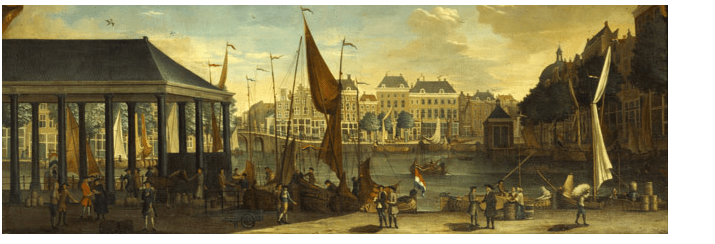
ISECS Congress 2015 | Opening Markets: Trade and Commerce in the Age of Enlightenment
Rotterdam, 26–31 July 2015
◊ ◊ ◊ ◊ ◊
The International Congress on the Enlightenment is the largest event in the field, and takes place every four years. Recent meetings have been held in Dublin (1999), Los Angeles (2003), Montpellier (2007) and Graz (2011). The 14th Congress will take place from 26 to 31 July 2015 in Rotterdam, the Netherlands. Congress facilities will be provided by Erasmus University Rotterdam, with tours and displays on local heritage coordinated by members of the Dutch-Belgian Society for Eighteenth-Century Studies.
The Congress is organized by the Organizing Committee of Dutch-Belgian Society of Eighteenth-Century Studies and is hosted by the Erasmus University Rotterdam. The Congress is preceded by an ordinary meeting of the ISECS General Assembly. Opening Markets includes theme-related sessions as well as plenary sessions featuring invited speakers. The Congress is organized into parallel sessions and round tables with keynotes elaborating on the subtopics. The Congress facilitates poster presentations. Preceding the Congress the organizers host an ISECS International Seminar for junior Eighteenth-Century scholars.
The scientific program is coordinated by an International Steering Committee made up of members of the Organizing Committee and eminent scholars from scientific institutes and universities in the world. A professional Congress Organizing Office is in charge of the practical aspects concerning the preparation, registration, communication and organization of the Congress, the accomodations for participants and the excursions and (partner)tours during and after the Congress.
The Scientific Steering Committee invites the submission of abstracts for oral and poster presentations at the Congress from January 2014. Abstracts must be submitted online by 31 December 2014. An individual may submit more than one abstract. Abstracts must not exceed 250 words. Presenters must be registered participants at the Congress. Accepted abstracts will be presented at the Congress and published in the Congress proceedings.
Additional information is available at the conference website. Also consult the first announcement of the preliminary programme, available for download as a PDF file here»
Exhibition | Artists & Amateurs: Etching in Eighteenth-Century France
Press release (3 June 2013) from The Met:
Artists and Amateurs: Etching in Eighteenth-Century France
The Metropolitan Museum of Art, New York, 1 October 2013 — 5 January 2014
Curated by Perrin Stein
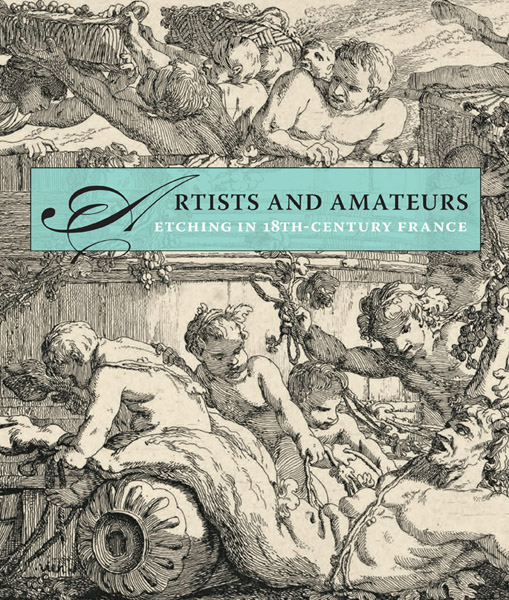 During the eighteenth century in France, a great number of artists—painters, sculptors, draftsmen, and amateurs—experimented with etching, a highly accessible printmaking technique akin to drawing. Featuring 130 works by such artists as Watteau, Boucher, Fragonard, Hubert Robert, and many others, Artists and Amateurs: Etching in Eighteenth-Century France will be the first exhibition to focus on the original etchings created by painters and amateurs in eighteenth-century France. It will present a fresh exploration of how etching flourished in ancien régime France, shedding new light on artistic practice and patronage at that time. In a period when artists strained to navigate the highly regulated Académie Royale and the increasingly discordant public spheres of the marketplace and the Salon, etching afforded them stylistic freedom and allowed them to produce exquisite works of art in a spirit of collaboration and experimentation. The exhibition will present etchings, plus a few drawings and preparatory sketches, from the Metropolitan Museum’s rich holdings, as well as loans from North American museums and private collections. The selection of prints includes a number of rare or unique examples.
While printmaking was dominated by professionals for much of its early history, the technique of soft-ground etching—where a plate was coated in varnish and could then be drawn on with a metal stylus—transformed the practice from a specialized technique practiced by an exclusive group with extensive training, to a highly accessible art form. Some artists, like Antoine Watteau and François Boucher, encountered the process within the thriving commerce of the Paris print trade, where a painter would sometimes be asked to make a preliminary sketch on a prepared copper plate to guide the professional printmaker who would later reinforce the design with engraving. Others, like Jean-Honoré Fragonard and Hubert Robert, first experimented with the technique during their student years in Rome, where Piranesi’s studio was in close proximity to the French Academy. For some, like Jean-Baptiste-Marie Pierre, etching formed a bridge with amateurs, wealthy members of the court or aristocracy who wanted to learn etching as a cultured, leisure pursuit. Because of these relationships, the making of the prints became intermingled with the collecting and studying of prints, creating an environment of cross-fertilization which led to a flourishing of the art form.
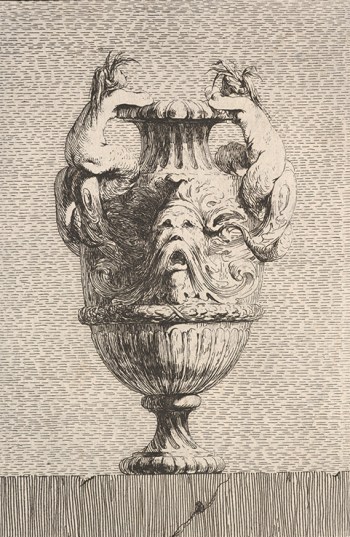
Jacques François Joseph Saly, Design for a Vase with Two Mermaids, from the “Vases” series, 1746 (NY: The Metropolitan Museum of Art)
Artists and Amateurs will highlight the freedom, spontaneity, and creativity of the medium of etching in the hands of artists and collectors. Over the course of the century, etching came to be viewed not solely as a reproduction medium, but also, as one capable of original artistic expression. As the free and improvisational aesthetic of the etching process increasingly was embraced, French artists looked to seventeenth-century masters—such as Rembrandt in the North and Salvator Rosa and Giovanni Benedetto Castiglione to the South—for inspiration. The expressive potential of the technique was also explored in a more experimental manner by artists like Gabriel de Saint-Aubin and Louis Jean Desprez, who harnessed the inky tonalities of the medium to their personal and idiosyncratic vision. The painters who felt the urge to pick up the etching needle were drawn to the freedom and accessibility of the technique, and not necessarily focused on exploiting commercial potential. Their prints tend to be rare and are valued for their qualities of expressiveness and experimentation—in many ways the opposite of the mass production and technical expertise of professional printmakers like Demarteau and Bonnet.
The exhibition will also focus on the French Academy in Rome as a setting that provided the means and freedom to explore this medium; the etchings made by amateurs, both in Rome and in Paris; and, finally, the increasing stylistic engagement with past masters. Overall there will be a balance between works of the most successful painters of the period and lesser known, but equally accomplished figures, including the work of amateurs and the working relationships between them where the influence went both ways.
The exhibition will be organized thematically and will explore how, where, and why artists first learned to etch, their occasional experimentation with marketing their prints for sale, and their technical innovations as they found new ways to manipulate the medium for individual expression. Highlights include Watteau’s Recruits Going to Join the Regiment (ca. 1715-16), Fragonard’s The Satyr’s Family (1763) and The Armoire (1778), Liotard’s Self-Portrait, Boucher’s Andromeda (1734), Gabriel de Saint-Aubin’s View of the Salon of 1753, de Boissieu’s Study of Thirteen Heads (ca.1770), and amateur Ange-Laurent de la Live de Jully’s etching after a drawing by Jacques-François-Joseph Saly of Nicolas Bremont, Cook at the French Academy in Rome (ca. 1754).
From Yale UP:
Perrin Stein, ed., Artists and Amateurs: Etching in Eighteenth-Century France (New York: The Metropolitan Museum of Art, 2013), 240 pages, ISBN: 978-0300197006, $60. With essay by Charlotte Guichard, Rena M. Hoisington, Elizabeth Rudy, and Perrin Stein.
On Site | Bratislava, Slovakia
Eighteenth-Century Encounters: Bratislava, Slovakia
By Michael Yonan
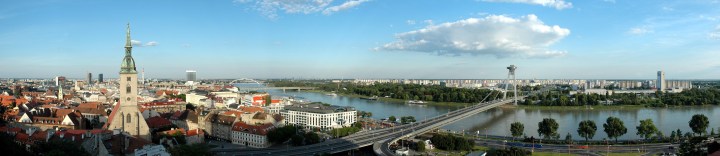
Panorama of Bratislava from the Castle
(Photo by Stano Novak, Wikimedia Commons, 2006)
◊ ◊ ◊ ◊ ◊
Bratislava? Is that in Russia?
It was a typical response to my telling friends that this year’s European peregrinations would take me to Vienna, Paris, and Bratislava. The first two need no introduction; Bratislava does. Despite being the capital and largest city of Slovakia and a cultural center in Central Europe, it is nowhere near as well known as Prague or Budapest, nearby cities with some shared history. Although Bratislava has developed in the two decades since Communism’s fall, it still feels somewhat neglected and lags behind its peers. And yet therein lies Bratislava’s considerable charm. During my week there, I was repeatedly impressed by the beauty of the old city and its many attractions for specialists of eighteenth-century art. I left convinced that it is the forgotten gem among European capitals.
 Today Bratislava is a Slovak city with an appropriately Slavic name. Its cultural history, however, is extraordinarily complex even for this region, and the city displays significant influence from its Czech, Austrian, and Hungarian neighbors. For much of its history, it was known principally by its German name, Pressburg, and it has been home to a sizeable German-speaking minority for centuries. A resident from 1777 to 1783, Franz Xaver Messerschmidt produced many of his ‘Character Heads’ while living there. Under Habsburg leadership, Bratislava was the administrative capital of Hungary, and major Hungarian noble clans – including the Esterházy, Pálffy, and the Erdődy families – built grandiose palaces. Maria Theresa was crowned King of Hungary there (that’s not a misprint: it was King of Hungary), afterward riding on horseback to a nearby hill, where with sword held aloft, she swore to defend the Hungarians against military invasion. She also renovated the local castle with rococo apartments, the most important eighteenth-century Habsburg decorative project outside of Austria. Unfortunately, the apartments burned in a fire at the castle in 1811; we know their appearance today from preparatory drawings. Unlike Budapest, which has a distinctly nineteenth-century look, central Bratislava feels firmly entrenched in earlier eras. Its winding streets, plentiful palaces, church after ornately-adorned church, and mysterious alleyways and staircases provide precisely the historical ambience many of us relish in Europe.
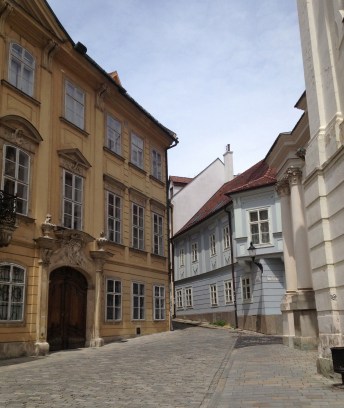
Mirbach Palace, Bratislava
As an example of its eighteenth-century architecture, there is the beautiful Mirbach Palace, located in the city center at Františkánske námestie 11. Its current name comes from a twentieth-century owner, but the building dates from 1768–1770, when the prosperous local brewer Michal Spech built for his family an impressive palatial residence that easily competes with the noble architecture nearby. The architect’s identity is unknown. What I love about this building is the beautiful rococo ornamentation incorporated onto its façade. These forms are lifted directly from prints, particularly by Cuvilliés, but they have a prominence here not always seen on eighteenth-century façades. And, interestingly, the rococo forms are kept rather abstract, with no special iconographical additions that would alert passersby to the inhabitants’ business or pedigree. Its beauty is all the more evocative by being located on a narrow cobblestoned street, a typical streetscape of central Bratislava.

Detail from Mirbach Palace, Bratislava
Inside the Mirbach Palace is the Bratislava City Art Museum, which holds a sizeable collection and mounts rotating exhibitions. Not far away is the Slovak National Gallery, Slovakia’s most important art institution. Here one can enjoy a comprehensive collection of eighteenth-century works by artists including Franz Palko, Franz Anton Maulbertsch, and Johann Michael Rottmayr.
While I’m plugging Bratislava, let me add in closing that the Slovaks give the Czechs some serious competition in the realm of beer (as explored by Mark Pickering earlier this year for The Guardian). With brewing skills of this caliber, it’s no surprise that Michal Spech could afford to build a gorgeous rococo abode.
All photos except the first, panoramic view are by the author.
Call for Papers | Prime Minister & Patron: Heinrich Count von Brühl
From the Call for Papers posted at the Bibliotheca Hertziana:
Prime Minister and Patron: Heinrich Count von Brühl (1700–1763)
Dresden and Rome, March 2014
Proposals due by 15 October 2013

◊ ◊ ◊ ◊ ◊
After attaining the Polish Crown, the Wettin Elector pursued the expansion of Dresden in order to transform it into a prestigious residence. Dresden evolved in the 18th century as a cultural centre of the Reich with outstanding art collections and a particular concentration of artists, architects, composers and singers.
The Saxon Prime Minister Heinrich Count von Brühl (1700–1763) was a key figure in this development: he has been responsible for the art collections, including the purchase of works of art, as well as the Court Theatre, the Court Opera and of the Meissen porcelain factory. He was also a close advisor of the Elector and King – and thus as “the second man in the state” – responsible for all domestic, foreign and financial matters at the Dresden court. Using the nearly unrestricted freedom of choice associated with this position for his own gain, he also built up a considerable personal fortune, which was made up of capital, farms, factories, works of art and luxury goods. (more…)
Journée d’étude | For the Love of Art, Amateurs in the Enlightenment
As noted at Le Blog de L’ApAhAu (with a PDF file of the programme available here) . . .
Pour l’amour de l’art: Les enjeux de la pratique amateur
de l’art dans l’Europe au siècle des Lumièress
Centre de la Méditerranée Moderne et Contemporaine, Campus Carlone, Nice, 13 September 2013
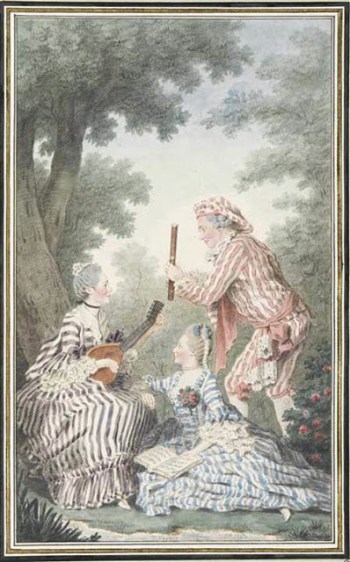 Au siècle des Lumières, le conflit qui oppose Diderot à Caylus, la figure indépendante du critique d’art face à l’amateur protecteur des artistes et juge de leur production, désormais bien étudié, est exemplaire. Dans le cadre de cette journée d’études, il ne s’agira pas de s’interroger sur la pratique de l’artiste professionnel ou semi– professionnel et sur les lieux de sociabilité qu’il fréquente, mais bien sur la pratique artistique d’un public amateur, en mettant l’accent sur le développement de ces pratiques d’amateurs comme marques de distinction sociale, culturelle et symbolique, sur les espaces sociaux et relationnels propres à l’amateurisme (hôtels particuliers, campagnes et châteaux d’agrément, villes d’eau… pourront donner lieu à des études de cas et à des études comparées), et sur la palette des arts pratiqués par ces amateurs qui jaugent leurs performances respectives (pour jouer du théâtre, il faut bien souvent savoir danser et jouer d’un instrument de musique). Cette rencontre voudrait également interroger la diffusion du modèle de l’amateur d’art dans les couches intermédiaires de la société, comme dans l’ensemble de la hiérarchie urbaine, et pas seulement dans les capitales et métropoles régionales.
Dès leur plus jeune âge, les héritiers de l’aristocratie et de ceux qui dans la haute bourgeoisie aspirent à y parvenir sont sensibilisés aux différentes formes artistiques, tant dans la sphère domestique que dans les institutions d’éducation. Cet engouement pour l’art a bouleversé sa pratique en la diversifiant et en la rendant beaucoup plus personnelle. La forme artistique s’est alors insérée dans les espaces privés et intimes de la vie des élites européennes. Cependant, dans une société où les apparences conditionnent la vie sociale, où les comportements sont réglés par des codes respectant une hiérarchie établie, la pratique désintéressée de l’art semble difficile à concevoir, car ceux qui font vivre l’art pratiquent avec maîtrise et assurance les jeux de distinction sociale que la « vie de société » recèle. Au-delà des valeurs esthétiques, par quels intérêts sont poussées ces élites dans leur pratique amateur de l’art ? Volonté de se distinguer socialement, désir de sociabilité ? Quelles logiques les conduisent à développer émulation et compétition dans la pratique amateur de l’art ? Que nous apprennent les écrits des protagonistes de ces jeux de société sur leur pratique et celle du monde dans lequel ils rivalisent ? Que nous disent-ils à travers le prisme de la pratique amateur de l’art sur les acteurs qui sont aussi les juges des performances des « sociétés » auxquelles ils appartiennent ?
Au siècle des Lumières, le conflit qui oppose Diderot à Caylus, la figure indépendante du critique d’art face à l’amateur protecteur des artistes et juge de leur production, désormais bien étudié, est exemplaire. Dans le cadre de cette journée d’études, il ne s’agira pas de s’interroger sur la pratique de l’artiste professionnel ou semi– professionnel et sur les lieux de sociabilité qu’il fréquente, mais bien sur la pratique artistique d’un public amateur, en mettant l’accent sur le développement de ces pratiques d’amateurs comme marques de distinction sociale, culturelle et symbolique, sur les espaces sociaux et relationnels propres à l’amateurisme (hôtels particuliers, campagnes et châteaux d’agrément, villes d’eau… pourront donner lieu à des études de cas et à des études comparées), et sur la palette des arts pratiqués par ces amateurs qui jaugent leurs performances respectives (pour jouer du théâtre, il faut bien souvent savoir danser et jouer d’un instrument de musique). Cette rencontre voudrait également interroger la diffusion du modèle de l’amateur d’art dans les couches intermédiaires de la société, comme dans l’ensemble de la hiérarchie urbaine, et pas seulement dans les capitales et métropoles régionales.
P R O G R A M M E
9:00 Accueil des participants
9:15 Introduction de la journée par David Rousseau et Marie Villion (Université de Nice Sophia-Antipolis, CMMC)
9:30 Alberto Frigo (Université de Caen-Basse Normandie, EA Identité et subjectivité), « La science du connaisseur »
10:05 Nadège Langbour (Université de Rouen, CEREdI), « Diderot et le paradoxe de l’amateur d’art »
10:40 Pause
11:00 Thomas Fouilleron (Archives et bibliothèque du Palais Princier de Monaco, CMMC), « Homme de goût ou goût de prince ? Jacques Ier de Monaco (1689–1751) amateur d’art »
11:35 Aude Gobet (Musée du Louvre), « De la difficile reconnaissance des amateurs d’art au sein de l’Académie des Sciences, Belles-Lettres et Arts de Rouen 1741–1791 »
12:10 Déjeuner
14:00 Thomas Vernet (Conservatoire à Rayonnement Régional de Paris), « « Cet art scientifique avoit toujours été l’amusement de récréation le plus à mon goût » – Nicolas-Louis Ledran (1687–1774), figure singulière d’un amateur de musique »
14:35 Vincent Gray (Université Toulouse II – Le Mirail, ERRAPHIS), « Le Projet concernant de nouveaux signes pour la musique et la Dissertation sur la musique moderne de Jean-Jacques Rousseau : de nouveaux signes musicaux pour un peuplede musiciens amateurs »
15:10 Pause
15:30 Michelle Garnier-Panafieu (Université Rennes 2, EA Histoire et critique des arts), « L’amateur dans la vie musicale parisienne durant la seconde moitié du XVIIIe siècle »
16:05 Isabelle Baudino (ENS Lyon, LIRE), « Les femmes artistes amateurs en Grande-Bretagne au XVIIIe siècle : une noble pratique ? »
16:40 Conclusions de la journée, Pierre-Yves Beaurepaire (Université Nice Sophia Antipolis, CMMC, Institut Universitaire de France)
Exhibition | Illuminated Palaces: Extra-Illustrated Books
Press release (15 May 2013) for the exhibition now on at The Huntington:
Illuminated Palaces: Extra-Illustrated Books from The Huntington Library
The Huntington Library, San Marino, 27 July — 28 October 2013
Curated by Stephen Tabor and Lori Anne Ferrell

Image from Mémoires du comte de Grammont (London, 1794)
with extra illustrations added by Richard Bull
◊ ◊ ◊ ◊ ◊
The eccentric art of customizing printed books by adding illustrations is the focus of a new exhibition now on view at The Huntington Library, Art Collections, and Botanical Gardens. Illuminated Palaces: Extra-Illustrated Books from The Huntington Library features more than 40 works dating from the late 1700s to the early 1900s, when the practice was most popular.
Extra-illustration is often referred to as ‘Grangerizing’, after a British clergyman named James Granger, but he did not invent the practice. In fact, extra-illustration has probably been practiced since the beginning of the printed book, says Stephen Tabor, the Huntington’s curator of early printed books and co-curator of the exhibition with Lori Anne Ferrell, English and history professor at Claremont Graduate University. But the practice did not soar in popularity until Granger published his Biographical History of England, from Egbert the Great to the Revolution in 1769. Granger’s book was essentially a catalog of portrait prints of famous English people, arranged by class—from otherwise ordinary commoners “remarkable from only one circumstance in their lives” to scientists, politicians, noblemen, kings, and queens. By creating an organized list of desiderata, Granger unwittingly motivated some collectors to illustrate copies of his own book with the portraits, setting off what one later critic called “a general rummage after, and plunder of, old prints.”
“Without intending to, he began a craze that lasted well into the 1900s, in which people would purchase a book, dismantle it, customize it with inserted illustrations, manuscripts, even other whole printed books, and reconstitute everything in a new form,” says Tabor. The practice gathered popularity at a time when wealthy Englishmen began collecting large numbers of engravings; it then caught on in America. “It’s at once fascinating and horrifying—the idea that someone would purposefully destroy a book, raid other books for illustrations, trim fine prints to size, and clip signatures of famous people in order to build their own custom creation.”
But, in fact, The Huntington has more than a thousand extra-illustrated books. Henry E. Huntington purchased most of them as part of the rare books and manuscripts he assembled in the early 20th century. Perhaps most surprisingly, says Tabor, “extra-illustrated books in the Library are home to more than 90 percent of the artwork at The Huntington. Truthfully, we’re still being surprised by what we find in these books because we’ve never had the resources to catalog them completely. That would take somebody expert in art history, manuscripts, and bibliography, and funds to keep the person on staff for many years.”
In fact, while working on the exhibition, Tabor and Ferrell discovered a pre-Revolutionary letter from George Washington to his brother Samuel. A prominent collector of American autographs bought it in 1886 and had it bound in an extra-illustrated book that Henry Huntington acquired in 1922. Soon after its rediscovery Tabor was able to bring it to the attention of a visiting editor of the ongoing Papers of George Washington project, who was delighted to have traced the missing original.
When important original works of art are found in extra-illustrated books, they are sometimes transferred from the Library to The Huntington’s art collections for cataloging and storage. A watercolor by William Blake, studies by Parmigianino, and numerous drawings by famous illustrators have turned up in the Library’s grangerized books.
Grangerizing became a matter of great intrigue for co-curator Ferrell when she was curating The Huntington’s exhibition The Bible and the People, in 2005. “It turns out that some of the most compelling of the Bibles are those that are extra-illustrated, and for obvious reasons,” she says. The blockbuster object of the Bible exhibition, she says, was the Huntington’s Kitto Bible, probably the largest Bible in the world. A 60-volume set, the Kitto was created in the mid 1800s by James Gibbs, who set out to “extra-illustrate” a regular two-volume Bible. By the time Gibbs finished his project, the Kitto Bible had expanded to hold more than 30,000 prints, engravings, and drawings, and a variety of other inserted materials. The entire Bible was displayed in the exhibition. “It’s an incredible work, absolutely astonishing,” says Ferrell. One volume of the Kitto—a massive tome containing just the books of Romans and I Corinthians—will be included in the Illuminated Palaces exhibition.
There was nothing simple or typical about how people went about the process of extra-illustration. Hobbyists went beyond illustrations to add other materials, including maps, pamphlets, original drawings, manuscripts, and news clippings. To create tidy volumes with leaves all the same size they mounted the added material, and often the leaves of the original book itself, in paper frames. But the process involved cutting and permanently altering the original material, “and for today’s book lovers and book conservators,” says Ferrell, “it’s considered a very questionable practice.” Extra-illustration, popular through the early 1900s, eventually vanished because collecting habits changed, the market for prints dropped, and the Great Depression made it impossible for most collectors to indulge this very expensive hobby.
Shakespeare has a particular appeal to grangerizers. On view in the exhibition will be one grangerized project of nine volumes of Shakespeare’s works expanded to 45. Other examples will include a rare pre-Granger example of extra-illustration, a copy of Virgil’s works from 1492, augmented 200 years later by a suite of German prints keyed to specific passages. “Faced with illustrations that were larger than the book,” says Ferrell, “the owner simply folded them to fit.”
The first and most famous of the grangerizers was a member of parliament, Richard Bull (1725–1806); he produced some 70 extra-illustrated volumes. After Granger published his Biographical History, Bull wrote to congratulate him: “I shall have pleasure in shewing you that I am endeavoring to follow your plan as near as I can.” He then went on to amass more than 14,000 prints and created, from Granger’s original work, 36 “giant bound volumes, using cuttings from the original book as the fragile thread running through the whole,” says Ferrell.
Two short videos produced by The Huntington will accompany the exhibition to help visitors get a richer sense of the ‘internal workings’ of grangerized books. Also, see this blog posting (25 July 2013) from The Huntington on how to inlay a print.
Exhibition | Useful Hours: Needlework and Painted Textiles
Press release (20 February 2013) for the exhibition now on at The Huntington:
Useful Hours: Needlework and Painted Textiles from Southern California Collections
The Huntington Library, Art Collections, and Botanical Gardens, San Marino, 1 June — 2 September 2013
Curated by Harold B. Nelson

Taking its title from a verse stitched in a 1796 sampler by 10-year-old Anne ‘Nancy’ Moulton, Useful Hours: Needlework and Painted Textiles from Southern California Collections explores the development of needlework and painted textiles in the United States in the late 18th and early 19th centuries. With a selection of 29 rare and finely wrought examples, the exhibition offers extraordinary insight into the early training, daily lives, and social and cultural values of American women during this rich period in American history.
Useful Hours includes several exceedingly rare pieces of 18th-century American needlework, drawn in large part from the collection of Victor Gail and Thomas H. Oxford, a promised gift to The Huntington, as well as from the collections of Los Angeles County Museum of Art and private lenders. The 25 surprisingly beautiful, touching, and painstakingly executed examples of American works are juxtaposed with four examples of British needlework, a related painting, American furniture, and other decorative arts objects, along with books and manuscripts from The Huntington’s collections.
“I hope visitors feel the sense of amazement that I feel when I explore these young women’s accomplishments,” said Hal Nelson, The Huntington’s curator of American decorative arts. “Their technical skill and creativity within needlework traditions of the time are truly marvelous. I also think people will be surprised when they realize these remarkable pieces are all from Southern California collections,” he added. “A common misconception is that the best American art collections are only on the East Coast, but when you see these pieces you instantly realize that is far from the case.”
Useful Hours is organized thematically, focusing on a variety of subjects, themes, and formats, including coats of arms, pictorial samplers, mourning pictures and memorials, family trees, pockets and pocket books, marking samplers (showing the basic stitches for practical domestic needs), and the relationship between needlework teachers and students. Each section of the exhibition illuminates the lives and accomplishments of the young needleworkers based on new curatorial research. (more…)
Call for Panels | College Art Association 2015, New York
I’m posting this particular call for panel proposals while wearing my hat as vice-president of the Historians of British Art. The announcement also serves as a general reminder, however, that all session ideas (in addition to those from affiliates) are due to CAA by 3 September 2013. HBA’s internal due date is Monday, 26 August. -CH
◊ ◊ ◊ ◊ ◊
HBA Session Proposals for the 2015 College Art Association Conference
New York, 11–14 February 2015
Proposals due by 26 August 2013
The Historians of British Art, an affiliate society of the College Art Association, welcomes proposals from members for its main session at the annual CAA conference in 2015 (February 11–14). Ideally, the session will accommodate a range of interests and multiple periods within the larger field of British art. Once HBA’s selection committee decides on a proposal, the individual(s) proposing the topic will need to follow the regular CAA procedures for panel submissions. Feel free to contact Craig Hanson with any questions, CraigAshleyHanson@gmail.com.
Exhibition | In the Name of the Rose: The Jacobite Rebellions
From Fairfax House:
In the Name of the Rose: The Jacobite Rebellions — Symbolism and Allegiance
Fairfax House, York, 9 August — 31 December 2013
 The Jacobite rebellions of 1715 and 1745 had a dramatic impact upon Georgian society. Shedding light on the secretive world of Jacobite allegiance during this troubled period, In the Name of the Rose uncovers the use of symbolism to convey covert messages of loyalty to the cause of the exiled Stuarts. At the heart of this exhibition lies the rose, the most potent and evocative of Jacobite symbols, inspiring faith, courage, and hope.
In association with the exhibition, Fairfax House will be hosting a one-day colloquium exploring the symbolic cultures of Jacobitism on Friday November 15, 2013.
◊ ◊ ◊ ◊ ◊
A fine Georgian townhouse, Fairfax House was originally built in 1762 as a winter home for Viscount Fairfax. Its richly decorated interiors were designed by York’s most distinguished 18th-century architect, John Carr. Converted to a cinema and dance hall during the early twentieth century, it was rescued from dereliction in the 1980s by York Civic Trust. The restored interiors are (now) beautifully complemented by Noel Terry collection of furniture, clocks, paintings and decorative arts, one of the finest private collections of its kind.
Call for Papers | Symbolic Visual Cultures of Jacobitism, 1688–1800
From Fairfax House:
Symbolic Visual Cultures of Jacobitism, 1688–1800
Fairfax House and The Hilton Hotel, York, 15 November 2013
Proposals due by 30 September 2013
 Jacobitism remains among the most evocative of British historical movements, associated with powerful currents of romanticism and nostalgia. It owes this place in the historical imagination not least to the richness of the symbolism to which this essentially covert political movement gave rise. The symbols of Jacobitism – the rose and rosebud, white ribbons and cockades, the butterfly, the sunflower, oak trees and oak leaves – have great historical and emotional significance and act as a potent focus of sentiment.
The symbolic language of the Jacobite cause is at the heart of the most significant public display of Jacobite material culture to take place for many years: the exhibition In the Name of the Rose: The Jacobite Rebellions, Symbolism & Allegiance, to be held at Fairfax House between August and December 2013. In association with this exhibition, Fairfax House will be hosting a one-day colloquium exploring the symbolic cultures of Jacobitism on Friday November 15, 2013.
The aim of this colloquium is to bring together interested parties from academic institutions, museums, libraries and other backgrounds who share an interest in the symbols associated with the Jacobite movement from its origins in the late seventeenth century to the end of the eighteenth century. Relevant topics may include (but would certainly not be limited to) the culture of Jacobite objects and images; the iconography of Jacobite symbols and emblems; the role of specific categories of material culture such as jewellery, glassware, clothing, architecture or weaponry in conveying Jacobite messages, either overt or covert; Jacobite symbols in art, music or literature. Established authorities on Jacobitism will be participating in the colloquium.
This full-day colloquium will be followed by a special guest lecture by Prof. Murray Pittock and launch of his new book at an evening reception at Fairfax House including the opportunity to see the exhibition, In the Name of the Rose.
Contributions are invited from scholars, graduate students, museum and library professionals and others, for papers not to exceed 20 minutes in length that explore any topic relevant to the field of Jacobite visual symbolism from the late seventeenth century to the end of the eighteenth century. Please submit proposals for papers (synopsis not to exceed 200 words) to: jacobitecolloquium@fairfaxhouse.co.uk










 Enfilade
leave a comment