Exhibition | Picturing America
In addition to the exhibition, the Dixon has devised a truly-inspired plan to lure visitors to the museums on Fridays: food trucks in the parking lot!
Picturing America: Signature Works from the Westmoreland Museum of American Art
Dixon Gallery and Gardens, Memphis, 4 August — 6 October 2013
Vero Beach Museum of Art, Vero Beach, Florida, 15 February — 25 May 2014
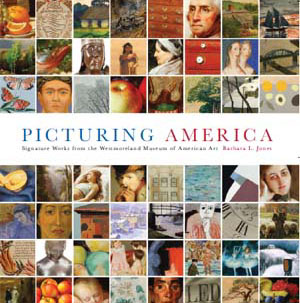 Over the past fifty years, the Westmoreland Museum of American Art, in Greensburg, Pennsylvania, has assembled a collection of works by significant American artists, concentrating on the mid-18th through the mid-20th centuries. Featuring works by John Singleton Copley, Charles Wilson Peale, and Mary Cassatt, Picturing America showcases the signature works from the museum’s collections, from preeminent American artists of the Hudson River School to modernists such as Milton Avery and Doris Lee.
Barbara Jones, Picturing America: Signature Works from the Westmoreland Museum of American Art (Greensburg, PA: Westmoreland Museum of American Art, 2010), 256 pages, ISBN: 978-0931241376, $45.
Westmoreland Museum of Art Embarks on Expansion
Press release (13 July 2013) from The Westmoreland:
 ◊ ◊ ◊ ◊ ◊
The Westmoreland Museum of American Art broke ground Friday [12 July 2013] to celebrate and begin the expansion and renovation of The Future Westmoreland. Ennead Architects of New York City and LaQuatra Bonci Associates: Landscape Architecture of Pittsburgh are working with the museum to create a new experience for visitors including a brand new wing, renovation of the existing building to have LEED silver certification, and a complete re-design of the grounds.
Pennsylvania’s First Lady Susan Corbett, Chairwoman of PA Council on the Arts, was a guest speaker at Friday’s ceremony, “The Westmoreland Museum of American Art has served as a cultural asset to downtown Greensburg and Southwestern Pennsylvania since its establishment in 1959, ” said Corbett, “The renovation and expansion of the museum will provide both visitors and residents with new ways of experiencing our American heritage.” (more…)
Call for Papers | HBA Young Scholar Session at CAA, 2014
Historians of British Art Young Scholar Session
College Art Association, Chicago, 12–15 February 2014
Proposals due by 15 August 2013
The Historians of British Art, a CAA-affiliated society, seeks papers for an upcoming mini-session of work by emerging scholars to be held during the HBA Business Meeting at CAA in Chicago (February 12–15, 2014). Current or recent graduate students are invited to submit proposals (if a Ph.D. recipient, the degree must have been earned within the past three years). Papers may address any topic related to British art, architecture, and visual culture and should be limited to fifteen minutes. This is an opportunity for informal presentations of new or ongoing research followed by open discussion.
To submit a paper for consideration, please send the following items to Jongwoo Jeremy Kim, HBA 2nd Vice President, at jongwoo.kim@louisville.edu: (1) a one page abstract; (2) a C.V. (limited to two pages).; and (3) a brief cover letter explaining interest in the field. The deadline for submission is August 15, 2013. Upon selection, each presenter will be requested to join HBA if not already a member.
Marking the 225th Anniversary of Gainsborough’s Death
When Valerie Hedquist, who’s finishing a book on the reception history of Gainsborough’s Blue Boy, recently pointed out to me that today will mark the 225th anniversary of Gainsborough’s death, I was happy to invite her to contribute a posting, even happier that she agreed. And thus here, for a brief moment, she leads us alongside the painter’s coffin towards Kew . . . –CH
◊ ◊ ◊ ◊ ◊
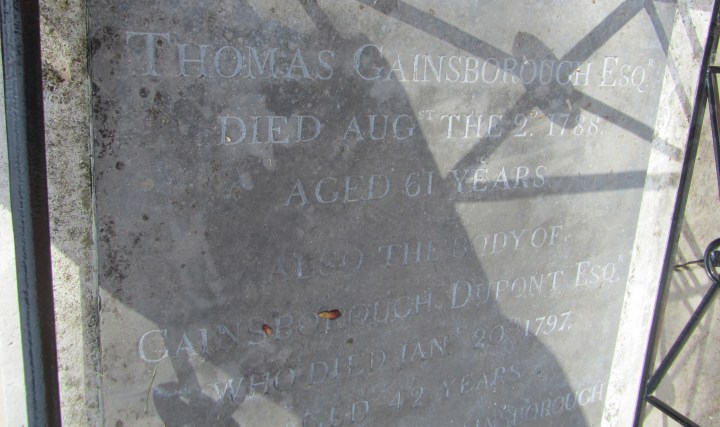
Born in 1727, Thomas Gainsborough fell ill in April 1788 and died of cancer several months later on Saturday, 2 August — 225 years ago today.
According to newspaper accounts, his death brought together “some of the most brilliant characters of the age.” Among the fifteen “few select friends” named in the obituary notice of the Whitehall Evening Post was Jonathan Buttall, regarded until recently as the subject of The Blue Boy. Along with men with connections to art, music, and theater, Buttall joined the procession of black-shrouded mourners traveling with the Gainsborough one last time as they accompanied his casket from the artist’s Pall Mall home westward to his burial plot at the Kew Green churchyard of St. Anne’s. While these individuals lived and worked in diverse London neighborhoods, their residences mostly concentrated in and around the artistic center of Soho, in contrast to the upscale West End, where Gainsborough had resided since 1774.
Who were these mourners? The surgeon and anatomist John Hunter and his neighbor, Sir Joshua; Thomas Linley and the playwright Richard Brinsley Sheridan; the American Benjamin West and the Swedish-born Scot, Sir William Chambers; the ‘father of English watercolour’ Paul Sandby; the wax portraitist Isaac Gosset and the stipple engraver Francesco Bartolozzi; the miniaturists Samuel Cotes and Jeremiah Meyer; the brother-in-law of the critic and newspaper publisher Sir Henry Bate Dudley, William Pearce; and Gainsborough’s nephew, Gainsborough Dupont, who, according to recent work by Susan Sloman, may be the actual sitter for Blue Boy.* Writing in his diary, Joseph Farington claimed it was Pearce at the artist’s bedside when he spoke his last words: “Vandyck was right.”
◊ ◊ ◊ ◊ ◊
* The most complete argument is made in Susan Sloman, “Gainsborough’s Blue Boy,” The Burlington Magazine 155 (April 2013): 231-37. Also see, Sloman, “ ’A Divine Countenance’: Gainsborough’s Portrait of His Nephew Rediscovered,” The Burlington Magazine 146 (May 2004), 319-22; and Sloman, in the exhibition catalogue Van Dyck in Britain, ed. by Karen Hearn (London: Tate Publishing, 2009).
82nd & Fifth | Mascarade à la Grecque
The latest installment of The Met’s 82nd & Fifth:
◊ ◊ ◊ ◊ ◊
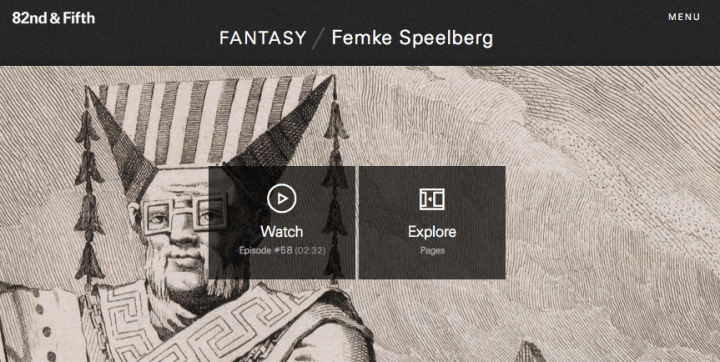
In “Fantasy” (episode #58), Femke Speelberg addresses the Mascarade à la Grecque; Suite des Vases; and [Cheminées], a series of eight etchings designed by Ennemond Alexandre Petitot, and etched and published by Benigno Bossi (1771, 1764).
Call for Papers | Museum Metaphors
From the conference website:
Museum Metaphors
University of Nottingham, 20 November 2013
Proposals due by 9 September 2013
Organised by Lucy Bradnock and Briley Rasmussen
Throughout the relatively short history of the art museum, metaphorical constructs have often been used to explain the museum’s social and cultural role, as well as to define its various protagonists. Through the metaphorical language of the museum as, for example, temple (Duncan), tomb (Adorno), laboratory (Barr), or supermarket (Warhol), artists, curators, critics, philosophers and historians have sought to read the institution of the museum as symbolic of particular cultural and social ideologies.
Against the backdrop of a growing current interest in institutional and exhibition histories, this symposium will consider the many metaphors that have been used to describe, define and theorise museums. We will also address how changes in the metaphorical language of the museum might indicate broader discursive shifts. In addition, it will ask what metaphorical constructs shape our conception of museums today. We seek proposals that address examples of museum metaphors from a range of historical, geographic, and theoretical perspective. Topics might include, but are not limited to:
• The museum metaphor in museological discourse
• The museum as metaphor in artistic practice
• Metaphor, behaviour and the museum’s publics
• Museum metaphor, modernism and postmodernism
• Metaphor and museum architecture and/or design
• Social and spatial metaphors in the museum context
• Museum metaphors in film, literature and popular culture
Please submit proposals of up to 250 words to Lucy Bradnock (lucy.bradnock@nottingham.ac.uk).
New Books | Summer Reading
With the arrival of August, many of you begin thinking about syllabi and teaching loads. If, however, you’re looking for a bit more summer reading before it all starts again, you might consider one of these books: a trio of novels and a sampling of non-fiction that might even count as research for those of you working on topics in natural history. -CH
◊ ◊ ◊ ◊ ◊
From the Peepal Tree Press:
David Dabydeen, Johnson’s Dictionary (Leeds: Peepal Tree Press, 2013), 224 pages, ISBN: 978-1845232184, $20.
 Manu, a revenant from Dabydeen’s epic poem “Turner,” leads us through 18th-century London and Demerara (in British Guiana), recounting experiences that might be dreamed or remembered. We meet slaves, lowly women on the make, lustful overseers, sodomites and pious Jews – characters who have somehow come alive from engravings by Hogarth and others. Hogarth himself turns up as a drunkard official artist in Demerara, from whom the slave Cato steals his skills and discovers a way of remaking his world. The transforming power of words is what enlightens Francis when his kindly (or possibly pederastic) master gifts him a copy of Johnson’s Dictionary, whilst the idiot savant, known as Mmadboy, reveals the uncanny mathematical skills that enable him to beat Adam Smith to the discovery of the laws of capital accumulation – and teach his fellow slaves their true financial worth. From the dens of sexual specialities where the ex-slave Francis conducts a highly popular flagellant mission to cure his clients of their man-love (and preach abolition), to the sugar estates of Demerara, Dabydeen’s novel revels in the connections of empire, art, literature and human desire in ways that are comic, salutary and redemptive.
◊ ◊ ◊ ◊ ◊
From Canongate:
Jonathan Grimwood, The Last Banquet (London: Canongate, 2013), 368 pages, ISBN: 978-0857868794, £15. [due out in North America from Europa Editions in October]
 Jean-Marie Charles d’Aumout is many things. Orphan, soldier, diplomat, spy, lover. And chef. This is his story.
We meet Jean-Marie d’Aumout as a penniless orphan eating beetles by the side of a road. His fate is changed after an unlikely encounter finds him patronage and he is sent to military academy. Despite his frugal roots, and thanks to wit and courage in great measure, he grows up to become a diplomat and spy. Rising through the ranks of eighteenth-century French society, he feasts with lords, ladies and eventually kings, at the Palace of Versailles itself.
Passion, political intrigue and international adventure abound in Jean-Marie’s life, yet his drive stems from a single obsession: the pursuit of the perfect taste. Three-Snake Bouillabaisse, Pickled Wolf’s Heart and Flamingo Tongue are just some of the delicacies he devours on his journey toward the ultimate feast. But beyond the palace walls, revolution is in the air and the country is clamouring with hunger of a different kind.
◊ ◊ ◊ ◊ ◊
From Harper Collins:
Michael Irwin, The Skull and the Nightingale: A Novel (New York: William Marrow, 2013), 416 pages, ISBN: 978-0062202352, $26.
 Michael Irwin’s The Skull and the Nightingale is a chilling and deliciously dark, literary novel of manipulation and sex, intrigue and seduction, set in 18th-century England.
When Richard Fenwick, a young man without family or means, returns to London from a Grand Tour of Europe in 1761, his godfather, James Gilbert, has an unexpected proposition. Gilbert has led a sedate life in the country, but now, in his advancing years, he feels the urge to experience, if vicariously, the extremes of human feeling—love and passion, in particular—along with something much more sinister. He asks Richard to serve as his proxy and to write to him of his city adventures, and his ward believes he has no option but to accept. It quickly becomes clear that Gilbert desires correspondence of a titillating nature—tales of carousal, seduction, and excess—and so Richard begins to write of London’s more salacious side. For here is an invitation to hedonism and Richard, eager to taste all that a privileged life has to offer, rises to the challenge.
But Gilbert’s elaborate and manipulative “experiments” into the most intimate workings of human behavior soon drag Richard into a vortex of betrayal, where lives may be ruined and tragedy is only a step away. And when Richard does the unthinkable and falls in love, the stakes are raised and he must make a defining choice. But what sort of man has he by now become?
◊ ◊ ◊ ◊ ◊
From Harvard UP:
Edward H. Burtt and William E. Davis, Alexander Wilson: The Scot Who Founded American Ornithology (Cambridge: Harvard University Press, 2013), 464 pages, ISBN 978-0674072558, $35.
 Audubon was not the father of American ornithology. That honorific belongs to Alexander Wilson, whose encyclopedic American Ornithology established a distinctive approach that emphasized the observation of live birds. In the first full-length study to reproduce all of Wilson’s unpublished drawings for the nine-volume Ornithology, Edward Burtt and William Davis illustrate Wilson’s pioneering and, today, underappreciated achievement as the first ornithologist to describe the birds of the North American wilderness.
Abandoning early ambitions to become a poet in the mold of his countryman Robert Burns, Wilson emigrated from Scotland to settle near Philadelphia, where the botanist William Bartram encouraged his proclivity for art and natural history. Wilson traveled 12,000 miles on foot, on horseback, in a rowboat, and by stage and ship, establishing a network of observers along the way. He wrote hundreds of accounts of indigenous birds, discovered many new species, and sketched the behavior and ecology of each species he encountered.
Drawing on their expertise in both science and art, Burtt and Davis show how Wilson defied eighteenth-century conventions of biological illustration by striving for realistic depiction of birds in their native habitats. He drew them in poses meant to facilitate identification, making his work the model for modern field guides and an inspiration for Audubon, Spencer Fullerton Baird, and other naturalists who followed. On the bicentennial of his death, this beautifully illustrated volume is a fitting tribute to Alexander Wilson and his unique contributions to ornithology, ecology, and the study of animal behavior.
◊ ◊ ◊ ◊ ◊
From Harvard UP:
Peter Hansen, The Summits of Modern Man: Mountaineering after the Enlightenment (Cambridge: Harvard University Press, 2013), 392 pages, ISBN 978-0674047990, $35.
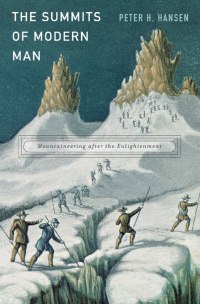 The history of mountaineering has long served as a metaphor for civilization triumphant. Once upon a time, the Alps were an inaccessible habitat of specters and dragons, until heroic men—pioneers of enlightenment—scaled their summits, classified their strata and flora, and banished the phantoms forever. A fascinating interdisciplinary study of the first ascents of the major Alpine peaks and Mount Everest, The Summits of Modern Man surveys the far-ranging significance of our encounters with the world’s most alluring and forbidding heights.
Our obsession with “who got to the top first” may have begun in 1786, the year Jacques Balmat and Michel-Gabriel Paccard climbed Mont Blanc and inaugurated an era in which Romantic notions of the sublime spurred climbers’ aspirations. In the following decades, climbing lost its revolutionary cachet as it became associated instead with bourgeois outdoor leisure. Still, the mythic stories of mountaineers, threaded through with themes of imperialism, masculinity, and ascendant Western science and culture, seized the imagination of artists and historians well into the twentieth century, providing grist for stage shows, poetry, films, and landscape paintings.
Today, we live on the threshold of a hot planet, where melting glaciers and rising sea levels create ambivalence about the conquest of nature. Long after Hillary and Tenzing’s ascent of Everest, though, the image of modern man supreme on the mountaintop retains its currency. Peter Hansen’s exploration of these persistent images indicates how difficult it is to imagine our relationship with nature in terms other than domination.










 Enfilade
leave a comment