New Book | The Scottish Town in the Age of the Enlightenment
From Edinburgh UP:
Bob Harris and Charles McKean, The Scottish Town in the Age of the Enlightenment, 1740–1820 (Edinburgh: Edinburgh University Press, 2014), 640 pages, (hardcover) ISBN: 978-0748692569, $165 / (softcover) ISBN: 978-0748692576, $50.
 This heavily illustrated and innovative study is founded upon personal documents, town council minutes, legal cases, inventories, travellers’ tales, plans and drawings relating to some 30 Scots burghs of the Georgian period. It establishes a distinctive history for the development of Scots burghs, their living patterns and legislative controls, and shows that the Scottish urban experience was quite different from other parts of Britain.
With population expansion, and economic and social improvement, Scots of the time experienced immense change both in terms of urban behaviour and the decay of ancient privileges and restrictions. This volume shows how the Scots Georgian burgh developed to become a powerfully controlled urban community, with disturbance deliberately designed out.
This is a collaborative history, melding together political, social, economic, urban and architectural histories, to achieve a comprehensive perspective on the nature of the Scottish Georgian town. Not so much a history by growth and numbers, this pioneering study of Scottish urbanization explores the type
of change and the quality of result.
Bob Harris is a lecturer in British History at the University of Oxford. He is a prolific historian who has written on many aspects of British politics and social and cultural history in the eighteenth and early nineteenth centuries. His publications include: A Patriot Press (Oxford, 1993); Politics and the Nation: Britain in the Mid-Eighteenth Century (Oxford, 2002); and Scotland in the Age of the French Revolution (Edinburgh, 2005).
The late Charles McKean was Professor of Scottish Architectural History at the University of Dundee and considered the pre-eminent historian of Scottish buildings and towns. He is author of: The Scottish Thirties: An Architectural Introduction (Scottish Academic Press, Edinburgh, 1987); For a Wee Country: Architectural Contributions to Scotland since 1840 (RIAS, Edinburgh, 1990); Edinburgh Portrait of a City (Century, London, 1993); and The Making of the Museum of Scotland (NMS, Edinburgh, 2000).
◊ ◊ ◊ ◊ ◊
C O N T E N T S
Introduction
Part I: Towns and Improvement
1 Scottish towns in context
2 Urban improvement
3 Urban embellishment and public buildings
4 A tale of five towns
Part II: Society and Culture
5 Middling ranks, homes and possessions
6 Cultural life: transformation and adaptation
7 ‘Community’, order, and the stability of the burgh
Conclusion
Appendix: Improvement Profiles
Bibliography
Index
The Art Bulletin 96 (September 2014)
In the current issue of The Art Bulletin:
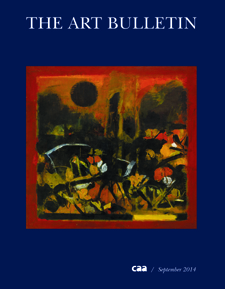 • Claudia Mattos, “Whither Art History? Geography, Art Theory, and New Perspectives for an Inclusive Art History,” pp. 259–64.
• Aaron Wile, “Watteau, Reverie, and Selfhood,” pp. 319–37.
Watteau’s fêtes galantes break with key aspects of academic art theory in early eighteenth-century France—particularly as put forward by Roger de Piles—to elicit an experience of reverie in the spectator. Watteau’s formal innovations inaugurated a new relationship between painting and beholder that opened up a new sphere of subjective experience, linking the artist’s enterprise with the rise of modern interiority.
• Ebba Koch, Review of Santhi Kavuri-Bauer, Monumental Matters: The Power, Subjectivity, and Space of India’s Mughal Architecture (Duke UP, 2011), pp. 362–65.
New Book | Paintings in the Collection of the Society of Antiquaries
Forthcoming from Brepols:
Jill Franklin, Bernard Nurse, and Pamela Tudor-Craig, Catalogue of Paintings in the Collection of the Society of Antiquaries of London (Turnhout: Harvey Miller, 2014), 520 pages, ISBN: 978-1909400191, $285 / 200€.
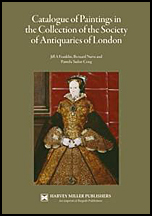 The paintings owned by the Society of Antiquaries of London are important for the quality of some of the individual paintings and for the collection as a whole. Before England’s National Portrait Gallery was founded, the Society pioneered the study of royal portraiture, seeking to establish the true likenesses of the Tudor and Plantagent monarchs and some of their continental counterparts. In the words of Sir Roy Strong, the Society’s early portraits are “of the utmost national importance … next to the Royal Collection, the most important series of early sixteenth-century royal portraits to survive as a group.” They are joined in this scholarly catalogue raisonée by works that have been exhibited in Europe’s major museums: among them are Hans Eworth’s portrait of Mary I, Simone dei Crocifissi’s Dream of the Virgin, an outstanding example of fourteenth-century Bolognese Gothic art now on long-term loan to the National Gallery, and portraits of Daniel and Rebecca Minet by Thomas Gainsborough. This fully illustrated catalogue, wedded to meticulous scholarship and the results of the latest scientific dating techniques, ensures that the art historical world now has access to art that will be studied and discussed for many years to come.
Colloquium | Smyrna: The Eye of Asia

William Pars, Sepulchral Monument at Mylasa, 1765
◊ ◊ ◊ ◊ ◊
From The British Museum:
The British Museum Classical Colloquium | Smyrna: The Eye of Asia
The British Museum, London, 5–6 December 2014
This colloquium over two days, in honour of Charles Sebag-Montefiore, will celebrate the 250th anniversary of the first Ionian expedition to the west coast of Turkey, commissioned by the Society of Dilettanti. The travellers were to settle at Smyrna, modern Izmir, the home of the Levant Trading Company, traditionally an international centre for foreigners travelling in the Ottoman world. Together with its unscheduled sequel in mainland Greece, the expedition was one of the most important cultural enterprises of the 18th century. It comprised a team of three talented men: the Classical scholar Richard Chandler, the architect Nicholas Revett, and the young painter and draughtsman William Pars. The published record of their experience had far- reaching consequences for modern understanding of Classical Turkey.
◊ ◊ ◊ ◊ ◊
F R I D A Y , 5 D E C E M B E R 2 0 1 4
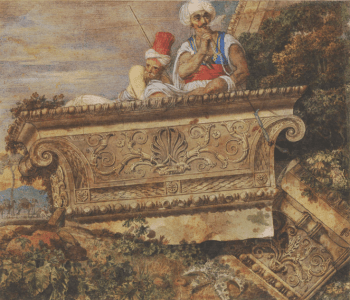
Pilaster capitals from the Temple of Apollo at Didyma, drawn by William Pars, 1765 (London: British Museum)
Starting at 5:30, two lectures and a musical performance:
Compound Eyes: A ‘Prehistoric’ Perspective on Mediterranean Cosmopolitanism,
Professor Cyprian Broodbank (John Disney Professor of Archaeology, McDonald Institute, University of Cambridge)
Smyrna: The Eye of Asia, Dr Philip Mansel (Institute of Historical Research)
Reception, book signing and musical performance by PAKAW!
S A T U R D A Y , 6 D E C E M B E R 2 0 1 4
9.30 Registration
10.00 Welcome and opening remarks by Lesley Fitton (Department of Greece and Rome, British Museum)
10.15 This Wonderful Day, Ian Jenkins (Department of Greece and Rome, British Museum)
10.30 A New Species of Human Being, Tuğba Tanyeri Erdemir (Centre for Science and Society, Science and Technology Museum, Middle East Technical University, Ankara)
11.30 Coffee
12.00 The Society of Dilettanti and Mediterranean Archaeology in the Eighteenth Century, Jason Kelly (Director, Indiana University-Purdue University Indianapolis Arts and Humanities Institute, Associate Professor of British History, IUPUI)
12.30 Travels with Richard Chandler, Alastair Blanshard (School of History, Philosophy, Religion & Classics, The University of Queensland)
13.15 Lunch
14.30 Chandler the Epigrapher, Robert Pitt (Athens)
15.00 The Troad, Lesley Fitton (Department of Greece and Rome, British Museum)
15.30 Quorum Pars Magna Fui: The Role of William Pars, Kim Sloan (Department of Prints and Drawings, British Museum)
16.00 Discussion and concluding remarks by Charles Sebag-Montefiore
Throughout the break periods a captioned slide show of William Pars drawings assembled by Celeste Farge will play in the auditorium.
New Book | Moving Pictures: Intra-European Trade in Images
Available from ArtBooks.com:
Neil De Marchi and Sophie Raux, eds., Moving Pictures: Intra-European Trade in Images, 16th–18th Centuries (Turnhout: Brepols, 2014), 340 pages, ISBN: 978-2503548081, $135 / 91€.
 This collection examines the volume, contexts, and mechanisms of trade in visual images in Early Modern Europe. Focusing overtly on the internal dynamics and links between art markets in the Early Modern period, it presupposes that art objects—here visual images—are objects of desire. During this period, however, desire changed; a great deal more of these objects came to be made for ordinary domestic consumption, including devotional purposes, than as tokens of the magnificence, piety, cultivation, or learning of individual commissioners. Probably most still were commissioned, but to satisfy tastes that, though differentiated internationally, were widely shared within one country or region. Most too were commissioned at a distance, by agents, and were moved between maker and end-point distributor by specialised traders, many of whom—though far from all—were large-scale operators. The dominant focus of contributors here is therefore on the agents of this distance trade, its mechanisms, and its impacts in terms of both satisfying and subtly shaping tastes at a range of prices. Measurement and mappings are aspects of this traffic. Focus was sharpened by concentrating on three questions: what is currently known about the number of images, whether in the form of paintings, prints, small sculptures or woven textiles, that circulated in early modern Europe? Through what channels and networks were they distributed? And what were the economic, social and institutional contexts?
Neil De Marchi is Professor of Economics at Duke University. His recent writing has been on the circumstances in which key players in contemporary art markets operate and the behaviours that stem from these constraints.
Sophie Raux is Associate Professor of Early Modern Art History at the University of Lille (France). Her research focuses mostly on the circulation and consumption of images and art objects in the Southern Low Countries and France.
◊ ◊ ◊ ◊ ◊
C O N T E N T S
• K. Brosens, Quality, Risk and Uncertainty and the Market for Brussels Tapestry, 1450–1750
• N. De Marchi (et al), Supply-Demand Imbalance in the Antwerp Painting Market, 1630–1680
• M. Szanto, The Pont Notre-Dame, Heart of the Picture Trade in France, 16th–18th Centuries
• S. Raux, Circulation, Distribution and Consumption of Antwerp Paintings in the Markets of the Southern Netherlands and Northern France, 1570–1680
• C. Rasterhoff, The Zeeland Connection: The Art Trade between the Northern and Southern Netherlands during the Seventeenth Century
• N. Gozzano, From Flanders to Sicily: The Network of Flemish Dealers in Italy and the International Art Market in the Seventeenth Century
• I. Cecchini, Going South: The Space for Flemish Art Dealers in Seventeenth-Century Northern Italy
• P. Michel, Paris, Market of Europe: Russian and English Buyers on the Paris Market in the Second Half of the Eighteenth Century
• C. Guichard, Small Worlds: The Auction Economy in the Late Eighteenth-Century Paris Art Market
• B. Miyamoto, Bidding as a Guide to British Visual Preference: A Late Eighteenth-Century Case Study
• D. Lyna, Towards an Integrated Market? The Austrian Netherlands and the Western European Trade in Pre-Owned Paintings, 1750–1800
Call for Articles | Rhetorics of Landscape: Court and Society
From H-Asia:
Rhetorics of Landscape: Court and Society in the Early Modern World
Proposals due by 21 November 2014
I am seeking targeted contributions for an edited volume exploring the role of landscape in the articulation and expression of imperial and elite identities and the mediation of relationships between courts and their many audiences across the early modern world. Through a series of focused studies from Asia, the Islamic world, and Europe, the volume seeks to illuminate how early modern courts and societies shaped, and were shaped by, the landscape, including both physical sites, such as gardens, palaces, cities and hunting parks, and conceptual ones, such as those of frontiers, idealized polities, and the cosmos. Please see description of the volume rationale below.
Proposals focusing on landscapes from all regions in Asia from the 16th to the 19th century are welcome. Areas of particular interest include, but are by no means limited to, Ming and Qing China; Choson Korea; Tokugawa Japan; pre-colonial Southeast Asia; the Mughal empire; Rajput states; the Ottomans, and Central Asian states. The volume is in preparation for submission to a US-based university press and will be peer-reviewed. Finished essays should be approximately 6,000–9,000 words inclusive of notes.
Potential contributors should plan on submitting a first draft for internal editing and comments by the end of January 2015, with drafts for peer review by 1 April 2015 (there may be some flexibility around deadline; please be in touch if you are interested but need a different schedule). Interested scholars should submit a proposal of 250–500 words and CV by Friday 21 November 2014, to stephen.whiteman@sydney.edu.au. Questions and comments are also welcome.
Stephen Whiteman
Department of Art History & Film Studies
The University of Sydney
New Book | Delicious Decadence
From Ashgate:
Christoph Vogtherr, Monica Preti, and Guillaume Faroult, eds., Delicious Decadence: The Rediscovery of French Eighteenth-Century Painting in the Nineteenth Century (Aldershot: Ashgate, 2014), 210 pages, ISBN: 978-1472449214, £55 / $100.
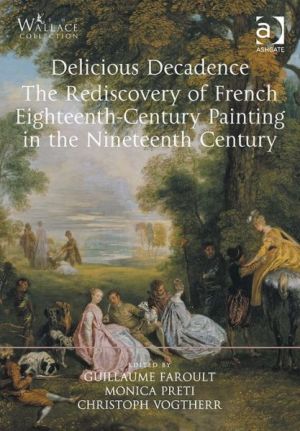 The history of collecting is a topic of central importance to many academic disciplines, and shows no sign of abating in popularity. As such, scholars will welcome this collection of essays by internationally recognised experts that gathers together for the first time varied and stimulating perspectives on the nineteenth-century collector and art market for French eighteenth-century art, and ultimately the formation of collections that form part of such august institutions as the Louvre and the National Gallery in London. The book is the culmination of a successful conference organised jointly between the Wallace Collection and the Louvre, on the occasion of the acclaimed exhibition Masterpieces from the Louvre: The Collection of Louis La Caze. Exploring themes relating to collectors, critics, markets and museums from France, England and Germany, the volume will appeal to academics and students alike, and become essential reading on any course that deals with the history of collecting, the history of taste and the nineteenth-century craze for the perceived douceur de vivre of eighteenth-century France. It also provides valuable insight into the history of the art markets and the formation of museums.
Christoph Martin Vogtherr has been Director of the Wallace Collection since 2011 and was previously Curator of Pictures pre-1800. Before joining the Collection he was Paintings Curator at the Foundation of Prussian Palaces and Gardens, Potsdam, Germany (1998–2007). In 2010 he published the catalogue raisonné of paintings by Watteau, Pater and Lancret in Berlin and Potsdam and, more recently, on Antoine Watteau, French eighteenth-century collecting and the Fête galante.
Monica Preti is an art historian who received her PhD in History and Civilization at the European University Institute (Fiesole, Florence). She is a former Research fellow at the Institut national d’histoire de l’art (Paris), and since 2006 she is Head of Academic Programs (History of Art and Archeology) at the Louvre’s Auditorium. Her research focuses on the history of taste, collections and museums in the eighteenth and nineteenth centuries.
Guillaume Faroult is Senior Curator at the Musée du Louvre in charge of French Paintings of the Eighteenth Century and British Paintings. He has curated many major exhibitions in these fields and in 2007 edited a catalogue raisonné of the paintings (mostly French of the eighteenth century) from the collection of Louis La Caze, now at the Louvre. He has published extensively about David, Fragonard and French eighteenth- and nineteenth-century collecting.
◊ ◊ ◊ ◊ ◊
C O N T E N T S
• Introduction, Christoph Martin Vogtherr
• The ‘rediscovery’ of 18th-century French painting before La Caze: Introductory notes, Monica Preti
• The taste for 18th-century painting and art market between 1830 and 1860 as regards the La Caze collection, Marie-Martine Dubreuil
• Watteau and Chardin, ‘the two most truly painters of the entire French School’: The rediscovery of Watteau and Chardin in France between 1820 and 1860, Guillaume Faroult
• Collectors of 18th-century French art in London: 1800–1850, Jon Whiteley
• ‘Elegant depravity and irresponsible gaiety’: The Murray of Henderland Collection and the Scottish taste for French 18th-century art, Frances Fowle
• ‘Ah! Que c’est francais!’: Thoré-Bürger and 18th-century French art, Frances Suzman Jowell
• Aesthetic, economic and political issues of the 1860 exhibition: Paintings of the French School from private collections, Pauline Prévost-Marcilhacy
• Early exhibitions of French 18th-century art in Berlin and the birth of Watteau research, Christoph Martin Vogtherr
• The National Gallery in the 19th century and French 18th-century painting, Humphrey Wine
• French 18th-century painting in England and the opening of the Wallace Collection, Stephen Duffy
Call for Papers | MAHS in the Twin Cities, 2015
I’m glad to put in a good word for MAHS, an organization that far exceeds common expectations of a regional society. Particularly because of its commitments to bringing together scholars from both the museum world and the academy, the organization fills a vital need within the field of art history in America. Conference participants will be in for a treat with the Minneapolis Institute of Arts’ hosting the exhibition Habsburg Splendor: Masterpieces from Vienna’s Imperial Collections during the event. The program will include general sessions on ‘Architecture’, ‘American Art’, ‘Latin American Art’, and ‘Nordic Art’; thematic sessions addressing ‘Midwest Collections’, ‘Representing Non-European Religions in Early Modern Europe’, ‘Clothing, Textiles, and Fiber’, ‘Decorative Arts and Design’, ‘Gender and Sexuality’, and ‘Prints and Drawings’; along with period panels on ‘Seventeenth- and Eighteenth-Century Art’ and ‘Nineteenth-Century Art’. See the newsletter for a full listing. –CH
◊ ◊ ◊ ◊ ◊
Midwest Art History Society Conference
Minneapolis and St. Paul, 26–28 March 2015
Proposals due by 15 December 2014
The University of St. Thomas Department of Art History is pleased to announce that we are co-hosting the 42nd annual Midwest Art History Society Conference with the Minneapolis Institute of Arts, with additional support from the Weisman Art Museum and the Thrivent Financial Collection of Religious Art. The conference will be held in the Twin Cities, March 26–28, 2015. Please consider submitting a proposal to present at the conference. There are a variety of thematic sessions planned, along with open sessions in many fields of the discipline, as well as a panel set aside for research by undergraduates. More information about the event, including descriptions of the sessions and instructions for application, is available in the MAHS newsletter.
Call for Articles | ‘The Architectural Review’ Seeks Submissions
From H-ArtHist:
 Does your research into architectural history deserve a wider public? The Architectural Review seeks contributors for its new History section, a 1,200-word feature which aims to bring the unexamined to light and open new perspectives on more familiar questions. Any subject relating to architecture or urbanism will be considered, whether it concerns a practice, person, building, exhibition, event, or a wider theme. However, international topics having current relevance for an audience of architects, historians, and non-specialists alike are particularly welcome. The tone should be witty and engaging, but also informed and authoritative.
Forthcoming examples include essays on British architecture on the eve of the First World War, queer Gothic space, Walter Gropius’s Playboy Club in London, and a postwar estate of Scandinavian-style houses for the intelligentsia in Warsaw.
Abstracts of 200 words maximum, plus a short biography, should be sent to the magazine’s History Editor, Tom Wilkinson, tom.wilkinson@emap.com.
Call for Papers | Domestic Devotions in the Early Modern World
From the project website:
Domestic Devotions in the Early Modern World, 1400–1800
St Catharine’s College, University of Cambridge, 9–11 July 2015
Proposals due by 7 January 2014
Across faiths and regions and throughout the world, the home was a centre for devotion in the early modern period. Holy books, prayer mats, candlesticks, inscriptions, icons, altars, figurines of saints and deities, paintings, prints and textiles all wove religion into the very fabric of the home. While research into religious practice during this period often focuses on institutions and public ceremonies, it is clear that the home played a profound role in shaping devotional experience, as a place for religious instruction, private prayer and contemplation, communal worship, and the performance of everyday rituals.
The ERC-funded research project Domestic Devotions: The Place of Piety in the Italian Renaissance Home will be hosting this three-day international interdisciplinary conference in July 2015. The project team invites proposals for 20-minute papers that explore domestic devotions in the early modern world. Papers may consider this theme from a variety of perspectives, including material culture studies, art and architectural history, gender studies, theology, religious studies, economic and social history, literary studies, musicology, archaeology and anthropology. Topics may include, though are not limited to
• Religion, ritual and belief in the home
• The use of images, objects or books in private devotion
• Daily life and life cycles
• The relationships between collective (e.g. institutional or non-familial) devotion and private devotion
• The role of the senses in spiritual experience
• The production and ownership of religious objects found in the home
• Gender, race or age and devotional life
• Policing and regulating household religion
• Encounters between different faiths and traditions in domestic context
• Domestic devotional spaces
• Music in domestic devotion
• Devotional literature
Plenary speakers will be Debra Kaplan (Bar-Ilan University), Andrew Morrall (Bard Graduate Center) and Virginia Reinburg (Boston College).
Please email abstracts of no more than 300 words to Maya Corry at mc878@cam.ac.uk, Marco Faini at mf531@cam.ac.uk, and Alessia Meneghin at am2253@cam.ac.uk by 7th January 2015. Along with your abstract please include your name, institution, paper title and a brief biography. Successful applicants will be notified by 7th February 2015.
The conference will take place at St Catharine’s College, Cambridge. College accommodation will be bookable nearer the time. Registration fees (tbc) will be kept as low as possible and graduate bursaries will be available to help with costs.










 Enfilade
leave a comment