Exhibition | Waterloo at Windsor: 1815–2015
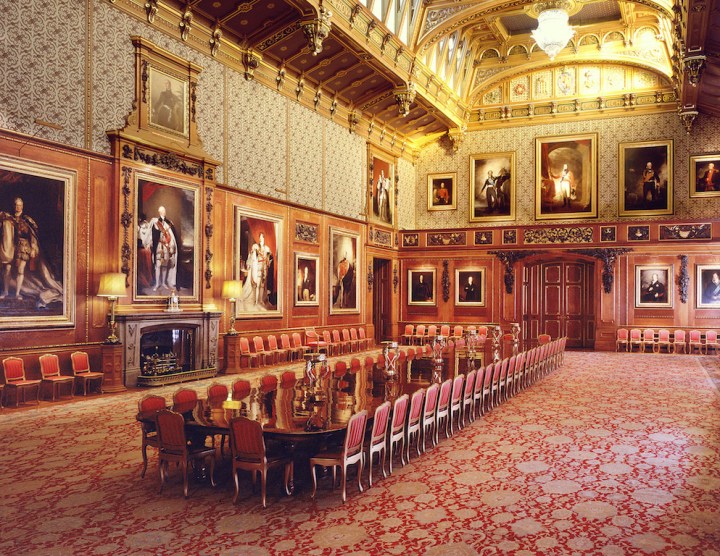
The Waterloo Chamber, Windsor Castle, Photo by Mark Fiennes for the Royal Collection Trust
© Her Majesty Queen Elizabeth II, 2014
◊ ◊ ◊ ◊ ◊
Press release (4 November 2014) from the Royal Collection:
Waterloo at Windsor: 1815–2015
Windsor Castle, 31 January 2015 — January 2016
In 2015 a special themed visit at Windsor Castle—incorporating an exhibition, a trail, and a new multimedia tour through the State Apartments—will mark the bicentenary of the Battle of Waterloo and the peace that followed nearly 25 years of war between France, under the Emperor Napoleon Bonaparte, and the allied forces including those of Great Britain, Austria, Prussia, and Russia.
Throughout the State Apartments visitors will discover unique artefacts associated with Waterloo, including items that belonged to the defeated Emperor, trophies from the battlefield, and documents from the Royal Archives. The centrepiece of the visit is the magnificent Waterloo Chamber, commissioned by George, Prince Regent (the future George IV) as a lasting monument to the battle at the heart of Windsor Castle. Throughout 2015, the route will be extended allowing visitors to walk into and around the room, rather than viewing the room from either end.
For nearly a quarter of a century Napoleon fought his way across Europe. In 1814 he was finally defeated and imprisoned, but in February of the following year he escaped exile from the Italian island of Elba. In the 100 days that followed, Napoleon overthrew the newly-restored French king and gathered his troops, before facing the leader of the allied army, the Duke of Wellington, 13 kilometres south of Brussels at Waterloo.
The Waterloo Chamber

Sir Thomas Lawrence, Arthur Wellesley, 1st Duke of Wellington, 1814–15, Royal Collection Trust © Her Majesty Queen Elizabeth II 2014
This vast room, measuring nearly 30 by 14.5 metres, was created for the sole purpose of displaying portraits of the statesmen, politicians, diplomats, and military leaders who were responsible for the overthrow of Napoleon. Despite never seeing active service, the Prince Regent regarded himself as a key player in the victory. In celebration of Napoleon’s abdication in April 1814, he invited several of the allied leaders and commanders to London and commissioned Britain’s pre-eminent portraitist, Sir Thomas Lawrence, to paint those attending. After Napoleon’s final defeat at Waterloo, Lawrence travelled to the Congress of Peace at Aix-la-Chapelle, then to Vienna and finally to Rome to complete the series.
The Waterloo Chamber remained unfinished at George IV’s death and was completed by his successor, William IV, who wanted the room to be more a commemoration of the battle than a celebration of the diplomacy that saw peace brought to Europe. A further nine portraits were added to the Waterloo Chamber’s ‘hall of fame’ by William IV and in Queen Victoria’s reign, bringing the total to 38.
Lawrence’s portrait of the Duke of Wellington dominates the room. The national hero stands beneath a triumphal arch, holding aloft the Sword of State, symbolising the sovereign’s royal authority. Beside him on a ledge rests a baton and letter signed George P.R., signifying his promotion to Field Marshal and the gratitude of the Crown. Wellington is flanked by portraits of Count Platov, commander of the Cossack cavalry, and Field Marshal Blücher, the head of the Prussian forces—the 72-year-old was nicknamed ‘Marshal Forwards’ because of his eagerness in battle. Lawrence’s portrait of Pope Pius VII, who was instrumental in the peace negotiations, is considered to be among the artist’s finest works. Imprisoned by Napoleon for many years, the Pope became a figurehead for the political and cultural regeneration of Europe after his release in 1814.
The Exhibition
Bringing together material from the Royal Collection and Royal Archives, the exhibition covers the days preceding the battle to the aftermath of conflict. Prints and drawings record the military action, devastated buildings and burial of casualties, as well as the celebration of victory. Public curiosity about Napoleon was fed by popular prints, such as those produced by the caricaturist Thomas Rowlandson.
Highlights of the Trail

Sevres porcelain factory, 1806–12, Hard-paste porcelain, gilt bronze mounts, internal wooden frame structure. Tables des Grands Capitaines, gifted to George, Prince Regent by the restored French king, Louis XVIII, courtesy Royal Collection Trust © Her Majesty Queen Elizabeth II 2014
George IV and his successors were avid collectors of works of art and souvenirs relating to the defeated Emperor. Napoleon’s cloak, taken from his fleeing carriage in the aftermath of the battle and later presented to George IV by Field Marshal Blücher, will be on display in the Castle’s Grand Vestibule. Made of red felt and lined with yellow silk brocade, it is appliquéd with Napoleon’s Imperial Eagle in silver thread. The cloak will be shown with other items removed from the Emperor’s baggage train, including Napoleon’s silver-gilt porringer—a small bowl used for food.
The Table des Grands Capitaines (Table of the Great Commanders, 1806–12), which will be on display in the King’s Drawing Room, was commissioned by Napoleon to immortalise his reign. Among the finest works ever produced by the Sèvres factory, it is decorated with the profile of Alexander the Great, the supreme military leader of antiquity, and other great commanders and philosophers. The table never left the factory and, after Napoleon’s final defeat, was presented to George IV by the restored French king, Louis XVIII, in gratitude for the allied victory. It was
one of George IV’s most prized possessions and
appears in his State portrait and in the painting by
Lawrence in the Waterloo Chamber.










 Enfilade
leave a comment