Exhibition | Liverpool’s Most Radical Son: Edward Rushton
◊ ◊ ◊ ◊ ◊
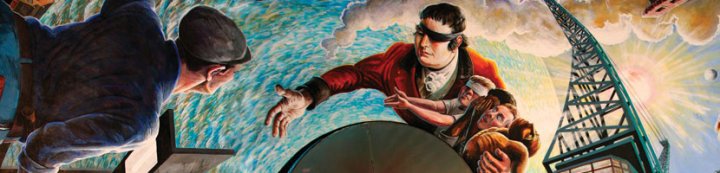
The Museum of Liverpool, the International Slavery Museum, and the Victoria Gallery and Museum celebrate the activism and legacy of Edward Rushton (1756–1814) with a trio of exhibitions:
Unsung – Liverpool’s Most Radical Son: Edward Rushton
The Museum of Liverpool, 7 November 2014 — 10 May 2015
International Slavery Museum, Liverpool, 7 November 2014 — 10 May 2015
Victoria Gallery and Museum, University of Liverpool, 7 November 2014 — 10 May 2015
What made a Liverpool bookseller, and former seaman, publican, and newspaper editor who was blind, take on George Washington, the President of the United States of America, over his personal and public failure to liberate enslaved Africans?

Moses Haughton (1773–1849), Portrait of Edward Rushton (Liverpool: Royal School for the Blind)
Edward Rushton’s knowledge of slavery was first hand—as a West Indies sea boy from the age of ten he had experience of both the slave trade and plantation slavery. In Caribbean waters his life was saved by an African sailor, Quamina, whom he had befriended, and who lost his own life in consequence. Two years later, at eighteen, Rushton was the only crewmember who tended the enslaved Africans infected with the epidemic eye disease, trachoma. Rushton caught the infection and became blind.
Surviving a period of poverty, he opened a bookshop on Paradise Street, which became a hub for Liverpool’s ‘Friends of Freedom’. Rushton was then able to establish the Liverpool School for the Indigent Blind—still in existence today—second only in the world to the Paris school.
Edward Rushton used his pen to support the revolutionary struggles in America, France, Haiti, Ireland, and Poland and was a friend to all who were oppressed whether by human exploitation or human frailty. At the heart was his plea to respect human rights. He saw the press gang as a “a National Stain” and slavery as the “ the Foulest Stain.” Rushton’s poetry broke the mould and gave a voice to the powerless and dispossessed across the world. His work reached a wide audience—it was published on both sides of the Atlantic in newspapers, collected volumes, in broadsides and put to music.
◊ ◊ ◊ ◊ ◊
Supported by the Heritage Lottery Fund and led by DaDaFest as part of DaDaFest International 2014, Unsung began last year in Liverpool as a city-wide project celebrating the social activism and legacy of Edward Rushton on the bicentenary of his death. Kathleen Hawkins wrote about the project for the BBC back in November.










 Enfilade
leave a comment