Exhibition | Wellington: Triumphs, Politics and Passions
Press release (29 October 2014) from the NPG:
Wellington: Triumphs, Politics and Passions
National Portrait Gallery, London, 12 March — 7 June 2015
Curated by Paul Cox with Lucy Peltz

Sir Thomas Lawrence, Portrait of Arthur Wellesley, 1st Duke of Wellington, 1815–16. (London: Wellington Collection, Apsley House, English Heritage).
The first gallery exhibition devoted to the Duke of Wellington will open at the National Portrait Gallery, to mark the 200th anniversary year of the Battle of Waterloo in 2015. Wellington: Triumphs, Politics and Passions will explore not only the political and military career of the victor of this great battle—but also his personal life through portraits of his family and friends.
Highlights include Goya’s portrait of Wellington started in 1812 after his entry into Madrid and later modified twice to recognise further battle honours and awards; and from Wellington’s London home, Apsley House, Thomas Lawrence’s famous 1815 portrait painted in the same year as the Battle of Waterloo. This iconic military image of Wellington was used as the basis of the design of the British five pound note from 1971 to 1991.
Drawn from museums and private collections including that of the present Duke of Wellington, the exhibition of 59 portraits and other art works has the support of the Marquess of Douro, and includes rarely-seen loans from the family including a portrait by John Hoppner of the Duke as a youthful soldier and a daguerreotype portrait by Antoine Claudet, in the new medium of photography, taken on Wellington’s 75th birthday in 1844. The family has also loaned Thomas Lawrence’s beautiful drawing of Wellington’s wife, Kitty (née Pakenham).
The real experience of soldiers fighting in Wellington’s armies will be explored through eyewitness accounts, including prints based on sketches by serving soldiers and the illustrated diary of a young officer, Edmund Wheatley written, in a lively style, with the intention of it being read by his sweetheart.

Francisco de Goya, Portrait of Arthur Wellesley, 1st Duke of Wellington, 1812–14 (London: The National Gallery).
Wellington: Triumphs, Politics and Passions considers the attempts of the art world to celebrate the Duke of Wellington’s military successes. Commemorative objects on display will range from royal commissions by Europe’s foremost artists and manufacturers to more modest souvenirs aimed at the domestic market. Wellington’s eventful and often difficult political career will be illustrated by examples of the many satirical prints published in the 1820s and 1830s and the exhibition will also examine the reappraisal of Wellington’s life that took place at his death and on the occasion of his lavish state funeral.
The Duke of Wellington’s long life (1769–1852) spanned the eighteenth and nineteenth centuries. Most famous for his victory over Napoleon at the battle of Waterloo, he later entered politics, serving twice as Prime Minister. Wellington: Triumphs, Politics and Passions will explore the role of visual culture in creating the hero, the legacy of heroism and the role of the portrait in Wellington’s own public and personal self-representation.
Curated by Paul Cox, Associate Curator, National Portrait Gallery, with close support from Dr Lucy Peltz, Curator of Eighteenth-Century Portraits, National Portrait Gallery, this biographical exhibition will use portraits and objects to explore Wellington’s military career and his sometimes controversial political and personal life.
Paul Cox, Associate Curator, National Portrait Gallery, London, says: “The Duke of Wellington’s victory over Napoleon at Waterloo is well known. This exhibition provides the opportunity to examine less familiar aspects of his life, including the long political career during which he saw through important forward-looking legislation, but suffered a dramatic loss of popularity. I hope that visitors to the exhibition will gain a fuller picture of Wellington as a man, rather than simply as a hero.”
The exhibition is part of the Battle of Waterloo 200th Anniversary Commemorations, the national partnership of commemorative events.
◊ ◊ ◊ ◊ ◊
Paul Cox, with a foreword by William Hague, Wellington: Triumphs, Politics and Passions (London: National Portrait Gallery, 2015), 128 pages, ISBN: 978-1855144996, £15.
This new book about the 1st Duke of Wellington provides a novel take on the traditional biography in that it explores the life of this complex man through portraits of Wellington himself, his friends, family and associates, as well as his political and military allies and opponents. There are examples of painted portraits by Goya and Thomas Lawrence, several caricatures that illustrate Wellingtons political career, and a watercolour by George Chinnery that shows the future duke as a young Major-General at the Chepauk Palace, Madras being received by Azim al-Daula, Nawab of the Carnatic, in February 1805. Also reproduced is a rare photograph, a Daguerreotype, made by Antoine Claudet on the occasion of Wellingtons seventy-fifth birthday in 1844, and sections of a sixty-six-foot roll from the Collection of the National Portrait Gallery depicting his entire funeral procession. Paul Cox explores Wellingtons military career and the battle of Waterloo, which remain central to his story, but also examines his personal relationships, his legacy and his enduring place in the popular imagination. Finally, a narrative chronology presents a useful overview of Wellingtons life and times.
Exhibition | Waterloo at Windsor: 1815–2015
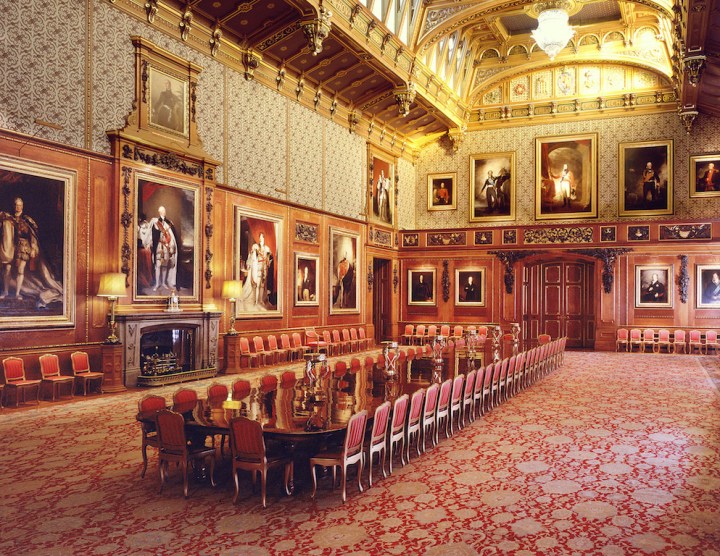
The Waterloo Chamber, Windsor Castle, Photo by Mark Fiennes for the Royal Collection Trust
© Her Majesty Queen Elizabeth II, 2014
◊ ◊ ◊ ◊ ◊
Press release (4 November 2014) from the Royal Collection:
Waterloo at Windsor: 1815–2015
Windsor Castle, 31 January 2015 — January 2016
In 2015 a special themed visit at Windsor Castle—incorporating an exhibition, a trail, and a new multimedia tour through the State Apartments—will mark the bicentenary of the Battle of Waterloo and the peace that followed nearly 25 years of war between France, under the Emperor Napoleon Bonaparte, and the allied forces including those of Great Britain, Austria, Prussia, and Russia.
Throughout the State Apartments visitors will discover unique artefacts associated with Waterloo, including items that belonged to the defeated Emperor, trophies from the battlefield, and documents from the Royal Archives. The centrepiece of the visit is the magnificent Waterloo Chamber, commissioned by George, Prince Regent (the future George IV) as a lasting monument to the battle at the heart of Windsor Castle. Throughout 2015, the route will be extended allowing visitors to walk into and around the room, rather than viewing the room from either end.
For nearly a quarter of a century Napoleon fought his way across Europe. In 1814 he was finally defeated and imprisoned, but in February of the following year he escaped exile from the Italian island of Elba. In the 100 days that followed, Napoleon overthrew the newly-restored French king and gathered his troops, before facing the leader of the allied army, the Duke of Wellington, 13 kilometres south of Brussels at Waterloo.
The Waterloo Chamber

Sir Thomas Lawrence, Arthur Wellesley, 1st Duke of Wellington, 1814–15, Royal Collection Trust © Her Majesty Queen Elizabeth II 2014
This vast room, measuring nearly 30 by 14.5 metres, was created for the sole purpose of displaying portraits of the statesmen, politicians, diplomats, and military leaders who were responsible for the overthrow of Napoleon. Despite never seeing active service, the Prince Regent regarded himself as a key player in the victory. In celebration of Napoleon’s abdication in April 1814, he invited several of the allied leaders and commanders to London and commissioned Britain’s pre-eminent portraitist, Sir Thomas Lawrence, to paint those attending. After Napoleon’s final defeat at Waterloo, Lawrence travelled to the Congress of Peace at Aix-la-Chapelle, then to Vienna and finally to Rome to complete the series.
The Waterloo Chamber remained unfinished at George IV’s death and was completed by his successor, William IV, who wanted the room to be more a commemoration of the battle than a celebration of the diplomacy that saw peace brought to Europe. A further nine portraits were added to the Waterloo Chamber’s ‘hall of fame’ by William IV and in Queen Victoria’s reign, bringing the total to 38.
Lawrence’s portrait of the Duke of Wellington dominates the room. The national hero stands beneath a triumphal arch, holding aloft the Sword of State, symbolising the sovereign’s royal authority. Beside him on a ledge rests a baton and letter signed George P.R., signifying his promotion to Field Marshal and the gratitude of the Crown. Wellington is flanked by portraits of Count Platov, commander of the Cossack cavalry, and Field Marshal Blücher, the head of the Prussian forces—the 72-year-old was nicknamed ‘Marshal Forwards’ because of his eagerness in battle. Lawrence’s portrait of Pope Pius VII, who was instrumental in the peace negotiations, is considered to be among the artist’s finest works. Imprisoned by Napoleon for many years, the Pope became a figurehead for the political and cultural regeneration of Europe after his release in 1814.
The Exhibition
Bringing together material from the Royal Collection and Royal Archives, the exhibition covers the days preceding the battle to the aftermath of conflict. Prints and drawings record the military action, devastated buildings and burial of casualties, as well as the celebration of victory. Public curiosity about Napoleon was fed by popular prints, such as those produced by the caricaturist Thomas Rowlandson.
Highlights of the Trail

Sevres porcelain factory, 1806–12, Hard-paste porcelain, gilt bronze mounts, internal wooden frame structure. Tables des Grands Capitaines, gifted to George, Prince Regent by the restored French king, Louis XVIII, courtesy Royal Collection Trust © Her Majesty Queen Elizabeth II 2014
George IV and his successors were avid collectors of works of art and souvenirs relating to the defeated Emperor. Napoleon’s cloak, taken from his fleeing carriage in the aftermath of the battle and later presented to George IV by Field Marshal Blücher, will be on display in the Castle’s Grand Vestibule. Made of red felt and lined with yellow silk brocade, it is appliquéd with Napoleon’s Imperial Eagle in silver thread. The cloak will be shown with other items removed from the Emperor’s baggage train, including Napoleon’s silver-gilt porringer—a small bowl used for food.
The Table des Grands Capitaines (Table of the Great Commanders, 1806–12), which will be on display in the King’s Drawing Room, was commissioned by Napoleon to immortalise his reign. Among the finest works ever produced by the Sèvres factory, it is decorated with the profile of Alexander the Great, the supreme military leader of antiquity, and other great commanders and philosophers. The table never left the factory and, after Napoleon’s final defeat, was presented to George IV by the restored French king, Louis XVIII, in gratitude for the allied victory. It was
one of George IV’s most prized possessions and
appears in his State portrait and in the painting by
Lawrence in the Waterloo Chamber.
New Book | Memoirs of the Court of George III
From Pickering & Chatto:
Michael Kassler, Lorna Clark, Alain Kerhervé, and Peter Sabor, eds., Memoirs of the Court of George III, 4 vols., (London: Pickering & Chatto, 2015), c.1600 pages, ISBN: 978-1848934696, £350 / $625.
 George III was one of the longest reigning British monarchs, ruling over most of the English-speaking world from 1760 to 1820. Despite his longevity, George’s reign was one of turmoil. Britain lost its colonies in the War of American Independence and the European political system changed dramatically in the wake of the French Revolution. Closer to home, problems with the King’s health led to a constitutional crisis. Charlotte Papendiek’s memoirs cover the first thirty years of George III’s reign, while Mary Delany’s letters provide a vivid portrait of her years at Windsor. Lucy Kennedy was another long-serving member of court whose previously unpublished diary provides a great deal of new detail about the King’s illness. Finally, the Queen herself provides further insights in the only two extant volumes of her diaries, published here for the first time.
The edition will be invaluable to scholars of Georgian England as well as those researching the French and American Revolutions and the history and politics of the Regency period more widely. It will complement the ongoing project, The Court Journals and Letters of Frances Burney (OUP).
• All texts are first-hand accounts from those close to George III and relate information on important events, including the American and French Revolutions and the King’s ‘madness’
• Two volumes are editions of previously unpublished manuscripts
• All the texts are rare and Queen Charlotte’s diaries are newly transcribed from the Royal Archives at Windsor Castle
• Editorial apparatus includes a general introduction, volume introductions, headnotes, footnotes and indexes to the texts
General Editor: Michael Kassler, Independent scholar
Volume Editor: Lorna J Clark, Carleton University
Volume Editor: Alain Kerhervé, University of Western Brittany
Consultant Editor: Peter Sabor, McGill University
Volume 1
The Memoirs of Charlotte Papendiek (1765–1840): Court, Musical and Artistic Life in the Time of King George III
Mrs Papendiek’s Memoirs record events at court from 1761—when the future Queen Charlotte came to England to marry King George—until 1792. The Papendieks knew many musicians, including John Christian Bach (son of Johann Sebastian), William Herschel (who became an astronomer) and Haydn. The memoirs also record meetings with artists of the day, such as Thomas Lawrence and Thomas Gainsborough. They are a unique resource, recording significant information about living conditions, dress, education and Anglo-German relations.
Volume 2
Mary Delany (1700–1788) and the Court of George III
Though she failed to become a handmaiden to Queen Anne, Mary Delany went on to become a figure at Court, eventually lodging at Windsor. This new edition of her correspondence during her years at Windsor presents previously unpublished letters as well as applying modern standards of editorial principles to her correspondence. The letters show the daily rituals of living at Court, document the first social steps of Fanny Burney and Mary Georgina Port, and supply new information on the family life of the royal family – including material on the assassination attempt against George III by Margaret Nicholson.
Volume 3
The Diary of Lucy Kennedy (1793–1816)
Lucy Kennedy (c.1731–1826), had an insider’s view of life in Windsor castle and of members of the Royal Family for fifty-three years. Her diary, preserved in the Royal Library, Windsor Castle, has never before been published. In it she writes a moving account of the death of Princess Amelia which precipitated the final illness of George III and the Regency. Her observations of his symptoms are relevant for modern-day diagnoses of his malady.
Volume 4
The Diary of Queen Charlotte, 1789 and 1794
Queen Charlotte kept a diary in which she recorded her daily activities as well as those of George III and other members of the royal family. Only her volumes for 1789 and 1794 survive, in the Royal Archives at Windsor Castle. Her 1789 diary shows how the king’s illness and recovery impacted upon their lives. Both diary volumes provide hitherto unpublished information about court life and the royal family.
New Journal | Royal Studies Journal
We are delighted to announce that the first issue of the Royal Studies Journal is out now. This issue features articles by Carole Levin, Cinzia Recca, and Nadia van Pelt as well as six book reviews of recent publications in the field of royal studies.
The Royal Studies Journal is a peer-reviewed, open access, interdisciplinary and international journal for the field of Royal Studies and will be published twice a year. Articles can be submitted in French, Spanish, Portuguese, and German, although English is preferred. Book reviews will also be featured. Shorter notices, news items, and conference reports will be on our official blog.
Please visit our website to find out more about the journal and how to submit articles to the RSJ. If you wish to contact us with any queries about the journal, suggestions of upcoming/recent works in the field to review or the submissions process, please email us at info.rsj@winchester.ac.uk.
◊ ◊ ◊ ◊ ◊
Royal Studies Journal 1.1 (2014)
Articles
Carole Levin, “Elizabeth’s Ghost: The Afterlife of the Queen in Stuart England”
Cinzia Reccia, “Maria Carolina and Marie Antoinette: Sisters and Queens in the Mirror of Jacobin Public Opinion”
Nadia Therese van Pelt, “Teens and Tudors: The Pedagogy of Royal Studies”
Book Reviews
Carey Fleiner, “Review: Lott, Death and Dynasty in Early Imperial Rome”
Stephen Donnachie, “Review: Perry, John of Brienne: King of Jerusalem”
Sean McGlynn, “Review: Richardson, The Field of Cloth of Gold”
Elena Woodacre, “Review: Cruz and Galli (eds.), Early Modern Hapsburg Women”
Estelle Paranque, “Review: Knecht, Hero or Tyrant? Henri III, King of France”
Charlotte Backerra, “Review: Aikin, A Ruler’s Consort in Early Modern Germany”
Call for Papers | Global France, Global French
From H-ArtHist:
Global France, Global French
Humanities Research Centre, Australian National University, Canberra, 21–23 October 2015
Proposals due by 5 March 2015
Confirmed keynotes
Professor Dominic Thomas, University of California, Los Angeles
Professor Charles Forsdick, University of Liverpool
In the eyes of many, France was the centre of the world throughout the modern age. Home of the Revolution and the Rights of Man, heart of a vast colonial empire, capital of the literary, fashion and art worlds, France, and Paris in particular, was at once historical and mythical. Today, following upon a sequence of ‘turns’, from the postcolonial to the global, this centre has given way to multiple centres, to conflicting and complementary sites of physical, economic and cultural exchange. As France has transitioned from a colonial power to a central member of the European Union, it has been forced to negotiate immigration policies, the rise of political extremism and the growing unrest over the linguistic, cultural and spatial borders that divide French society. Debates about French national identity rage in political and cultural sectors: while some seek to bolster a weakened idea of ‘Frenchness’, others, for example the signatories of the 2007 Littérature-monde manifesto, aim to redefine or ‘world’ that identity.
Art work by Fabienne Verdier
At the same time, the ‘global turn’ in French studies has encouraged scholars to re-examine French literature, language, culture and history through a new, decentred perspective. Recent criticism in literature and history, for example, has returned to early modern literary texts and spaces as well as to major historical events like the French Revolution, exploring the ways in which these traditions and events were not determined in a cultural vacuum, but, as Peter Hulme has noted, ‘were the product[s] of constant, intricate, but mostly unacknowledged traffic with the non-European world’.
The goal of this colloquium is to offer an image of global France and global French, past, present and future. How have French culture and politics been shaped by encounters with European neighbours and with the non-European world? How do contemporary migratory patterns and networks between France and the wider world compare to historical ones? How have neo-colonial practices been reshaped by globalized markets and transnational capital? How have various art forms allowed for the articulation of displacement, community and solidarity throughout French history and into the global present? In short, is the global a new horizon, or one that we are just discovering?
Our aim is to generate an interdisciplinary discussion among colleagues in a wide range of fields, including literature, film, linguistics, cultural studies, history, art history, philosophy, music and digital humanities. Topics for papers/panels include but are not limited to:
• Global vs. local (cultures, histories, languages, art forms)
• Migration: patterns and networks
• Migration: language and policy
• The European Union and French national identity
• Multicultural, multilingual, multiethnic France/Paris
• Colonial, postcolonial, neo-colonial flows and encounters
• Translation among languages, cultures, media
• The circulation of bodies, capital, ideas, linguistic forms, art forms
• Borders: visible and invisible, inner and outer, real and imagined, linguistic and geopolitical
• Travel, tourism, trade
• Diasporas, past and present
Please send an abstract of 300 words and a CV (max 2 pages) to Leslie.Barnes@anu.edu.au. Papers can be in English or French. The deadline for abstracts is 5 March 2015.
Call for Papers | Re-imagining Childhood: Images and Objects
From H-ArtHist:
Re-imagining Childhood: Images, Objects and the Voice of the Child
Centre for the Study of Play and Recreation, University of Greenwich, 9 May 2015
Proposals due by 1 March 2015
The Society for the Study of Childhood in the Past
This conference aims to stimulate interdisciplinary debate on the question of what images and material objects can tell us about the subjective experience of being a child in the past. It will explore the ways in which non-written evidence—in particular that which comes under the heading ‘material culture’ and ‘visual culture’—can be used to open up new possibilities for the study of the history of childhood.
As Peter Stearns indicated in his “Challenges in the History of Childhood” (The Journal of the History of Childhood and Youth, 2008), no one interested in the importance of history as a way to understand the human condition, can ignore the importance of historical perspectives about childhood. The history of childhood has been shaped by the concerns of the world in which its historians live. Although the discipline that we understand today as ‘history of childhood’ is less than 100 years old, it is a field of growing interest, as reflected in the ever-greater number of publications dealing with the subject. Childhood and children are increasingly present on the bookshelves, in documentaries and in exhibitions, and there seems to be an almost inexhaustible consumption of the values and ideas that children and childhood represent. Thus we find ourselves at a fascinating time for considering what it is that adults seek in the image of the child. What attracts us? What disturbs us? What is at play in the gaze of the child?
One could claim that all histories written about children are related, in one way or another, to the book that is considered to represent the origin of the discipline: Centuries of Childhood (L’Enfant et la Vie Familiale sous l’Ancien Régime), which Philippe Ariès wrote in 1960. Ariès’ great success was to convince almost all his readers that childhood has a history and that, across time and in different cultures, both ideas about childhood and the experience of being a child have changed. While Aries’ evidence was wide-ranging, he has been much criticised for failing to subject it to proper scrutiny. In particular, he has been accused of ‘reading’ images too literally. As a result, historians became very cautious about the use of non-written evidence which has only recently started to make a renewed and welcome impact. It is clear that most approaches to the history of childhood depend heavily on textual sources, but this approach can lead to a distorted understanding, in so far as many experiences of the past are not reflected in those texts. Other paths could be—and must be—explored.
Re-imagining Childhood attempts to go beyond this limitation by arguing that the history of childhood—or, at least, any history of childhood which purports to cover more than a limited historical period—is possible only through a multidisciplinary exercise that adds evidence from visual or material culture to the study of published sources. The study of the material and visual culture of childhood provides a way to contribute to a better understanding of earlier concepts of childhood. These additional sources also help us to tap into children’s experiences and they thereby serve as helpful tools in unravelling the ‘voice of the child’.
We welcome original studies that focus on any historical period, carried out within the arts and humanities or the social sciences, that shed light on the power of objects and images to bring children back into the history of childhood. An abstract of no more than 300 words for a 20-minute presentation, along with the title, name and affiliation, should be send to Leticia Fernández-Fontecha Rumeu (playandrecreation@greenwich.ac.uk) by March 1st. Applicants whose papers are accepted will be notified by March 15th.
New Book | The Visual Culture of Catholic Enlightenment
From Penn State UP:
Christopher M. S. Johns, The Visual Culture of Catholic Enlightenment (University Park: Penn State University Press, 2014), 440 pages, ISBN: 978-0271062082, $90.
 Until relatively recently, most scholars considered the notion of a Catholic enlightenment either oxymoronic or even illusory, since the received wisdom was that the Catholic Church was a tireless and indefatigable enemy of modernist progress. According to Christopher Johns, however, the eighteenth-century papacy recognized the advantages of engaging with certain aspects of enlightenment thinking, and many in the ecclesiastical hierarchy, both in Italy and abroad, were sincerely interested in making the Church more relevant in the modern world and, above all, in reforming the various institutions that governed society. Johns presents the visual culture of papal Rome as a major change agent in the cause of Catholic enlightenment while assessing its continuing links to tradition. The Visual Culture of Catholic Enlightenment sheds substantial light on the relationship between eighteenth-century Roman society and visual culture and the role of religion in both.
Exhibition | Canaletto’s Architecture: Celebrating Georgian Britain

Canaletto (Giovanni Antonio Canal), London: The Thames from Somerset House Terrace towards the City
(Royal Collection Trust/© Her Majesty Queen Elizabeth II 2014)
◊ ◊ ◊ ◊ ◊
Press release (November 2014) from Abbot Hall (with a more complete posting available here) . . .
Canaletto’s Architecture: Celebrating Georgian Britain
Abbot Hall Art Gallery, Kendal, Cumbria, 22 October 2015 — 14 February 2016
Abbot Hall was built in the Palladian style just three years after Canaletto left England for the last time. In 1746, by then in his late 40s, he first arrived for a prolonged stay in London. He was to remain for most of the following 10 years.
Already a well established artist, his work had proved very popular with aristocratic Englishmen doing their Grand Tour of Europe. In the 1720s, having started his career as a theatrical scene painter, Canaletto started painting his distinctive views of Venice, frequently featuring the many major churches designed for it by Palladio. One of his clients was Joseph Smith, an English merchant banker who lived in Venice for 70 years, for 16 of which he was the British consul there. Smith bought many Canaletto works for himself, and also helped arrange commissions from wealthy English collectors—by the late 1720s his works were already in the collections of Goodwood, Chatsworth, Woburn and of the Prime Minister, Sir Robert Walpole. Smith himself owned by far the largest collection of works, including 52 oil paintings and over 140 drawings, which he eventually sold to George III in 1762 for £10,000—half the sum the latter paid the previous year for Buckingham Palace.

Canaletto (Giovanni Antonio Canal), Portrait of Canaletto with St Paul’s in the Background at Anglesey Abbey, Cambridgeshire (National Trust Images/Hamilton Kerr Inst/Chris Titmus)
Canaletto came to London as an indirect result of the War of the Austrian Succession, which started in 1741. This had made continental travelling difficult for his wealthy English patrons, severely reducing his income. He therefore decided to move himself to London, setting up his studio near Golden Square. He arrived a month after Culloden, the last pitched battle fought on British soil, and at the beginning of a period of unprecedented domestic peace and prosperity, which saw London turning into the world’s richest and largest city.
Although the bulk of the works with English subjects were of London scenes, with the Thames a frequent presence, he was also a regular visitor to the countryside, often at the invitation of his rich patrons, and painted several views of Warwick Castle, as well as of Alnwick, Badminton, Eton and Walton.
The rapid change of London’s architecture during his time here is also documented. In The Old Horse Guards from St James’ Park of 1749, he caught the Horse Guards Parade ground, complete with parading soldiers, as well as men peeing against the wall of Downing Street, and dozens of people promenading, showing the artist’s interest in depicting scenes of daily life. Within a couple of years, from almost exactly the same spot, he was back painting the new Horse Guards parade, the one that is still there today—it can be dated very precisely to 1752–53, as the clock tower still has scaffolding on it, while the south wing had yet to be constructed.
Canaletto is often accused of depicting London whilst using bright Venetian lighting. However, in both his pictures of the Horse Guards, the light is soft and diffused. In A View of Walton Bridge the sky is even more typically ‘English’—and un-Venetian—with the sun competing with storm clouds brewing overhead. The picture also includes a portrait of Thomas Hollis, who commissioned 5 works from Canaletto, as well as a rare self-portrait of the artist, shown painting the scene. The bridge was regarded at the time as an advanced feat of engineering. The contrasting stately bulk of Westminster Bridge and the views from it was evidently something that fascinated Canaletto, who clearly would have agreed with Wordsworth’s later opinion that “earth hath not anything to show more fair.” The bridge was under construction during his time here, and he painted and sketched it repeatedly. In one of the pictures from the Royal Collection, he frames a view of the Thames, St Paul’s and the City as if he had drawn the scene from under one of the new arches of the bridge, while others show it still under construction.
It is easy to forget that Canaletto continued to paint Venetian scenes throughout his time in London. Worked up from his sketches, or done from memory, these provided him with a significant proportion of his income whilst in London, as his more conservative patrons demanded work that they were familiar with, rather than venturing into the new views that the artist was confronting. For example, his Bucintoro at the Molo on Ascension Day, showing the state barge after the annual ‘marriage’ of Venice with the sea—which, when it sold for $20,000,000 in 2005, was briefly his most expensive painting sold at auction—was painted in London in 1754.
Ruskin had a particular down on Canaletto. It is, however, unclear quite how familiar the ascerbic critic was with genuine works by the Venetian. As a hugely popular artist, his work was widely forged and copied both during his lifetime and afterwards. It is possible that Ruskin was sometimes writing about Canaletto pupils and assistants, when he thought he was writing about Canaletto himself. In “Notes on the Louvre”, writing about a picture of the Salute and the entrance to the Grand Canal, he said that it is “cold and utterly lifeless—truth is made contemptible” and that “boats and water he could not paint at all.” The picture has since been re-attributed to Canaletto’s pupil Michele Marieschi. Similarly the “bad landscape” he saw in Turin is almost certainly a work by Bernardo Bellotto, Canaletto’s nephew. Writing about Canaletto’s “vacancy and falsehood” in Modern Painters, he refers to a painting in the Palazzo Manfrin—Augustus Hare, who visited it at about the same time, noted that the palazzo “has a picture gallery which is open daily, but contains nothing worth seeing, all the good pictures having been sold.” It is unclear which work Ruskin was referring to when he said that Canaletto’s depiction of architecture was “less to be trusted in its renderings of details than the rudest and most ignorant painter of the 13th century.” Certainly that is not the view of most modern critics of most properly authenticated works by Canaletto, but Ruskin was never one to allow the facts to affect his pet prejudices.
At Auction | Sotheby’s Old Master Week
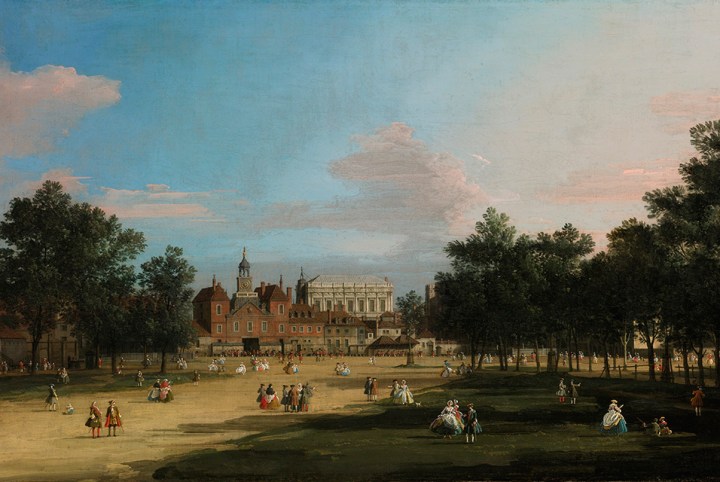
Giovanni Antonio Canal, called Canaletto, London, a View of the Old Horse Guards and Banqueting Hall, Whitehall Seen from St. James’ Park, ca. 1749. Estimate. $4–6 million. Photo: Sotheby’s.
◊ ◊ ◊ ◊ ◊
Press release (16 December 2014). . .
Sotheby’s Sale 9302 | Master Paintings: Part I
New York, 29 January 2015
Sotheby’s January 2015 Old Master Week in New York will feature a select group of highly important paintings assembled by noted collector J. E. Safra (included in Sale 9302). The choice offering of 17 paintings presents a wide range of styles and genres of the period including the Dutch Golden Age, as well as 18th-century Italian and French. The vast majority of the works have been off the market for at least 20 years and together the group is estimated to bring $22–34 million. The paintings will go on public exhibition, alongside Sotheby’s Old Master Week sales, beginning 24 January.
Leading a very strong group of Dutch works to be offered in Sotheby’s January 2015 sales is Frozen River at Sunset, painted by Aert van der Neer in or shortly after 1660, a period that was a high point for Dutch landscape painting and for the artist himself (est. $4–6 million). The work embodies the artist’s fascination with the people and the world around him and most notably the effect of light on a winter landscape and how it can transform the content and mood of a composition.
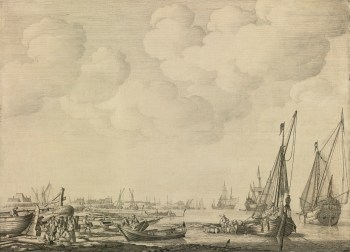
Willem van de Velde the Elder (1611–1693), Dutch Harbor in a Calm with Small Vessels. Lot 32, estimate $2–3 million.
Willem van de Velde the Elder’s Dutch Harbor in a Calm with small Vessels is one of the greatest examples of a penschilderij (pen and ink painting) remaining private hands (est. $2–3 million). Executed in a remarkable combination of pen, ink and brush over a thin layer of lead white, the use of quills of varying sizes and inks in different shades creates a remarkable sense of recession without the loss of any detail, even in the distant buildings of the town beyond.
A Roemer, an Overturned Pewter Jug, Olives and a Half- Peeled Lemon on Pewter Plates is a key work in Pieter Claesz.’s development as a painter of still-life, signaling a new approach to the genre (est. $2–3 million). In this modest ontbijtje (breakfast piece), he abandons the more luxurious displays of his early years in favor of compositions with fewer objects organized around a simple geometric structure and restricts his palette to suit this more muted style.
Among the wonderful Italian works to be offered from Mr. Safra’s collection is an exquisite example of views from Canaletto’s English period: London, A View of the Old Horse Guards and Banqueting Hall, Whitehall seen from St. James’ Park (est. $4–6 million). In May of 1746, Canaletto transferred his studio to London, perhaps in pursuit of fresh challenges. The outbreak of the War of the Austrian Succession in 1740 had discouraged English visitors from undertaking the Grand Tour, and these had made up the majority of Canaletto’s patrons. The painting is presumed to date to 1749, when the old, red brick Horse Guards had been condemned. This perhaps captured the imagination of the artist, compelling him to record the architecture in painted form for posterity.
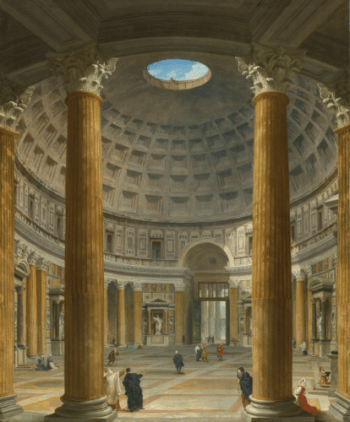
Giovanni Paolo Panini, Rome, The Pantheon, A View of the Interior towards the Piazza della Rotonda, 1732. Lot 91, estimate $3–5 million.
Giovanni Paolo Panini’s Rome, The Pantheon, A View of the Interior towards the Piazza della Rotonda is the earliest dated view of the interior of the Pantheon in Rome by the artist (est. $3–5 million). The work is in fantastic condition and a wonderful snapshot of figures marveling at the spectacular construction around them, in much the same way as they do today. Panini offers us a broad spectrum of the social tapestry of Rome in 1732; the spirited figures include soldiers, clergymen, beggars and other people at prayer, all dwarfed by the ancient Roman temple. As is typical of Panini’s great works, the meticulously observed architecture, particularly the Corinthian capitals, is bathed in the warm and inviting glow of Rome’s afternoon light










 Enfilade
leave a comment