Exhibition | Jean-Jacques de Boissieu
◊ ◊ ◊ ◊ ◊
From the Städel Museum:
Jean-Jacques de Boissieu: A Contemporary of Städel’s / Ein Zeitgenosse Städels
Städel Museum, Frankfurt, 11 February — 10 May 2015
Curated by Jutta Schütt
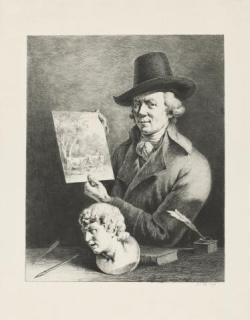
Self-Portrait of Jean-Jacques de Boissieu, 1796, etching.
Jean-Jacques de Boissieu (1736–1810) was already a highly acclaimed artist beyond France in his lifetime. Not only princes but also private collectors like Johann Friedrich Städel were fascinated with the landscapes, genre scenes, and portraits depicted in the artist’s drawings and prints. The founder of the Städelsches Kunstinstitut acquired over twenty drawings and far more than two hundred etchings by de Boissieu, which still rank among the central holdings of the Städel’s Department of Prints and Drawings. Created in a period of historically revolutionary events, de Boissieu’s oeuvre mirrors the landscape and life of the province around the artist’s native city of Lyon with an almost irritatingly unexcited and serious steadiness. His etched landscapes and portraits as well as his subtly nuanced brush and chalk drawings reveal a progressive realism that hints at a bourgeois understanding of art independent of any academic norms.
Call for Papers | Fancy‒Fantaisie‒Capriccio: Diversions and Distractions
From the Call for Papers:
Fancy‒Fantaisie‒Capriccio: Diversions and Distractions in the Eighteenth Century
Toulouse, 3–4 December 2015
Proposals due by 31 March 2015
Keynote speaker: Professor Martin Postle, Deputy Director of Studies, Paul Mellon Centre for British Art
In conjunction with the exhibition of paintings, Fantasy Figures, to be held at the Musée des Augustins, Toulouse, the Université de Toulouse Jean Jaurès and the University of Exeter are pleased to announce a call for papers for an interdisciplinary colloquium.
Associated with the imagination and not reason, fancy (fantaisie) in the eighteenth century was a sort of whimsical distraction from the everyday. For Voltaire it was ‘a singular desire, a passing whim’ (‘un désir singulier, un goût passager’), while for Samuel Johnson it was ‘something that pleases or entertains without real use or value’. Together with its near-synonym caprice (capriccio), fancy was part of a rich semantic network, connecting wit, pleasure, erotic desire, spontaneity, improvisation, surprise, deviation from norms, the trivial and inconsequential. Unpredictable and quirky, it offered many outlets for artistic creativity.
Papers are invited that investigate the expressive freedom of fancy (fantaisie, capriccio) in European culture during the eighteenth century—in figure and landscape painting, architecture and garden design, philosophy and fiction, theatre and music. Topics may include, but are not limited to the following:
• Tensions between fancy/capriccio and reason
• Fancy’s relationship to the imagination
• Fancy as a precursor of the Gothic and the fantastic
• The fancy picture or tête de fantaisie
• Capriccio in landscape, architectural painting, engraving
• Fancy in conjunction with a space, place or decorative schema
• Fantasia in musical composition or musical theatre
• Anecdote, imagination and desire in fiction
• The role of fancy in the discourse of love and seduction
• Creativity as a deviation from norms and rules
The colloquium will incorporate a guided visit of the fantasy figures exhibition with the curators. It is hoped that a volume of published essays will arise from the event. Participants should be prepared to meet their own travel and accommodation expenses. Refreshments will be provided on the day. Proposals (maximum 250 words in English or French) should be submitted to Professor Melissa Percival, University of Exeter, M.H.Percival@exeter.ac.uk by the 31 March 2015.










 Enfilade
leave a comment