Exhibition | Bonaparte and the British: Prints and Propaganda

James Gillray, Maniac Ravings, 1803, hand-coloured etching on paper
(London: The British Museum)
◊ ◊ ◊ ◊ ◊
From The British Museum:
Bonaparte and the British: Prints and Propaganda in the Age of Napoleon
The British Museum, London, 5 February — 16 August 2015
This exhibition focuses on the printed propaganda that either reviled or glorified Napoleon Bonaparte, on both sides of the English Channel. It explores how his formidable career coincided with the peak of political satire as an art form. 2015 marks the 200th anniversary of the Battle of Waterloo—the final undoing of brilliant French general and emperor Napoleon Bonaparte (1769–1821). The exhibition will include works by British and French satirists who were inspired by political and military tensions to exploit a new visual language combining caricature and traditional satire with the vigorous narrative introduced by Hogarth earlier in the century.
The print trade had already made the work of contemporary British artists familiar across Europe. Continental collectors devoured the products of the London publishers, and artists across Europe were inspired by British satires. This exhibition includes work by James Gillray, Thomas Rowlandson, Richard Newton and George Cruikshank, some of the most thoughtful and inventive artists of their day. The range and depth of the British Museum’s collection allows the satirical printmakers’ approach to be compared with that of portraitists and others who tended to represent a more sober view of Napoleon.
The exhibition begins with portraits of the handsome young general from the mid-1790s and ends with a cast of his death mask and other memorabilia acquired by British admirers. Along the way, the prints will examine key moments in the British response to Napoleon—exultation at Nelson’s triumph in the Battle of the Nile in 1798, celebration of the Peace of Amiens in 1802, fear of invasion in 1803, the death of Nelson at the Battle of Trafalgar in 1805, and Napoleon’s triumph at Austerlitz, delight at his military defeats from 1812 onwards, culminating in his exile to Elba in 1814. 1815 sees triumphalism after Waterloo and final exile to St Helena, but some prints reflect an ambiguous view of the fallen emperor and doubts about the restoration of the French king Louis XVIII.
◊ ◊ ◊ ◊ ◊
From The British Museum Press:
Tim Clayton and Sheila O’Connell, Bonaparte and the British: Prints and Propaganda in the Age of Napoleon (London: The British Museum Press, 2015), 256 pages, ISBN: 9780714126937, £25.
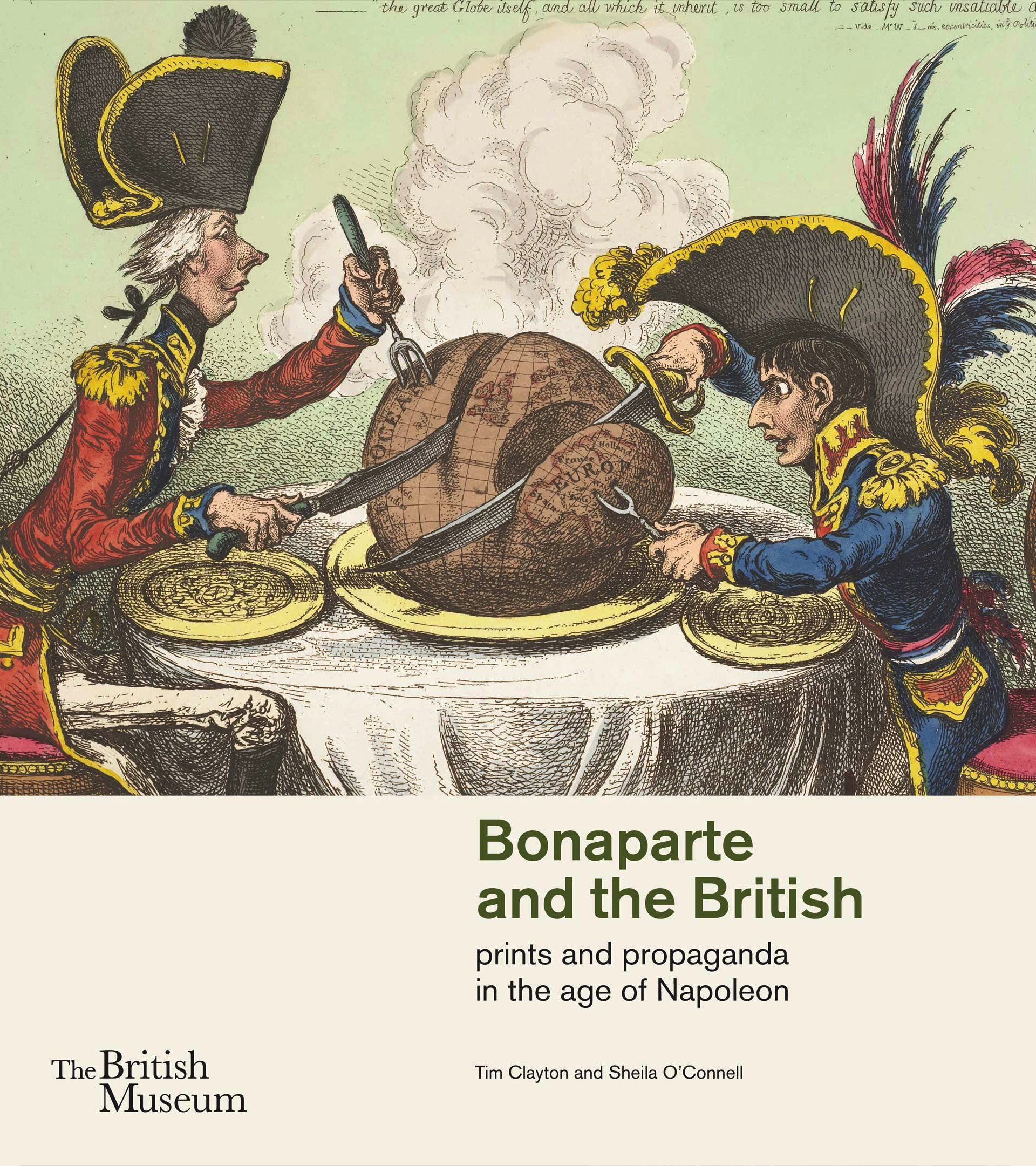 This fascinating book explores through contemporary prints how Bonaparte was seen from across the English Channel where hostile propaganda was tempered by admiration for his military and administrative talents. Featuring works from The British Museum’s world-renowned collection of political satires, including examples by the greatest masters of the genre, James Gillray, Thomas Rowlandson and George Cruikshank, the authors examine in detail these fascinating and humorous prints.
Attitudes to Bonaparte were coloured by political tensions in Britain as highlighted in satires of Charles James Fox, Richard Brinsley Sheridan, Lord Holland and other radicals. French, German, Russian and Spanish copies of British prints demonstrate the wide dissemination of prints and the admiration of continental artists for British satirists. From portraits of the handsome young general to the resplendent Emperor to the cast of his death mask, this book explores crucial events of Bonaparte’s career and the period. French satires showing the British in relation to Bonaparte are also included alongside portraits of Bonaparte and his family made for the British market. This richly illustrated title reveals the stories behind the prints, explaining how satire was used as propaganda and how the artists worked. It features intricately detailed prints in full colour, bringing to life a key period in European history.
Tim Clayton is a leading authority on British prints of the period and the author of several critically acclaimed military histories. Sheila O’Connell is curator of British prints before 1900 at The British Museum.
Exhibition | Vanishing Ice: Alpine and Polar Landscapes in Art

William Hodges, The Resolution and Adventure, 4 January 1773, Taking Ice for Water, Latitude 61 Degrees South, ink and wash on paper; 14 x 22″ (Mitchell Library, State Library of New South Wales).
Click here for more information.
◊ ◊ ◊ ◊ ◊
From the McMichael press release (9 December 2014) for the Vanishing Ice exhibition:
Vanishing Ice: Alpine and Polar Landscapes in Art, 1775–2012
Whatcom Museum, Bellingham, Washington, 3 November 2013 — 16 March 2014
El Paso Museum of Art, 1 June — 24 August 2014
Glenbow Museum, Calgary, Alberta, 27 September 2014 — January 4, 2015
McMichael Canadian Art Collection, Kleinburg, Ontario, 31 January — 26 April 2015
On January 31, 2015, the powerful and provocative exhibition Vanishing Ice: Alpine and Polar Landscapes in Art, 1775–2012 opens at the McMichael Canadian Art Collection. Since debuting in 2013 at the Whatcom Museum in Bellingham, Washington, the exhibition has garnered attention for its unique interweaving of art, history, and science. Showcasing the beauty and fragility of Earth’s frozen frontiers through the eyes of artists, writers, and naturalists over a period of more than 200 years, the exhibition offers a unique take on the timely subject of climate change.
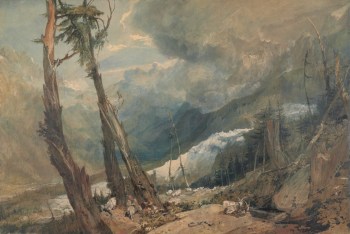
Joseph Mallord William Turner, Mer de Glace, in the Valley of Chamouni, Switzerland, 1803, watercolor, graphite, gum, 28 x 41″ (New Haven: Yale Center for British Art, Paul Mellon Collection)
Vanishing Ice features over seventy works including drawings, prints, paintings, photographs, videos, and installations by fifty artists from twelve countries. Among these historical and contemporary artists are: Ansel Adams, Lita Albuquerque, James Balog, Thomas Hart Benton, David Buckland, Gustave Doré, Lawren Harris, Isaac Julien, Kahn & Selesnick, Rockwell Kent, Paul D. Miller (aka DJ Spooky), Alexis Rockman, Camille Seaman, and Spencer Tunick. The exhibition unfolds thematically, geographically, and chronologically, moving from alpine to Arctic and Antarctic landscapes.
The idea for Vanishing Ice grew out of curator Barbara Matilsky’s doctoral dissertation, written thirty years ago about the sublime landscapes of French artist-naturalist-explorers who were among the first to depict the poles and mountain glaciers. As Matilsky became aware of the increasing number of contemporary artists who were venturing to the Arctic and Antarctic, she saw an opportunity to compare historical and contemporary depictions of these rapidly changing landscapes, as epitomized by the juxtaposition of Arthur Oliver Wheeler’s 1917 image of the Athabasca Glacier in Jasper National Park and Gary Braasch’s 2005 photograph of the same location.
“I am hoping that Vanishing Ice will stimulate a new appreciation for alpine and polar landscapes by revealing their significance for both nature and culture,” said exhibition curator Barbara Matilsky from the Whatcom Museum. “In the past, artists and naturalists expanded the public’s awareness of Earth’s icy frontiers. Today, artists continue to collaborate with scientists, motivated by the belief that art will help people to visualize the accelerating effects of climate change. They awaken the world to both the beauty and increasing vulnerability of ice, which is critical for biological and cultural diversity. Their work will hopefully inspire activism on the regional and national levels to make the requisite policy changes that will bring Earth back into balance.”
The McMichael is the exhibition’s final stop on a tour that included the Whatcom Museum; the El Paso Museum in Texas; and most recently the Glenbow Museum in Calgary.
“The McMichael nurtures a special interest in exploring the intersection of art and nature, and encouraging meaningful dialogue about the environment,” said Dr. Victoria Dickenson, Executive Director and CEO of the McMichael. “Vanishing Ice is both a beautiful glimpse of some of the most remote and fragile ecosystems, and a call to action on what many people hold to be the defining issue of this generation.”
Vanishing Ice, which will span the McMichael’s upper level of gallery spaces, will be complemented by an exhibition based on the McMichael’s permanent collection of works related to the Arctic, opening on February 14, 2015. The installation will include paintings and drawings by members of the Group of Seven, including Lawren Harris—famed for his depiction of icebergs and glaciers—and works by Inuit artists, including Tim Pitsiulak.
Vanishing Ice: Alpine and Polar Landscapes in Art, 1775–2012 is organized by the Whatcom Museum. Major funding for the exhibition has been provided by the Paul G. Allen Family Foundation and the National Endowment for the Arts with additional support from the Norcliffe Foundation, the Washington State Arts Commission, and the City of Bellingham.
From the University of Washington Press:
◊ ◊ ◊ ◊ ◊
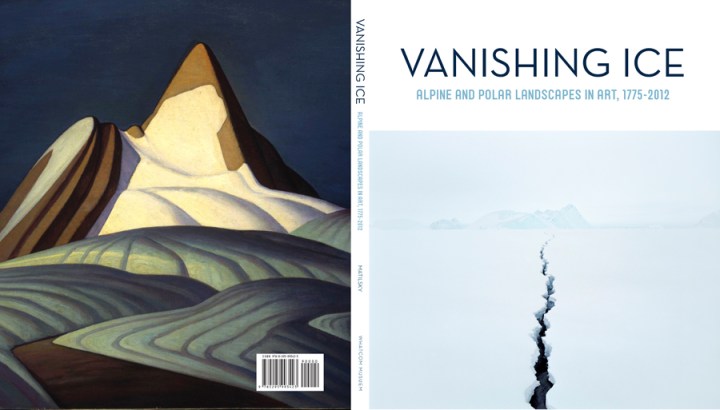
Barbara C. Matilsky, Vanishing Ice: Alpine and Polar Landscapes in Art, 1775–2012 (Seattle: University of Washington Press, 2013), 144 pages, ISBN: 978-0295993423, $40.
Vanishing Ice introduces the rich artistic legacy of the planet’s frozen frontiers now threatened by a changing climate. Tracing the impact of glaciers, icebergs, and fields of ice on artists’ imaginations, this interdisciplinary survey explores the connections between generations of artists who adopt different styles, media, and approaches to interpret alpine and polar landscapes.
Beginning in the eighteenth century, collaborations between the arts and sciences contributed to a deeper understanding of snowcapped mountains, the Arctic, and Antarctica. A resurgence of interest in these environments as dramatic indicators of climate change galvanizes contemporary expeditions to the glaciers and the poles. Today, artists, writers, and scientists awaken the world to both the beauty and increasing vulnerability of ice.
Barbara C. Matilsky is curator of art at the Whatcom Museum, Bellingham, Washington. She is the author of numerous books, including Fragile Ecologies: Contemporary Artists’ Interpretations and Solutions.
C O N T E N T S
Director’s Foreword
Prologue
From the Sublime to the Science of a Changing Climate
Voyage to Glacial Peaks
Magnetic Attraction: The Allure of the Poles
Elegy: The Open Polar Sea
Timeline
Checklist of the exhibition
New Book | Country Houses and the British Empire, 1700–1930
From Manchester UP:
Stephanie Barczewski, Country Houses and the British Empire, 1700–1930 (Manchester: Manchester University Press, 2014), 230 pages, ISBN: 978-0719096228, £75.
 Country Houses and the British Empire, 1700–1930 assesses the economic and cultural links between country houses and the Empire between the eighteenth and twentieth centuries. Using sources from over fifty British and Irish archives, it enables readers to better understand the impact of the empire upon the British metropolis by showing both the geographical variations and its different cultural manifestations. Stephanie Barczewski offers a rare scholarly analysis of the history of country houses that goes beyond an architectural or biographical study, and recognises their importance as the physical embodiments of imperial wealth and reflectors of imperial cultural influences. In so doing, she restores them to their true place of centrality in British culture over the last three centuries, and provides fresh insights into the role of the Empire in the British metropolis.
Stephanie Barczewski is Professor of Modern British History at Clemson University.
◊ ◊ ◊ ◊ ◊
C O N T E N T S
Introduction: British Country Houses and Empire, 1700–1930
1 Colonial Merchants
2 Indian Nabobs
3 West Indian Planters
4 Military and Naval Officers and Other Categories of Imperial Estate Purchasers
5 The Impact of Imperial Wealth on British Landed Estates
6 The Cultural Display of Empire in Country Houses
7 The Discourse of Commodities
8 The Discourse of Cosmopolitanism
9 The Discourse of Conquest
10 The Discourse of Collecting
Conclusion
Appendices
Select bibliography
Index
Workshop | On Site: Western Travellers Sketching in the Ottoman Empire
From H-ArtHist:
On Site: Western Travellers Sketching Topographies in the Ottoman Empire
Freie Universität Berlin, 19 February 2015
In the 17th and 18th centuries, the relations between the European countries and the Ottoman Empire were characterised by an increase in economic and diplomatic relations, but at the same time by military conflicts and aspirations. Europeans travelling to the Ottoman Empire in the 17th and 18th centuries were thus motivated by a variety of reasons and interests, which could be of a diplomatic, military, economic, religious, antiquarian or scholarly nature. Drawings and sketches were produced in these contexts both by travelling artists and by amateur draughtsmen.
The workshop investigates the activity of topographical sketching of landscapes or cityscapes during these travels with a particular focus on the implications of on-site sketching. The central question is how this artistic practice of sketching in a transcultural setup can be understood and conceptualised in art historical terms. We invite papers that deal with aspects of the following three fields.
Iconography
How did travelling draughtsmen choose their subjects and viewpoints? Which landscapes and cityscapes were considered significant and for what reasons (military, religious, antiquarian, aesthetic)? Did the permanent presence of conflict, both military and religious, between the Ottoman Empire and various European states, have an impact on the production and interpretation of these drawings?
Authenticity
Did these pictorial renderings aim at authenticity, and if so, how? How did travelogues testify to the authenticity of images? How did the knowledge, the preconceptions, the expectations and the fantasies of alterity that the travellers brought with them inform their practice of sketching on site; Or rather: In which way were such notions visually negotiated and thereby transformed?
Practices, Techniques, and Modes of Representation
How was the practice of drawing on site (i.e. outside, in a foreign country, as a stranger) conceived of and dealt with? Which practices, techniques and modes of representation were applied under these conditions? What effects did sketching bans and a fear of pictures and their producers have on travelling draughtsmen? How were these situations described and reflected in travellers’ writings?
Concept: Ulrike Boskamp, Annette Kranen
Venue: Freie Universität Berlin, Koserstraße 20, 14195 Berlin, Room A 163
◊ ◊ ◊ ◊ ◊
P R O G R A M
13.15 Ulrike Boskamp (Berlin), Welcome and Introduction
13.30 Palmira Brummett (Providence), Mapping the Ottomans: Moving from Narrative to Image at the ‘Limits’ of Empire
14.30 Irini Apostolou (Athens), The Representation of the Levant by French Travellers in the Seventeenth and Eighteenth Centuries
15.30 Coffee Break
16.00 William Kynan-Wilson (Berlin/Cambridge), Mediating Images in Jacques Carrey’s View of Athens (1674)
17.00 Annette Kranen (Berlin), Presenting Travel: Movement, Space and Places in Seventeenth-Century Western Images of the Ottoman Territories
18.00 Final Discussion
Exhibition | Jean-Jacques de Boissieu
◊ ◊ ◊ ◊ ◊
From the Städel Museum:
Jean-Jacques de Boissieu: A Contemporary of Städel’s / Ein Zeitgenosse Städels
Städel Museum, Frankfurt, 11 February — 10 May 2015
Curated by Jutta Schütt
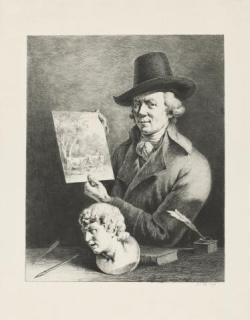
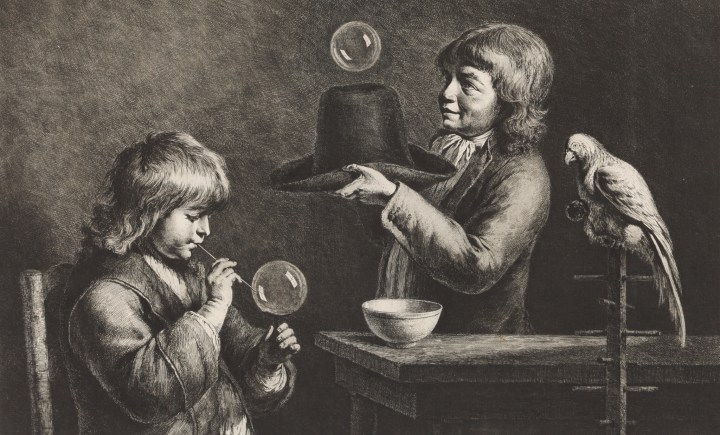
Self-Portrait of Jean-Jacques de Boissieu, 1796, etching.
Jean-Jacques de Boissieu (1736–1810) was already a highly acclaimed artist beyond France in his lifetime. Not only princes but also private collectors like Johann Friedrich Städel were fascinated with the landscapes, genre scenes, and portraits depicted in the artist’s drawings and prints. The founder of the Städelsches Kunstinstitut acquired over twenty drawings and far more than two hundred etchings by de Boissieu, which still rank among the central holdings of the Städel’s Department of Prints and Drawings. Created in a period of historically revolutionary events, de Boissieu’s oeuvre mirrors the landscape and life of the province around the artist’s native city of Lyon with an almost irritatingly unexcited and serious steadiness. His etched landscapes and portraits as well as his subtly nuanced brush and chalk drawings reveal a progressive realism that hints at a bourgeois understanding of art independent of any academic norms.
Call for Papers | Fancy‒Fantaisie‒Capriccio: Diversions and Distractions
From the Call for Papers:
Fancy‒Fantaisie‒Capriccio: Diversions and Distractions in the Eighteenth Century
Toulouse, 3–4 December 2015
Proposals due by 31 March 2015
Keynote speaker: Professor Martin Postle, Deputy Director of Studies, Paul Mellon Centre for British Art
In conjunction with the exhibition of paintings, Fantasy Figures, to be held at the Musée des Augustins, Toulouse, the Université de Toulouse Jean Jaurès and the University of Exeter are pleased to announce a call for papers for an interdisciplinary colloquium.
Associated with the imagination and not reason, fancy (fantaisie) in the eighteenth century was a sort of whimsical distraction from the everyday. For Voltaire it was ‘a singular desire, a passing whim’ (‘un désir singulier, un goût passager’), while for Samuel Johnson it was ‘something that pleases or entertains without real use or value’. Together with its near-synonym caprice (capriccio), fancy was part of a rich semantic network, connecting wit, pleasure, erotic desire, spontaneity, improvisation, surprise, deviation from norms, the trivial and inconsequential. Unpredictable and quirky, it offered many outlets for artistic creativity.
Papers are invited that investigate the expressive freedom of fancy (fantaisie, capriccio) in European culture during the eighteenth century—in figure and landscape painting, architecture and garden design, philosophy and fiction, theatre and music. Topics may include, but are not limited to the following:
• Tensions between fancy/capriccio and reason
• Fancy’s relationship to the imagination
• Fancy as a precursor of the Gothic and the fantastic
• The fancy picture or tête de fantaisie
• Capriccio in landscape, architectural painting, engraving
• Fancy in conjunction with a space, place or decorative schema
• Fantasia in musical composition or musical theatre
• Anecdote, imagination and desire in fiction
• The role of fancy in the discourse of love and seduction
• Creativity as a deviation from norms and rules
The colloquium will incorporate a guided visit of the fantasy figures exhibition with the curators. It is hoped that a volume of published essays will arise from the event. Participants should be prepared to meet their own travel and accommodation expenses. Refreshments will be provided on the day. Proposals (maximum 250 words in English or French) should be submitted to Professor Melissa Percival, University of Exeter, M.H.Percival@exeter.ac.uk by the 31 March 2015.
LACMA’s New Vicente Albán Paintings

Vicente Albán, Indian Woman in Special Attire (India en traje de gala), ca. 1783, Los Angeles County Museum of Art, purchased with funds provided by the Bernard and Edith Lewin Collection of Mexican Art Deaccession Fund.
◊ ◊ ◊ ◊ ◊
From LACMA’s Unframed (28 January 2015) . . .
LACMA’s New Vicente Albán Paintings from Ecuador Now on View
Ilona Katzew, Curator and Department Head, Latin American Art
Back in 1996, when I organized my first exhibition of Spanish colonial art in New York City, I included a group of fascinating works portraying racial types from Ecuador. The paintings were part of a set of six canvases, four of which had just been acquired by a private collector. The whereabouts of the two missing canvases was at the time unknown. Inscribed with the numeral 1 in the lower center, it was clear that this set was the first of two. The other series (bearing the numeral 2) is now in the Museo de América in Madrid and was shipped to Spain’s Royal Cabinet of Natural History in the late 18th century. It is signed by the Quito master Vicente Albán (active 1767–96). LACMA’s recent acquisition of the two missing paintings from the first set is thrilling. What makes these paintings exceptional? To start, there were only two sets created of Ecuadorean racial types (in contrast to the over 120 sets of the popular Mexican casta paintings that I have identified to date). Striking for their meticulous portrayal of local bounty and combination of indigenous and European textiles and jewels, the works are also eloquent documents of the Hispanic Enlightenment.

Vicente Albán, Noble Woman with Her Black Slave (Sra. principal con su negra esclava), ca. 1783, Los Angeles County Museum of Art, purchased with funds provided by the Bernard and Edith Lewin Collection of Mexican Art Deaccession Fund.
In Noble Woman with Her Black Slave, the white (or Spanish) woman wears an array of exquisite textiles, a string of pearls, and other jewels such as a gold crucifix and oval reliquary to signal that she is Catholic (and hence ‘civilized’). Her black slave (a conventional status symbol) is more modestly, if still lavishly, bedecked and is depicted barefoot. Worth noting are the ‘black’ flowers of the noblewoman’s skirt and hat. Scientific analysis has shown that they were originally painted in silver—a feature that would have bolstered the image of the colony as a land of unsurpassable riches. Though now irreversibly tarnished, it is not hard to imagine the impact that the painting once caused, peppered with abundant touches of gold and silver.
In Indian Woman in Special Attire, ancient indigenous costume elements—including a tupu (metal pin) fastening her lliclla (shoulder mantle), a belt with tocapus (geometric motifs associated with rank), which was an essential part of a coya, or queen’s dress, and a small chu’spa (a bag to carry coca leaves that gave energy and staved off hunger)—are combined with elements of European dress, such as the lavishly ornamented lace collar and sleeves of her blouse. Noticeable, too, is the black fabric laid over her skirt, fastened with a black sash. The X-radiograph clearly shows the large-sized pin, which is difficult to see due to the tarnishing of the metallic silver paint. It also reveals a delicate herringbone pattern on the woman’s mantle, now virtually undetectable to the naked eye. The pattern may suggest that this is a textile type known as tornasol (literally meaning ‘turns to the sun’). These shimmering silk fabrics were highly coveted in Europe and favored by the Spanish nobility. Colonial Andean weavers skillfully adapted them to their ancient textile traditions by combining a dark fiber warp (usually made of alpaca) and brighter contrasting weft (commonly silk). When the fabrics moved, they caught the light and created a glimmering two-tone effect. Contemporaneous travelers described this kind of pleated mantle as a distinct costume element worn by noble Indians.
One of the most salient elements of the paintings is the gigantic fruit placed next to the figures, making an explicit connection between the region’s inhabitants and its flora. The works convey a sense of American nature as extravagantly fertile. In Europe there existed the widespread idea that the Americas were an unusually hot place where nature and people—regardless of their racial makeup—ripened and spoiled quickly. These paintings counter such notion by representing local types from Ecuador dressed in lavish clothing and standing next to an assortment of giant tropical fruits, emphasizing the abundance of the land. An elaborate key in the lower section describes the trees and fruits, directing the viewer to selected parts of the canvases. This technology of production and reception of meaning was amply used in New World pictures (though it was by no means exclusive to it) to render ‘difference’ clear, transmit specific information, and reinforce the overall efficacy of messages.
Several scholars have linked the set at the Museo de América in Madrid with the Spanish botanist José Celestino Mutis (1732–1808), who led an important royal-sponsored expedition to the viceroyalty of Nueva Granada (1783–1816), and produced thousands of images of the region’s flora. (Nueva Granada refers to the Spanish colonial jurisdiction in northern South America, corresponding mainly to modern Colombia, Ecuador, Panama, and Venezuela.) This would explain the equal emphasis lavished on the racial types of the region and the precise botanical renditions that show both the exterior and the interior of local fruits. Throughout the 18th century, the Spanish Crown sponsored a number of expeditions to the Americas to gain better knowledge of their natural resources and exploit them for commercial ends. The production of images became an inherent part of these Enlightenment-era imperial taxonomic projects.
Despite the scant information about Vicente Albán (who signed the Madrid set), we know that he often collaborated with his brother, Francisco (1742–88), and that they both were regarded among the most prominent Quito painters of the day. Mutis may have commissioned Vicente to paint the Madrid set as a gift for Madrid’s Royal Natural History Cabinet, which was established in 1771. LACMA’s paintings, which are not signed, are very similar to the works in Madrid. But they also present intriguing formal and stylistic differences. The Madrid set, for example, is painted more freely and possibly by more than one hand, suggesting that it was created with workshop assistance. The figures in the LACMA pictures, on the other hand, seem to sit better in space and are more restrained in their handling of details (check back next week on Unframed to read more about the conservation process of these paintings). It is likely that Mutis also commissioned the set to which LACMA’s paintings belong as a gift for another important patron who supported his expedition. It is important to keep in mind, however, that LACMA’s set also could have been commissioned by another Enlightened royal functionary that remains unidentified. Commissioning replicas was part and parcel of the culture of image making at the time, and it was not uncommon among Spanish functionaries to request copies of the same image. In addition, artists often copied their own paintings, which had an important place in their workshops. Rich in detail, these two extraordinary pictures add an important dimension to our collection of viceregal art. A more complete study of the works will soon be published in a handbook of LACMA’s growing Spanish colonial collection.
Exhibition | Close-up and Personal: Eighteenth-Century Gold Boxes
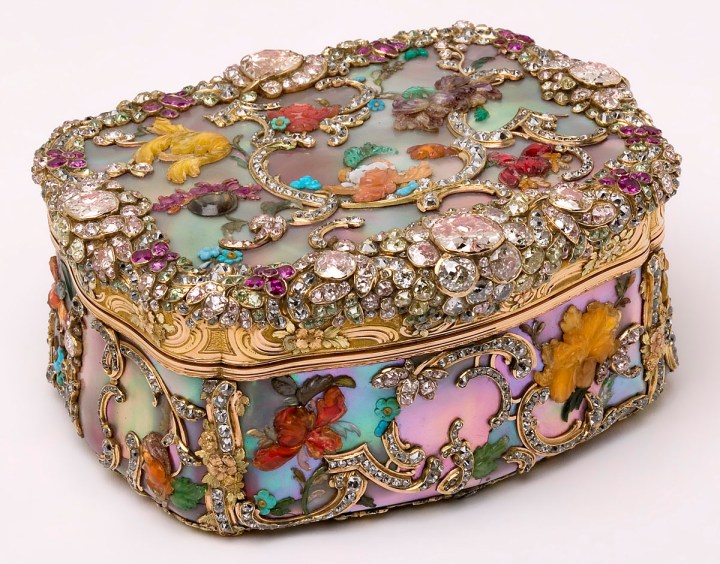
Snuffbox with Flowers, Berlin, Germany, ca. 1765, from the Rosalinde and Arthur Gilbert collection on loan to the Victoria and Albert Museum, London (formerly in the collection of Frederick II of Prussia, 1712–1786), photo Victoria and Albert Museum, London.
◊ ◊ ◊ ◊ ◊
A loan exhibition from the V&A, Close-Up and Personal includes 28 boxes in LA and nearly 60 in Cambridge. As reported by Paula Weideger for The Financial Times in 2009, the history of the fate of the collection is complicated, thanks partially to Arthur Gilbert’s conflicted relationship with LACMA, where he served as a member of the board of trustees. From LACMA:
Close-up and Personal: Eighteenth-Century Gold Boxes
from the Rosalinde and Arthur Gilbert Collection
Los Angeles County Museum of Art, 6 September 2014 — 1 March 2015
The Fitzwilliam Museum, Cambridge, 24 March — 6 September 2015
“So small a thing imposes on people,” remarked the notorious Giacomo Girolamo Casanova (1725–1798), who also carefully selected the type of tobacco to send inside such boxes when he presented them as gifts. Taking snuff and carrying it with you in an elaborate container was a universal practice in 18th-century Europe. A year before the death of the Elector of Cologne, one of the most powerful men in Europe at the time, Casanova had been given a snuffbox decorated with the Elector’s portrait. Going incognito to the Ridotto (the famous gambling halls of Venice), it was important that Casanova use an accessory he had not been seen with before. However, the very distinctive gold box with the Elector’s portrait eventually betrayed him when a former lover remembered it.
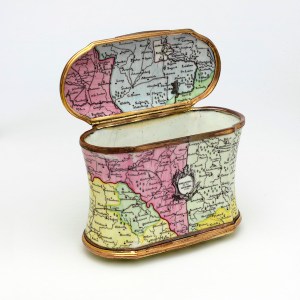
Double Snuffbox with Maps, ca. 1757, possibly Berlin, Germany, from the Rosalinde and Arthur Gilbert collection on loan to the Victoria and Albert Museum, London.
You yourself may recognize some of the gold boxes on view at LACMA through March 1, 2015. Carefully collected by Rosalinde and Arthur Gilbert in Los Angeles, they are here on loan from the Victoria and Albert Museum in London. Designed to carry just a small amount of powdered tobacco, the fine decorations of these pocket-sized containers have to be examined close up. The proximity of the viewing experience makes it very personal, intensifies the response, and can be a powerful experience when shared. Even today, a common reaction when examining them is wonderment, but these complex objects also have the potential to spark a wide range of emotions. Infinitely customizable, gold boxes became the most versatile form of gift in the 18th century.
Unlike the cups of precious metal that continue to lend themselves to specific types of acknowledgment such as loyalty of service or achievements in sport, these portable presents made it possible to communicate a spectrum of sentiments in a variety of social situations. While the double snuffbox covered with maps detailing maneuverings in the Seven Years’ War was probably made in Berlin or among the Prussian allies, other examples are less readily attributable to one side of the conflict. The same imagery would have been understood as a political statement and demonstration of allegiance by participants on either side.
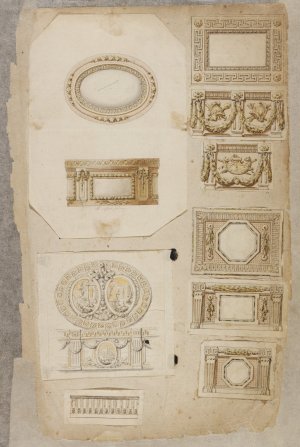
Pierre-Philippe Choffard, Design for an Oval Gold Box, 1759, Victoria and Albert Museum, London.
Elite production of the flashiest boxes was controlled by Frederick II, King of Prussia from 1740 to 1786, who banned imports from France (the unrivalled center of production at the time) “for the best [interest] of the gold workers in Berlin.” He presented some of his lavish commissions to courtiers and other sovereigns, and the local industry flourished under his patronage. Frederick’s personal enjoyment of these intensely bejeweled trinkets, and appreciation for their artistry, inspired him to engage with the manual process of designing them himself. Often the precious metal of the boxes is marked, revealing the places, names, and sometimes dates attached to their making and circulation. However, the designers, royal or otherwise, upon whose creativity all gold snuffboxes depend, cannot be as readily identified. A design on paper signed ‘Choffard fecit 1759’ for a box bearing the mark of maker Jean Ducrollay, is the great exception. However, we have very little information about Pierre-Philippe Choffard as a man or an artist.
Tantalizing details are a major characteristic of gold boxes, and eccentric examples have captivated many onlookers through their puzzling appearance. Like other curious objet d’art, such as the elephant supported musical vanity box (called a nécessaire), some snuffboxes were more than just containers. In the form of gadgets or figurines, they beg to be picked up and turned over in the hand. For example, a delicate box imitating a wicker basket reveals (when the lid is lifted) a cornucopia of fruit painted to fool the eye.
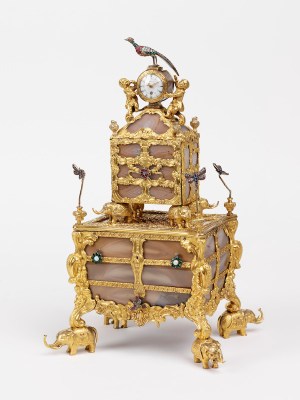
James Cox, Nécessaire, ca. 1770, from the Rosalinde and Arthur Gilbert collection on loan to the Victoria and Albert Museum, London.
You would have to travel to Strawberry Hill near London, the residence of Horace Walpole (1717–1797), to see a truly bizarre example of a snuffbox commissioned exclusively as a curiosity rather than a functional object. Exploiting the genre’s reputation for erudite encoding and connoisseurial delectation, it titillates through its command of wit. An elaborate ruse, it was conceived by the French patron of the arts Marie Anne de Vichy-Chamrond, marquise du Deffand (1697–1780) as a fake declaration of love from a social rival of hers to Walpole, the fourth Earl of Orford and a famous English collector. Her good friend was completely taken in by the exquisite portrait-clad box containing a flattering letter, and he wrote to the marquise about the excitement it gave him. Although the prank was at his expense, he seems to have been rather tickled by the incident. In the introduction to the catalog of his private collections, he recounts the practical joke as an enticement to his readers.
There can be no joking about the significance of the display of gold snuffboxes in the Koenig Gallery. Nothing prepares you for the power of these petite and precious masterpieces of extraordinary design and making. To really understand their attraction, you must encounter the real thing. And once you do, you will have an insider’s view of the preoccupations and passions of 18th-century aristocrats as well as an admiration for the genius of the best makers and designers of the period. With their curious shapes, elaborate surfaces, and the intriguing thoughts they express, gold boxes are some of the most delightful objects ever made.
New Book | Commercial Visions in the Dutch Golden Age
From The University of Chicago Press:
Dániel Margócsy, Commercial Visions: Science, Trade, and Visual Culture in the Dutch Golden Age (Chicago: The University of Chicago Press, 2014), 336 pages, ISBN: 978-0226117744, $40.
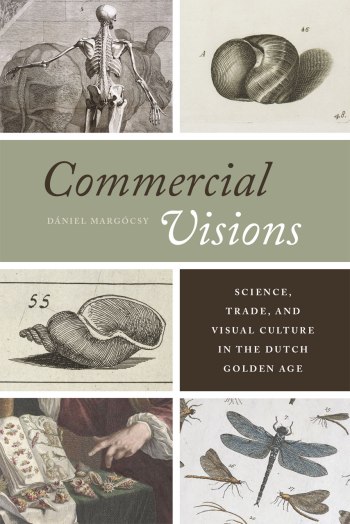 Entrepreneurial science is not new; business interests have strongly influenced science since the Scientific Revolution. In Commercial Visions, Dániel Margócsy illustrates that product marketing, patent litigation, and even ghostwriting pervaded natural history and medicine—the ‘big sciences’ of the early modern era—and argues that the growth of global trade during the Dutch Golden Age gave rise to an entrepreneurial network of transnational science.
Margocsy introduces a number of natural historians, physicians, and curiosi in Amsterdam, London, St. Petersburg, and Paris who, in their efforts to boost their trade, developed modern taxonomy, invented color printing and anatomical preparation techniques, and contributed to philosophical debates on topics ranging from human anatomy to Newtonian optics. These scientific practitioners, including Frederik Ruysch and Albertus Seba, were out to do business: they produced and sold exotic curiosities, anatomical prints, preserved specimens, and atlases of natural history to customers all around the world. Margócsy reveals how their entrepreneurial rivalries transformed the scholarly world
of the Republic of Letters into a competitive marketplace.
Margócsy’s highly readable and engaging book will be warmly welcomed by anyone interested in early modern science, global trade, art, and culture.
Dániel Margócsy is assistant professor at Hunter College, City University of New York.
◊ ◊ ◊ ◊ ◊
C O N T E N T S
List of Illustrations
1 Baron von Uffenbach Goes on a Trip: The Infrastructure of International Science
2 Shipping Costs, the Exchange of Specimens, and the Development of Taxonomy
3 Image as Capital: Forging Albertus Seba’s Thesaurus
4 Anatomical Specimens in the Republic of Letters: Scientific Publications as Marketing Tools
5 Commercial Epistemologies: The Anatomical Debates of Frederik Ruysch and Govard Bidloo
6 Knowledge as Commodity: The Invention of Color Printing
7 Peter the Great on a Shopping Spree
Acknowledgments
Abbreviations
Notes
Bibliography
Exhibition | Enlightenment: Carte Blanche of Christian Lacroix
◊ ◊ ◊ ◊ ◊
Press release from the Musée Cognacq-Jay:
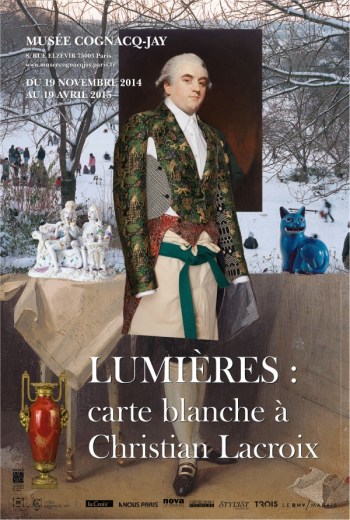
Lumières: Carte Blanche à Christian Lacroix
Musée Cognacq-Jay, Paris, 19 November 2014 — 19 April 2015
Curated by Christian Lacroix and Rose-Marie Mousseaux
In celebration of its grand reopening, the Musée Cognac-Jay has offered Christian Lacroix a creative carte blanche.
Established in 1928 by the founder of the La Samaritaine department store, Ernest Cognacq, in 1990 the museum was transferred to the Hôtel Donon, a recently-renovated sixteenth-century townhouse in the Marais district. The Musée Cognacq-Jay is home to a collection of emblematic eighteenth-century artworks, selected by its founder to be displayed in wood-panelled rooms representative of “the artistic décor of French life.”
Renowned for his creative collaborations with museums, Christian Lacroix has accepted the dual challenge of reimagining the ‘guiding narrative’ of the exhibition spaces while exploring a concept which has shaped his own approach to his art—the fascination exerted by the eighteenth century. He has curated contributions from over 40 contemporary artists, invited to reflect upon ten key themes identified in Ernest Cognacq’s collections with a view to enhancing our understanding of the Age of Enlightenment and its continued relevance in our own era.
◊ ◊ ◊ ◊ ◊
Christian Lacroix
Visions of the Enlightenment
 My perspective on the Age of Enlightenment is simply that of someone who is passionate about that era. It is an indirect perspective of the late 19th and early 20th century, when the Cognacqs built up their collection in consultation with ‘enlightened’ art historians. However, I admit that its influence on my work is less clear, as I see myself as more Dionysian than Apollinian. I can only gratefully advocate everything that the Enlightenment brought about in terms of social progress, political thinking, the fight against obscurantism, tolerance and a thirst for knowledge, as demonstrated by the encyclopaedists. All the more so given that, paradoxically, this seemingly unshakeable knowledge, these foundations that were thought to be the definitive basis of modern societies were suddenly undermined, disputed and denied in the early 21st century. If only for these reasons, it is interesting to make these connections between the 18th century and our own times. However, in my opinion we should also consider 19th-century taste—the ‘century of the pastiche’—when almost nothing new was created. Post-Napoleon III, decorative arts did nothing but ‘sample’ previous centuries, just as the Romantic period revived the medieval troubadour. There was no sign of pure, ex nihilo ‘contemporary creativity’, unlike what was emerging in England and the northern countries. From 1880 to 1910, people were expected to live in accordance with good taste—that is, past tastes—as the middle class post-Napoleon III adopted the style of the pre-Revolution enlightened aristocracy. I must confess that, beyond my appreciation and respect for the Age of Enlightenment, I am not impervious to all the rococo froth it created and inspired in the second half of the 19th century and beyond, with the somewhat risqué ‘marquise’, ‘shepherdess’ style, which was basically bourgeois and borderline kitsch. Contemporary artists often look back upon the 18th century from this angle.
◊ ◊ ◊ ◊ ◊
Rose-Marie Mousseaux, Director of the Musée Cognacq-Jay
A Return to the Museum’s Founding Vision
The Musée Cognacq-Jay is more than just a general collection of 18th-century art. It is an evocation of the taste in the 1900s for the Age of Enlightenment. The artistic collaboration with Christian Lacroix happened at exactly the same time as we were rethinking our vision of the Musée Cognacq-Jay, its place among Paris’s museums today, and what it has to offer in terms of revealing the appeal of the 18th century. To develop our 21st-century perspective, we had to go back to the founding vision of Ernest Cognacq, philanthropist and founder of the La Samaritaine department store who bequeathed the works to the City of Paris.
The exhibition design had not been reviewed since the museum moved premises in 1990, although the thematic display of the works had changed over time. This resulted in the creation of a temporary exhibition space but also led to an imbalance between the number of exhibits and the space in the rooms to display them. The empty galleries detracted from the ‘charm’ of the tour through the wood-panelled rooms. Finally, when the exhibits in the collection underwent the statutory inspection of their condition and physical integrity, we were able to look at each item in greater detail and consider its importance and meaning in the context of the collection as whole.
Today, the challenge is to make the museum’s layout clearer by structuring it around better defined themes. By giving Christian Lacroix carte blanche, we were able to identify ten recurring themes within the collection and structure them around two key aspects of 18th-century society—the importance of social occasions and the emergence of the individual. The layout has therefore been designed to go beyond the chronological limits of the temporary exhibition and incorporate several of the themes explored in the museum’s future permanent exhibition spaces. We adopted the same approach when deciding how to present each theme.
Christian Lacroix played a key role in presenting the collections in a way that was both physical and conceptual. The carte blanche that we gave him marks a highlight in the history of the Musée Cognacq-Jay. The temporary exhibition that he has curated combines contemporary works with historical exhibits and is an opportunity to reconsider our perspective of the Age of Enlightenment, its promises, and disappointments by inviting visitors to explore and reflect upon its legacy.
◊ ◊ ◊ ◊ ◊
The New Museum Layout
Thanks to Christian Lacroix’s input, we have been able to rethink how the museum’s collections are displayed and show the exhibits in a new light by presenting them in a more structured way that reflects the personalities of Ernest Cognacq and Marie-Louise Jay. The themes explored as part of this new layout reflect the different motifs found in the collection, which were influenced by the choices made by Ernest Cognacq and Marie-Louise Jay as collectors and by the major artistic movements of the 18th century.
The tour begins in the introductory room, which explains the history of the collection and its founders. After that, the exhibition is structured around ten different themes:
• Sensory experience and knowledge in the 18th century (room 2)
• Shows, balls, and sociability (rooms 3 and 4)
• Paris, capital of the Enlightenment (room 5)
• Europe’s artistic economy (rooms 6 and 7)
• 18th-century exoticism (room 8)
• The classical model (room 9)
• Childhood and education (rooms 10 and 11)
• Portraits and the emergence of the individual (rooms 12, 13 and 15)
• The age of Boucher (room 14)
• Fables, stories, and novels (room 17)
Throughout the exhibition, Christian Lacroix draws links between the museum’s collections and photographs, textiles, design pieces, and installations by contemporary artists. In doing so, he encourages visitors to reflect on how the Age of Enlightenment has influenced today’s society and gain a better understanding of its cultural legacy.
Details are available from the press kit, available as a PDF file here»
◊ ◊ ◊ ◊ ◊
It seems to me that the historiographical layers involved with the new presentation of the museum are also playing out in curious ways with the fate of La Samaritaine, the department store founded by Ernest Cognacq; Adan Gopnik provides commentary in “The View from a Bridge: Shopping, Tourism, and the Changing Face of Luxury,” The New Yorker (8 December 2014), pp. 42–47. –CH










 Enfilade
leave a comment