The Chelsea Antiques Fair, March 2015
As noted at ArtDaily:
The Chelsea Antiques Fair
Chelsea Old Town Hall, Kings Road, London, 18–22 March 2015
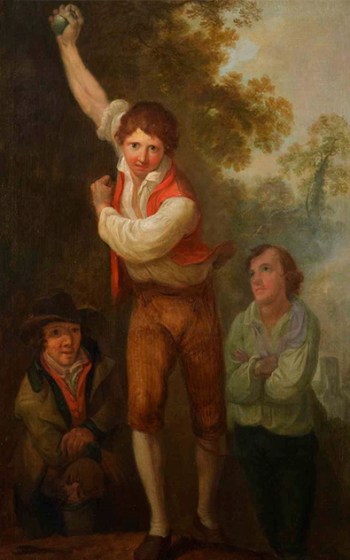
Irish Road Bowlers, ca. 1790s
The earliest known depiction of Irish Road Bowling will be offered by Bagshawe Fine Art at The Chelsea Antiques Fair, which opens the day after St Patrick’s Day at the Chelsea Old Town Hall on Wednesday, 18th March 2015 and runs until Sunday, 22nd March (it coincides with The BADA Fair, just half a mile away). Dr Fintan Lane, the Irish historian and author of Long Bullets: A History of Irish Road Bowling, has stated that in his opinion this is the earliest known visual depiction of the sport.
Nicholas Bagshawe explains: “This fascinating picture depicts the Irish sport of road bowling. This sport, possibly of Dutch origin, has been played in Ireland since the 17th century and is still played today, predominantly in the counties of Armagh and Cork. The sport consists of a contest between two or more players who attempt to throw a metal ball down a country road course of a specific length. The winner is the one who completes the course in the fewest throws.”
The Irish Road Bowling historian, Fintan Lane, states that the earliest painting known before this discovery was by Daniel MacDonald (1821–1853), which dates from circa 1847. According to Bagshawe “it is not yet totally certain who the artist of this picture is, but we are becoming increasingly convinced that it is the work of Nathaniel Grogan Junior (Irish, ca. 1765–1820).” The oil on canvas measures 47 x 33 inches and is dateable from the style of painting and the costumes of the players to the years around 1790 to 1800.
Bagshawe explains that “in English terms it appears to have an affinity with the styles of George Morland, Francis Wheatley or even the portraitist John Opie. But it is none of these directly, and given the specifically Irish nature of the subject, we must be looking for an Irish artist. The Grogans, both senior and junior, seem the most likely candidates; and, when we consider that they were both Cork artists, this becomes a very strong possibility. As art historians start to differentiate their work more accurately, it seems that Nathaniel Grogan senior, while a better known and seemingly more prolific artist, might not have been capable of painting a large front-of-stage figure with quite the fluency shown here. It is more likely that we are looking at the work of his son. Grogan Junior was, like his father, a Cork painter, and he must have started out as a pupil and collaborator of the older artist. However, such few documented sketches as we know to exist by the younger man do show a greater fluency with the figure, and he must be the most likely candidate for this picture. When we add to that the fact that he is known to have exhibited a picture in his lifetime called The Bowl Players, this attribution becomes all the more plausible. There is more to learn about this intriguing picture, but without doubt it already presents itself as a fascinating piece of Irish social history.”
The painting shows two young men, jackets off, competing with each other. The third figure, with hat and coat, is likely to be the ‘road-shower’. This man would have marked the point (the ‘tip’) where the previous shot had stopped and thus the place from where the bowler would take his next throw. The bowler holds the metal ball (probably still a cannon-ball at this stage) high in the air, from where he would bring it down in a fast underarm action. This high-arm action, sometimes known as the ‘windmill’ style was a technique favoured by players in the Cork area; therefore, it is felt that the scene depicted in the painting is taking place in Co. Cork.










 Enfilade
leave a comment