Call for Papers | The Japanese Palace in Dresden

From H-ArtHist:
Das Japanische Palais in Dresden: Vom Porzellanschloss Augusts des
Starken zum Museumsschloss des frühen Bildungsbürgertums
Dresden, 9–10 October 2015
Proposals due by 26 April 2015
Tagung an der TU Dresden, Fritz-Thyssen-Projekt zur Baugeschichte des Japanischen Palais
Die Tagung hat das Japanische Palais in Dresden-Neustadt zum Gegenstand, das heute etwas abseitig gelegen kaum in seinem wahren Wert wahrgenommen wird. Es handelt sich bei diesem Bau um eines der Hauptwerke des Dresdner Barocks und stellte in seiner ursprünglichen Planung ein absolutes Unikat in der europäischen Architektur des 18. Jahrhunderts dar. 1729 bis 1734 zu großen Teilen aufgeführt, sollte es die reiche Sammlung Augusts des Starken an ostasiatischem Porzellan und die neu geschaffenen, kostbaren Porzellanstücke der Meißner Manufaktur aufnehmen und so Sachsens Glanz eindrücklich präsentieren. Das heutige Schattendasein des Bauwerks liegt wohl auch darin begründet, dass der Tod Augusts des Starken seine Fertigstellung vereitelte und somit das Gebäude nie auf spätere Schlossbauten ausstrahlen konnte.
An der Planung des Japanischen Palais war der König selbst rege beteiligt: Vielfältige regionale, überregionale und internationale Inspirationen und Gedankenansätze flossen hier zusammen und ließen ein einzigartiges Bauwerk entstehen. So ist neben vorbildhaften Bauten, Konzepten und zeremoniellen Eigenheiten auch nach den Erfahrungen der Architekten sowie den politischen Rahmenbedingungen zu fragen.
Nach dem Paradigmenwechsel des späten 18. Jahrhunderts hin zu einer Kultur der Aufklärung und des breiter zugänglichen Wissens sind die Umbauten der Jahre 1786 und 1835 insbesondere vor dem Hintergrund des sich entwickelnden europäischen Bibliotheks- und Museumswesens sowie des Bildungsbürgertums zu würdigen. Die nicht unbedeutenden Zeugnisse der Semperschen Neugestaltung werfen nicht zuletzt auch Fragen zu dessen Italienforschungen und seiner Polychromieschrift auf.
Geplant ist ein anderthalb tägiges Tagungsprogramm mit einer Exkursion ins Japanische Palais und in die Dresdner Porzellansammlung. Sie sind eingeladen, sich mit einem Beitrag an der Tagung zu beteiligen. Die Vorträge sollten die Länge von 20 Minuten nicht überschreiten. Bitte senden Sie bis zum 26. April 2015 einen Vortragsvorschlag von maximal 400 Wörtern sowie einen Kurzlebenslauf, ggf. mit den wichtigsten Publikationen. Die finalen Einladungen ergehen Ende Mai.
Zu den möglichen Themen zählen:
Block 1 – Barock
Europäischer Schlossbau
• Vorbildhaftigkeit bedeutender europäischer Residenzschlösser (v. a. Versailles, Stockholm, Berlin, Escorial)
• Architekten am sächsischen Hof (v. a. Zacharias Longuelune, Matthäus Daniel Pöppelmann und Jean de Bodt)
• Galerie- und profane Zentralbauten in Europa
• Kapellen und Paradeschlafzimmer in barocken Residenzschlössern
Politik
• Sachsen und Habsburg
• Sachsen und Preußen: Konkurrenz und Vorbildhaftigkeit
Städtebau
• Integration von Schlossbauten in bestehende und neu zu schaffende Strukturen
• Achsbildung im Schlossgelände und der Umgebung
• Der Alterswert bestehender Residenzen versus repräsentative Neubauten
Porzellan und Chinoiserie
• Porzellansammlungen an den europäischen Fürstenhöfen
• Porzellan als Prestigegut und seine räumliche Präsentation
• Asien in der europäischen Wahrnehmung
Gartenbaugeschichte
• Gartenkultur in Sachsen, Frankreich und Holland
• Einbeziehung natürlicher Gegebenheiten in die Planungen
Block 2 – Klassizismus und Historismus
Bibliotheken
• Vorbildhafte Architekturen im 18. Jh.
• Von der privaten Sammlung zur öffentlichen Bibliothek
Gottfried Semper
• Antikensammlungen in Europa
• Die Polychromieschrift und Italienforschungen Gottfried Sempers
• Begriff des Gesamtkunstwerks bei Semper
Rahmenbedingungen: Seitens der Tagung werden die Kosten für die Anfahrt und die Unterkunft getragen. Eine Publikation der Tagungsbeiträge ist nicht vorgesehen.
Organisatoren: Dr. Stefan Hertzig (stefan.hertzig@mailbox.tu-dresden.de); Dr. Kristina Friedrichs (kristina.friedrichs@mailbox.tu-dresden.de).
Conference | Challenging Materials: Joshua Reynolds
From The Paul Mellon Centre for Studies in British Art:
Challenging Materials: Joshua Reynolds and Artistic Experiment in the Eighteenth Century
The Wallace Collection, London, 15 May 2015
Organized by The Paul Mellon Centre for Studies in British Art and The Wallace Collection

Joshua Reynolds, Portrait of Mrs Mary Robinson, ‘Perdita’ , 1783–84 (London: The Wallace Collection)
This on-day conference, which accompanies the exhibition Joshua Reynolds: Experiments in Paint at the Wallace Collection, is designed to investigate and contextualise the artist’s famously experimental practice. Building upon the technical findings of the Reynolds Research Project at the Wallace Collection, and also on a range of recent conservation projects on Reynolds’s paintings, it will explore his distinctive manipulation of paint as a medium. Papers will explore new perspectives on Reynolds’s experimental forms of pictorial composition, narrative and allusion, and to look afresh at the dynamic interactions between the artist, his sitters and his models in the studio. As well as focusing on Reynolds’s own art in detail, the conference seeks to place his experimental activities within the context of wider artistic, cultural and scientific practices of the eighteenth century.
Confirmed Speakers: Mark Aronson, Helen Brett, John Chu, Cora Gilroy-Ware, Matthew C. Hunter, Rica Jones, Andrew Loukes, Martin Myrone, Marica Pointon, Martin Postle, Sophie
Reddington, Lisa Renne and Iris Wien.
The conference will take place on 15th May 2015 in London at The Wallace Collection. Tickets can be purchased via Eventbrite. General Admission: £65 (+ admin fee) / Concession Ticket: £45 (+ admin fee).
◊ ◊ ◊ ◊ ◊
F R I D A Y , 1 5 M A Y 2 0 1 5
9.00 Private view of Joshua Reynolds: Experiments in Paint
10.00 Introduction: Mark Hallett and Christoph Vogtherr
10:15 Session 1
• Marcia Pointon (Professor Emeritus in History of Art, The University of Manchester), Known Knowns, Known Unknowns and Unknown Unknowns: Finish and unfinish, in a portrait by Reynolds from the 1750s (?)
• Helen Brett (Painting Conservator, Tate and Martin Postle, Deputy Director, The Paul Mellon Centre), ‘New Light on an old Warhorse’: Joshua Reynolds’s portraits of Lord Ligonier
11:15 Coffee Break
11:45 Session 2
• John Chu (Research Cataloguer, Tate Britain), Experiment, Excess, Patronage: Joshua Reynolds and the 3rd Duke of Dorset
• Iris Wien (Marie Curie/IPODI Fellow, Technical University Berlin), Character as experiment: Reynolds’s A Strawberry Girl and his Boy Holding a Bunch of Grapes
• Rica Jones (Conservator of Paintings, formerly at Tate Gallery), ‘I can vouch for them to be authentick and just, either from my own experiments and observations, the information of persons of undoubted veracity who have practised them, or clear deductions from unquestionable principles’: An appraisal of Robert Dossie’s ‘Handmaid to the Arts’ and the climate in which it was produced in the 1750s
13:15 Lunch Break
14:15 Session 3
• Sophie Reddington (Paintings Conservator, Private Studio and Andrew Loukes, Curator of Exhibitions and Collections, Petworth House, National Trust), Toil and Trouble: The history, materials and restoration of Reynolds’s largest work
• Mark Aronson (Chief Conservator, Yale Centre for British Art), Canvas, a Time Based Media: Joshua Reynolds’s portraits revealed through X-radiography
• Elizaveta Renne (Keeper of British and Scandinavian Paintings at the State Hermitage Museum in St Petersburg), The painting which ‘might be called great if it were more correct: it might perhaps have been correct had it not attempted to be great’
16:00 Coffee Break
16:30 Session 4
• Matthew Hunter (Assistant Professor and Graduate Program Director, Department of Art History and Communication Studies, McGill University), ‘The Unique Art of Hightening and Preserving the Beauty of Tints to Futurity without a Possibility of Changing’: William Birch’s Chemical Gambits
• Cora Gilroy-Ware (from September 2015, Huntington Library/California Institute of Technology), ‘Her swelling breast palpitates’: Life and death in the works of William Hilton
• Martin Myrone (Lead Curator for Pre-1800 British Art, Tate Britain), Painting after Reynolds (around 1820)
18.00 Drinks Reception
Call for Papers | Animating the Georgian London Town House
From The Paul Mellon Centre for Studies in British Art:
Animating the Georgian London Town House
London, 17 March 2016
Proposals due by 8 May 2015
Organised by The Paul Mellon Centre, The National Gallery, and Birkbeck College, University of London
Eighteenth-century country houses loom large in the British national consciousness. Yet, for every great country house from this period, there was usually also a town house. Wilton is much visited and discussed, but we know so much less about its counterpart in London: Pembroke House. Chatsworth has officially been recognised as one of the country’s favourite national treasures, but most of its visitors know little of Devonshire House, which the family once owned in the capital. In part, this is because town houses were often leased, rather than being passed down through generations as country estates were. But, most crucially, many London town houses, including both Pembroke House and Devonshire House, no longer exist, having been demolished in the early twentieth century.
Following on from the Animating the Eighteenth-Century Country House conference in March 2015, this related event will seek to resurrect the lost town houses of the eighteenth and early nineteenth centuries, exploring the position they once occupied in the lives of families and the nation as a whole. Some—such as Spencer House—have survived; others have left fragmentary traces; others have been completely destroyed and can only be recreated on the basis of inventories and descriptive accounts. There is much still to be uncovered about the collections of paintings, sculpture and decorative arts which these buildings once housed as well as about their furnishing, their architecture and gardens, and what refashioning occurred over time.
What was the significance of the town house for families such as the Devonshires and Pembrokes? How much time did they spend in London, relative to their sojourns in the country, and was one home considered more important? How did this vary between families? How did owners arrange their possessions between their houses? London town houses were often the setting for elite socialising, so is it the case that they would house their owners’ most impressive works of art? Was Joshua Reynolds right to bemoan in 1787, on learning that the Duke of Rutland was to keep Poussin’s Seven Sacraments at Belvoir Castle, that ‘the great works of art which this nation possesses are not (as in other nations) collected together in the capital, but dispersed about the country’? When and why were items moved between town and country, and are there discernable patterns over the period? Were London town houses opened to the public in the same way as country houses, and what did visitors say about what they encountered?
As well as mapping the relationship between the town house and the country house, this conference will also explore the geography of London: the location of these properties (especially within the West End), the most important estates (such as the Bedford or Grosvenor estates), and the reputations which various areas accrued. How did these houses position their owners in the complex social and political milieu of Georgian London, and what roles did they play in the lives and activities of those who owned, leased and inhabited them? How was this different for men and for women? And what was the significance of owning a town house freehold, leasehold—or just renting one for a season?
Proposals for contributions are welcomed from art historians and historians working on all aspects of eighteenth and early nineteenth-century town houses, including architecture, painting, sculpture, the decorative arts and garden history. Abstracts for 25-minute conference papers should be no longer than 300 words in length, and should be accompanied by a short biography (of no more than 100 words) detailing any work or recent publications of particular relevance. Please send abstracts and biographies by FRIDAY 8th MAY 2015 to Ella Fleming at the Paul Mellon Centre: efleming@paul-mellon-centre.ac.uk.
Exhibition | Paper Architectures

Filippo Juvarra, Premier projet pour la chapelle Saint Hubert à la Venaria Reale, Turin, vers 1716. Plume et encre brune, 15,9 x 31,3 cm, inv. CD 73 (Paris: Les Arts Décoratifs).
◊ ◊ ◊ ◊ ◊
From the Musée des Arts décoratifs:
Paper Architectures: Drawings from Piranesi to Mallet-Stevens
Architectures de Papier: Dessins de Piranèse à Mallet-Stevens
Musée Nissim de Camondo, Paris, 26 March — 21 June 2015
Curated by Basile Baudez
For the first time at the Musée Nissim de Camondo, in conjunction with the Salon du Dessin, the theme of which this year is architecture, the Musée des Arts décoratifs Graphic Arts Department is featuring a selection of its finest works. They give an idea of the wealth and diversity of architectural drawings, ranging from those that record a key phase in the creative process or a highly finished drawing for a client to a architectural ‘tableau’ painted for the Salon, a sketchbook fantasy or a visual compendium compiled for architectural students. Architectural drawings show the diversity of their purposes: the solving of a structural problem, the reinterpretation of archeological decoration, a description of an industrial process or the design of a garden. All these drawings, acquired or donated to the Musée des Arts décoratifs since its founding, plunge us into the heart of a strange, fascinating and highly varied world.
Call for Papers | Travellers and the Musical Imagination, 1500–1900
From H-ArtHist:
Travellers to Faraway Countries and the Musical Imagination on the Move, 1500–1900
Università del Salento, Lecce, 28–29 September 2015
Proposals due by 30 April 2015
International Musicological Society-Study Group on Musical Iconography
By the early sixteenth century, European encounters with faraway cultures had led to a new awareness of the cultural ‘other’ and of non-European musical cultures, which found its expression in the writings of travelers and scholars, in the imagination of visual artists, and in the rendering of ‘exotic’ features in musical compositions. Some of the images associated with this emerging awareness, may have been the result of firsthand experiences or eyewitness participation. Others, by contrast, represented mostly secondhand impressions, which despite pretensions of authenticity, partook in visual or auditory imaginary journeys whose details in many cases could have been triggered by learned traditions of literary culture. Quite often, depictions were far removed from the ‘original’; they were idealized and filtered through European sensibilities and according to models of the classical world; as such, iconographical patterns, once crystallized, could have been transmitted from author to author through centuries, thus further removing the received image from the original (if such original ever existed). Ultimately, the firsthand experience of distant cultures made possible the rise of a new sensitivity towards indigenous strands of music to be (re-) interpreted according to the patterns of colonialist imagination. In this context, a better understanding of the ‘constructedness’ of images is crucial for musical iconography.
We invite paper proposals for a two-day conference, which address the following topics, among others:
• Images of music in illustrated chronicles and travel accounts related to America, Asia, Africa, Australia and Europe (‘Grand Tour’)
• Visual references to foreign (exotic, oriental), indigenous (ethnic) and bucolic (pastoral) music in music treatises, emblematic literature, paintings, drawings, engravings, pictorial cycles to be found within aristocratic palaces and residences etc.
• Italian music and dance as viewed through the eyes of transalpine travellers and scholars
• Italian music (and related imagery) as a source of inspiration for composers
• Transmission, reception and circulation of pictorial topoi to be found in music historiography
• Processes of ‘othering’ vs. ‘assimilating’, ‘artistic’ vs. ‘ethnological’ approaches
• Exotic strands in the decoration of musical instruments
Abstracts of no more than 300 words for 20-minute papers in English or Italian may be sent by 30 April 2015 to daniela.castaldo@unisalento.it
Scientific Committee
Daniela Castaldo (Local Organizer, Università del Salento)
Gabriela Currie (University of Minnesota)
Dinko Fabris (IMS President, Università della Basilicata)
Nicoletta Guidobaldi (Università di Bologna-Ravenna)
Björn R. Tammen (Österreichische Akademie der Wissenschaften, Vienna)
William Bartram Exhibition Slated for 2018
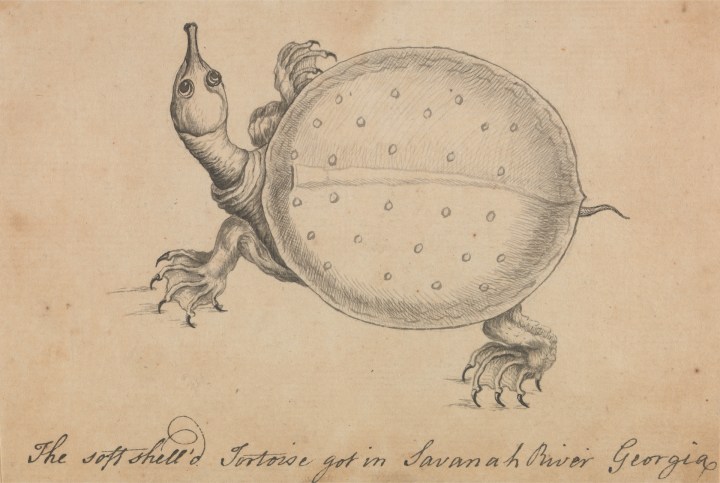
William Bartram, The Soft Shell’d Tortoise Got in Savanah River Georgia, ca. 1773, Gray and black wash over graphite on medium, cream, slightly textured laid paper (New Haven: Yale Center for British Art, Gift of Charles Ryskamp)
◊ ◊ ◊ ◊ ◊
From the YCBA:
This spring [2015], Laurel Waycott, a second-year PhD student in the History of Science and Medicine, and Jacob Stewart-Halevy, a sixth-year student and PhD candidate in the History of Art, will work with Amy Meyers, Director of the Center, and Florence Grant, Postdoctoral Research Associate in the Director’s Office, on the first major exhibition of the work of William Bartram (1739–1823). A Philadelphia-based naturalist, Bartram was the first American-born artist to depict the flora and fauna of North America extensively. The exhibition is scheduled to open at the Center in 2018.
Waycott and Stewart-Halevy have chosen to study Bartram because of his distinctive position in eighteenth-century American natural history, both as a keen observer of American species and their environmental relationships, and as a correspondent with the natural history communities of Great Britain and the Continent.
“I am hoping to explore the dynamic among literary description, personal narrative, and imaginative naturalism in Bartram’s early efforts to catalogue North American species. The contradiction between the meticulous and the fanciful in his animal and botanical drawings seem key to the environmentalism of the moment,” said Stewart-Halevy.
Waycott says studying at the Center will add a unique dimension to her research into the intersections of art, science, and nature, and that the exhibition offers a wonderful opportunity to bring the intertwined histories of science and art to a wider public.
Meyers also appreciates the fresh perspectives the students will bring to the project. “I look forward to working with Laura and Jacob, who will inflect our study of Bartram with exciting new approaches to his life and work. Their cross-disciplinary training will enable us to interpret his contributions to the development of colonial and early republican art and science in important ways.” said Meyers.
Royal Oak Foundation Lectures, Spring 2015
A selection of the season’s offerings from The Royal Oak Foundation as related to the eighteenth century:
Royal Oak’s speakers are engaging, knowledgeable experts with a passion for a variety of topics related to The Royal Oak Foundation’s mission.
Charles Hind | Palladianism: Four Centuries of Style
First Baptist Church, Charleston 12 May 2015
Chicago Architectural Foundation, 8 May 2015
The MAA Carriage House, Washington, D.C., 5 May 2015
Abigail Adams Smith Auditorium, New York, 7 May 2015
The Union League of Philadelphia, 4 May 2015
The year 2015 marks the 300th anniversary of the publication of the first English translations of Andrea Palladio’s I Quattro Libri dell’Architettura [The Four Books of Architecture] and Colen Campbell’s Vitruvius Britannicus. Since the early 17th century, Palladio’s work, as adapted by Inigo Jones for English taste and needs, has influenced architects and clients. British Palladianism, as developed by Jones, Campbell, Lord Burlington and William Kent also proved hugely influential in northern Europe and in the British Colonies including India and North America.
Charles Hind, Chief Curator and H.J. Heinz Curator of Drawings at the Royal Institute of British Architecture, will examine the development of Palladianism in Britain using drawings, photographs and models from the RIBA’s collections, as well as contemporary architects’ practices. He will demonstrate how the contributions of this 16th-century Venetian man influenced centuries of style, and how Palladianism became one of the most important styles ever designed by a single architect, and is still used in public and private buildings.
Charles Hind’s areas of specialty are Andrea Palladio and British architecture from 17th to early 20th centuries. He co-curated a major European exhibition on Palladio in 2008–2009, and served as joint curator and co-author of the catalogue for the 2010 exhibition Palladio and His Legacy: A Transatlantic Journey. Mr. Hind has written numerous journal and magazine articles and lectured on architecture and British country houses. He also leads art and architecture tours in Virginia, St. Petersburg, and Venice. Mr. Hind has curated a number of exhibitions held in the RIBA Heinz Gallery and in the V&A+RIBA Architecture Gallery at the Victoria & Albert Museum.
◊ ◊ ◊ ◊ ◊
David Milne | ‘Still Life Drama’: A Walk Through Dennis Severs’ House
The Explorers Club, New York, 18 June 2015
At the Dennis Severs’ House at 18 Folgate Street in London, visitors are invited not to a museum to learn how people lived in the past, but rather to participate in what the founder called “a still life drama.” Guests walk through each room of the house in a multisensory experience feeling as if the 18th- and 19th-century inhabitants have only just withdrawn a moment before. These encounters were designed by American collector and founder Dennis Severs, who bought a semi-derelict early 18th-century house in the 1970s and then set about bringing it back to life. With no desire to restore the house, Severs instead wanted to honor what he imagined were the echoes of the house’s history. So armed with a chamber stick and pot, he created the fictional story of a Huguenot silk merchant’s family who might have lived in the house for generations from 1724 to 1914.
The triumph and tragedy of this fictional family is told through each room over several stories. Severs filled the house with original objects he bought in London’s street markets and sale rooms, atmospherically lit by candlelight. Painstakingly assembled over 20 years, many of the rooms are mocked up in the manner of stage scenery using inexpensive materials—all is artifice but still conveys a haunting sense of London’s past: silk waistcoats are flung across rumpled bed clothes, a card game has just ended, fires crackle, and steam rises from a filled punch bowl. Curator David Milne will discuss Dennis Severs’ incredible vision and illustrate how his remarkable home uniquely captures a moment in time.
David Milne has served as curator of Dennis Severs’ House since 1990. He has previously worked for Paul Dyson & Associates on projects for the Royal Historic Palaces, the Royal Opera House, the V&A Museum, Versace and Armani. He has been invited to give lectures for The National Trust and English Heritage, and was awarded the Verney fellowship by the Nantucket Historical Association in 2006–2008.
◊ ◊ ◊ ◊ ◊
Sean Sawyer | Tales of Loss & Redemption: The Country House in the National Trust
Castle Hill on the Crane Estate, Boston, 14 April 2015
The Explorers Club, New York, 28 April 2015
The Union League of Philadelphia, 27 April 2015
From the 1880s through the 1930s, Britain experienced a revolution in land ownership only paralleled in its history by the Norman Conquest and the Dissolution of the Monasteries. Britain’s landed elites found themselves under attack by the forces of modernity on all fronts, and their bastions, the country house, fell to the auction block and the wrecker’s ball in increasing numbers throughout the first half of the 20th century. Into this breach in the fabric of British landed society stepped a reluctant new force of social order, the National Trust.
The Royal Oak Foundation’s Executive Director, Dr. Sean E. Sawyer will discuss the National Trust’s role in rescuing some of Britain’s greatest country houses and their internationally significant collections of decorative and fine arts.
From a reluctant recipient of a handful of houses in the 1920s, the Trust evolved, through its Country Houses Scheme, to lead the way in preserving houses and collections through the bleakest years of the post-World War II era. The last decades of the 20th century saw a revival of fortunes for the country house and the Trust’s adaptation as its role as a leading operator of visitor attractions. This is a story full of deaths, both mortal and material, and of daring rescues and bureaucratic blindness. This illustrated lecture will explore some of the Trust’s most important properties, including Blickling and Hardwick Hall, and of the families and great characters who haunt them still.
Sean Sawyer became the Executive Director of The Royal Oak Foundation in October 2010. He received a B.A. summa cum laude from Princeton University in 1988 and his Ph.D. from Columbia University in 1999, specializing in 18th- and 19th-century British architectural history. In 1996, he was awarded the Society of Architectural Historians of Great Britain’s Hawksmoor Essay Medal, and in 2002 he attended the Attingham Summer School as a Royal Oak Fellow. Dr. Sawyer has taught at Columbia, Fordham and Harvard universities as well as The Parsons / New School Master’s Program in the History of Decorative Arts & Design at the Cooper-Hewitt. He has contributed essays and articles to numerous publications on Sir John Soane and late Georgian architecture and urbanism as well as Dutch-American history and architecture. From 2001 to 2007, he served as Executive Director of the Wyckoff House & Association, a Brooklyn-based organization focused on the operation of the Wyckoff Farmhouse Museum. Prior to joining Royal Oak, Sean was the Director of Administration and Development for the History Department at Columbia University for three years. He is a founding and current member of the Board of Directors for the Dyckman Farmhouse Museum Alliance, which supports the Dyckman Farmhouse Museum in Inwood, northern Manhattan.
◊ ◊ ◊ ◊ ◊
Michael Snodin | A Little Gothic Castle: Horace Walpole and Strawberry Hill
Scandinavia House, New York, 23 March 2015
The Union League of Philadelphia, 24 March 2015
Boston Athenaeum, 26 March 2015
Timken Museum, San Diego, 30 March 2015
UCLA Faculty Center, Los Angeles, 1 April 2015
Arader Galleries, San Francisco, 2 April 2015
Strawberry Hill, the fantasy gothic revival castle in Twickenham, was created during the mid-18th century for the politician, historian, and author Horace Walpole. But Strawberry Hill was more than an assemblage of bricks, plaster and papier mâché: it was the place to house Walpole’s eclectic collection. Portraits by renowned artists, furniture, and porcelain were displayed alongside eccentricities such as a limewood ‘lace’ cravat carved by Grinling Gibbons, embroidered gloves belonging to James II, and Dr. Dee’s mirror.
Mr. Snodin will describe Walpole’s collection—nearly all dispersed in an 1842 auction—and discuss the treasure hunt which is now underway to return as much as possible to the house. He also will illustrate the house’s incredible interiors and reveal how medieval architecture was the inspiration for the style of this summer villa: the stone fan vaulting of Henry VII’s chapel in Westminster Abbey influenced an ethereal confection of gilded plaster and papier mâché for Walpole’s Gallery. “My house is of paper like my writings,” wrote Walpole, “and both will blow away ten years after I am dead.” However, the house has miraculously survived and is now restored to its original appearance from 1790.
Michael Snodin is a design and architectural historian and Chairman and Hon. Curator of the Strawberry Hill Trust and the Strawberry Hill Collection Trust. In his career at the Victoria and Albert Museum he was Head of the Designs Collection, a Senior Curator and a Senior Research Fellow. He curated galleries as well as several major exhibitions including Horace Walpole and Strawberry Hill which opened in 2009 at The Yale Center for British Art. In addition to exhibition catalogues, his publications include many specialist articles. He is curator of Strawberry Hill Restored, which will open in 2017.
Conference | Ordo inversus um 1800
From H-ArtHist:
Ordo inversus: Formen und Funktionen einer Denkfigur um 1800
Weimar, Goethe- und Schiller-Archiv, Weimar, 26–28 March 2915
Tagungsleitung: Andrea Albrecht, Franziska Bomski, Lutz Danneberg
Die Jahrestagung des Zentrums für Klassikforschung wendet sich der ideengeschichtlichen Zäsur des ordo inversus um 1800 zu. Diese Denkfigur meint eine zirkuläre Bewegung des Ausgehens von einem Anfangs- zu einem Endpunkt, der durch ein Zurückkehren wieder mit dem Ausgangspunkt verbunden wird. Als Methodenkonzept spielt der ordo inversus von der Antike über das Mittelalter und die Frühe Neuzeit eine zentrale Rolle in den verschiedensten Wissensbereichen und Disziplinen, in denen er vor allem epistemische Sicherheit garantiert. Der Verlust seiner Plausibilität im 18. Jahrhundert provoziert eine Reihe von Restitutionsversuchen, die sich auf vielfältige Weise nicht nur in der Naturphilosophie und Hermeneutik, sondern auch in Kunst, Literatur und Ästhetik niederschlagen. So lässt sich mit Beginn der ›Moderne‹ ein Funktionswandel des ordo inversus beobachten, der mit modifizierten Formen der Denkfigur einhergeht.
Diese Veränderungen sollen in ihrem historischen Kontext nachgezeichnet und analysiert werden. Ein wesentliches Ziel besteht dabei darin, das derzeit vor allem einzeldisziplinär behandelte Phänomen des ordo inversus in seinen grundlegenden, verschiedene Wissensbereiche gleichermaßen durchgreifenden Formen und Funktionen sichtbar zu machen und auf diese Weise einen disziplinenübergreifenden Einblick in den historischen Wandel im Übergang zur ›Moderne‹ zu liefern. Dabei sollen insbesondere Antike, Mittelalter und Frühe Neuzeit als ideengeschichtlich relevante Traditionen für die Verhandlung des Konzepts im späten 18. Jahrhundert und frühen 19. Jahrhundert deutlich gemacht werden.
Gäste sind herzlich willkommen, eine Anmeldung ist nicht erforderlich.
◊ ◊ ◊ ◊ ◊
D O N N E R S T A G , 2 6 M Ä R Z 2 0 1 5
14.00 Andrea Albrecht, Franziska Bomski, Lutz Danneberg, Begrüßung und Einführung
15.00 Christel Meier-Staubach, Reditus omnium quae in suas causas reversura sunt: Figurationen des ordo inversus in der pseudo-dionysischen Tradition
16.00 Kaffeepause
16.30 Anselm Steiger , Inversio: Zu einer Matrix der Theologie Martin Luthers und des frühneuzeitlichen Luthertums
20.00 Wolfgang Proß, Herders Epitaph: Anfang, Ordnung und Neuanfang in Kultur- und Geschichtsphilosophie der Neuzeit (1500–1800)
F R E I T A G , 2 7 M Ä R Z 2 0 1 5
9.00 Violetta L. Waibel, Denken und Fühlen: Zum ordo inversus in Hardenbergs »Fichte-Studien«
10.00 Andrea Albrecht, Zirkelschmiede und Sphärometer: Jean Pauls humoristischer Blick auf den ordo inversus
11.00 Kaffeepause
11.30 Maarten Bullynck, In und außer der Ordnung: Mathematische Denkfiguren der Klassik
12.30 Mittagspause
14.30 Mitgliederversammlung des Zentrums für Klassikforschung
17.00 Franziska Bomski, Revolutionen des Weltsystems: Empirie und Kalkül bei Kopernikus und Laplace
17.00 Tilman Venzl, Johann Wolfgang Goethe: »Urworte. Orphisch«
18.15 Britta Hochkirchen, Subversion oder Restitution einer Denkfigur? Christian Rohlfs Weimarer Landschaftsbilder
18.15 Thomas Lange, Zeit sichtbar machen: Überlegungen zur Veranschaulichung des Raum/Zeit-Komplexes in den vier Dimensionen von Runges »Zeiten«
20.00 Gemeinsames Abendessen
S A M S T A G , 2 8 M Ä R Z 2 0 1 5
9.00 Olav Krämer, Vom vollendeten Kunstwerk zu den allgemeinsten Prinzipien der Ästhetik und zurück: Wilhelm von Humboldts Versuch »Über Göthes Herrmann und Dorothea« (1799)
10.00 Pierfrancesco Basile, Emersons naturalistischer Idealismus
11.00 Kaffeepause
11.30 Laurenz Lütteken, ›Zeit seines Lebens nicht an seinem Platze‹ Rochlitz und Mozart
Informationen und Kontakt
Klassik Stiftung Weimar
Referat Forschung und Bildung
Burgplatz 4 | 99423 Weimar
forschung.bildung@klassik-stiftung.de
Exhibition | Drawings of Alexandre-François Desportes (1661–1743)
Soon to be on view at the Petit Château at Sceaux:
L’Œil du Maître: Esquisses d’Alexandre-François Desportes (1661–1743)
des collections de la Cité de la Céramique
Musée du Domaine Départemental de Sceaux, 20 March — 28 June 2015
Curated by Dominique Brême
 Du 20 mars au 28 juin, le musée du Domaine départemental de Sceaux vous propose une exposition au Petit-Château sur le peintre des chasses de Louis XIV et de Louis XV et de leur meute royale : Alexandre-François Desportes, représentant brillant du ‘grand goût français’. Les animaux, les paysages et l’art de vivre sont les trois thématiques abordées dans cette exposition au travers de soixante esquisses et dessins, établissant un lien entre l’artiste, associé à la décoration des grandes résidences royales et princières, et le domaine de Sceaux.
Cours d’histoire de l’art : L’âge d’or de la nature morte française, par Dominique Brême, directeur du Domaine départemental de Sceaux et commissaire de l’exposition.
Mercredi 8 avril : Genèse et expansion de la nature morte en Europe
Mercredi 15 avril : Le modèle des Écoles du Nord
Mercredi 6 mai : La nature morte en France au XVIIe siècle
Mercredi 13 mai : Alexandre-François Desportes
Mercredi 3 juin : Nicolas de Largillierre et Jean-Baptiste Oudry
Mercredi 10 juin : Jean-Siméon Chardin
Journal of the History of Collections 27 (March 2015)
In addition to the following articles related to the eighteenth century in the current issue of the Journal of the History of Collections , I would draw your attention to Stefan Krmnicek’s article on coins from the Tux Collection and Jessica Priebe’s article on Boucher, both of which have been published online but will also appear as part of forthcoming issues in the coming months. They serves as a useful reminder that with the advantages of digital advance access, ‘current issue’ no longer tells the whole story. –CH
◊ ◊ ◊ ◊ ◊
Stefan Krmnicek, “‘Nummus aliquantulum suspectus’: The Counterfeit Coins of the Tux Collection (1715–1798) at the University of Tübingen,” Journal of the History of Collections, first published online: 8 February 2015.
The coin collection of the Institute of Classical Archaeology at the University of Tübingen contains some fifty counterfeits, imitations and fabrications of ancient coins which can be traced back to the bequest of the Stuttgart senior civil servant (Regierungsrat) Carl Sigmund Tux (1715–1798) at the ducal court of Württemberg. These coins are of particular historical value, for all fabrications in the Tux collection are fixed with a terminus ante quem through the bequest of 1798. A selection of the most interesting counterfeit specimens is presented and discussed against the background of the history of the Tux collection and the early development of numismatics at the University of Tübingen. Additionally, Tux’s descriptions of the counterfeit coins provide first-hand insight into the abilities, knowledge and limitations in ancient numismatics of the most passionate coin collector and leading coin specialist at the ducal court of Württemberg in the Baroque period.
Jessica Priebe, “The Artist as Collector: François Boucher (1703–1770),” Journal of the History of Collections, first published online: 28 January 2015.
The name François Boucher is synonymous with the visual and material culture of luxury in mid eighteenth-century France. His paintings are filled with desirable objects that informed the tastes of collectors. What is less known is that Boucher was a prolific collector of art and nature, with more than 13,000 different objects in his collection at the time of his death in 1770. Despite this, a formal study of his collection is almost entirely absent from the existing field of historical scholarship. This article aims to bring to light Boucher’s activities as a collector, in particular his interest in natural objects for which he was especially well known. It also considers the extent to which Boucher’s passion for collectable objects had an impact on his practice as an artist.
◊ ◊ ◊ ◊ ◊
Journal of the History of Collections 27 (March 2015)
A R T I C L E S
Rachel Finnegan, “The Travels and Curious Collections of Richard Pococke, Bishop of Meath,” pp. 33–48.
This article examines the collecting career of the Revd Richard Pococke (1704–1765), some time Bishop of Ossory and subsequently Bishop of Meath, who travelled extensively in Europe and the Eastern Mediterranean from 1733–41 and accumulated a modest yet important collection of antiquities, coins, medals and natural curiosities. Using evidence from his recently published Grand Tour correspondence, together with other contemporary sources such as letters and sale catalogues, this article considers his foreign travels and mode of collecting and also the scholarly uses to which his foreign collections were put, including his contribution to learned societies, and the publication of his eastern travels.
Leanne Zalewski, “Fine Art for the New World: Thomas Jefferson, Collecting for the Future,” pp. 49–55.
Of Thomas Jefferson’s many accomplishments—President of the United States, co-author of the Declaration of Independence, and founder of the University of Virginia—his art collection fails to top the list. However, Jefferson’s vision for the developing nation involved a strong interest in the arts. As such, he assembled his own art collection and planned an ideal, but ultimately unrealized, sculpture gallery. His collection, neither vast nor impressive, included portraits, busts, engravings, and copies after Old Master paintings. Although it included not a single work of European or American art could be called a masterpiece or canonical work, yet his collection was the first significant art collection in the United States. Why? This article examines the legacy of his trailblazing assemblage through an analysis of his fine art collection both real and ideal within the broader context of the history of collecting in the United States.
Richard Scully, “A Serious Matter: Erwin D. Swann (1906–1973) and the Collection of Caricature and Cartoon,” pp. 111–122.
This paper explores the origins and development of the Swann Collection of Caricature and Cartoon, begun by Erwin D. Swann in 1966, and currently held by the Library of Congress in Washington, dc. One of the world’s few collections dedicated to the preservation of original comic art by caricaturists and cartoonists from the eighteenth to the twentieth century, Swann’s collection also transcends national boundaries, and embraces comic art as one of the ‘universal folk expressions’. An established art collector, Swann sought to give caricature and cartoon the same status as ‘high’ art, and worked hard to achieve this prior to his death in 1973. His work has been continued, and his collection maintained, in subsequent years. A closer investigation of the collection’s genesis, and the intentions of Swann himself, sheds light on the significance of this unique archive, and its utility for the continuing, ‘serious’ scholarship of comic art worldwide.
R E V I E W S
• Elizabeth Williams, Review of Tessa Murdoch and Heike Zech, eds., Going for Gold. Craftsmanship and Collecting of Gold Boxes (Eastbourne: Sussex Academic Press, 2014), pp. 124–25.
• Tom Stammers, Review of Alexandra Stara, The Museum of French Monuments 1795–1816: ‘Killing Art to Make History’ (Farnham: Ashgate Publishing, 2013), pp. 125–26.
• Tom Stammers, Review of Andrea Meyer and Bénédicte Savoy, eds., The Museum is Open: Towards a Transnational History of Museums, 1750–1940 (Berlin: De Gruyter, 2014), pp. 127–28.
• Clare Barlow, Review of Rosie Dias, Exhibiting Englishness: John Boydell’s Shakespeare Gallery and the Formation of a National Aesthetic (New Haven and London: Yale University Press, 2013), pp. 128–29.










 Enfilade
leave a comment