Exhibition | Costumes by Bellange and Berain
From Chantilly:
Fastes de cour au XVIIe siècle: Les costumes de Bellange et Berain
Château de Chantilly, 13 May — 13 August 2015
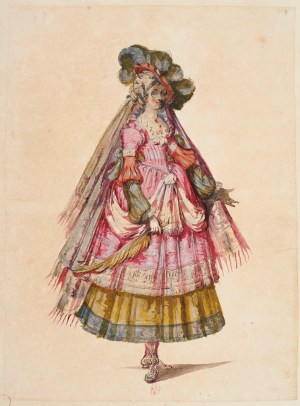 This exhibition is the first public showcasing of a portfolio acquired by the Duke of Aumale in 1854, which is now kept in the Condé museum in Chantilly. The portfolio features 23 exceptional drawings by Jacques Bellange (c. 1575–1616), depicting the Lorraine region festivities for the wedding of Henri de Bar and Marguerite de Gonzague (1606), as well as a series of 34 prints by Jean Berain (1640–1711) featuring watercolour, gold and silver highlights and magnificently depicting the splendours of the courts of Lorraine and France from the beginning to the end of the 17th century.
Paulette Choné and Jérôme de La Gorce, Fastes de cour au XVIIe siècle: Les costumes de Bellange et Berain (Saint-Remy-en-l’Eau: Éditions Monelle Hayot, 2015), 264 pages, ISBN: 978-2903824945, 49€.
Paulette Choné, professeur émérite des Universités, a enseigné l’histoire de l’art moderne à l’Université de Bourgogne. Philosophe, spécialiste de la civilisation des XVIe et XVIIe siècles, elle a consacré une large partie de ses travaux à l’art lorrain, aux fêtes de cour, aux études emblématiques qu’elle a contribué à mettre à l’honneur en France.
Jérôme de La Gorce est directeur de recherche au CNRS, historien d’art et musicologue. Auteur de plusieurs livres, il s’est spécialisé dans les arts de l’éphémère en étudiant notamment les dessins relatifs aux fêtes, aux spectacles et aux cérémonies aux XVIIe et XVIIIe siècles.
Call for Papers | 2016 Society of Architectural Historians, Pasadena
From SAH:
Society of Architectural Historians 69th Annual Conference
Pasadena/Los Angeles, 6–10 April 2016
Proposals due by 9 June 2015
The Society of Architectural Historians is now accepting abstracts for its 69th Annual International Conference in Pasadena/Los Angeles, April 6–10, 2016. Please submit abstracts no later than June 9, 2015, for one of the 38 thematic sessions, Graduate Student Lightning Talks or for open sessions. The thematic sessions have been selected to cover topics across all time periods and architectural styles. SAH encourages submissions from architectural, landscape, and urban historians; museum curators; preservationists; independent scholars; architects; and members of SAH chapters and partner organizations.
◊ ◊ ◊ ◊ ◊
A selection of sessions that might be relevant to the eighteenth century:
Fiske Kimball and Visual Culture
Session Chair: Marie Frank, University of Massachusetts Lowell, Marie_Frank@uml.edu
2016 marks the centenary anniversary of the publication of Fiske Kimball’s Thomas Jefferson Architect (1916), a seminal book that not only established Jefferson as an architect but also propelled the young Kimball to the forefront of architectural history in the United States. Until his death in 1955, Kimball remained a powerful and influential voice in the arts. As a historian, his pioneering publications earned him the sobriquet “the father of American architectural history.” As an educator, he established the School of Fine Arts at the University of Virginia and laid the groundwork for the Institute of Fine Arts in New York City. As a preservationist, he played a critical role at Monticello, Colonial Williamsburg, Fairmount Park, and numerous other historic sites. As a critic, he wrote regularly on contemporary architecture. As the director of the Philadelphia Museum of Art (1925–55), he oversaw the construction of the new museum, installed period rooms, and built the collection. He practiced architecture throughout his life and had a keen regard for landscape architecture and its history.
The range of Kimball’s activities invites connections between disciplines often studied in isolation. This session therefore seeks to examine Kimball’s contributions as a lens to situate architectural history within the broader context of visual culture in the early twentieth century. Papers on a broad range of topics are welcome. Topics can include studies of individual projects in which Kimball had a presence; or they might provide more synthesizing studies on his methodology and the current state of research; or address the legacy of Kimball-inspired scholarship. Because he spent over half of his professional career as a museum director, papers could also address the role of the architectural historian within museum studies.
◊ ◊ ◊ ◊ ◊
Graduate Student Lightning Talks
Session Chairs: R. Scott Gill, University of Texas at Austin, SAHligtningtalks@gmail.com
This session is composed of approximately 12 five-minute talks that allow graduate students to introduce their current research. We are seeking work in various forms, including a focused summation, concentrated case study, and methodological exegesis. The individual talks are divided into thematic groups with a short question and discussion period following each set of presentations.
Graduate students are invited to submit a concise abstract (under 300 words). Preference will be given to doctoral students, but all graduate students are encouraged to apply, and the Lightning Talks co-chairs welcome geographic and institutional diversity. The Graduate Student Lightning Talks provide graduate students with an invaluable opportunity to test their ideas, refine their thoughts, and enhance their presentation skills among a circle of empathetic and supportive peers.
◊ ◊ ◊ ◊ ◊
History of Heritage Preservation Revisited
Session Chair: Josep-Maria Garcia-Fuentes, Newcastle University, josep.garciafuentes@ncl.ac.uk
Although we should conceptualise medieval relics as the prime forms of Western heritage, it is well known that the modern Western understanding of heritage and preservation have their origin in the debates that took place between the French Revolution and the Industrial Revolution. They were later enriched through different national-building processes during 19th and 20th centuries, and finally spread worldwide after World War II when the United Nations decided to create World Heritage.
This globalization of the modern Western understanding of heritage and preservation has challenged the contemporary notion of heritage and has given rise to dissonances and conflicts around the world. In the emergent interdisciplinary field of heritage studies is widely accepted that Heritage should be understood as a process rather than as an object to be revered and preserved—that is, as the constantly changing outcome of the struggle between those who aspire to capitalize it. This dynamic and creative understanding is rather different from the preservation and conservation paradigm widely assumed within the field of architecture. However, in recent years new attempts by architects and architectural historians have been made to define a novel approach to this discussion.
This session welcomes papers reviewing and examining this dynamic political, social and cultural process from late 18th century up to the present. Innovative research on case studies about the history of preservation and conservation and on the theoretical conceptualization of heritage are particularly welcome, as well as on architects and provocative key case studies ranging in scope from individual architectural works to the urban scale. The ultimate goal is to interconnect existing original research on Heritage and preservation with the aim to contribute to the definition of a new approach to Heritage research grounded on the history of Architecture.
◊ ◊ ◊ ◊ ◊
Reframing Landscape History
Session Chairs: John Beardsley, Dumbarton Oaks, beardsleyj@doaks.org and Anatole Tchikine, Dumbarton Oaks, tchikinea@doaks.org
Originally a subfield of art history, garden and landscape studies is now truly interdisciplinary in scope and objectives, combining a variety of methodologies and perspectives that are no longer peculiar to the humanities. Correspondingly, its focus has evolved from gardens as primarily artistic creations to the more inclusive category of designed landscapes to the still broader study of landscape as a meeting point of environmental, social, and economic histories. While this approach has allowed garden and landscape historians to transcend the boundaries of individual disciplines, it has also posed the challenge of generating constructive cross-disciplinary dialogue. In what ways can practitioners and scholars from divergent disciplinary backgrounds, who are trained to prioritize different sets of data, find a common language of communication? And does this move away from the traditional emphasis on iconography and meaning towards broader concerns with ecology, planning, and sustainability reflect a desire to incorporate new and potentially enriching perspectives—or does it represent a gradual displacement of garden and landscape studies from the domain of the humanities to that of social sciences?
Intended to mark the 75th anniversary of Dumbarton Oaks Research Library and Collection envisaged by its founders as a “home for the humanities,” this session invites papers to reflect on the history and the current disciplinary status of garden and landscape studies addressing the different methodological approaches, institutional frameworks, and individual visions that informed this field’s past and are likely to shape its future. Papers should consider this topic not just as a theoretical or historiographical challenge, but as one to be worked through by a discussion of specific examples of landscape interpretation.
Exhibition | A Golden Age of China: Qianlong Emperor, 1736–1795

Jin Tingbiao, Chinese active (c. 1750–68), and Giuseppe Castiglione (attributed to), Italian 1688–1766, worked in China 1714–66, The Qianlong Emperor Enjoying the Pleasures of Life, poem inscribed by Qianlong Emperor in the spring of 1763, coloured inks on silk, 168 x 320 cm (The Palace Museum, Beijing, Gu5278)
◊ ◊ ◊ ◊ ◊
From the press release (26 March 2015) for the exhibition:
A Golden Age of China: Qianlong Emperor, 1736–1795
National Gallery of Victoria, Melbourne, 27 March — 21 June 2015
Hidden treasures from Beijing’s Palace Museum in the Forbidden City have come to Melbourne for the first time, in an Australian exclusive exhibition. A Golden Age of China: Qianlong Emperor, 1736–1795 tells the story of China’s foremost art collector Qianlong Emperor, one of China’s most successful rulers, fourth emperor of the Qing dynasty (1644–1911) and longest living emperor in Chinese history.
This exhibition provides an unprecedented opportunity to explore a rich concentration of more than 120 works from the Palace Museum’s art collection, which is built on the imperial collection of the Ming and Qing dynasties and holds some of China’s most rare and valuable works of art in its collection. . . .

Giuseppe Castiglione, Portrait of Qianlong Emperor in Ceremonial Court Robe, 1736, coloured inks on silk, 239 x 179 cm (The Palace Museum, Beijing, Gu6464)
The Qianlong Emperor’s long 60-year reign (1736–1795) was a particularly fascinating time in China’s history. Under his rule, China was the wealthiest and most populous nation in the world. Qianlong’s ability to preserve and foster his Manchu warrior-huntsman traditions whilst adopting the Confucian principles of political and cultural leadership, resulted in the successful governing of 150 million Chinese people.
It was his ability to adopt Chinese ways, yet honour his Manchu traditions that made him one of the most successful emperors of the Qing dynasty. He studied Chinese painting, loved to paint, and particularly loved to practice calligraphy. He was a passionate poet and essayist, and over 40,000 poems and 1300 pieces of prose are recorded in his collected writings. Qianlong wrote more poetry in his lifetime than all the poets in the Tang dynasty (618–906) combined, a dynasty known for its golden age of poetry. Aside from his own art practice, Qianlong combined his passion for collecting art with his role as preserver and restorer of Chinese cultural heritage. He also embraced the arts of other cultures: European, Japanese and Indian. Giuseppe Castiglione, an Italian Jesuit brother, exerted a great deal of influence over the arts in the court
academy of the Qianlong Emperor.
The exhibition puts the spotlight on Qianlong’s reign and art in five separate sections: Manchu Emperor, Son of Heaven, Imperial art under the Emperor’s patronage, Imperial art of religion and Chinese scholar, art connoisseur and collector. Visitors can enjoy a lavish display of paintings on silk and paper, silk court robes, precious-stone inlayed objet d’art and portraits of the Qianlong Emperor, Empress and imperial concubines; paintings of hunting scenes, court ceremonies and the private life of the Qianlong Emperor; and paintings of the Emperor as scholar and art collector. The exhibition also presents paintings and calligraphy by the Emperor himself as well as classical paintings in his collection. The exhibition includes a sumptuous display of ceremonial weapons of swords, bows and arrows, a chair made of antlers’ horns, silk court robes and ceremonial hats, amongst other ceremonial and palace treasures.
New Book | The Vitruvian Tradition in Enlightenment Poland
Forthcoming from Penn State UP:
Ignacy Potocki, Remarks on Architecture: The Vitruvian Tradition in Enlightenment Poland, edited and translated by Carolyn C. Guile (University Park: The Pennsylvania State University Press, 2015), 176 pages, ISBN: 978-0271066288, $75.
 At the end of the eighteenth century, the authors of Poland’s 3 May 1791 Constitution became the heirs to a defunct state whose territory had been partitioned by Russia, Prussia, and Austria. At this moment of intensive national postmortem, Ignacy Potocki, an eminent statesman and co-author of the Constitution, composed an architectural treatise. One of the best-preserved examples of early modern Polish architectural thought, published and translated here for the first time, the Remarks on Architecture announces itself as a project of national introspection, with architecture playing a direct role in the betterment of the nation. In it, Potocki addresses his remarks to the contemporary Polish nobility and conveys the lessons of a Vitruvian canon that shaped Continental classical architectural theory and practice throughout the early modern period. He argues that architecture is a vessel for cultural values and that it plays an important part in the formation and critique of broader national traditions. In her introduction, Carolyn Guile further explores Polish Enlightenment architectural writing as an example of cultural exchange, inheritance, and transformation.
Carolyn C. Guile is Assistant Professor of Art History at Colgate University.
Exhibition | Thé, Café ou Chocolat?
From the Musée Cognacq-Jay:
Thé, Café ou Chocolat? l’essor des boissons exotiques au XVIIIe siècle
Tea, Coffee, or Chocolate? The Boom of Exotic Drinks in the Eighteenth Century
Musée Cognacq-Jay, Paris, 26 May — 27 September 2015
Curated by Rose-Marie Herda-Mousseaux
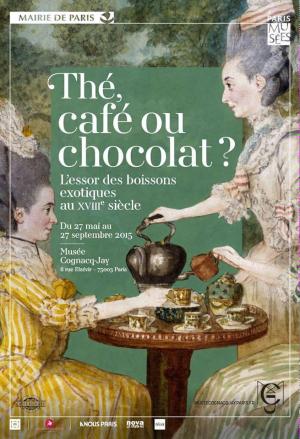 Praised for their medical and therapeutic virtues, the ‘exotic’ beverages, introduced to Europe in the 17th century became a real cornerstone of pleasure and social life during the 18th century. Drinks made with cocoa, coffee and tea—plants not grown in Europe—became an integral part of aristocratic and the upper middle class society following their official introductions to the courts of Europe. As an imported material, their high purchase price in the 17th and 18th centuries classed tea, coffee and chocolate as luxury goods and enhanced their prestigious. This was reflected in items of furniture and tableware designed for the consumption of these new drinks. Porcelain tea sets and other beautiful and luxurious pieces were produced in specialised manufactories. The rise of these products also created a new need for places designed for the public consumption of these drinks, such as cafes, and new mealtime additions such as at breakfast and afternoon tea, that spread throughout society. This exhibition offers a new overview of these beverages and their entry into the rituals of everyday life, presenting works by many iconic 18th-century artists such as Boucher and Chardin.
Louées pour leurs vertus médicales et thérapeutiques, les boissons dites « exotiques », introduites au XVIIe siècle en Europe, ont été associées aux plaisirs et aux sociabilités du XVIIIe siècle. Les boissons issues du cacaoyer, du caféier et du théier—plantes exogènes à l’Europe—ont fait partie intégrante des sociabilités de l’aristocratie et de la haute bourgeoisie dès leurs introductions officielles auprès des cours d’Europe. En tant que matière importée, leur coût d’achat classe au XVIIe et au XVIIIe siècles le thé, le café et le chocolat parmi les produits de luxe et ajoute à leur consommation celle de l’image affichée du prestige. Leur consommation s’est matérialisée dans l’apparition de mobiliers et de nécessaires ou services produits dans les manufactures. Elle a aussi permis l’existence de lieux de consommation publique, les cafés, et de nouvelles pratiques de table, telles le petit déjeuner et le goûter, qui se diffusent progressivement dans la société. Organisée autour de trois axes—« Vertus et dangers des boissons exotiques », « Cercles de consommation » et « Nouveaux services »—cette exposition propose une nouvelle lecture de ces boissons entrées dans les rituels du quotidien, en présentant des oeuvres de nombreux artistes emblématiques du XVIIIe siècle comme Boucher ou Chardin.
Commissaire: Rose-Marie Herda-Mousseaux, conservateur du patrimoine et directrice du musée Cognacq-Jay, avec la collaboration scientifique de Patrick Rambourg, chercheur et historien spécialiste de la cuisine et de la gastronomie, et de Guillaume Séret, docteur en histoire de l’art, spécialiste de la porcelaine de Sèvres.
Rose-Marie Herda-Mousseaux, Patrick Rambourg, Guillaume Séret, Thé, Café ou Chocolat? l’essor des boissons exotiques au XVIIIe siècle (Paris Musées, 2015), 176 pages, ISBN: 978-2759602834, 35€.
The press release (a 14-page PDF file) is available here»
Exhibition | From Sèvres to Fifth Avenue
Now on view at The Frick:
From Sèvres to Fifth Avenue: French Porcelain at The Frick Collection
The Frick Collection, New York, 28 April 2015 — 24 April 2016
Curated by Charlotte Vignon
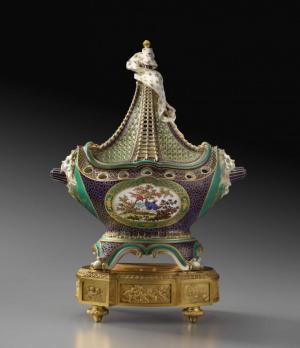 Between 1916 and 1918, Henry Clay Frick purchased several important pieces of porcelain to decorate his New York mansion. Made at Sèvres, the preeminent eighteenth-century French porcelain manufactory, the objects—including vases, potpourris, jugs and basins, plates, a tea service, and a table—were displayed throughout Frick’s residence. From Sèvres to Fifth Avenue brings them together in the Portico Gallery, along with a selection of pieces acquired at a later date, some of which are rarely on view. The exhibition presents a new perspective on the collection by exploring the role Sèvres porcelain played in eighteenth-century France, as well as during the American Gilded Age.
Conference | Archival Afterlives
From The Royal Society:
Archival Afterlives: Life, Death, and Knowledge-Making
in Early Modern British Scientific and Medical Archives
The Royal Society, London, 2 June 2015
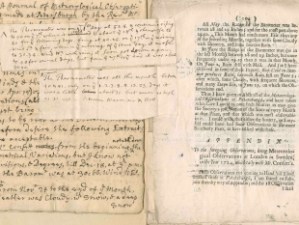
William Derham’s annotated proof of Philosophical Transactions (RS L&P/121/1/5)
Early modern naturalists collected, generated, and shared massive amounts of paper. Inspired by calls for the wholesale reform of natural philosophy and schooled in humanist note-taking practices, they generated correspondence, reading notes (in margins, on scraps, in notebooks), experimental and observational reports, and drafts (rough, partial, fair) of treatises intended for circulation in manuscript or further replication in print. If naturalists claimed all knowledge as their province, natural philosophy was a paper empire. In our own day, naturalists’ materials, ensconced in archives, libraries, and (occasionally) private hands, are now the foundation of a history of science that has taken a material turn towards paper, ink, pen, and filing systems as technologies of communication, information management, and knowledge production. Recently, the creation of such papers, and their originators’ organization of them and intentions for them have received much attention. The lives archives lived after their creators’ deaths have been explored less often. The posthumous fortunes of archives are crucial both to their survival as historical sources today and to their use as scientific sources in the past.
How did (often) disorderly collections of paper come to be “the archives of the Scientific Revolution”? The proposed conference considers the histories of these papers from the early modern past to the digital present, including collections of material initially assembled by Samuel Hartlib, John Ray, Francis Willughby, Isaac Newton, Hans Sloane, Martin Lister, Edward Lhwyd, Robert Hooke, and Théodore de Mayerne. The histories unearthed—of wrangling over the control and organization of the papers of dead naturalists (and by extension, of the legacies of the dead and the living), of putting the scraps and half- finished experiments cast off by fertile minds to work, of extending and preserving their legacies in print —serve not only as an index of the cultural position of scientific activity since the early modern period. They also engage us in thinking about genealogies of scientific influence, the material and intellectual resources that had to be deployed to continue the scientific project beyond the life of any one individual, the creation and management of scientific genius as a posthumous project, and scientific activity as a collective endeavor in which scribes, archives and library keepers, editors, digital humanists and naturalists’ surviving friends and family members had a stake.
◊ ◊ ◊ ◊ ◊
P R O G R A M M E
9:15 Registration and coffee
9:30 Welcome and Introduction by Vera Keller, Anna Marie Roos, and Elizabeth Yale
9:45 Session I | Archival Afterlives: Miscellanies and Method
Chair: Anna Marie Roos, University of Lincoln
• Vera Keller, University of Oregon: Scarlet Letters: The Mayerne Papers within the Royal Society Archives
• Richard Serjeantson, Trinity College, Cambridge University: University Natural Philosophy in the Archives
11:00 Tea and coffee
11:15 Session II | Archival Afterlives: Natural Histories
Chair: Felicity Henderson, University of Exeter
• Elizabeth Yale, University of Iowa: ‘A Dying Hand’: Crafting the Posthumous Legacies of John Ray
• Anna Marie Roos, University of Lincoln: ‘Fossilised Remains’: William Huddesford, and the Lhwyd and Lister Ephemera in the Bodleian Library
12:30 Lunch
1:45 Session III | Archival Afterlives: Script and Print in the Sloane Collections
Chair: Anne Goldgar, King’s College, London
• Arnold Hunt, King’s College London, Under Sloane’s Shadow: The Archive of James Petiver
• Alison Walker, British Library: Collecting Knowledge: Annotated Material in the Library of Sir Hans Sloane
3:00 Session IV | Archival Afterlives: Archiving for Future Pasts
Chair: TBA
• Leigh Penman, University of Queensland: ‘Omnium exposita rapinae’: A Biography of the Papers of Samuel Hartlib, 1662–2015
•Victoria Sloyan, Wellcome Library: Collecting Genomics: Archiving Modern, Collaborative Science
4:15 Tea and coffee
4.30 Commentary and discussion led by Michael Hunter, Birkbeck College, University of London
5:30 Plenary Session
• Lauren Kassell, Pembroke College, Cambridge: Stars and Scribes, Astrology and Archives (simulcast University of Oregon)
Abstracts are available here»
Exhibition | Drawn from the Antique: Artists and the Classical Ideal
From the Teylers Museum:
Drawn from the Antique: Artists and the Classical Ideal
Teylers Museum, Haarlem, 11 March – 31 May 2015
Sir John Soane’s Museum, London, 25 June — 26 September 2015
Curated by Adriano Aymonino and Anne Varick Lauder
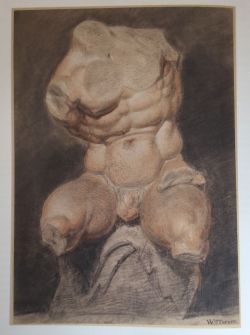
J.M.W. Turner, Study of the Belvedere Torso, black, red, and white chalks (London: V&A)
Famous statues from classical antiquity such as the Apollo Belvedere, the Laocoön and the Venus Pudica were for many centuries the chief attractions of Rome. These ‘heroes’, or plaster copies of them, were depicted in innumerable paintings, drawings and prints. It was above all the heroic nude from antiquity that inspired artists from all over Europe to produce new—in some cases trail-blazing—creations. Young artists depicted antique sculptures, or copies of them, as part of their training: this was believed to be the best way of learning how to render the classical ideal. The exhibition will include paintings and drawings of academies of art, workshops, and individual studios in which artists are hard at work vying with the ancients.
The works on display are of outstanding quality. Some of them have never been exhibited before. For this exhibition, the private collector and art dealer Katrin Bellinger has provided on loan a substantial proportion of her collection of works featuring artists’ studios. Bellinger, whose husband is the well-known entrepreneur Christoph Henkel, is a leading actor in the international art trade, specialising in old drawings. Besides the works from Katrin Bellinger’s private collection, the exhibition also includes loans from museums including the British Museum, the Rijksmuseum, and the Victoria and Albert Museum.
A useful review is available at Lowell Libson, Ltd.
◊ ◊ ◊ ◊ ◊
The catalogue will be available from Artbooks.com:
Adriano Aymonino and Anne Varick Lauder, Drawn from the Antique: Artists and the Classical Ideal (London: Sir John Soane’s Museum, 2015), 256 pages, ISBN: 978-0957339897, $50.
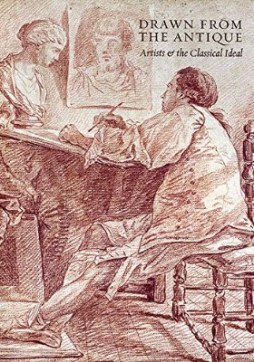 This exhibition and the accompanying catalogue examine one of the most important educational tools and sources of inspiration for Western artists for over five hundred years: drawing after the Antique. From the Renaissance to the nineteenth century, classical statues offered young artists idealised models from which they could learn to represent the volumes, poses and expressions of the human figure and which, simultaneously, provided perfected examples of anatomy and proportion. For established artists, antique statues and reliefs presented an immense repertory of forms that they could use as inspiration for their own creations. Through a selection of thirty-nine drawings, prints and paintings, covering more than four hundred years and by artists as different as Baccio Bandinelli, Federico Zuccaro, Hendrick Goltzius, Peter Paul Rubens, Michael Sweerts, Charles-Joseph Natoire, Henry Fuseli and Joseph Mallord William Turner, this catalogue provides the first overview of a phenomenon crucial for the understanding and appreciation of European art.
Exhibition | Drawn with Spirit: Pennsylvania German Fraktur
The exhibition at the Philadelphia Museum of Art closed last week; the catalogue is distributed by Yale UP:
Lisa Minardi, with an interview by Ann Percy, Drawn with Spirit: Pennsylvania German Fraktur from the Joan and Victor Johnson Collection (New Haven: Yale University Press, 2015), 364 pages, ISBN: 978-0300210521, $65.
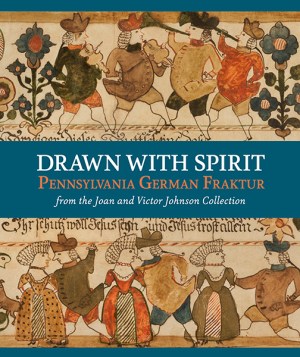 Among the most beloved forms of American folk art, fraktur is a Germanic tradition of decorated manuscripts and printed documents noted for its use of bold colors and whimsical motifs. This publication makes a landmark contribution to the study of Pennsylvania German fraktur, and offers the most comprehensive study of the topic in over 50 years. The featured objects, most of which have never been published, accompany significant new information about the artists who made these works and the people who owned them. An introductory essay sets the renowned Johnson Collection within the context of collecting and scholarship on Pennsylvania German folk art and then highlights major new discoveries, including connections between fraktur and related examples of furniture and prints. An interview with the collectors offers valuable insights into the formation of this special group of objects, which includes birth and baptismal certificates, bookplates, religious texts, writing samples, house blessings, cutworks, and printed broadsides. The splendid color illustrations reveal schools of artistic and regional influence, giving a nuanced understanding of how artists took inspiration from one another and how designs were transferred to new locations. Detailed catalogue entries include extensive information about each piece as well as complete translations.
Lisa Minardi is an assistant curator at Winterthur Museum and a specialist in Pennsylvania German art and culture.
Call for Papers | Women in the Global Eighteenth Century
Women in the Global Eighteenth Century
The 2015 Biennial Conference of The Aphra Behn Society for Women in the Arts, 1660–1830
Seton Hall University, South Orange, New Jersey, 5–6 November 2015
Proposals due by 15 May 2015
In The Global Eighteenth Century, Felicity Nussbaum and her contributors urged scholars to see the eighteenth century as “wide”: a period with a geographical as well as temporal sweep. Such a perspective, Nussbaum contended, would require different, more complex narratives of the people, events, systems, and discourses of the age. In the spirit of our namesake Aphra Behn, whose poetry, drama, plays, and translations reflect a complex awareness of a widening world, The Aphra Behn Society for Women in the Arts, 1660–1830 takes up the challenge posed by The Global Eighteenth Century to invite papers exploring any aspect of women and the arts in this “global eighteenth century.” How does a wider, potentially global, lens change the view of people, places, and things both familiar and strange, domestic and imperial, Us and Other? How does gender affect those views?
The Aphra Behn Society for Women and the Arts invites papers addressing the intersection of gender and the global eighteenth century from a wide variety of disciplines, including but not limited to Literature, History, Art History, Music History, Modern Languages, Philosophy, Religious Studies, and Women and Gender Studies. We welcome papers on this topic from all sub-fields of these disciplines.
Papers might address the following topics:
- Investigations or representations of ‘difference’ in literature and the sister arts
- Representations of social and political authority
- The arts, women, and empire
- Women and the construction of literary, artistic, domestic, public, national, imperial, and colonial spaces
- Women and travel writing
- Women and diaspora
- Women and the metropole
- Women and indigenous knowledge
- Women, genre (textual, visual, musical, etc.), and space/place
- Notions of performance and gender
- Notions of gender and race, class, religion, or other markers, perhaps under pressure in a widening context
- Gender and encountering the Other
- Women, modernity, and post-colonial situations
- Women and the colonial or post-colonial Enlightenment
As always, we also welcome abstracts for papers not related to the conference theme. Please upload 1–2 page abstracts or panels by May 15, 2015. In addition, the Society and its journal, ABO are sponsoring a pre-conference Wikipedia Edit-a-Thon on Wednesday, November 4th, from 12:00 to 5:00 pm at the Grand Summit Hotel. Participation is free and open to everyone, although participants must supply their own laptops. Registration for this event is on the conference registration form.
The registration fee includes all conference events, including the Wikipedia Edit-a-thon, the luncheon, the concluding banquet, a performance by Seton Hall students, and a reception with the rare books librarians and university archivists to view highlights of the university’s collection. The Society also sponsors a graduate student travel award ($150) and a graduate student essay prize ($150 and the possibility of publication in ABO: Interactive Journal for Women in the Arts, 1640–1830). For more information, see the conference website or contact the conference organizers, Dr. Kirsten Schultz at Kirsten.schultz@shu.edu or Dr. Karen Gevirtz at Karen.gevirtz@shu.edu.
Plenary lecture by Dr. Lynn Festa, Associate Professor of English, Rutgers University.
Sponsored by The Aphra Behn Society for Women in the Arts, 1660–1830, the College of Arts and Sciences, and the Women and Gender Studies Program at Seton Hall University.










 Enfilade
leave a comment