Journée d’étude | Du ‘portrait du roi’ aux portraits du Regent
As noted at H-ArtHist:
Du ‘portrait du roi’ aux portraits du Régent: Philippe II d’Orléans, entre pouvoir et légitimité
Université Paris I Panthéon-Sorbonne, 23 September 2015
À l’occasion du tricentenaire de l’avènement de la Régence en septembre 2015, cette journée d’étude est consacrée à la figure de Philippe II d’Orléans (1674–1723). Elle interroge l’image du Régent comme objet de tensions entre représentation politique du pouvoir et quête de légitimité dynastique.
La ‘régence absolue’ fait le lien entre le long règne de Louis XIV et celui, encore naissant, de Louis XV. Existe-t-il un portrait politique du Régent qui s’appuie sur l’iconographie du corps sacré du roi, que ce soit celle de son illustre aïeul comme de celle du jeune souverain mineur ? A contrario, quel rôle a pu jouer la question anthropologique dans la représentation de Philippe d’Orléans qui ne détient aucun pouvoir de droit divin ?
Les organisateurs souhaitent s’appuyer sur cette dualité pour développer une réflexion propre à l’histoire de l’art, dans le cadre spécifique de la représentation visuelle. La question des portraits du Régent sera abordée selon l’angle anthropologique, politique, de la diffusion et de la métaphore.
Comité d’organisation
Étienne Jollet (université Paris I Panthéon-Sorbonne)
Valentine Toutain-Quittelier (université de Poitiers)
Contact
Valentine Toutain-Quittelier: valentinetoutain@yahoo.fr
Université Paris I Panthéon-Sorbonne:
Galerie Colbert – Salle Vasari
2 rue Vivienne, 75002 Paris
Métro: Bourse ou Palais-Royal-musée du Louvre
◊ ◊ ◊ ◊ ◊
P R O G R A M M E
9.30 Accueil des participants
9.40 Ouverture de la journée, Étienne Jollet (université Paris I Panthéon-Sorbonne)
9.50 Introduction, Valentine Toutain-Quittelier (université de Poitiers)
10.10 I. TRAITS ET PORTRAITS
Présidence de séance et intervention liminaire: Véronique Meyer (université de Poitiers)
• Christophe Henry (université Paris I Panthéon-Sorbonne), Du duc d’Orléans au Régent
• Françoise Joulie (musée du Louvre), Les allégories du Régent
11.10 Pause
11.20 II. L’EXERCICE DU POUVOIR
Présidence de séance et intervention liminaire: Étienne Jollet (université Paris I Panthéon-Sorbonne)
• Valentine Toutain-Quittelier (université de Poitiers), Le Régent et le Dauphin au plafond de la Banque royale: une dualité impossible?
• Christine Gouzi (université Paris IV Sorbonne), Un portrait littéraire du Régent: Philippe II d’Orléans d’après le Dictionnaire des artistes de l’abbé de Fontenai (1776)”
12.30 Déjeuner
14.30 III. CIRCULATION DES MODELES
Présidence de séance et intervention liminaire: Pascal Bertrand (université Bordeaux III)
• Véronique Meyer (université de Poitiers), Portraits gravés du Régent
• Sébastien Bontemps (université Paris I Panthéon-Sorbonne), Les portraits sculptés du Régent
15.40 Pause
16.00 IV. DECOR ET METAPHORE
Présidence de séance et intervention liminaire: Étienne Jollet (université Paris I Panthéon-Sorbonne)
• Jean-François Bédard (université de Syracuse, USA), Le Palais-Royal, portrait architectural du Régent
• Michaël Decrossas (INHA), À la gloire du Régent. Projet de décor allégorique pour le château de Saint-Cloud
17.10 Conclusion de la journée, Valentine Toutain-Quittelier (université de Poitiers)
Acquisitions | Set of Five Ivories by Le Marchand Bought for Scotland
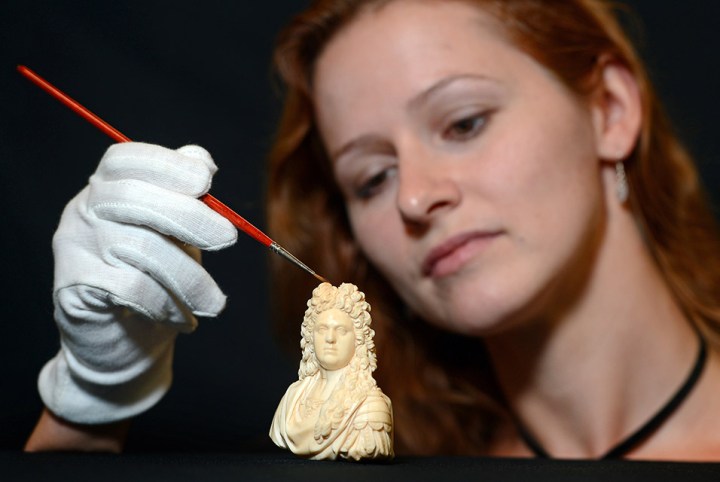
Lydia Messerschmidt, assistant conservator at National Museums Scotland, works on one of five ivories.
Photo: © Neil Hanna
◊ ◊ ◊ ◊ ◊
From the Art Fund:
David Le Marchand (1674–1726) was one of the most prominent ivory carvers and one of the most influential portraitists of his day in Britain. His works were highly prized for his extraordinary skill in rendering likeness and for the sheer expense of the ivory, his chosen specialist material. For Le Marchand, ivory held a nostalgic significance. He was born in 1674 in the northern French port of Dieppe, a town famed for its long tradition in ivory carving. However, following the edict of Nantes, which saw the ensuing persecution of French Protestants, Le Marchand fled his native France. Still in his early twenties, he settled in Edinburgh and was given a licence to practise the art of ivory cutting on the condition that he trained Scottish apprentices in the craft.
National Museums Scotland has acquired a rare group of five ivories by Le Marchand. The set was commissioned by the Mackenzie family and comprises of four medallions and a miniature bust. One of the medallions depicts Sir James Mackenzie of Royston and is dated 1696, the year Le Marchand arrived in Scotland suggesting that the ivories are likely to be the very first that he carved in Britain.
Stephen Deuchar, director of the Art Fund, said: “This interesting group of ivories, with its excellent provenance and rich object biographies, is an ideal fit for National Museums Scotland, particularly given the Museum’s interest in Scottish identity and its relationship with the rest of the world. Scotland now has a meaningful presence of works by Le Marchand, which will appeal to scholars, students, artists and families alike. I look forward to seeing them in the new galleries.”
The ivories will go on display in one of the ten new galleries opening next summer at the National Museum of Scotland.
Exhibition | Bawdy Bodies: Satires of Unruly Women

◊ ◊ ◊ ◊ ◊
Opening next week at The Lewis Walpole Library:
Bawdy Bodies: Satires of Unruly Women
The Lewis Walpole Library, Farmington, CT, 24 September 2015 — 26 February 2016
Curated by Hope Saska and Cynthia Roman with contributions by Jill Campbell
Characterized by comically grotesque figures performing lewd and vulgar actions, bawdy humor provided a poignant vehicle to target a variety of political and social issues in eighteenth-century Britain. Bawdy Bodies: Satires of Unruly Women explores the deployment of this humorous but derisive strategy toward the regulation of female behavior. The exhibition will present satirical images of women from a range of subject categories including the royal family, aging members of fashionable society, disparaged mothers, political activists, gamblers, medical wonders, artists, performers, and intellectuals.
The exhibition is co-curated by Hope Saska, Curator of Collections and Exhibitions at the Art Museum of the University of Colorado, Boulder, and Cynthia Roman, Curator of Prints, Drawings, and Paintings at the Lewis Walpole Library, with contributions by Yale Professor of English Jill Campbell. It will be on view at the Lewis Walpole Library, 154 Main Street, Farmington, Connecticut, on Wednesdays from 2:00 to 4:30 pm and by appointment.
◊ ◊ ◊ ◊ ◊
P U B L I C L E C T U R E
Amelia Rauser | Rock, Paper, Scissors: Dimensionality and
Neoclassical Aesthetics in the Art and Fashion of the 1790s
28 October 2015, 5:30 pm, Sterling Memorial Library Lecture Hall
In the 1790s, women dressed in imitation of antique statuary. Yet most devotees of the style had never seen the originals they emulated; rather, they were inspired by print representations of them, and this process of translation—from three-dimensional sculptures into two-dimensional paper representations and then back into fabric gowns swathed around moving bodies—created several interesting effects, including a pronounced emphasis on contour. This lecture will discuss the way 1790s fashionable dress was mediated by print, and connect this phenomenon to the contemporary vogue for John Flaxman’s outline drawings and other aspects of neoclassical taste.
Amelia Rauser is the author of Caricature Unmasked: Irony, Authenticity, and Individualism in Eighteenth-Century English Prints (2008). Her new project, “Living Statues: Neoclassical Culture and Fashionable Dress in the 1790s—London, Paris, Naples,” is a study of the radical style of undress in the 1790s and its connection to contemporary aesthetic, political, and scientific thought. Dr. Rauser is Professor of Art History at Franklin & Marshall College.
G R A D U A T E S T U D E N T W O R K S H O P S
Limited enrollment by application
Jill Campbell (Yale University) | ‘We are an injured body’: Collectivity and the Female Body
2 October 2015, Lewis Walpole Library
Amelia Rauser (Frankin & Marshall College) | Expressive Bodies in Eighteenth-Century Satirical Prints
30 October 2015, Lewis Walpole Library
Details for all of these events can be found here»
Exhibition | Aristocratic Life in the Eighteenth Century
From the Musée National de la Renaissance:
Être et paraître, la vie aristocratique au XVIIIe siècle:
Trésors cachés du Musée national de la Renaissance
Château de La Roche Guyon, 11 April — 29 November 2015
Curated by Muriel Barbier
 Sortis exceptionnellement des réserves du musée national de la Renaissance, des objets d’art du XVIIIe siècle retracent en dix tableaux les thèmes majeurs de la vie aristocratique à l’époque des Lumières. Au travers de quatre-vingt-cinq oeuvres, le quotidien de l’aristocratie du XVIIIe siècle revit dans les grands salons du château de La Roche Guyon ornés de leurs lambris d’époque et dépourvus de mobilier.
Une journée ordinaire dans une demeure seigneuriale au siècle des Lumières. L’exposition, articulée en dix vitrines, suit le déroulement d’une journée de la haute société des Lumières, en abordant les thèmes suivants : toilette et soins, parure et élégance, arts de la table, lecture et écriture, jeux et divertissements, priser et fumer, ouvrages de dames, prières et dévotions, armes d’apparât et chasse. Cette présentation, entend faire comprendre la fonction de ces objets, la préciosité de leur décor et leur utilisation. Elle propose une autre approche des arts décoratifs non fondée sur l’évolution des stymes et des techniques mais sur l’histoire des civilisations et des moeurs.
Muriel Barbier, Être et paraître: La vie aristocratique au XVIIIe siècle (Artlys, 2015), 142 pages, ISBN: 978-2854956108, 18€.
Bénédicte Bonnet Saint-Georges reviewed the exhibition for La Tribune de l’Art (21 August 2015).
New Book | Studying 18th-Century Paintings and Works of Art on Paper
From Archetype Publications:
Helen Evans and Kimberley Muir, eds., Studying 18th-Century Paintings and Works of Art on Paper (London: Archetype Publications, 2015), 172 pages, ISBN: 978-1909492233, £45 / $95.
Pre-Publication Discount Price: £35 + postage when ordered using a Visa/MasterCard from Archetype’s London office by sending an email by 22nd September 2015 to info@archetype.co.uk
 This is the second CATS Conference Proceedings with papers from the international conference Technology & Practice: Studying 18th-Century Paintings & Art on Paper. The conference was organised by CATS in collaboration with Helsinki Metropolia University of Applied Science in Helsinki, Finland; Nationalmuseum in Stockholm, Sweden; and University of Oslo, Norway. The conference focused on artists’ techniques and materials, source research, conservation science, the history of science and technology, trade and pharmacy during the 18th century. Speakers explored tradition and changes in artistic practices in the light of the establishment of a series of national Art Academies in Europe throughout the century. Papers include topics such as workshop practice and materials, art historical and technical approaches to documentary evidence and technical examination and the analysis of paintings and drawings. Also issues of trade, supply and questions concerning the demand for materials for diverse artistic expressions are analysed and discussed.
C O N T E N T S
Foreword
• Mikkel Bogh, Discipline and wonder: The 18th-century art academy and the invention of the artist as a free practitioner
• Loa Ludvigsen, Mikala Bagge and Vibeke Rask, The effect of Prussian blue on the technique of the Danish court painters Hendrik Krock and Benoît le Coffre
• Carol Pottasch, Susan Smelt and Ralph Haswell, Breaking new ground: Investigating Pellegrini’s use of ground in the Golden Room of the Mauritshuis,
• Leila Sauvage and Cécile Gombaud, Liotard’s pastels: Techniques of an 18th-century pastellist
• Tine Louise Slotsgaard, An investigation of the painting technique in portraits by Jens Juel
• Andreas Burmester and Stefanie Correll, 72 florin for colours, white and glue: The Tiepolos, the Veninos and Würzburg
• Piet Bakker, Margriet van Eikema Hommes and Katrien Keune, The coarse painter and his position in 17th- and 18th-century Dutch decorative painting
• Ige Verslype, Johanneke Verhave, Susan Smelt, Katrien Keune, Hinke Sigmond and Margriet van Eikema Hommes, A ‘painted chamber’ in Beverwijk by Jacobus Luberti Augustini: Novel insights into the working methods and painting practices in a painted wall-hanging factory
• Clara de la Peña Mc Tigue, 18th-century practices in the art academies in Spain: The use of paper in prints and drawings
• Ingelise Nielsen and Niels Borring, Nicolai Abildgaard: An 18th-century Danish artist and his paper
• Niels Borring, Semi-mechanical transfer methods in Nicolai Abildgaard’s drawings
• Troels Filtenborg, Canvas supports in paintings by Nicolai Abildgaard: Fabrics and formats
• Alexandra Gent, Rachel Morrison and Nelly von Aderkas, ‘1st olio after Capivi’: Copaiba balsam in the paintings of Sir Joshua Reynolds
• Richard Mulholland, Ferdinand Bauer’s Flora Graeca colour code
Coming Soon: A New Journal for 18th-Century Art
We are delighted to announce the launch of Journal18—a new digital publication entirely dedicated to eighteenth-century art and material culture.
Journal18 is an online, open access, peer-reviewed journal devoted to art and culture of the long eighteenth century from around the globe. Inspired by the rich and exciting state of the field of eighteenth-century art history, Journal18 has been founded as a scholarly forum to support and extend that richness. Taking form as a digital publication, Journal18 embraces the accessibility and flexibility of its format, seeking the widest possible engagement with the latest research in the field.
Journal18 will be the first journal dedicated to the field of eighteenth-century art history, and one of the few online and fully open access journals for the discipline of art history more broadly. Appearing twice a year, Journal18 will publish thematic issues of articles investigating all aspects of eighteenth-century visual and material culture. Throughout the year, Journal18 will also offer a forum for intellectual exchange in the Notes & Queries section: a space for short notes, reviews, archival discoveries, or scholarly musings.
Journal18 will launch in Spring 2016 with Issue #1—Multilayered. This inaugural issue of Journal18 will explore the multilayered nature of eighteenth-century art. Contributions will focus on artworks that bear traces of multiple hands as a result of workshop production, cross-cultural exchange, re-use, restoration, vandalism, or other factors.
We are currently accepting submissions for Notes & Queries, but we are no longer accepting submissions for Issue #1—Multilayered. For all inquiries including proposals for contributions to Notes & Queries please contact the editors at: editor@journal18.org. Keep up to date with Journal18 by following us on Twitter @Journal18 and Facebook.
J18 Founding Editors
Noémie Etienne (Getty Research Institute)
Meredith Martin (NYU and Institute of Fine Arts)
Hannah Williams (Queen Mary University of London)
Editorial Board
Nebahat Avcioglu (Hunter College/CUNY); Finbarr Barry Flood (Institute of Fine Arts/NYU); Esther Bell (Fine Arts Museums of San Francisco); Daniela Bleichmar (University of Southern California); Jeffrey Collins (Bard Graduate Center, New York); Thomas Crow (Institute of Fine Arts, New York); Craig Hanson (Calvin College); Anne Higonnet (Barnard College/Columbia University); Kristina Kleutghen (Washington University, St Louis); Anne Lafont (INHA, Paris); Ewa Lajer-Burcharth (Harvard University); Mark Ledbury (University of Sydney); Katie Scott (Courtauld Institute of Art); Charlotte Vignon (Frick Collection); Michael Yonan (University of Missouri)
Symposium | Retail Realms in Eighteenth-Century Britain
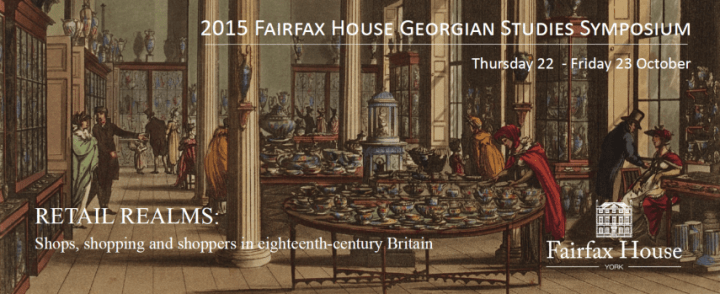
From the symposium flyer:
2015 Fairfax House Georgian Studies Symposium
Retail Realms: Shops, Shoppers and Shopping in Eighteenth-Century Britain, c.1680–1830
York Hilton Hotel and Fairfax House, York, 22–23 October 2015
The long eighteenth century was a transformative age for shops and shopping in Britain. Far-reaching changes took place in the way people shopped, the things they bought, the shops themselves and the ways in which they were run. For an increasing portion of Georgian ‘polite society’, shopping, from being primarily a matter of obtaining the necessities of life, became a pleasurable leisure activity in its own right, associated with sociability, sensory experience and the expression of identity. Many historians who have explored the social and cultural dynamics of shopping in the eighteenth century have argued that this period saw a ‘consumer revolution’.
The Georgian shopping experience was not just a social or economic process. Located in shops, showrooms and high streets, it extended to the assembly rooms and drawing rooms of polite society. It encompassed the way goods were packaged and advertised, included the strategic developments in shop design and was a contributing factor in the progressive refashioning of the urban environment. Indeed, the retail realm, as this symposium will examine, was a vital element in the physical reshaping of eighteenth-century British life.
Retail Realms: Shops, Shoppers and Shopping in Eighteenth-Century Britain (the third annual Fairfax House Symposium in Georgian Studies) will bring together research and material from museum professionals, academics, independent scholars and those with an interest in retail history or passion for Georgian studies. Linked to the museum’s exhibition Consuming Passions, the two-day conference will be focused around the core themes of consumerism, consumption and shopping in the long eighteenth century.
Registration details are available here»
◊ ◊ ◊ ◊ ◊
T H U R S D A Y , 2 2 O C T O B E R 2 0 1 5
9:15 Registration and coffee
9:45 Welcome and introduction by Hannah Phillip (Director, Fairfax House)
10:00 Panel 1: Objects of Desire
• In pursuit of oral perfection: dental retail in the eighteenth century, Rachel Bairsto (British Dental Association Museum)
• Mrs Bowes’ purchases in London, 1743–63, Howard Coutts (The Bowes Museum)
• Marketing quality in eighteenth-century England, Rachael Morton (University of Warwick)
• Shopping for shells, Beth Fowkes Tobin (University of Georgia)
11:40 Keynote Address
Retailing Luxuries: The Deards family’s toyshops in London, Bath and Yorkshire, Vanessa Brett (author of Bertrand’s Toyshop in Bath: Luxury Retailing 1685–1785)
12:30 Lunch break
13:30 Primary Materials: Parallel Discussion Sessions
• Mike Rendell – Richard Hall, Haberdasher, at No 1 London Bridge
• Valerie Jackson-Harris – The eighteenth-century trade card
14:10 Panel 2: The World of Consumption
• In pursuit of pastries, millinery and men: polite female consumption in eighteenth-century Bath, Rose McCormack (Aberystwyth University)
• Shopping for paintings in Georgian Bath, Amina Wright (Holburne Museum)
• A world of goods? Products, promotions and place names in English shops, 1740–1820, Jon Stobart (Manchester Metropolitan University)
15:20 Tea
15:40 Panel 3: Retail Environments
• ‘Behind great glass windows, absolutely everything one can think of is neatly, attractively displayed’: foreigners’ accounts of shopping in London, Alison O’Byrne (University of York)
• An ‘elegant, extensive, & convenient shew-room’: the architecture and interior design of the eighteenth-century shop, Ralph Harrington (University of Leeds)
• Antiquity and improvement: polite shopping Georgian York, Matt Jenkins (University of York)
16.50 Day 1 concluding remarks
17:30 Drinks reception and private view of the exhibition Consuming Passions: Luxury Shopping in Georgian Britain.
19:00 Conference dinner
F R I D A Y , 2 3 O C T O B E R 2 0 1 5
9:00 Registration
9:30 Panel 4: Branding Advertising, Display
• Josiah Wedgwood I – the salesman, Gaye Blake-Roberts (The Wedgwood Museum)
• Rethinking the eighteenth-century trade card: thoughts on their development, form and function, Elenor Ling (The Fitzwilliam Museum)
• Your humble and obedient servant, Sylvia Hogarth (textiles historian)
10:40 Coffee
11:00 Panel 5: Texts and the Retail Realm
• Catalogues of trivialities? Consumer experience in Austen’s writings, Jane Taylor (University College London)
• ‘Every employment delightful’: shops, self-sufficiency and feminine networks in Frances Burney’s Cecilia (1782) and The Wanderer (1814), Chloe Wigston Smith (University of Georgia)
• Browsing the past: Leigh Hunt and the memorial function of shopping, Markus Poetzsch (Wilfrid Laurier University)
12:20 Lunch break
13:20 Walking Tour: Exploring Georgian York’s Retail Realms
14:30 Keynote Address
Shopping & Sensibility, Helen Berry (Newcastle University)
15:30 Tea
15:50 Panel 6: Beyond Shopping
• ‘…the whole Consumpt of Scotland, or nearly so, has been Smuggled’: how tea smuggled from Gothenburgh dominated the market in the north east of England and Scotland, Derek Janes (University of Exeter)
• ‘Things that are not trifles’: purchasing, pilfering and peddling gloves in eighteenth-century England, Liza Foley (National College of Art and Design, Ireland)
• Sabine Winn and the art of long-distance shopping at Nostell Priory, 1775–1798, Kerry Bristol (University of Leeds)
17:00 Day 2 Concluding remarks
Please note that this programme is provisional and details are subject to change.
New Book | Antiquarianism and the Visual Histories of Louis XIV
From Ashgate:
Robert Wellington, Antiquarianism and the Visual Histories of Louis XIV: Artifacts for a Future Past (Farnham: Ashgate, 2015), 286 pages, ISBN: 978-1472460332, $110.
 Antiquarianism and the Visual Histories of Louis XIV: Artifacts for a Future Past provides a new interpretation of objects and images commissioned by Louis XIV (1638–1715) to document his reign for posterity. The Sun King’s image-makers based their prediction of how future historians would interpret the material remains of their culture on contemporary antiquarian methods, creating new works of art as artifacts for a future time. The need for such items to function as historical evidence led to many pictorial developments, and medals played a central role in this. Coin-like in form but not currency, the medal was the consummate antiquarian object, made in imitation of ancient coins used to study the past. Yet medals are often elided from the narrative of the arts of ancien régime France, their neglect wholly disproportionate to the cultural status that they once held. This revisionary study uncovers a numismatic sensibility throughout the iconography of Louis XIV, and in the defining monuments of his age. It looks beyond the standard political reading of the works of art made to document Louis XIV’s history, to argue that they are the results of a creative process wedded to antiquarianism, an intellectual culture that provided a model for the production of history in the grand siècle.
Robert Wellington is a lecturer at the Centre for Art History and Art Theory, Australian National University.
◊ ◊ ◊ ◊ ◊
C O N T E N T S
Introduction: Medals and the Material Turn in the King’s History
1 Antiquarianism at Court
2 The Petite Académie and the histoire métallique of Louis XIV
3 The Cabinet des Médailles at Versailles
4 Images Inscribed and Described by the Petite Académie
5 The Antiquarian Origins of Louis XIV’s Medals Books
6 Portraiture, Physiognomy, and the Numismatic Sensibility
7 Numismatic Resonances: Le Brun’s Cycle for the Hall of Mirrors at Versailles
Epilogue
Bibliography
Index
Call for Papers | Creativity and the City, 1600–2000
From H-ArtHist:
Creativity and the City, 1600–2000
University of Amsterdam, 27–29 October 2016
Proposals due by 15 November 2015
Organized by Amsterdam Centre for Cultural Heritage and Identity, University of Amsterdam, the Netherlands
Keynote Speakers
• Jo Guldi, Brown University
• Ilja Van Damme, Antwerp University
• Scott Weingart, Carnegie Mellon University
This international and interdisciplinary conference on the history of creativity and the city aims to bring together recent research in the fields of history, arts, and digital humanities. In the last decade, scholars in the humanities and social sciences have explored the complex interplay between places and their culture using a variety of methods and approaches. The conference examines the relationship between cultural artefacts (art, books, etc.) and the urban networks and spaces in which they were conceived, (re)produced, distributed, mediated, and consumed in early modern and modern Europe. How such issues can be studied by means of existing and novel (digital) methods, as well as comparative and long-term approaches, is the second major theme of the conference.
We invite researchers in the fields of history, arts and culture, urban studies, media studies and the digital humanities to submit abstracts. Papers may address all kinds of cultural expressions and products—from books, (applied) arts and theatre, to films, media and music. The committee particularly invites scholars who will reflect on methodological questions and the use of computational techniques for historical research.
The list of possible themes includes but is not limited to:
• Space and place (built environment, local amenities, spatial distribution, transnational connections, etc.)
• Entrepreneurs and firms (business strategies, networks, collaboration and competition etc.)
• Intermediaries and institutions (guilds, societies, museums, policy, etc.)
• Markets and labour markets (distribution, training, cross-sectoral linkages, etc.)
• Text analytics for historical corpora (information retrieval, pattern recognition, tagging and annotation, etc.)
• Digital cultural heritage (3D/4D modelling, visual and audio-visual content analysis, etc.)
• Analysis and visualization (prosopography, network analysis, discourse analysis, etc.)
Please submit your details, abstract (300 words max.) and 5 key words before 15 November 2015 through the conference management system. When your paper is embedded in a larger research project, please also provide its title and affiliation. A scientific committee will evaluate the abstracts and sessions will be formed on the basis of the selected papers. For inquiries, please contact us at achi.red@uva.nl.
Abstract submission: 15 November 2015
Notification of abstract acceptance: Early January 2016
Registration will open in February 2016
Advisory Committee: Rens Bod, Jan Hein Furnée, Lia van Gemert, Jaap Kamps, Joep Leerssen, Julia Noordegraaf, Harm Nijboer, and James Symonds.
Conference Organizers: Jan Bolten and Claartje Rasterhoff.
New Book | Pompeo Batoni: A Complete Catalogue of His Paintings
Scheduled for publication next month from Yale UP:
Edgar Peters Bowron, Pompeo Batoni: A Complete Catalogue of His Paintings (London: The Paul Mellon Centre for Studies in British Art in association with the Museum of Fine Arts, Houston, 2015), 2-volume boxed set, 750 pages, ISBN: 978-0300148169, $300.
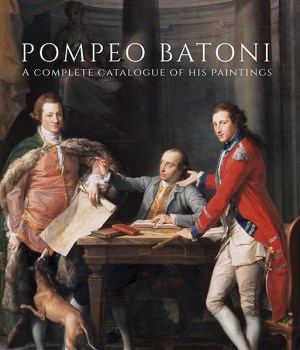 This meticulously researched catalogue presents an authoritative assessment of the works of Pompeo Batoni (1708–1787), one of the 18th century’s most celebrated painters. Born in Lucca, Batoni established himself in Rome and received commissions from popes, princes, and British aristocrats on the Grand Tour. Batoni was highly sought after for his theatrical yet incisive—and often flattering—portraits. Connoisseurs and cognoscenti also prized his learned and technically brilliant allegorical, religious, and mythological compositions.
With entries on more than 480 paintings and 250 drawings, this magnificent two-volume set provides the most complete examination to date of Batoni’s entire oeuvre. Featuring beautiful, high-quality reproductions, the book provides thorough details on provenance and exhibition history as well as biographies of the portrait sitters. New analysis of the works, resulting from decades of research, reinterprets some of Batoni’s iconography, identifies new textual and visual sources of his imagery, and reveals insights gleaned from unpublished archival materials.
Edgar Peters Bowron is the former Audrey Jones Beck Curator of European Art at the Museum of Fine Arts, Houston.










 Enfilade
leave a comment