New Book | Qing Encounters: Artistic Exchanges
From Getty Publications:
Petra ten-Doesschate Chu and Ning Ding, eds., Qing Encounters: Artistic Exchanges between China and the West (Los Angeles: Getty Publications, 2015), 320 pages, ISBN 978-1606064573, $55.
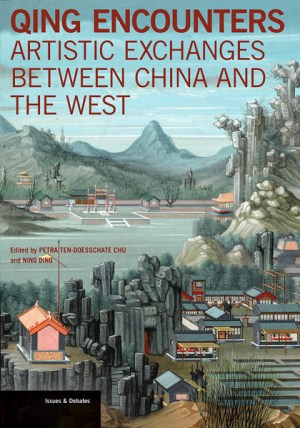 Qing Encounters: Artistic Exchanges between China and the West examines how the contact between China and Europe in the eighteenth and early nineteenth centuries transformed the arts on both sides of the East-West divide. The essays in the volume reveal the extent to which images, artifacts, and natural specimens were traded and copied, and how these materials inflected both cultures’ visions of novelty and pleasure, battle and power, and ways of seeing and representing. Artists and craftspeople on both continents borrowed and adapted forms, techniques, and modes of representation, producing deliberate, meaningful, and complex new creations. By considering this reciprocity from both Eastern and Western perspectives, Qing Encounters offers a new and nuanced understanding of this critical period.
Petra ten-Doesschate Chu is professor of art history and museum studies and director of graduate studies in Museum Professions at Seton Hall University. Ning Ding is professor of art history and theory and vice-dean at the School of Arts, Peking University.
◊ ◊ ◊ ◊ ◊
C O N T E N T S
Foreword
Acknowledgments
Petra ten-Doesschate Chu and Ning Ding, Introduction
Part I: Collection and Display
• Richard Vinograd, Hybrid Space of Encounter in the Qing Era
• Anna Grasskamp, Frames of Appropriation: Foreign Artifacts on Display in Early Modern Europe and China
• Kristel Smentek, Global Circulations, Local Transformations: Objects and Cultural Encounter in the Eighteenth Century
• Mei-Mei Rado, Encountering Magnificence: European Silks at the Qing Court during the Eighteenth Century
Part II: Knowledge and Information Exchange between China and the West
• John Finlay, Henry Bertin and the Commerce in Images between France and China in the Eighteenth Century
• Che-Bing Chiu, Vegetal Travel: Western-European Plants in the Garden of the Emperor of China
• Yuen Lai Winnie Chan, Nineteenth-Century Canton Gardens and East-West Plant Trade
• Marcia Reed, Imperial Impressions: The Qianlong Emperor’s Print Suites
Part III: Modes and Meaning of (Adopted) Techniques of Representation
• Yue Zhuang, Hatching in the Void: Ritual and Order in Bishu Shanzhuang Shi and Matteo Ripa’s View of Jehol
• Ya-Chen Ma, War and Empire: Images of Battle during the Qianlong Reign
• Kristina Kleutgehn, From Science to Art: The Evolution of Linear Perspective in Eighteenth-Century Chinese Art
• Lihong Liu, Shadows in Chinese Art: An Intercultural Perspective
Part IV: Chinoiserie, Européenerie, Hybridity
• Yeewan Koon, Narrating the City: Pu Qua and the Depiction of Street Life in Canton
• Greg M. Thomas, Chinoiserie and Intercultural Dialogue at Brighton Pavilion
• Stacey Sloboda, Surface Contact: Decoration in the Chinese Taste
• Jennifer Milam, Betwixt and Between: ‘Chinese Taste’ in Peter the Great’s Russia
Biographical Notes on Contributors
Illustration Credits
Index
Conference | A Revolution in Taste: Francis Haskell’s Nineteenth Century

◊ ◊ ◊ ◊ ◊
From the conference website:
A Revolution in Taste: Francis Haskell’s Nineteenth Century
St John’s College and the Ashmolean Museum, Oxford, 23–24 October 2015
A two-day conference is to be held at St John’s College, Oxford and the Ashmolean Museum to explore the work of art historian Francis Haskell (1928–2000). Writing at the intersection of cultural history, art history and the history of ideas, Haskell made a seminal contribution to the study of the formation of taste in nineteenth-century Britain and Europe.
The conference will revisit terrain mapped out by Haskell in Rediscoveries in Art, namely the transformation of the art world between the 1770s and 1870s, a period when war, revolution, plunder and state-formation brought fundamental changes to the knowledge of and trade in Old Master paintings. Distinguished speakers include scholars and curators from Britain, France and Italy. The conference aims to comprehend the forces which transformed how art was acquired, displayed and interpreted in the nineteenth century. But it will also grapple with the methodological and philosophical issues raised by Haskell’s provocative approach to the history of collecting.
Both days of the conference will be held in the auditorium of St Johns College, Oxford. Delegates at the conference will receive lunch, teas and coffee, and a wine reception at the Ashmolean on Friday 23rd from 18.00 to 19.30 (this event is free although places are limited so it is essential to register). The fee for attending both days is £80 for professionals (£35 for students); the cost of attending for just one day is £45 for professionals (£20 for students). Registration for the conference is open until October 15th. To book, please follow this link.
The conference is organized by Dr Tom Stammers, cultural historian at the University of Durham and visiting Deakin Fellow in Oxford (2014–15). For all inquiries contact Tom directly (t.e.stammers@durham.ac.uk) or write to the conference email address francishaskell2015@gmail.com.
◊ ◊ ◊ ◊ ◊
F R I D A Y , 2 3 O C T O B E R 2 0 1 5
9.30 Registration
10.00 Welcome remarks by Tom Stammers
10.10 Keynote 1 | Nicholas Penny
Chair: Craig Clunas
11.00 Session 1 | Rediscoveries in Post-Revolutionary Europe
Chair: Christina Anderson
• Charlotte Guichard, Naming the Artist: Attribution and Artistic Expertise at the End of the Eighteenth Century
• Xanthe Brooke, William Roscoe (1753–1831) and His Collection of North European Renaissance Art in Liverpool
• Véronique Gerard-Powell, The Altamira Collection and the Sale of Spanish Art in London
12.30 Lunch
13.30 Session 2 | Art and Interpretation in Nineteenth-Century France
Chair: Frances Suzman Jowell
• Camille Mathieu, Breaking Up the Museum of Rome: Mobility and the Antique in the Napoleonic Era, 1796–1817
• Richard Wrigley, Ingres’ Monsieur Bertin and the Vicissitudes of Bourgeois Taste
• Juliet Simpson, Reimagining the Northern Nineteenth Century: Art and the Politics of Patrimony in the French Third Republic
15.00 Coffee
15.30 Session 3 | Private Palaces of Art
Chair: Arthur Macgregor
• Susanna Avery-Quash, Rediscovering John Julius Angerstein’s ‘Other’ Art Collection at ‘Woodlands’, Blackheath
• Stephen Lloyd, From Venice to Knowsley: The Rediscovery and Conservation of Borgognone’s Series of Paintings on Silver-gilt Leather, The Children of Israel
• Pauline Prévost-Marcilhacy, The Pereire Brothers and Collecting in the Second Empire
17.15 Keynote 2 | Charles Hope
Chair: Geraldine Johnson
18.00 Wine Reception at the Ashmolean
19.30 Dinner at the Ashmolean Restaurant
S A T U R D A Y , 2 4 O C T O B E R 2 0 1 5
9.30 Registration
9.45 Keynote 3 | Stephen Bann
Chair: Julia Langbein
10.30 Session 4 | History, Images and Criticism
Chair: Ludmilla Jordanova
• Donata Levi, Rediscovering Crowe
• Jenny Graham, Afterlives: Rewriting Giorgio Vasari in the Nineteenth Century
• Jon Whiteley, Francis Haskell and Nineteenth-Century French Art
12.30 Lunch
13.00 Session 5 | Exhibitions and Ephemeral Museums
Chair: Linda Whiteley
• Jeremy Warren, A Nineteenth-Century Phenomenon: The Birth of the New Kunstkammer
• Cécilia Hurley Griener, Juggling with Masterpieces in the Long Nineteenth Century
• Bénédicte Savoy, Les Spoliations Napoléonniennes (communication en français)
14.30 Coffee
15.00 Session 6 | Collecting Dynasties
Chair: Adriana Turpin
• Charles Sebag-Montefiore, The Barings: A Dynasty of Art Collectors
• Dora Thornton, Reinterpreting a Rothschild Schatzkammer at The British Museum: The Waddesdon Bequest
• Tom Stammers and Silvia Davoli, Orléans and Bonaparte in Exile: Collecting at the End of the Age of Revolutions
16.30 Keynote 4 | Pascal Griener
Chair: Matthew Walker
17.15 Closing discussion, with Larissa Haskell
Exhibition | Lawrence Weiner: Within a Realm of Distance at Blenheim
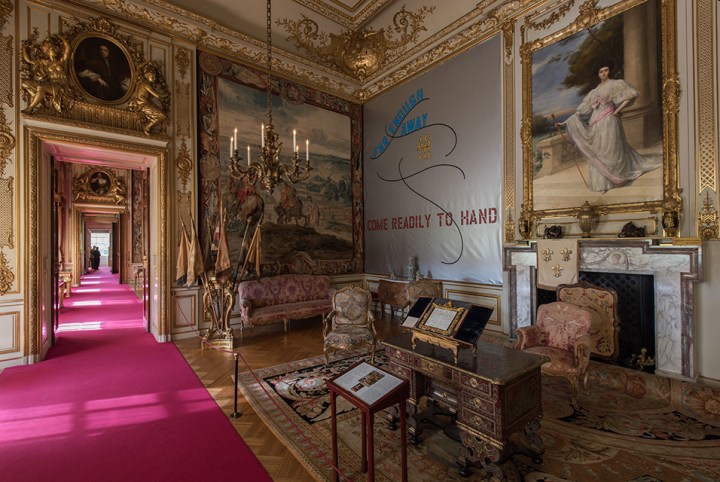
Lawrence Weiner, Far Enough Away as To Come Readily to Hand, installed in the First State Room at Blenheim Palace. Photo by Hugo Glendinning.
◊ ◊ ◊ ◊ ◊
Press release, via Art Daily (11 October 2015) . . .
Lawrence Weiner: Within a Realm of Distance
Blenheim Palace, Woodstock, Oxfordshire, 10 October — 20 December 2015
Blenheim Art Foundation presents a new exhibition by American artist and founding figure of Conceptual Art, Lawrence Weiner, titled Within a Realm of Distance. On view now at Blenheim Palace, the exhibition showcases works conceived by the artist over the past several decades, in addition to significant works created especially for the Palace. Integrated throughout the ornate interior as well as the monumental exterior of the 18th-century building, the exhibition demonstrates the artist’s practice of using language as a medium to create a multitude of sculptural forms, viewed in contrast to the traditional backdrop of the UNESCO World Heritage site.
Lawrence Weiner is regarded as one of the most influential artists working today with a career spanning over fifty years. The exhibition, conceived by the artist in close collaboration with Blenheim Art Foundation and co-curator Christian Gether, Director, ARKEN Museum of Modern Art, features a new and ambitious body of work presented in a building that dates back to 1704 and which famously became the birth place of British Prime Minister Sir Winston Churchill in 1874. Existing as an idea rather than a physical object, Weiner invites visitors to experience his work in tandem with the rich heritage of the Palace.
Using the Palace as a support structure for his artistic vision, Weiner has created several site-specific installations, allowing visitors to experience his work and the building’s historic collections simultaneously. The work—which gives the exhibition its name Within a Realm of Distance—is made up of brightly coloured and three-dimensional urethane and vinyl lettering, strikingly situated on the frieze of the Palace’s main entrance. The ceiling of the Long Library, which runs the entire length of the Palace’s West Front making it one of the longest rooms in a private house in Britain, now features the work More than Enough after being almost untouched for the last 200 years. Site-specific pieces have also been made for the west side of the Great Hall where the words Near & Far & Equal Measure at Some Point, are located above the arch, and the text So Far Flung adorns the Green Drawing Room.
Additional works include Far Enough Away as To Come Readily to Hand, an almost four metre pvc banner with vinyl overlay, has replaced the tapestry depicting the Battle of Blenheim hanging in the First State Room. In the Chapel, is A Penny Here, A Penny There, above the marble monument to the first Duke and Duchess and their two sons. Found Alone after Any Given Time, consisting of seven embroideries displaying differing texts, are also hung in place of existing drawings and prints throughout the Palace and presented as a homily. The works are both subtly and strikingly juxtaposed against the art and architecture of the Palace, creating something completely unique.
Within a Realm of Distance is the second exhibition by Blenheim Art Foundation, a programme of contemporary art which sees exhibitions presented at the Palace by internationally acclaimed contemporary artists, and follows the inaugural exhibition Ai Weiwei at Blenheim Palace (2014). The Foundation was established by Lord Edward Spencer-Churchill, whose family have resided at Blenheim Palace since the early 18th century, and whose brother is the 12th Duke of Marlborough. A dedicated collector of contemporary art, Lord Edward has long held the ambition to launch a contemporary art programme at Blenheim Palace, and realised Blenheim Art Foundation in 2014 with its Director, Michael Frahm.
Michael Frahm, Director, Blenheim Art Foundation, said, “During the months of October through to December, to visit Blenheim Palace will be a new experience and one that is rooted in a consideration of our own relation to objects and the world around us. Weiner’s sculptures meet history in a way that has never been done before at Blenheim Palace and we hope this will challenge, excite and inspire our visitors. The exhibition is a testament to Weiner’s past achievement and an assured demonstration of his continued creative exuberance.”
Lord Edward Spencer Churchill, Founder, Blenheim Art Foundation, said, “We are truly delighted and excited to be showing Lawrence Weiner Within a Realm of Distance at Blenheim Palace. This our second show after the phenomenally successful inaugural show by Ai Weiwei. Lawrence’s work speaks for itself, and he is a giant of the contemporary art scene. One of the fathers of modern conceptualism and a man of vast intellect and humanity; we are so excited to welcome him and his ideas to Blenheim.”
Lawrence Weiner said, “…where we are in the midst of where we were, the relationships of objects to objects in relation to human beings.”
Lawrence Weiner (b.1942) lives and works in West Village, New York and is considered a seminal figure in the founding of Conceptual Art. Weiner is one of the most radical artists to use language as his artistic medium and in 1969 Weiner cemented his mode of practice in a Statement of Intent, which, considered a pivotal moment at the beginning of the artistic movement, stipulated that his statements were the artwork whilst both their production and interpretation “rests with the receiver.”
Recent and current solo exhibitions include: Straight Down to Below: Lawrence Weiner (part of Artist Rooms on Tour at Tate Modern and National Galleries of Scotland), Woodhorn Museum, Northumberland, 25 October – 19 April 2015; All In Due Course, South London Gallery, London, 26 September – 23 November 2014; The Grace of A Gesture (curated by Thomas Kellein), Written Art Foundation in conjunction with the 55th Venice Biennale, Palazzo Bembo, Venice, 29 May – 4 November 2013; As Far As The Eye Can See, Whitney Museum of American Art, New York, 15 November – 10 February 2008. He participated in documenta 5, 6, 7, and 13 (1972, 1977, 1982, 2012); the 36th, 41st, 50th and 55th Venice Biennales (1972, 1984, 2003, 2013); and the 27th Biennale de Sao Paulo (2006).
Lecture | Margaret Oppenheimer, ‘Madame Jumel Collects’
Next month at the Mid-Manhattan Library:
Margaret Oppenheimer, ‘Madame Jumel Collects’
Mid-Manhattan Library, New York, 12 November 2015
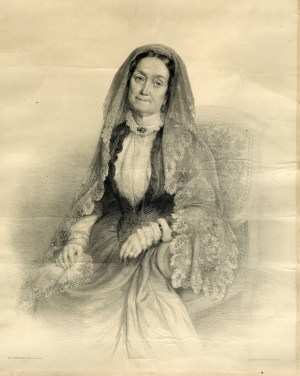
Eliza Jumel, seen in a lithograph she commissioned in 1852 (Collection of the Morris-Jumel Mansion)
The amazing Eliza Jumel—raised in a brothel, indentured as a servant, and confined to a workhouse while her mother was in jail—rose to become one of the richest women in New York. Along the way, she turned herself into an art connoisseur, acquiring more than 240 paintings while living in Paris between 1815 and 1817. In this richly illustrated lecture, art historian Margaret Oppenheimer will bring Jumel’s pioneering collection back to life, discussing the paintings, their owner, and the early nineteenth-century art scene in New York and Paris. Oppenheimer is the author of the new biography The Remarkable Rise of Eliza Jumel: A Story of Marriage and Money in the Early Republic, forthcoming from Chicago Review Press on November 1.
Thursday, November 12, 6:30–8pm; admission is free.
◊ ◊ ◊ ◊ ◊
Margaret A. Oppenheimer, The Remarkable Rise of Eliza Jumel: A Story of Marriage and Money in the Early Republic (Chicago: Chicago Review Press, 2015),
352 pages, ISBN: 978-1613733806, $30.
 Eliza Jumel (1775–1865) was born in poverty in Providence, Rhode Island, and died one of the richest women in New York. During her rise from the workhouse to Paris’s place Vendôme, she acquired a fortune from her first husband, a French merchant, and nearly lost it to her second, the notorious Aaron Burr. Divorcing him promptly amid lurid charges of adultery, she lived on triumphantly to the age of ninety, astutely managing her property and public persona. After her death, a titanic battle over her estate went all the way to the United States Supreme Court . . . twice. During the decades-long fight over Eliza’s dollars, claimants adapted her life history to serve their own ends. Family members described a woman who earned the gratitude of Napoleon I and shone at the courts of Louis XVIII and Charles X. Their opponents painted a less flattering picture: they said Eliza bore George Washington an illegitimate son, defrauded her first husband, and even plotted his death.
Margaret A. Oppenheimer holds a Ph.D. in art history from New York University. She is the author of The French Portrait: Revolution to Restoration (2005), the collaborating writer of the first edition of Art: A Brief History (2000), and a contributor to A Personal Gathering; Paintings and Sculpture from the Collection of William I. Koch (1996). Her articles on eighteenth- and nineteenth-century French art have appeared in Apollo, the Gazette des Beaux-Arts, the Metropolitan Museum Journal, and other publications. In her off-hours from working as a writer and copy editor, she volunteers as a docent at the Morris-Jumel Mansion in New York City, Eliza Jumel’s former home.
Exhibition | Titian to Canaletto: Drawing in Venice
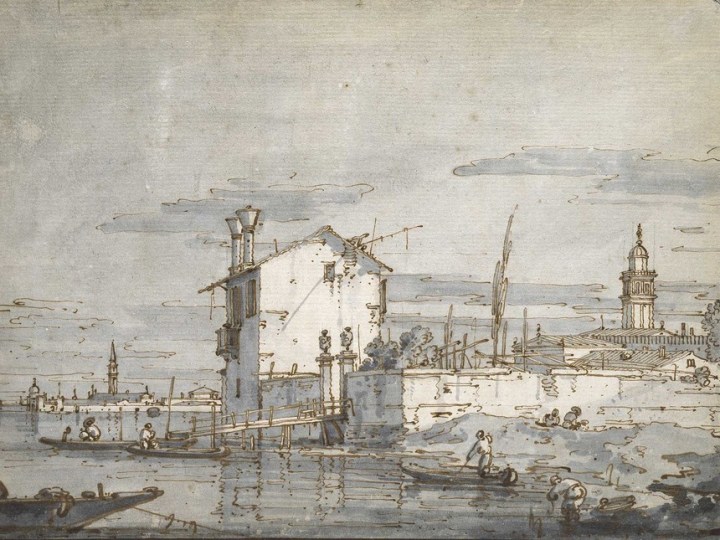
Giovanni Antonio Canal, known as Canaletto (1697‒1768), An Island in the Lagoon, pen, brown ink with grey wash over ruled pencil lines on blue paper, 20 x 27.9 cm (Ashmolean Museum, University of Oxford).
◊ ◊ ◊ ◊ ◊
Press release (28 August 2015) for the exhibition opening this week at the Ashmolean:
Titian to Canaletto: Drawing in Venice
Ashmolean Museum of Art and Archaeology, Oxford, 15 October 2015 — 10 January 2016
Curated by Catherine Whistler
Featuring a hundred drawings from the Uffizi, the Ashmolean, and Christ Church, Oxford, Titian to Canaletto is a groundbreaking exhibition based on new research. Venetian art has long been associated with brilliant colours and free brushwork, but drawing has been written out of its history. This exhibition highlights the significance of drawing as a concept and as a practice in the artistic life of Venice. It reveals the variety of purposes and techniques in drawing from Bellini, Titian and Tintoretto to Tiepolo and Canaletto. In a parallel exhibition, Jenny Saville Drawing, one of the UK’s most celebrated contemporary artists, Jenny Saville, has produced new work on paper and canvas in response to the Venetian Old Masters.
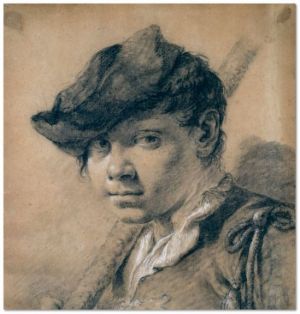
Giovanni Battista Piazzetta (1682‒1754), Head of a Youth, black and white chalks on brownish paper, 31.5 x 29.9 cm (Ashmolean Museum, University of Oxford)
Putting the words ‘drawing’ and ‘Venice’ together seems paradoxical. Writing on Venetian art has located creativity and artistic ambition in painting above all, emphasizing the materiality and sensuous effects achieved by Venetian artists. The intellectual and reflective qualities encapsulated in drawing are seen as irrelevant in the artistic world of Venice. The idea that Venetian artists did not use or value drawing was articulated in Florence, in Giorgio Vasari’s Lives of the Artists of 1568. Vasari’s influential statements were repeated and elaborated by later writers, so that in 1770s London, Joshua Reynolds confidently asserted that artists in Venice did not care about drawing with all of its virtues of discrimination and judgement, and that they went straight to working with brushes on canvas. This potent literary tradition had a major impact on the survival of drawings.
Titian to Canaletto presents new research which traces continuities in Venetian drawing over three centuries, from around 1500 to the foundation of the first academy of art in Venice in 1750. The exhibition emphasizes the role of drawing from sculpture and from life in the education and identities of Venetian artists, and it reveals tensions between theory and practice in the activities of artists and of collectors. Venetian artists used drawing for innovating and experimenting, or as a tool for research and observation; a variety of drawings were made and admired as works of art in their own right. The exhibition poses questions about the survival and value of drawings: does the fact that we have so few by Titian mean that he did not draw? Why were many Venetian drawings thought unworthy of collecting?
Ironically, while the story that Venetian artists did not respect drawing was first told in Florence, one of the world’s great collections of Venetian drawings is held at the Uffizi where many drawings were acquired in the mid-seventeenth century for Leopoldo de’Medici. Not only are there masterpieces by Carpaccio, Bassano, Titian and Tintoretto, and high-quality works by lesser-known seventeenth- century artists, there are also drawings that reveal early attitudes to collecting and connoisseurship. The Uffizi will also lend drawings by Tiepolo that have never been shown before, to be grouped with the Ashmolean’s own superb collection. Pioneering collectors in England owned Venetian drawings, and loans of important works by Veronese and Tintoretto will come from the intact early eighteenth-century collection at Christ Church, Oxford, together with the extraordinary Portrait of a man, by Giovanni Bellini.
Dr Catherine Whistler, Keeper of the Department of Western Art, Ashmolean Museum, and curator of the exhibition, says: “The beauty and visual impact of these drawings speak eloquently of the importance of drawing in Venice. We hope this exhibition will challenge traditional views of Venetian art and provoke new thinking on some of the greatest names in Italian art from the Renaissance to the eighteenth century.”
Dr Alexander Sturgis, Director of the Ashmolean, says: “The Ashmolean is bringing to a close its year of drawings exhibitions with this landmark show. Titian to Canaletto includes some of the Ashmolean’s greatest treasures, brought together with examples from two of the world’s finest collections of Old Master drawings—that of the Uffizi and the Christ Church Picture Gallery. Many of the works in the exhibition have not been displayed in public since the 1950s. The captivating beauty of these drawings is evident in the response they have elicited from one of this country’s most distinguished contemporary artists, Jenny Saville, who has produced a new body of work inspired by pieces in the exhibition and her enduring love of Venetian art.”
In Jenny Saville Drawing, Jenny Saville will present a body of drawings, including several new and unseen works in a dedicated exhibition space that accompanies Titian to Canaletto: Drawing in Venice. The rich material and gestural qualities of Venetian drawings have been an inspiration for the thoughtful yet visceral works on paper and canvas that will be on view. For Jenny Saville, the blurred or grainy charcoal marks and the agile, robust pen lines of Venetian artists such as Titian or Palma Giovane become catalysts for exploring the nature and power of drawing, in new, highly charged works of art.
◊ ◊ ◊ ◊ ◊
The catalogue is distributed by ACC:
Catherine Whistler, ed., Drawing in Venice: Titian to Canaletto (Oxford: Ashmolean Museum/ Woodstocker Books, 2015), 256 pages, ISBN: 978-1854442994, $45.
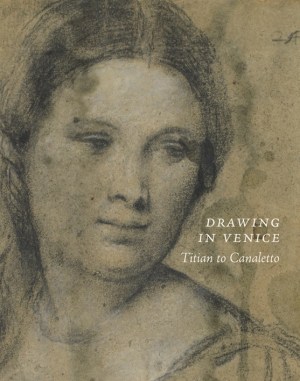 Featuring over a hundred drawings from the outstanding collections of graphic art at the Uffizi, Florence, and the Ashmolean, and Christ Church, Oxford, Drawing in Venice is based on ground-breaking new research and accompanies an Ashmolean-Uffizi collaborative exhibition (2015–16) which traces continuities in Venetian drawing over three centuries, from around 1500 down to the foundation of the first academy of art in Venice in 1750.
Venetian art has long been associated with brilliant colours and free brushwork, but drawing has been written out of its history. This book highlights the significance of drawing as a concept and as a practice in the artistic life of Venice. It reveals the variety of aims, purposes, and techniques in drawing through the works of the Venetian Renaissance masters Giovanni Bellini, Titian, and Tintoretto to those of the great eighteenth-century artists, Giovanni Battista Tiepolo and Canaletto.
Dr Catherine Whistler is Keeper of the Western Art Department at the Ashmolean Museum, University of Oxford. Her previous publications include Michelangelo and Raphael Drawings (1990); Drawings by the Carracci from British Collections (joint author, 1996); Opulence and Devotion: Brazilian Baroque Art (2001); and Graceful and True: Drawings in Florence c.1600 (joint author, 2003).
C O N T E N T S
Essays
1 Catherine Whistler, Drawing in Venice from Titian to Canaletto: Practice and Perception
2 Giorgio Marini, Disegni a stampa: Drawing Practice and Printmaking in Venice from the Sixteenth to the Eighteenth Centuries
3 Marzia Faietti, Giorgio Vasari’s ‘Life of Titian’: Critical Misinterpretations and Preconceptions Concerning Venetian Drawing
4 Jacqueline Thalmann, General John Guise and His Collection of Venetian Drawings
Catalogue Entries
Glossary of Materials and Techniques of Drawing
Artists’ Biographies
Bibliography
New Book | Eternity’s Sunrise: The Imaginative World of William Blake
From Yale UP:
Leo Damrosch, Eternity’s Sunrise: The Imaginative World of William Blake (New Haven: Yale University Press, 2015), 344 pages, ISBN: 978-0300200676, $30.
 William Blake (1757–1827), overlooked in his time, remains an enigmatic figure to contemporary readers despite his near canonical status. Out of a wounding sense of alienation and dividedness he created a profoundly original symbolic language, in which words and images unite in a unique interpretation of self and society. He was a counterculture prophet whose art still challenges us to think afresh about almost every aspect of experience—social, political, philosophical, religious, erotic, and aesthetic. He believed that we live in the midst of Eternity here and now, and that if we could open our consciousness to the fullness of being, it would be like experiencing a sunrise that never ends.
Following Blake’s life from beginning to end, acclaimed biographer Leo Damrosch draws extensively on Blake’s poems, his paintings, and his etchings and engravings to offer this generously illustrated account of Blake the man and his vision of our world. The author’s goal is to inspire the reader with the passion he has for his subject, achieving the imaginative response that Blake himself sought to excite. The book is an invitation to understanding and enjoyment, an invitation to appreciate Blake’s imaginative world and, in so doing, to open the doors of our perception.
Leo Damrosch is Research Professor of Literature, Harvard University. His previous books include Jean-Jacques Rousseau: Restless Genius, a National Book Award finalist; Tocqueville’s Discovery of America; and Jonathan Swift: His Life and His World, winner of the National Book Critics Circle Award in biography and a finalist for the Pulitzer Prize in biography. He lives in Newton, MA.
AIC Director Douglas Druick Announces Retirement

Douglas Druick, photo by Robert Carl
◊ ◊ ◊ ◊ ◊
Press release from the Art Institute of Chicago, via ArtDaily (8 October 2015). . .
Douglas Druick, President and Eloise W. Martin Director announced today his plans to retire from the Art Institute of Chicago. An internationally recognized scholar and curator who joined the Art Institute in 1985, during his distinguished 30 years of service Druick chaired two of the museum’s eleven curatorial departments and led the institution as its president and director since 2011, overseeing many milestones in the museum’s illustrious history.
“Douglas is one of the most respected, thoughtful, and innovative museum leaders in the world. He has made extraordinary contributions to the development of the Art Institute—ushering the museum into the digital age, achieving an unparalleled ranking among the world’s top three museums on TripAdvisor for three years running, and managing the largest gift of art since the museum’s founding with the contemporary works from Stefan Edlis and Gael Neeson,” said Bob Levy, Chairman of the Board of Trustees of the Art Institute of Chicago. “Douglas’s initiatives to place a stronger emphasis than ever before on visitor access and engagement, and to champion global diversity as it is reflected in the museum’s audiences, collections, and programs, will only continue to advance the Art Institute’s global reach and reputation for excellence.”
“It has been my honor to serve as the Art Institute’s president and director,” said Druick. “I have been deeply proud to lead one of the finest museums in the world, and to work for three decades with an exceptional cadre of remarkably talented museum colleagues. It is my hope that together we have ensured a solid footing for the Art Institute to continue to grow stronger and more vibrant, financially stable and internationally renowned, with a future filled with more opportunities than challenges.”
Under Druick’s leadership, since 2011, the Art Institute has offered more than 100 internationally recognized and innovative exhibitions that have inspired and educated millions of visitors who count on the museum to encourage the individual experience of exceptional works of art. During Druick’s tenure, the museum achieved-and continues to record-the highest attendance numbers in its history. He managed the largest gift of art to the Art Institute since its founding, in the generous and extraordinary collection of Stefan Edlis and Gael Neeson, affirming the museum’s legacy as an international leader in contemporary art and realizing the promise of the Modern Wing.
Druick’s commitment to bring the museum fully into the digital age-overseeing a comprehensive plan to install wireless internet in the galleries and public spaces, launching a pioneering Online Scholarly Catalogue Initiative, and recalibrating the museum’s culture to prioritize visitor access and engagement-has ensured the Art Institute’s continued preeminence as one of the world’s most exceptional museums.
Druick noted, “The next chapter in the life and legacy of the Art Institute hinges on an all-important five to seven year endeavor to realize the museum’s long range plan that I believe requires uninterrupted leadership. I will retire with confidence, knowing that the foundation for the museum’s future is firmly in place and that we will energetically pursue our ambitious vision. For decades, the Art Institute’s life has been my own, but I need now to draw a distinction between my professional and personal life. I am doing so to realize long held plans with my partner and frequent collaborator Peter Zegers to actively pursue new directions and experiences together, here and abroad.”
Douglas Druick, 70, received a B.A. in English and Philosophy from McGill University in Montreal in 1966, and an M.A. in English from the University of Toronto in 1967. In 1972, he received his M.Phil. in the History of Art from Yale University, followed by his Ph.D., also from Yale, in 1979. From 1973 to 1984, Druick was the Curator of European and American Prints at the National Gallery of Canada in Ottawa.
He first came to the Art Institute in 1985 as the Chair and Prince Trust Curator of Prints and Drawings. Four years later, in 1989, he also became the Searle Curator of European Painting at the Art Institute. In 2006, while remaining the Chair of the Department of Prints and Drawings, he was named the Chair of the Department of Medieval to Modern European Painting and Sculpture, deftly stewarding the Art Institute’s renowned Impressionist, Post-Impressionist, and Modern collections.
As chair of two of the museum’s largest departments Druick oversaw the acquisition of thousands of notable prints and drawings of all schools and many important European paintings, both building on the collections’ strengths and expanding the geographical representation of nineteenth- and twentieth-century art.
During his tenure at the Art Institute, Druick conceived and organized or contributed to some of the most significant exhibitions in the museum’s history. These exhibitions include Odilon Redon: Prince of Dreams, 1840–1916 (1994); Gustave Caillebotte: Urban Impressionist (1994) with Gloria Groom; Van Gogh and Gauguin: The Studio of the South (2001) with Peter Zegers; Cézanne to Picasso: Ambroise Vollard, Patron of the Avant-Garde (2006) with Gloria Groom; and, in contemporary art, Jasper Johns: Gray (2007) with James Rondeau-named ‘Best Monographic Museum Show Nationally’ by the American section of the International Art Critics Association.
Druick has published and lectured extensively, with 15 exhibition catalogues to his credit, numerous essays and articles, and talks and lectures from Vienna to London and from Amsterdam to San Francisco.
He has been awarded many professional honors and has served on various advisory councils and boards, including as the Chairman of the Arts and Artifacts Indemnity Advisory Panel, National Endowment for the Arts (2002–2004); a Founding Board Member of the Association of Art Museum Curators (2002–2008); and the National Committee for the History of Art (2003–2009). The Government of France named him an ‘Officier des Arts et Lettres’ in 2012, and he was elected as a Fellow to the American Academy of Arts & Sciences in 2013.
Douglas Druick will remain fully engaged in his duties as President and Eloise W. Martin Director until his successor has been appointed and installed. The Board of Trustees of the Art Institute of Chicago deeply respects and has enormous gratitude for Druick’s service and his stewardship of the museum, and will begin the important work to formulate an approach to his succession.
New Book | Fashion Plates: 150 Years of Style
Due out next month from Yale UP:
April Calahan, edited by Karen Trivette Cannell, with a foreword by Anna Sui, Fashion Plates: 150 Years of Style (New Haven: Yale University Press, 2015), 440 pages, ISBN: 978-0300212266, $150.
 Prior to the invention of photography, European and American magazines used colorful prints to depict the latest fashion trends. These illustrations, known as ‘fashion plates’, conveyed the cutting-edge styles embraced by the fashion-conscious elite and proved inspirational to the upwardly mobile. Fashion Plates: 150 Years of Style is a comprehensive survey containing 200 fashion plates, many reproduced at actual size, from publications dating from 1778 to the early 20th century.
A number of these charming illustrations are extremely rare, and have not appeared in print since their publication in the periodicals in which they first ran. Organized chronologically and featuring both men’s and women’s garments, these lively and colorful vignettes not only are beautiful, but also clearly illustrate the evolution of fashion over time. Many of the plates were produced by important artists of the day, including Léon Bakst, George Barbier, and Georges Lepape. With texts by April Calahan on the social, political, and economic significance of fashion and its industries, and a foreword by award-winning fashion designer Anna Sui, this exquisite slipcased publication fills an important gap in the literature on the history of fashion and provides an entertaining historical overview for the general reader.
April Calahan is a fashion historian, writer and art appraiser, as well as special collections associate at the Fashion Institute of Technology, New York. Karen Trivette Cannell is assistant professor and head of special collections and the archive at the Fashion Institute of Technology, New York. Anna Sui is a fashion designer living in New York City.
Exhibition | Collecting the Arts of Mexico
Now on view at The Met:
Collecting the Arts of Mexico
The Metropolitan Museum of Art, New York, 17 July 2015 — 7 August 2016

Nicolás Enríquez, The Virgin of Guadalupe with the Four Apparitions (detail), 1773, oil on copper, 56.5 x 41.9 cm (New York: The Metropolitan Museum of Art, New York, 2014.173)
In 1911, Emily Johnston de Forest gave her collection of pottery from Mexico to the Metropolitan Museum. Calling it ‘Mexican maiolica’, she highlighted its importance as a North American artistic achievement. De Forest was the daughter of the Museum’s first president and, with her husband, Robert, a founder of The American Wing. The De Forests envisioned building a collection of Mexican art, and, even though their ambitions were frustrated at the time, the foundational gift of more than one hundred pieces of pottery anchors the Met’s holdings. Today, more than a century later, their vision resonates as the Museum commits to collecting and exhibiting not just the arts of Mexico, but all of Latin America. This exhibition highlights the early contributions of the De Forests and others, and presents recent additions to the collection for the first time.
Learn more about five paintings by Nicolas Enriquez (1704–1790) featured in this exhibition on MetCollects.
Exhibition | The Edible Monument: The Art of Food for Festivals

Marcantonio Chiarini and Giacomo-Maria Giovannini, Disegni del convito fatto dall’illustrissimo signor senatore Francesco Ratta all’illustrissimo publico, eccelsi signori anziani and altra nobilità: terminando il svo confalonierato li 28. febraro 1693 (The Getty Museum). More information is available here.
◊ ◊ ◊ ◊ ◊
The Edible Monument revisits the exhibition mounted at the Getty in 2000, with the publication this fall of an accompanying catalogue.
The Edible Monument: The Art of Food for Festivals
The Getty Research Institute, Los Angeles, 13 October 2015 — 23 March 2016
Detroit Institute of Arts, 16 December 2016 — 16 April 2017
Curated by Marica Reed
Elaborate artworks made of food were created for royal court and civic celebrations in early modern Europe. Like today’s Rose Bowl Parade on New Year’s Day or Mardi Gras just before Lent, festivals were times for exuberant parties. Public celebrations and street parades featured large-scale edible monuments made of breads, cheeses, and meats. At court festivals, banquet settings and dessert buffets displayed magnificent table monuments with heraldic and emblematic themes made of sugar, flowers, and fruit. This exhibition, drawn from the Getty Research Institute’s Festival Collection, features rare books and prints, including early cookbooks and serving manuals that illustrate the methods and materials for making edible monuments.
Edited by Marcia Reed with contributions by Charissa Bremer-David, Joseph Imorde, Marcia Reed, and Anne Willan, The Edible Monument: The Art of Food for Festivals (Los Angeles: Getty Publications, 2015), 192 pages, ISBN 978-1-60606-454-2, $35.
 The Edible Monument considers the elaborate architecture, sculpture, and floats made of food that were designed for court and civic celebrations in early modern Europe. These include popular festivals such as Carnival and the Italian Cuccagna. Like illuminations and fireworks, ephemeral artworks made of food were not well documented and were challenging to describe because they were perishable and thus quickly consumed or destroyed. In times before photography and cookbooks, there were neither literary models nor a repertoire of conventional images for how food and its preparation should be explained or depicted. Although made for consumption, food could also be a work of art, both as a special attraction and as an expression of power. Formal occasions and spontaneous celebrations drew communities together, while special foods and seasonal menus revived ancient legends, evoking memories and recalling shared histories, values, and tastes. Drawing on books, prints, and scrolls that document festival arts, elaborate banquets, and street feasts, the essays in this volume examine the mythic themes and personas employed to honor and celebrate rulers; the methods, materials, and wares used to prepare, depict, and serve food; and how foods such as sugar were transformed to express political goals or accomplishments.
Marcia Reed is chief curator at the Getty Research Institute. She is coeditor of China on Paper (Getty Publications, 2007).
◊ ◊ ◊ ◊ ◊
C O N T E N T S
Acknowledgments
1 Marcia Reed—Food, Memory, and Taste
2 Marica Reed—Court and Civic Festivals
3 Marcia Reed—Feasting in the Streets: Carnivals and the Cuccagna
4 Joseph Imorde—Edible Prestige
5 Charissa Bremer-David—Of Cauliflower and Crayfish: Serving Vessels to Awaken the Palate
6 Anne Willan—Behind the Scenes
Contributors
Illustration Credits
Index
◊ ◊ ◊ ◊ ◊
Note (added 2 November 2016) — The DIA venue was not included in the original posting.










 Enfilade
1 comment