Smithsonian American Art Museum Fellowships, 2016–17
Smithsonian American Art Museum Fellowships, 2016–17
Applications due by 1 December 2015
The Smithsonian American Art Museum (SAAM) and its Renwick Gallery invite applications for research fellowships in the art, craft, and visual culture of the United States. Fellowships are residential and support full-time independent and dissertation research.
Each scholar is provided a carrel in SAAM’s Fellowship Office, situated across the street from the museum. Available research resources there include a 180,000-volume library that specializes in American art, history, and biography; the Archives of American Art; the graphics collections of SAAM and the National Portrait Gallery; the Joseph Cornell Study Center; and the Nam June Paik Archive, as well as a variety of image collections and research databases. During their stay at SAAM, scholars will be part of one of the nation’s oldest and most distinguished fellowship programs in American art and will have the opportunity to attend a wide variety of lectures, symposia, and professional workshops. Short research trips are also possible.
Qualifications and Selection
Predoctoral applicants must have completed coursework and preliminary examinations for their doctoral degree and must be engaged in dissertation research. Postdoctoral fellowships are available to support specific research projects by scholars who have earned a PhD or equivalent. Senior fellowships are intended for scholars with a distinguished publication record who have held their doctoral degree for more than seven years or who possess a commensurate record of professional accomplishment at the time of application.
Applications will be evaluated on the quality of the proposed research project and the applicant’s academic standing, scholarly qualifications, and experience. The project’s compatibility with Smithsonian collections, facilities, staff, and programs will also be considered. A committee of curators and historians will review the proposals.
Fellowships
SAAM hosts fellows supported by the Smithsonian Institution Fellowship Program and also offers the following named fellowships:
The Joe and Wanda Corn Fellowship is endowed by their former students Mike Wilkins and Sheila Duignan and supports scholars whose research interests span American art and American history. The recipient will be jointly appointed at SAAM and NMAH (National Museum of American History) and will draw on the resources of both museums.
The Douglass Foundation Fellowship in American Art is given for predoctoral research in American art.
The Patricia and Phillip Frost Fellowship is offered to support research in American art and visual culture.
The George Gurney Fellowship funds a one- to three-month research appointment in American art, preferably sculpture, in honor of the distinguished career of SAAM’s former curator of sculpture.
The James Renwick Fellowship in American Craft is available for research in American studio crafts or decorative arts from the nineteenth century to the present.
The Sara Roby Fellowship in Twentieth-Century American Realism is awarded to a scholar whose research topic is in the area of American realism.
The Joshua C. Taylor Fellowship is supported by alumni and friends of the fellowship program.
The Terra Foundation Fellowships in American Art seek to foster a cross-cultural dialogue about the history of the art of the United States up to 1980. Three twelve-month fellowships will be awarded annually, one each at the predoctoral, postdoctoral, and senior levels, to scholars from abroad who are researching American art or to U.S. scholars who are investigating international contexts for American art.
The William H. Truettner Fellowship supports one to three months of research, in recognition of Mr. Truettner’s career of nearly fifty years as a curator of painting and sculpture at SAAM.
The Wyeth Foundation Predoctoral Fellowship is awarded for the advancement and completion of a doctoral dissertation that concerns the study, appreciation, and recognition of excellence in all aspects of American art.
Support
The stipend for a one-year predoctoral fellowship is $32,700 plus research and travel allowances. The stipend for a one-year postdoctoral or senior fellowship is $48,000 plus research and travel allowances. The standard term of residency is twelve months, but shorter terms will be considered; stipends are prorated for periods of less than twelve months.
Applicants are encouraged to share their research proposals with potential Smithsonian advisors before submitting applications. For research consultation, contact Amelia Goerlitz at GoerlitzA@si.edu or Emily D. Shapiro at ShapiroED@si.edu.
For Applications or General Information
Call SAAM’s Fellowship Office at (202) 633-8353 or e-mail AmericanArtFellowships@si.edu. A link to the online application for the Smithsonian Institution Fellowship Program can be accessed via our website. Applicants should propose a primary advisor/supervisor from SAAM to be eligible for a fellowship at this unit. Only one application is necessary; applicants will automatically be considered for all relevant awards. December 1, 2015, is the application deadline for fellowships that begin on or after June 1, 2016. Awards are based on merit. Fellowships are open to all qualified persons regardless of race, color, religion, gender, national origin, age, sexual orientation, or condition of handicap. The Smithsonian Institution’s Office of International Relations will assist with arranging J-1 exchange visas for fellowship recipients who require them. For other Smithsonian opportunities, visit the Smithsonian Office of Fellowships and Internships webpage or e-mail siofi@si.edu.
Exhibition | In Pursuit of Antiquity

William Chambers, Presentation drawing showing a perspective view of an unexecuted design for a Mausoleum
for Frederick, Prince of Wales, initialed and dated 1751, Pencil, pen and ink, and watercolour, 490 x 705 mm
(London: Sir John Soane’s Museum)
◊ ◊ ◊ ◊ ◊
Press release (17 August 2015) from Berlin’s Museum for Architectural Drawing:
In Pursuit of Antiquity: Drawings by the Giants of British Neo-Classicism
Auf den Spuren der Antike: Meisterzeichnungen des britischen Neoklassizismus
Sir John Soane’s Museum, London, 1 February — 1 June 2008
Museum für Architekturzeichnung, Berlin, 3 October 2015 — 14 February 2016
Curated by Jeremy Musson
Important architectural drawings held by Sir John Soane’s Museum, one of the most significant collections of its kind in Great Britain, form a new temporary exhibition at the Museum for Architectural Drawing in Berlin. In Pursuit of Antiquity: Drawings from the Giants of British Neo-Classicism illustrates the ambition of leading British architects of the late 18th century who strove to create new architecture in the Classical tradition that could compete—in terms of public works, private houses, mausolea, interior detail and even furnishings—with the glories of the ancient world. Illustrating this central theme, some of the finest drawings and designs by Sir John Soane himself, Robert Adam, George Dance the Younger, Sir William Chambers, and James Wyatt are being shown for the first time in Germany.
In Pursuit of Antiquity is curated by architectural historian and author Jeremy Musson and was originally shown at Sir John Soane’s Museum in 2008. Musson’s selection from the Museum’s unrivalled collection includes an astonishingly detailed cutaway drawing of Holy Trinity Marylebone, one of Soane’s three neo-classical churches. Such designs are a reminder of the passionate belief held by Soane and his architectural contemporaries that the quality of a society could be judged by its public buildings. London was then the centre of the largest empire since Rome, and the exhibition includes Soane’s design for two huge triumphal arches (celebrating Waterloo and Trafalgar) at each end of Downing Street. The deliberate association of ancient and modern empires is clear.
Alongside designs for monumental public architecture, In Pursuit of Antiquity also includes more intimate details, such as chimneypieces and domestic furniture, whose Egyptian, Grecian, and Roman nuances reflect aspirations for the birth of a new golden age. The exhibition focuses on ancient Rome and its great monuments as a source of inspiration to the architectural students of the 18th and 19th centuries who exhaustively measured, studied, surveyed, and, above all, drew these structures as part of their education. The exhibition also explores the idea of an architectural drawing—from sketch to final presentation. Drawings by French and Italian artists such as Percier, Clérisseau, and the great Piranesi, all represented in Soane’s collection, illustrate the links between these architects and British architects.
Often described as ‘the father of modern architecture’, Sir John Soane (1753–1837) brought together a magnificent collection of architectural drawings intended to provide exemplars for himself, his sons, and his assistants. It was to be a source of reference, inspiration, ideas, and comparison and later became a key aspect of his conscious creation of a museum collection. Today, the outstanding drawings held at Sir John Soane’s Museum stand alongside the collection of the Royal Institute of British Architects as the two pre-eminent collections of architectural drawings in the country.
Jeremy Musson is an architectural historian, broadcaster and author. He is the author of The Drawing Room: Country House Design and Decoration (2014), English Country House Interiors (2011), How to Read a Country House (2006), and series editor of books published from the archive of Country Life, including The Regency Country House and The Country Houses of Adam. He also contributes to The British Art Journal and The Georgian Group Journal . He lectures regularly, including for the University of Cambridge, the Attingham Summer School, and the Royal Oak. Born in London in 1965, Musson lives in Cambridge with his family.
Exhibition | The Fabric of India
I noted this exhibition last fall, but it’s worth following up now that the show is on view at the V&A (3 October 2015 — 10 January 2016). The press release is available as a PDF file here, with information on the catalogue included below. –CH
◊ ◊ ◊ ◊ ◊
From the V&A shop:
Rosemary Crill, The Fabric of India (London: V&A Publishing, 2015), 240 pages, ISBN: 978-1851778539, £30 / $60.
 This is the first truly comprehensive book on Indian textiles, featuring stunning examples from all over the country. Lavishly illustrated, it begins with an in-depth exploration of the different materials, techniques, and dyeing processes used in the creation of these sumptuous fabrics before exploring the central importance of cloth to Indian life and culture from ancient times to the present day. Special features focus on objects of historical importance, including a Kashmir map shawl, Tipu Sultan’s tent, and a remarkable 18th-century temple hanging from South India.
While many are familiar with Mughal velvets, western-market chintzes, or rural embroideries, for example, this book will surprise, inspire, delight, and inform with an extraordinary range of material, much of it new. Along with presenting great historical masterpieces, the importance and variety of the basic fibers—silk, cotton, wool—from which Indian textiles are traditionally made is emphasized, and the remarkable techniques of weaving, printing, dyeing, and embroidery that have made them prized across the world are illustrated in specially taken photographs.
VMFA Acquires Royal Portrait by Benjamin West

Benjamin West, Portrait of Prince William and his Elder Sister, Princess Sophia, 1779, oil on canvas, 61 x 85 inches
(Richmond: VMFA).
◊ ◊ ◊ ◊ ◊
From the VMFA press release (1 October 2015) . . .
At the Virginia Museum of Fine Arts, an important work by American painter Benjamin West was recently installed in the McGlothlin American Galleries. The portrait was acquired during the June 18 meeting of the VMFA Board of Trustees and is among the most valuable acquisitions in VMFA history.
Benjamin West, known as the ‘father of American painting’, was at one point the most prominent painter in the British Empire. He served as President of the Royal Academy, History Painter to the King, and Surveyor of the King’s Pictures until his death in 1820. While in London, he also mentored American artists Charles Wilson Peale, Gilbert Stuart, and John Trumball—each of whom is represented in VMFA’s American Galleries. This is one of six group portraits commissioned by King George III during the American Revolution. Intended as a gift for the king’s brother, HRH Prince William Henry, Duke of Gloucester and Edinburgh, it is the only one of the six outside the Royal Collection. Descended in the family of George III, whose daughter HRH Princess Mary wed the sitter, Prince William, the painting celebrates the king’s protection of his niece and nephew at a moment during their father’s ill-health. In acknowledgement of the king’s generosity, the children and father—symbolized by the robe and crown—signal their obedience to the king, symbolized by the lion. This patriarchal narrative of duty and protection served a dual purpose as wartime propaganda. As the king served to protect his subjects, so his subjects—the colonists—owed their obedience to the king.
The acquisition of Portrait of Prince William and his Elder Sister, Princess Sophia was made possible by the J. Harwood and Louise B. Cochrane Fund for American Art. Since 1988, this permanent endowment has provided support for the acquisition of historic American paintings, sculpture, works on paper, and decorative arts, ca. 1700–1945, including those native to Virginia. It has been funded with outright gifts, 220 parcels of real estate in Manchester, and their former home and farm in Hanover County. Proceeds from the sales of the real estate have been added to the Cochrane endowment principal. The endowment is now nearly 30 years old and has underwritten 79 important American acquisitions
Call for Panel Proposals | SAH in Glasgow, 2017

From SAH:
Society of Architectural Historians Annual Conference
Glasgow, 7–11 June 2017
Session Proposals due by 16 January 2016
At its 2017 Annual International Conference in Glasgow, Scotland, SAH will offer a total of 36 paper sessions. The Society invites its members, including graduate students and independent scholars, representatives of SAH chapters, and partner organizations, to chair a session at the conference. As SAH membership is required to chair or present research at the conference, non-members who wish to chair a session will be required to join SAH at the time of submitting a proposal.
Since the principal purpose of the SAH Annual International Conference is to inform conference attendees of the general state of research in architectural history and related disciplines, session proposals covering every period in the history of architecture and all aspects of the built environment, including landscape and urban history, are encouraged.
Session proposals are to be submitted online beginning October 1, 2015, through 5:00 pm CST, January 16, 2016. The portal will close automatically at this time. Proposals will be reviewed by Sandy Isenstadt, SAH 1st vice president-elect and conference chair.
Prospective chairs must include the following in their proposal:
1. A session title not longer than 65 characters, including spaces and punctuation
2. Summary of the subject and the premise in no more than 500 words
3. Name, professional affiliation (if applicable), address, telephone and email address
4. A current CV (2 pages maximum)
View the complete call for sessions and submit a proposal online at sah.org/2017.
Questions? Contact Sandy Isenstadt at sandy.isenstadt@gmail.com or Kathy Sturm at 312.543.7243 or ksturm@sah.org.
Bard Graduate Center’s 2015–16 Seminar Series
Here are some of the highlights that might be of particularly relevant for eighteenth-century studies, though be sure to have a look at the full schedule. -CH
◊ ◊ ◊ ◊ ◊
2015–16 Seminar Series
Bard Graduate Center, New York
RSVP is required. For general information or to reserve your place, please visit us online, email academicevents@bgc.bard.edu, or call 212.501.3019.
 BGCTV. All events listed below will be live-streamed on BGC’s online live-streaming channel. The live-streaming of our research events reflects Bard Graduate Center’s commitment to making our innovative programming more widely available and so shaping the global discourse about the cultural history of the material world.
October 6, 6–7:30pm
Susan Hunter
MA Candidate, Bard Graduate Center; Associate Director, Winston Art Group
“Case Study: Sir Thomas Hanmer’s Silver Gilt Sideboard Dish in the Collection of the Federal Reserve Bank of New York”
October 13, 6–7:30pm
Anne Higonnet
Professor of Art History, Barnard College, Columbia University
“A Digital Enlightenment: Experiments in the Teaching of Eighteenth-Century Decorative Arts”
November 10, 12–1:30pm
Tian Chun
Associate Professor, Art and Design History, Guangzhou Academy of Fine Arts; Visiting Fellow, Bard Graduate Center
“Parasols and Pagodas: Lacquer Furniture and East West Exchange in the Seventeenth and Eighteenth Centuries”
January 26, 6–7:30pm
Robert Wellington
Lecturer, Center for Art History and Art Theory, Australian National University
“Sun King to Moon King: Emulating the Grand Siècle in the Eighteenth and Nineteenth Centuries”
March 2, 12–1:30pm
Margaret Holben Ellis
Eugene Thaw Professor of Paper Conservation, New York University; Director, Thaw Conservation Center, Morgan Library and Museum
“Paper is Part of the Picture”
March 22, 6–7:30pm
Dedo von Kerssenbrock-Krosigk
Head, Glasmuseum Hentrich
“The Meaning of Glass: What Do People Think When They Think About Glass?”
March 29, 6–7:30pm
Anne T. Gerritsen
Associate Professor of History, University of Warwick
“‘The best Rubarbe is that which is brought from China fresh and newe’: Rhubarb and the Imagination of China in European Visual Print Culture, 1500–1850”
April 5, 5:30–7pm
Giorgio Riello
Professor of Global History and Culture, Director of the Institute of Advanced Study, University of Warwick
“Global Things: Trade and Material Culture in the First age of Globalization, c. 1500–1800”
Exhibition | Woven Gold: Tapestries of Louis XIV
Press release (30 April 2015) from The Getty:
Woven Gold: Tapestries of Louis XIV
The Getty Center, Los Angeles, 15 December 2015 — 1 May 2016
Curated by Charissa Bremer-David
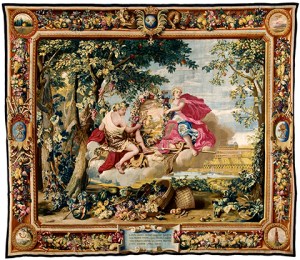
Autumn, after 1664, tapestry, wool, silk and gilt-metal wrapped thread, Gobelins Manufactory, cartoon attributed to Beaudrin Yvart (French, 1611–1690), after Charles Le Brun (French, 1619–1690), The Mobilier National, France. Photo by Lawrence Perquis.
It was during the reign of the Sun King, Louis XIV (r. 1643– 1715), that the art of tapestry weaving in France blossomed. Three hundred years after his death, the Getty Museum will showcase 15 monumental tapestries—from the French royal collection during the reign of Louis XIV. Woven Gold: Tapestries of Louis XIV will be the first major museum exhibition of tapestries in the Western United States in four decades.
During Louis XIV’s time, colorful and glittering tapestries, handwoven after designs by the most renowned artists, were the ultimate expression of status, power, taste, and wealth. The exhibition will feature 15 larger-than-life tapestries ranging in date from about 1540 to 1715 and created in weaving workshops across northern Europe. In an exclusive loan from the French nation, most of the tapestries are from the collection of the Mobilier National, which preserves the former royal collection. Eleven have never before been exhibited in the Unites States. The Getty Museum is supporting the conservation of two of the tapestries.
At the Getty, preparatory drawings, related prints and a life-sized cartoon (oil) will accompany the immense hangings. The tapestries in the exhibition are after works of art by Raphael (Raffaello Sanzio, Italian, 1483–1520), Peter Paul Rubens (Flemish, 1577–1640), Charles Le Brun (French, 1619–1690), and others. They come from the most notable workshops in Europe, including the Gobelins, which rose to preeminence under Louis XIV’s patronage. Several of the best-preserved and most famous examples of Gobelins weaving will be on view in the exhibition.
Woven Gold: Tapestries of Louis XIV is curated by Charissa Bremer-David, curator of sculpture and decorative arts at the Getty, and was organized by the J. Paul Getty Museum in association with the Mobilier National et les Manufactures Nationales des Gobelins, de Beauvais et de la Savonnerie.
◊ ◊ ◊ ◊ ◊
Charissa Bremer-David, with essays by Pascal-François Bertrand, Arnauld Brejon de Lavergnée, and Jean Vittet, Woven Gold: Tapestries of Louis XIV (Los Angeles: Getty Publications, 2015), 168 pages, ISBN: 978-1606064610, $50.
 Meticulously woven by hand with wool, silk, and gilt-metal thread, the tapestry collection of the Sun King, Louis XIV of France, represents the highest achievements of the art form. Intended to enhance the king’s reputation by visualizing his manifest glory and to promote the kingdom’s nascent mercantile economy, the royal collection of tapestries included antique and contemporary sets that followed the designs of the greatest artists of the Renaissance and Baroque periods, including Raphael, Giulio Romano, Rubens, Vouet, and Le Brun. Ranging in date from about 1540 to 1715 and coming from weaving workshops across northern Europe, these remarkable works portray scenes from the bible, history, and mythology. As treasured textiles, the works were traditionally displayed in the royal palaces when the court was in residence and in public on special occasions and feast days. They are still little known, even in France, as they are mostly reserved for the decoration of elite state residences and ministerial offices. This catalogue accompanies an exhibition of fourteen marvelous examples of the former royal collection that will be displayed exclusively at the J. Paul Getty Museum at the Getty Center from December 15, 2015, to May 1, 2016. Lavishly illustrated, the volume presents for the first time in English the latest scholarship of the foremost authorities working in the field.
Charissa Bremer-David is curator in the Department of Sculpture and Decorative Arts at the J. Paul Getty Museum. She is author of French Tapestries and Textiles in the J. Paul Getty Museum (Getty Publications, 1997) and has published extensively on French tapestries.
◊ ◊ ◊ ◊ ◊
Also on view at the Getty
As 2015 is the tercentenary of the death of Louis XIV, several exhibitions at the Getty Center will explore the Sun King’s tremendous influence on Western Art and his distinctive role as collector, heir, and patron of the art of tapestry and other arts.
• A Kingdom of Images: French Prints in the Age of Louis XIV, 1660–1715
16 June to 6 September 2015
• Louis XIV at the Getty
9 June 2015 to 31 July 2016
• Louis Style: French Frames, 1610–1792
15 September 2015 – 3 January 2016
New Book | Conundrum: Puzzles in the Grotesques Tapestry Series
Forthcoming from The Getty:
Charissa Bremer-David, Conundrum: Puzzles in the Grotesques Tapestry Series (Los Angeles: Getty Publications, 2015), 76 pages, ISBN: 978-1606064535, $20.
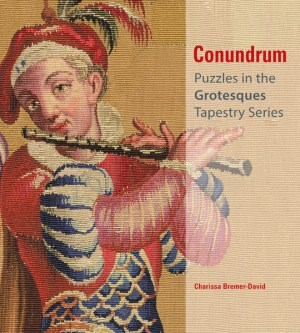 The whimsical imagery of four tapestries in the permanent collection of the J. Paul Getty Museum and currently on display at the Getty Center is perplexing. Created in France at the Beauvais manufactory between 1690 and 1730, these charming hangings, unlike most French tapestries of the period, appear to be purely decorative, with no narrative thread, no theological moral, and no allegorical symbolism. They belong to a series called the Grotesques, inspired by ancient frescos discovered during the excavation of the Roman emperor Nero’s Domus Aurea, or Golden House, but the origins of their mysterious subject matter have long eluded art historians. Based on seven years of research, Conundrum: Puzzles in the Grotesques Tapestry Series reveals for the first time that the artist responsible for these designs, Jean-Baptiste Monnoyer (1636– 1699), actually incorporated dozens of motifs and vignettes from a surprising range of sources: antique statuary, Renaissance prints, Mannerist tapestry, and Baroque art, as well as contemporary seventeenth-century urban festivals, court spectacle, and theater.
Conundrum illustrates the most interesting of these sources alongside full-color details and overall views of the four tapestries. The book’s informative and engaging essay identifies and decodes the tapestries’ intriguing visual puzzles, enlightening our understanding and appreciation of the series’ unexpectedly rich intellectual underpinnings.
Charissa Bremer-David is curator in the Department of Sculpture and Decorative Arts at the J. Paul Getty Museum. She is author of French Tapestries and Textiles in the J. Paul Getty Museum (Getty Publications, 1997) and has published extensively on French tapestries.
Exhibition | Louis Style: French Frames, 1610–1792
◊ ◊ ◊ ◊ ◊
Press release for the exhibition now on view at The Getty:
Louis Style: French Frames, 1610–1792
The Getty Center, Los Angeles, 15 September 2015 — 3 January 2016
Curated by Davide Gasparotto, Anne Woollett, and Gene Karraker
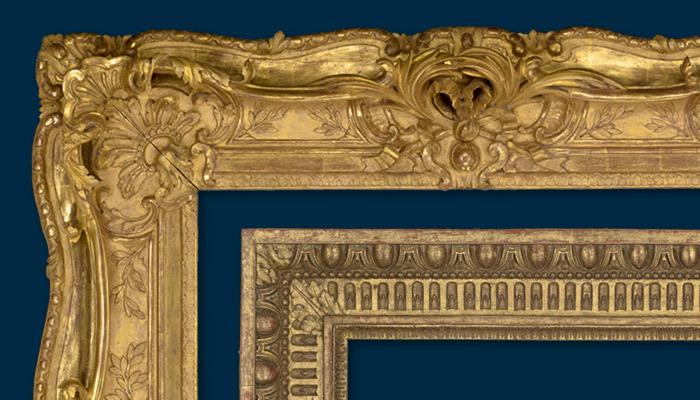
Louis Style: French Frames, 1610–1792 celebrates the dramatic stylistic transformation and technical skill of French frame making in the 17th and 18th centuries. Drawn from the J. Paul Getty Museum’s collection of antique frames, this exhibition presents an array of French design in wall furniture under four kings—from the simple moldings and Italian-inspired ornaments in the time of Louis XIII (1610–1643), to the opulent carved and gilded masterpieces in the age of Louis XIV (1643–1715), to the sculptural forms and rich finishes of the transitional period of the Régence (1715–1723) and Louis XV (1723–1774), and concluding with the restrained treatments preferred during the reign of Louis XVI (1774–1792).
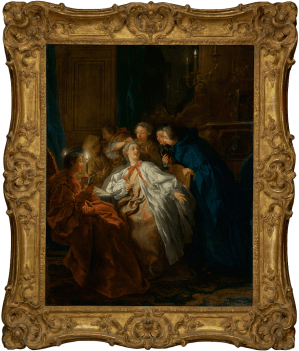
Jean-François de Troy, Before the Ball, 1735, oil on canvas, in a Louis XV frame, carved and gilded oak (The J. Paul Getty Museum)
Louis Style: French Frames, 1610–1792 will be the first exhibition devoted to frames at the Getty Museum. Featuring more than forty frames and framed paintings, Louis Style offers visitors the rare opportunity to consider in depth the types and function of this art form. The installation provides a rich compendium of French design and craftsmanship, along with practical tools, such as the vocabulary of ornament needed to identify the period of a frame, as well as insight into the construction and gilding techniques specific to frames made in France. By addressing the important relationship between a painting and its frame (which sometimes date from different periods and regions), visitors to the exhibition will also gain an awareness of the significance and use of frames in museums.
During the early 1600s through the 1700s—a golden age for frame-making in Paris—the functional surrounds for paintings became expressions of artistry, innovation, taste, and wealth. The primary stylistic trendsetters were the kings of France, whose desire for increasingly opulent forms of display spurred the creative efforts of brilliant designers and craftsmen to magnificent expressions of their personal styles. French frames of this period are distinguished by the use of oak and gold leaf as materials, and techniques of water gilding, elaborate carved ornamentation and varied finishes.
Over the course of several decades, the Museum has assembled a substantial group of period frames to enhance and appropriately display its paintings collection, resulting in a rich and varied assemblage of moldings. Enduring visitor interest in frames and framing led to the publication of D. Gene Karraker’s Looking at European Frames: A Guide to Terms, Styles and Techniques (J. Paul Getty Museum, 2009), illustrated exclusively by works in the collection. The celebration of the 300th anniversary of the death of Louis XIV this year, marked by two major loan exhibitions at the Getty Center, provides the opportunity to present one of the largest and most beautiful areas of the frame collection.
Louis Style: French Frames, 1610–1792 was organized by Senior Curator of Paintings and Department Head, Davide Gasparotto, Curator of Paintings, Anne Woollett, and Associate Conservator of Frames, Gene Karraker.
Hartwig Fischer Appointed as Director of The British Museum
Press release (29 September 2015) from The British Museum:
 Sir Richard Lambert, Chair of the Trustees of the British Museum, this morning announced to staff that Hartwig Fischer had been appointed Director of the British Museum. Dr Fischer, who is currently the Director General of the Staatliche Kunstsammlungen Dresden, will take up the post in Spring 2016. The current Director, Neil MacGregor, will retire from the Museum at Christmas. The appointment has been confirmed by the Prime Minister, the Rt Hon David Cameron.
Chairman of the Trustees Sir Richard Lambert said, “On behalf of the Trustees I am very happy to announce the appointment of Hartwig Fischer—currently Director General of the Staatliche Kunstsammlungen Dresden—as Director of the British Museum. He is one of the outstanding museum directors in the world. He is not only a great scholar, but an experienced administrator and a gifted linguist with a global reputation for rethinking and representing great collections. In Essen he directed one of the leading museums of 20th-century art in Germany and in Dresden he directs a museum whose collections are amongst the greatest in the world. Neil MacGregor has been a brilliant Director of the British Museum and has transformed its presence across the world. The Trustees are confident Dr Fischer will be a worthy successor.”
Hartwig Fischer said: “When I was growing up in Hamburg, Britain was always present in my family life. It has remained so ever since. I never dreamt that I would be invited to be responsible for this great British institution and I am conscious that nobody could fail to grasp what the British Museum represents not only for the UK but for the whole world. For many years I have looked to the British Museum as a model of public engagement, critical scholarship, and international outreach. I am of course daunted by such a responsibility but I know that nobody directs such a museum alone and the colleagues of the British Museum are admired and envied around the world. I am greatly looking forward to working with them. I have visited the British Museum on many occasions as a member of the public and have always admired the way every member of the team plays their part in making the collection available to the public all over the world. It’s an honour to be asked to become the Director of the British Museum and to follow in the footsteps of Neil MacGregor, who has done more than anybody else to position the Museum as one of modern society’s key institutions, fostering knowledge, understanding, and global citizenship.”
Neil MacGregor said “Hartwig Fischer is the perfect choice to run the British Museum. The Museum, its staff, its Trustees and its unparalleled collection is truly international. It therefore makes absolute sense for the new Director to reflect this global outlook. Dr Fischer is a well-respected scholar with extensive experience. He will, I am sure, build on the British Museum’s recent successes to ensure the Museum remains one of the world’s greatest museums.”
Hartwig Fischer is currently the Director General of the Dresden State Art Collections (Staatliche Kunstsammlungen Dresden) where he is responsible for fourteen museums and four separate institutions in four cities. His focus since his appointment in 2012 has been on modernizing and developing the State Art Collections, which date back to the 16th century. The collections are some of Germany’s finest, spanning more than 5,000 years of art, archaeology, anthropology and cultural history. Prior to that appointment, Fischer was Director of the Folkwang Museum in Essen (2006–2012). Whilst in post he oversaw the fundraising and restoration of the historic museum and the construction of a new building, and presided over a period of increasing visitor figures and popularity. He began his museum career at the Kunstmuseum in Basel, where he was curator of 19th-century and Modern Art from 2001–2006. Fischer has studied the History of Art, History and Classical Archaeology in Bonn, Berlin, Rome and Paris and holds a Doctorate in Philosophy from the University of Bonn. He speaks German, English, French and Italian. He was born in Hamburg 14 December 1962 and is married to psychoanalyst Ilaria Piqueras Fischer.










 Enfilade
leave a comment