Exhibition | Art of the Fold: Drawings of Drapery and Costume
Press release (2 September 2015) for the exhibition now on view at the Getty:
Art of the Fold: Drawings of Drapery and Costume
The J. Paul Getty Museum, Los Angeles, 6 October 2015 — 10 January 2016
Curated by Stephanie Schrader
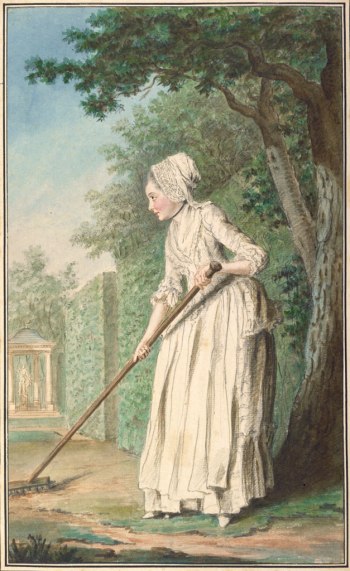
Louis Carrogis de Carmontelle, The Duchess of Chaulnes as a Gardener in an Allée, 1771, watercolor and gouache over black and red chalk (The J. Paul Getty Museum)
Drawn from the J. Paul Getty Museum’s renowned permanent collection, Art of the Fold: Drawings of Drapery and Costume explores how artists harnessed the expressive potential of cloth to convey meaning.
“From the fourteenth to the eighteenth centuries, the convincing depiction of voluminous folds of fabric was a standard part of artistic training and practice,” explains Timothy Potts, director of the J. Paul Getty Museum. “Focusing on the relationship between the body and clothing, artists of this period exploited drapery and costume to enhance the depiction of a figure’s emotional state and place in society. The drawings in this exhibition demonstrate the many ways in which artists employed drapery to evoke moods, shape identities, and tell stories.”
In Standing Female Saint (about 1450), from the Circle of Martin Schongauer, the abstract pattern of drapery folds generates an agitated sense of motion. Rather than outlining the body beneath it, the flowing tunic accentuates an emotional fervor typical of German fifteenth-century devotional imagery.
Drapery also played a crucial part in artists’ characterization of the human figure. In Hans Brosamer’s Study of a Pleated Skirt and Study of a Hanging Drapery (about 1500) the artist accurately depicts the tonal variations and ranges of light and shade created by folded fabric, capturing the natural flow of cloth with a refined linear quality and variegated hatchings. By isolating drapery from a human form, while at the same time making it anthropomorphic, the artist celebrates drapery as an independent subject.
In drawings of soldiers, peasants, nobles, and foreigners, clothing served as a primary indicator of social standing and class. In Jacob Jordaens’ Man Kneeling, Facing Right (about 1630) the artist applied opaque watercolor in thick layers creating angular, broken folds that animate the pose and heighten the sense of piety. Often a figure’s clothing indicates status or rank in the social hierarchy, and the flamboyant uniforms of the mercenary soldiers and the elegant attire of the upper classes convey their status.
In their depictions of costume, artists often departed from strict naturalism and relied upon their vivid imaginations. “Drawings of foreigners suggest how dress is embellished and exoticized, whereas theatrical costumes further illustrate how clothing can mask the identities of individuals represented,” says Stephanie Schrader, curator of drawings at the J. Paul Getty Museum, who organized the exhibition.
A checklist of the 38 works on view is available as a PDF file here.










 Enfilade
leave a comment