Exhibition | Olafur Eliasson: Baroque Baroque

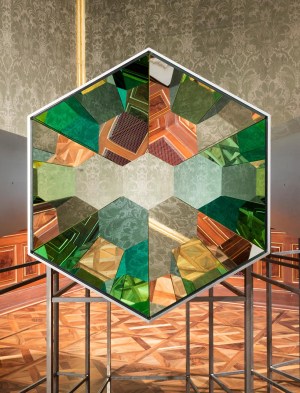
Olafur Eliasson, Wishes versus Wonders, 2015, as installed at the Winter Palace of Prince Eugene of Savoy, Vienna, 2015
Photo by Anders Sune Berg
◊ ◊ ◊ ◊ ◊
Press release for the exhibition now on view in Vienna’s Winter Palace:
Olafur Eliasson: Baroque Baroque
Winter Palace of Prince Eugene of Savoy, Vienna, 21 November 2015 — 6 March 2016
With works from Thyssen-Bornemisza Art Contemporary (TBA21), Vienna and Juan & Patricia Vergez private collections, Buenos Aires
Olafur Eliasson: Baroque Baroque brings together a significant selection of artworks by Danish-Icelandic artist Olafur Eliasson from the private collections of Thyssen-Bornemisza Art Contemporary and Juan and Patricia Vergez and presents them within the grand baroque setting of the Belvedere’s Winter Palace. The former city residence of Prince Eugene of Savoy (1663–1736), was an important site of artistic and scientific patronage in baroque Vienna. Baroque Baroque is an encounter between artworks, aesthetics, and worldviews from two vastly different epochs. The exhibition challenges viewers’ habits of perception and proposes that reality can be understood as unstable and evolving, as a process of constant negotiation. Surprising affinities between Eliasson’s works and their temporary settings become evident as the juxtapositions explore the relationships between object and viewer, representation and experience, actual and virtual, giving rise to a concept of the baroque superimposed on itself—the Baroque Baroque.
Olafur Eliasson, Seu planeta compartilhado (Your shared planet), 2011, as installed at the Winter Palace of Prince Eugene of Savoy, Vienna in 2015. Photo by Anders Sune Berg.
While emphasizing the way spaces are constructed by history and tradition, Eliasson’s works address the viewer in her embodied experience. Through the use of projections, shadows, and reflections, the artworks foreground the relationship between body, perception, and image. They anchor agency in the body and mind in motion as they invite the viewer’s active engagement by mirroring, fragmenting, and inverting her position within space.
Eliasson says, “I find it inspiring that the baroque exhibited such confidence in the fluidity of the boundaries between models of reality and, simply, reality. The presentation of my works at the Winter Palace is based on trust in the possibility of constructing reality according to our shared dreams and desires and on faith in the idea that constructions and models are as real as anything.”
TBA21 Founder, Francesca von Habsburg says: “This exhibition brings together several elements that I think support the vision of collectors and their responsibility as well as their ability to create art projects that defy traditional categorization. Both Patricia and Juan Vergez and I have been collecting and supporting Olafur Eliasson for many years with great enthusiasm, as he is indeed a renaissance man of many talents! In this presentation we wanted to introduce a parallel, that Olafur himself has mirrored in the exhibition rooms, that juxtaposes the precious Baroque cultural heritage of Vienna with the work of an artist that I feel very close to.”
In the entrance Vestibule, the light installation Die organische und kristalline Beschreibung (1996) floods the walls, floor, and ceiling with swelling washes of blue and yellow light, an ocean of color that loosens the viewer’s sense of the stability of her environment. In Yellow corridor (1997), monofrequency light is used to heighten the precariousness of our relationship to visible space. Eliasson’s optical machines and installations—such as Kaleidoscope (2001), New Berlin Sphere (2009), Your welcome reflected (2003), and Seu planeta compartilhado (Your shared planet, 2011)—reflect the artist’s ongoing investigations of color, perception, transformation, and deconstruction, an inquiry that is particularly interesting in relation to the baroque context. A site-specific intervention in the form of a continuous mirror traversing the enfilade of grand rooms further disorients the viewer by folding and re-folding the complex spaces it produces. Wishes versus wonders (2015), a steel half-ring mounted to the mirror wall in the Hall of Battle Paintings, stages an encounter between reality, illusion, and the elaborate artifice of the surroundings, simultaneously multiplying lines of potentiality.
Within this terrain of doubling and paradox, Eliasson calls into question our received habits of seeing and experiencing space. His artworks make us wonder and reconsider, giving meaning to the enigmatic doubling inherent in Baroque Baroque.
Belvedere–The Winter Palace of Prince Eugene of Savoy
Prince Eugene’s Winter Palace [begun in 1697] is one of the most magnificent baroque edifices in Vienna and is the fourth exhibition venue of the Belvedere Museum. Originally built as a lavish urban residence for Prince Eugene of Savoy (1663–1736), then acquired in the eighteenth century by Empress Maria Theresa before being used for the Court Treasury and later as the Ministry of Finance, this baroque palace underwent extensive renovation before reopening as a public museum in October 2013. Since then the Belvedere has staged numerous exhibitions at the Winter Palace, placing particular emphasis on programs and projects that create a dialogue between the baroque setting and contemporary art. Artistic interventions result in inspiring new artworks created in situ that draw on the palace’s unique ambiance and history. Vital starting points have been the city palace’s architecture, the prince’s former collections, and the holdings of the Belvedere.










 Enfilade
leave a comment