Conference | Art, Law and Crises of Connoisseurship
From ArtWatch UK; also see Brian Allen’s remarks in The Guardian (14 November 2015). . .
Art, Law and Crises of Connoisseurship
The Society of Antiquaries of London, 1 December 2015
Connoisseurship may be defined as expertise in art in the very narrowest of senses; surprisingly, however, it is also a definition in which many different disciplines intersect. In the public realms of law and the art world, a ‘connoisseur’ must be recognized as being an expert, as being capable of giving credible testimony regarding the subject, and as remaining actively engaged with the world in which attributions and authentications are made. This public recognition takes years of work and is hard-won. Yet, does this public recognition of expertise signify accuracy or truth in the claims that a connoisseur makes about art? This one-day conference investigates the always-interrelated and often mutually-troubled processes by which connoisseurship is constructed in the fields of art and law, and the ways in which these different fields come together in determining the scope and clarity of the connoisseur’s ‘eye’.
Art, Law and Crises of Connoisseurship is organized by ArtWatch UK, the Center for Art Law (USA) and the LSE Cultural Heritage Law (UK), to be held at The Society of Antiquaries of London, Burlington House, Piccadilly, London W1J 0BE. All inquiries to artwatch.uk@gmail.com. Admission is by ticket only. For ticket prices and to purchase tickets (exclusively through Eventbrite ), please click here.
◊ ◊ ◊ ◊ ◊
P R O G R A M M E
8.30 Registration
I | The Making of Art and the Power of Its Testimonies
9.00 Michael Daley — Like/Unlike, Interests/Disinterest
Michael Daley (UK), Director, ArtWatch UK, an artist who trained for twelve years (with post-graduate studies at the Royal Academy Schools) and taught in art schools for fifteen years before practicing as an illustrator (principally with Financial Times, The Times Supplements, The Independent and, presently, Standpoint magazine), will suggest that the principles of sound connoisseurship in making attributions and appraising restorations are implicit in fine art training and practice, and will discuss the trial in Italy of Professor James Beck on a charge of aggravated criminal slander brought in Italy by a restorer against the scholar but not against the newspapers which had carried his reported comments.
9.25 Euphrosyne Doxiadis — Perception, Hype and the Rubens Police
Euphrosyne Doxiadis (Greece), a painter/scholar whose 1996 book The Mysterious Fayum Portraits: Faces from Ancient Egypt won the won the Prix Bordin, the Prix d’ ouvrage by the Académie des Beaux-Arts, Institut de France, and, the 1997 ‘Prize of the Athens Academy’, will challenge the Rubens attribution given to the National Gallery’s oil on panel Samson and Delilah in the 28th year of her researches. Astonished at her first sighting of this painting in the National Gallery, the author will discuss both its manifest artistic disqualifications and the edifice of support that surrounds an attribution first made in 1930 by a leading Rubens scholar who today is notorious for his many excessively-generous certificates of authenticity.
9.40 Jacques Franck — Why the Mona Lisa Would Not Survive Modern Day Conservation Treatment
Jacques Franck (FR), an art historian and a painter trained in Old Master techniques, is the Permanent Consulting Expert to the Armand Hammer Center for Leonardo Studies at UCLA, and an editorial consultant to Academia Leonardi Vinci. He was a curator/exhibitor in the Uffizi’s exhibition La mente di Leonardo (2006) and will draw on experiences as an adviser to the Louvre’s restorations of Leonardo’s St Anne and Belle Ferronnière, and his current PhD investigations on Leonardo’s sfumato technique at the École Pratique des Hautes Études in Paris, to demonstrate the threats presently facing the Mona Lisa in a museum conservation system that he considers inadequate to preserve the masterpiece in the event of it being cleaned at the Louvre.
9.55 Ann Pizzorusso — Leonardo’s Geology: The Authenticity of The Virgin of the Rocks
Ann Pizzorusso (US) is a professional geologist and a Renaissance scholar whose work focuses on Leonardo da Vinci as a geologist. She has written numerous scholarly articles on Leonardo and his students, and the artists who preceded and followed him, analyzing the use of geology in their works. Her landmark article, “Leonardo’s Geology: The Authenticity of The Virgin of the Rocks” compared the two versions of the paintings. Demonstrating geology as a diagnostic tool—which was in fact Leonardo’s trademark—she will attribute only one of the two versions to Leonardo. Her new, four gold medals-winning book, Tweeting Da Vinci, discusses how the geology of Italy has influenced its art, literature, religion, medicine.
10.10 Discussion
10.30 Coffee
11.00 Segolene Bergeon-Langle — Can Science Deliver Its Promises to Art?
Segolene Bergeon-Langle (FR), France’s Honorary General Curator of Heritage, is both a scientist and an art historian. A former Head of Painting Conservation in the Louvre and the French National Museums, and a former Chair of the ICCROM Council (Rome), she is presently a member of the Louvre’s preservation and conservation committee. She will discuss various restoration cases showing how scientific analysis can fail properly to understand painters’ techniques and the deterioration of paint layers when questions are inadequately framed or when the interpretation of scientific reports is inadequate. Such difficulties can be overcome when connoisseurs themselves ask for scientific analysis to clarify some problem they have encountered, or when they can examine technical reports together with their scientific partners so as to avoid otherwise possible misinterpretations.
11.15 Michel Favre-Felix — Overlooked Witnesses: The Testimony of Copies
Michel Favre-Felix (FR) is a painter, the president of ARIPA (association for the respect of the integrity of artistic heritage), the director of the review Nuances, and the 2009 recipient of the ArtWatch International Frank Mason Prize, will present two restoration cases, studied from the French Museums’ scientific files, illustrating how restorations fail by not heeding the testimony of historical copies. He will stress the importance of disciplined arguments and of expert guidance from art historians, in a critical approach, rather than as the endorsement of ‘discoveries’ claimed during restorations by restorers. His cases will demonstrate how successive restorations can impose fresh and compounding misrepresentations on art when supposedly correcting previous errors.
11.30 Kasia Pisarek — How Reliable Are Today’s Attributions in Art? The Case of La Bella Principessa Examined
Kasia Pisarek (Poland/UK), an independent art historian and research specialist on attributions, took an MA at the Sorbonne and a PhD at the University of Warsaw. Her doctoral dissertation “Rubens and Connoisseurship: On the Problems of Attribution and Rediscovery,” identified many recently fallen Rubens attributions. She will set out a number of interlocking aesthetic, art historical and technical arguments against the recently claimed attribution to Leonardo of the drawing La Bella Principessa, which appeared anonymously and without provenance in New York in 1998. Her findings were published in the June 2015 Artibus et Historiae.
11.45 Discussion
12.15 Lunch
II | Righting the Record: Diverse Experts as Authority
1.15 Introduction by session moderator Tatiana Flessas
1.20 Brian Allen — Throwing the Baby out with the Bathwater: The Demise of Connoisseurship since the 1980s
Brian Allen (UK) is a former Director of Studies at the Paul Mellon Centre for Studies in British Art and is now Chairman of the London Old Master dealers Hazlitt Ltd. He will speak about the gradual demise of connoisseurship in academic art history (especially in the UK) over the past three decades and will consider the effect of this on the study of art history and the art market. Up to the early 1980s few questioned the importance for young art historians of acquiring the skills to determine authorship but as the discipline of art history evolved from its amateur roots in Britain so too did a determination to adopt the theoretical principles of other areas of study. Only now are we witnessing the consequences of this change of emphasis.
1.35 Peter Cannon-Brookes — Reconciling Connoisseurship with Different Means of Production of Works of Art
Peter Cannon-Brookes (UK) turned from natural sciences to art history and has been active as a museum curator with strong interests in conservation and security. Connoisseurship has been undermined by the decay of museum-based pre-Modern Movement scholarship leading to the growing corruption of reference collections and of connoisseurship enhanced by the detailed study of them. Can the systems of stylistic analysis evolved from the 1940s and social anthropology be reconciled with the actual processes of production of works of art throughout the ages? The business models adopted by Raphael, El Greco and Rubens are by no means exceptional, and the evident disdain of Rodin for those prepared to pay high prices for indifferent drawing-room marble versions of his compositions, encourage re-evaluation of connoisseurship as an essential tool.
1.50 Charles Hope — Demotion and Promotion: The Asymmetrical Aspect of Connoisseurship
Charles Hope (UK) is a former Director of the Warburg Institute and will discuss the tension that exists between connoisseurship as a type of expertise acquired by long experience and as an activity based on the use of historical evidence and reasoned argument. Will claim that, in practice, these two aspects are often in contradiction to one another, and that many connoisseurs have been unable or unwilling to provide clear arguments about how they have reached their opinions. Too often, judgements about authorship are decided by appeals to authority, and almost by vote, rather than by evidence.
2.05 Martin Eidelberg — Fact vs. Interpretation: The Art Historian at Work
Martin Eidelberg (US), professor emeritus of art history at Rutgers University, will discuss the reliability and fallibility of provenance and scientific analysis of pictures in determining the authenticity of paintings. Using case histories that he has gathered from his research in preparing a catalogue raisonné of the paintings of Jean Antoine Watteau (1684–1721), he will consider whether such supposedly factual data is reliable, or whether it is subjective and open to the interpretation of scholars.
2.20 Discussion
2.40 Robin Simon — Owzat! The Great Cricket Fakes Operation
Robin Simon (UK) is Editor of The British Art Journal and Honorary Professor of English, UCL. Recent books include Hogarth, France and British Art and (with Martin Postle) Richard Wilson and the Transformation of European Landscape Painting. He will report his discovery (in 1983) that many of the paintings depicting cricket in the MCC collection at Lord’s were fakes, most of them made by one person between 1918 and 1948 but purporting to date from the 16th century to the 20th. They had been presented to MCC by Sir Jeremiah Colman (of the mustard family) who acquired them from a variety of agents and dealers. It is quite a tale and turns, among other things, upon an ingenious manipulation of provenance.
2.55 Anne Laure Bandle — Sleepers at Auction: Boon or Bane?
Anne Laure Bandle (CH) is guest lecturer at the LSE, director of the Art Law Foundation, and a trainee lawyer at the law firm Froriep in Geneva. She wrote a PhD in law on the misattribution of art at auction and more specifically on the sale of sleepers. She will discuss the creation of sleepers at auction by means of different cases, and focus on the attribution process of auction houses and their liability when selling a sleeper.
3.10 Elizabeth Simpson — Connoisseurship: Its Use, Disuse, and Misuse in the Study of Ancient Art
Elizabeth Simpson (USA) is a professor at the Bard Graduate Center in New Yor, a consulting scholar at the University of Pennsylvania Museum of Archaeology and Anthropology in Philadelphia, and director of the project to study and conserve the collection of wooden objects excavated from the royal tumulus burials at Gordion, Turkey. She will address the use and misuse of connoisseurship in the study of ancient art, the scholarly and methodological divides between archaeology and art history, and the current trend away from connoisseurship in the study of ancient art and artifacts. She will also show how connoisseurship is used to fabricate narratives for looted objects in order to validate unprovenienced works in private and museum collections.
3.25 Round table discussion
3.45 Tea
III | Wishful Thinking, Scientific Evidence, and Legal Precedent
4.15 Introduction by session moderator, Charles Hope
4:20 Irina Tarsis — Reputation is no Substitute to Due Diligence: Lessons from the Closure of the Knoedler Gallery (1857–2011)
Irina Tarsis (USA), is an art historian and an attorney based in Brooklyn, NY. Founder and Director of Center for Art Law, Ms. Tarsis is an author of multiple articles on the subject of restitution, provenance research, book history and copyright issues. With degrees in International Business, Art History and Law, in her practice Ms. Tarsis focuses on ownership disputes surrounding tangible and intangible property. She will discuss the history of the Knoedler Gallery that closed after more than 160 years in business having sold a cache of misattributed forgeries. Short of a dozen lawsuits were brought against the principles and staff of the Gallery for selling works attributed to the blue chip artists. Ms. Tarsis will discuss the responsibilities of dealers, collectors and art advisors to their clients and the scholarship when handling art in business transactions.
4:35 Nicholas Eastaugh — The Challenge of Science: Does ‘Fine Art Forensics’ Really Exist?
Dr Nicholas Eastaugh (UK), Founder/Director, Art Analysis and Research Ltd., London, originally trained as a physicist before going on to study conservation and art history at the Courtauld Institute of Art, London, where he completed a PhD in scientific analysis and documentary research of historical pigments in 1988. Since 1989 he has been a consultant in the scientific and art technological study of paint and paintings. A frequent lecturer, he is also a Visiting Research Fellow at the University of Oxford. In 1999 he co-founded the Pigmentum Project, an interdisciplinary research group developing comprehensive high-quality documentary and analytical data on historical pigments and other artists’ materials. This led to the publication of The Pigment Compendium in 2004, which quickly became a standard reference text in the field. In 2008 he identified the first of the forgeries to be recognised as by Wolfgang Beltracchi, the now infamous Red Painting with Horses.
4.50 Megan Noh — Trends in Authentication Disputes
Megan E. Noh (USA) is the Associate General Counsel of Bonhams, one of the world’s largest international auction houses. Based in the New York office, Ms. Noh practices in a global hub for art transactions, and is uniquely poised to observe the numerous transactions conducted by Bonhams which require its specialists’ assistance with the authentication process, as well as the growing body of caselaw and legislative efforts emerging from this key jurisdiction. Ms. Noh’s presentation will cover trends in authentication disputes, including the cessation of artists’ foundations and authentication boards to issue opinions confirming attribution, as well as increased litigation and reliance of parties on scientific evidence and testimony. She will also elucidate the position of auction houses as a liaisons or ‘middlemen’ in this process, facilitating the flow of information as between collectors (sellers and buyers) and third party authenticators.
5.25 Final discussion moderated by Charles Hope
5.50 Closing remarks by Irina Tarsis
Exhibition | Rise and Fall: The Earl of Mar and the 1715 Jacobite Rising
Press release (9 November 2015) for exhibitions now on view in Edinburgh:
Rise and Fall: The Earl of Mar and the 1715 Jacobite Rising
Calum Colvin: Jacobites by Name
Scottish National Portrait Gallery, Edinburgh, 14 November 2015 — 27 March 2016

Sir Godfrey Kneller, Portrait of John Erskine, 6th Earl of Mar, with His Son Thomas, Lord Erskine (Collection of Earl of Mar & Kellie at Alloa Tower, National Trust for Scotland)
The 300th anniversary of the 1715 Jacobite Rising will be marked by two fascinating new displays at the Scottish National Portrait Gallery this winter. A key player in the rising, John Erskine, 6th Earl of Mar, will be the focus of Rise and Fall, while Calum Colvin, one of Scotland’s leading contemporary artists, will explore the visual imagery and legacy of the Jacobite Risings of 1715 and 1745 in Jacobites by Name.
Responsible for initiating and subsequently ending the Rising, the Earl of Mar (1675–1732) was an extraordinary individual, passionate about both politics and the arts. Born in Alloa, Clackmannanshire, he was a Member of Parliament and later Secretary of State for Scotland, before being deprived of office by the new Hanoverian king, George I, in 1714. Mar raised the standard of rebellion against the Hanoverians, and from September to December 1715 he was effectively ruling Scotland.
The 1715 Rising is a key date in the power struggle between the Protestant Hanoverians and of the exiled Stuarts. It was a major attempt by the Jacobites—the supporters of King James VII (of Scotland) and II (of England) and his heirs—to regain the throne for the Stuart claimant, James Francis Edward Stuart. However victory eluded Mar and he ultimately fled to France with James Stuart in 1716, where he remained until his death in 1732.
At the centre of Rise and Fall will be two large and impressive portraits of the Earl and his wife, Frances Pierrepont (of around 1714), by Sir Godfrey Kneller, the leading portrait painter in England of the time. These imposing paintings usually hang at the National Trust for Scotland property Alloa Tower—the ancestral home of the Earls of Mar and Kellie—and were commissioned by Mar himself. Although he is often defined by his political and military career, Mar was a man of fine taste and an enthusiastic patron of the arts, with a talent for amateur architecture and garden design.
Prints, drawings and miniatures also on show in Rise and Fall bring alive this cataclysmic episode of Scottish history and shed light on the life and interests of the Earl of Mar. Key loans have come from the collection of the current Earl and Mar of Kellie and the National Records of Scotland.

Calum Colvin, Lochaber no More, 2015
The Scottish National Portrait Gallery’s outstanding Jacobite collection has been used to inspire a contemporary intervention which complements Rise and Fall by the renowned Scottish artist Calum Colvin. His Jacobites by Name inventively combines photography with painting and installation. The result includes new works such as Lochaber no More (2015) which links two images of Charles Edward Stuart, commonly known as Bonnie Prince Charlie, the second Jacobite pretender to the throne and instigator of the failed 1745 Jacobite Rising. The first of the images shows Charles as a young man and the other much older.
To make his photographic works, Colvin constructs a set in his studio, using furniture and ornaments, and then paints images on to these three-dimensional objects. When seen through the lens of his camera, a two-dimensional image is formed, a blend of reality and illusion. Lochaber no More is a powerful evocation of the passage of time and the melancholy of lost Jacobite hope, while fragments of burned tartan hint at the tragic outcome of the last rising. In his work, Colvin also alludes to the tradition of secret symbolism and optical illusionism in Jacobite-related art; because support for the exiled Stuarts was dangerous and could lead to accusations of disloyalty to the Crown, ‘secret’ portraits of the Pretenders were to be discovered on folded fans, sewn discreetly onto articles of clothing, or concealed inside the lid of a closed box.
Colvin was born in Glasgow and studied art in Dundee and London, before coming to prominence in the mid-1980s. He has exhibited extensively in Europe and the United States and has worked on commissions for the National Galleries of Scotland.
Christopher Baker, Director of the Scottish National Portrait Gallery said: “The Jacobite struggle remains potent and romantic 300 years after the key events that defined it. These complementary displays connect powerful portraiture of the 18th century with contemporary responses, and remind us in an engaging and inspiring way of a turbulent period in Scottish history. We are especially grateful to the National Trust for Scotland, the Earl of Mar and Kellie and the artist Calum Colvin for their generosity and commitment to the project.”
Calum Colvin commented: “This new body of work investigates the traces of Jacobite material culture, portraiture and visual illusion to be found in Scottish museums up and down the country. I wanted to take a fresh look at this material with a view to re-interpret the matrix of symbols and allusions that they carry and, through a range of different types of contemporary making, bring them into the digital age. The works are contrasted with the existing collection in the Scottish National Portrait Gallery and question the role of this familiar iconography in Scottish national culture.”
About the National Trust for Scotland
One of Scotland’s leading conservation charities, the National Trust for Scotland cares for some of the nation’s most important heritage sites, from grand castles to humble homes and wild coastline. With more than 100 properties packed with paintings, textiles, ceramics, sculpture and fine furniture, the Trust holds Scotland’s biggest collection of in-situ artworks. Amongst its gems include many fine pictures by artists including Raeburn, Batoni and Peploe to name a few. Some of Scotland’s finest contemporary works, including pieces by Ken Currie, Julia Douglas and Julie Roberts, are on currently on display at Drum Castle in Aberdeenshire while Aberdeen Art Gallery undergoes a major refurbishment.
About Alloa Tower
Alloa Tower is the ancestral home of the Erskine family, the Earls of Mar and Kellie. The tower is the largest, oldest keep in Scotland and was originally built to guard the nearby ferry crossing on the River Forth. The Erskines were aides to the Stuart monarchs and guardians to the royal children—Mary, Queen of Scots and James VI both spent part of their early lives at Alloa Tower. It was Mary who granted the earldom to the Erskines in 1565. Since its construction around 1368, Alloa Tower has been altered many times and provides a rich variety of architectural styles and historic collections. Once part of a much larger mansion, with extensive gardens modelled on those of Versailles, among the features within the tower are a sweeping, eighteenth-century Italianate staircase, a medieval oak beamed roof, a dungeon and a well. It also houses collections of important paintings, on loan from the Erskine family, including the two full length portraits by Sir Godfrey Kneller on display here.
In 2015 the fourteenth-century Alloa Tower in Clackmannanshire was acquired by the National Trust for Scotland (NTS), having previously been managed by NTS working in partnership with the Clackmannanshire Heritage Trust, with financial support from Clackmannanshire Council. From 1988, Alloa Tower was restored from a semi-derelict state and first opened to the public in 1996. It is this partnership, and the philanthropic endeavours over many years of the current Earl of Mar and Kellie and his father, that have enabled NTS to secure the tower’s long-term future.
Historians of Netherlandish Art Fellowships, 2016–17
From HNA:
Historians of Netherlandish Art Fellowships, 2016–17
Applications due by 14 December 2015
We urge members of Historians of Netherlandish Art to apply for the 2016–17 Fellowship. Scholars of any nationality who have been HNA members in good standing for at least two years are eligible to apply. The topic of the research project must be within the field of Northern European art ca. 1400–1800. Up to $2,000 may be requested for purposes such as travel to collections or research facilities, purchase of photographs or reproduction rights, or subvention of a publication. Preference will be given to projects nearing completion (such as books under contract). Winners will be notified in February 2016, with funds to be distributed by April. The application should consist of: 1) a short description of project (1–2 pp), 2) budget, 3) list of further funds applied/received for the same project, and 4) current cv. A selection from a recent publication may be included but is not required. Pre-dissertation applicants must include a letter of recommendation from their advisor.
Applications should be sent, preferably via e-mail, by December 14, 2015, to Paul Crenshaw, Vice-President, Historians of Netherlandish Art. E-mail: paul.crenshaw@providence.edu; Postal address: Providence College, 1 Cummingham Square, Providence RI 02918-0001.
New Book | The Frick Collection: Decorative Arts Handbook
Press release (10 June 2015) from The Frick:
Charlotte Vignon, The Frick Collection: Decorative Arts Handbook (New York: The Frick Collection in association with Scala Arts Publishers, 2015), 172 pages, ISBN: 978-1857599398 $25.
 The unique atmosphere of The Frick Collection has as much to do with the decorative arts as with the old master paintings that line the museum’s walls. Indeed the enamels, clocks and watches, furniture, gilt bronzes, porcelain, ceramics, silver, and textiles far exceed in number, and are the equal in quality, of the works on canvas and panel. The institution announces the publication of the first handbook devoted to the decorative arts in the collection. This long overdue book will help convey the balance among the various art forms represented in the house and provide a valuable introduction to this area. Comments Director Ian Wardropper, “Despite the manifest importance of decorative arts at the Frick, until recently our small staff did not include a specialist in the field. Thanks to an endowment campaign and the generosity of a number of supporters a permanent curatorial position was created in September 2009. With energy and imagination, the first incumbent of this curatorship, Charlotte Vignon, has initiated a series of exhibitions that highlight this aspect of the collection. The present handbook is another indication of her scholarly dedication to the decorative arts.”
The Frick Collection: Decorative Arts Handbook offers fresh insight on various works long in the museum’s holdings and also includes commentary on more recently acquired examples. Exquisitely illustrated with new photography, this paperback volume is available in English and French editions.
Henry Clay Frick: Developing a Decorative Arts Collection
Acquiring paintings preoccupied Henry Clay Frick when he moved to New York in the first years of the twentieth century. While renting William H. Vanderbilt’s mansion at Fifth Avenue and 51st Street, he devoted his attention to collecting masterpieces by Rembrandt, Velázquez, and other masters. As the sumptuous house he constructed at 70th Street took shape between 1912 and 1914, he recognized the need for furnishings of a caliber that matched his painting collection. Interestingly, most of his purchases in this area were made just before or after he began to occupy the house and in a very concentrated period of time.
A trip to London and Paris in the spring of 1914 inspired many of the choices Frick would make for his New York mansion. After meeting Victor Cavendish, the ninth Duke of Devonshire, at Landsdowne House in London and his country house at Chatsworth, Frick acquired from him a suite of tapestry furniture thought to be eighteenth-century Gobelins. Impressed by the Wallace Collection and wishing to emulate it, he set out to acquire high-quality decorative arts of different periods and materials, especially porcelain, oriental carpets, and French Renaissance enamels and furniture, such as pieces made by André-Charles Boulle, with their distinctive turtle-shell and brass veneers. In Paris, through the intermediary of the American decorator Elsie de Wolfe, he purchased French furniture from the collection of Sir John Murray Scott (inherited from Lady Wallace, the widow of the founder of the Wallace Collection). In a single month, he spent more than $400,000, more than he had ever spent on collecting in this field.
In some cases, furniture and decorative arts were assembled to complement specific rooms of the house. Elsie de Wolf, for example, counseled the acquisition of a desk by the great French eighteenth-century cabinetmaker Jean-Henri Riesener together with Sèvres porcelain for Adelaide Frick’s second-floor dressing room, which was lined with wall panels painted by François Boucher’s workshop. The room and its furnishings were transferred to the first floor in 1935. Other great eighteenth-century French furnishings for Adelaide’s dressing room came through Joseph Duveen, then the head of Duveen Brothers. After Fragonard’s cycle of paintings was installed in the drawing room in 1915–16, Duveen sold Frick many more works to embellish its decor. French Renaissance furniture was bought to complement the collection of sixteenth-century enamels acquired in 1916; Henry’s office was transformed into a gallery for its display. The Italian Renaissance cassoni were always intended to be placed beneath masterpieces of painting in the West Gallery or elsewhere.
Carefully selected blocs of decorative arts, such as the forty-six pieces of Limoges enamel Frick acquired through Duveen from the estate of J. Pierpont Morgan, were one means by which the collection grew quickly. Morgan’s death in 1913 gave Frick the opportunity to choose from one of the finest and largest collections in the world just when he was seeking to expand in this area. Another example was the group of fifty Chinese porcelain jars and vases that Duveen had also acquired from Morgan’s estate. Apart from the windfall of the availability of the Morgan collection, Duveen’s own stock was so extensive and of such quality that Frick could buy from him French royal commissions, such as Gilles Joubert’s chest of drawers, which was among some twenty-five pieces of furniture that arrived at Fifth Avenue and 70th Street during the year 1915.
Later Acquisitions
Generous gifts from members of the Frick family and other donors have continued to enrich the decorative arts collection. The founder’s son, Childs, gave about two hundred pieces of Chinese blue-and-white porcelain in 1965, considerably augmenting those works his father had purchased fifty years earlier. In 1999, Winthrop Kellogg Edey’s extraordinary collection of some forty clocks and watches arrived at the Frick. Henry Arnhold has recently given us the Great Bustard from his distinguished and comprehensive collection of Meissen porcelain, and another one hundred and thirty-five works are pledged to the Frick as a bequest. Individual objects of great merit are prized additions to our holdings. Diane Modestini gave us our first piece of Italian majolica in honor of her husband Mario Modestini in 2008. On occasion, acquisitions are also made, such as the unusual vase japon, purchased in 2011.
Exhibition | Jean-Étienne Liotard: A Cosmopolitan Artist
Press release (12 November 2015) from the Getty:
Jean-Étienne Liotard: A Cosmopolitan Artist
J. Paul Getty Museum, Los Angeles, 20 October 2015 — 24 April 2016
Curated by Ketty Gottardo

Jean-Étienne Liotard, Portrait of Maria Frederike van Reede-Athlone at Seven Years of Age, 1755–56, pastel on vellum, 54.9 x 44.8 cm (Los Angeles: Getty Museum)
Swiss artist Jean-Étienne Liotard (1702–1789) excelled at the delicate art of pastel. His finest portraits display an astonishing realism achieved through intense observation and remarkable technical skill and feature royalty, aristocrats, and the bourgeoisie. Jean-Étienne Liotard: A Cosmopolitan Artist, comprised of pastels and drawings from the Getty Museum’s collection and two spectacular loans from a private collection, is now open and continues through April 24, 2016, at the Getty Center.
“For most of his very long career, Liotard worked as an itinerant portraitist,” says Timothy Potts, director of the J. Paul Getty Museum. “The works of art in this room testify to the artist’s numerous travels and fame as well as to his astonishing facility in the medium of pastel.”
The remarkable success of pastel in the eighteenth century was due to the high demand for portraits from the nobility and bourgeoisie. The ease and swiftness with which pastel could be used allowed for much shorter sittings that pleased artists and sitters alike. Unlike oil painting, pastel does not need to dry, so drawings could be executed quickly, with changes and corrections easily made. The Portrait of Lord Mountstuart features a young English aristocrat whom Liotard encountered during a brief stay in Geneva in the midst of his Grand Tour to Italy; Mademoiselle Jacquet was a famous singer at the Paris Opera; Jean Tronchin was among Liotard’s cultivated Swiss patrons; and the magnificent Portrait of Baroness Maria Frederike, one of the Getty’s most-beloved treasures, is probably the most famous portrait he executed in Holland.
In his Treatise on Painting (1781), Liotard recommended the use of nine tones—four light, four dark, and one medium—to build up pastel images. Colors were blended with brushes, fingers, a stump, or even his own long beard. Liotard preferred to use vellum—made from calf skin—for his support, which imitated the texture of skin in portraits. “The delicate tone of skin seen in Liotard’s Portrait of Jean Tronchin (1759) is remarkable. Liotard used the texture of the vellum, along with a fine sfumato effect, to define his rich, fleshy, and aged face,” says Ketty Gottardo, associate curator of drawings and curator of the installation.
Liotard innovated a drawing technique that reinforced his compositions with large areas of tone applied to the verso (back), which would create glowing, translucent effects on the recto (front). After drawing the basic outlines of a composition, Liotard would turn over the sheet of paper and hold it against a window or source of light in order to trace it onto the verso with a thin stick of black chalk. Then he would fill in entire areas of the verso with watercolor, chalk, or pastel which served to enhance the colors on the front.
Additional information is available at Iris: The Online Magazine of the Getty.
Exhibition | Art of the Fold: Drawings of Drapery and Costume
Press release (2 September 2015) for the exhibition now on view at the Getty:
Art of the Fold: Drawings of Drapery and Costume
The J. Paul Getty Museum, Los Angeles, 6 October 2015 — 10 January 2016
Curated by Stephanie Schrader
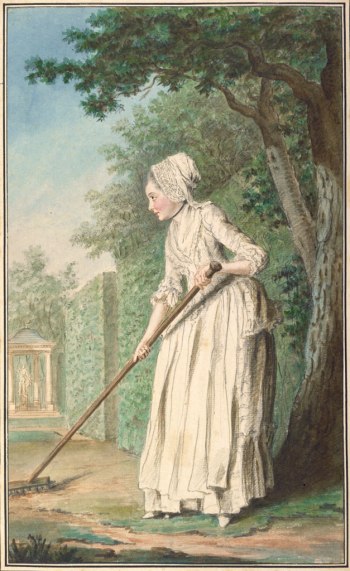
Louis Carrogis de Carmontelle, The Duchess of Chaulnes as a Gardener in an Allée, 1771, watercolor and gouache over black and red chalk (The J. Paul Getty Museum)
Drawn from the J. Paul Getty Museum’s renowned permanent collection, Art of the Fold: Drawings of Drapery and Costume explores how artists harnessed the expressive potential of cloth to convey meaning.
“From the fourteenth to the eighteenth centuries, the convincing depiction of voluminous folds of fabric was a standard part of artistic training and practice,” explains Timothy Potts, director of the J. Paul Getty Museum. “Focusing on the relationship between the body and clothing, artists of this period exploited drapery and costume to enhance the depiction of a figure’s emotional state and place in society. The drawings in this exhibition demonstrate the many ways in which artists employed drapery to evoke moods, shape identities, and tell stories.”
In Standing Female Saint (about 1450), from the Circle of Martin Schongauer, the abstract pattern of drapery folds generates an agitated sense of motion. Rather than outlining the body beneath it, the flowing tunic accentuates an emotional fervor typical of German fifteenth-century devotional imagery.
Drapery also played a crucial part in artists’ characterization of the human figure. In Hans Brosamer’s Study of a Pleated Skirt and Study of a Hanging Drapery (about 1500) the artist accurately depicts the tonal variations and ranges of light and shade created by folded fabric, capturing the natural flow of cloth with a refined linear quality and variegated hatchings. By isolating drapery from a human form, while at the same time making it anthropomorphic, the artist celebrates drapery as an independent subject.
In drawings of soldiers, peasants, nobles, and foreigners, clothing served as a primary indicator of social standing and class. In Jacob Jordaens’ Man Kneeling, Facing Right (about 1630) the artist applied opaque watercolor in thick layers creating angular, broken folds that animate the pose and heighten the sense of piety. Often a figure’s clothing indicates status or rank in the social hierarchy, and the flamboyant uniforms of the mercenary soldiers and the elegant attire of the upper classes convey their status.
In their depictions of costume, artists often departed from strict naturalism and relied upon their vivid imaginations. “Drawings of foreigners suggest how dress is embellished and exoticized, whereas theatrical costumes further illustrate how clothing can mask the identities of individuals represented,” says Stephanie Schrader, curator of drawings at the J. Paul Getty Museum, who organized the exhibition.
A checklist of the 38 works on view is available as a PDF file here.
Exhibition | The Luxury of Time: European Clocks and Watches
From The Met:
The Luxury of Time: European Clocks and Watches
The Metropolitan Museum of Art, New York, 16 November 2015 — 27 March 2016

Clockmaker: Ferdinand Berthoud (French, 1727–1807); Case maker: Balthazar Lieutaud (French, ca. 1720–1780, master 1749). Longcase astronomical regulator (detail), ca. 1768–70. Case: oak veneered with ebony and brass, with gilt-bronze mounts; Dial: white enamel; Movement: gilded brass and steel; Height: 90.5 in. (229.9 cm). The Metropolitan Museum of Art, New York, (1982.60.50).
Time is all around us, displayed on our phones and computers. Today, almost nobody needs to own a watch or a clock to tell the time. Access to the right time is not the luxury it once was. Yet the fascination with clocks and watches persists, and the thriving market for mechanical timekeepers is deeply aware of their history. Clocks and watches have always been about more than just telling time: they have been treasured as objects of desire and wonder, personal items imbued with value that goes beyond pure functionality. As works of art, they represent the marriage of innovation and craftsmanship.
This exhibition explores the relationship between the artistry of the exterior form of European timekeepers and the brilliantly conceived technology that they contain. Drawn from the Museum’s distinguished collection of German, French, English, and Swiss horology from the sixteenth through the nineteenth century, the extraordinary objects on view show how clocks and watches were made into lavish furniture or exquisite jewelry.
The creation of timekeepers required that clockmakers work with cabinetmakers, goldsmiths and silversmiths, enamelers, chasers and gilders, engravers, and even those working in sculpture and porcelain. These craftsmen were tasked with accommodating internal mechanisms by producing cases that, in both shape and function, adapted to timekeeping technologies. Their exteriors are often as complicated as the movements they house. Examining the dialogue between inside and out, adornment and ingenuity, The Luxury of Time
reveals the complex evolution of European clockmaking and
the central place of timekeepers in the history of decorative arts.
◊ ◊ ◊ ◊ ◊
The catalogue is scheduled for publication in February. From Yale UP:
Clare Vincent and Jan Hendrik Leopold, with Elizabeth Sullivan, European Clocks and Watches in The Metropolitan Museum of Art (New York: The Metropolitan Museum of Art, 2016), 288 pages, ISBN: 978-1588395795, $65.
 Among the world’s great technological and imaginative achievements is the invention and development of the timepiece. Examining for the first time the Metropolitan Museum’s unparalleled collection of European clocks and watches created from the early middle ages through the 19th century, this fascinating book enriches our understanding of the origins and evolution of these ingenious works. It showcases 54 extraordinary clocks, watches, and other timekeeping devices, each represented with an in-depth description and new photography showing the exterior as well as the inner mechanisms. Included are an ornate celestial timepiece that accurately predicts the trajectory of the sun, moon, and stars and a longcase clock by David Roentgen that shows the time in the ten most important cities of the day. These works, created by clockmakers, scientists, and artists in England, Germany, France, Italy, and the Netherlands, have been selected for their artistic beauty and design excellence, as well as for their sophisticated and awe-inspiring mechanics. Built upon decades of expert research, this publication is a long-overdue survey of these stunning visual and technological marvels.
Clare Vincent is associate curator, European Sculpture and Decorative Arts, The Metropolitan Museum of Art. J. H. Leopold was former assistant keeper in charge of the horological collections at The British Museum. Elizabeth Sullivan is research associate, European Sculpture and Decorative Arts, The Metropolitan Museum of Art.
New Book | How to Read Chinese Ceramics
Published by The Met and distributed by Yale UP:
Denise Patry Leidy, How to Read Chinese Ceramics (New York: The Metropolitan Museum of Art, 2015), 144 pages, ISBN: 978-1588395719, $25.
 Chinese ceramics are among the most significant and widely collected decorative arts produced anywhere in the world, with a history that spans millennia. Despite the saturation of Chinese ceramics in global culture—in English, the word ‘china’ has become synonymous with ‘porcelain’—the function of these works and the meaning of their often richly decorated surfaces are not always readily apparent.
This new installment in the successful How to Read series enlightens readers on Chinese ceramics of all kinds, using highlights from the outstanding collection of The Metropolitan Museum of Art as a teaching tool. Accessible to a general audience and written by an expert on the subject, this book explains and interprets 40 masterworks of Chinese ceramics. The works represent a broad range of subject matter and type, from ancient earthenware to 20th-century porcelain, and from plates and bowls to vases and sculptural figures. Lavish illustrations showcase these stunning works and the decorations that adorn them, including symbolic scenes, flowers, and Buddhist and Chinese historical figures.
Denise Patry Leidy is curator in the Department of Asian Art, The Metropolitan Museum of Art.
An interview with Leidy is available here»
Exhibition | Chinese Lacquer: Treasures from the Irving Collection
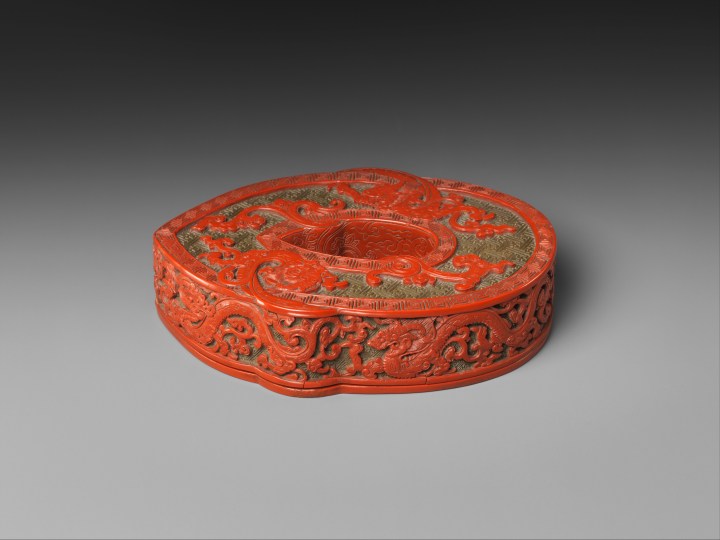
清乾隆 剔彩玉玦形漆盒 / Box in the Shape of an Archaic Jade Jue, Qianlong period (1736–95), carved red and green lacquer; 3.2 x 9.2 x 13 cm (New York: Metropolitan Museum of Art, 2015.500.1.9a, b).
◊ ◊ ◊ ◊ ◊
Now on view at The Met:
Chinese Lacquer: Treasures from the Irving Collection, 12th–18th Century
The Metropolitan Museum of Art, New York, 15 August 2015 — 19 June 2016
Lacquer, the resin of a family of trees found throughout southern China—as well as in Southeast Asia, Korea, and Japan—is an amazing material. When exposed to oxygen and humidity, lacquer hardens or polymerizes, becoming a natural plastic and an ideal protective covering for screens, trays, and other implements. Mixed with pigments, particularly cinnabar (red) and carbon (black), lacquer has been also used as an artistic media for millennia.
This installation, which features all of the most important examples of Chinese lacquer in the Museum’s collection, explores the laborious techniques used to create scenes based on history and literature, images of popular gods and mythical and real animals, and representations of landscapes and flowers and birds.
Exhibition | Chinese Textiles: Ten Centuries of Masterpieces

清中期 納紗繡戯服男帔 / Theatrical Robe for a Male Role, second half of the 18th century, silk florentine stitch embroidery on silk gauze, 140.7 x 226.7 cm (New York: The Metropolitan Museum of Art, 32.30.10).
◊ ◊ ◊ ◊ ◊
Now on view at The Met:
Chinese Textiles: Ten Centuries of Masterpieces from the Met Collection
The Metropolitan Museum of Art, London, 15 August 2015 — 19 June 2016
This installation, which explores the cultural importance of silk in China, showcases the most important and unusual textiles from the Museum’s collection. In addition to three rare pieces dating from the Tang dynasty (618–906), when China served as a cultural hub linking Korea and Japan to Central and West Asia, and ultimately to the Mediterranean world, the exhibition also includes eleventh- and twelfth-century tapestries from Central Asia, as well as contemporaneous Chinese examples of this technique.
Spectacular embroideries—including an imperial fourteenth-century canopy decorated with phoenixes and flowers, and a monumental late seventeenth- or early eighteenth-century panel showing phoenixes in a garden—are also on view, together with theatrical garments, court costumes, and early examples of badges worn at court to designate rank.










 Enfilade
leave a comment